How to Choose Programmatic SEO Tools or AI Content Platforms

Programmatic SEO tools or AI content platforms sounds like a tooling decision. For most B2B SaaS teams, it isn't. It's a decision about whether you're buying channel output or buying a system that can carry your market point of view across dozens, then hundreds, of assets.
I've seen this movie a few times. A team buys an SEO tool because they need more content. Then they realize the tool can generate drafts, but it can't really hold their positioning, audience nuance, product truth, and messaging logic together. So the draft comes out thin, the review cycle gets longer, and everyone quietly decides the AI is the problem. Usually it isn't.
If you're a demand gen leader, this choice matters because content isn't a side project. It's campaign fuel. Pick the wrong category, and you don't just lose writing quality. You lose time, pipeline speed, internal trust, and a lot of energy to frustrating rework.
Key Takeaways:
- Programmatic SEO tools are usually stronger when your main problem is page production, template scale, and search coverage.
- AI content platforms make more sense when your team needs content to reflect positioning, personas, product truth, and campaign narrative across channels.
- If more than 30% of a draft gets rewritten in review, your issue probably isn't writing speed. It's missing strategy inputs upstream.
- Buyers should score tools on input depth, review burden, and cross-functional fit, not just draft quality.
- A 60-minute evaluation with three live scenarios will usually tell you more than a feature checklist ever will.
The Real Buyer Problem Is Rework, Not Raw Content Volume
Most teams don't go shopping for programmatic SEO tools or AI content platforms because they're curious. They go shopping because content production has become a headache. Traffic goals are up. Campaign demand is up. Product launches keep coming. And the same five people are still trying to brief, write, review, revise, publish, and measure everything.
The visible problem looks like output. The root problem is usually rework tax. That's the part a lot of buyers miss.

Back when I was the sole marketer at a SaaS company, I could write 3 to 4 strong posts a week because I had all the context in my head. Then the team grows. More people get involved. Now the writer doesn't have the product nuance, PMM has a different angle, demand gen wants campaign fit, and leadership wants the narrative tightened up. Same company. More resources. Slower output. Lower consistency. Sound familiar?
Picture a demand gen manager on a Tuesday afternoon. They need a webinar landing page, three nurture emails, paid social copy, and a thought leadership article to support a campaign launch next week. The draft comes back fast, but it misses the market enemy, softens the differentiators, and says a feature does something it doesn't do. Now PMM rewrites it, sales wants changes, brand steps in, and the asset that was supposed to save time eats half the day instead.
That's why a lot of these evaluations go sideways. Buyers compare generation speed when they should be comparing revision load. One gets you a draft. The other determines whether the draft survives contact with your actual business.
If you want to see what that looks like in a real workflow, you can request a demo and pressure test it against your own campaign inputs.
What Actually Matters When Comparing These Two Categories
The important criteria aren't the ones vendors usually push first. Word count, one-click generation, and generic workflow claims sound nice. But for scaling SaaS marketing teams, the decision usually comes down to six things.
A Tool That Lacks Strategic Inputs Creates Expensive Drafts
The first filter I use is what I call the Context Depth Test. Ask a simple question: what does the system know before it starts writing?
If the answer is mostly keywords, SERP gaps, and page structure, you're likely looking at a programmatic SEO tool. That can be useful. No issue there. But if your team needs the system to reflect category point of view, audience pain, persona goals, product definitions, feature limits, brand rules, and message hierarchy, then channel data alone won't get you very far.
That's the hidden connection a lot of teams miss. The quality problem often starts before the model writes a single sentence. April Dunford made this point years ago in a panel I watched in Toronto. Tactics without strategy are bad bets. Content tools that start with tactics usually force humans to re-insert the strategy later.
Use this rule. If a platform can't ingest and apply at least four strategic layers, market position, audience, product truth, and brand voice, expect heavy editing.
Review Burden Is A Better Metric Than Draft Speed
A fast first draft can still be a slow system. Buyers should measure time to approved asset, not time to initial output.
Let's pretend your team generates 20 assets a month. If each one takes 45 extra minutes of review because the messaging drifts, that's 15 hours gone. Not on writing. On fixing. And that's a conservative number. I've seen teams spend more time arguing with the draft than they would've spent writing from scratch.
The Red Pen Ratio is a useful benchmark here. Take three recent AI-assisted drafts and estimate how much of each was materially rewritten. If the number is under 15%, the system is probably giving you useful leverage. Between 15% and 35%, you've got mixed fit. Above 35%, the tool is creating review work, not reducing it.
Fair point, some buyers do need raw speed first. If you're publishing large volumes of lower-stakes search pages, draft speed matters a lot. But for campaign content, product marketing content, and category definition pieces, review burden usually tells the truth faster than output metrics do.
Cross-Channel Consistency Matters More Than Single-Asset Quality
A lot of SEO tools are built to win the page. Demand gen teams need something broader. They need the article, the landing page, the email, the ad angle, and the follow-up asset to all sound like they came from the same company with the same argument.
This is where the Single Thread Rule helps. If a tool can produce one decent article but can't carry the same narrative into adjacent assets, you're not evaluating a content system. You're evaluating a draft generator.
And that difference matters. B2B buyers rarely convert because of one page. They convert because the same message keeps showing up in slightly different forms until the market gets it. That's especially true when you're trying to define a category or challenge an old way of doing things.
You can verify this during evaluation by giving both vendors the same prompt pack:
- A category article brief
- A product launch email brief
- A webinar landing page brief
- A sales follow-up brief
Then compare narrative consistency across all four outputs. Most buyers never do this. They should.
The Right Category Depends On Your Content Mix
This is the honest limitation part. Programmatic SEO tools aren't wrong. They're just built for a narrower job.
If your content engine is mostly high-volume, template-based, search-led pages, they can be a strong fit. Think location pages, use-case pages at scale, glossary content, comparison clusters, or structured library builds where consistency matters less than coverage and production speed. In that world, page-level optimization and template discipline carry a lot of weight.
AI content platforms fit better when the content mix is messier and more strategic. That usually means category creation, thought leadership, campaign assets, product marketing, buyer enablement, and cross-functional work where PMM, demand gen, content, and leadership all need the same message backbone.
So use the 70/30 Rule. If 70% or more of your planned output is structured search content, start with programmatic SEO tools. If 30% or more of your content directly shapes pipeline, positioning, or executive narrative, evaluate AI content platforms first.
How To Run A Fair Evaluation Without Getting Distracted By Demos
Most vendor evaluations drift into theater. Nice UI. Fast generation. A slick walkthrough. Then six weeks later the team learns the hard part happens after the draft.
A better process is simpler and a little more uncomfortable.
Start With Three Real Scenarios, Not A Generic Trial
Use live scenarios from your own business. Not a sandbox brief. Not a made-up keyword.
I like the Three-Scenario Buyer Test:
- One SEO-led asset
- One campaign asset
- One positioning-heavy asset
For a scaling SaaS team, that might be a comparison page, a webinar promo sequence, and a category point-of-view article. Each scenario should include the actual inputs your team relies on: audience, pain points, product notes, message hierarchy, and brand constraints.
Why three? Because one asset can flatter a tool. Three exposes patterns.
Score On Output Quality And Input Handling
Most evaluation sheets over-index on the draft itself. That misses half the job.
A better scorecard uses five dimensions:
| Evaluation Dimension | What To Check | Strong Signal |
|---|---|---|
| Input Depth | How much strategy, audience, and product context the tool can use | It works from more than keywords and SERP data |
| Output Accuracy | Whether claims, positioning, and feature language stay true | Minimal factual correction needed |
| Review Load | How much human rewriting happens before publish | Under 15% major rewrite |
| Cross-Team Fit | Whether PMM, content, and demand gen can all use it | Shared workflow, shared source inputs |
| Asset Range | Whether it handles more than one content type well | Good results across at least 3 asset types |
One thing I'd watch closely: where the errors come from. If the issue is style polish, that's manageable. If the issue is wrong positioning, wrong audience logic, or wrong product framing, that's upstream system failure.
Run A Live Edit Test With Stakeholders In The Room
Buyers often evaluate in isolation. Then procurement gets involved, then PMM, then brand, then leadership, and the whole thing stalls.
Run one live session with the people who normally create review friction. Give them the same draft. Watch what they change. Count the changes by type.
Use this Error Source Matrix:
- Strategy errors: wrong market angle, weak differentiation
- Audience errors: wrong pains, wrong sophistication level
- Product errors: wrong feature use, wrong boundaries
- Brand errors: tone drift, messaging drift
- SEO errors: weak structure, missing search intent
If most edits land in the first four buckets, you don't have an SEO problem. You have a context problem.
Around the middle of the process, this is where a useful product conversation usually becomes obvious. If you want to run that sort of test against your own workflows, you can request a demo and use your real campaign materials rather than sample prompts.
Common Buyer Mistakes That Create A Bad Decision
This category is still noisy. Which means buyers can make a pretty rational decision and still end up with the wrong tool.
Buyers Often Overweight SERP Features And Underweight Message Integrity
This happens all the time. The team gets excited about keyword clustering, page scoring, optimization prompts, and competitor outlines. Those things matter. But if your content needs to influence pipeline, integrity of message usually matters more than SERP convenience.
A page can rank and still be commercially weak. It can bring in traffic and still create zero buying momentum. That's the trap.
The hard truth isn't that SEO features are unimportant. It's that they can distract from the bigger question: does this system help your company say the same smart thing over and over again across the funnel?
Teams Buy For The Content Team And Forget Demand Gen
Content teams and demand gen teams don't always evaluate the same way. Content may care more about production flow and editorial quality. Demand gen cares whether the asset can support launch timing, campaign cohesion, and pipeline contribution.
When those needs get split, the wrong buyer often wins the evaluation.
I've seen this before. A team buys a writing tool because editorial likes the interface. Then demand gen still has to rebuild assets for campaigns because the tool isn't grounded in offer strategy, audience pain, or funnel stage. That's two workflows, not one. Expensive mistake.
If demand gen owns revenue pressure, demand gen should have veto power in the evaluation. Not total control. But real influence.
Buyers Ask For A Winner Instead Of Defining Their Own Fit
People want a clean answer. Which category is better? Which one should we buy?
That's not really the question. The real question is what kind of machine you're trying to build.
Some teams need a publishing machine. Some need a messaging machine. A few need both, but even then one usually matters first. If you don't decide that up front, you end up picking based on surface-level strengths.
So don't ask vendors to win the category battle. Make them win your use case.
A Decision Framework B2B Teams Can Actually Use
You don't need a 40-line procurement sheet to make this call. You need a few sharp questions, a clear scoring rule, and enough honesty to admit what your team is actually bad at.
The Channel Vs Strategy Matrix Reveals The Better Fit Fast
Use this matrix with your buying group:
| If Your Team Mostly Needs... | Programmatic SEO Tools | AI Content Platforms |
|---|---|---|
| High-volume page production | Strong fit | Mixed fit |
| Template-driven search coverage | Strong fit | Mixed fit |
| Cross-channel campaign assets | Weak to mixed fit | Strong fit |
| Category definition content | Weak fit | Strong fit |
| Positioning consistency across teams | Weak fit | Strong fit |
| Heavy PMM and demand gen collaboration | Weak to mixed fit | Strong fit |
This isn't a universal law. A few tools blur the lines. But as a buyer framework, it gets you close fast.
The 5-Question Filter Prevents Overbuying
Answer these five questions as a group:
- Do we mainly need more pages, or better market narrative?
- Is our biggest bottleneck writing time, or review and rework?
- Do our assets need to support campaigns beyond organic search?
- Are PMM and demand gen active contributors to content creation?
- Will weak messaging cost us more than slow publishing in the next 12 months?
If you answer "better narrative," "review and rework," "yes," "yes," and "yes," you're probably evaluating AI content platforms, whether you realize it yet or not.
Short version. The tool category should match the bottleneck category.
A 30-Day Pilot Usually Beats A Long RFP
Long RFPs feel safe. They also hide weak adoption risk.
A 30-day pilot with real scenarios, shared scoring, and a mandatory edit log gives you cleaner signal. You'll see who actually uses the system, what breaks, where review piles up, and whether the output holds up once your real stakeholders touch it.
Use these pilot thresholds:
- Approve rate above 70% after first draft review
- Major rewrite rate below 20%
- At least 3 asset types tested
- At least 3 stakeholder groups involved
- Time to usable draft under 30 minutes for standard assets
Not every team needs all five thresholds. But if you're missing most of them, don't get seduced by the demo.
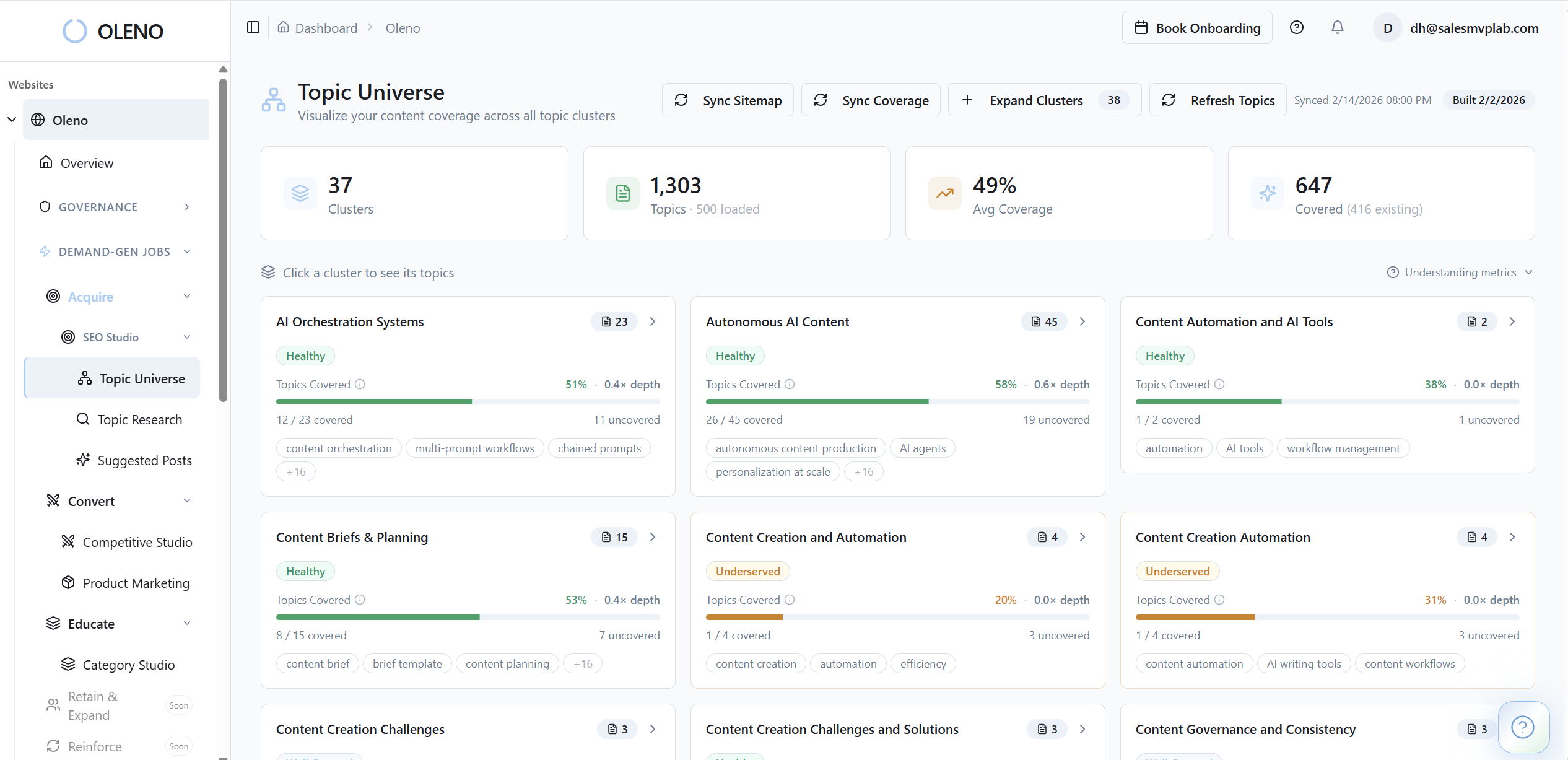
How Oleno Fits When Strategy Has To Survive Execution
Oleno fits this decision when your team doesn't just need more content. It fits when you need the system to carry market narrative, audience context, product truth, and campaign execution together.
That's the distinction. Oleno isn't built around channel optimization alone. It's designed for teams that need planning, messaging inputs, execution flow, and publishing support to stay connected. For a demand gen manager, that matters because the article, launch page, buyer enablement asset, and follow-up sequence usually can't live as separate thinking exercises.
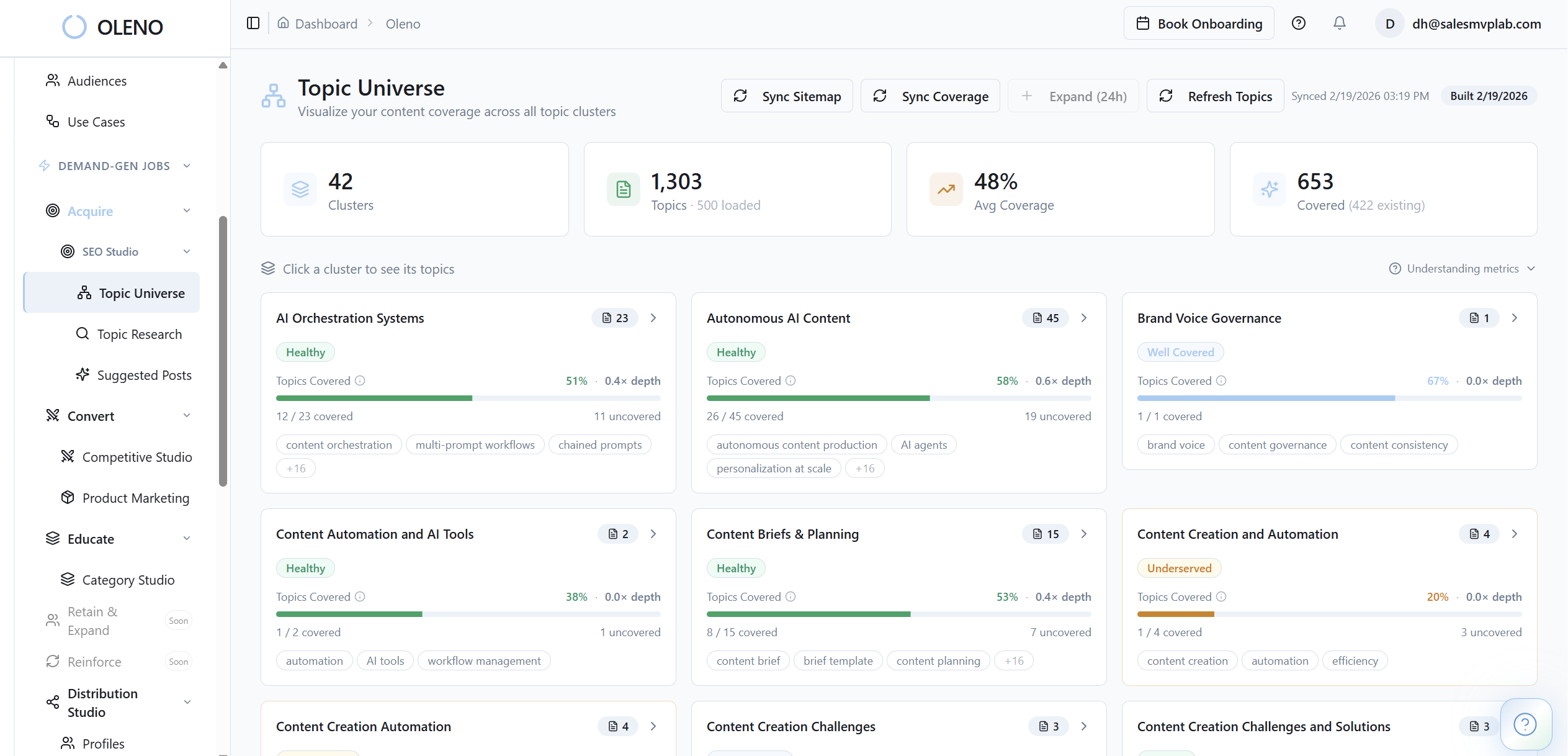
The product context behind Oleno points in that direction. Areas like planning, publishing, brand voice governance, buyer enablement, product marketing, audiences and personas, and category-focused workflows suggest a broader operating model than a page-level SEO tool. That's useful if your team is trying to reduce narrative drift and the handoff overhead between PMM, content, and demand gen.
There is a tradeoff, though. If your main job is mass-producing highly structured search pages, a narrower tool may feel simpler at first. That's valid. But if your bigger headache is that everyone keeps rewriting the same ideas because the strategy never makes it into execution, then a more complete system usually deserves a hard look.
If that sounds close to the problem you're dealing with, the next practical step is to book a demo and run the evaluation against three real assets from your pipeline, not a canned sample.
About Daniel Hebert
I'm the founder of Oleno, SalesMVP Lab, and yourLumira. Been working in B2B SaaS in both sales and marketing leadership for 13+ years. I specialize in building revenue engines from the ground up. Over the years, I've codified writing frameworks, which are now powering Oleno.
Frequently Asked Questions