How to Drive Engagement with Thought Leadership Content

47 tabs open. 3 half-finished docs. And somehow your demand gen manager is still expected to drive engagement with thought leadership that sounds sharp, matches the campaign, and doesn't need six rounds of review. That's the trap.
Most teams think thought leadership breaks because nobody has enough time to write it. I don't buy that. It usually breaks because the system around the writing is broken, and the moment you try to scale it across a growing SaaS team, the cracks show fast.
Key Takeaways:
- Thought leadership usually fails from coordination cost, not lack of ideas
- If 3 or more people touch every draft, you need a system, not better prompts
- The fastest way to drive engagement with thought leadership is to tie POV to a specific audience, use case, and campaign moment
- Raw volume is useful only when consistency holds past 20 to 40 pieces a month
- In the GEO era, consistent narrative beats random bursts of smart content
- The right workflow starts with governance, then variations, then production
- AI can speed up drafts, but without structure it just shifts the work into editing
If you're trying to drive engagement with thought content across a scaling SaaS team, the old patchwork of prompts, freelancers, docs, and reviews is going to cost more in coordination than it saves in speed. If you want to see what a more governed system looks like, you can request a demo.
Why Thought Leadership Engagement Breaks as Teams Grow
Thought leadership engagement drops when strategy and execution get separated. The visible problem is weak posts, slow publishing, or low response. The deeper problem is that the people shaping the message are no longer the people writing the content, and the handoff process strips out the good stuff.

The symptom looks like weak content, but the root cause is translation loss
Back in 2012-2016 I ran a website with a huge contributor network. At our peak, we hit 120k unique visitors a month. We got there with depth and breadth, a lot of contributors, and a lot of pages. That experience taught me something that still holds up: volume works when the system protects quality. Without that, volume just gives you more average content faster.
Now compare that to what happens inside a mid-market SaaS team scaling past 200 employees. A VP Marketing has the positioning in their head. PMM has product nuance. Demand gen has campaign context. A writer or freelancer gets a brief that captures maybe 60% of it if you're lucky. Then the draft comes back and everyone can feel something is off, but nobody can point to the exact sentence where the context got lost. So the review loop starts.
That's the Strategy-Execution Gap in real life. Strategy lives in decks, kickoff calls, Slack threads, and somebody's head. The published article gets the leftovers.
A day in the life tells the story better than any theory
Picture a demand gen manager on a Tuesday at 4:30 pm. They've got a webinar launch next week, paid campaigns going live, and they need two supporting articles plus social cutdowns that actually drive engagement with thought leadership, not just fill the calendar. They open the doc, pull in notes from PMM, chase approvals from product marketing, and send a rushed brief to a freelancer. Three days later the draft is polished, readable, and still wrong for the campaign.
That is where teams lose. Not because nobody is smart. Because the process turns every piece into a translation exercise.
I've seen this a lot. And honestly, it's exhausting. You start with "we just need a draft faster" and end up in a world where every draft creates more work than it removes.
The old fixes all create a different version of the same problem
Hiring more writers sounds logical. Agencies sound efficient. Prompting tools feel fast. Fair point, all of them can work in a narrow slice of the problem. If you have a very strong internal operator who can brief clearly, review aggressively, and keep the narrative tight, you can get decent output.
But that's also the catch.
The 3-Touch Rule is the thing I'd use here: if a piece needs input from strategy, product, and demand gen, and there's no system carrying that context forward, your content operation starts to break. At 1 or 2 contributors, you can brute force it. At 3 or more, coordination cost starts outrunning creation speed. That's when thought leadership stops driving engagement and starts becoming a bottleneck. So what do you replace it with?
The Real Cost of Chasing Engagement With a Patchwork Workflow
Patchwork workflows cost time, message clarity, and market trust. They look cheaper because the inputs are cheap. But once you count rework, delayed campaigns, and brand drift, the real cost gets ugly fast.
Prompting is fast for drafts, slow for systems
Prompting feels productive because it gives you words right away. You ask for a post, get a post. You ask for a rewrite, get a rewrite. For one-off work, that can be useful.
For ongoing demand gen, it falls apart.
A prompt doesn't remember the full campaign context unless you rebuild it each time. It doesn't protect your positioning. It doesn't know which persona this version is for unless you restate it. And it definitely doesn't know where your product truth begins and ends. So the speed is real up front, but the debt shows up later in editing. That's why I think the Editing Tax is one of the most ignored costs in B2B marketing right now.
The Editing Tax Rule is simple: if your team spends more than 15 minutes fixing voice, positioning, and accuracy per draft, the tool is not saving time. It's just moving labor downstream. Most AI writing setups quietly fail this test.
Teams lose pipeline velocity long before they notice content quality slipping
A lot of demand gen managers don't feel this first as a content problem. They feel it as a campaign speed problem. The launch is delayed. The nurture sequence goes out without supporting articles. The webinar follow-up lacks a strong point of view. Paid media has to recycle old assets because the new ones aren't approved yet.
That's the hidden connection. Weak thought leadership engagement doesn't just hurt brand. It slows the whole funnel.
I saw a version of this at a SaaS company with a great content team. They ranked really well. The writing had personality. The design was strong. But the content sat too far away from the actual product and demand-gen narrative, so it didn't support conversion. Traffic looked healthy. Pipeline connection didn't. That's a painful place to be because on paper it seems like content is working.
It's not enough to publish smart things. The content has to pull readers closer to the problem your product actually solves.
GEO raises the standard from "good article" to "consistent body of proof"
Humans still matter. Search engines still matter. But now LLMs matter too, and they don't evaluate your content the same way. Google's guide to creating helpful, reliable, people-first content still points you toward expertise and consistency, which is exactly the point. And McKinsey's research on personalization reinforces something adjacent but important here: relevance compounds when the message matches the audience.
In GEO, fragmented content leaves weak signals. One article says one thing. Another uses different language. A third sounds like a freelancer. A fourth sounds like generic AI. That's not authority. That's noise.
So if you want to drive engagement with thought leadership now, the bar isn't "can we publish?" It's "can we express the same sharp point of view across dozens or hundreds of assets without drift?" That's a different game entirely.
And the answer isn't more output. It's a better system for producing it.
If this is sounding uncomfortably familiar, that's because it usually is. Midway through the quarter is where most teams realize they don't have a writing problem. They have an operating model problem. If you want to pressure test that for your team, request a demo.
How to Drive Engagement With Thought Leadership That Actually Compounds
You drive engagement with thought leadership by making it specific, repeatable, and audience-matched. Not generic. Not inspirational for its own sake. Not detached from the rest of your demand gen system.
Start with the Audience-Use Case Matrix
The first move is diagnostic. Before you write more, figure out whether your thought leadership is too broad to resonate.
I use a simple model for this: the Audience-Use Case Matrix. Put your key audiences on one axis. Put your real use cases or campaign jobs-to-be-done on the other. If your content ideas sit in the middle as broad education that could apply to anyone, engagement will be soft. If your content sits at clear intersections, like "VP Marketing at a scaling SaaS team trying to reduce review cycles" or "Demand gen manager needing persona-specific campaign assets," you're much more likely to get traction.
Ask yourself four questions:
- Who is this for, exactly?
- What active problem are they trying to solve right now?
- What belief do we want to shift?
- What next action should feel obvious after reading?
If you can't answer those in under 60 seconds, the draft is probably too vague.
This is where a lot of companies miss. They think thought leadership should be broad to get more reach. In practice, the opposite often works better. Narrower framing gets stronger engagement because readers feel seen.
Build a POV Spine before you build the article
A good thought leadership piece needs a backbone. I call it the POV Spine. It's 4 parts:
- A clear enemy or broken old way
- A root-cause explanation
- A better model
- A practical implication for the reader
Without that spine, you get smart-sounding content that doesn't stick.
Let's say your point of view is that fragmented execution kills demand gen. Fine. Then every article, post, or campaign asset built from that idea should reinforce some version of that belief. Not word for word. But structurally. That's how you drive engagement with thought leadership over time. Readers start seeing a pattern. The market starts understanding how you think.
We saw something similar years ago when founder-led content was being repurposed into articles. The ideas were strong because the founder actually had something to say. But without search structure and topic discipline, the content missed intent. So the lesson wasn't "founder content doesn't work." It was "raw insight needs a system." Same here.
Use the 70-20-10 Variation Rule
Engagement improves when content is consistent and tailored at the same time. That's a tricky balance if you don't have a framework.
The 70-20-10 Variation Rule solves it. Keep 70% of the core narrative fixed, your point of view, your main argument, your product truth. Adapt 20% for the audience or persona, meaning examples, objections, and language. Then use 10% for campaign context or format, like whether this becomes an article, webinar follow-up, LinkedIn post, or sales enablement asset.
This matters a lot for scaling SaaS teams. A CMO might care about narrative drift and resource allocation. A demand gen manager is usually thinking about campaign fuel, speed, and proof of contribution to pipeline. Same core thesis. Different edge.
Not everyone agrees with this approach. Some teams prefer to create net-new content for every persona. I get the logic. If you have a huge team, maybe that's workable. For most mid-market SaaS teams, it creates duplication and more review burden. Variation usually beats reinvention.
Treat thought leadership like a portfolio, not a post
This is the part most teams overlook. One smart article is nice. A coordinated body of content is what changes market perception.
Back when we scaled content to 120k monthly visitors, most pages got less than 100 views a month. That's important. On their own, many pages looked small. Together, they created breadth, depth, and long-tail capture. We saw traffic spikes at 500 pages, 1000 pages, 2500 pages, 5000 pages, then 10000 pages. That's the compounding effect.
Thought leadership works similarly. One sharp opinion won't move much. But 20, 40, 80 pieces that all reinforce the same market view across different audiences and use cases? Different story.
So build a portfolio. Mix article types. Some should educate. Some should define the category. Some should support evaluation. Some should connect directly to campaigns. If your mix is too top-heavy on broad awareness, you may get attention without momentum. If it's too product-heavy, you may lose trust. The balance matters.
Put governance before generation
This is the non-obvious part. Teams usually want to solve production first. I think that's backwards.
Governance comes first. Define how you sound. Define what you believe. Define what is true about the product. Define who you're talking to. Define the use cases. Once those are locked, generation gets easier and safer.
The Governance-First Threshold I'd use is this: if your team has more than 2 contributors touching content, or publishes more than 8 substantial pieces per month, undocumented judgment starts becoming a liability. At that point, your best people are spending their time re-explaining standards that should already exist.
That's why consistency across scale beats raw volume. Volume without governance creates drift. Governance with production creates compounding.
How Oleno Turns Thought Leadership Into a Repeatable System
Oleno turns governed strategy into repeatable execution. It doesn't replace your positioning work. It makes that positioning show up consistently in the content that actually gets published.
Governance that carries context forward
This is where most tools stop too early. They help you draft. Oleno starts further upstream.
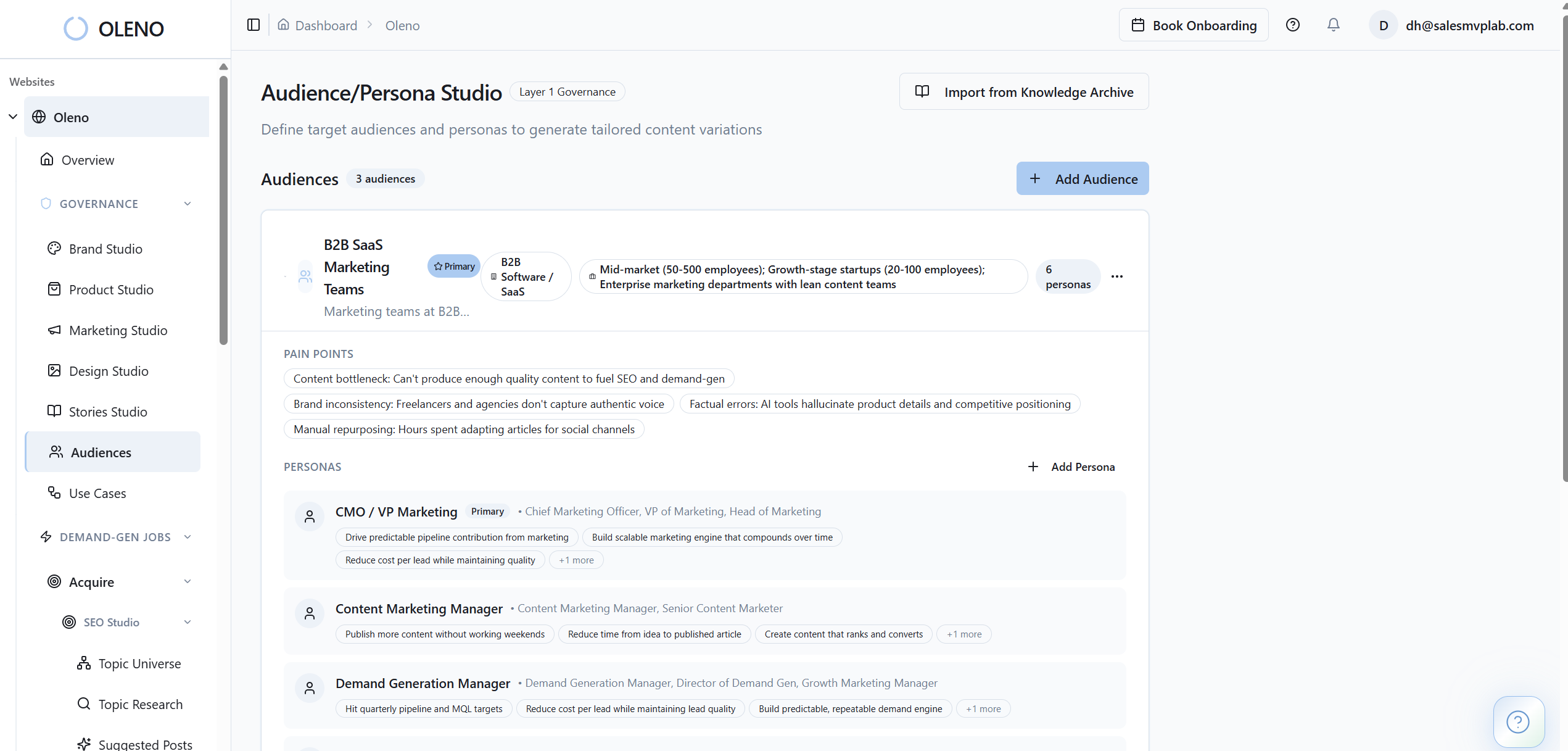
Marketing Studio encodes your point of view, category framing, and key messages so every piece isn't starting from a blank slate. Audience & Persona Targeting lets the same core idea get framed differently for a CMO versus a demand gen manager. Use Case Studio models the actual workflows and outcomes content should speak to, which is a big deal when you're trying to drive engagement with thought leadership for multiple segments without turning everything generic.
That matters because most review cycles are really context-recovery cycles. People aren't just editing sentences. They're re-injecting audience nuance, persona goals, use-case relevance, and strategic framing that got lost on the way to the draft.
Systems that reduce the editing tax
Oleno also closes the quality loop. Product Studio keeps product claims grounded so content doesn't drift into invented features or fuzzy positioning. Stories Studio brings in real anecdotes and lived experience so thought leadership sounds like it came from practitioners, not a machine. And the Quality Gate runs 80+ automated checks across voice, structure, grounding, and quality before something moves forward.
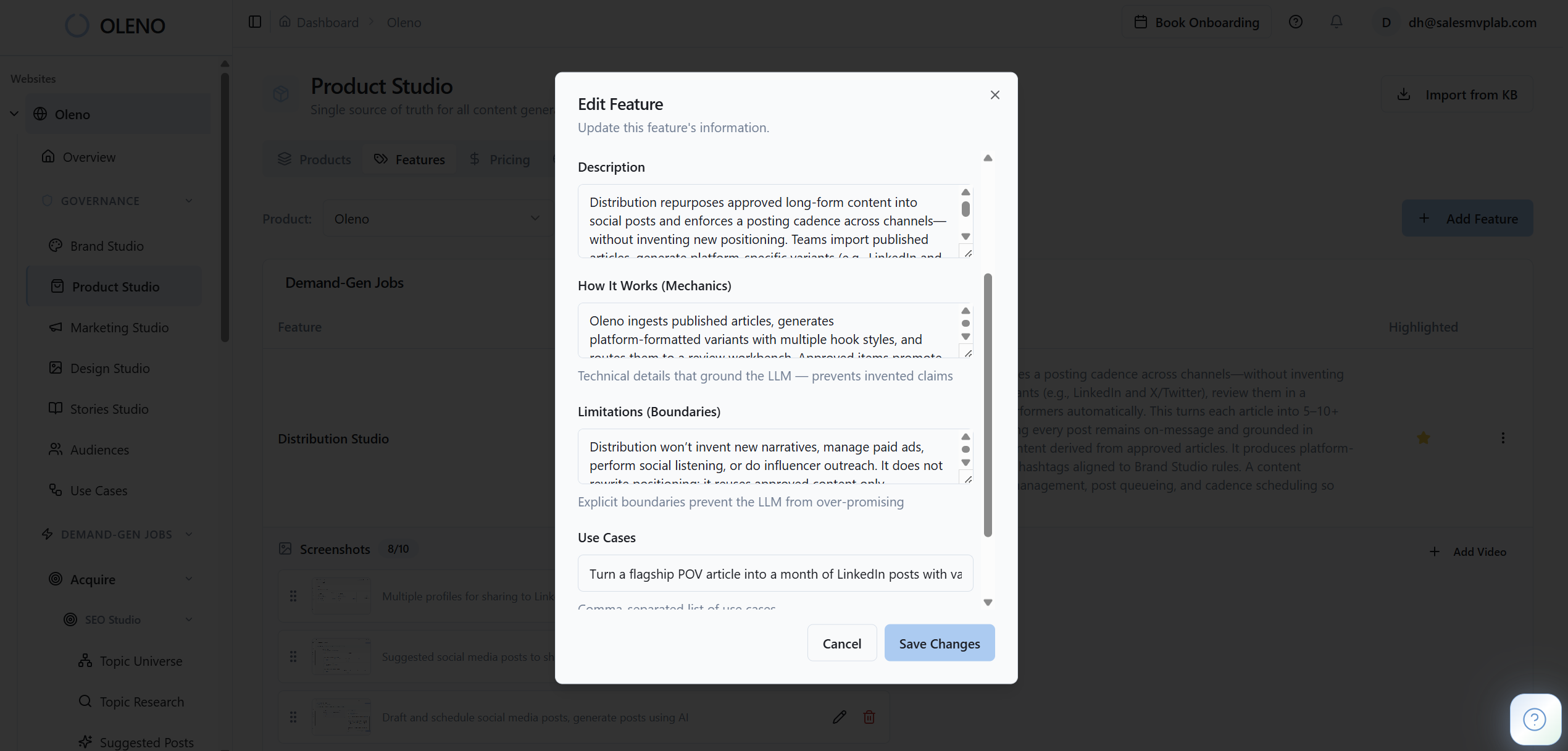
So the transformation isn't abstract. The coordination-heavy loop of brief, rewrite, review, and fix gets replaced with a governed process that keeps strategy persistent across outputs.
For scaling teams, that's huge. Programmatic SEO Studio can keep acquisition content moving on a steady cadence. Category Studio can produce longer-form market narrative pieces. Product Marketing Studio and Buyer Enablement Studio can support the middle and bottom of funnel. Then the Orchestrator handles pacing and execution order so content doesn't rely on someone manually pushing every draft uphill.
That's the point. Not faster text. More reliable execution.
Where Oleno fits, and where it doesn't
Worth noting, this isn't for everyone. If you're pre-product and still figuring out your positioning, there isn't much governance to encode yet. If you're a solo creator, this is probably overkill. And if you're a huge enterprise with a 10-person content department and mature editorial systems, you may have a different problem set.
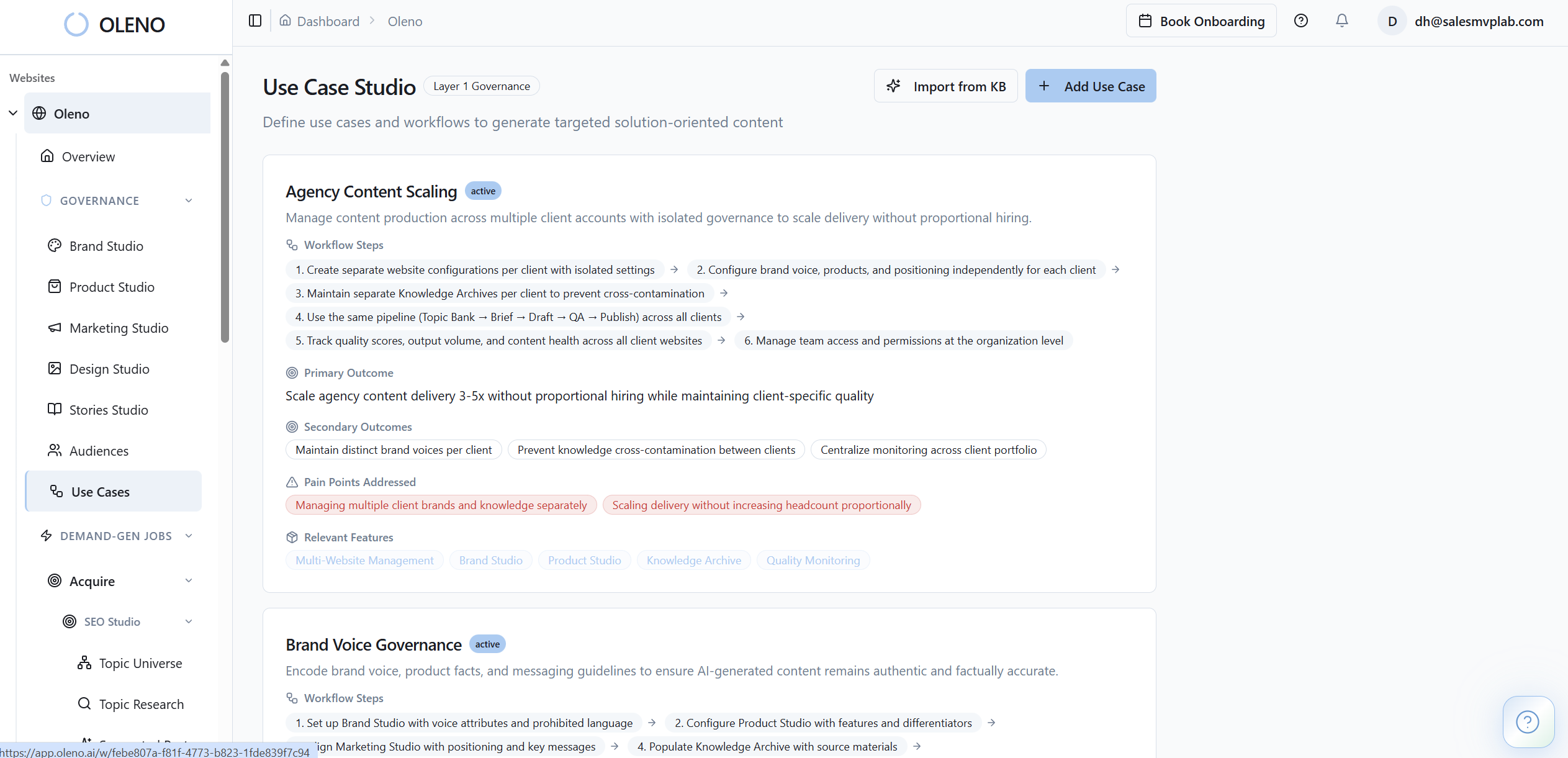
Oleno also doesn't replace technical SEO, keyword research tools, analytics, CRO, paid media, or campaign strategy. You still need those disciplines. It handles the content execution layer: governed creation, quality control, and steady output across content types.
If your team already knows what it wants to say but struggles to say it consistently at scale, this is where Oleno fits. If that sounds like your situation, you can book a demo.
The Teams That Win Will Be the Ones With Systems
Thought leadership is not the hard part. Sustaining it is. That's what breaks most teams.
If you're scaling a SaaS company and trying to drive engagement with thought leadership, you probably don't need more random output. You need a way to keep strategy, audience context, and product truth intact from idea to publish. That's the difference between occasional good content and a system that compounds.
The market is getting less forgiving. GEO raises the bar. Campaigns need fuel faster. Teams get more specialized, which means more handoffs and more chances for drift. The old patchwork can limp along for a while. Then it starts costing you.
A system fixes that. And once you feel the difference, it's hard to go back.
About Daniel Hebert
I'm the founder of Oleno, SalesMVP Lab, and yourLumira. Been working in B2B SaaS in both sales and marketing leadership for 13+ years. I specialize in building revenue engines from the ground up. Over the years, I've codified writing frameworks, which are now powering Oleno.
Frequently Asked Questions