How to Improve Marketing Team Efficiency for Better Results

Google rankings are table stakes now. If your agency is trying to improve marketing team efficiency with more prompts, more freelancers, and more review rounds, you're probably adding motion, not leverage.
I've seen this movie before. The hard part isn't getting words on a page. It's getting the right words, in the right voice, for the right client, over and over again, without your team getting buried in edits.
Key Takeaways:
- Improving marketing team efficiency usually has less to do with effort, and more to do with execution design
- Agencies don't usually break on writing capacity first, they break on context transfer and review load
- GEO changes the standard because AI engines reward consistency, structure, and authority across scale
- If you manage more than 3 active content accounts, you need a governance layer, not just faster drafting
- A simple rule: if edit time is more than 30% of total production time, your workflow is upside down
- The best way to improve marketing team efficiency is to encode strategy once, then reuse it across briefs, drafts, reviews, and refreshes
If you want to see what that looks like in practice, you can request a demo.
Why agency content operations get slower as you grow
Agency content operations get slower as you grow because every new client adds voice rules, product context, approval habits, and edge cases. More accounts should create scale. In most shops, they create drag. That's why improving marketing team efficiency gets harder right when your book of business gets healthier.

Back in 2012-2016 I ran a website that got to 120k unique visitors a month. We had 80 regular contributors and 300+ guest contributors. What I learned from that period was pretty simple. Volume works when quality has structure behind it. Without structure, volume just gives you more inconsistency to manage.
A lot of agency owners think their bottleneck is writer throughput. It usually isn't. The real problem is what I call the Context Relay Gap. Strategy starts with the client. Then it gets translated by the account lead, retranslated in a brief, half-translated in Slack, then interpreted by a writer who wasn't in the kickoff call. By the time the draft shows up, the original point of view has been diluted 3 or 4 times.
You can see it in a normal Tuesday. An account manager is in ClickUp at 9:12 AM, trying to brief a writer on a cybersecurity client. By 11:30, the writer has a draft, but the positioning sounds like every other cybersecurity company on the planet. At 2 PM, the strategist rewrites the intro, swaps three product claims, fixes the competitor framing, and sends it back. At 5 PM, the client says, "This doesn't really sound like us." One article. Four people. Most of the day gone.
That pain gets worse in the GEO era. AI engines aren't just scanning for keywords. They're picking up whether a brand has a clear, repeated, structured point of view across a body of work. Fragmented execution can't hold that line. And when it can't, your team feels it. You start wondering why more output still feels like less progress.
The hidden cost isn't drafting, it's translation loss
Translation loss is what happens when strategy keeps getting handed off between people and tools until the original meaning gets blurred. Agencies live in this problem because they serve multiple brands at once. Each brand has its own language, proof points, use cases, and red lines.
There's a reason this feels expensive even when labor looks "efficient" on paper. Say your team spends 90 minutes drafting an article, then 70 minutes across internal review, revision notes, and client-facing fixes. That means 44% of production time sits after the draft. My rule is simple: once edit and correction time crosses 30%, you don't have a writing problem anymore. You have a system problem.
Some people will say this is just the cost of custom client service. Fair point. Custom work does require nuance. But nuance is not the same thing as chaos. The best agencies preserve nuance by standardizing context, not by re-explaining the same account every week.
Why more AI often makes the agency workflow worse
AI speeds up first drafts. That's true. It also creates a nasty trap for agencies because speed at the top of the funnel creates cleanup at the bottom.
Prompt-based workflows push judgment onto your senior team. Someone has to decide what should be written, how the client's POV should show up, what claims are safe, what examples fit, and what tone won't trigger a rewrite from the client. So the junior team or the tool produces text fast, but the expensive people still carry the thinking. That's not really how you improve marketing team efficiency. It's how you hide the bottleneck under a pile of drafts.
I've seen this firsthand with small SaaS teams too. At one company, I could write 3-4 solid blog posts a week because I had all the context in my head and a structured framework to work from. As the team grew, output should have gone up. It didn't. The writer had less context than I did, so quality dropped. I had less time than I used to, so review became slower. Same thing happens inside agencies all the time.
GEO rewards consistency, not content chaos
GEO changes the economics of agency delivery because consistency across scale now matters more than raw publishing volume. You can still get some wins from isolated strong posts. But to improve marketing team efficiency in a way that compounds, you need consistent authority signals across dozens or hundreds of pieces.
According to Google's guidance on creating helpful, reliable, people-first content, search systems reward content that shows expertise, trust, and a clear purpose. And Google's search quality evaluator guidelines keep pushing in the same direction: experience and credibility matter. LLM-driven discovery pushes even harder on that. If your client's articles sound like five different writers with five different mental models, that's a visibility problem, not just a workflow problem.
Agencies that figure this out don't just ship more. They create a library where each piece reinforces the next. That's the shift. So the question becomes: what kind of operating model actually supports that?
The real bottleneck is fragmented execution, not writer output
Fragmented execution means the work is technically getting done, but the system holding it together is broken. Briefing lives in one place. voice rules in another. Product truth in someone's head. Competitive framing in old decks. Review comments in email. That's why teams struggle to improve marketing team efficiency even after hiring, outsourcing, or adding AI.
Most agency owners don't need a bigger writing bench first. They need a better operating model. The old way is basically a relay race with missing handoffs. The new way is more like a control tower. Same planes. Same runway. Less circling.
Diagnose your agency with the 4-30-3 test
If you want a fast way to see whether your content operation is healthy, use the 4-30-3 test.
First, are you managing more than 4 active client content programs at once? Second, is more than 30% of production time spent editing, revising, or re-briefing? Third, are there 3 or more people translating client strategy before a draft gets approved? If you answer yes to two of those three, fragmentation is already costing you margin.
I like diagnostic rules because they cut through vague talk. You don't need a six-week audit to see the problem. You need to look at where senior attention is getting burned. If your most expensive people spend their week fixing interpretation errors, your system is upside down.
Not every agency hits this wall at the same point. A very niche shop with one offer and very tight ICP alignment can stretch longer. That's valid. But once brand complexity rises, those exceptions disappear fast.
Why handoffs break faster than most leaders expect
Handoffs seem harmless when you're small. You think, "We'll just build better briefs." But every handoff compounds misunderstanding. By the third handoff, the writer is often optimizing for what was easiest to document, not what actually matters to the client.
This is where agencies lose quality without realizing it. The visible symptom is a draft that feels generic. The hidden cause is that the writer never got the real ingredients: buyer objections, product boundaries, preferred examples, category enemy, and the specific way this client talks about outcomes. So they do what anyone would do. They fill the gap with plausible-sounding language.
That plausible language is expensive. It creates the Editing Tax. And the Editing Tax is one of the biggest reasons agencies fail to improve marketing team efficiency as they scale. Money leaks through revision loops, not just through payroll.
The old stack creates local optimization and global mess
A lot of agency stacks are optimized locally. One tool for briefs. One for SEO guidance. One for drafting. One for project management. One for QA. On paper, each tool does its job. Across the system, nobody owns continuity.
This is the part people rarely say out loud. A stitched-together workflow can look sophisticated and still produce weak economics. You get speed in one step, then lose it in the next two. You get output, but no narrative memory. You get drafts, but not reliable coverage across personas, use cases, and funnel stages.
The Content Systems Institute has written extensively about operational maturity and how disconnected workflows create quality drift over time. Their material on content operations maturity is worth reading if you're trying to put names to this problem. The broader point is simple. Local wins don't add up if the system doesn't preserve context.
That sets up the real move. If fragmented execution is the problem, then improving marketing team efficiency has to start with system design, not writer pressure.
A better way to improve marketing team efficiency at scale
A better way to improve marketing team efficiency starts by treating content production like an operating system, not a string of isolated assignments. The shift is from "brief every asset" to "encode the rules once." That's what makes quality repeatable without turning your senior people into full-time editors.
Honestly, this is where most teams get uncomfortable. Because the old model feels more hands-on, and hands-on feels safer. But manual control and actual control are not the same thing.
Start with governance before production
The first move is governance. That sounds heavier than it is. It just means capturing the things that should stop changing from draft to draft.
For agencies, that usually includes brand voice, positioning, product truth, audience definitions, use cases, and approved claims. I call this the Fixed Core model. Fixed core, flexible execution. If the fixed core isn't documented, every article becomes a fresh interpretation exercise. That's a waste.
Before you scale output for a client, lock these five things:
- Voice patterns and words they naturally use
- Product claims and clear boundaries
- Primary personas and buying context
- Use cases and desired outcomes
- Category framing and core point of view
Once those are stable, writers don't need to guess as much. Reviewers don't need to re-teach as much. Clients see themselves in the work faster.
Build around account memory, not one-off briefs
A lot of agencies are still operating brief by brief. That's the wrong unit of scale. The right unit is account memory.
Think about a strong account lead. After 90 days, they know the founder's pet phrases, what examples the client hates, which competitor references are useful, what claims trigger legal review, and what the buying committee actually cares about. That memory is valuable. But if it lives only in one person's head, it's fragile and expensive.
So what should replace it? A governed account layer that carries memory into every draft. Same idea as a great restaurant line cook setting up the station before service. The speed during service isn't magic. It's prep. Content works the same way. If the ingredients are prepped right, output gets faster and cleaner.
This is also where agencies can create separation. The shops that improve marketing team efficiency the most are the ones that stop selling "we write articles" and start operating "we maintain governed narrative systems for each client."
Use the 70-20-10 production split
One framework I like for agency delivery is the 70-20-10 split.
About 70% of content production should come from governed, repeatable systems. SEO articles, comparison pages, use-case pages, refreshes, repurposed social. About 20% should come from adaptive work inside a stable system. New campaign themes, product shifts, market reactions. The final 10% is true ad hoc content where speed matters more than pattern consistency.
If your ratio is flipped, and 70% of work is custom, reactive, and re-briefed from scratch, your margins are going to get punished. Not immediately maybe. But over time, absolutely.
Some agencies push back on that because they worry the work will feel templated. Fair concern. I've seen templated content fail hard. But the issue wasn't the system. The issue was weak inputs. Strong governance creates distinct outputs. Weak governance creates sameness.
Diagnose what kind of efficiency problem you actually have
You can only improve marketing team efficiency once you know which efficiency problem you're dealing with. There are usually three.
The first is a throughput problem. Not enough output, too few hands. The second is a quality problem. Drafts come out, but they miss the mark and trigger rewrites. The third is a coverage problem. The team produces decent work, but not across the full set of personas, use cases, and funnel stages the client needs.
Most agencies think they have a throughput problem. A lot of them actually have a quality and coverage problem wearing a throughput costume. You don't notice that at first because the visible pain is "we need more done." But when you look closer, a bunch of work is getting done twice, and important topics are still being missed.
Treat refresh as efficiency, not cleanup
One more thing that gets overlooked. Refresh work is not maintenance fluff. It's efficiency.
Agencies waste a lot of time recreating content that should have been updated instead. Product claims change. Positioning shifts. Old comparison pages drift. Stats get stale. If nobody owns refresh, your library slowly becomes a pile of half-useful assets that still require explanation on every sales call.
That's why I think refresh should be operationalized. If an article drifts from current truth, it should be flagged before a client notices. That one change alone can improve marketing team efficiency because it protects the value of work you've already paid to produce.
How Oleno turns governed strategy into repeatable execution
Oleno turns governed strategy into repeatable execution by separating the rules from the output. You define voice, positioning, audience context, and product truth once, then the system applies that context through briefs, drafts, QA, and ongoing operations. For teams managing multiple brands or websites, that matters because client-specific nuance has to survive scale.
Governance that preserves client context
This is the part I think agencies will care about first. Oleno uses Brand Studio, Marketing Studio, Product Studio, Audience & Persona Targeting, and Use Case Studio to hold the context that usually gets lost in handoffs.
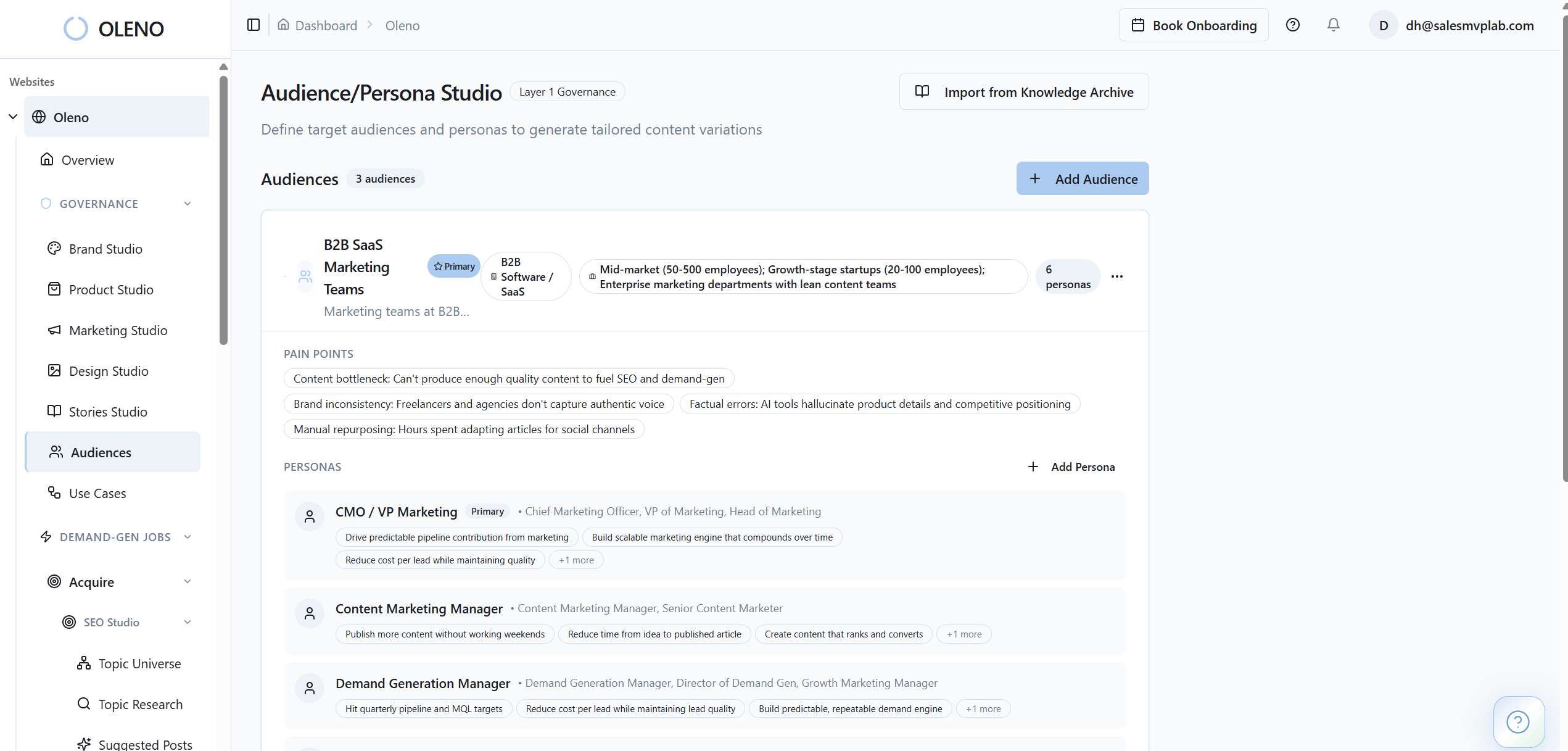
So instead of reteaching a writer how one client talks about risk, or what another client can and can't claim, that information is captured and reused. Brand Studio governs tone and style. Marketing Studio encodes category framing and key messages. Product Studio keeps product descriptions and boundaries accurate. Audience & Persona Targeting and Use Case Studio shape the content around who the client sells to and what those buyers are trying to get done.
That's a big deal for agencies managing multiple brands. It means the rules behind the work are defined once and enforced consistently, instead of living in scattered docs, Slack threads, and editor memory.
Production that scales without adding the same headcount
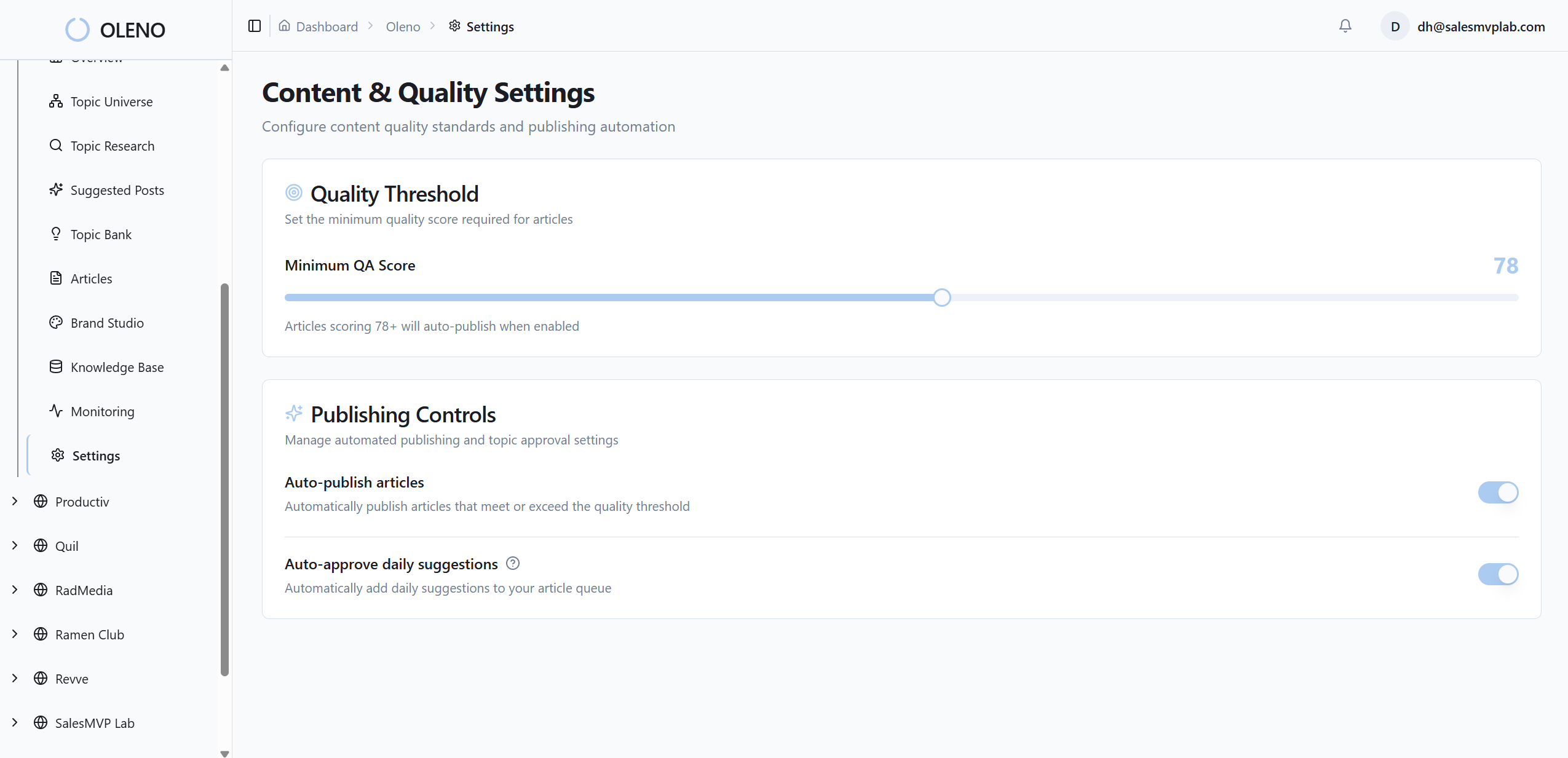
On the execution side, Programmatic SEO Studio, Product Marketing Studio, Buyer Enablement Studio, and Writing Studio handle different job types without forcing your team back into prompt-by-prompt work. Storyboard helps allocate content across audiences, personas, products, and use cases so coverage doesn't get lopsided. The Orchestrator then runs approved jobs through the pipeline based on quotas and cadence settings.
What I like about that setup is that it respects how agencies actually work. You still need strategy. You still need account judgment. You still need technical SEO outside the platform. Oleno isn't replacing those things. It handles the governed content production layer that usually eats all the time.
And then there's the Quality Gate. Every article goes through automated checks for voice compliance, product accuracy, structure, grounding, and more before it reaches review. That matters because agencies don't need more raw drafts. They need fewer bad ones.
We had an experienced SEO consultant review Oleno output and the reaction was basically that it passes the slop test. That phrase stuck with me because everyone in content knows what slop feels like the second they read it. Agencies can't send slop to clients. They pay for it twice.
Visibility into what is actually happening
The last piece is operational visibility. Agencies often run content delivery on vibes. You know who's busy. You know which client is noisy. But you don't always know where quality is slipping, where coverage is thin, or whether output is actually compounding.
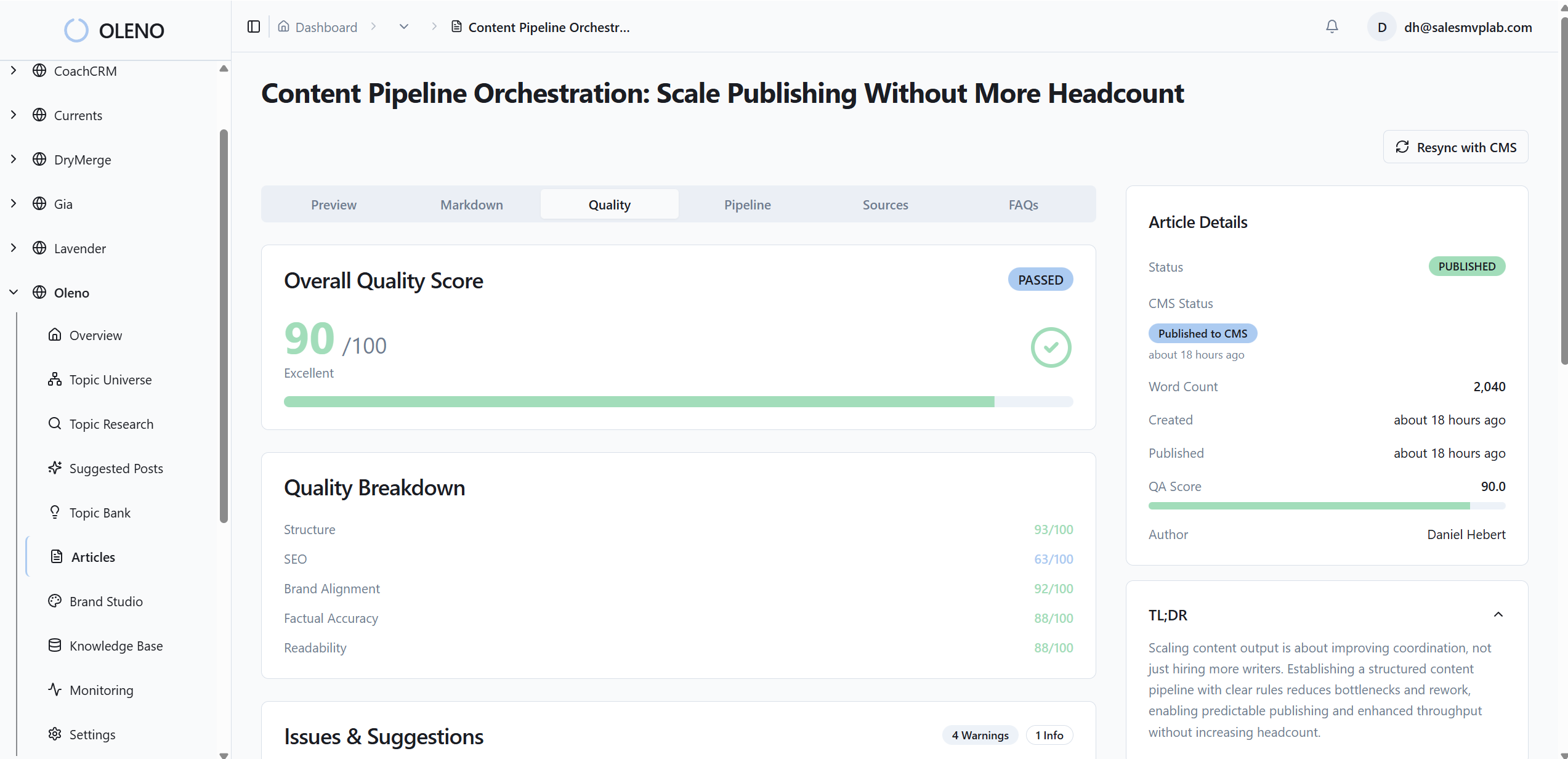
Oleno's Executive Dashboard gives visibility into output cadence, quality score trends, coverage gaps, pipeline health, and quota utilization. CMO Copilot surfaces recommendations based on governance data, content performance, and coverage gaps. Content Refresh & Drift Monitoring flags content that has fallen out of sync with current truth.
That doesn't mean the platform becomes your whole marketing stack. It doesn't do technical SEO, keyword rank tracking, or PR. And that's important to say. This isn't for solo bloggers, pre-revenue startups still inventing their positioning, or giant enterprises with huge in-house editorial teams already built for this. But for agencies serving multiple B2B clients and trying to improve marketing team efficiency without hiring in lockstep, the fit is pretty obvious.
A lot of people describe the value in labor savings. That's true, but incomplete. The bigger win is continuity. You stop resetting context every week.
The agencies that win will scale consistency, not just content
Improving marketing team efficiency isn't about cranking the draft machine harder. It's about reducing translation loss, shrinking the Editing Tax, and building a system where client strategy actually survives execution. That's what agencies need now, especially as GEO raises the bar for consistency and authority.
If your team is buried in rewrites, context gaps, and voice drift across client accounts, that's the signal. Not that your people are weak. That your operating model is.
When you're ready to see how Oleno handles governed content execution for agencies, book a demo.
About Daniel Hebert
I'm the founder of Oleno, SalesMVP Lab, and yourLumira. Been working in B2B SaaS in both sales and marketing leadership for 13+ years. I specialize in building revenue engines from the ground up. Over the years, I've codified writing frameworks, which are now powering Oleno.
Frequently Asked Questions