How to Keep B2B SaaS Messaging Consistent Across Campaigns and AI Tools
Your product marketer briefs a campaign in Claude. Your demand gen manager writes the email in ChatGPT. An agency builds the landing page from a shared folder.
Imagine the three drafts come back with three different promises. The landing page describes a place to keep company information. The email promises that every AI answer will follow it. The agency adds a claim about automatically updating old campaigns.
Everyone started with the same product. Somewhere between the brief and the finished copy, the story changed.
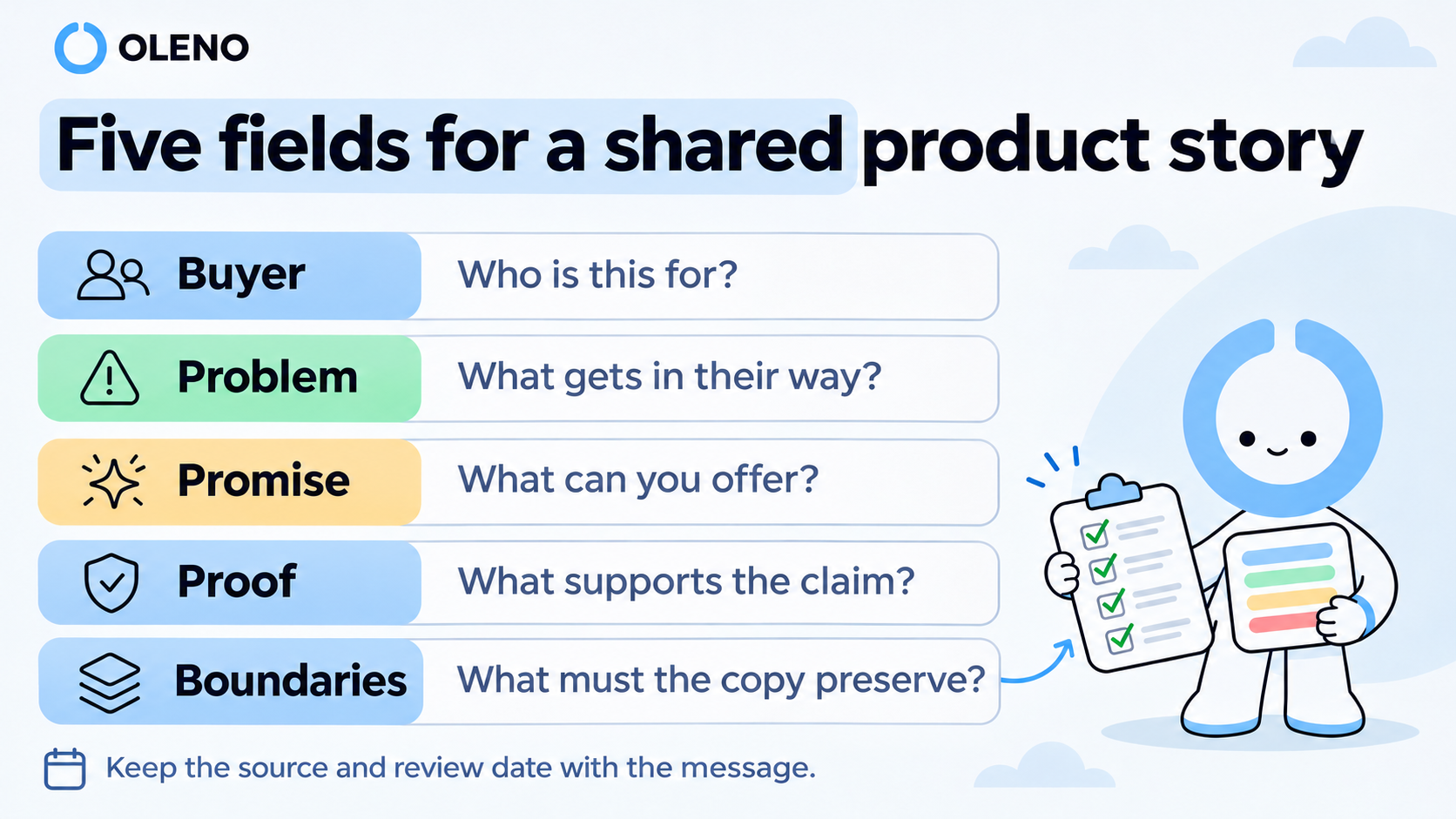
A messaging framework gives contributors a reference they can check before making those choices. For a B2B SaaS campaign, a useful starting point is five fields: buyer, problem, promise, proof and boundaries. Keep them with the brief and the sources behind it, then review how each asset applies them.
Start with the message everyone needs to understand
A message such as “help teams work better with AI” leaves a lot for a writer to decide. Which team? What work? What help does the product provide? A writer answering those questions alone may arrive at a different product story from the person who wrote the brief.
The framework needs enough detail to guide those decisions. It does not need to become another long document that nobody opens.
| Field | Question to answer | What to record |
|---|---|---|
| Buyer | Who is this campaign for? | The role, situation and task that matter here. |
| Problem | What is getting in their way? | A specific difficulty the product can help address. |
| Promise | What can you offer this buyer? | An outcome tied to supported product capabilities. |
| Proof | Why can you make that claim? | The exact source, relevant version and permission to use it. |
| Boundaries | What must the copy preserve? | Conditions, limits and claims the evidence does not support. |
Start with one buyer situation. A product marketing manager handing work to an agency needs different detail from a marketing leader evaluating a new team process. Both may care about consistent messaging, but a single campaign still needs a clear priority.
The promise should follow from the problem and what the product actually does. If you cannot explain how the capability supports the promise, resolve that before asking someone to write the landing page.
Build the framework around a concrete campaign
Consider an illustrative Oleno campaign for a product marketing manager whose teammates and agency use different AI tools. The following is sample campaign planning, not a customer story or a measured result.
Buyer: A B2B SaaS product marketing manager sharing campaign work with internal contributors and an agency.
Problem: Contributors find different versions of the positioning and product details, so the PMM keeps correcting the same claims in briefs and drafts.
Promise: Keep the company information and marketing processes the team needs in one maintained place, available to people and compatible AI tools with the appropriate access.
Proof: Current approved product records describe how the team maintains positioning, messages, audiences and product details in Oleno. A permitted demonstration can show a compatible tool requesting relevant information. Evidence for this capability does not establish a percentage reduction in review time or prove that every model will use it correctly.
Boundaries: The connected tool must request and use the information. People maintain the strategy and review the work. Oleno does not automatically rewrite existing pages or guarantee that every AI output follows the guidance.
Those boundaries help a writer make a practical choice. “Give your team a shared reference for the product story” fits the example. “Make every AI answer accurate” promises an outcome the product cannot guarantee.
Give proof its own attention. A product record may support a capability statement. A documented customer result may support a specific outcome when you have permission to use it. One cannot substitute for the other.
Keep the source link, date or version, and intended use beside the claim. If a supporting statement is an assumption, label it and decide what evidence is still needed.
Use the same framework for a landing page and an email
Now give the framework to two contributors. One is building the campaign landing page. The other is writing an email that invites the same buyer to explore it.
The assets have different jobs. The landing page has room to explain the offer and answer questions. The email needs a clear reason to click. Their wording can reflect that difference.
Landing page example
Sample headline: “Give your team one place for the product story.”
Sample supporting copy: “Keep positioning, product details and shared marketing Plays in Oleno. Your teammates and compatible AI tools can request the information they need for the campaign.”
Below that copy, explain what the connection involves, who maintains the information and what the buyer would see in a demonstration. Make material conditions easy to find. A headline should not depend on a buried disclaimer to correct its meaning.
This version gives the buyer a product explanation. It describes the shared reference and how contributors can access it without promising that every finished asset will be correct.
Campaign email example
Sample subject: “Which product brief is your agency using?”
Sample body: “Your positioning changed, but the campaign may still start from an older brief. Oleno gives your team a maintained place for company information and shared Plays that compatible AI tools can request. See how your next campaign could use the same product reference.”
The email leads with the handoff problem because that is the reason to investigate. It can leave the detailed walkthrough to the landing page, provided the page explains the conditions behind the offer.
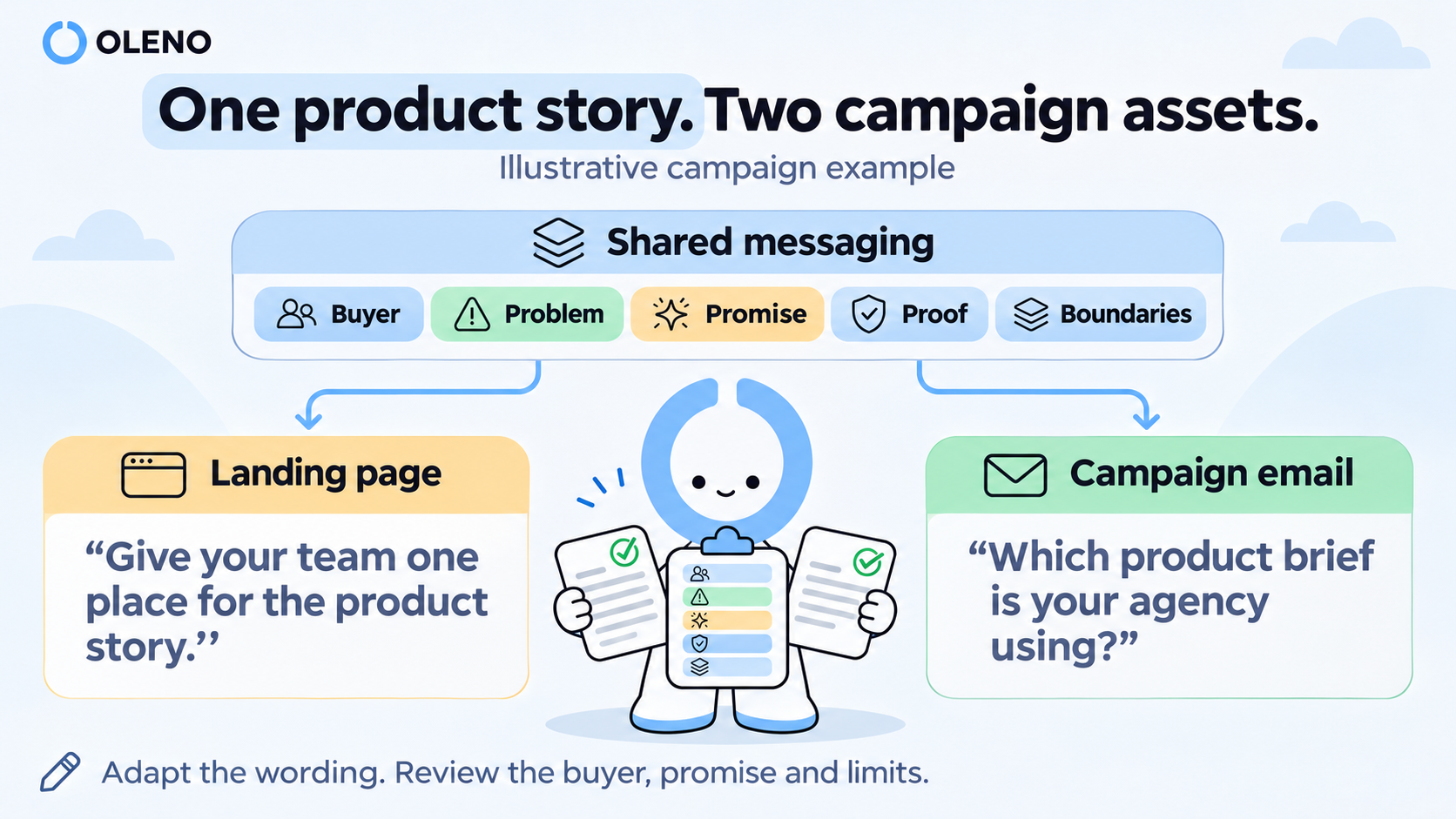
Compare the two assets before approving either. Do they address the same buyer situation? Does the email promise something the landing page cannot demonstrate? Has either writer added a capability because it made the copy sound stronger?
If an email draft says “Oleno automatically keeps every campaign up to date,” return to the boundaries field. The issue is a product claim. Editing the tone will not resolve it.
Tell each AI tool which information to use
Sharing the framework with a person and using it in an AI tool both require an explicit handoff. Include the buyer, the asset’s job, the relevant product sources and the limits on the promise.
For example, a campaign instruction could say:
Use the current approved messaging and relevant product details for this campaign. Write for a B2B SaaS PMM handing work to an agency. Draft an email that leads to the landing page. Preserve the supported promise and conditions. Flag any claim that needs evidence.
When the connection supports it, ask the AI tool to retrieve the relevant information from Oleno and check what it returned before drafting. The connection needs the right permissions, and the tool has to request and apply the information.
An approved product description being available does not establish that a particular draft used it. Review the output against the framework and the source material. Keep useful feedback and decisions with the saved work so the next contributor can understand why the copy changed.
A shared Play can describe this process: find the current guidance, draft for the selected asset and review the claims. The person doing the work can adapt the steps to the assignment.
Let the wording change without changing the offer
A campaign does not need identical sentences everywhere. A landing page may explain a capability directly. An email may open with a problem. A sales conversation may need an example that answers an objection.
During review, separate wording choices from decisions that change the message.
| Wording can vary | Changes that need a messaging or product check |
|---|---|
| Hook, subject line and sentence length | Who the campaign is for |
| Order of the explanation | What the product promises |
| Example used for the asset | Which capabilities the copy implies |
| Level of detail | Evidence, conditions and limits |
| CTA suited to the next step | Whether a result is demonstrated or assumed |
Read the copy as a buyer would. “Ask your AI tool for current product information” describes an action. “Your AI always knows the latest product information” implies automatic, reliable behavior. Similar vocabulary can hide a different promise.
When contributors disagree, identify the field that needs a decision. If they are choosing different buyers, revisit the brief. If they disagree about a feature, check the product source. If the approved promise is too broad to guide the work, the owner needs to revise it.
Give changes an owner and a review date
Put a named owner, review date and source version beside the framework. Record why the message changed so a teammate can distinguish an intentional decision from an accidental rewrite.
When a capability or condition changes, update the approved reference and identify the campaign assets that used it. Review those assets in the systems where they live. The team still needs to decide which changes matter and release the updates.
Oleno provides a maintained place for positioning, buyer information, product details and shared Plays. Compatible AI tools can request the information they need through MCP. The people and tools making the campaign do the writing, design and production, and the team reviews the result.
For your next campaign, choose two assets and put them beside the same framework. Check the buyer, problem, promise, proof and boundaries in each. Note where a claim changes, find the source of that change and give the correction an owner.
Check your next campaign against these five messaging fields.
About Daniel Hebert
I'm the founder of Oleno, SalesMVP Lab, and yourLumira. Been working in B2B SaaS in both sales and marketing leadership for 13+ years. I specialize in building revenue engines from the ground up. Over the years, I've codified writing frameworks, which are now powering Oleno.
State of AI in Marketing 2026
Free report · 2026
Your campaign might be the wrong answer.
Read State of AI in Marketing 2026 before writing another campaign.
Get the reportFrequently Asked Questions