How to Maintain Quality Across Multiple Brands Without Creating a Review Machine

If you're trying to maintain quality across multiple brands, you already know the real problem isn't writing. It's the frustrating rework that shows up after the draft is done, when PMM says the claims are off, demand gen says the angle is wrong, and somebody notices the voice sounds like the other brand.
This gets worse as teams grow. More people should mean more output, but in practice it often means more interpretation, more handoffs, and more places for narrative drift to creep in. I've seen this a lot in SaaS teams. Quality usually doesn't break because people are lazy or untalented. It breaks because the rules live in decks, docs, and people's heads.
For teams managing several products, business units, or client brands, the goal isn't just to publish more. It's to maintain quality across multiple brand contexts without hiring a small army of reviewers. That's where the model has to change, and it's also where Oleno starts to make sense.
Key Takeaways:
- More contributors usually create more variance unless brand, product, and audience rules are defined in a system that travels with each content job.
- When brand standards live in documents instead of the workflow, review cycles expand because every reviewer becomes a translator.
- Quality tends to hold when voice, messaging, and approved product claims are encoded once and checked automatically before publication.
- Oleno uses brand studio, marketing studio, product studio, audience & persona targeting, use case studio, and quality gate to keep each brand context separate.
- Teams using a governed content model can move from scattered manual review to a steadier production pace, and some use cases are designed to support 3-5x more delivery without proportional hiring.
Why Quality Breaks First When More Contributors Join
More Contributors Create More Variance, Not More Consistency
The default assumption is that more people means more capacity. Fair point. On paper, that's true. But in content operations, every new contributor also adds a new interpretation layer. That's where things start to wobble.
A PMM writes from product truth. A content marketer writes from search intent. A demand gen lead wants campaign fit. An agency writer is trying to absorb all of that from a brief that was probably rushed. Nobody is being unreasonable. They just aren't working from the exact same operating context.
Back in 2012-2016 I ran a website called Steamfeed. At our peak, we hit 120k unique visitors a month. We had 80 regular contributors and over 300 guest contributors. That breadth worked because every topic had depth, and the publishing motion was consistent enough to compound. But that's the part people miss. Volume only works when quality holds. Once variance gets too high, the catalog stops compounding and starts leaking trust.
The same thing showed up in smaller SaaS teams too. When I got to PostBeyond, I could put out 3-4 strong posts a week because the context lived in my head. As the team grew, output should have gone up. Instead, the new writer had less context than I did, took longer, and needed more correction. That's the Multi-Context Drift Rule: once more than 3 contributors touch the same message without a shared operating system, review time usually starts rising faster than output.
Review Cycles Expand When Brand Rules Live In Documents
Documents feel organized. They usually aren't enough.
A style guide in Notion. A messaging deck from last quarter. A product sheet in Google Drive. A few Slack threads explaining what not to say. That's how most teams run multi-brand quality control. Then everyone wonders why approvals take forever.
Let's pretend you have 4 brands, 3 contributors, and 2 reviewers. If each draft creates just 20 minutes of extra interpretation work per reviewer, per brand, across 12 pieces a month, you've quietly burned 16 extra review hours. That's not strategy time. That's translation time.
And it gets uglier at the handoff points. One person says "pipeline acceleration." Another says "revenue efficiency." A third pulls in a feature claim that was valid two months ago but not now. You can fix it manually. Sure. But manual correction doesn't scale. It compounds overhead.
If you want to see what governed execution looks like in practice, you can request a demo.
Quality Holds When Rules Are Built Into The Workflow
Quality Holds When Governance Is Built Into The System
Maintaining quality across multiple brands gets a lot easier when the team stops relying on memory. That's the shift.
Most AI writing tools focus on output. Draft faster. Rewrite faster. Publish more. Useful, up to a point. But the problem in multi-brand environments usually isn't draft speed. It's whether the output stays aligned to your actual positioning, your approved claims, your voice, and the audience you're trying to reach.
I remember hearing April Dunford on a panel years ago. One guy kept rattling off tactics and tools and channels. Then she cut through it with one line: tactics without strategy are shit. Crude, yes. Also right. When positioning is clear, the tactics get clearer. When it's fuzzy, every content asset becomes an argument in draft form.
That's why I think the old prompt-first model breaks down pretty fast here. Prompting can generate text. It can't reliably carry the full business context across five brands, multiple personas, shifting product truths, and different use cases unless humans keep re-injecting that context every time. And when humans carry the system, the system doesn't really scale.
The rule I use is simple: if reviewers are correcting the same kind of issue twice a week, that rule belongs in the workflow, not in someone's head.
Brand Consistency Requires Separate Rules, Not Shared Guesswork
A lot of teams try to solve multi-brand quality with one master prompt and one giant style guide. I get the instinct. It's tidy. It also tends to blur important differences.
Different brands need separate boundaries. Different audiences need separate language choices. Different products need separate approved claims. If you mix all that together, you don't get consistency. You get bleed.
Think of it like electrical wiring in an office. You can bundle the cables into one messy line and hope nobody unplugs the wrong thing. Or you can isolate the circuits so one issue doesn't take down the whole floor. Multi-brand content works the same way. Separate the rules, and problems stay contained.
That's also where generic AI-content writing tools usually fall short. They're anchored in channels and tactics. They can produce a draft. They usually don't know your market POV, what your product does and doesn't do, who the audience is, or which message is allowed for which brand context. So the burden snaps back to the team. More edits. More meetings. More headache, especially when evaluating maintain quality across multiple.
The better model is to define truth once, by brand, audience, and use case, then have the workflow apply it every time. That's not glamorous. It is reliable.
How Oleno Keeps Each Brand Context Separate
Oleno Separates Governance From Execution So Quality Does Not Drift
Oleno handles this by separating setup from production.
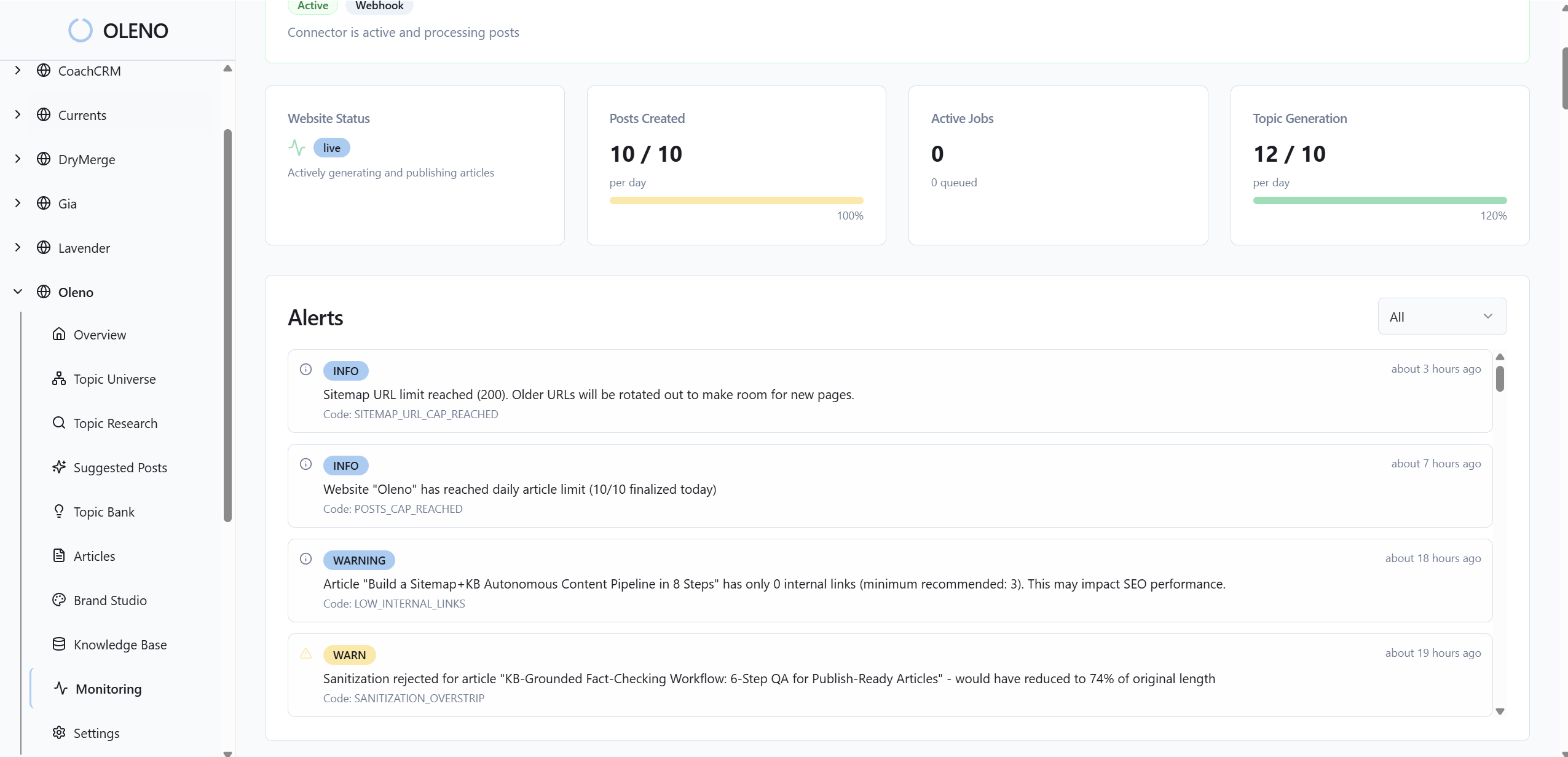
The governance side is where the team defines what is true and how each brand should sound. Brand Studio stores voice rules, preferred terms, prohibited terms, CTA style, and structure expectations. Marketing Studio stores category framing, messaging, and narrative point of view. Product Studio stores approved product descriptions, feature boundaries, supported and unsupported use cases, pricing, and screenshots. Audience & Persona Targeting and Use Case Studio define who you're talking to and what they care about.
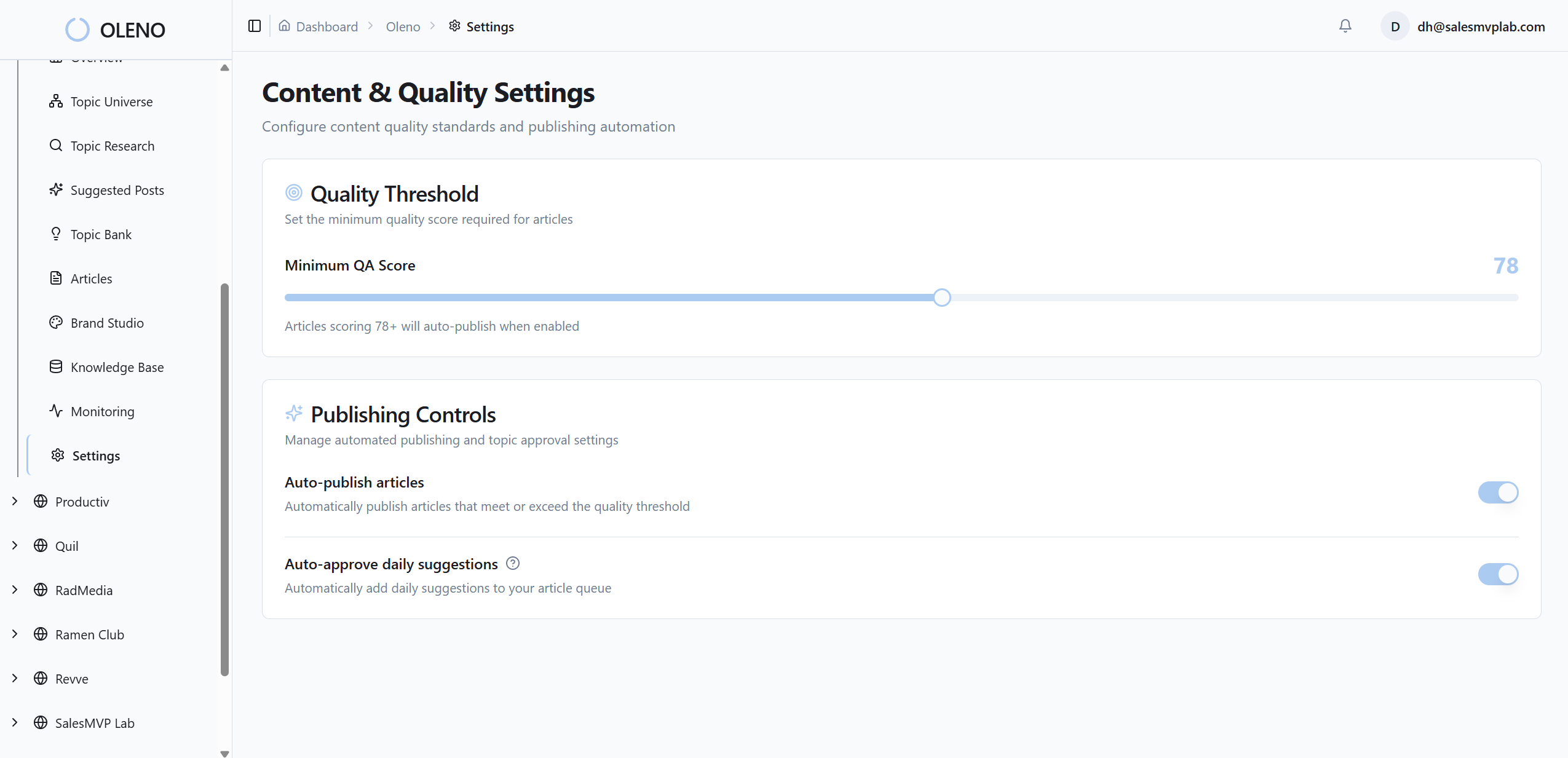
Then the execution side runs jobs through that context instead of asking writers or reviewers to remember everything each time. That's a big shift. You're not starting from a blank page and a clever prompt anymore. You're starting from a configured operating context.
I wouldn't claim software alone fixes bad messaging. It doesn't. But once your messaging is clear, this structure matters a lot. It's the difference between "please remember the rules" and "the rules are already attached to the work."
Brand, Product, And Audience Rules Travel Through The Workflow
This is the part that matters most for teams trying to maintain quality across multiple brands.
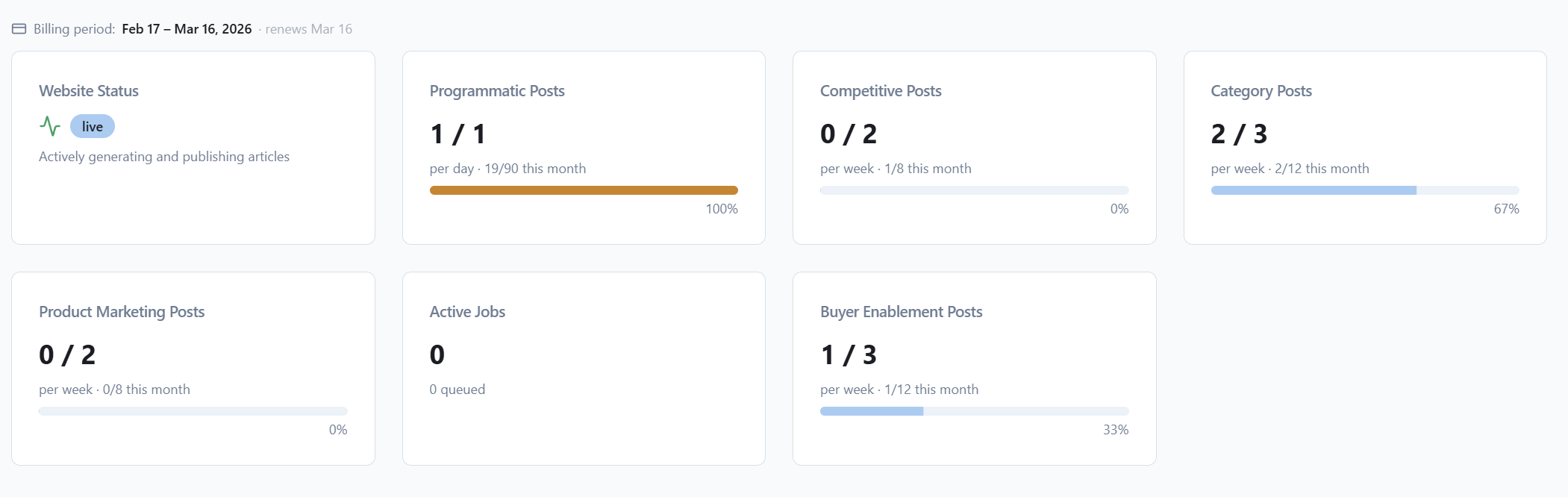
Oleno applies governance context at the brief, draft, and QA stages. That means brand voice, product truth, audience context, and use case framing shape the work as it's being built, not as an afterthought. So if one brand speaks to enterprise PMMs and another speaks to agency owners, the system can frame the same topic differently without forcing a human to reinterpret that split every single time.
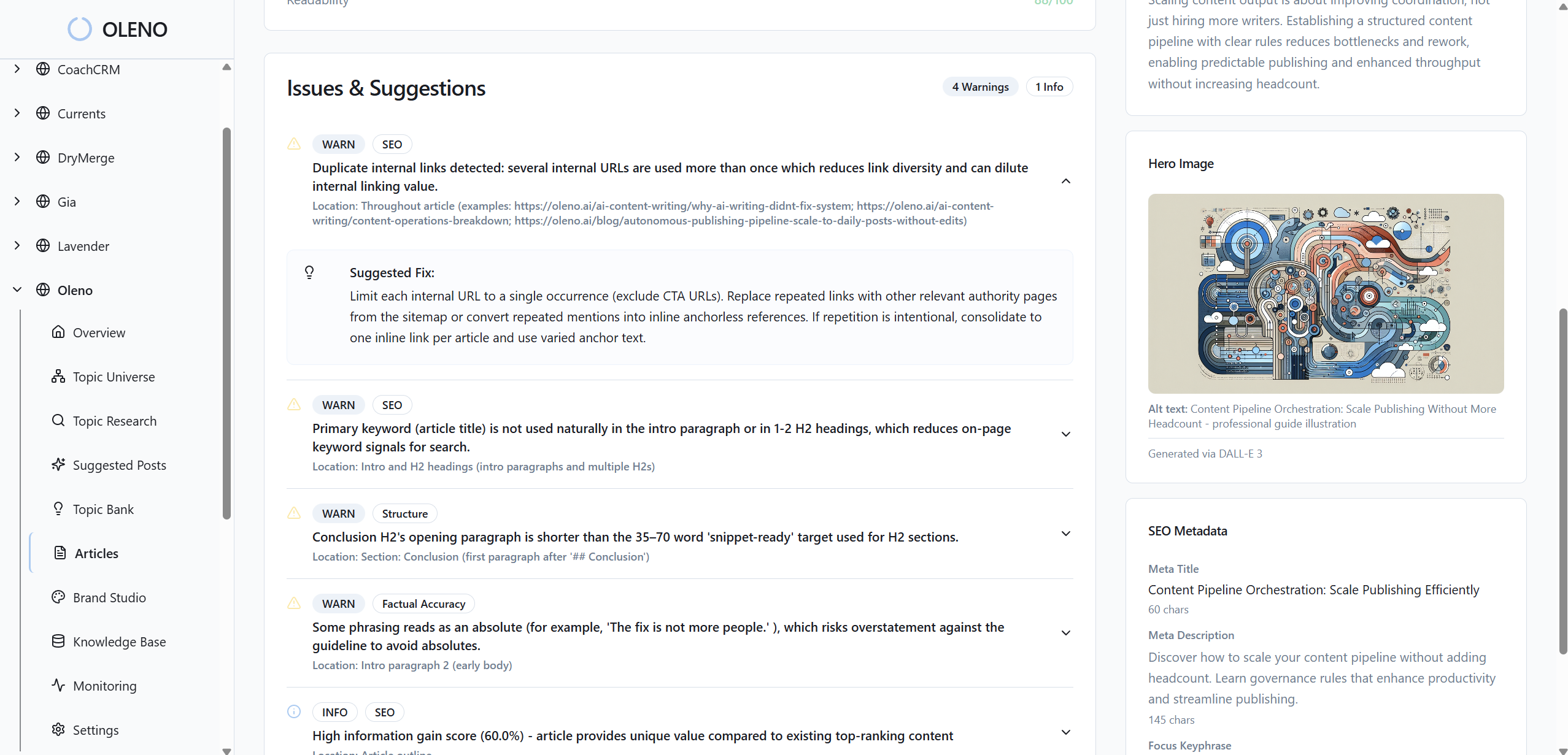
That reduces what I call rebrief tax. At a lot of companies, PMMs keep rewriting the same guidance into new briefs because nobody trusts the system to carry it forward. Oleno cuts that repeated setup work by pulling from the configured source of truth instead.
And there are real operational consequences to that. Less narrative drift. Fewer accidental claim mismatches. Fewer drafts that sound sort of right but not quite. If your team keeps getting stuck in that last 15% of revision pain, this is usually why.
Mid-funnel product content is where the payoff becomes really visible. If you'd like to see that layer in action, you can request a demo.
Quality Gates Block Content Before Inconsistency Reaches Publication
Review is expensive. Blocking bad output earlier is cheaper.
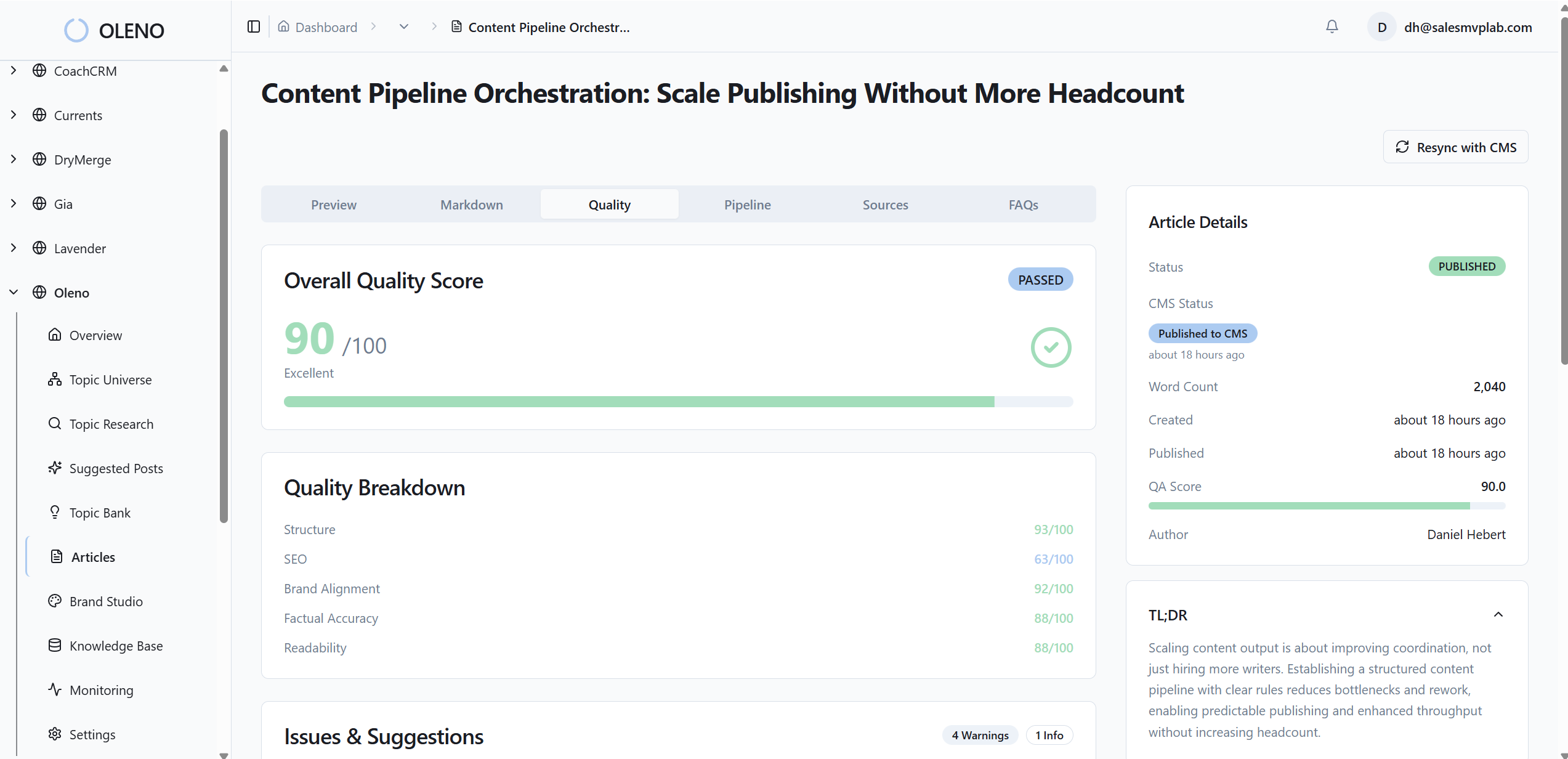
Oleno's Quality Gate scores output before it reaches the review queue, and Product Studio's QA layer cross-checks drafts against approved product truth. That matters because multi-brand quality failures aren't always stylistic. A lot of them are factual. Wrong feature framing. Outdated pricing or use-case guidance. Audience mismatch. Tone drift that sounds small until you see it repeated across ten assets.
The practical rule here is the 80/20 Review Threshold. If more than 20% of your review comments are recurring brand, message, or claim issues, you don't have a reviewer problem. You have a system design problem.
Oleno also uses the Orchestrator to run approved topics through the content pipeline on cadence, so teams aren't manually stitching together briefs, drafts, QA, and publishing every day. Jobs move through the pipeline, quotas and pacing are enforced, and quality checks happen before content gets near your CMS publishing flow.
That's important for another reason. The more manual steps you keep, the more each brand starts depending on reviewer vigilance. And reviewer vigilance is not a strategy.
One Team Can Support Several Brands Without Adding Headcount At The Same Rate for Maintain quality across multiple
One Team Can Support Multiple Brand Contexts Without Multiplying Headcount
Let's use the agency scenario, because it's one of the clearest examples.
Say an agency manages content for 8 SaaS clients. Same writing pool. Different voices. Different product truths. Different audiences. Different claims they're allowed to make. In the manual model, each new client adds more than just work. It adds another layer of interpretation and another set of review rituals.
So the agency hires another writer. Then another editor. Then the account team spends more time clarifying than planning. Output grows a bit, but not enough to justify the coordination cost. Sound familiar?
The governed model changes that by isolating each client context. Brand rules are defined separately. Messaging is defined separately. Product boundaries are defined separately. Audience and use case framing are defined separately. Now each job pulls from the right context instead of relying on whoever last touched the brief to remember the difference, especially when evaluating maintain quality across multiple.
That's how teams can start pushing toward the 3-5x delivery range described in agency scaling use cases without proportional hiring. Not because people work harder. Because the system stops forcing them to re-explain the business every time.
Isolated Governance Prevents One Brand's Language From Leaking Into Another
This is one of those problems that sounds minor until you've lived with it.
A writer finishes Brand A in the morning and Brand B after lunch. Brand A uses sharp competitor framing. Brand B has a more measured tone. Brand A says "category shift." Brand B never uses that language. Brand A can make one kind of claim. Brand B can't. If those boundaries aren't isolated, the phrasing bleeds. Then your PMM catches it. Then legal catches something else. Then the editor rewrites half the piece.
I've watched this happen enough times to know the pattern. People call it a quality issue. It's really a context containment issue.
Oleno addresses that by keeping those governance inputs distinct. Brand studio handles how each brand sounds. Marketing studio holds the market framing and narrative rules. Product studio keeps product claims and limits grounded. Audience & persona targeting and use case studio keep the reader context specific. That means one brand's language is much less likely to leak into another because the job isn't built on shared guesswork.
There is a case to be made for keeping some shared rules across a portfolio. That's valid. Most multi-brand companies do want umbrella standards. But if shared rules start replacing brand-specific rules, quality gets generic fast. And generic is usually where trust starts slipping.
Better Systems Reduce Drift, But They Don't Invent Strategy
Governance Improves Quality, But It Does Not Replace Strategic Ownership
This is worth being direct about.
Oleno doesn't invent your positioning for you. It doesn't decide what your market POV should be. It doesn't create product truth out of thin air. The team still has to define approved claims, boundaries, audience segments, and message direction.
That's actually one of the reasons the model is credible. Strategy stays human. The system executes inside the boundaries you set.
If your team hasn't decided what each brand stands for, no platform is going to rescue that. It may help expose the gaps faster. That's useful. But it won't magically turn unclear strategy into sharp messaging. You still need ownership from PMM, marketing leadership, or whoever holds the narrative standard.
Bad Inputs Still Create Constrained Outcomes
You can have a strong workflow and still get weak output if the inputs are weak.
If product studio has outdated claims, those issues can travel. If the brand voice setup is vague, the content may still feel soft around the edges. If your audience definitions are too broad, the message may sound generic even when it's technically aligned.
So yes, governed execution reduces inconsistency and lowers fabrication risk. But it works best when the source material is solid. Think of it like building with a jig in a workshop. The jig helps you cut the same shape every time. If the measurement is off at the start, you'll still get the wrong shape. Just very consistently.
That's not a flaw in the model. It's just the honest boundary. And I think buyers trust this more when you say it plainly.
The Fastest Way To Tighten Multi-Brand Quality Control
Teams Scale Quality Faster When Governance Is Operationalized
If your team is buried in approvals, the answer probably isn't another reviewer.
It's usually to stop asking reviewers to carry institutional memory by hand. Once voice rules, messaging, product truth, audience context, and use case logic are defined in the system, the work gets tighter upstream. That's where the speed comes from.
The benefit isn't just fewer edits. It's fewer avoidable conversations. Less "did we approve this phrasing for that brand." Less "can someone check if this claim is still current." Less waiting around because one person is the only source of truth.
If that's the bottleneck you're dealing with, book a demo and look specifically at how Oleno handles multi-brand setup, governed execution, and quality gate checks.
The Fastest Path To Consistency Is Removing Manual Interpretation
Most teams don't need more content advice. They need fewer places where people have to guess.
That's the whole point. When manual interpretation sits at the center of the workflow, quality drifts, meetings pile up, and senior people become bottlenecks. When the rules are set once and applied every time, quality has a better chance of holding as output rises.
And that's really the question underneath all of this. Not "can we generate more content?" You probably can. The better question is whether you can maintain quality across multiple brands without creating a review machine that eats the team alive.
That's the problem worth solving.
About Daniel Hebert
I'm the founder of Oleno, SalesMVP Lab, and yourLumira. Been working in B2B SaaS in both sales and marketing leadership for 13+ years. I specialize in building revenue engines from the ground up. Over the years, I've codified writing frameworks, which are now powering Oleno.
Frequently Asked Questions