How to Manage 100+ Content Contributors with Deterministic QA
I’ve run content programs where the bottleneck wasn’t ideas or writers. It was coordination. Back at Steamfeed, we had 80 regulars and 300 guests submitting. The machine worked because we built lanes and rules before we chased volume. When that slipped, we felt it in rework, delays, and late-night fixes that no one had planned for.
Here’s the tension most teams live with: you want breadth and depth, but every additional contributor multiplies handoffs and opinions. Editing becomes triage. Quality turns subjective. The fix isn’t more editors or more meetings. It’s turning recurring edits into deterministic gates that prevent problems upstream, then verifying the rest with code, not vibes.
Key Takeaways:
- Replace ad-hoc edits with rules writers can run before submitting
- Use briefs with Information Gain targets to prevent copycat content
- Score drafts against an objective QA gate; pass or fix, no purgatory
- Make post-draft steps deterministic: links, schema, visuals, publishing
- Align incentives with roles and SLAs tied to rolling QA scores
Want to see the whole system working, not just a slide? Try Oleno For Free.
Why People-Heavy Editorial Models Break At 100+ Contributors
Most editorial programs break at 100+ contributors because coordination cost grows faster than content output. Every handoff adds latency and introduces inconsistency, and editors turn into traffic cops instead of quality architects. The result is slower shipping, drifting voice, and frustrated contributors waiting on subjective feedback.

The Hidden Coordination Tax That Buries Teams
When volume rises, every draft collects steps: intake, triage, review, fixes, re-review, and publish. Each one is “a minute here, five minutes there,” until the queue bloats and cycle time doubles. The worst part? Editors waste energy making the same comments repeatedly because the system doesn’t remember past decisions.
I’ve watched Slack turn into a queue. People “bump” threads, editors copy/paste notes, and no one is sure what “done” means anymore. You can’t out-hire that problem. You have to remove it. Move feedback upstream into briefs and a ruleset contributors use before they submit. Then measure drafts by a score, not a feeling.
The shift is simple in principle:
- Encode recurring edits as pre-commit checks in the brief and QA rubric
- Give contributors a pass/fail gate and remediation notes
- Preserve editors’ time for rule design and narrative choices
What Do 100+ Contributors Really Need?
Clear lanes. Contributors need to know exactly what “good” looks like, how long review takes, and what’s non-negotiable. Give each role a definition, SLA, and permission set tied to performance. Remove ambiguity and you’ll remove rework, because people self-correct when the rules are visible and objective.
In practice, that looks like role-based incentives. Recurring contributors who maintain a rolling passing QA score can bypass manual edits. Guests get tighter gates until they demonstrate consistency. Everyone sees the same brief template, the same KB anchors, and the same pass criteria. You’re not managing relationships, you’re operating a system.
Do this and something surprising happens. The backlog shrinks without adding staff. Not because people got faster, but because they’re no longer chasing moving targets.
Rethink The Work: From People Management To Systems Design
Scaling contributor operations isn’t a hiring plan. It’s a system design problem where you shift human judgment to where it matters and let rules catch the rest. Deterministic gates keep structure and accuracy steady, while drafting remains creative but guided by a differentiated brief.
Define Roles, SLAs, And Permissions With Intent
Name the lanes: guest, vetted freelancer, recurring contributor. Give each lane submission limits, review SLAs, and escape hatches that are earned, not granted. For example, recurring contributors who keep a 90-day passing QA average can skip manual edits and publish to draft automatically.
Policy, not preference, is the point. If a rule changes, version it. People respect the system when the system respects them. And when exceptions do happen, you document the new rule instead of leaving a sticky note in someone’s DMs.
Over time, SLAs reduce drama. Contributors know that “submit by Wednesday” means “feedback by Friday” if they miss the score, and “scheduled Monday” if they pass.
How Deterministic QA Changes Incentives
When the gate is objective and visible, contributors stop guessing. A publish checklist they can pass without a human becomes the shortest path to “shipped.” Editors stop playing proofreader and start playing designer, maintaining the rules that shape quality instead of rewriting sentences.
Here’s the rub: deterministic does not mean rigid prose. It means rigid structure and quality checks. Drafts can be creative; structure can’t drift. That balance keeps voice and accuracy stable while freeing editors to work on narrative and thesis, not commas.
If you want a process anchor on this, see how process orchestration balances deterministic gates with flexible tasks in Camunda’s guide to deterministic vs. non-deterministic orchestration.
The Real Cost Of Manual Review Dependency
Manual reviews feel cheaper than they are. The direct hours are obvious; the hidden costs, latency, context switching, structural drift, aren’t. You won’t see them in a dashboard. You will feel them in missed windows, confused contributors, and flat discoverability.
The Rework Math You Are Probably Not Tracking
Let’s pretend you run 150 contributors, each submitting one draft monthly. Average manual edit time is 45 minutes, plus 15 minutes of back-and-forth. That’s 150 hours a month in pure rework, not counting context switching. At a blended 75 per hour, you’re burning over 11,000 dollars on repeatable fixes.
That’s the modest estimate. Add the cost of missed windows, events, launches, seasonality, and the total creeps higher. The fix isn’t hero editing. It’s removing the need for heroics: encode the recurring notes as checks in the brief and QA gate, then let pass/fail drive behavior.
If you’re formalizing the checks, borrow patterns from software quality. Templates and pass/fail criteria, like those in the aqua-cloud functional testing template, translate cleanly to content QA.
The Discoverability Tax From Structural Drift
Unstructured intros, weak H2 openers, missing schema, and wrong internal links add up. They reduce snippet eligibility and LLM quote-ability. You won’t trace a single drop to one issue, but you’ll notice the slope flatten. Structure isn’t a nice-to-have, it’s how machines understand your work.
Solve this at the system level. Make every H2 open with a direct-answer paragraph. Generate JSON-LD programmatically. Inject internal links from a verified sitemap with exact-match anchors. None of that should depend on a human remembering a step.
Still doing this by hand month after month? You don’t need to. Try Generating 3 Free Test Articles Now and compare the before-and-after rework.
The Moment You Lose Trust Is Small And Expensive
Teams rarely blow trust with a single catastrophic miss. It’s usually a small error at the wrong time, a mislabeled feature, an off-brand claim, a sloppy image, that lands in front of an important reader. You can’t predict which draft does it. You can prevent the class of error.
The 3 AM Rollback No One Budgets For
I’ve lived this. At Steamfeed, we once rolled back a post after it started climbing because a last-minute edit introduced a factual error. It cost sleep, goodwill, and a chunk of traffic. If a gate checked factual claims against the KB before publish, that rollback doesn’t happen.
You can’t police every draft at 2 am. Your system can. Pre-deploy checks exist for a reason in software, and they translate to content. As AWS notes in discussions of modern testing practices, adding structure catches classes of issues you’ll never predict individually. See the thinking behind that in AWS’s take on going beyond traditional testing.
When A Single Off-Brand Post Hits Your Product Feed
A post that sounds off does more harm than a post that never shipped. Readers smell inconsistency instantly. Sales pastes it into a deck, then apologizes in the next call. Voice rules and banned terms don’t belong in a static doc. They belong in a gate, applied every time, the same way.
I’m not arguing for robotic tone. I’m arguing for guardrails that protect brand trust while letting your best ideas through. Guardrails earn their keep the first time they save a high-visibility piece from a subtle but costly miss.
The Playbook For Deterministic Contributor Operations
A deterministic system shifts human time to narrative decisions while code polices structure, accuracy, and packaging. You’re not restricting creativity, you’re removing the need for correction.
Centralize Your Knowledge Base And Ship A 30-Minute Onboarding Packet
Pull product pages, docs, core positioning, and banned terms into a single KB. Pair it with a 10-page quick-start: must-know claims, approved lines, example H2 openers, and common gotchas. Make every brief cite the KB sections contributors must use, so accuracy stops depending on memory.
This is where many teams stumble. They assume expertise lives in heads and Slack threads. It can’t at scale. The KB becomes the shared brain. And when it updates, your rules update, so the system learns without a meeting.
Pro tip: version your KB and your brief template. Policy drift is real. Versioning keeps every contributor on the same page, literally.
Implement An Automated QA Gate That Scores What Ships
Design a rubric with 80-plus checks across structure, voice alignment, KB accuracy, snippet readiness, internal links, schema, and visuals. Set a minimum passing score that’s non-negotiable. Route fails back with remediation notes and examples, and reward high scorers with fewer manual touchpoints.
If you need inspiration for structured checks, look at how pre-deploy guardrails work in AI and software testing. The principles in Tricentis’s overview of LLM testing map cleanly to content: define classes of risk and test them before you ship.
Interjection. Don’t overdo it. A gate should measure what matters, not everything that moves.
How Oleno Enforces Deterministic QA And Scale
Deterministic operations aren’t about dashboards or after-the-fact analytics. They’re about a governed pipeline that enforces structure, originality, and brand execution before anything ships, then publishes cleanly across your stack.
Topic Universe And Brief Generation Keep Writers Inside The Right Lanes
Oleno maps your topic landscape and enforces 90-day cooldowns so clusters don’t get saturated. Each approved topic becomes a structured brief with competitive research and an Information Gain score, so you cover what matters and add something new. Writers get KB citations and a differentiated outline that anchors accuracy and angle.
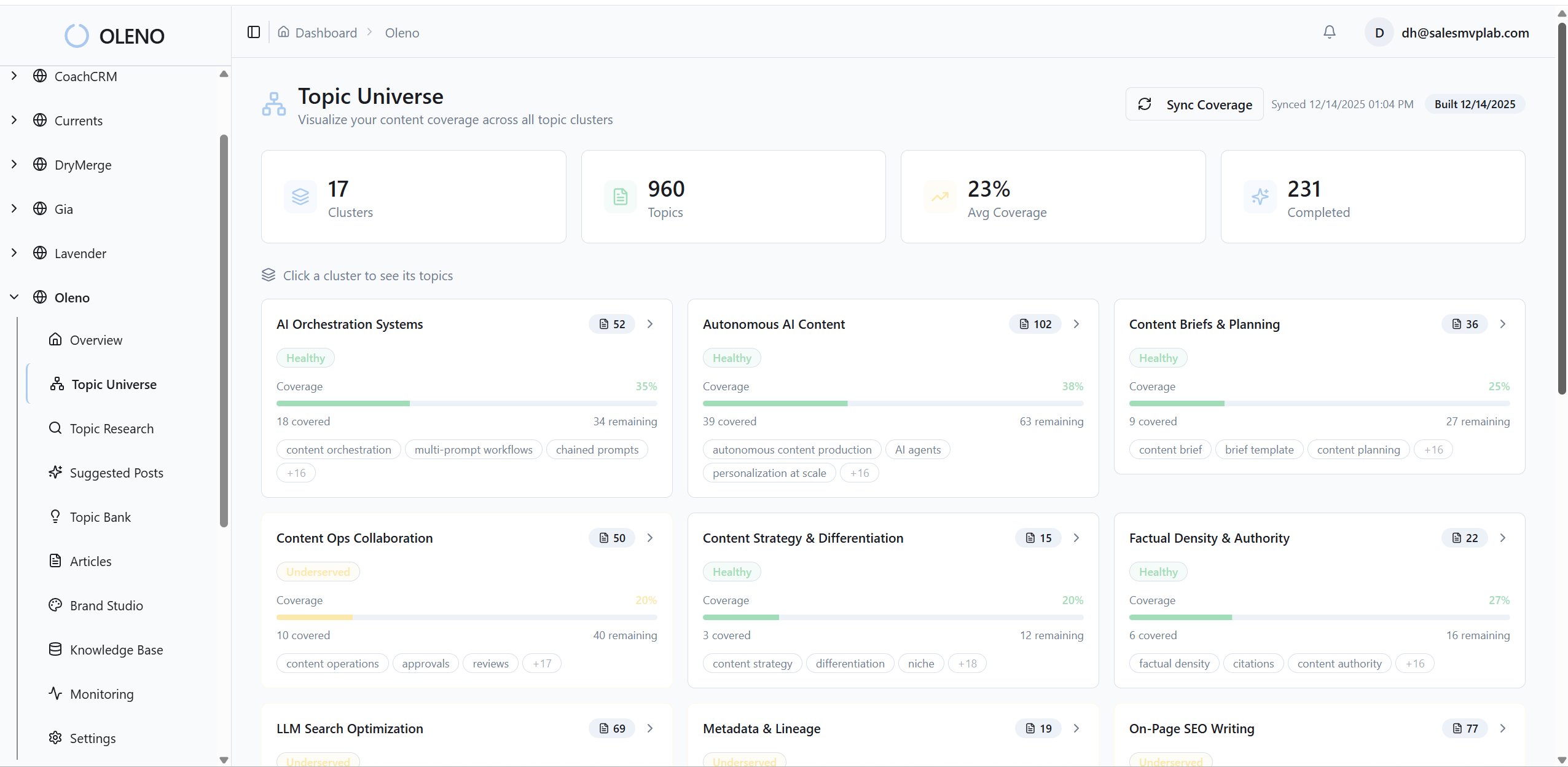
Because prioritization comes from coverage and saturation, not gut feel, you avoid over-publishing pet topics while ignoring gaps. The pipeline stays full automatically, and draft quality starts higher because differentiation is enforced before writing begins.
QA-Gate And Enhancement Loops Raise Quality Without Adding Editors
Oleno evaluates drafts against 80-plus criteria: structure and hierarchy, KB accuracy, brand alignment, snippet-ready openings, and visual placement. Low-scoring areas trigger automatic refinement loops that remove AI-sounding phrasing and normalize tone. Editors move upstream to design rules; Oleno handles the rule enforcement.
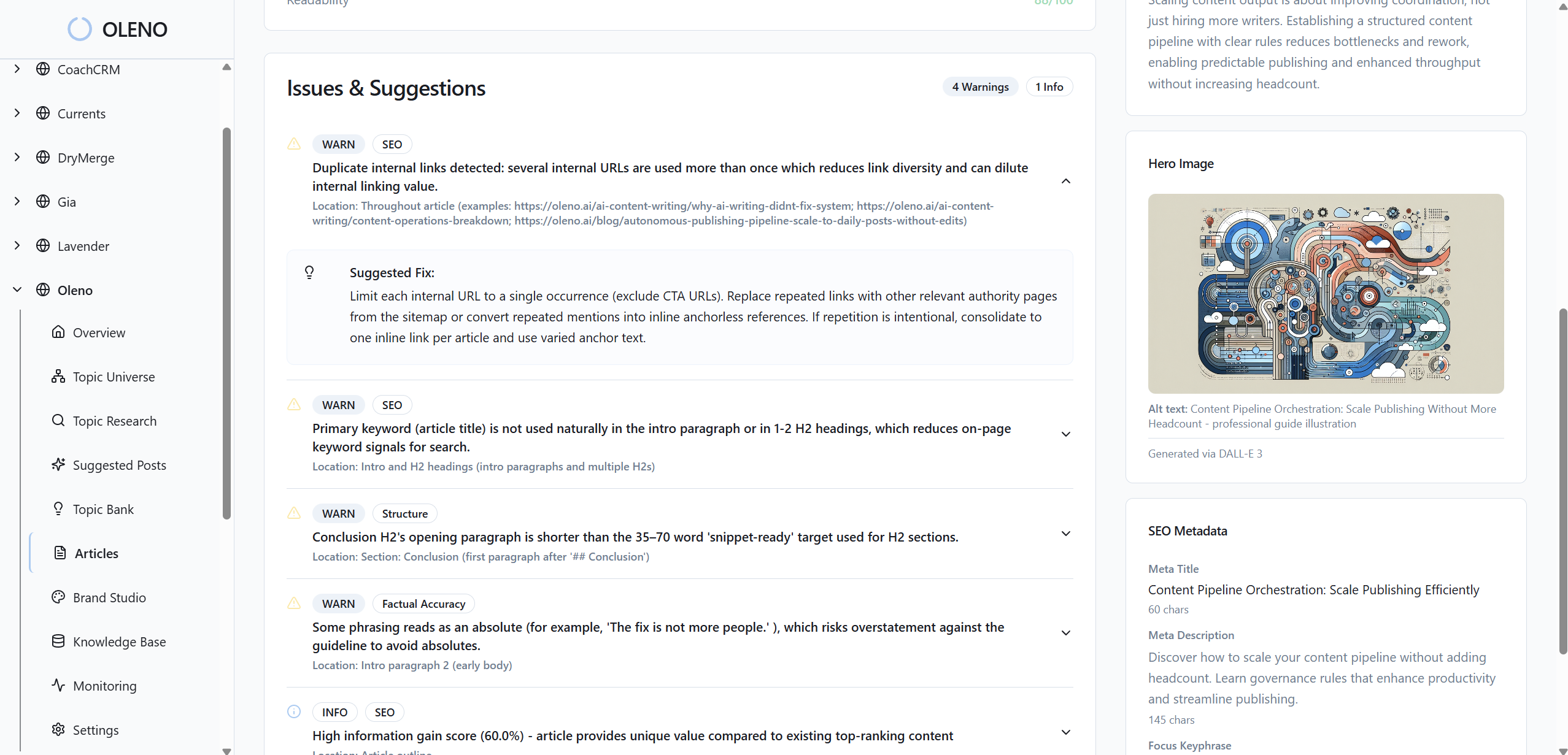
Tying back to the rework math, this is where the hours collapse. Instead of 45-minute manual edits and 15-minute back-and-forth, most issues never reach a human. You recover time and reduce latency without expanding your editing bench.
Deterministic Internal Links, Schema, And Visuals Remove Fragile Steps
Internal links are injected from your verified sitemap with exact-match anchors. JSON-LD is generated programmatically for Article, FAQ, and BreadcrumbList and attached for publishing. Visual Studio generates brand-consistent hero and inline images and matches product screenshots to relevant sections, prioritizing solution areas.
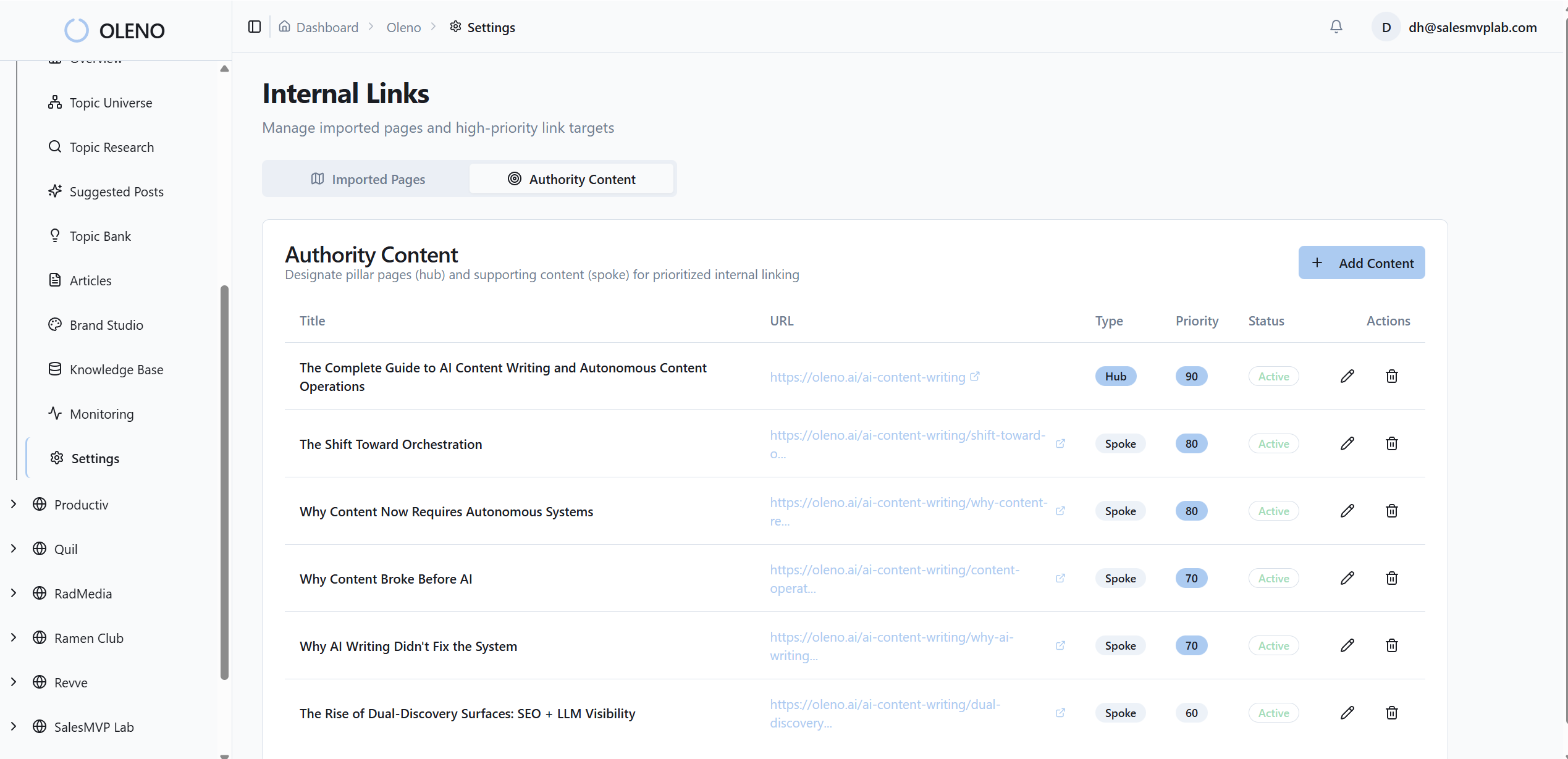
Those three moves eliminate link rot, broken markup, and generic visuals, the same structural drift that quietly taxes discoverability over time. You get consistent packaging that machines can parse and humans can trust.
Publishing Connectors And Duplicate Prevention Protect Your Brand
WordPress, Webflow, and HubSpot connectors convert content to CMS-ready HTML, map fields, and ship as draft or live. Duplicate prevention and idempotent delivery keep your feed clean. Delivery failures trigger notifications without noise, so you stay informed without babysitting the pipeline.
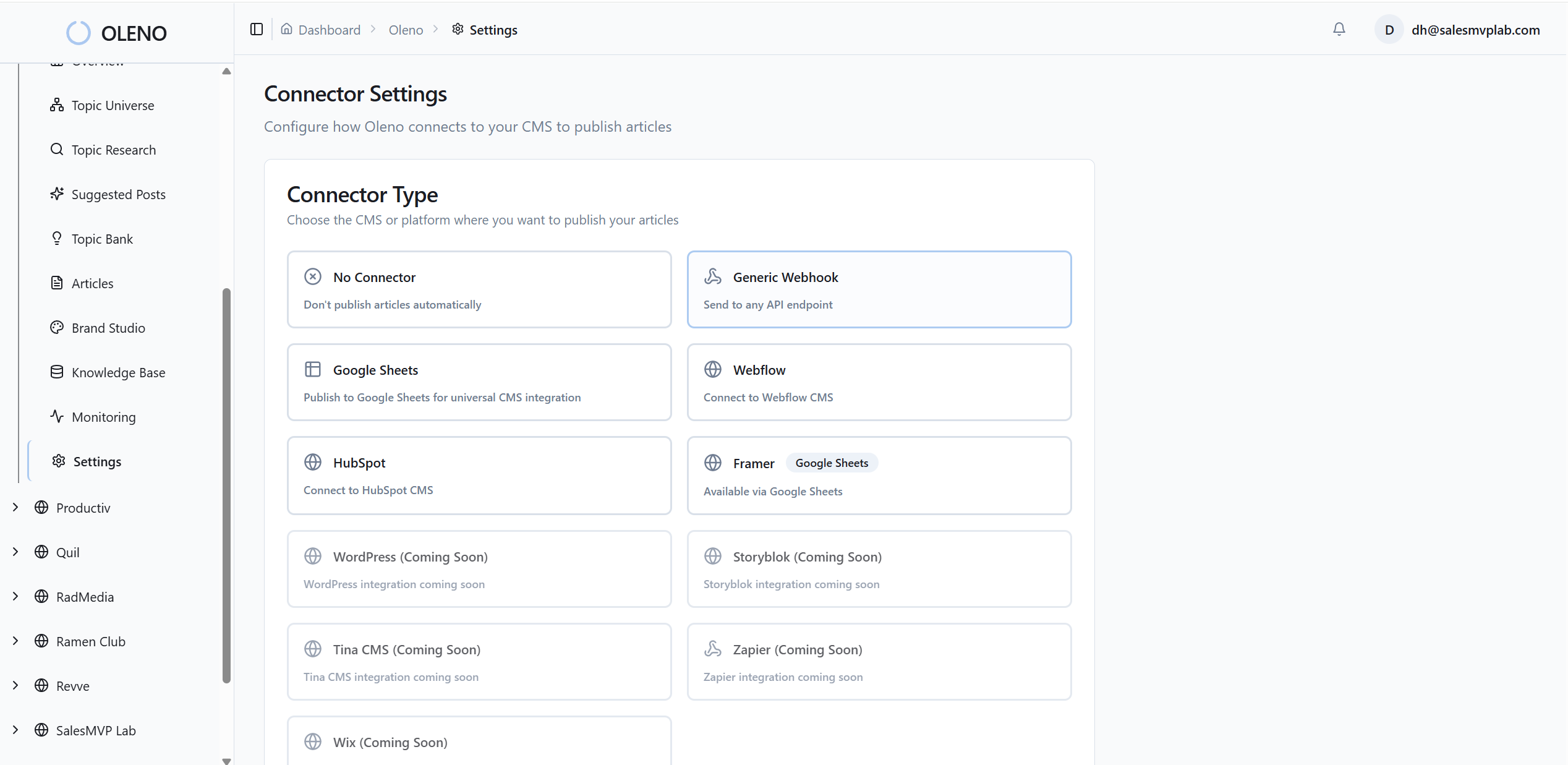
If you’re wrestling with brittle handoffs now, this is the safety net that keeps shipping predictable. It’s not glamorous. It is reliable.
Want to see a governed pipeline run end to end and compare your rework time to the baseline you have today? Try Using An Autonomous Content Engine For Always‑On Publishing.
Conclusion
Most teams try to scale contributors with more people and more meetings. That works, until it doesn’t. The more reliable path is a deterministic system: brief for differentiation, gate for quality, code the packaging, and publish without drama. Do that, and your editors stop triaging. Your contributors stop guessing. And your content starts compounding.
About Daniel Hebert
I'm the founder of Oleno, SalesMVP Lab, and yourLumira. Been working in B2B SaaS in both sales and marketing leadership for 13+ years. I specialize in building revenue engines from the ground up. Over the years, I've codified writing frameworks, which are now powering Oleno.
Frequently Asked Questions