How to Manage AI Marketing Work When Every Teammate Uses a Different Tool
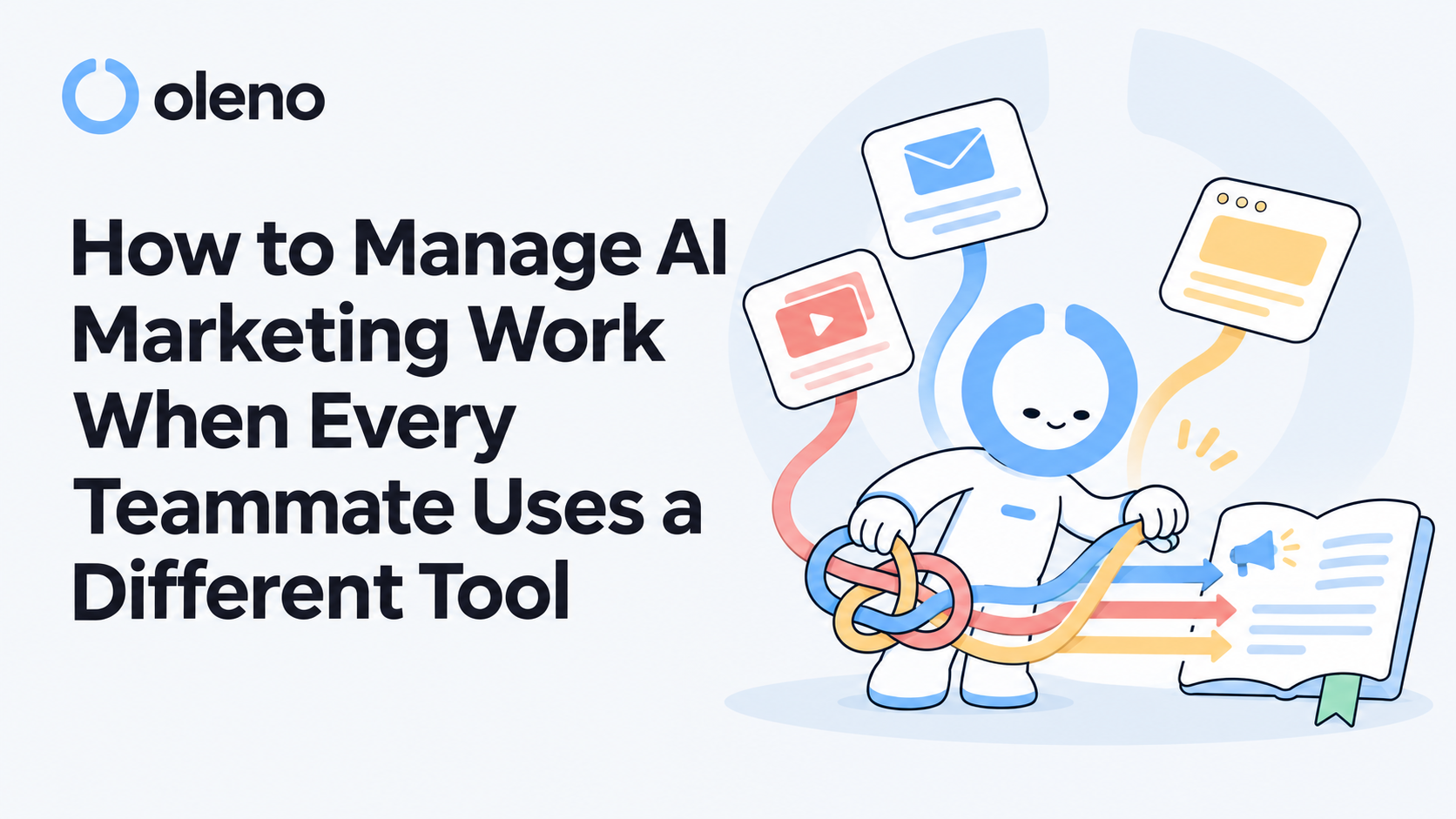
Your campaign email is in ChatGPT. The landing page draft is in Claude. Your agency has the sales deck. Which versions use the current product story, and what’s actually ready for review?
You could ask everyone to use the same AI tool. But you would still need to know which information they used, what changed after feedback and whether the person responsible approved the version in front of you.
To manage AI marketing work across contributors, give people a shared company reference and a process they can use. Then keep the drafts, sources and decisions needed to review the work and pass it on.
Follow one campaign across three contributors
Imagine a B2B SaaS team launching a new reporting feature. This is a hypothetical example.
Your demand generation manager drafts the campaign email in ChatGPT. A freelance writer builds the landing page in Claude. An agency prepares a sales deck using its own tools.
The email starts from this week’s launch brief. The writer copies a product description from an older page. The agency uses a deck from the previous campaign.
Each person produces something worth reviewing. But the email targets marketing leaders, the landing page speaks to analysts and the deck includes a capability that is still planned.
You leave comments on all three. Later, the agency sends a revised deck, the writer shares a new document and your demand generation manager posts an updated email in chat. You now have to reconstruct which corrections were made and which questions remain open.
The different tools are only part of the situation. The contributors also started with different references, and the review decisions ended up in different places.
Give contributors the same company reference
Before anyone drafts the next version, agree on the information the campaign should use.
For this launch, that means the intended buyer, the problem being addressed, the positioning, the available product capabilities and the evidence behind important claims. It also means naming the boundaries: which capabilities are planned, which customer quotes have permission for public use and which statements need further checking.
Keep that reference somewhere the team can maintain and retrieve. Assign someone to update it when the product or positioning changes. A folder of old briefs becomes difficult to rely on when nobody knows which one still applies.
People should select the information relevant to their assignment. The email writer may need the buyer problem, offer and permitted proof. The landing page writer may also need product mechanics and objections. The agency may need approved screenshots and the explanation behind each slide.
They can share the same company story without receiving an identical pile of documents.
In our example, the team agrees that the campaign speaks to marketing leaders. The product owner confirms what the reporting feature currently does. The agency removes the planned capability from the deck before the next review.
Share the process behind the assignment
A shared reference tells contributors what the company wants to communicate. A reusable AI marketing workflow should also show them how your team approaches the work.
A reusable Play can record the assignment’s inputs, suggested steps, expected outputs and review points. For a campaign, it might guide contributors to confirm the buyer and offer, choose supporting evidence, prepare a draft and ask for review before producing the remaining assets.
Make the review questions specific. Does the email give the buyer a clear reason to click? Does the landing page explain the offer behind that click? Can a salesperson use the deck without introducing a different product promise?
The process should leave room for the assignment. A writer updating an existing page may have little reason to repeat research that is still current. A new claim may need additional checking. People can adapt ordinary steps while respecting required approvals and access restrictions.
When the process needs changing, update the shared Play deliberately. Keep the version used for the original job so someone returning later can understand how that work was done.
Keep enough work for someone else to continue
The final file can be useful without explaining how it reached that point.
Suppose the agency sends a polished deck. One slide says the reporting feature “cuts weekly reporting time in half.” You remember asking for that sentence to be removed, but the file contains no source or explanation. Was it restored after someone supplied evidence, or copied back from an earlier draft?
To answer, you need the relevant versions and the decision behind the change.
For work that needs review or continuation, preserve the selected draft, the sources it relied on, the feedback on that version, the decisions made and the next task. Include the actual file or an accessible reference when another person needs to edit it.
A useful note for this hypothetical deck would be: “Removed the time-saving claim from version three because we have no approved evidence for it. Product review is still needed on slide six. Next task: replace the old screenshot.”
That gives the next contributor something they can act on. They can see the decision and avoid reopening it without new evidence.
You do not need to keep every experimental sentence. Choose the work that explains the important decisions and supports the next step.
Make the status of each version clear
“Here’s the latest” leaves a reviewer with several questions. Latest saved version? Latest reviewed version? Approved for the website, or still waiting on product?
Use status descriptions that make the next action clear:
- Saved: The version has been kept. Saving alone says nothing about its quality or approval.
- Unfinished: Work remains. Name the missing decision, source or task.
- Reviewed: Someone checked the identified version. Their feedback may still require changes.
- Approved: The responsible person accepted that version for a stated purpose.
- Published: The work was released through the relevant channel, with that release confirmed.
Keep feedback attached to the version it concerns. If a reviewer approves email version two and someone changes the offer in version three, the earlier approval does not establish approval of the revised offer.
For the campaign, the email might be approved while the landing page is awaiting product review and the deck still needs a new screenshot. Record those states separately. A campaign-level “done” label would hide work the team still needs to finish.
Decide who can approve each deliverable and who handles publication. A reviewer should be able to tell what they are being asked to check before opening the file.
Use Oleno to test one shared assignment
Oleno is a shared marketing work system behind the AI tools a team already uses. It brings maintained company knowledge, Resources, reusable Plays and selected saved work together.
Through supported, authorized connections, compatible AI tools can request the relevant company information and process for an assignment. People and their connected tools do the research, writing, design and production. The team chooses which outputs, sources, feedback and decisions to save.
For our hypothetical campaign, that could mean using the maintained buyer and product information, choosing a campaign Play and keeping selected deliverables with their review decisions. Resources can provide the screenshots, examples and supporting material needed for the job.
Check the exact workflow your team intends to use. Saving and continuation are still being qualified across supported clients, and some files require a separate tool to open or edit. The next contributor also needs permission to access the saved work and its sources.
Oleno knows what people and connected tools save. It does not automatically capture every AI chat or learn from every correction. People maintain company information, decide whether the process needs changing and choose what to approve or publish.
Start with one shared assignment and a second contributor. Ask that person to find the selected draft, identify its source material, explain its review status and continue the next task. If they still need you to reconstruct the decisions, use that gap to decide what the team should save next time.
That is a practical test of marketing work management for a marketing team using different AI tools.
About Daniel Hebert
I'm the founder of Oleno, SalesMVP Lab, and yourLumira. Been working in B2B SaaS in both sales and marketing leadership for 13+ years. I specialize in building revenue engines from the ground up. Over the years, I've codified writing frameworks, which are now powering Oleno.
State of AI in Marketing 2026
Free report · 2026
Your campaign might be the wrong answer.
Read State of AI in Marketing 2026 before writing another campaign.
Get the reportFrequently Asked Questions