How to Refresh AI Content Marketing Assets Before They Decay

Your old AI-assisted posts don't decay because the model wrote one weak paragraph 9 months ago. They decay because nobody tied refresh decisions to product truth, sales objections, search movement, and the assets your team is still distributing every week.
If you want to refresh AI content before it turns generic or wrong, the job is not "rewrite the article." The job is to decide what changed, whether the asset still deserves to exist, and where the update needs to travel after the blog post changes.
That sounds obvious. It usually isn't. The marketers we talk to can spot stale content in 30 seconds, but the actual refresh workflow still lives across Search Console, Slack, a product launch doc, a CMS draft, and someone's memory of what sales has been hearing lately. If you want to see how a marketer-led refresh workflow can work without handing the whole thing to AI, request a demo.
Key Takeaways:
- AI content decay is usually an editorial systems problem, not a writing problem.
- Don't hand content refresh entirely to autonomous AI workflows.
- Refresh triggers should come from product launches, feature changes, SERP shifts, and sales objections.
- The marketer must stay in the editor's seat during refresh decisions.
- Use editorial triage: refresh, consolidate, or retire.
- Tie every update back to product truth, not model memory.
- Refreshing content requires a system that outlasts a single AI writer tool.
Why AI Content Decays Before Anyone Notices
AI content decays when the article keeps ranking, selling, or circulating after the product, message, market, or buyer question has changed.

The mistake is treating decay as a copy problem. A stale article often still reads fine. The intro has rhythm. The headings are clean. The paragraphs pass a quick skim. But the feature claim is old, the positioning is from two launches ago, the sales story has moved on, and the article now creates cleanup work for every channel that reuses it.
The visible problem is rarely the real problem
A content manager opens an old comparison article at 4:42 PM because a sales rep dropped it into Slack and asked, "Can we still send this?" The article mentions the old packaging. The screenshot shows the old UI. The CTA points to a page that doesn't match the current pitch. Nobody did anything reckless. The asset just kept living after the business changed.
We see this all the time with AI-assisted content libraries. The team shipped fast, then the product team changed a feature, demand gen changed the campaign angle, and sales learned a sharper objection from live calls. The article didn't get worse on its own. The company moved and the article didn't move with it.
Content decay has three main signals:
- Traffic drops: rankings, impressions, or clicks fall after a stable period.
- Product drift: facts, features, screenshots, pricing, integrations, or claims no longer match reality.
- Message fatigue: the article still says the old thing after the company learned a better story.
Traffic decay is the easiest to see because Google Search Console's Performance report puts the trend in front of you. Product drift is more dangerous because the page can still perform while saying the wrong thing. Message fatigue is the most ignored, because it feels subjective until sales starts rewriting the pitch in every follow-up.
Better prompts don't fix stale systems
A one-off AI writer can rewrite paragraphs quickly, and that's useful in the right moment. Fair point. If you have 12 blog posts and one product marketer owns all of them, you can probably refresh AI content with a spreadsheet, a model, and a disciplined afternoon once a month.
That breaks when the library becomes a real asset. Past 50 published pieces, refresh becomes less like writing and more like product management. You need a backlog, triggers, priority calls, owners, and a reason for why one asset gets fixed before another. The analogy is useful because product teams don't ship every bug fix just because a bug exists. They triage based on impact.
Teams should not hand content refresh entirely to autonomous AI workflows. The AI can summarize, draft, compare, and clean up. But the AI shouldn't decide whether an article still matches the market, whether two assets should merge, or whether a dated opinion should be removed entirely. Those are marketing calls.
The risk is not that AI writes a clunky sentence. The risk is that AI confidently preserves the wrong strategy.
How to Spot Decay Signals and Refresh Triggers
Refresh AI content by separating what changed in the asset from what changed around the asset.
The fastest audit starts with four triggers: product launches, feature changes, SERP shifts, and sales objections. Each trigger points to a different kind of update. Treat them the same and you'll waste time rewriting pages that need consolidation, or worse, leave wrong product messaging live because traffic still looks healthy.
Sort decay into traffic, product, and message buckets
Start by tagging every suspect asset with one primary decay reason. Not five. One. If the primary reason is unclear, don't refresh yet. You don't know what problem you're solving, which means the rewrite will probably become a general polish pass.
For traffic drops, compare the last 28 or 90 days against the previous matching period. Look for pages that lost impressions on important queries, not just pages that lost sessions. A post can lose traffic because the query changed, because competitors updated, because Google started showing a different intent, or because the page fell from position 3 to position 8. Different causes. Different fixes.
For product drift, audit claims against source material. Product pages, changelog notes, pricing docs, help-center articles, launch briefs, and PMM notes beat model memory every time. If the model "remembers" your feature but the Product Truth source says something else, the source wins. Always.
For message fatigue, look at the gap between the article and the current sales story. We once saw a positioning question phrased like this: "For positioning and marketing mix do you think I should focus on potential donors or the homeless?" That sentence has nothing to do with SaaS content refresh on the surface, but the underlying issue is the same. The writer was wrestling with users versus buyers. In B2B SaaS, your article might still speak to the user after the company learned the buyer is the real audience.
Use triggers instead of vibes
Refresh triggers should be explicit enough that someone else on the team can apply them without asking you what you meant. A product launch should trigger updates to product-led pages, comparison pages, feature pages, buyer enablement content, and any blog post that mentions the changed capability. A SERP shift should trigger a search intent review, not an automatic rewrite. A sales objection should trigger a messaging review, especially if reps keep explaining the same thing manually.
The practical rule is simple: if the trigger changes what the buyer believes, refresh the argument. If it changes what the product does, refresh the facts. If it changes how the page is discovered, refresh the structure. If it changes all three, the asset needs a deeper rebuild.
We like a 10-minute audit per asset before any rewriting starts:
- Mark the decay signal: traffic, product, message, or distribution.
- Name the trigger: launch, feature change, SERP shift, objection, campaign shift, or stale source.
- Find the source of truth: product doc, launch note, sales call theme, analytics view, or approved positioning.
- Decide the action: refresh, consolidate, retire, or leave alone.
- List reuse points: blog, email, social, sales deck, help center, or nurture sequence.
That last step gets skipped too often. Asset reuse is where refresh work compounds. If you update the blog post but leave the email sequence, LinkedIn post, and sales follow-up using the old claim, you didn't refresh the content system. You refreshed one page.
Watch for audience drift inside old assets
Audience drift is sneaky because the article can still sound smart. The issue is that it now speaks to the wrong decision-maker. A post written for practitioners might need to become buyer-facing after the product moves upmarket. Or a buyer-facing page might need a practitioner section because implementation objections are slowing deals.
One old research note put the distinction plainly: "the homeless are the company product's users, the donors are the customer (i.e., who's paying for it)." Different market, same pattern. B2B marketers run into this constantly. Admins use the product. Department heads buy it. Finance approves it. The article needs to know which person it is trying to move.
Another useful line from that same kind of positioning conversation: "This will inform which audience is your core audience for the plan." For refresh work, that sentence should sit at the top of the brief. If the audience changed, the article probably needs more than updated examples. It needs a different spine.
The audience call is where human review matters. The model can identify possible personas. It can't know which buyer your GTM motion is prioritizing this quarter unless your system gives it that strategy and a marketer confirms the call.
How to Decide Refresh, Consolidate, or Retire
Editorial triage prevents the team from rewriting everything just because something feels old.
The decision should come before the draft. Refresh the asset when the core intent still matters. Consolidate when multiple pages now answer the same buyer question. Retire when the article creates risk, confusion, or maintenance cost that outweighs its value.
Refresh when the asset still owns a useful job
A refresh makes sense when the article still maps to an important buyer question, still supports a current campaign, or still earns distribution. Don't punish a good asset for being old. If the angle remains right and the product facts are behind, update the facts. If the structure still matches intent but the SERP changed, adjust the sections. If the examples are stale, replace the proof.
Use a refresh when:
- The page still targets a current ICP, persona, or use case.
- The main search intent still matches the article.
- The product messaging is close but needs current proof.
- Sales or customer success still sends the asset.
- The article has backlinks, rankings, citations, or internal equity worth preserving.
Having said that, refresh is not sentence polish. Sentence polish is what teams do when they don't want to make harder calls. If an article has the wrong target audience, wrong category frame, and wrong product story, rewriting the intro won't save it.
I like scoring refresh candidates on a 1 to 3 scale across three questions: does this asset still match the buyer, does it still match the product, and does it still match demand? A total score of 7 or higher gets refreshed. A 4 to 6 goes to consolidation review. A 3 usually gets retired unless it has strategic value outside search.
Consolidate when the library starts arguing with itself
Consolidation is the right move when two or more assets compete for the same buyer question, especially after a positioning change. The common mistake is to refresh each page separately. That keeps the mess alive. It just makes the mess newer.
Content libraries built with AI often create this problem faster because producing similar pages is easy. You might have one post on AI content governance, another on brand voice governance, another on factual grounding, and another on avoiding generic AI output. Each one made sense when shipped. Six months later, the stronger move may be one deeper asset that carries the whole argument.
Consolidate when:
- Two pages target the same query or intent.
- One page has the better rankings and another has the better explanation.
- The old framing competes with the new positioning.
- Internal links split authority across similar pages.
- Sales only needs one asset and keeps asking which one to send.
The donor-user example applies here too. "For many companies, customers and users are two different things." If your library has three posts mixing those audiences without saying which one matters, consolidation can make the story clearer. One strong asset can define the audience split and give sales a clean link.
Retire when the asset costs more than it returns
Retiring content feels harsh. It shouldn't. Some assets served their purpose and now create more risk than value. If the article explains a deprecated feature, targets a persona you no longer sell to, or makes a claim the team wouldn't defend on a sales call, keeping it live is not discipline. It's clutter.
Retire when:
- The product claim is no longer true and shouldn't be replaced.
- The target audience no longer matches the GTM motion.
- The search intent has moved too far from your offer.
- The page attracts the wrong traffic or wrong deals.
- The article would need a full rewrite but has no strategic value.
There is a case for keeping historically useful content live with a clear update note. Totally valid. Some categories need an archive trail. But for most B2B SaaS sites, old content is not a museum. It's part of the current buying experience.
A simple rule works: if you wouldn't send the asset to a qualified prospect today, decide why. If the reason is fixable, refresh it. If two assets answer the same question, consolidate them. If the reason is structural, retire it.
If your current refresh process is stuck in ad hoc rewrites, we can walk through how to move from article-by-article cleanup to a governed refresh system. request a demo.
How to Build a Platform Refresh System
A platform refresh system keeps product truth, editorial workflow, and asset reuse connected after the first publish date.
Refreshing content requires a system that outlasts a single AI writer tool. The AI writer can generate the update. The platform has to remember the strategy, ground claims in approved sources, route the right human review points, and push the update into the places where the asset gets reused.
Ground every update in product truth
Fact grounding is the first line between useful AI content and confident nonsense. The model should not be treated as the source for what your product does, what your pricing includes, what integrations exist, or what the team believes now. It should write from sources the marketing team approves.
A good refresh workflow starts by asking: what source changed? If the answer is "the model says the article seems outdated," stop. Find the product launch note, feature record, pricing page, PMM brief, sales objection, or approved positioning update that created the refresh need. Then let AI compare the old asset against that source.
In practice, your refresh brief should include:
- The original asset: URL, title, target persona, target query, and distribution use.
- The decay reason: traffic, product, message, or distribution.
- The trigger: launch, feature change, SERP movement, sales objection, or campaign shift.
- The source of truth: approved product, messaging, research, or sales material.
- The editorial decision: refresh, consolidate, retire, or hold.
That sequence matters. Without it, you get a rewrite. With it, you get an editorial decision that AI can execute around.
Put human review where the call changes the outcome
The marketer does not need to approve every synonym. That's where AI saves time. The marketer does need to approve the points where a wrong call changes the asset's meaning.
There are four review points that matter most in refresh work. First, the marketer confirms why the asset is being refreshed. Second, they approve the brief, especially the audience and source grounding. Third, they approve the outline, because consolidation and structure decisions happen there. Fourth, they edit the draft for voice, claims, and distribution fit.
That split is counterintuitive to teams that think "human review" means proofreading after the AI finishes. Proofreading is late. Expensive. Often annoying. The better move is to make the important calls before the draft exists.
A refresh workflow without human review points is like letting a junior marketer rewrite a sales deck without telling them the new pitch. They might produce clean slides. They might even improve the writing. But if the story is wrong, the polish makes the problem harder to spot.
Treat reuse as part of the refresh, not a follow-up
Asset reuse should be mapped before the rewrite begins. If the blog post feeds an email sequence, a LinkedIn post, a sales follow-up, and a product marketing page, the refresh brief should list those places. Otherwise the old message keeps circulating under a new URL.
The practical move is to maintain a reuse map for each important asset. Not a massive content inventory nobody opens. Just the places where the claim, angle, or story is repeated. Blog to email. Blog to social. Blog to sales enablement. Blog to product page snippet. Blog to customer onboarding doc.
The refresh decision should then ask:
- Which reused assets inherit this update?
- Which claims need to change everywhere?
- Which channel versions need a different angle?
- Which old snippets should be retired?
- Who owns the final approval for each destination?
"Finding and motivating donors is a whole other kettle of fish..." is a line from a different kind of marketing conversation, but it captures the reuse problem well. The blog update is one job. Getting the right story into every place the buyer sees it is another. Don't pretend they're the same task.
Design for cadence, not hero projects
Refresh should not become a quarterly guilt project. Those projects start big, get political, and usually die once the team has cleaned up the most obvious pages. The better system runs continuously against triggers.
A useful cadence looks like this:
- Weekly: review sales objections, product changes, and urgent drift.
- Monthly: review traffic drops and SERP shifts for priority pages.
- Launch cycle: update all affected assets before or alongside launch.
- Quarterly: consolidate overlapping content and retire dead weight.
The quarterly pass is where strategy comes back in. Product messaging changes. Category language changes. Your point of view gets sharper. Search and AI engines also reward content that stays useful, and Google's guidance on helpful content keeps coming back to the same principle: make content for people, with clear value and trust signals.
We're not 100% sure every refresh program needs the same cadence. A high-velocity PLG company shipping weekly needs tighter product drift checks than a mature enterprise SaaS with slower release cycles. The rule still holds: if the product or market moves faster than your content review cycle, your library will drift.
Use platform memory instead of re-prompting every Monday
A one-off AI writer forces the marketer to re-supply context every time. Voice. Positioning. Product truth. ICP. What not to say. Which audience matters. Which examples are approved. Which claims are off limits. That tax feels small on one article and brutal across a library.
A platform refresh system stores the context once and applies it every time. Not because the marketer disappears. The opposite. The marketer can make better calls because they're not wasting energy rebuilding the same setup in a blank chat window.
The trade-off is real. A platform takes more setup than opening ChatGPT. If you're refreshing three assets a year, that setup may be overkill. If your team has a real back catalogue, an active distribution cadence, frequent product changes, and multiple people touching content, the setup becomes the thing that keeps quality from depending on one person's memory.
That is the real split. AI writer tools are good for one-off assistance. Refresh systems are for keeping a content library accurate, differentiated, and worth distributing after the first publish date.
How Oleno Runs Governed Content Refresh
Oleno turns refresh from a rewrite request into a governed workflow tied to product truth, marketer review, and publishing.
The platform is built for B2B SaaS teams that want AI to do production work while the marketer makes the editorial calls. Oleno doesn't ask the model to guess what changed. It gives the model stored strategy, approved sources, product truth, voice, and a shaped brief before any draft update happens.
Product truth and strategy stay attached to every refresh
Oleno's Product Truth Library stores the products, features, integrations, pricing, help-center sources, and changelog entries the system is allowed to cite. When a refresh touches a product claim, the draft is grounded against that library rather than whatever the model remembers from the open web. That matters because invented feature claims are one of the fastest ways to turn an old content asset into a sales problem.
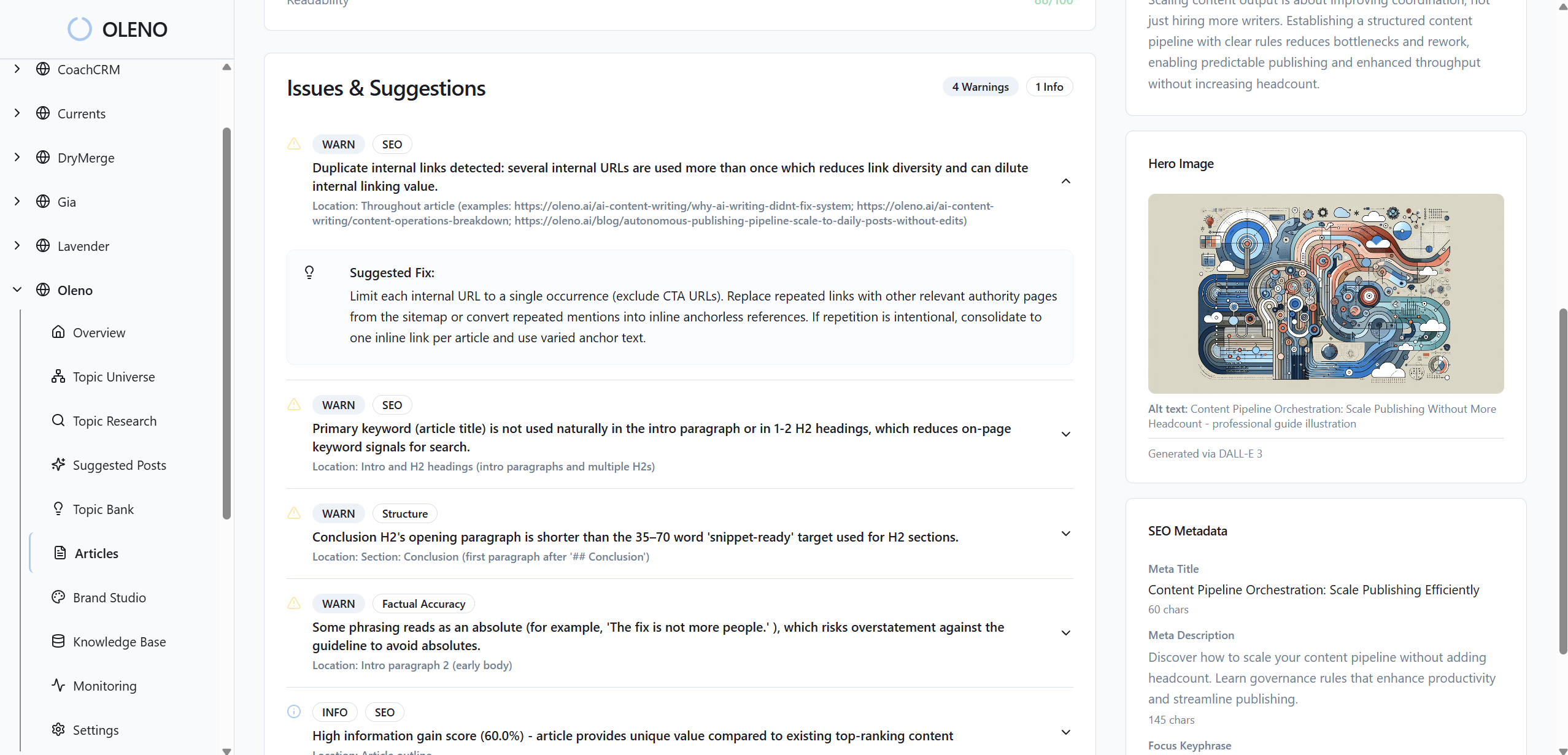
Oleno also stores Brand & Voice Memory, Positioning & Messaging Control, Customer Stories, and Proprietary IP & Frameworks. So when a marketer refreshes AI content, the update inherits the same voice, market POV, audience definitions, anti-personas, and approved stories as the rest of the library. The marketer isn't re-prompting the model with the same context every Monday.
For refresh work specifically, Oleno's Content Refresh & Drift Monitoring scans published pieces for drift signals like outdated statistics, dead links, stale competitor claims, and declining organic traffic. When drift is detected, the system proposes a remediation plan and re-enters the affected piece into the pipeline at the right review point for marketer approval. That module is sales-led and configured by the Oleno implementation team, which is worth saying plainly because not every team needs it on day one.
The marketer shapes the work before the draft changes
Oleno's refresh workflow preserves the review points that matter. The marketer shapes the research direction, reviews the brief, reviews the outline, and edits the draft. AI handles research synthesis, brief drafting, outline scaffolding, drafting, editing support, image generation, and publishing work around those calls.
That is the practical version of staying in the editor's seat. The marketer decides why the asset is being updated, which sources count, whether the structure still works, and what final version deserves to go live. Oleno does the production work between those decisions.
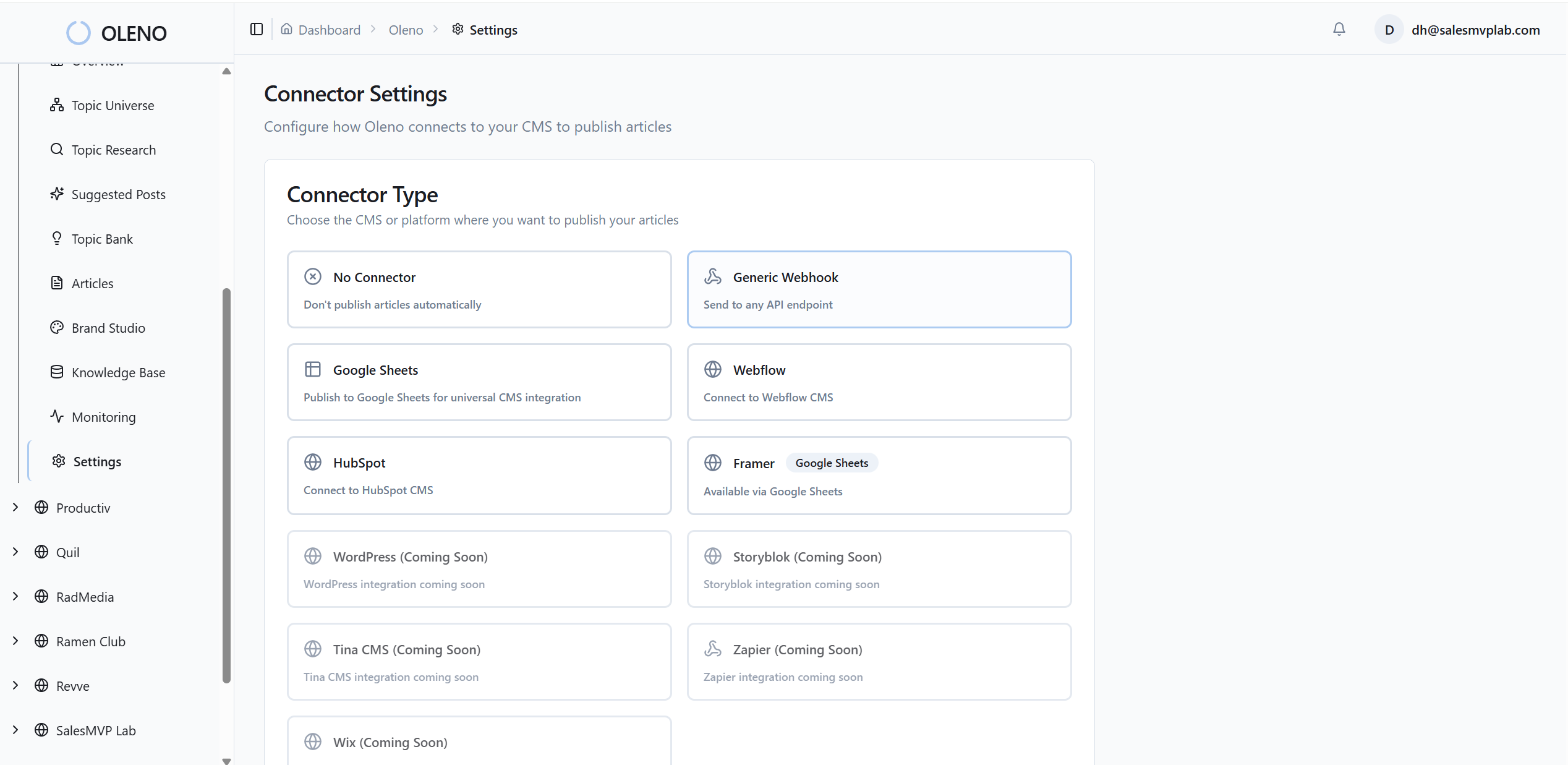
Quality Gate then scores drafts against factual grounding, voice match, structure, link health, and SEO density before the marketer sees the piece. Publish can push approved content into supported destinations like WordPress, Webflow, Storyblok, HubSpot, Tina, Wix, Framer, Google Sheets, Webhook, and Zapier, with CMS-specific publishing behavior handled inside the platform.
If your back catalogue is starting to drift faster than your team can manually track it, the next step is not another prompt template. It's a refresh workflow with product truth and marketer review built in. book a demo.
The Back Catalogue Needs an Owner
Refreshing AI content is not about making old posts sound newer.
The real work is deciding which assets still matter, what changed, which source proves it, and where the update needs to travel after the blog post changes. Traffic drops, product drift, message fatigue, sales objections, launch notes, and reuse points all belong in the same workflow.
If you take one thing from this, make it the triage rule. Refresh when the asset still has a job. Consolidate when the library is repeating itself. Retire when the asset no longer matches the business. Then tie every update to product truth and make the marketer approve the calls that actually change the outcome.
Better prompts won't save a decaying library. A better refresh system might.
About Daniel Hebert
I'm the founder of Oleno, SalesMVP Lab, and yourLumira. Been working in B2B SaaS in both sales and marketing leadership for 13+ years. I specialize in building revenue engines from the ground up. Over the years, I've codified writing frameworks, which are now powering Oleno.
Frequently Asked Questions