How to Repurpose One Launch Narrative Into 20 Assets

You spend 3 weeks getting a launch story right, then lose it in 3 days of rewrites, Slack threads, and one-off AI prompts. That’s usually where “repurpose one launch narrative” breaks down: not in strategy, but in execution.
Demand-gen content execution platform is a governed content operations system that turns strategic messaging into consistent, multi-format demand-generation output by connecting planning, brand rules, product truth, audience context, and execution in one repeatable workflow. Unlike repurposing tools or generic AI writers, a demand-gen content execution platform is built to preserve strategic meaning as your story gets translated across channels, formats, and audiences.
This category showed up because the old way stopped holding up. GEO changed the standard. It’s no longer enough to have one great launch page if the 19 surrounding assets sound softer, vaguer, or slightly off.
Key Takeaways:
- One strong launch asset is not enough. GEO rewards repeated, consistent signals across many surfaces.
- The real enemy is The Strategy-Execution Trade-off: the false choice between speed and message control.
- Most repurposing systems convert formats. They do not preserve strategy.
- If every derivative asset needs manual rescue, your issue is upstream structure, not writer effort.
- The unit of scale is not the asset. It’s the governed narrative behind the asset.
- When one launch narrative gets broken into reusable modules, 20 supporting assets becomes realistic.
- Product-led systems matter because they reduce the editing tax that kills momentum.
Why Strong Launch Narratives Fall Apart After Week One
A launch narrative usually dies right after the flagship asset ships. The launch page is sharp, the announcement post is solid, leadership is happy, and then the rest of the asset set starts drifting. What was clear on Monday becomes vague by Thursday because every follow-on asset gets recreated by a different person, prompt, or interpretation.

Most Launch Content Breaks After The Flagship Asset Ships
Picture a Head of Marketing at a growth-stage SaaS company. Monday morning, the team finally agrees on the story: the problem, the product angle, the proof, the audience, the why now. By Friday, that same story has been split into a blog post, email sequence, LinkedIn posts, sales enablement doc, customer update, comparison page, and some AI-assisted drafts that kind of sound right but not really. Sound familiar?
That’s not a creativity problem. It’s a systems problem. The enemy here is The Strategy-Execution Trade-off. Teams feel like they have to pick one: move fast with prompts and accept drift, or keep the story tight and accept slow output. Most teams bounce between those two bad options and call it content operations.
I’ve seen this up close. When I was the only marketer on a small SaaS team, I could write 3-4 strong posts a week because the context lived in my head. Once more people got involved, output didn’t really scale. It got slower. The writer didn’t have all the product nuance, positioning nuance, or market context I had, and I had less and less time to fill the gap. So every asset became a translation exercise. That’s where the headache starts.
Speed Without Narrative Control Produces More Assets But Less Clarity
Prompting feels productive because you get text quickly. That part is true. The problem is that fast text is not the same thing as repeatable demand gen.
One launch message can turn into 20 assets. Sure. But only if those 20 assets keep repeating the same strategic signal in ways that fit the format. If they start softening the claim, changing the framing, inventing different proof points, or speaking to the wrong audience, you’re not scaling the narrative. You’re diluting it.
There’s a simple test I use. Read five assets from the same launch back to back. If they feel like five different people kind of understood the same meeting, you’ve got narrative drift. If they sound like one company making one clear argument in five different places, you’re in better shape. That difference matters more than most teams think.
GEO Punishes Inconsistency Harder Than Old Search Ever Did
Old launch playbooks could get away with a lot. One strong page. A few campaign emails. Some social promotion. Maybe a webinar. Maybe a follow-up blog. Good enough.
GEO changed that. Large language models don’t just inspect one page. They infer what your company believes by looking across a wider body of content. Google’s documentation on helpful content and people-first content has pushed in this direction for a while, and AI answer engines have made the pressure more obvious (Google Search guidance, Google AI Overviews).
If your launch page says one thing, your supporting article says another, and your social posts flatten the whole message into generic advice, your authority signal weakens. Not because any single asset is terrible. Because the ecosystem doesn’t agree with itself.
That’s why one great launch story so often underperforms. It wasn’t the story. It was the follow-through.
Why Repurposing Often Fails To Preserve Strategy
Repurposing is supposed to save time. Most of the time, it just relocates the work. Instead of writing from scratch, you spend your week fixing assets that are close but not usable. The hidden problem is that most repurposing systems are built for format conversion, not strategic preservation.
Format Multiplication Is Not Message Amplification
A lot of teams say they want to repurpose one launch narrative. What they really mean is they want to turn one document into many deliverables. Those are not the same thing.
A PDF can become a blog post. A webinar can become clips. A launch memo can become a thread. Fine. But format multiplication doesn’t automatically strengthen the market message. In fact, if there’s no control layer around what must stay constant, more assets can actually create more confusion.
I’d argue there’s a 3-layer rule here. If you want one launch narrative to survive translation, you need to lock three things before production starts:
- the core claim
- the proof that supports the claim
- the audience framing that explains why the claim matters
Miss one of those, and repurposing turns into paraphrasing. Miss two, and you’re basically improvising.
That’s why a lot of “content repurposing” advice falls short. It’s obsessed with outputs. Chop this webinar into clips. Turn this post into a carousel. Rewrite this page into an email. Fine. But if the strategic core isn’t defined first, all you’re doing is multiplying surface area.
Generic AI Can Rephrase Words But It Can’t Hold Your Positioning
This is where some people push back. Fair point. AI can absolutely help you move faster. I use AI. Most smart teams do. The issue isn’t whether AI can generate text. The issue is whether it can preserve your company’s point of view, product truth, and audience nuance without a lot of cleanup.
Usually, it can’t. At least not on its own.
Prompting is useful for individual tasks. It is weak as a system of execution. That’s because the human still has to carry the logic across drafts. You still have to decide what should exist, what angle fits which audience, what claims are defensible, which proof points repeat, and what gets cut. As one strong breakdown of prompt-led workflows put it, teams end up compensating with more editing, more review, and more meetings. That isn’t leverage. It’s debt.
You can feel this on launch week. The AI output looks decent at first glance. Then you notice it softened the differentiation, generalized the customer pain, missed the product boundary, or made the post sound like it could belong to any B2B SaaS company. So you edit. Then someone else edits. Then the founder comments. Then PMM fixes a product detail. Then demand gen asks for a more campaign-friendly version. And now your “fast workflow” is a slow one wearing a different shirt.
One Launch Narrative Only Compounds When The Asset Set Reinforces The Same Claim
For growth-stage SaaS teams, this matters even more because you don’t have spare bandwidth. You probably have one person who owns too much. Strategy, content, launches, website, email, maybe paid, maybe sales enablement too. You don’t need more drafts. You need fewer interpretation loops.
That’s why the right question isn’t “how do we create 20 assets faster?” It’s “how do we make 20 assets reinforce the same market claim?”
Once you see it that way, the whole workflow changes. The launch page is no longer the finished product. It’s the source model. And the rest of the asset set should behave like faithful re-expressions of that model.
If you want to see how search visibility has shifted toward broader narrative consistency, not just isolated page ranking, look at how AI search products synthesize sources and repeated signals across surfaces (Perplexity product overview, Google Search Central on AI features).
That’s the reframe. Repurposing is not about making more stuff. It’s about preserving meaning across more surfaces.
The Editing Tax Is What Kills Most Repurposing Plans
The editing tax is where good intentions go to die. It starts small. A few draft comments. A few Slack clarifications. A few “can you tighten this up?” requests. Then suddenly the whole launch support plan is sitting on one senior marketer’s shoulders again.
Extra Review Usually Means The System Failed Upstream
Every extra reviewer feels like risk management. Sometimes it is. But often it’s a sign that the structure was weak before drafting even started.
If the strategic message is clearly defined, the product truth is clear, the audience angle is clear, and the derivative formats are mapped in advance, you usually don’t need five people rescuing the same asset. You might still want a final check. That’s fair. But rescue editing and validation are not the same thing.
Let’s pretend your team wants 20 launch-related assets in 30 days. If each asset needs 45 minutes of rescue editing from a senior leader, that’s 15 hours gone. If they need 90 minutes, now you’re at 30 hours. That’s basically a week of attention from the one person who should be thinking about pipeline, positioning, and the next move. Lost.
That’s why I’m pretty skeptical when teams say their issue is “we just need more writers.” Sometimes you do. But more often, you need better upstream structure.
More Writers And More Prompts Can Increase Drift Instead Of Output
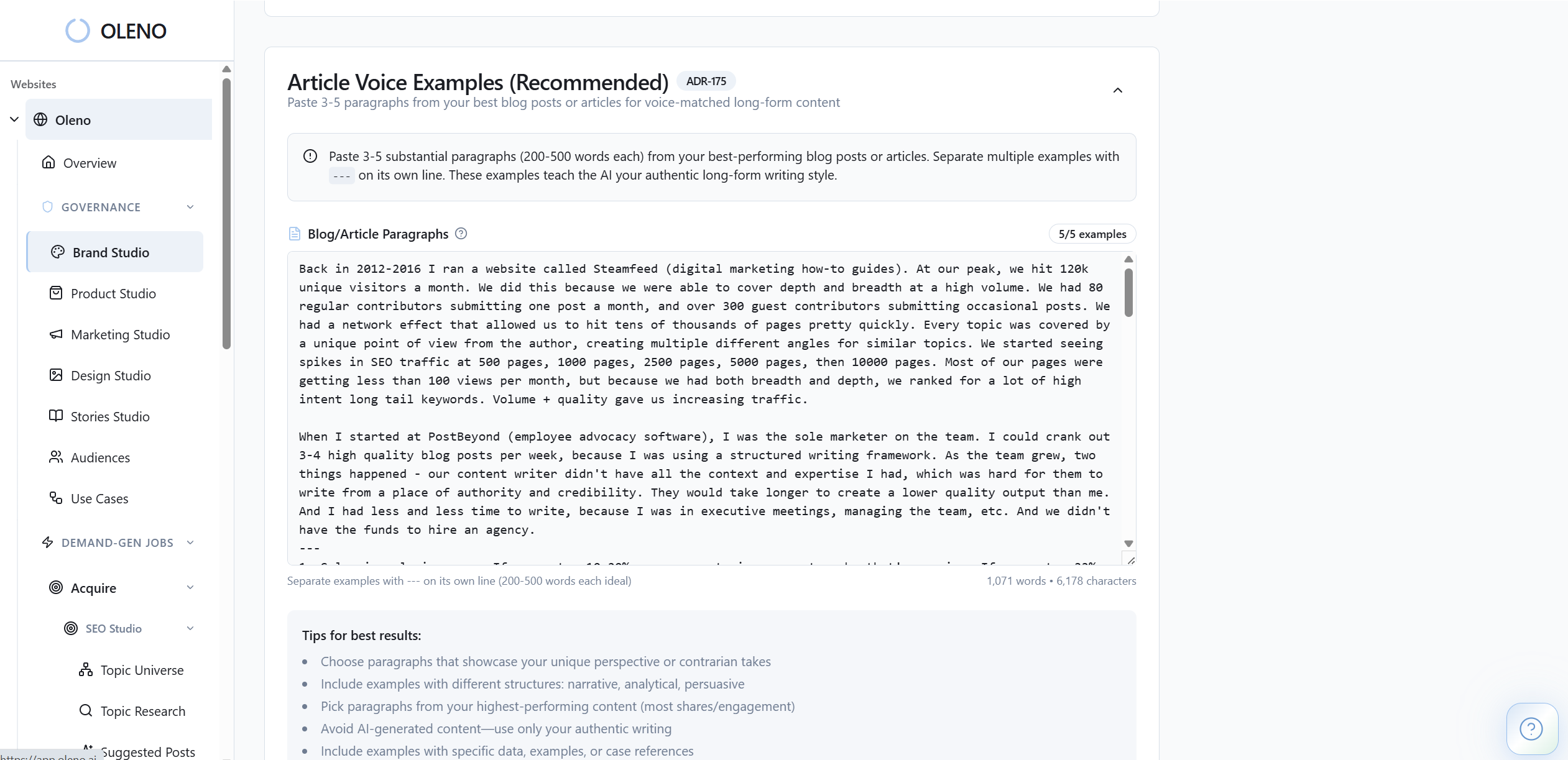
I learned this the hard way. At PostBeyond, adding writing capacity didn’t really fix the bottleneck because the bottleneck was context transfer. The deeper product and market understanding didn’t automatically move from my head into the workflow. So the writer took longer and the output needed more work. Nobody was doing a bad job. The system just wasn’t carrying the context.
Same thing happens with prompts. More prompts create more versions. More versions create more judgment calls. More judgment calls create more editing. Then people wonder why the process feels broken even though there’s a lot of activity.
At a bigger content property I ran years ago, we hit 120k monthly visitors because we had both volume and depth. We had 80 regular contributors and 300-plus guest contributors. We saw traffic spikes at 500 pages, 1000 pages, 2500 pages, 5000 pages, then 10000 pages. But the point people miss is this: volume worked because the underlying quality and topical coverage held together. Breadth without coherence just gives you more pages. It doesn’t always give you more authority.
In GEO, Inconsistent Supporting Content Weakens The Launch Itself
This part is counterintuitive for a lot of teams. Supporting content is not just support. It shapes how your core story is understood.
If your launch page says you solve a specific problem for a specific buyer with a specific point of view, but your follow-on assets drift into generic education, the market gets mixed signals. AI systems do too. And mixed signals are expensive.
| Dimension | Old Way | Category Way |
|---|---|---|
| Core workflow | Every asset is a fresh drafting and review exercise | One governed narrative is translated through a repeatable system |
| Speed vs quality | Teams choose between fast output and brand consistency | Speed and consistency are designed to work together |
| Message fidelity | Positioning drifts across people and channels | Core claims stay anchored across derivative assets |
| Review burden | Senior marketers fix voice, accuracy, and alignment manually | Review focuses on fit and validation, not rescue editing |
| GEO impact | Inconsistent support content weakens authority signals | Repeated aligned signals strengthen citation potential |
| Budget efficiency | Assets get rewritten, duplicated, or abandoned | One narrative compounds into reusable multi-format content |
That table is the whole argument in a nutshell. The launch doesn’t fail because the flagship asset is bad. It fails because the surrounding system keeps translating the story differently.
Why This Feels So Heavy For Small Marketing Teams
The human cost is easy to underestimate until you’ve lived it. The launch narrative is finally right. Then the next ten days turn into cleanup. Draft fixes. Clarification messages. Review comments. Last-minute rewrites. Same strategy, explained over and over to different people in slightly different contexts.
Launch Momentum Dies When Follow-On Assets Need Rescue
You know the feeling. Launch day feels good. Maybe even great. The page is live, internal team is aligned, people are posting, the founder is energized. Then the support content starts coming in and it all gets murky.
The blog draft is too broad. The LinkedIn post sounds like generic advice. The sales sheet overstates a claim. The comparison page misses the real pain. And now instead of amplifying the launch, you’re manually rescuing it.
Last summer, the founder story behind this whole approach started with exactly that kind of frustration. He was using a bunch of GPTs, copying and pasting outputs into a CMS, and burning 3-4 hours a day on repetitive work. That’s not just inefficient. It makes you start resenting the process itself.
Fast Drafts Feel Worse When They Always Create Cleanup Work
Speed stops feeling useful when it creates rework. That’s the emotional trap.
You start distrusting AI, not because the idea is bad, but because your experience of “fast” has been draft now, fix later. Every time. So you stop seeing acceleration as leverage and start seeing it as mess creation.
Some teams respond by slowing everything down and going fully manual again. I get the instinct. The status quo does have one merit: manual review can protect quality in the short run. That’s real. But it doesn’t scale, and it definitely doesn’t compound. So you stay safe, but small.
Burnout Usually Comes From Repeated Translation, Not Just Volume
This surprised me more than anything else when I started paying attention to content systems. Teams rarely burn out because they published too many assets. They burn out because each asset feels like a new act of interpretation.
Same launch. Same strategy. Same target buyer. But the team has to keep restating it from scratch. That repeated translation is what drains people.
And once the team feels that drag a few times, launches start to feel heavier before they even begin. That’s a bad place to operate from.
In the middle of all this, if you want to see what a more governed model looks like, request a demo. Not because a demo solves the theory by itself, but because seeing the workflow makes the trade-offs way easier to spot.
How To Turn One Launch Narrative Into A Real Asset System
One launch narrative can become 20 GEO-friendly assets. But not if you start with asset requests. You have to start with the narrative system underneath them.
For growth-stage SaaS teams, this is really for you if you’ve got one strong story, limited bandwidth, and a real need to show up consistently across blog, product marketing, buyer education, and social without rebriefing the whole company every 48 hours.
- Narrative Governance: Define the launch story as controlled messages, proof points, audience angles, and non-negotiable claims before production starts.
- Modular Execution: Break that story into reusable parts that can be adapted across channels without rewriting the strategy every time.
- Compounding Distribution: Publish an asset ecosystem that repeats the same authoritative signals across discovery surfaces so GEO visibility strengthens over time.
Diagnose Whether Your Launch Narrative Is Ready To Scale
Before you try to create 20 assets, run what I call the Spine Test. If you can’t answer these five questions clearly, you’re not ready to repurpose yet.
First, what is the single market claim this launch is making? Second, what proof makes that claim believable? Third, who is the primary audience and what specific problem are they trying to solve? Fourth, what product truths must never get softened or expanded? Fifth, what should every derivative asset repeat in some form?
If you can answer all five in under 10 minutes, you’ve probably got a usable narrative spine. If the answers spark debate, you’re still in strategy formation, not execution. Different stage. Different work.
This is where a lot of launches get rushed. People want output because launch dates are real. Totally fair. But a fuzzy narrative spine is expensive. It creates confusion later, when every writer, PMM, founder, and prompt has to guess what the story really is.
Build Message Modules Before You Build Assets
Once the spine is clear, the next move is modularization. One launch story should be broken into parts that can travel.
I like a 6-module model for this:
- core problem
- sharp point of view
- product truth
- proof or evidence
- audience-specific angle
- call to next action
That gives you building blocks. Not templates. Building blocks.
A blog post might use all six. A LinkedIn post might use three. A product-led email might use four with more proof. A buyer FAQ page might use product truth plus objection handling. The point is that the strategy gets broken into reusable units first, then adapted by surface.
One quick interjection. This is where most teams save or lose the whole launch.
When we were recording founder videos and turning them into content at LevelJump, we got speed. But we didn’t get enough search structure or topic discipline. Good raw material is not the same as usable modules. Until the pieces are organized, you still end up rewriting by hand.
Map Modules To Audience, Funnel Stage, And Surface
This is the part most teams skip, and it’s why repurposing feels random. A launch asset plan needs a routing model.
I use a simple conditional rule here. If an asset is meant for early discovery, lead with problem framing and point of view. If it’s meant for mid-funnel education, lead with product truth and use case relevance. If it’s meant for evaluation, lead with proof, differentiation, and boundary clarity. Same launch. Different entry point.
That means your 20 assets shouldn’t all say the same thing the same way. They should reinforce the same claim from the angle each surface needs. That’s a huge difference.
A workable 20-asset mix could look like this:
- 1 launch page
- 2 supporting blog posts
- 2 use case pages
- 2 buyer FAQ pieces
- 1 comparison-oriented page
- 3 email assets
- 6 social posts
- 2 founder-led thought pieces
- 1 sales enablement doc
Now, not every team needs exactly 20. Some need 8. Some need 30. The number is less important than the matrix. If you can’t explain why each asset exists, you’re probably producing content instead of building coverage.
And if you want to talk through what that matrix looks like for your team, request a demo. Sometimes one live walkthrough is faster than another week of trying to duct-tape the process together.
GEO Visibility Comes From Repeated Strategic Signals, Not Content Volume Alone
This is the final piece. GEO favors consistency across scale. Not raw volume. Not random frequency. Consistency.
That means your asset system should repeat a stable set of signals:
- who the product is for
- what problem it solves
- what makes the approach different
- what claims are grounded in product truth
- what language defines the category or point of view
LLMs don’t need 20 duplicate pages. They need a coherent field of evidence. One launch page, one buyer guide, one use case article, one FAQ hub, one founder POV post, one comparison page, one social stream. Different formats. Same strategic center.
There’s a case to be made for looser creative workflows in some brand contexts. I’m not against creativity. But for product launches, especially in B2B SaaS, loose systems usually produce vague content. And vague content doesn’t compound.
The unit of scale is the narrative. The assets are just where it shows up.
How Oleno Turns One Narrative Into A Working System
This is where the category becomes practical. Oleno operationalizes the narrative system so your team doesn’t have to manage every translation step by hand. The point isn’t faster drafting for its own sake. The point is preserving message fidelity while increasing output, so one launch narrative can reliably show up across articles, product marketing pieces, buyer enablement content, and social distribution without the usual editing tax.
How Oleno Encodes The Narrative Before Drafting Starts
Oleno starts by putting the strategic context in the system, not in scattered docs and Slack threads. brand studio defines how the content should sound. marketing studio encodes the point of view, category framing, and core messages. product studio holds approved product truth so launch claims stay accurate. audience & persona targeting and use case studio make sure the same launch gets framed differently for the right buyer and use case.
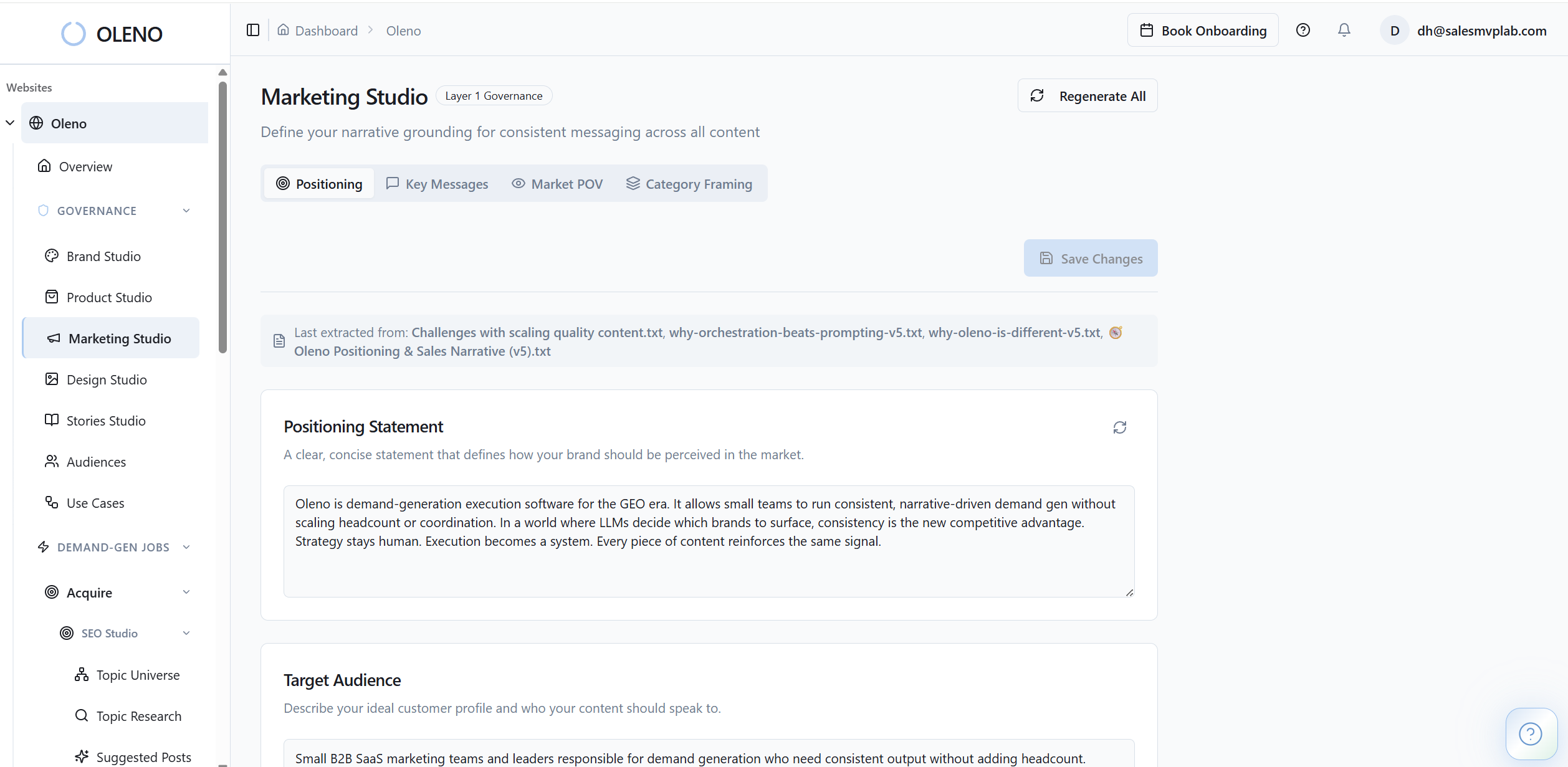
That matters because most launch drift happens before editing. It happens when the writer, freelancer, agency, or prompt doesn’t have the same operating context the Head of Marketing has. Oleno closes that gap upstream. So instead of every asset becoming a fresh interpretation, the system starts from the same narrative spine and generates from there.
The founder story is pretty telling here. This all started with manually prompting GPTs, copying output into a CMS, and losing 3-4 hours a day to repetitive work. Then the workflow got hard-coded into a real engine. Same need. Very different operating model.
How Governed Execution Reduces Review Loops
Once the narrative is set, the orchestrator moves jobs through a repeatable flow instead of asking the team to manage every handoff manually. For launch-related content, that can mean product marketing assets, buyer enablement pieces, category content, and supporting acquisition content all working from the same strategic inputs. quality gate checks outputs against defined standards before they move forward, and cms publishing closes the loop once content is ready.
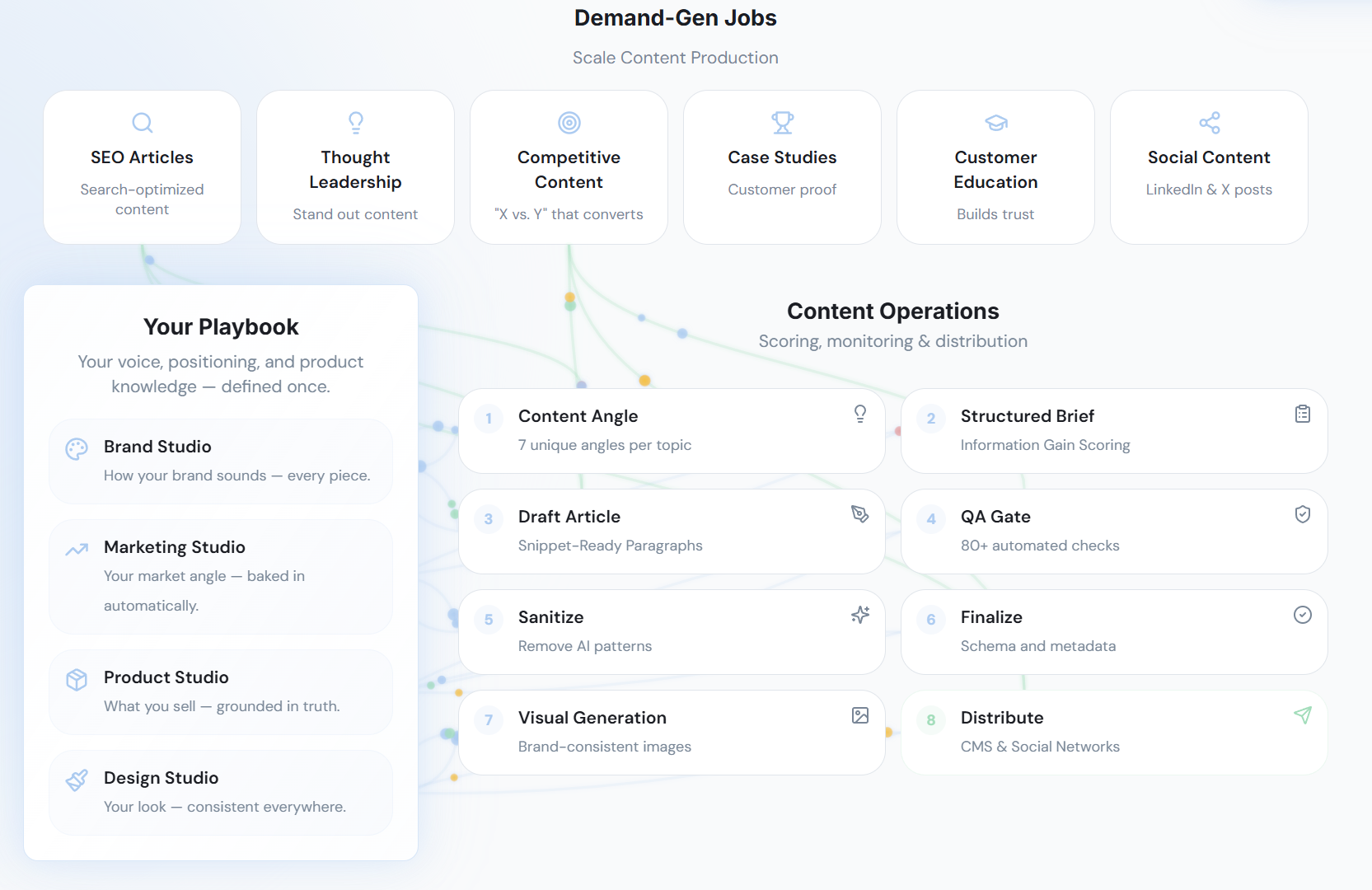
This changes the nature of review. You’re not rewriting for coherence from scratch. You’re validating fit, deciding priority, and tightening where needed. That’s a much better use of senior marketing time.
And there’s another layer here that matters in practice. stories studio can pull real founder stories, customer anecdotes, and sales insights into the content stream so the assets feel lived-in instead of generic. ip studio adds original internal thinking that public web content won’t give you. That combination is a big part of why governed content tends to feel more grounded.
Why The Real Win Is Narrative Compounding
The best proof of this model is kind of funny. One person, Trung at Revve, read a single Oleno-generated article and signed up from that. No demo. No sales call. Just “Well damn.” That’s not because one article is magic. It’s because when the output itself passes the slop test, the quality argument gets a lot more credible.
For growth-stage teams, that’s the actual gain. Not just faster writing. More reliable narrative compounding across the funnel. programmatic seo studio can keep acquisition content moving. product marketing studio can support feature launches and use case education. buyer enablement studio can reinforce evaluator-facing content. distribution & social planning can turn approved articles into channel-specific social outputs. All of it anchored to the same strategic center.
If you’re trying to stop launch narratives from dying after announcement week, the answer usually isn’t another writing tool. It’s a system that keeps strategy intact while the asset count grows. If that’s what you’re trying to build, book a demo.
The Teams That Compound Narrative Win Longer
One strong launch story is useful. One strong launch story that turns into 20 aligned assets is a real market advantage. That’s the shift.
The old way treats every derivative asset like a new task. The better way treats the launch narrative like infrastructure. Once that clicks, repurposing gets easier, review gets lighter, and GEO signals get stronger because the surrounding content keeps saying the same clear thing. That’s usually what the market was missing the whole time.
About Daniel Hebert
I'm the founder of Oleno, SalesMVP Lab, and yourLumira. Been working in B2B SaaS in both sales and marketing leadership for 13+ years. I specialize in building revenue engines from the ground up. Over the years, I've codified writing frameworks, which are now powering Oleno.
Frequently Asked Questions