How to Scale Content From 1 to 50 Articles/Month with a 1-Person Team

If you’re a one-person content team, you don’t need pep talks. You need a clean way to go from “what should I write next?” to “published, on-brand, and visible” without burning nights and weekends. I’ve been on both sides—the solo operator and the exec who needs content to drive pipeline, not vanity traffic. The solution isn’t more drafts. It’s fewer decisions, enforced earlier.
Back in the Steamfeed days, we scaled to 120k monthly visitors by pairing volume with real depth. Later, at PostBeyond and LevelJump, I learned the hard way that context switching kills throughput. When I moved to Proposify, our content ranked everywhere, but too much of it sat far from the product story. Great traffic. Wrong buyers. Lesson learned: scale only works when the system points to outcomes you actually want.
Key Takeaways:
- Replace ad hoc tasks with a map-to-publish system that enforces decisions upstream
- Select topics from a compact “topic universe” and kill low-differentiation briefs before writing
- Ground drafts in your knowledge base and enforce brand voice to reduce rework
- Automate visuals, internal links, schema, and publishing to protect your calendar
- Use a QA gate for structure, accuracy, and snippet-readiness—not just typos
- Balance pillars with cooldowns so authority compounds rather than fragments
Ready to skip the theory and see throughput? Try a controlled run: Try Generating 3 Free Test Articles Now.
Why Speed Without A System Makes Things Worse
Speed without a system multiplies mistakes because you scale decisions, not just words. Topic selection, differentiation, visuals, links, schema, and publishing are separate jobs—but your brain treats them as interruptions. The result is rework and drift. Example: solid drafts that die in publishing because metadata wasn’t handled upstream.
The Hidden Complexity In Small-Team Content Ops
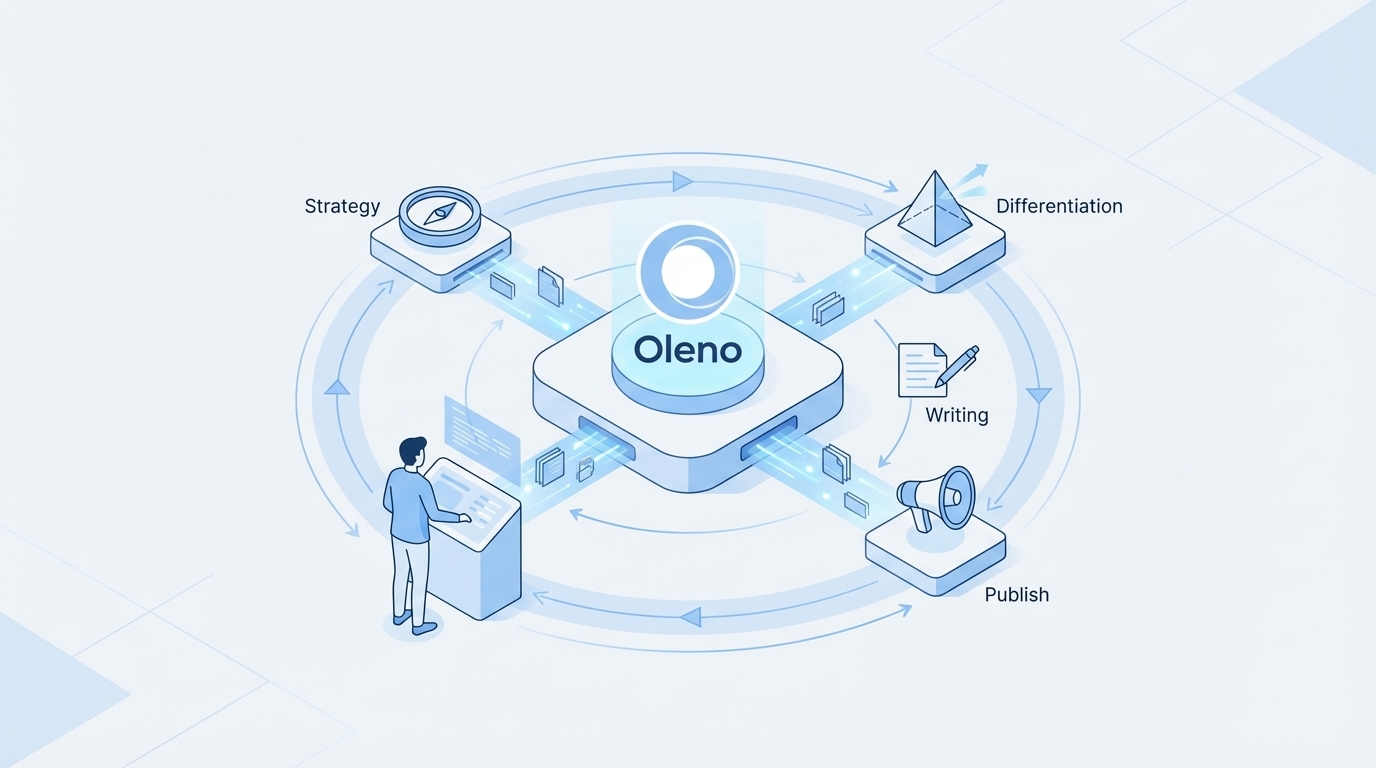
Publishing more without a plan feels productive, until your pipeline becomes a maze. Each step—topic, brief, draft, visuals, links, schema, publish—carries unique rules. When one person owns everything, context-switching becomes the real cost center. I’ve lost more hours to rework than to writing.
The fix isn’t hustle. It’s a system that pre-decides the messy parts. In practice, that means a compact strategy layer that tells you what to write next, a brief that enforces information gain, and deterministic enhancements afterward. A good litmus test: can your next article flow from the last one without inventing new rules? If not, your system is improvisation.
If this sounds familiar, you’re not alone. Content operations sprawl when roles blur. Frameworks that unify strategy and execution reduce that sprawl and improve reliability, as discussed in the Content Marketing Institute’s guidance on uniting roles to scale content operations. You don’t need more hands. You need fewer variations.
What Gets Lost Between Topic, Draft, And Publish
Most teams lose precision at the handoffs. Topic selection drifts from product narrative. Drafts echo what’s already ranking. Visuals, links, and schema bolt on at the end and break things. Shipping turns into cleanup.
When I worked with founder-led content, we tried “record → transcribe → publish.” Fast? Yes. Search-ready? Not really. Without structured briefs and snippet-ready openers, our great ideas didn’t stick in search. The upstream decision that fixes this is simple: enforce differentiation and structure before a single paragraph exists. Then the downstream steps become predictable, not heroic.
A lot of “content scaling” playbooks talk headcount and channels. That’s secondary. Your first job is mapping upstream decisions to downstream outcomes so publishing is a foregone conclusion—not a scramble. That’s what separates scale from noise, a point even enterprise ops teams echo in their content scaling frameworks.
Why Should Solo Teams Rethink “More Posts” Right Now?
Because “more” without information gain teaches algorithms to ignore you. If your article adds nothing new, you train search—and AI assistants—to skip your take. That’s avoidable.
Here’s the move: adopt a strategy layer that prioritizes high-gain topics and run an information gain check inside your brief. If it’s low, you either find the unique angle or you don’t write it. That one rule saves days. It also forces clarity on product alignment so you’re not farming traffic that will never convert.
Volume isn’t the villain. Blind volume is. When you pair cadence with enforced differentiation, you get compounding authority instead of sporadic spikes. That’s where solo teams can win.
What Actually Bottlenecks A Solo Content Operation
The bottleneck isn’t your writing speed. It’s ungoverned decisions across strategy, structure, and correctness. You can write fast and still publish slowly if each piece needs bespoke rules. Fix the system, and the drafts get easier. Example: pre-approved topic clusters, brief templates with differentiation checks, and code-based enhancements.

Where Traditional Advice Falls Short
Not every playbook translates to a one-person setup. Agile rituals, capacity trackers, and “hire three freelancers” aren’t the lever. You still carry topic selection, differentiation, structure, visuals, internal links, and publishing. Each one can break.
What works is turning fragile steps into governed ones. Decide topics from coverage gaps, not guesses. Enforce information gain before writing. Automate visuals and link injection with rules. Then publishing is a button, not two hours of field mapping. Teams that focus on workflow mechanics over outcomes miss this—the system has to own the outcome, not the operator. That’s why “prompt your way there” rarely sustains beyond a few posts; it creates drafts, not a reliable pipeline.
If you want a sanity check against the usual “just write more” advice, take a look at how tooling guides often focus on tactics, while real bottlenecks remain unaddressed; even mainstream guides to scaling content creation acknowledge repeatability, not headcount, is the point.
The Difference Between Writing Problems And System Problems
Writing problems look like style or voice. System problems are repeatability, coverage, and correctness. Fixing voice won’t save you from misaligned topics or missing schema. I’ve seen strong writers ship content that didn’t move pipeline because the system let misalignment through.
Solve for system: a topic universe that maps pillars and gaps; briefs that enforce differentiation; a QA gate that checks structure, KB grounding, and snippet readiness; deterministic enhancements for links, schema, and visuals. When those pieces exist, the writing slot is just that—a slot. Not a rescue mission. It also lowers the pressure on your “best day,” because the rails do most of the work.
The Hidden Costs Draining Your Limited Hours
Ad hoc workflows look harmless until you add up the time. The real cost isn’t just the draft; it’s the handoffs you’re doing alone. Topic discovery. Differentiation decisions. Visual selection. Link validity. Schema. Publishing fields. Each one steals minutes that don’t feel like work—until they do.
Time Math For Ad Hoc Workflows
Let’s pretend a single post takes six hours end to end. Topic 0.5, brief 0.75, draft 2.5, images 0.5, links 0.25, QA 0.75, publish 0.75. Ten posts is 60 hours. Fifty is 300. You don’t have that.
Automating drafting (after a tight brief), visuals, links, schema, and QA reliably trims 40–60% of this time. Not because “AI writes for you,” but because the system removes cleanup. I’ve cut my own review cycles by days just by moving snippet checks and link injection into the pipeline. Enterprise teams make the same case in their content scaling playbooks: remove manual steps; protect cadence.
Quality Risk From Generic AI Drafts
Unconstrained AI tends to produce generic text and factual drift. That means frustrating rework and credibility dents you feel for months. The fix is structural: ground drafts in your knowledge base, enforce brand voice up front, and require snippet-ready openers for every H2.
When we used transcribed thought leadership without these rails, it sounded smart but didn’t rank, and it didn’t tie back to the product story. Once we layered in KB grounding and a QA gate, retries dropped. Fewer surprises. Fewer 3am edits. More time actually spent publishing.
The Opportunity Cost Of Misaligned Topics
At Proposify, we ranked incredibly well across a wide range of topics. But some of those pages didn’t ladder into the product narrative. Great traffic, poor pipeline. That gap matters for solo teams because you can’t afford to invest time in pages that can’t convert.
Choose topics from your knowledge base and sitemap signals. Align pillars to sales conversations. A lot of folks chasing “content scaling” end up with beautiful pages that never connect to product—something even growth practitioners call out in their own scaling frameworks. Credibility is built on relevance, not pageview spikes.
The 3am Edit Spiral You Are Tired Of
If you’ve ever planned to ship at 5 pm and ended up fixing HTML, alt text, and schema until midnight, you know the spiral. It starts small. One missing field. One broken image. One duplicate publish. It ends with tomorrow already behind. That’s a publishing system problem, not a writing problem.
When A Publish Breaks Your CMS And Momentum
Publishing is fragile when fields, images, and metadata are manual. You can be meticulous and still miss things. I’ve had duplicate post issues that nuked a morning and torpedoed cadence for a week. Not fun.
Use connectors that map fields, embed visuals and metadata, attach JSON-LD, and prevent duplicates by design. The goal isn’t speed for speed’s sake—it’s stability. When the backend is predictable, you can publish daily or near-daily without that low-grade anxiety that something will break after you click “go.” Some teams cover similar ground in their own notes on content scaling pitfalls. The consistent theme: protect the last mile.
The Late Handoff That Kills Your Week
You finally get a draft you can’t use. Off-brand. Light on facts. Now you’re the writer, editor, and fact checker. That’s the moment to move quality earlier. Enforce information gain before writing. Ground in your KB. Run an automated QA gate for structure, voice, and snippet readiness so drafts arrive closer to “done.”
I’ve seen first drafts improve dramatically when the brief is rigid about angle and coverage. It’s not creativity-killing; it’s clarity. Guardrails make it easier to say no to meandering takes that would never ship.
Who Owns Quality When You Are The Only One?
You do, which means the system has to carry most of the load. Codify voice, banned terms, section patterns, and openers. Automate checks for alt text, internal links, and schema. Leave yourself a final read for nuance and story, not rescue.
In other words, act like your own QA department—with software doing the boring parts. That’s how you ship consistently without turning every publish into a fire drill.
Still firefighting the last mile? Offload the heavy lifting and keep pace: Try Using An Autonomous Content Engine For Always‑On Publishing.
A Repeatable Map To Publish Pipeline You Can Run In 90 Days
A 90-day map-to-publish plan turns chaos into cadence by enforcing choices upstream and automating enhancements downstream. Start with a quick audit, build a topic universe with cooldowns, design briefs that force originality, then automate draft, visuals, links, schema, QA, and publishing. Example: ship 3–5 articles in weeks 3–4, then ramp to 10–12 weekly by month three.
Build The Foundation: Audit, Pillars, And A Compact Topic Universe
Begin with a one-hour baseline audit. Pull your sitemap and knowledge base into one view. Tag what’s current, duplicate, or missing. Identify 3–5 pillars that reflect your real product conversations so new posts extend authority, not start from zero.
Next, cluster topics by pillar and label saturation: underserved, healthy, well-covered, saturated. Apply a 90-day cooldown on angles to avoid over-publishing. Your output is a 30–60 topic backlog prioritized by product alignment and coverage gaps. That becomes your weekly cadence. Not perfect, just consistent.
If you like reference points, long-form primers on content scaling and practical takes from operators like Alex Birkett can help you sanity check your backlog size and cadence targets.
Lock Differentiation Before Draft: Deterministic Briefs And KB Grounding
For each approved topic, write a brief that forces originality. Include audience, angle, H2 structure, snippet-ready openers, product tie-ins, and external references. Run an information gain pass; if it’s low, kill it. Better to skip than ship another derivative post.
Only then draft—grounded in your knowledge base and strict voice constraints. Drafts come back clean but link- and image-free. That separation matters. It makes your enhancement steps testable and reliable, because you’re not fighting the model’s guesses about anchors or image needs. And because each H2 opens with a direct answer, you increase eligibility for snippets and AI citations.
Automate Enhancement And Publishing: Visuals, Links, Schema, QA, And Cadence
Generate a hero and 2–3 inline visuals that match brand style references. Place product screenshots where they reinforce your solution section. Inject 5–8 internal links using only verified URLs and exact title anchors. No guessing. No fabricated links.
Add a QA gate with automated checks for structure, snippet-ready openers, voice alignment, KB accuracy, image alt text, filenames, and link validity. Require a passing score before your quick human pass. Publish via connectors that map fields, embed visuals and metadata, attach JSON-LD, and prevent duplicates. Then use cooldowns to keep coverage balanced across pillars. That’s how one person runs a daily or near-daily cadence without the headache.
How Oleno Automates The One Person Content System
Oleno turns the map-to-publish workflow into a continuous, governed system that runs daily. It handles strategy, differentiation, writing, visuals, QA, and publishing so you don’t juggle a dozen tools and manual checks. Think “decide once, reuse everywhere.” Example: Topic Universe picks priorities; briefs enforce originality; enhancements run deterministically.
Topic Universe Prioritization And Cooldowns
Oleno’s Topic Universe discovers topics from your knowledge base, sitemap, and focus areas, then clusters coverage and labels saturation. It enforces a 90-day cooldown so you don’t over-publish the same idea and cannibalize your own rankings. The practical benefit is simple: you always know what to write next, and your pillars stay balanced without a spreadsheet.
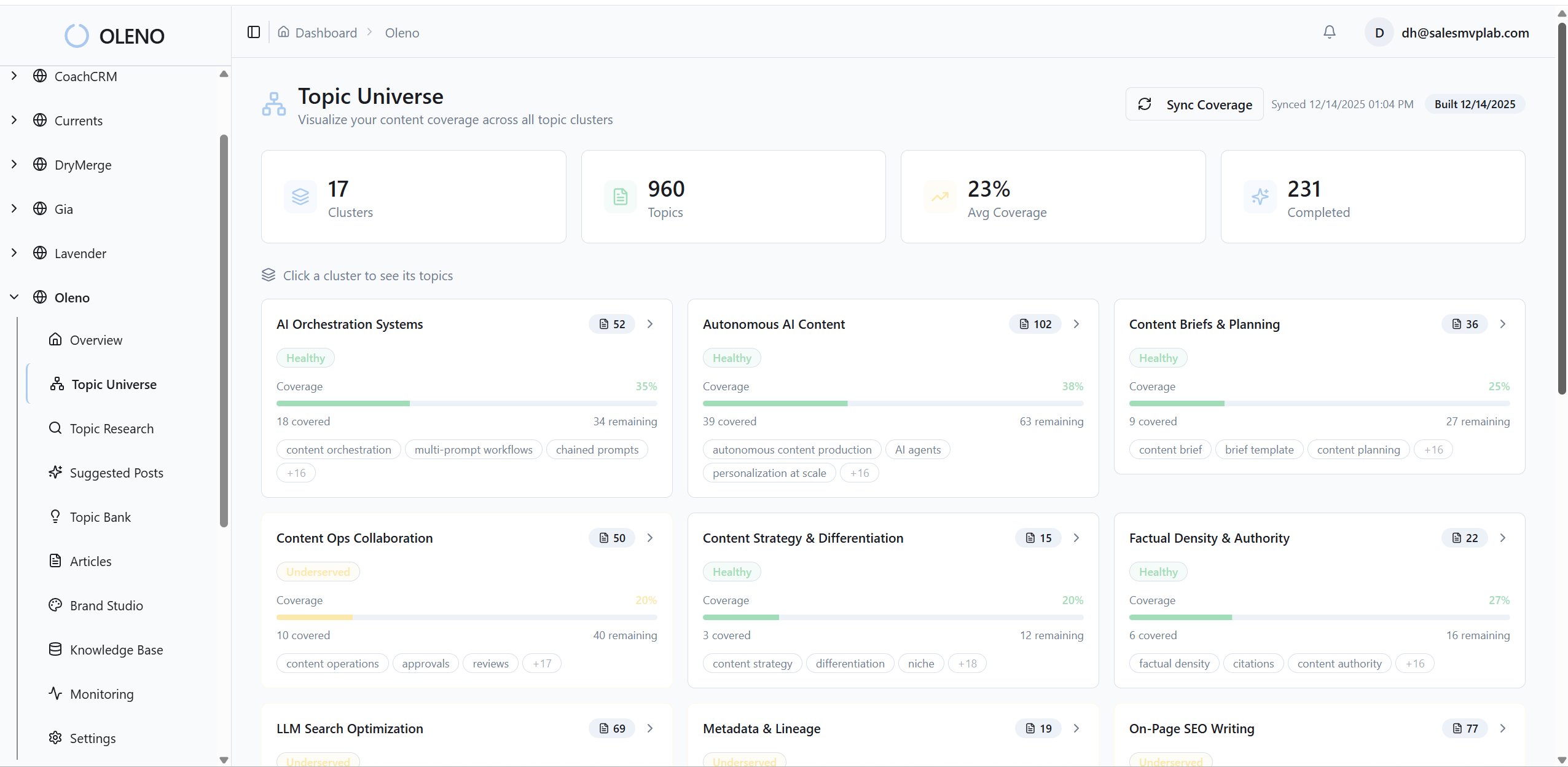
Because Topic Universe feeds suggestions continuously, you avoid “empty backlog” weeks. Also, coverage data loops back into the system, so each article improves the next set of choices. That’s how a solo operator gets the compounding effect teams usually need a strategist for.
Information Gain Briefs And Snippet‑Ready Structure
Oleno generates briefs with competitive research and an information gain score. Low-differentiation outlines are flagged before writing, so you don’t waste time on angles that add nothing new. Drafts follow snippet-ready structure—every H2 opens with a tight, three-sentence direct answer. That combination reduces rewrites and improves eligibility for citations.
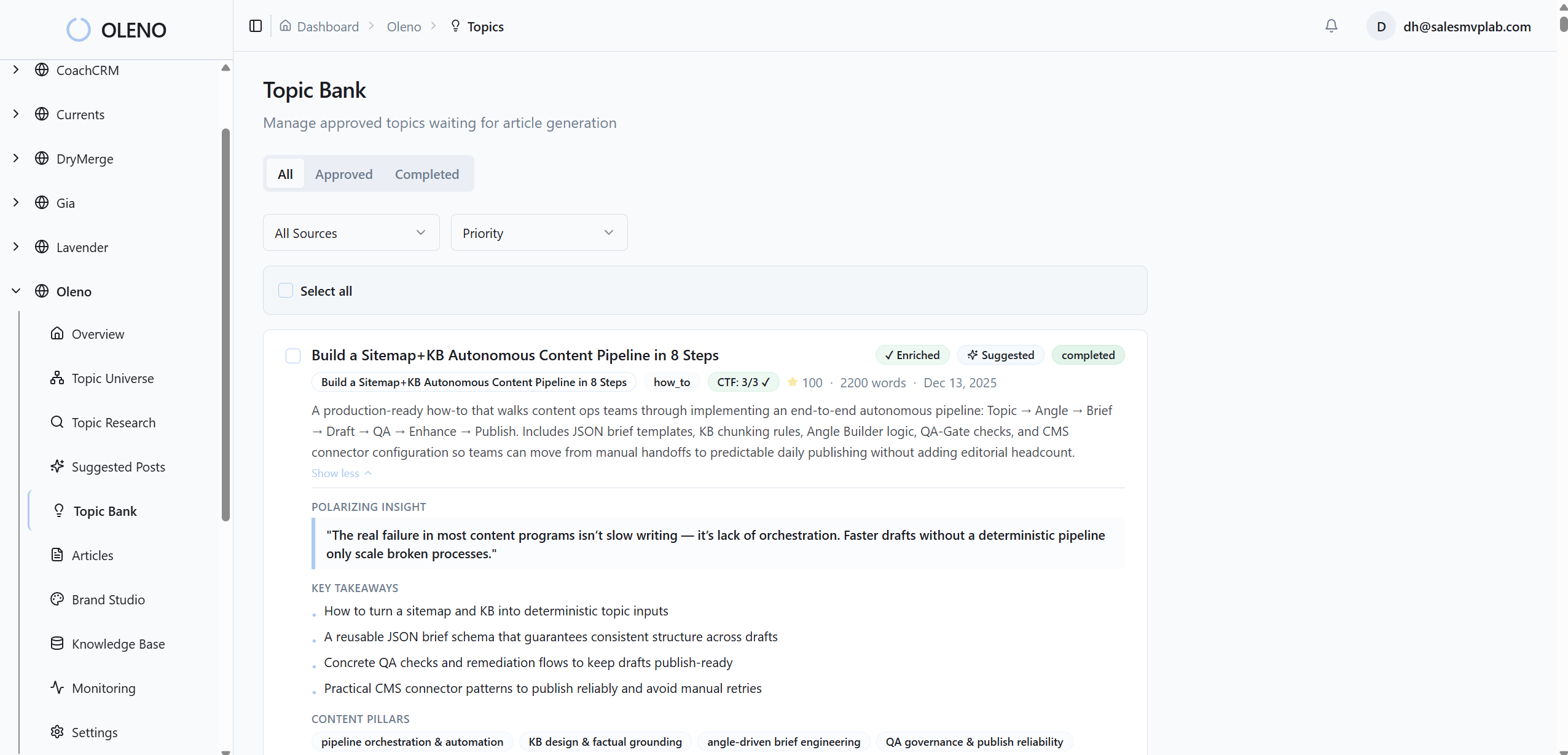
I like this for a practical reason: it moves the “hard thinking” upstream. When the brief is clear about value-add and structure, the draft returns on-brand, grounded in your KB, and close to publish-ready. You spend your time on narrative nuance, not structural triage.
Visual Studio, Deterministic Linking, Schema, And QA Gate
Oleno’s Visual Studio generates brand-consistent hero and inline images using your colors, logos, and style references. Product screenshots are matched to relevant sections—especially the solution section—using semantic similarity. Meanwhile, internal links are injected from verified sitemaps with exact-match anchors, and JSON-LD schema is generated programmatically for each article.
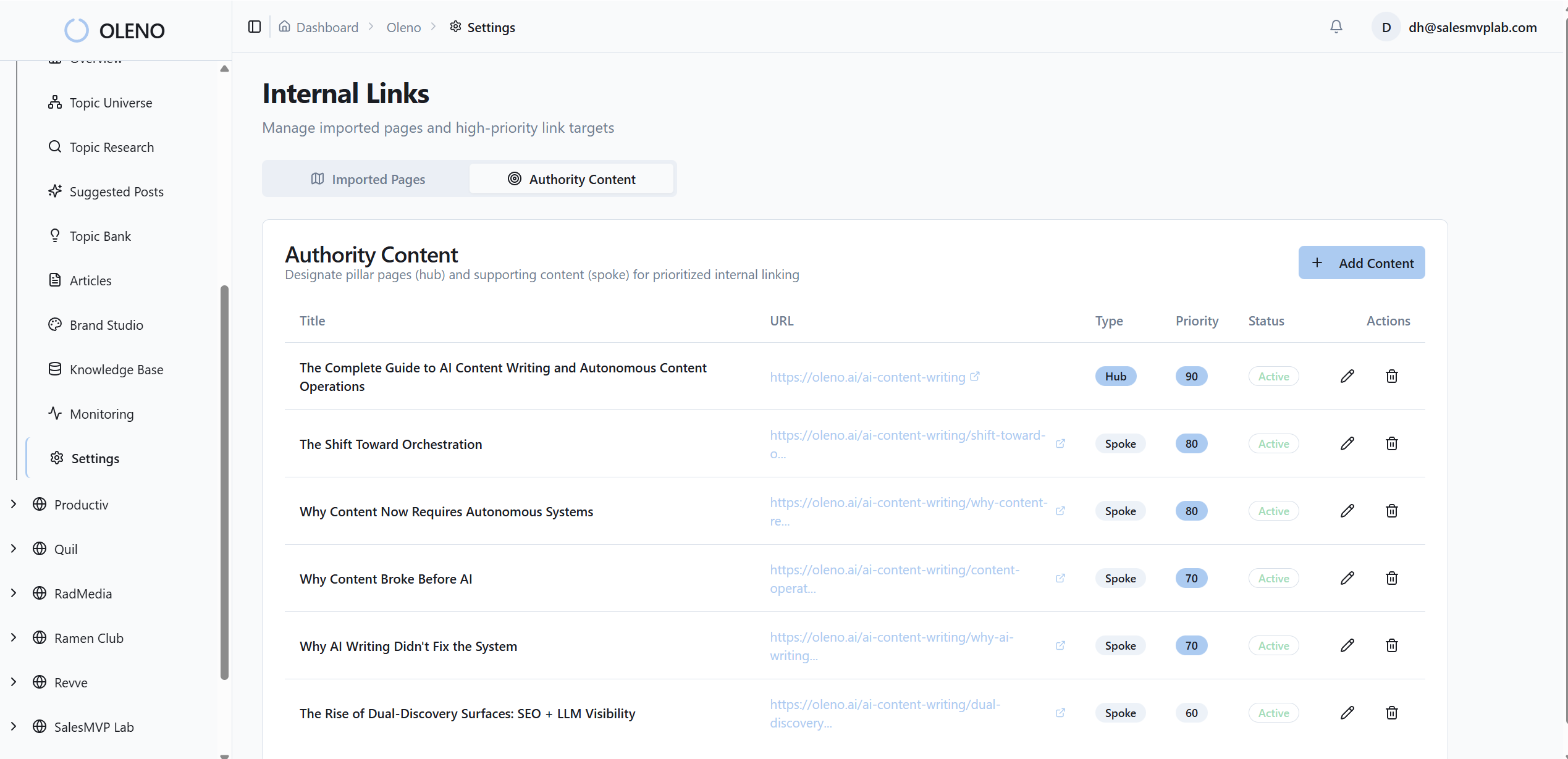
Finally, Oleno’s QA gate evaluates drafts against 80+ criteria, including structure, brand alignment, information gain, snippet readiness, and visual checks. Drafts refine until quality thresholds are met, then publish via connectors to WordPress, Webflow, or HubSpot, with duplicate prevention and correct field mapping. Net effect: fewer 3am edits, a steadier cadence, and content that compounds toward your product narrative.
Want to see the full pipeline run without handoffs? Try Oleno For Free and generate your first set of articles.
Conclusion
You can’t outwork a broken system. Not as a one-person team. The move is to decide upstream, automate downstream, and let the rails do the heavy lifting. Pick topics from a clear universe. Enforce information gain in the brief. Ground drafts in your KB. Automate visuals, links, schema, QA, and publishing. Then keep cadence with cooldowns. That’s how you get from one to fifty articles a month without trading your nights and your brand voice to do it.
About Daniel Hebert
I'm the founder of Oleno, SalesMVP Lab, and yourLumira. Been working in B2B SaaS in both sales and marketing leadership for 13+ years. I specialize in building revenue engines from the ground up. Over the years, I've codified writing frameworks, which are now powering Oleno.
Frequently Asked Questions