How to Stop Over-Publishing: A 90-Day Content Cooldown Framework
Most teams measure content by volume. Feels productive. Feels active. But the law of diminishing returns hits fast when you’re publishing into the same cluster with the same angle. You’re not building authority; you’re fragmenting it. I’ve done it. I’ve watched high-output teams do it. The pattern is predictable.
When I ran a contributor network in the early 2010s, our traffic spiked when we combined breadth and depth, not more of the same. Later, in small SaaS teams, the opposite bit us: fast, frequent, overlapping posts that diluted our strongest pages. The fix wasn’t more writing time. It was rules. Cooldowns. Gating. Governance that said when not to hit publish.
Key Takeaways:
- Treat topic re-coverage as risky by default; enforce cooloffs at the cluster level
- Gate every brief on information gain before any drafting starts
- Replace calendar quotas with enforceable rules and exception triggers
- Consolidate competing URLs to protect your flagship pages and link equity
- Make governance visible in your workflow so duplication can’t slip through
Want a system to enforce cooldowns without spreadsheets? Try Generating 3 Free Test Articles Now.
Why Publishing More Dilutes Your Authority
Publishing more dilutes authority when pieces overlap intent and split equity across similar URLs. The signal weakens as internal links scatter and angles repeat, even if each article seems “good.” A cluster with three “ultimate guides” to the same question is a slow-motion traffic leak.
The duplication spiral that kills signal
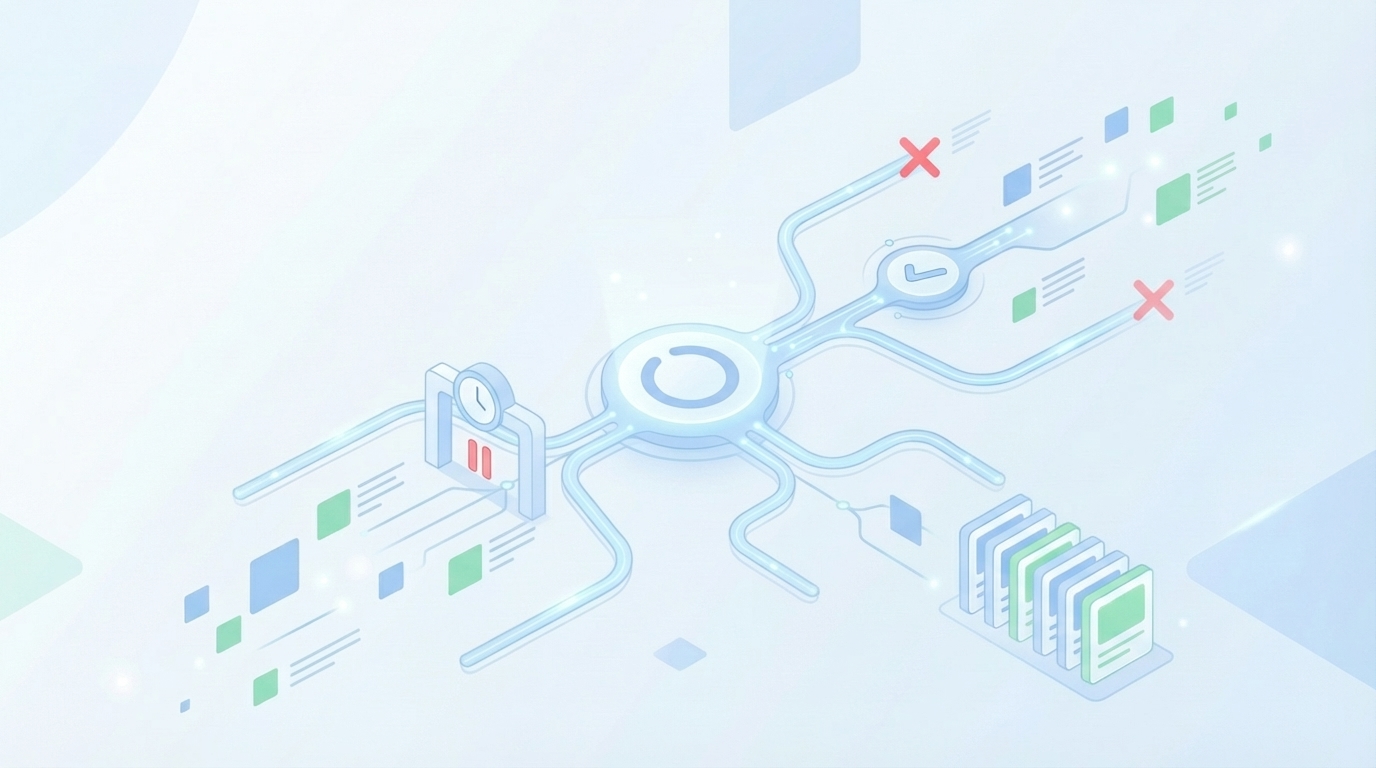
Stop assuming more posts equal more authority. You know the spiral: a draft gets approved because “it’s timely,” then another covers the same question with a slightly different headline, then a third tries a new intro but takes the same angle. Individually fine. Collectively noisy.
Run a simple 90-day audit and tag every article by cluster and search intent. If multiple pieces chase the same intent with similar subheads, they’re competing, not compounding. The fix starts with visibility into cluster coverage, then removing low-gain repeats from the queue. Treat re-coverage as risky by default, not harmless filler.
What is topic saturation and how do you detect it?
Topic saturation happens when a cluster moves from healthy coverage to overlapping duplication, where adding another net-new page lowers overall clarity. You detect it using objective signals: coverage counts, recency, internal link density, and angle similarity. If the indicators trend up together, you’re saturated.
Make the shifts explicit, healthy, well-covered, saturated, so the rule is clear. When saturated, the default is don’t publish a new article unless a cooldown expires or information gain crosses your threshold. No “we’ll see how it ranks.” Your guardrail is the call.
Why information gain should gate new briefs
Information gain gates new briefs because it forces novelty before effort. Score each outline for what’s new relative to your site and the current corpus. Set a minimum threshold. No threshold, no draft.
If a score comes in low, you’ve got three choices: reframe the angle to target a different intent, merge the plan with an existing page, or choose a different topic in the cluster. Don’t proceed on vibes. Proceed on evidence.
Shift From Volume To Cooldown Governance
Shifting from volume to cooldown governance replaces quota thinking with cluster-level rules. You define cooldowns, info gain minimums, and exception triggers by intent, not by date. For example, bottom-of-funnel content may cool down for 60 days, while top-of-funnel sits at 120. Rules beat calendars.
Cluster level rules beat calendar goals
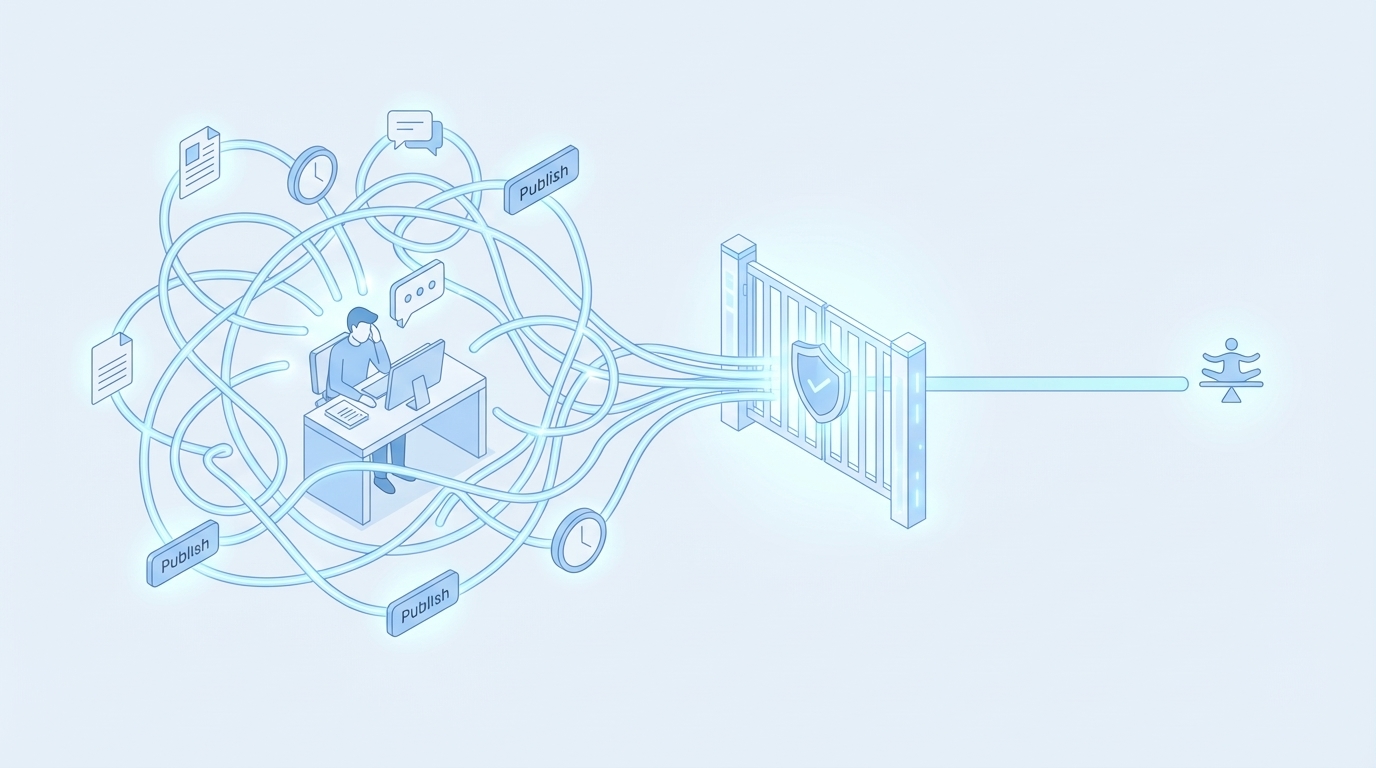
Replace “three posts per week” with cluster policies. Calendars push teams to fill empty boxes; policies protect the integrity of clusters. Create rules per cluster and intent that define default cooldown windows, allowable exceptions, and information gain minimums. Then enforce them.
A practical example: bottom-of-funnel pages can re-open in 60 days if a product change materially shifts the narrative, but only if a higher info gain threshold is met. Broad top-of-funnel content holds at 120 days and requires a unique asset (template, data, diagram) before proceeding. Write it down. Encode it in your workflow.
What traditional calendars miss about re-coverage
Calendars optimize dates, not duplication risk. They rarely encode when not to write. Add a pre-scheduled checkpoint five days before draft start that re-runs saturation signals and information gain. If the cluster turned saturated or a sister post shipped, the calendar doesn’t decide. The rule does.
Kill or postpone the brief unless the new information gain justifies the work. It’s easier to say “we follow the rule” than to debate another “quick” post. Governance saves you from the frustrated rework later.
How do you decide to republish, refresh, or archive?
Use a simple decision matrix. If the target URL exists and the intent still matches, prefer refresh. If intent shifted substantially, republish at the same URL and redirect older variants. If traffic, links, and conversions are near zero and the piece is off-strategy, archive.
Document each call with two one-sentence notes: the information gain rationale and the business impact (pipeline relevance, activation, support deflection, etc.). A paper trail keeps decisions defensible and repeatable. For a broader lens on the discipline behind this, see NN/g on content governance.
The Costs Of Over-Publishing You Can Actually Avoid
Over-publishing burns hours, fragments authority, and increases maintenance. The costs show up in rework, weaker internal linking, and confused signals to search engines. Model the time and the click leakage, even as a hypothetical. Once leaders see the math, the cooldown conversation gets easier.
Engineering hours lost to rework in content teams
Let’s pretend you pay eight hours per article across brief, draft, edit, and publishing. Thirty redundant posts in a quarter is 240 hours lost. That’s a month of senior time you could invest in a pillar refresh, a comparison guide, or product education that maps to pipeline.
Take your last quarter, run the math, and socialize the avoided cost each time cooldowns block low-gain work. This isn’t about saying no to writing. It’s about saying yes to higher-leverage writing.
Cannibalization and diluted internal linking
Multiple near-duplicates fragment authority and confuse internal linking. You end up with weak cross-links and scattered anchors that fight each other. The remedy is consolidation: one definitive URL per intent, and supporting articles pointing to it with consistent anchors.
Add a simple rule: any new draft must include target anchors that reinforce a single primary page per intent. This mirrors both Google’s guidance on duplicate content and practical patterns described by practitioners like Ahrefs on keyword cannibalization. Not perfect, but directionally right.
Let’s pretend you publish 30 extra posts, the math hurts
Model the impact. If each new post cannibalizes 5 percent of clicks from the main page, the flagship article loses 150 percent of its traffic across a cluster. That compounds with diluted backlinks and mixed anchors.
You’re not adding reach. You’re spreading the same demand across more URLs and increasing maintenance. Cooldowns and consolidation are cheaper than a cluster-wide rewrite and months of re-linking. Pick the cheaper path.
The Human Side Of Hitting Publish Too Often
Over-publishing isn’t just an SEO issue; it’s a team issue. Late nights. Slack pings. “Quick takes” that weren’t quick. Add rules that reduce decision fatigue when energy is low or pressure is high. Guardrails protect quality and morale.
The 3 a.m. incident no one needed
We’ve all shipped a hot take at midnight that created morning rework. Add a stop rule for after-hours publishing on saturated topics. If urgency is emotional, sleep on it. In the morning, run information gain and a quick saturation check.
Most of those pieces don’t survive the light of day. Which is good. Your team gets its time back and your site stays coherent. That’s the point.
When leadership asks for one more take
Say yes to the outcome, not the copy. Offer a refresh of the canonical page, a new section that addresses the angle, or a CTA module that spotlights the announcement. If a net-new post is still required, timebox an exception with a documented reason, the planned redirect, and the date it will be merged into the canonical asset.
Make the tradeoff visible. It turns a soft “no” into a structured “yes, and here’s how we avoid fragmentation.”
When should you override a cooldown?
Set a small list of exception triggers: product GA, security incidents, major PR, or legal changes. Even then, require a one-paragraph rationale, an information gain check, and a plan to consolidate within 30 to 60 days. Exceptions should be logged, visible, and rare.
If they’re not rare, your rules need a rethink or your portfolio needs new pillars. The signal is telling you something. Listen to it.
Tired of manual guardrails and negotiation cycles? Try Using An Autonomous Content Engine For Always-On Publishing.
The 90-Day Content Cooldown Framework You Can Run Now
A 90-day cooldown framework prevents duplication and keeps clusters healthy. It hinges on daily detection, cluster-specific rules, information gain gating, and workflow enforcement. Start simple. Iterate as your portfolio grows.
Detect saturation with objective signals and automated checks
Stand up a daily detection pass. Pull cluster coverage counts, last-publish dates, angle similarity, and current internal link targets. Label clusters as underserved, healthy, well-covered, or saturated so everyone sees the same truth. Visibility cuts debate.
If a proposed brief targets a saturated cluster, block it until after the cooldown or raise the information gain bar. Store results in a simple log so decisions have context and history. Make it boring to over-publish.
Design 90-day, cluster specific cooldown rules
Start with a 90-day default. Then tune. Bottom-of-funnel or product-change topics can drop to 60 days with stricter information gain thresholds. Evergreen top-of-funnel often extends to 120 days. The unit of governance is the cluster, not the calendar week.
Encode rules by cluster and intent, including exception triggers and who can approve them. The output is a short policy your workflow can enforce without manual debate. Policy removes the need for perfect judgment in every meeting.
Gate every brief with information gain before writing
Make briefing the gate, not an optional step. Score novelty versus your site and top-ranking coverage. Require a minimum score, a list of new subtopics, and at least one unique asset like a template, data point, or diagram.
If a brief fails, reframe the angle to hit a different intent, or swap topics. No draft begins without passing the gate. Ever. Your future self will thank you.
Enforce rules inside your editorial and tooling workflow
Bake rules into the tools. Add a cooldown field to your CMS or project board. Auto-calculate next eligible date per cluster. Insert a pre-write checklist with the information gain score and target URL decision.
Push duplicate detection into QA so duplicates can’t publish. Log exceptions with a reason and planned consolidation date. Governance lives in the workflow, not a slide.
How Oleno Automates Cooldowns, Gating, And No-Repeat Publishing
Oleno automates cooldowns and no-repeat publishing by making rules executable. Topic Universe maps clusters and enforces cooloffs, Information Gain Scoring blocks low-value outlines, and QA plus publishing checks prevent duplicates at the end. You get fewer debates, cleaner clusters, and stronger canonical pages.
Topic Universe enforces cooldowns and shows saturation at a glance
Oleno’s Topic Universe maps your topic landscape, tracks coverage, and labels clusters as underserved, healthy, well-covered, or saturated. It enforces a 90-day cooldown before re-covering the same topic, so duplicate ideas don’t slip into the queue “by accident.” You see the state. The system applies the rule.
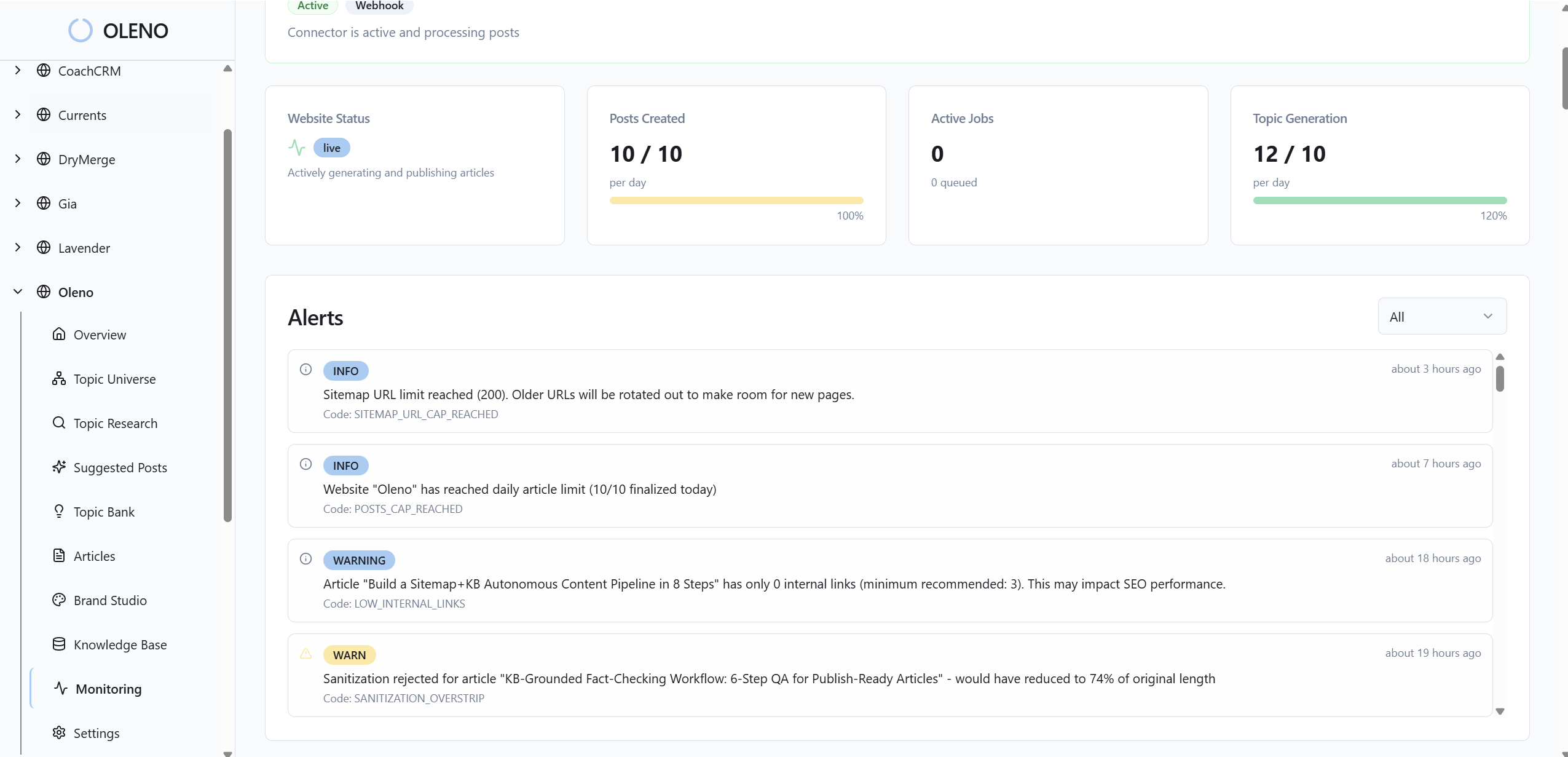
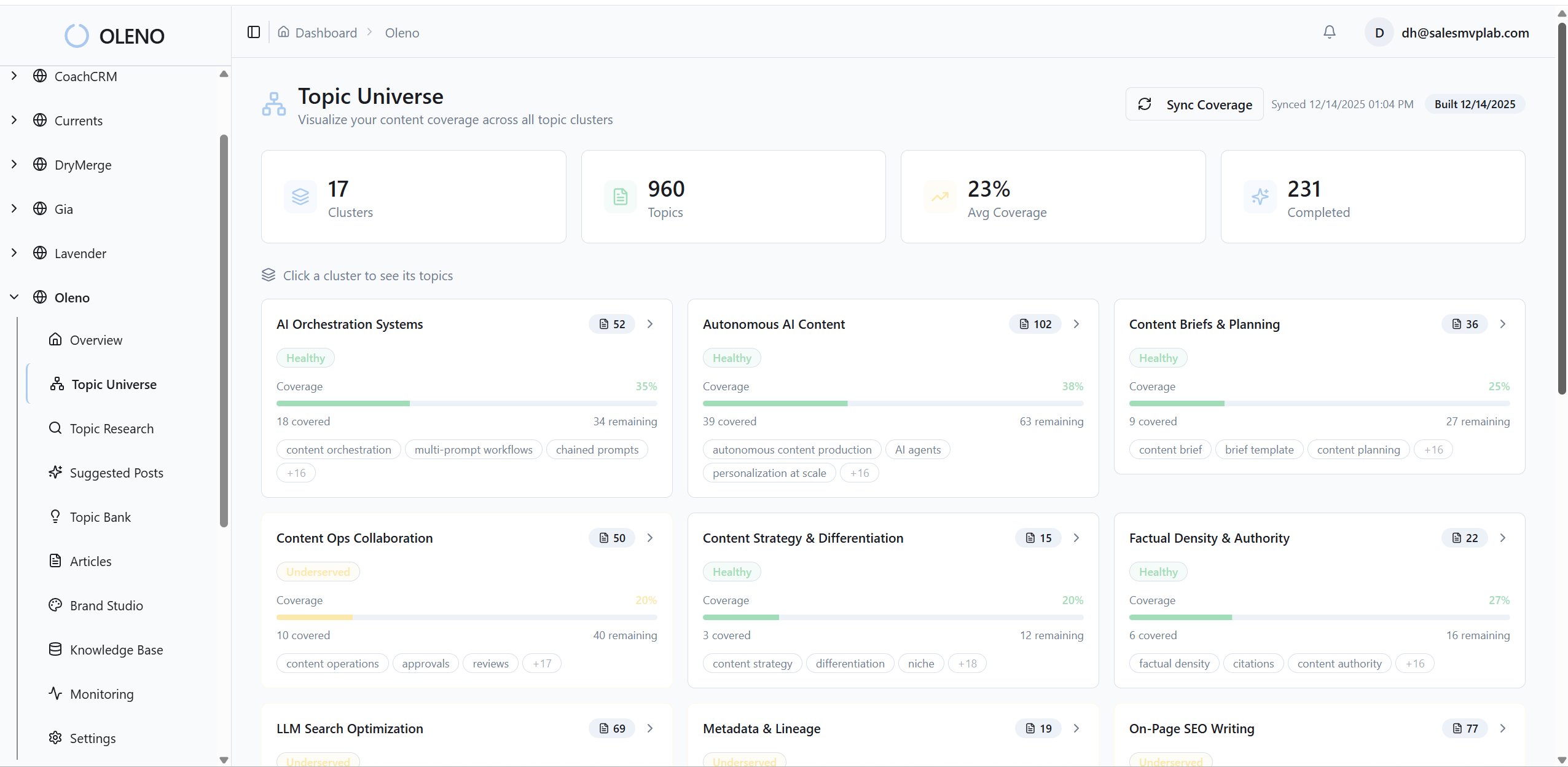
Because Topic Universe focuses on coverage and saturation, not rankings or dashboards, you get decisions grounded in what strengthens authority over time. The net effect is simple: more time spent on gaps that build authority, less time spent on repeats that dilute it.
Information Gain Scoring blocks low value outlines before drafting
Oleno’s Brief Generation runs competitive research and calculates an Information Gain Score before anyone writes. Low-differentiation outlines are flagged, and you can raise thresholds for saturated clusters or time-sensitive categories. The gate is objective and visible.
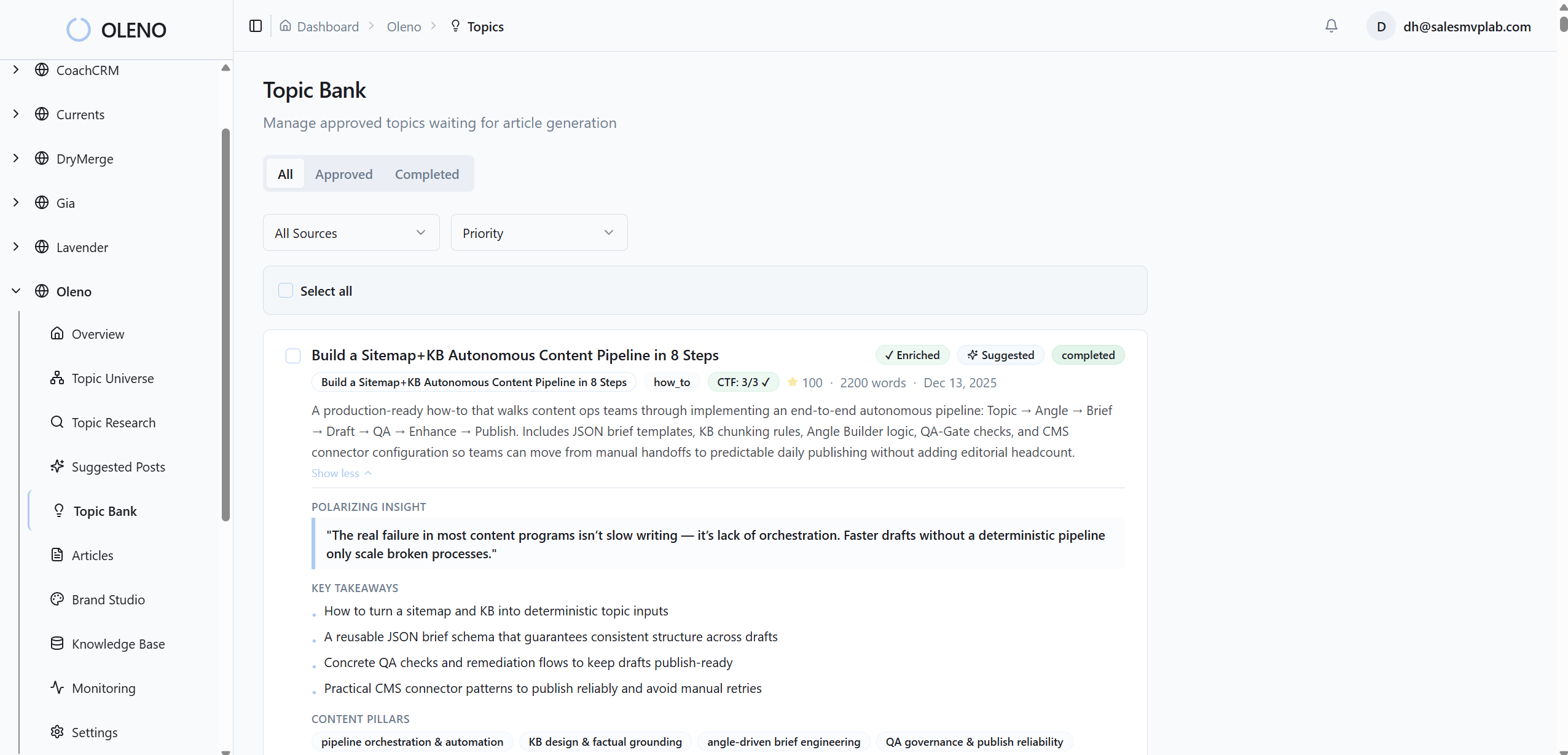
Practically, this saves hours and reduces rework. When a brief pauses or merges into an existing URL, stakeholders see the reason immediately. Oleno makes novelty a precondition, not a hope.
QA and publishing checks prevent duplicates and normalize structure
Oleno’s QA Gate evaluates content against 80+ criteria, structure, clarity, brand alignment, snippet readiness, and information gain, then refines until standards are met. On delivery, publishing connectors convert markdown to CMS-ready HTML, map fields automatically, and prevent duplicate posts.
Deterministic internal linking and auto-generated schema help consolidate equity around your canonical pages instead of leaking it across variants. Together, these controls reduce editing loops and keep your architecture coherent under pressure. Want this running in the background while your team focuses on strategy? Try Oleno For Free.
Conclusion
You don’t need more content. You need fewer, stronger pages that say something new and own their intent. Cooldowns, information gain gating, and workflow enforcement make that routine instead of heroic. Put the rules in place once. Let them run. Then watch authority compound, quarter after quarter.
About Daniel Hebert
I'm the founder of Oleno, SalesMVP Lab, and yourLumira. Been working in B2B SaaS in both sales and marketing leadership for 13+ years. I specialize in building revenue engines from the ground up. Over the years, I've codified writing frameworks, which are now powering Oleno.
Frequently Asked Questions