If Every Segment Has Its Own Copy, You Have No Brand

When you have 3 segments and 3 freelancers, you don’t have tailored messaging. You have 9 different chances for your brand to drift. If every segment has its own copy, you probably felt this pain this week: one draft sounded too generic, another sounded too salesy, and a third was technically right but somehow still not you.
Demand-gen content execution platform is a governed demand-generation system that turns approved strategy, audience context, and product truth into consistent published content by operationalizing execution within fixed marketing rules instead of relying on prompts, handoffs, and manual review loops. Unlike a generic AI writing tool, this category keeps strategic control upstream and lets variation happen inside boundaries, not outside them.
Key Takeaways:
- Segment-specific messaging is useful. Segment-specific brand reinvention is not.
- The real enemy is the Strategy-Execution Trade-off: move fast and drift, or preserve quality and slow to a crawl.
- If every segment has its own copy and every audience version requires fresh human judgment, your process usually breaks once you’re trying to manage more than 8-10 active assets at once.
- GEO rewards repeated brand signals across many surfaces, not isolated personalized pieces.
- Good variation changes examples, objections, and context. It doesn’t change your core story.
Brand Fragmentation Usually Starts Before Anyone Opens the Draft
If every segment has its own copy, the problem rarely starts in the doc itself. It starts upstream, when strategy gets split into different briefs, different prompts, different freelancers, and different review instincts before anyone writes a line.

A lot of teams think brand inconsistency shows up in the final draft. It usually starts much earlier. It starts when every segment gets its own brief, its own prompt, its own freelancer, its own review style, and its own interpretation of what the company is trying to say.
That sounds organized on paper. In practice, it creates a version-control problem for your narrative. Not a writing problem. A system problem.
Personalization Without Rules Turns Into Narrative Drift
Most marketers want the same thing here. They want content that feels relevant to the segment without sounding generic. Fair point. You should want that. A founder buying software doesn’t think like a PMM. A Head of Content at a growth-stage SaaS won’t use the same language as an enterprise CMO.
Picture a Tuesday morning. A PMM opens Notion, a freelancer opens a Google Doc, and someone else pastes a prompt into ChatGPT. By Thursday, you have three drafts for three audiences, each using a different problem statement, a different product definition, and a different tone. Nothing is obviously broken. Which is exactly why this slips through.
The trouble starts when relevance gets built through separate creative interpretation every single time. One writer leans into pain points. Another leans into features. A third writer uses a tone that feels more polished than practical. Nobody meant to break the brand. They just each made a series of reasonable local decisions. That’s how drift happens.
Prompting makes this worse, not better, if there’s no governing system behind it. Prompts treat each piece like a standalone event. Demand gen isn’t standalone work. It’s cumulative. Every page, post, comparison, and article teaches the market who you are. If those signals disagree, you’re training the market to stay confused.
That’s why this isn’t just a messaging headache. It’s a visibility problem too. In the GEO era, LLMs don’t just read one page. They synthesize patterns across many. If your positioning shifts from asset to asset, they have less reason to trust your brand as a stable source.
You can pressure-test whether segmentation is helping or hurting with a quick check on your last 10 pieces. Do they describe the same problem the same way? Do they use the same product definition within a sentence or two? Would a prospect recognize them as coming from one company if your logo disappeared? Miss on 2 of those 3 and you don’t have segmented relevance. You have fragmented execution.
That’s the first tell. The second is worse: once drift starts upstream, review becomes your only safety net. And that’s where the Strategy-Execution Trade-off takes over.
Most Teams Aren’t Tailoring Content, They’re Rebuilding The Brand Repeatedly
Back in 2012-2016 I ran a website that got to 120k unique visitors a month. We had 80 regular contributors and 300+ guest contributors. So I’m not anti-volume. Not even close. I’ve seen firsthand that breadth plus depth can compound hard, especially once you start crossing page-count thresholds like 500, 1000, 2500, 5000, then 10000.
But there’s a catch. Volume only compounds when the center holds.
At that site, the topic range was wide, but the publishing engine still had a shape to it. There was enough structure that contributors expanded coverage without blowing up the whole editorial identity. Later, on smaller SaaS teams, I saw the opposite. One writer lacked the product context. Another needed a longer brief. Then I had less time to write because I was in meetings and running the team. Output slowed down, and quality slipped at the same time. Brutal combo.
That’s the hidden cost of segmented copy when each segment gets its own process. You’re not creating variations of one brand. You’re rebuilding the brand from scratch for every audience, every time. And that only works if the person doing the rebuild has all the context in their head. Usually, they don’t.
Here’s a blunt rule. If every segment has its own copy and each version needs a fresh kickoff, fresh positioning judgment, and fresh cleanup from a senior marketer, the process is already too expensive. Below 3 segments, you can sometimes muscle through it. At 4 or more active segments, the coordination cost usually grows faster than the return.
A lot of heads of marketing know this instinctively. They read a draft and say, “It’s close.” That word, close, is doing a lot of work. Close means the process failed to carry strategy into execution. Close means you still have to bridge the gap yourself. Close means you are the system.
And when you are the system, scale is fake. More output just means more cleanup.
In GEO, Mixed Signals Hurt More Than No Signals
What happens when your blog says one thing, your comparison pages say another, and your thought leadership sounds like a third company entirely?
You don’t just get weaker conversion. You get weaker market memory.
The GEO shift changed what good content looks like. SEO let some teams win on tactics for a long time. Rank for a query. Build enough pages. Tighten on-page basics. That still matters. But LLM visibility asks a different question: is this brand clear enough, specific enough, and consistent enough to cite? That’s a tougher bar.
According to Google’s documentation on AI-generated search experiences and helpful content guidance, consistency, usefulness, and people-first substance still matter a lot in how content gets surfaced and evaluated (Google Search Central). And retrieval systems generally perform better when source material uses stable concepts and definitions. Microsoft’s guidance on grounding and retrieval points to the same pattern: better source consistency improves answer quality (Microsoft Azure AI documentation).
Now, to be fair, inconsistent wording alone won’t tank an otherwise strong brand. A great company can survive some messy content. That’s true. The issue is what happens when inconsistency becomes the norm across dozens or hundreds of assets. Then the market stops seeing variation and starts seeing vagueness.
A lot of teams underestimate this because they evaluate pieces one by one. One article looks fine. One landing page looks fine. One social thread looks fine. But the market doesn’t consume your brand one asset at a time. It absorbs the average of all your signals. And averages tell the truth.
So silence isn’t your only risk now. Contradiction is. Which sets up the next question: why do teams still act like relevance and consistency have to compete?
The Real Trap Is Thinking Relevance And Consistency Compete
If every segment has its own copy, teams usually think they’re making a smart trade: more personalization in exchange for a little messiness. What they’re actually doing is treating relevance and consistency like opposing forces when they should be produced by the same system.
The market treats this like a copywriting debate. One side argues for strong brand consistency. The other argues for deep segmentation and personalization. Both are partly right, which is why this trap sticks around.
The real problem is the false choice underneath it.
Segment Relevance Should Flow From Strategy, Not Replace It
Segment relevance should be downstream of strategy, not a rewrite of it.
That sounds obvious. It rarely shows up that way in the workflow. A team starts with a broad narrative. Then they create a version for fintech. Another for healthcare. Another for founders. Another for PMMs. Pretty soon, every version has its own logic, examples, urgency, and tone. The brand core gets negotiated in every draft instead of decided once.
This is not a copywriting problem. It’s an execution architecture problem. If your strategy lives in slide decks, Notion docs, message houses, and one smart marketer’s brain, it will degrade the second output gets distributed across contributors. The more segments you add, the more times your core story gets reinterpreted.
A better rule is simple. Keep 70-80% of the narrative fixed across segments. Let the remaining 20-30% vary based on audience pain, use case, objection handling, examples, and language preference. If more than a third of the asset changes, you’re probably not tailoring. You’re repositioning.
There are exceptions. Early-stage companies still figuring out who buys often need to test wider message variation. That’s valid. I’d argue that once you’re past early product-market fit, that freedom becomes a liability. Past roughly $20k MRR, fuzzy positioning usually stops being charming and starts becoming expensive.
Not personalization versus consistency. Strategy first, variation second. That’s the real split.
Manual Review Protects Quality By Slowing The Whole System
If your Head of Marketing spends more than 5 hours a week fixing “almost right” drafts, you don’t have a writing issue. You have an execution bottleneck.
Manual review feels responsible because it catches mistakes. And it does. I’m not going to pretend human review has no value. It has a lot of value, especially for new messaging, product launches, and category work. The problem is where it sits in the system. If quality only appears at the end, senior people become permanent editors.
That is the Strategy-Execution Trade-off in plain English. You either protect quality through manual review, which doesn’t scale, or you move faster with AI and accept drift from voice, positioning, and product truth. Different tools package it differently. Same trap.
Agencies don’t solve it. You still brief them. Freelancers don’t solve it. You still context-load them. Generic AI writers don’t solve it. You still prompt, inspect, revise, and reprompt. Hiring more writers doesn’t solve it either if the leader still has to be the final translator between strategy and output.
Here’s the threshold I’d use. If review cycles are taking longer than 72 hours from draft to approval, stop adding reviewers. Every extra person after two usually adds preference conflict faster than it adds quality. Shift the work upstream into clearer rules, approved claims, and tighter audience inputs.
I’ve seen this movie a few times. When one person still holds the company story in their head, scaling output just scales review debt. That’s why the bottleneck isn’t content volume or prompts. It’s fragmented execution without a system.
Faster Drafting Didn’t Fix The Operating Problem
AI made the first draft faster. It did not make demand gen run.
That’s the part a lot of teams discover the hard way. They get excited because a draft appears in minutes instead of hours. For ad hoc tasks, that’s genuinely useful. For ongoing demand generation, the draft is the easy part.
The hard part is deciding what should exist, keeping it aligned to one point of view, adapting it correctly for each audience, checking product accuracy, publishing consistently, and making sure the whole thing compounds instead of contradicts itself. AI can generate text. Humans still carry the system unless the system itself is designed.
Think of it like a kitchen line during a dinner rush. A faster knife doesn’t fix a bad ticketing system, missing prep, or no one owning the pass. You’ll produce food faster, sure. You’ll also ship the wrong orders faster. Same with content ops. Same with demand gen.
One founder I talked to was juggling multiple GPTs, copy-pasting prompts, manually moving output into the CMS, and burning 3-4 hours a day on the loop. For a minute it felt efficient. Then the math got ugly. If every segment has its own copy and every asset still needs manual orchestration, faster drafting just means you arrive at the bottleneck sooner.
This is where a lot of teams hit the wall. They bought speed, but they kept all the coordination cost. That’s debt with a nice interface.
The Bill Shows Up In Time, Rewrites, And Weak Market Memory
If every segment has its own copy, the cost doesn’t stay theoretical for long. It lands in calendars, edit queues, delayed campaigns, and a market that can’t quite remember what you stand for.
The cost of fragmented segment copy isn’t abstract. It lands in weekly calendars, review queues, budget meetings, and eventually pipeline.
Every New Segment Adds Coordination Before It Adds Return
Let’s pretend you have 4 core audience segments, 2 funnel stages per segment, and 3 major campaigns this quarter. That’s 24 content variants before you even get into channels. If each asset needs a brief, draft, review, revisions, approval, and publish step, the workload grows way faster than most teams expect.
Now add just 45 minutes of review and revision per piece. You’ve created 18 hours of coordination time before measuring results. If the real number is 90 minutes, which isn’t rare once positioning gets fuzzy, that’s 36 hours. Nearly a full work week. Gone.
This is why growth-stage teams feel stuck. They aren’t lazy. They aren’t short on ideas. They’re carrying a system where every new segment multiplies handoffs. So the team looks busy, content still ships inconsistently, and quarter after quarter feels like a reset.
One practical diagnostic helps here. Count how many people touch a typical segmented asset before publish. If the answer is 4 or more, reduce it. At 4+ touches, latency usually grows faster than quality. In small teams, 2 reviewers is usually the ceiling. After that, extra review mostly catches preference conflicts, not actual errors.
That’s the hidden invoice. More segments don’t just create more content. They create more coordination, and coordination is where speed dies first.
The Editing Loop Eats Senior Marketing Time First
At one SaaS company, we had great writers and strong design. We ranked really well for a lot of topics. But the content sat too far from the solution, so it was hard to tie back to pipeline. We won traffic and lost narrative. That’s a painful trade.
You see the same thing in review loops. The first draft is decent. The second draft gets closer. Then the Head of Marketing steps in to fix positioning, sharpen the pain, pull it toward the product, remove vague claims, and make it sound like the company again. One “quick pass” turns into 30 minutes. Then 45. Then an hour because the piece was aimed at the wrong version of the audience to begin with.
This is where senior marketing time disappears. Not in big strategy offsites. In a thousand tiny corrections.
And once that leader becomes the cleanup layer, the whole team starts depending on it. Writers write looser because edits will come later. Reviewers get less precise because someone senior will catch it. The system quietly trains everyone to pass ambiguity downstream.
If you want a red-flag checklist, look for these signals before your dashboard tells you anything:
- Drafts are often described as “close”
- The same product explanation gets rewritten every week
- Segment-specific pieces use different language for the same core problem
- One leader is still the final voice check on most assets
- Publishing slows every time that person gets busy
That’s not a talent issue. That’s the editing tax.
Weak Brand Signals Make You Harder To Cite And Harder To Trust
What does “too late” look like when brand inconsistency spills into discoverability?
It looks like this. Your site has good content. Your team has clear intent. But your acquisition articles frame the problem one way, your bottom-of-funnel pages frame it another way, and your executive thought leadership uses a third angle entirely. Nothing is wildly wrong. It just doesn’t reinforce.
LLMs notice that faster than a human buyer does. They look for stable definitions, repeated claims, specific audience framing, and consistent product descriptions. If your signals disagree, you become harder to summarize. If you’re harder to summarize, you’re easier to skip.
Honestly, this surprised a lot of people more than anything else. We got used to evaluating content as isolated assets. GEO pushes you to evaluate your whole corpus like a memory system. Repetition is no longer redundancy. It’s evidence.
And if every segment has its own copy with a different center of gravity, the model doesn’t see a focused company. It sees noise wearing a logo.
What It Feels Like When You’re Still Carrying The Brand In Your Head
You become the brand police because the process can’t hold the line. Every draft is almost right, which is another way of saying not right enough to publish without you. Every freelancer needs re-briefing. Every AI draft needs re-anchoring. Every quarter feels like a fresh start because the system never actually captured the strategy. If you’re the Head of Marketing on a 1-3 person team, that’s the exhausting part. Not the writing. The constant translation.
One Brand System, Different Expressions
If every segment has its own copy, the fix is not to kill segmentation. The fix is to stop letting segmentation behave like brand reinvention. You need one operating system for the story, then controlled variation inside it.
The alternative is not one generic message for everyone. That would be lazy. The alternative is one brand system with controlled variation.
This is where the category matters. A demand-gen content execution platform emerged because GEO made ad hoc content operations too fragile to trust at scale. When the old approach depends on prompts, handoffs, and repeated human interpretation, adding audiences doesn’t create leverage. It creates more ways to drift.
Before the H3s, here’s the model in plain English:
- Governance First: Strategy, voice, product truth, and audience definitions are set before generation so execution stays inside approved boundaries.
- Controlled Variation: Segment-specific content adapts examples, objections, and framing without changing the core narrative or point of view.
- Systemic Execution: Planning, creation, review, and publishing run as one repeatable system instead of disconnected tasks.
| Dimension | Old Way | Category Way |
|---|---|---|
| Brand consistency | Each segment gets rewritten through separate prompts, people, or vendors | Core positioning and voice stay fixed across variations |
| Speed vs control | Teams choose fast output with drift or slow output with review bottlenecks | Teams execute quickly inside strategic boundaries |
| Audience targeting | Relevance comes from ad hoc customization | Relevance comes from controlled variation tied to defined audiences |
| Review process | Senior marketers manually catch drift and weak positioning | Rules reduce rework before content reaches review |
| GEO readiness | Mixed signals make authority harder for LLMs to detect | Repeated signals strengthen citation and visibility |
| Budget efficiency | Output gets rewritten, reset, or lost in handoffs | Content compounds because execution stays aligned |
The Brand Should Stay Fixed Even When The Examples Change
A brand system needs invariants. That’s the first principle.
Your core problem statement, category framing, product definition, claims you can defend, tone boundaries, and point of view should not swing wildly by segment. Those are the rails. What can vary are the examples, the stakes, the objections, the workflow details, and sometimes the order in which you explain the same truth.
A simple way to build this manually is to create two columns. In the left column, list 5-7 things that must stay fixed in every asset. In the right column, list 5-7 things that are allowed to vary by audience. If the fixed column is fuzzy, stop publishing and tighten it first. If the variable column is empty, your segmented content will feel generic.
This is also where people overcorrect. Some teams hear “consistency” and flatten everything. Fair point, that can happen. The goal isn’t rigid sameness. The goal is recognizable sameness. Big difference.
The market should feel like it’s hearing one company talk to different people, not different companies borrowing the same category.
Good Variation Changes Context, Not Conviction
For most growth-stage SaaS teams, 3 audience inputs are enough to create useful variation without causing drift: industry context, role-specific pain, and primary use case. Beyond that, complexity usually rises faster than clarity.
If you’re writing for a founder versus a Head of Marketing, the opening problem can change. The stakes can change. The examples definitely should change. The founder may care about wasted budget and speed to pipeline. The Head of Marketing may care more about review loops, team coordination, and proving ROI. Same brand. Same product truth. Different entry point.
That’s what controlled variation looks like. You aren’t changing conviction. You’re changing route.
One concrete test helps here. Hand two segmented drafts to someone outside the company and ask: do these sound like the same brand speaking to two different people, or two different brands talking about a similar product? If they choose option two, your variation has gone too far.
The teams that do this well usually encode audience realities before they generate content. They don’t leave audience nuance to whoever happens to touch the prompt last. That one shift changes everything.
Strong Teams Operationalize Judgment Before They Scale Output
Weak systems rely on heroic judgment at the end. Strong systems operationalize judgment at the start.
That’s the whole game.
Back when output from a single expert was enough, you could get away with tribal knowledge. One smart marketer held the tone, the positioning, the product nuance, and the audience context. Once the team grows, or once volume grows, that breaks. Fast.
So what do category leaders do instead? They define the decision rules first.
Use this maturity check:
- Can everyone on the team explain your category in one sentence?
- Do you have approved product claims and clear boundaries on what not to say?
- Can a writer tell the difference between what changes by segment and what never changes?
- Do your last 20 assets reinforce one market point of view?
- Can content publish on cadence without one leader fixing every draft?
If you answer no to 3 or more, you don’t need more prompts. You need a system.
That sounds blunt. It’s meant to. Because this is one of those areas where nicer language tends to hide the problem. And the payoff is real. One experienced SEO consultant reviewed Oleno output and said it passed the slop test. That matters because content leaders know exactly what slop looks like. A piece that passes on first read usually came from strong upstream rules, not just a lucky draft.
How Oleno Turns Strategy Into Repeatable Output
Oleno shows what this category looks like in practice. Instead of asking humans to remember the strategy on every asset, it turns strategy, audience context, and product truth into execution rules the workflow can actually use.
Oleno Moves Strategy Out Of Docs And Into The Workflow
Oleno uses brand studio, marketing studio, and product studio to capture how you sound, what you believe, and what is true about the product. That’s a big shift. Strategy stops being reference material and starts becoming execution input.
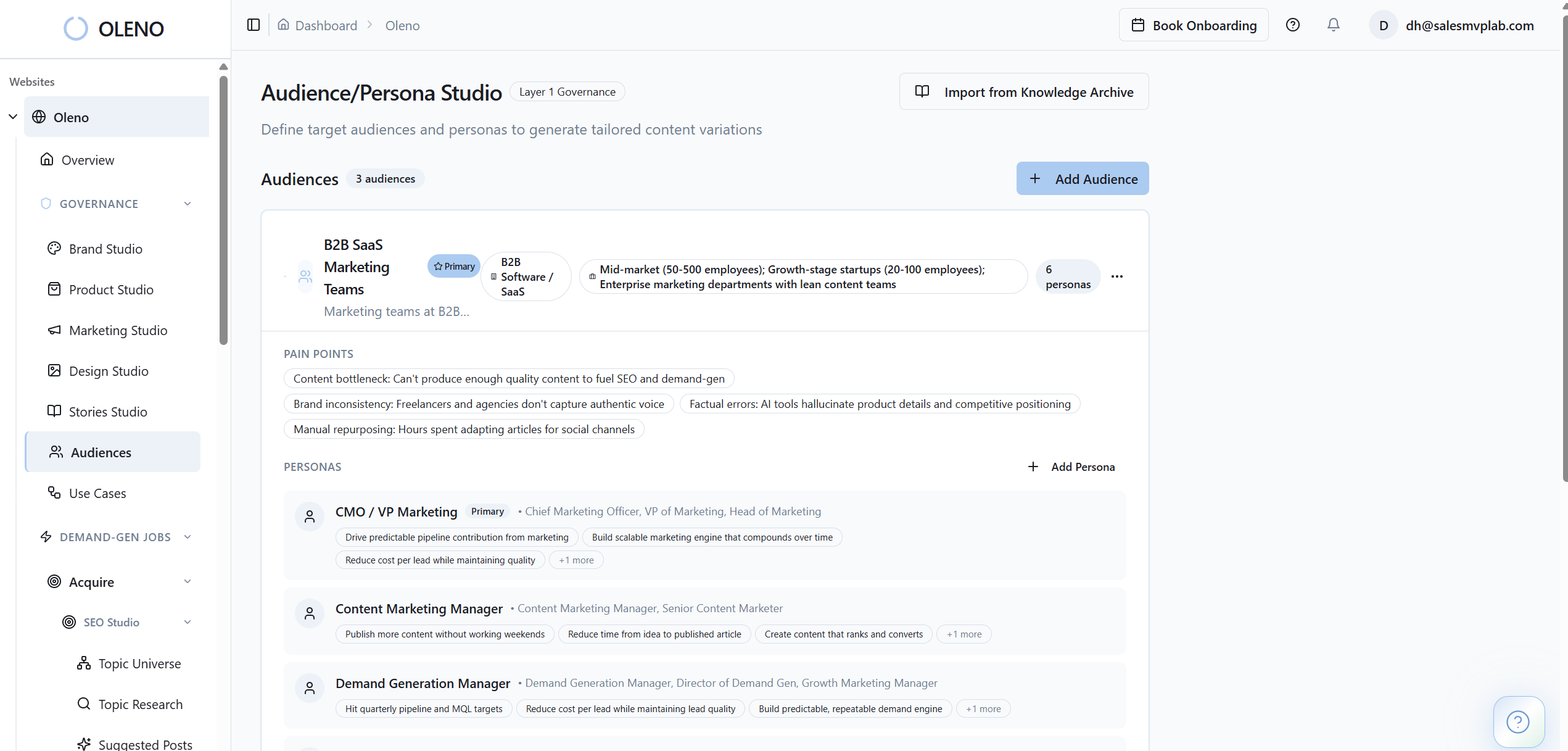
Then audience & persona targeting and use case studio shape how the same topic should be expressed for different roles, company types, and workflows. So a topic can change for a founder versus a Head of Marketing without changing the underlying narrative. That’s the difference between useful segmentation and brand drift.
This also cuts review load in a very practical way. Product studio gives the system approved product descriptions and boundaries, which lowers the odds of invented claims or off-message explanations showing up in the draft. You still keep human judgment. You just stop spending it on preventable corrections.
If you want to see what governed execution looks like when strategy is built into the workflow, you can request a demo.
Audience Variation Works Better When The Rules Come First
The system is designed so variation happens after the core rules are set, not before. That’s why storyboard, orchestrator, and the content studios matter together. Planning decides what should exist. The governed inputs shape how it should sound and what it can say. Then the job types execute on that foundation.
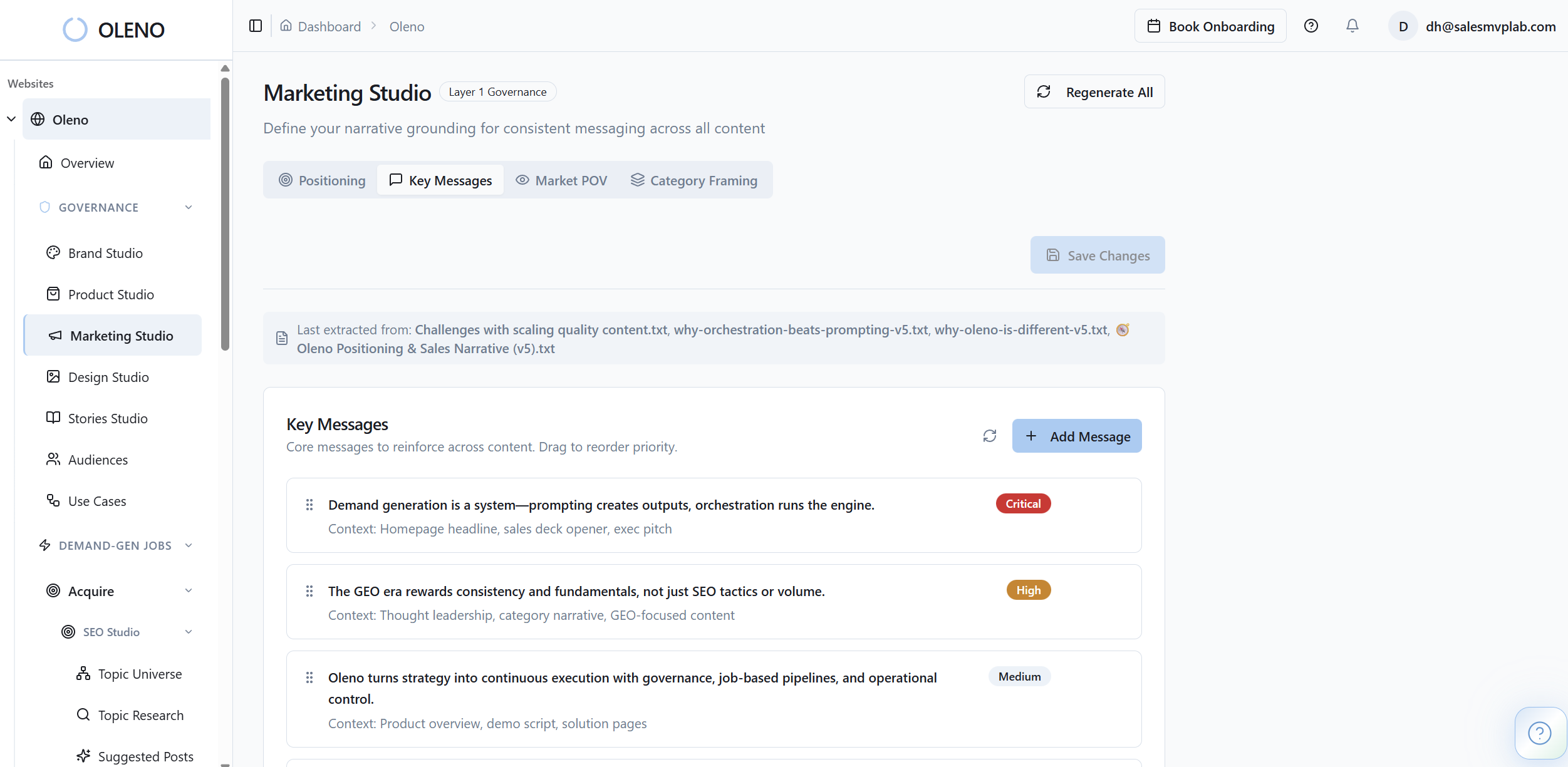
For growth-stage teams, that usually means less re-briefing and fewer “make this sound like us” edits. Programmatic seo studio, category studio, buyer enablement studio, and product marketing studio can all pull from the same center instead of inventing their own version of the brand.
One customer reaction summed up the value better than a feature list could. After seeing the output, Anders Uhl said, “This is like adding 3 people to my team.” I like that quote because it captures the practical outcome. Not theory. Not shiny AI copy. More real output capacity without adding three more coordination problems.
The Goal Isn’t More Copy, It’s Stronger Market Presence
More copy by itself doesn’t matter much. More aligned copy does.
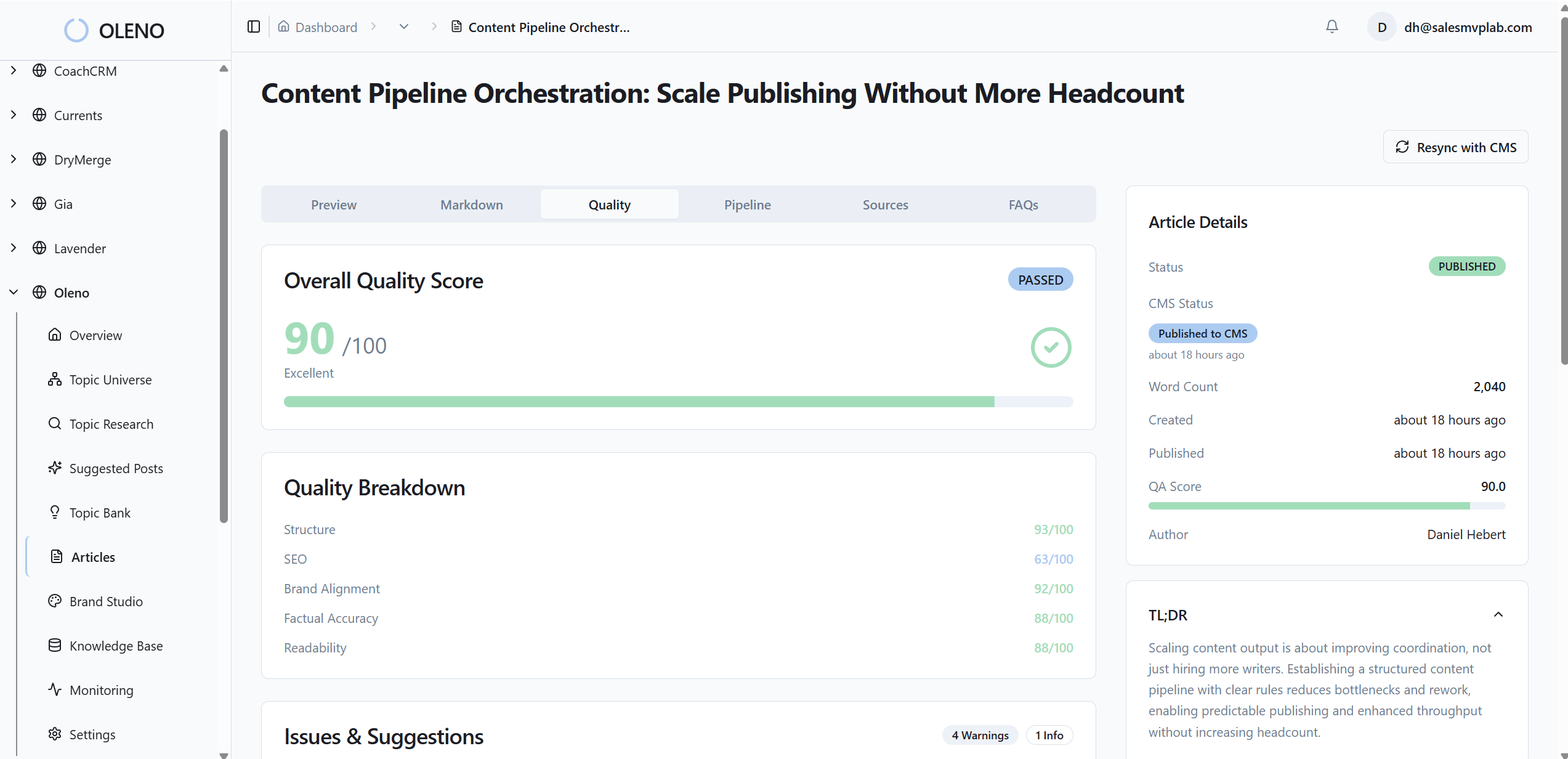
Oleno’s quality gate checks content before it reaches the review queue, and cms publishing closes the loop to get approved work live without another copy-paste chain. That matters because consistency only compounds when good content actually gets published on cadence. Content refresh & drift monitoring also matters once you have a library, because old content can quietly drift out of alignment even if the new stuff is solid.
And if your team wants visibility into what’s shipping, where coverage gaps exist, and how the pipeline is performing, executive dashboard gives that operating view without forcing the Head of Marketing to micromanage every step.
The point isn’t to produce more words. It’s to make sure the market keeps hearing the same clear story often enough, across enough surfaces, that your brand becomes easy to remember and easy to cite.
One Brand, Many Segments, No Reinvention
If every segment has its own copy, you don’t have a segmentation win. You have a brand control problem. The answer is not less relevance. It’s one brand system that decides what stays fixed, what can flex, and how execution happens without making the Head of Marketing carry the whole thing.
Segmented messaging isn’t the problem. The problem is rebuilding the brand every time you segment. Once you see that, the path gets clearer. Fix the system first. Define what stays fixed. Define what’s allowed to vary. Then publish from one brand core instead of a pile of local interpretations.
That’s how content starts to compound. Not because you wrote more. Because the market kept hearing the same clear story from different angles.
About Daniel Hebert
I'm the founder of Oleno, SalesMVP Lab, and yourLumira. Been working in B2B SaaS in both sales and marketing leadership for 13+ years. I specialize in building revenue engines from the ground up. Over the years, I've codified writing frameworks, which are now powering Oleno.
Frequently Asked Questions