If You Scale Content, You Will Scale Inconsistency

If you scale content before fixing the system, you usually scale the mess first. You felt this recently if your week got eaten by rewrites, context-setting, and trying to make five different pieces sound like they came from one company.
Demand-generation content execution software is a governed content operations category that turns positioning, product truth, audience context, and brand rules into repeatable demand-generation output by coordinating planning, creation, QA, and publishing as one system. Unlike AI writing tools or SEO platforms, demand-generation content execution software is built to make your whole go-to-market signal hold together over time, not just generate another draft.
GEO changed the standard. Search used to reward isolated wins. LLM-driven discovery rewards repeated clarity across dozens, then hundreds, of assets. That's why if you scale content without fixing how execution works, you don't really scale content. You scale inconsistency.
Key Takeaways:
- If you scale content without a system, Fragmented Demand Generation gets worse, not better.
- GEO rewards repeated clarity across brand voice, positioning, audience context, and product truth.
- The real bottleneck usually isn't writing speed. It's execution coherence.
- More contributors often means more rework tax unless context is encoded once and reused.
- Strong rankings can still miss pipeline if content isn't tied to a clear demand-gen narrative.
- Category leaders run planning, writing, QA, and publishing as one system, not separate tasks.
- The shift is from prompt-led work to system-led execution.
Why Scaling Content Usually Makes the Underlying Problem Worse
Scaling content makes inconsistency louder. That's the first thing most teams miss. Fragmented Demand Generation already exists long before you notice it in pipeline or AI visibility, because the patchwork feels normal while you're inside it.

A Head of Marketing at a growth-stage SaaS usually isn't dealing with one broken thing. They're dealing with a writer here, a freelancer there, SEO notes in one doc, positioning in someone's head, product facts in Slack, and distribution in another tool. Every individual step can look fine on its own. Put it together, and you get drift.
More Content Does Not Fix Fragmented Demand Generation
Most teams think the answer is more output. More articles. More social posts. More program pages. More comparison pages. But more output only helps if the output compounds. If it doesn't, you're just making more stuff that needs review, more stuff that needs context, more stuff that says roughly the same thing in slightly different ways.
Back in 2012-2016 I ran a site that got to 120k monthly visitors. We saw traffic spikes at 500 pages, then 1000, then 2500, then 5000, then 10000. But that worked because it had both volume and a real point of view across a wide surface area. Volume alone wasn't the trick. Volume plus consistency was.
That's the part a lot of teams skip. They remember the volume. They forget the system underneath it.
Prompting makes this confusion worse because it produces something quickly. And quick output feels like progress. Fair point, prompt-based tools are useful for individual tasks. We use prompts too. But prompt output is not the same as a repeatable demand-gen system, and if you've already got narrative drift, prompting tends to multiply it.
If you want to see what fixing that looks like in practice, you can request a demo.
GEO Punishes Drift That Older Content Systems Could Hide
GEO isn't SEO with a fresh coat of paint. In the SEO era, you could get away with a lot of tactical content if you were disciplined on keyword coverage and links. In the GEO era, engines are synthesizing what your brand means across many sources. That puts pressure on consistency in a way older systems could sometimes hide.
Three audiences are now reading your content at once: humans, search engines, and LLMs. And they all pick up on different signals. Humans notice whether your argument is sharp. Search engines notice whether your structure and topical coverage are strong. LLMs notice whether your company keeps saying the same thing clearly enough to be cited with confidence.
That last part matters more than most teams realize. A brand that publishes 12 loosely aligned posts a month can lose to one that publishes 4 tightly aligned ones, because repeated clarity creates a stronger signal. That's the hidden shift. GEO made marketing fundamentals visible again.
The Real Bottleneck Is Not Drafting Speed But Execution Coherence
AI made drafting faster. It did not make demand generation coherent. That's why so many teams feel weirdly disappointed after adopting AI tools. They got faster text, but not a better system.
I remember hearing April Dunford on a panel years ago after another marketer spent way too long rattling off tactics and tools. Then she cut in with the line that stuck: tactics without strategy are shit. Crude phrasing. Accurate point. Because when positioning is clear, the tactics get clearer. When positioning is muddy, every tactic turns into guesswork.
So what's really happening when a team says content isn't scaling? Usually this:
- They can generate drafts.
- They can't keep the drafts aligned.
- Humans end up carrying the strategy manually.
- Coordination cost starts to exceed creation cost.
That isn't a drafting problem. That's an execution coherence problem. And once you see it, you can't unsee it.
The Market Has Been Solving the Wrong Content Problem
The market spent years trying to solve content production. That's not the wrong instinct. Teams do need to publish more. But production was never the whole problem. The bigger problem was always whether the work held together across channels, contributors, and time.
Most tools solve slices. Writing tools help with copy. SEO tools help with keywords. Agencies help with throughput. Freelancers help fill gaps. Each one can be useful. None of them, by themselves, solve the full demand-gen execution problem.
Content Teams Need a System That Compounds, Not Just More Assets
Content doesn't compound because it exists. It compounds because each new asset reinforces the same market story, reaches the right audience, and connects back to a real buying problem. Without that, each quarter starts to feel like a reset.
You probably know the feeling. New campaign. New brief. New contractor. New messaging doc. New product updates. New angle. And suddenly you're re-explaining the business again to get one article out the door.
At one SaaS company I was the sole marketer and could write 3-4 solid posts a week because I had the context in my head and a framework I trusted. As the team grew, output didn't get easier. It got harder. The writer had less context than I did, took longer, and the drafts came back weaker. More people, but less momentum. That's the Context Gap Rule: if contributor count goes up faster than shared context, inconsistency grows faster than output.
There is a case to be made for staying small and keeping all the context in one person. Early on, that's valid. But once you're trying to scale, that model breaks. It breaks on time first, then quality, then morale.
Prompting Sits on Top of Operational Chaos
Prompting is a tactic layer. That's all. Useful, yes. Sufficient, no.
Prompt-based workflows push judgment back onto the humans. People still have to decide what to create, load the right context, catch inaccuracies, enforce voice, connect the piece to the funnel, and publish it in the right format. So while it feels like leverage, a lot of the real system still lives in meetings, edits, and tribal knowledge.
That's why prompt-heavy teams often end up in a weird place. They can generate lots of text but still don't trust the output. Then review cycles get longer. More stakeholders get pulled in. And the savings disappear into rework.
The old way is basically this:
- prompt from scratch
- patch context in manually
- review for drift
- fix factual issues
- reframe for audience
- publish by hand
- repeat next week
Not much compounds there.
This Is Not Another AI Writing Tool
That distinction matters. A writing tool produces content. A demand-generation execution system produces alignment across content.
For growth-stage SaaS teams, especially the Head of Marketing who is doing strategy in the morning and editing drafts at night, the real need isn't another place to generate copy. It's a way to keep positioning, product truth, audience context, and voice from splitting apart every time a new asset gets created.
This category exists because the old categories were built around tasks. Drafting. SEO scoring. editing. distribution. The newer problem is system-level. Who is this for? Mostly lean B2B SaaS teams who already know what they want the market to believe, but don't have a reliable way to express that at scale without turning reviews into a second job.
And that's the shift. You're not buying more words. You're buying a way for the work to stop resetting.
The Cost of Fragmentation Shows Up Long Before the Dashboard Does
Fragmentation rarely announces itself with one big failure. It leaks. A little more review time here. A slightly off-message article there. A comparison page that ranks but doesn't convert. A social post that sounds like a different company. Then six months later, the team feels busy and the market signal still looks thin.
That's why the cost compounds faster than most people expect.
Every New Contributor Adds Rework Tax When Context Is Missing
Each new contributor should increase capacity. In practice, they often increase review debt first, especially when evaluating if you scale content.
I've seen this up close. At PostBeyond, adding a writer didn't create instant leverage because the writer didn't have the same market context, customer pattern recognition, or product nuance I had in my head. So the output slowed down and quality dropped. Nobody was doing bad work. The system was asking humans to supply too much missing context each time.
You can use a simple threshold here. If a new contributor's draft needs more than 30% rewritten for messaging, audience fit, or product accuracy, your issue isn't talent. It's context transfer. That's the Rewrite Threshold. Above 30%, stop hiring around the problem and encode the context.
Let's pretend a lean team publishes 8 articles a month. If each article takes 45 extra minutes of review because strategy, audience, and product framing weren't embedded upfront, that's 6 hours gone monthly. Add social derivatives, PMM pages, and sales enablement content, and that number gets ugly fast. Small leaks. Big bill.
Strong Rankings Can Still Produce Weak Demand Generation
This one stings because it looks like success from the outside. You rank. Traffic goes up. Everyone feels good. But the demand-gen connection is weak.
I saw that too. We had a strong content team at one company. Great writers. Great designers. We ranked for a lot of stuff. But too much of the content was detached from the product narrative and the buying motion, so there wasn't a clear path from traffic to trial or to pipeline. We won the keyword and missed the demand-gen point.
That happens when content is treated like a channel metric instead of part of a larger market story. Rankings are useful. They're just not the whole game.
Worth noting, not every article needs a product tie-in. Some should educate broadly. That's fair. But if the library as a whole doesn't reinforce what your company does, who it's for, and why your approach is different, the traffic won't carry the business very far.
Scale Turns Small Inconsistencies Into Market-Level Confusion
One inconsistent article isn't a big deal. Fifty are.
That's where Fragmented Demand Generation becomes market confusion. One piece says you're for mid-market teams. Another sounds founder-led and startup scrappy. Another pushes product-led use cases. Another reads like a generic SEO agency wrote it. The market starts getting mixed signals, and LLMs do too.
This is the core comparison:
| Dimension | Fragmented Demand Generation | Demand-Generation Content Execution Software |
|---|---|---|
| Strategic Source Of Truth | Messaging lives across briefs, prompts, docs, and people | Strategy is encoded once and applied across outputs |
| Content Creation Model | Each asset starts from scratch with manual prompting and reviews | Content comes from governed context and repeatable workflows |
| Quality Control | Humans catch drift late through editing and meetings | Drift gets reduced before draft and before publish |
| Market Signal | Voice, POV, and product framing vary by author and channel | Repeated clarity builds a stronger signal for search and LLMs |
| Team Efficiency | Coordination cost rises with every contributor and campaign | Output grows without matching handoff overhead |
| Demand-Gen Impact | Rankings, volume, and pipeline connection stay uneven | Content supports one coherent full-funnel motion |
That table looks simple. Living it is not.
When Nothing Compounds, The Work Starts To Feel Pointless for If you scale content
The frustrating part usually isn't writing. It's carrying the whole strategy in your head every single time.
You open a draft and immediately know what's wrong. Wrong angle. Wrong audience. Too neutral. Not enough product truth. Too much product truth. Good sentences, bad strategy. So you rewrite the brief, rewrite the intro, rewrite the framing, and tell yourself next time will be different. Then next time shows up and it's the same movie.
Last summer, building and marketing a small app, I spent 3-4 hours a day prompting, copy-pasting, cleaning things up, and manually pushing content into the CMS. The text wasn't the hard part. The hard part was that the system still depended on me to carry all the judgment. AI produced words. I still had to carry the marketing.
Busy teams confuse motion with momentum all the time. Understandably. When everyone's shipping something, the work feels alive. But if every quarter starts with new prompts, new context, and new alignment, the machine isn't running. You're pushing it.
What Category Leaders Do Instead of Scaling Chaos
Category leaders don't start with output. They start with what must stay true as output grows. That's the whole shift.
They treat demand generation like an operating system, not a pile of content tasks. Which means the first question stops being "how do we get more content out?" and becomes "what has to be encoded so every piece reinforces the same signal?" Different question. Better question.
- Governed Strategy: Positioning, category framing, product truth, and brand rules are defined before generation starts.
- Unified Context: Audience segments, personas, use cases, and messaging live together so each asset reflects the same strategic reality.
- Systemic Execution: Planning, creation, QA, publishing, and reuse run as one workflow so output compounds instead of resetting.
That three-part model matters because it changes where quality comes from. Not from heroic editing at the end. From structure at the beginning.
Governance Has To Exist Before Generation Starts
If you generate first and define the rules later, drift is inevitable. Maybe not on asset one. Definitely by asset twenty.
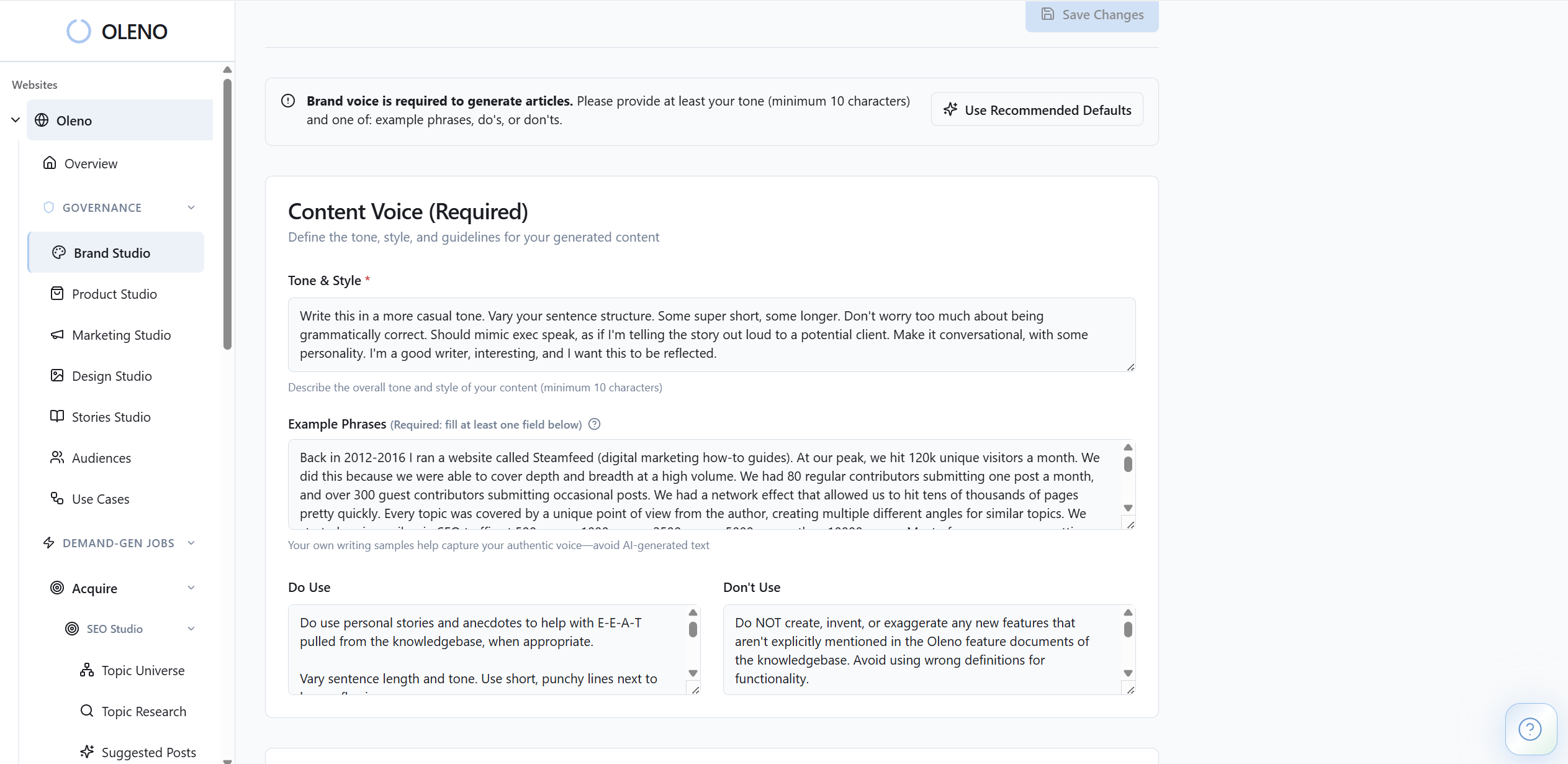
Most teams do the reverse. They write first, then review for voice, then review for message, then review for product accuracy. That's backwards. The cost gets paid late, when changing direction is expensive.
A more reliable rule is the Front-Load Rule: define the things you don't want debated in review. Brand tone. market POV. product definitions. enemy framing. audience language. unsupported claims. If a team is still arguing those in the editing stage, generation started too early.
We're not 100% sure every company needs the same level of rigor here. A tiny founder-led team can sometimes get away with looser rules for a while. But once more than 2 contributors touch content regularly, structure starts paying for itself quickly, especially when evaluating if you scale content.
Audience, Product Truth, And POV Need To Live Together
One of the biggest hidden mistakes in content ops is splitting context across systems. Product truth in one place. Personas in another. Positioning in slides. Brand voice in a dusty doc. Then everyone wonders why outputs feel generic or wrong.
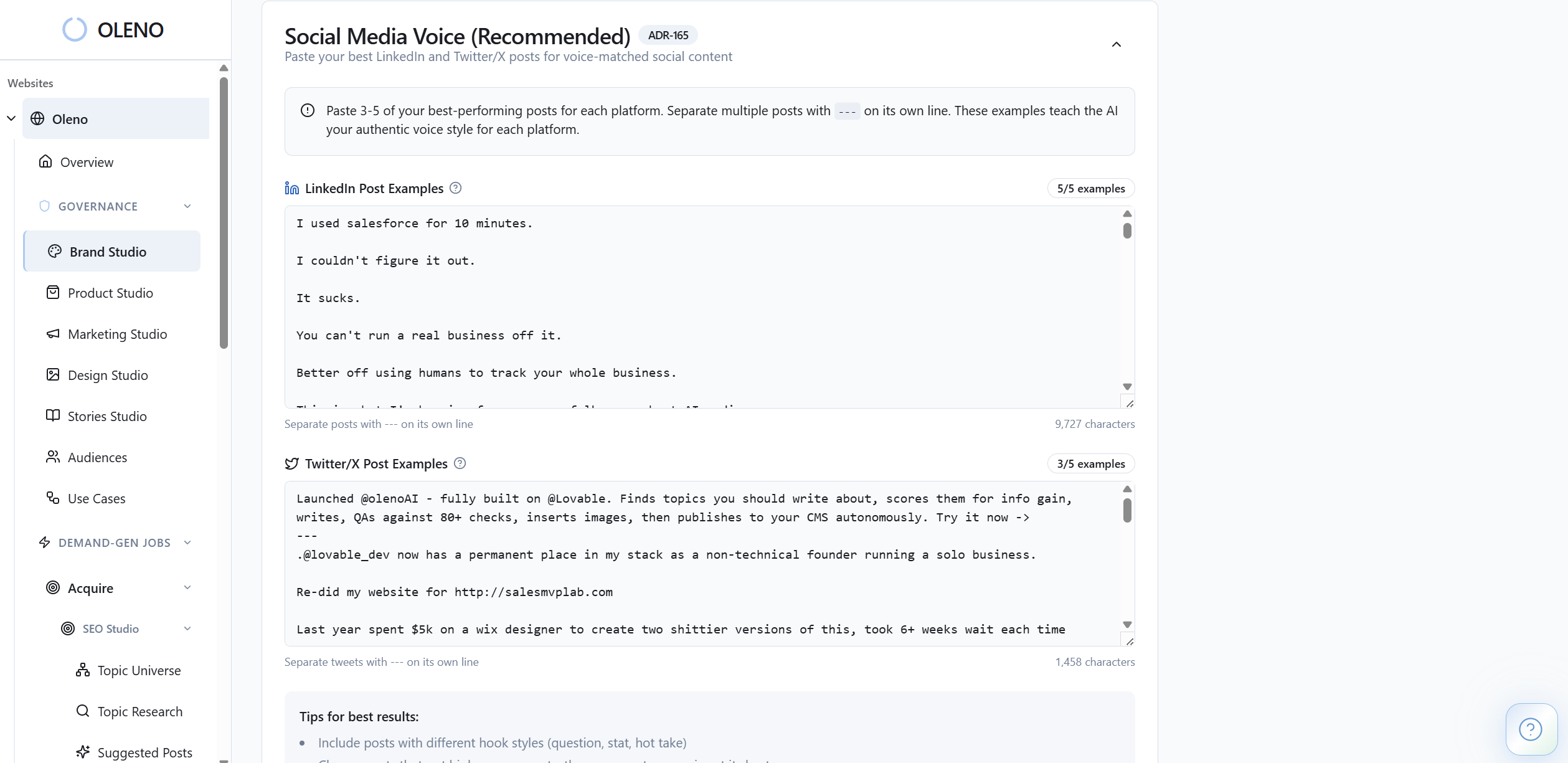
Demand generation only compounds when those layers work together. A feature matters differently to a Head of Marketing at a growth-stage SaaS than it does to an enterprise CMO. A use case matters differently in acquisition content than in evaluation content. Your product story changes shape depending on buyer stage, but the truth underneath it shouldn't drift.
Think of it like a sales team running without a shared CRM, shared messaging, or shared customer notes. You'd never expect consistency. Content is the same. If narrative, audience, and product context are spread across separate islands, every draft becomes a fresh negotiation.
That said, some teams worry this sounds rigid. Fair concern. Too much structure can flatten good writing. The answer isn't no structure. It's enough structure to keep truth consistent while leaving room for point of view and style.
If you're trying to move from scattered prompting to a more repeatable system, you can request a demo.
Compounding Visibility Comes From Repeated Clarity
Compounding visibility isn't mysterious. It's repeated clarity over time.
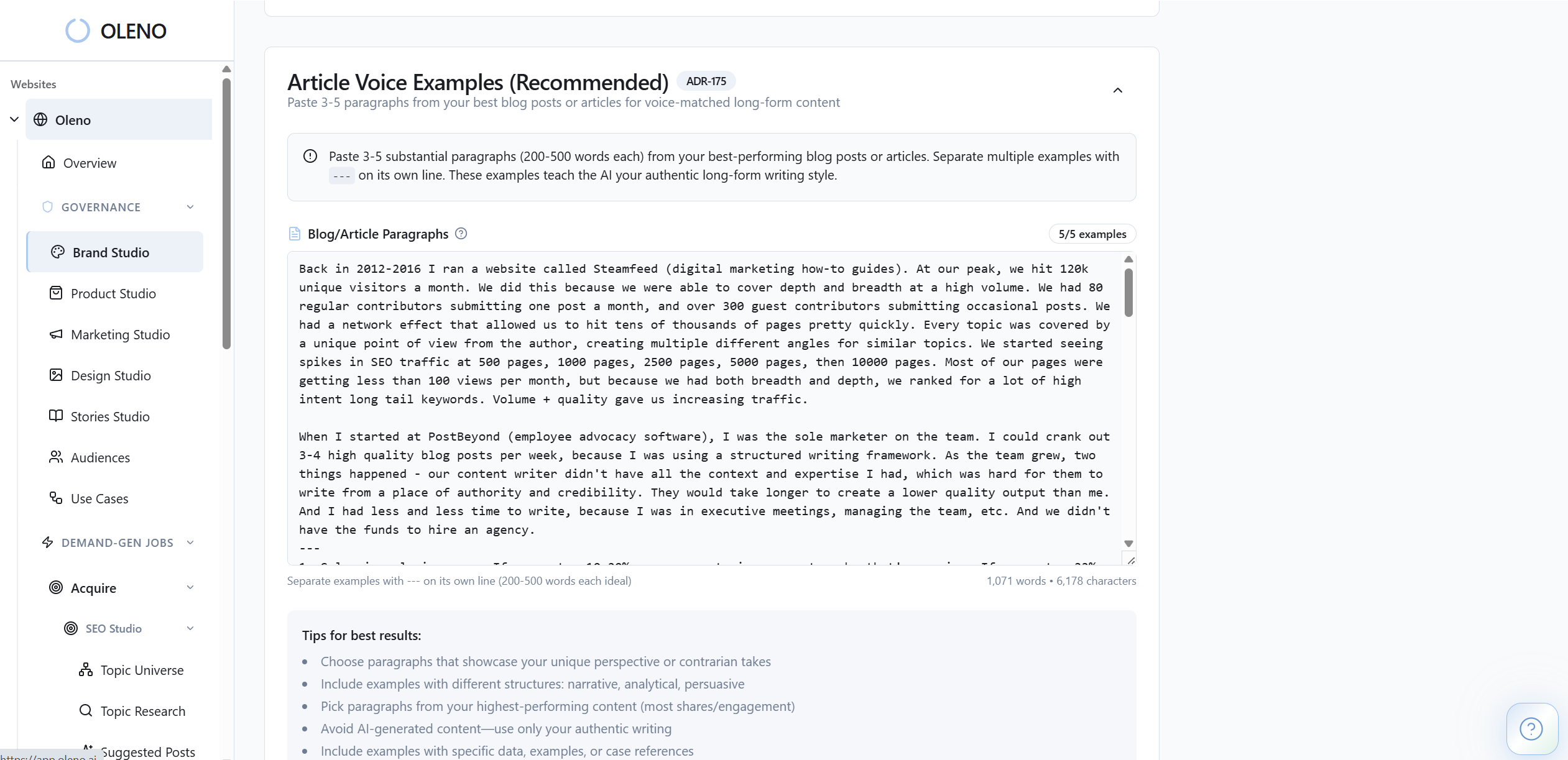
At Steamfeed, most pages got under 100 visits a month. On paper, that can look weak. But the library kept growing in depth and breadth, and that created step-function traffic gains as the catalog matured. The lesson wasn't "publish endlessly." The lesson was that consistent coverage plus real depth creates compounding returns.
In GEO, repeated clarity matters even more. LLMs are piecing together who you are from many surfaces. So if your narrative is clear across your category content, product-led content, comparison pages, and social distribution, your odds of being surfaced improve. Not because one piece was brilliant. Because the full body of work agrees with itself.
That's why I think a lot of marketers are aiming at the wrong metric. They chase isolated wins. One article that ranks. One post that pops. One campaign that lands. Useful, sure. But category leaders design for library effects. If one asset succeeds and the next ten dilute the story, you didn't build momentum. You interrupted it.
Diagnose Your Current State Before You Add More Volume
Before you add another writer, agency, or AI workflow, diagnose the actual issue. Otherwise you may pour fuel on the wrong fire.
Ask yourself:
- Do new contributors need heavy messaging rewrites before publish?
- Does product context live in people's heads more than in a usable system?
- Do your SEO wins often feel detached from pipeline or trial intent?
- Does each quarter start with a fresh round of briefing and re-alignment?
- If you doubled output next month, would review load grow at the same rate?
If you answered yes to 3 or more, you're probably not facing a content volume problem. You're facing a demand-generation execution problem. Different diagnosis. Different fix.
Short version: if you scale content now, you'll probably scale whatever is already broken.
What Governed Execution Looks Like In Practice
This is where the category gets practical. In practice, governed demand-generation execution means marketing defines the strategic rules once, then the system keeps applying them across jobs, channels, and publishing cycles. That's the part most tools don't really do.
Oleno is built around that model. Not as another prompt box, but as a system for turning go-to-market strategy into repeatable execution.
Oleno Turns Strategy Into Execution Rules Instead Of Review Debt
A lot of review debt exists because strategy never got encoded upstream. So editors end up doing strategy correction inside drafts.
Oleno tackles that by separating the strategic inputs from the content output. marketing studio captures category framing, key messages, and the company's point of view. product studio centralizes approved product descriptions, feature boundaries, and supported use cases, which matters if you're worried about factual drift. audience & persona targeting and use case studio keep buyer context tied to the work so a piece can be framed for the right segment instead of a generic reader.
That combination matters because the system isn't guessing what the company stands for each time. It's working from approved context. Which means fewer resets, fewer "this doesn't sound like us" edits, and less time arguing with drafts.
Output Grows Without Matching Coordination Cost
This is where the operational layer matters. programmatic seo studio handles acquisition content on a steady cadence. product marketing studio and buyer enablement studio cover the deeper product and decision-stage work. category studio supports the long-form thought leadership that defines the market narrative. Then orchestrator runs the flow from brief to draft to QA to publishing based on priorities and quotas instead of someone manually shepherding each piece.
And quality gate matters more than people think. If you're scaling output, you need objective checks before content reaches publish. Otherwise every increase in volume becomes a review burden.
For lean teams, that's the shift. Not "write with AI." More like: set the rules, run the jobs, inspect exceptions.
The Goal Is Reliable Demand-Gen Execution, Not Autonomous Writing
This is probably the biggest misunderstanding in the market. People think the promise is autonomous writing. I don't think that's the real promise. The real promise is reliable demand-gen execution.
So yes, Oleno publishes to your CMS through cms publishing. Yes, stories studio can pull founder stories, customer anecdotes, and sales insights into thought leadership so the content feels lived-in. Yes, storyboard and the executive dashboard help leaders see what is getting covered and where gaps still exist. But the bigger value is that all of this works as one system instead of one more disconnected layer.
If your team is tired of manually carrying brand, product, and audience context through every asset, that's the difference worth seeing. You can book a demo.
The Companies That Win Will Not Be The Ones That Publish The Most
They'll be the ones whose market signal stays clear as output grows.
That's the whole argument. Fragmented Demand Generation looks manageable at low volume because humans can patch it. Once you scale, the patching becomes the job. And when that happens, inconsistency spreads faster than visibility.
Demand-generation content execution software is the category built for that problem. Not more content for the sake of it. More consistency, more repeatability, and more compounding signal across the full body of work. If you get that part right, scaling content starts working the way people hoped it would in the first place.
About Daniel Hebert
I'm the founder of Oleno, SalesMVP Lab, and yourLumira. Been working in B2B SaaS in both sales and marketing leadership for 13+ years. I specialize in building revenue engines from the ground up. Over the years, I've codified writing frameworks, which are now powering Oleno.
Frequently Asked Questions