In-House, Agency, or Orchestration Platform: How to Choose When You Need to Scale Content Marketing

You probably don’t have a writing problem. You have a coordination problem that shows up as slow drafts, off-brand edits, and last-mile publishing chaos. I’ve lived both sides. As a solo marketer, I could write fast but couldn’t keep up. As a sales leader, I saw great content that ranked, yet it didn’t point back to the product clearly enough to move pipeline.
When you need to scale, you’re not deciding how to write more words. You’re deciding how to run a system that turns strategy into published, on-brand articles reliably. That choice, whether in-house, agency, or a governed platform like Oleno, determines your speed, your quality, and your sanity at 20, 50, or 200 articles.
Key Takeaways:
- Measure where time vanishes after “draft done,” then turn recurring edits into upstream rules
- Treat content like an operating system: own the rules, rent the hands, and make the system do the enforcing
- Model total cost to publish, not cost per draft, including governance and error risk
- Decide your tradeoffs: control, speed, differentiation, then be consistent about them
- Keep strategy and governance in-house, let a platform do the glue work, and pull in agencies for spikes and specialties
- Use deterministic steps for links, schema, visuals, and QA to eliminate rework and drift
More Writers Won’t Fix Your Scale Problem
More writers increase draft volume, not throughput. The real slowdown hides between “draft done” and “publish ready,” where structure, links, visuals, schema, and CMS work pile up. If every step lives in a different tool or person’s head, you create queues, rework, and drift as volume rises.

The bottleneck is coordination, not copy
The time sink sits in handoffs. Topic selection in a sheet, research in tabs, writing in docs, visuals in a drive, publishing in your CMS. Each handoff adds another queue. You fix the same edits over and over because your rules exist as tribal knowledge, not system logic. That is coordination debt, not a writing gap.
Map the gap between “draft” and “published.” Track average minutes spent on voice edits, internal links, schema, visuals, and CMS formatting. If that adds up to more than 40 percent of total effort, the blocker is orchestration. A system-first approach, like what you’ll see in autonomous content operations, reduces the last-mile chaos. For a deeper view of why old workflows crumble, review this content operations breakdown.
For an operations lens on scaling, the Content Marketing Institute’s experts stress process before volume in their guidance on scaling content operations. It aligns with what you are seeing on the ground.
What outcome do you actually want?
“More traffic” is vague. Aim for compound authority in two clusters, a 50 percent cut in time-to-publish, and 60 percent fewer brand edits. When outcomes get precise, your choices get simpler. If you want compounding and determinism, speed-only tactics fall short.
Make non-negotiables explicit and upstream:
- KB-grounded accuracy
- Brand voice consistency
- Section-level snippet readiness
- Verified internal links
- Schema every time
Then decide your trade. You can buy speed, control, or differentiation. Usually not all three at once. Rank them based on your constraint, whether budget, headcount, or time.
Curious what this looks like in practice? Try generating 3 free test articles now.
You’re Choosing An Operating System For Content
Scaling content is like choosing an OS. You can stitch tools together and manage the handoffs manually, or you can run a governed pipeline that enforces rules and ships consistently. The goal is simple: own the rules, let execution flex with volume, and keep the narrative tight.

Own the rules, rent the hands
Keep strategy, brand voice, and your knowledge base in-house. That is your IP. Convert recurring edits into upstream policies so they are enforced during briefing and drafting, not after. Then you can rent execution capacity confidently, because the rules do the judgment. See how this shift works in practice with the orchestration shift.
Topic selection should be system-led, not opinion-led. Use your KB and sitemap to set coverage and cooldown windows, so you do not over-publish saturated clusters. Execution partners operate inside that map. If content is infrastructure, content requires autonomy explains why the system matters more than the tool list.
For another angle on process discipline, Optimizely’s guidance on how to scale content creation echoes the same principle: clarity of process beats brute-force volume.
What should you own vs outsource?
Own the topics and clusters, information gain standards, voice rules, and product claims. These assets compound and protect you from vendor churn. Outsource elastic production tasks like writing, images, and localization when your system can verify outputs automatically. That shift turns people management into policy management.
A hybrid model works well. Keep a small editorial core to curate the KB and narrative. Use a platform to enforce rules and reduce cleanup. Plug in agency or freelancers when demand spikes. You scale without giving up narrative control.
Decision guardrails by stage
- Early-stage: prioritize speed to signal. A platform that enforces structure and voice lets one operator ship frequently. Pull in a boutique agency for PR or creative bursts when needed.
- Growth-stage: lock governance first. Scale across clusters with cooldowns and information gain checks. Agencies handle specialized formats, but the system remains in-house so content compounds.
- Enterprise: centralize KB, voice, and schema rules for multi-region work. The platform provides determinism across locales. Agencies focus on campaigns and localization under your rules.
The Hidden Costs That Blow Up Your Model
Your cost problem is not the retainer or salary line. It is the hidden tax of rewrites, last-mile fixes, and error risk. Model total cost to publish, not cost per draft, and the best option becomes pretty obvious.

Model TCO in 15 minutes
Let’s pretend you need 20 long-form pieces a month. In-house includes salaries, benefits, tools, design, management time, and the rewrite tax. Agencies include retainers, account time, onboarding, and revisions. A platform includes subscription, KB and voice setup, and enforcement-driven savings on edits and publishing.
Add the governance delta. Count average edits per post, internal link fixes, schema misses, and brand corrections. If you touch six or more items post-draft, multiply those minutes by burdened hourly rates. Pair this with qa systems and see how upstream enforcement changes the math. Predictable volume modeling also benefits from topic discovery, since you avoid starvation and duplicates.
If you need a quick market view on tradeoffs, StellarContent lays out the cost and velocity dynamics in their analysis of content scaling tradeoffs.
When fixed costs beat variable
If your monthly volume is stable, say 15 to 30 assets, a salaried operator plus a platform typically beats a retainer on unit economics within a few months, provided the rewrite loop is eliminated. The caveat is real. If the system does not enforce rules upstream, fixed costs become sunk costs and throughput stalls.
Watch “publish per operator.” If one operator with a platform ships more consistently, fixed is winning. If volume is lumpy or unpredictable, variable might be safer while you finalize governance.
Where agencies actually save money
Agencies save money when the skill is specialized, the timeline is compressed, or the format is truly new.
- Specialized skills: motion design, multilingual SEO, complex technical migrations, intricate product stories
- Speed to output: campaign in a month, launch support, or peak season surges
- Net-new formats and channels: run pilots, then encode what works into your system for ongoing scale
If you want a maturity lens on ramp and growth, SocialFirm breaks down patterns in scaling your content from year 1 to year 5.
Control, Speed, Differentiation: Pick Two (But Be Honest)
The expensive mistake is chasing speed while quietly giving away control and differentiation. You get volume. You also get generic content that does not advance your narrative or your pipeline. Be honest about what you value most right now, then choose accordingly.
Why control matters more than you think
Quick story. I led growth at a proposal software company. Our team wrote strong pieces that ranked, and we celebrated the traffic. Pipeline did not move much. The fix was not better sentences. We aligned topics and structure to the solution narrative and enforced it, so every piece could point back to the product credibly.
Control is not micromanaging drafts. It is owning the rules. Brand voice, accepted claims, KB sources, internal link targets, and schema patterns. If your team edits these by hand, control is fragile. If the system enforces them, control scales. Differentiation starts with deliberate information gain. If you do not require new insight before writing, you will publish lookalike content and pay twice.
How fast do you need signal?
Be clear about feedback loops. If you are testing positioning, a weekly cadence with strict structure gives you cleaner signal for sales conversations. Agencies can accelerate the first month. A platform gives you repeatability so the signal is trustworthy. Risk matters. If you are worried about off-brand claims, a governed system reduces the headache. If you must hit a market moment, elastic capacity helps. Keep ownership of the rules so speed does not erode voice. For more on the limits of speed-only tactics, this explainer on ai writing limits pairs well with practical brand voice enforcement.
A Better Mix: Strategy In-House, Execution Through A Platform
The strongest model I keep seeing win is simple. Keep strategy and governance in-house, let a platform enforce rules and ship daily, and plug agencies into the system for specialized work. You get consistency, elasticity, and compounding authority without becoming an editing shop.
Design the governance first
Start with a living knowledge base. Approved facts, positioning lines, banned terms, and product claims. Pair it with voice rules and narrative templates that force direct answers and snippet-ready sections. Encode this once, enforce it always. Require information gain at the brief stage. If an outline does not add something new, it waits. That is how you protect brand equity at scale.
Automate the risky “boring” parts. Internal links from a verified sitemap, programmatic schema, and brand-constrained visuals. Deterministic beats manual when accuracy matters. Aprimo’s perspective on content scaling and governance lines up with this discipline.
When should you layer in an agency?
Use agencies for creative leaps, brand films, or high-stakes narratives. Also for specialized skills like technical SEO or localization. Keep them inside your rules so outputs are publish-ready without your team becoming a revision factory. If you need a new format fast, pilot with an agency. When the pattern works, encode it so the next fifty pieces ship without re-briefing.
Consider a short ramp retainer while your platform enforces consistency. Then taper as your internal operator gets leverage and your system compounds.
Metrics that predict compounding authority
Measure coverage, not just counts. Track cluster saturation and re-coverage windows. Healthy cadence plus cooldowns beat random bursts. Audit information gain at the brief level, then reward high-gain pieces in QA. Monitor “publish-ready ratio,” the share of drafts that pass without manual edits. As it rises, your unit economics improve.
Interjection. If you can’t measure it upstream, you’ll pay for it downstream.
Ready to eliminate rework and drift without adding headcount? Try using an autonomous content engine for always-on publishing.
How Oleno Operationalizes Scale Without Headcount Bloat
Oleno turns strategy into published articles with text, visuals, links, and schema handled end to end. The system emphasizes determinism where accuracy matters and flexibility where creativity matters. You keep control of the rules. The platform handles the glue work you should not be doing by hand.
What Oleno runs end to end
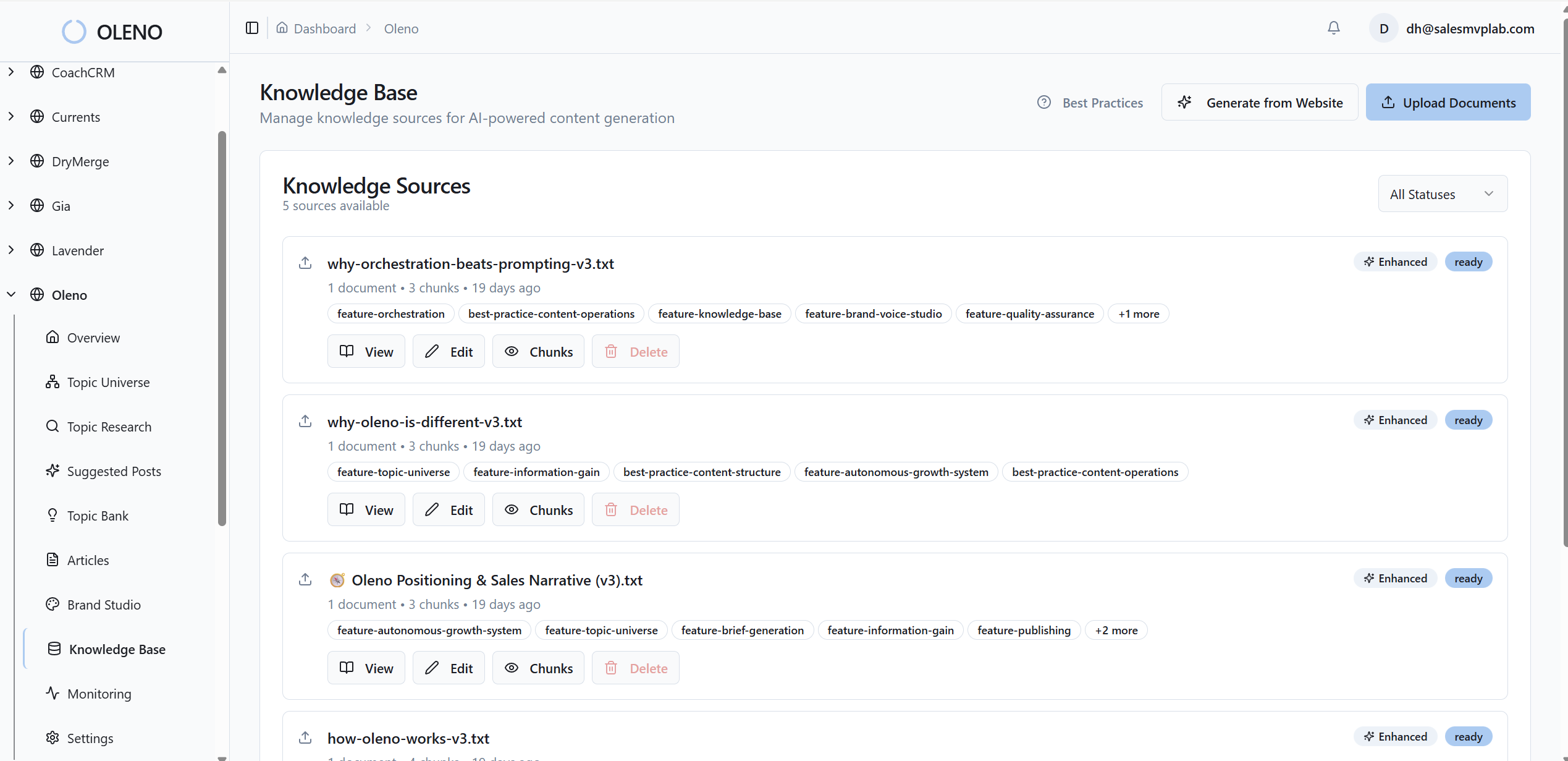
Oleno covers the full flow: Topic Universe maps clusters and coverage, briefs score uniqueness, drafts follow snippet-ready structure, Visual Studio generates brand visuals, deterministic internal links and JSON-LD are injected, then quality checks enforce standards before publishing to your CMS. The result is consistent throughput with fewer handoffs.
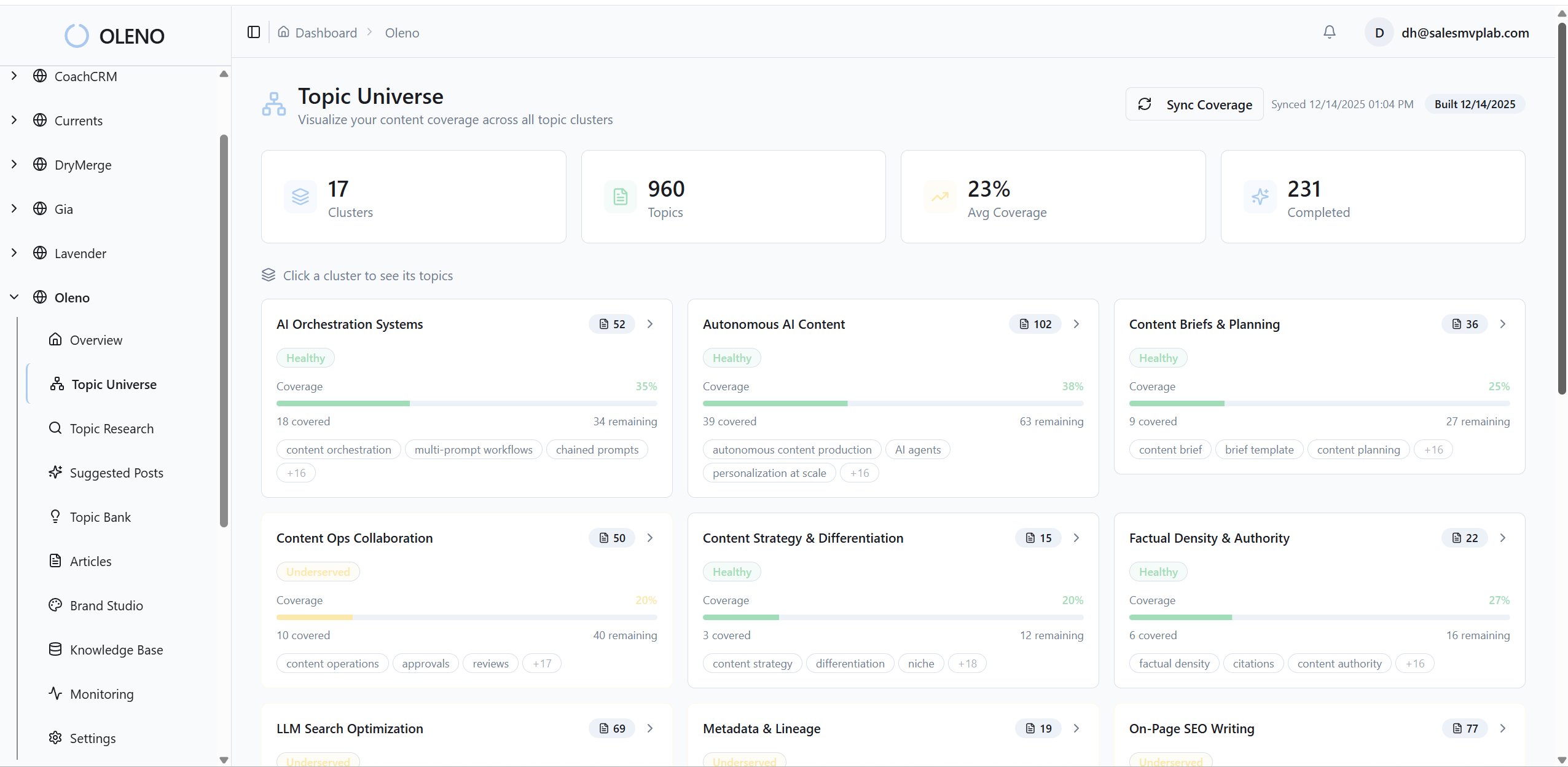
- Topic Universe prioritizes what to write next and enforces cooldowns
- Information Gain Scoring prevents lookalike content before writing
- Snippet-ready H2 openings improve clarity for search and AI
- Visual Studio creates brand-consistent hero and inline images
- Internal links use only verified sitemap URLs with exact-match anchors
- Schema markup is generated automatically
- QA evaluates 80+ criteria before publishing
For a governance perspective on platforms, Woodwing’s guide to avoiding content marketing scale failure underscores why deterministic steps matter.
How does it reduce rework and brand drift?
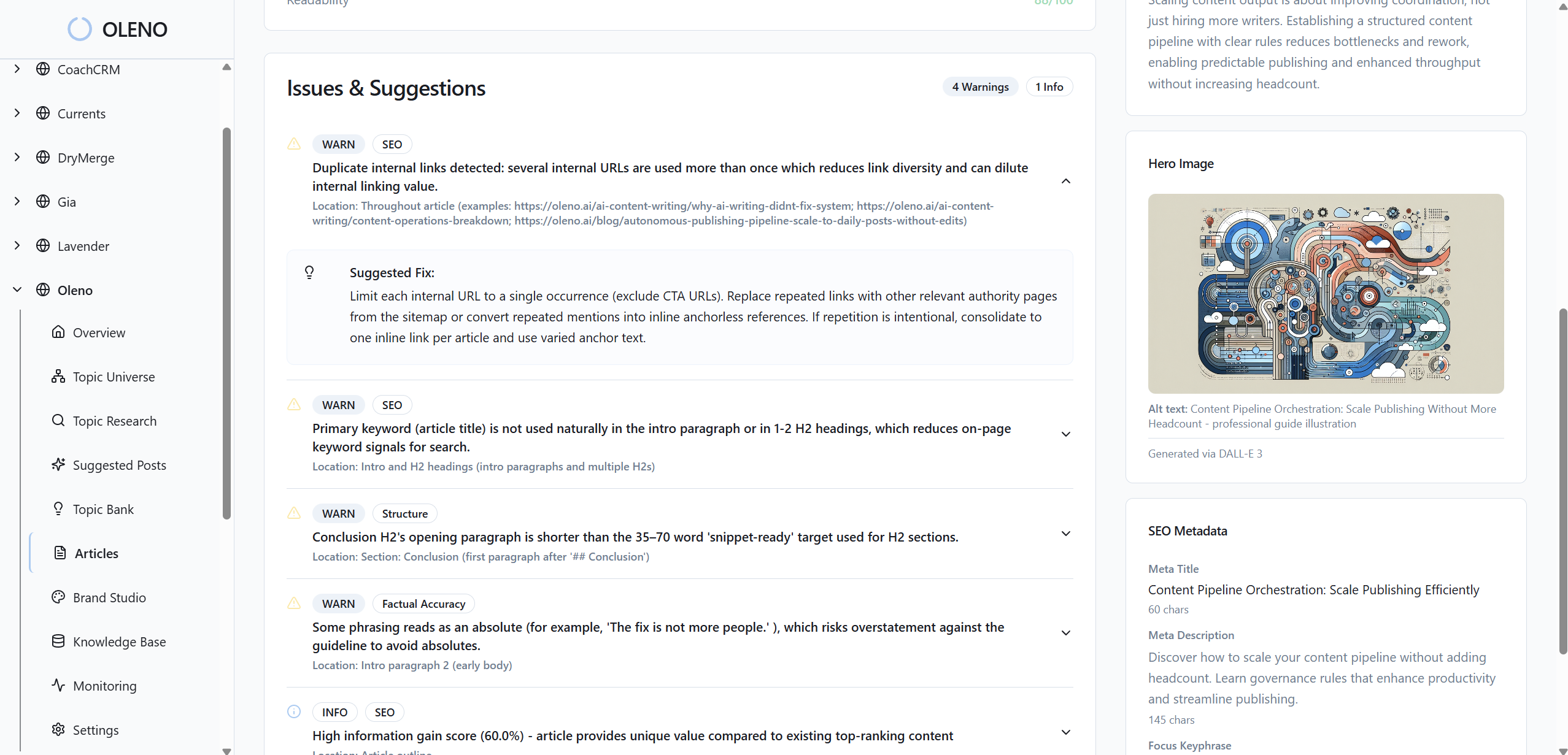
Remember the rewrite loop. Oleno’s QA-Gate checks structure, voice alignment, KB grounding, and snippet readiness. Low-scoring areas trigger automatic refinement loops, so your team is not patching drafts post hoc. Visual Studio replaces the scramble for images by generating brand-aligned visuals and adding alt text and filenames automatically. Links and schema come from code, not guesswork, which removes fabricated URLs and publishing surprises.
If you want the big-picture view again, this overview of autonomous content operations shows how the parts fit together. And if you care about both SEO and AI visibility, you can connect the structure to LLM citation patterns with dual discovery.
Where Oleno fits with your team and partners
One strategic operator can run a daily cadence with Oleno. Agencies plug into the system for specialized formats. Product marketing curates the knowledge base and voice rules. Everyone plays their part, and the rules keep the work aligned. Oleno handles the system’s coordination so your team focuses on owning the narrative.
Oleno does not chase dashboards or rank tracking. It exists to ensure what ships is correct, differentiated, and on-brand. That is the point. Write less about performance, spend more time controlling inputs, and let consistency compound.
Want to see it run in your stack without a long setup? Try Oleno for free.
Conclusion
You are not choosing between writers and tools. You are choosing how your system will work when you need 20 or 200 articles to ship without stress. Own the rules. Enforce them upstream. Use a platform to eliminate handoffs and last-mile fixes. Bring in agencies for the work that actually benefits from specialization.
If you get the operating system right, you publish faster, edit less, and build authority that compounds. The tradeoffs get clearer. The costs get cleaner. And your team stops being editors and starts being system owners.
About Daniel Hebert
I'm the founder of Oleno, SalesMVP Lab, and yourLumira. Been working in B2B SaaS in both sales and marketing leadership for 13+ years. I specialize in building revenue engines from the ground up. Over the years, I've codified writing frameworks, which are now powering Oleno.
Frequently Asked Questions