Information-Gain Checklist: 7 Tests to Prove Article Differentiation

Differentiation isn’t a creative mood. It’s an operational posture. When you ship articles that look like everything else on page one, it’s not because your team can’t write. It’s because your process lets “pretty good” outlines slide through with no evidence they add anything new. That’s fixable.
Back when I ran a contributor network that pushed 10,000+ pages live, I learned this the hard way. Volume without unique angles hits a ceiling. At PostBeyond, when I was the only marketer, I could crank quality because I had guardrails in my head. As teams grew, those guardrails disappeared. That’s where an information-gain checklist earns its keep.
Key Takeaways:
- Treat differentiation like QA: gate topics before any draft starts
- Score information gain across seven tests; enforce a pass threshold
- Run a 3-minute SERP scan to identify gaps and duplication risks
- Block topics that fail critical tests (novel claim and depth delta)
- Log pass/fail decisions in the brief to reduce rework debates
- Use visuals as evidence, not decoration, to support new claims
Why Differentiation Fails Without Operational Gates
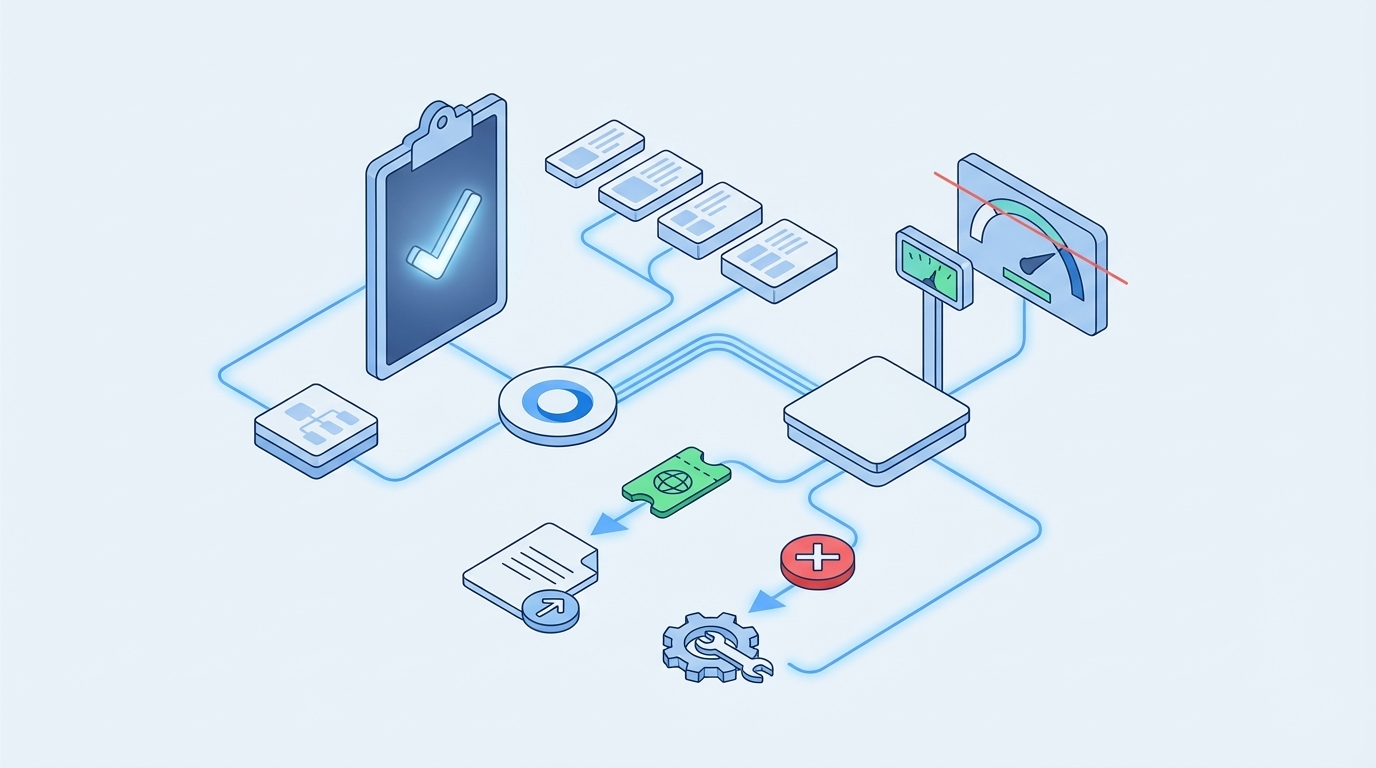
Differentiation fails because teams rely on style upgrades instead of process controls. Without gates, lookalike outlines pass quietly and create repetitive content. Add an information-gain checklist to your brief with thresholds and a pass/fail flag. For example, require a novel claim and two net-new sections before writing.
The stylistic trap that keeps teams stuck
Most teams “differentiate” by rewriting the same five headers in their own voice. It feels fresh internally and reads like déjà vu externally. Voice edits can’t compensate for missing proof. If the outline mirrors competitors, the draft inherits sameness. You don’t fix that with adjectives. You fix it by blocking the outline.
The shift is simple. Write down your rules. Things like “no draft unless we can state a falsifiable claim” and “two sections competitors don’t cover” force decisions when they’re cheap. A checklist turns taste into criteria. Your writers stop guessing. Your editors stop retrofitting. And your calendar stops filling with near-duplicates that require cleanup later.
What is information gain and why does Google care?
Information gain asks one question: what will a reader learn here that they can’t get from the current corpus? It rewards novelty, clarity, and useful detail, not just length. You don’t need to predict rankings; you need to prove you’re adding something substantive versus rephrasing consensus.
Industry folks have been calling this out for a while. Think of it as an antidote to content sameness. Frameworks like the one described by Animalz on information gain break novelty into practical signals—fresh claims, original data, new angles, and applied examples. Your job isn’t to “hack” results. It’s to make duplication structurally hard.
The 3-minute pre-brief scan that changes decisions
Before you greenlight a topic, run a three-minute scan. Use operators like intitle:"your topic", inurl:guide, site:competitor.com, and "keyword" -site:yourdomain.com. Skim the top five results. Note repeated headers, missing claims, weak examples, and outdated data. If you can’t name three net-new contributions, pause the brief.
I’ve seen this save entire sprints. The scan surfaces two truths fast: where the herd is clustered and where the gaps live. Maybe no one defines thresholds. Maybe visuals are generic. Maybe examples lack numbers. Capture those as your “must add” list. If the list is empty, your idea might still be worth writing—but probably as a subsection of a pillar, not a standalone post. Ready to operationalize this from day one? Try Generating 3 Free Test Articles Now.
The Real Root Cause of Repetitive Content
Repetition happens because teams compare against memory, not the current SERP or their own corpus. Research defaults to familiar tools and competitor outlines. Without a structured scan and a score, novelty stays optional. Put a pre-write gate in the brief and block the pipeline until uniqueness is proven.

What traditional research misses in saturated SERPs
Traditional research tools surface the same “People also ask,” the same headings, and the same entities. That’s useful for coverage, terrible for differentiation. When every outline starts from the same sheet music, you end up harmonizing—beautifully—and still playing the same song.
If you’re operating in a saturated space, you need to look where outlines don’t. Forums and issue trackers. Support tickets. Sales call transcripts. That’s where sticky problems hide, especially ones the market doesn’t write about yet. Tie those artifacts to your brief. Make them evidence. When SERPs look identical, novelty often lives in who the piece is for and which decision moments you actually resolve.
How do you calculate an information gain score?
Keep scoring simple. Use a 0–100 rubric across seven tests: novel claim (20), proprietary data or workflow output (15), practical example with numbers (15), perspective shift (10), depth delta beyond common coverage (20), visual evidence (10), and audience/intent fit (10). Require 70+ to pass, with no zeros on novel claim or depth delta.
If you want background on why these signals reflect novelty and utility, a primer like Machine Learning Mastery’s overview of information gain helps shape intuition. You’re not building a ranking model. You’re building a gate that blocks sameness. The math is a forcing function. It makes editorial judgment explicit.
Where duplication hides in your own sitemap
Most teams accidentally compete with themselves. Two posts answer the same question with near-identical structure. Internal links split. Crawlers shrug. The fix isn’t always delete. It’s combine, redirect, and enforce a cooldown before you re-cover a saturated angle.
Run weekly checks like site:yourdomain.com "topic" and intitle:"topic". Compare headers, not just titles. If two pages resolve the same intent, merge the weaker into the stronger and move on. For teams that manage clusters, a 90-day cooldown keeps good intentions from turning into cannibalization. You’re protecting your definitive asset per query, not fighting it.
The Cost of Publishing Without Proof of Differentiation
Publishing undifferentiated content creates hidden costs—rework, coordination, and opportunity. Let’s pretend you ship 20 articles monthly, 30% overlap, and each rewrite costs three hours. That’s 18 hours gone, not counting context switching. Add brand confusion and delayed projects. The longer you wait to gate, the more you pay to unwind duplication.
The rework tax you do not budget for
Rewrites look cheap on paper. They’re not. One duplicate draft becomes three partial edits as you try to untangle overlap across related posts. People reopen briefs. Managers weigh in. Slack messages multiply. The actual tax is coordination—context switching that steals momentum from the work that would move metrics.
I’ve watched sprints lose a week to “quick refreshes.” The culprit wasn’t a bad writer. It was a missing gate. Preventing one poor brief often saves more hours than polishing three nearly-there drafts. If you need a nudge from another domain, the value of checklists and formal gates is well-documented in other disciplines; see how structured controls improve outcomes in Thomson Reuters’ guidance on generating and using checklist gates.
The compounding SEO debt from sameness
Undifferentiated posts split relevance signals. You dilute internal links, confuse crawlers, and bury the page that should win. The penalty isn’t always a drop; it’s a ceiling you can’t break. You plateau because your site sends mixed messages about what should be canonical for a given query.
You don’t need to play oracle. Just gate at the outline. Build one definitive asset per cluster and make the rest intentionally supportive. When someone wants to “sneak in” a similar topic because it feels easy, the score should make the real cost visible. If the gate says fail, you pivot or merge—before time is spent.
What belongs in your pass or fail gate?
Three rules are non-negotiable. First, a minimum overall score (for example, 70+). Second, no zeros on critical tests like novel claim and depth delta. Third, a remediation path that’s easy to apply: merge with a sibling, pivot to a narrower use case, bury as a sub-section, or cancel.
Make this visible in the brief. Record the score, the evidence links, and the decision. The habit reduces debates because you’re not arguing taste—you’re pointing to the gate everyone agreed on. If you’d rather automate than build this from scratch, we do this upstream. Still wrestling with manual reviews? Try Using An Autonomous Content Engine For Always-On Publishing.
The Human Pain of Rework and Second-Guessing
Operational debt shows up as people pain—slack threads, backchannel questions, and nervous leadership check-ins. A real gate removes that anxiety. When the checklist is visible and enforced, alignment happens early and stays intact post-publish. You protect weekends, not just metrics.
The draft you shipped and wish you had not
We’ve all defended a publish that looked fine in isolation and wrong in context. I’ve done it. The brief was thin. The angle was safe. It read clean and did nothing for the portfolio. A month later, we were cleaning up cannibalization and asking why it didn’t resonate with sales.
My rule now: if I can’t point to two tests that score high—novel claim and depth delta—I stop the piece. No “we’ll add examples later.” No “we’ll make it unique in the edit.” That’s how you create the rework tax you hate. Honesty early beats heroics late.
When sales asks why we published another same article
Sales isn’t wrong to worry about mixed signals. They live with the market’s confusion. I’ve invited a rep to do a three-minute SERP scan with me—on a Zoom—just to show the gaps we’ll fill or why we’re pausing the topic. It turns a complaint into alignment.
Teaching the gate helps too. Show the tests. Share how proprietary data or a product workflow output turns a “nice post” into a useful asset for their calls. When differentiation is visible and repeatable, you won’t need a big meeting every time you pitch a topic.
When a brief fails, what should you do?
Don’t force it. Choose one of four plays. Combine with an existing article and redirect. Pivot to a narrower job-to-be-done. Bury it as a supporting section on a pillar page. Or cancel and move on. A canceled topic that saved six hours is a win, not a miss.
Log the failure reason in the brief. Over time, you’ll see patterns—angles you keep trying that never pass, topics you revisit too soon, or tests you need to raise the bar on. That’s process improvement, not a setback. Your roadmap stays clean and your team stays sane.
The New Way, Run The Information-Gain Checklist Before You Write
Place the checklist inside your brief and enforce it at approval. Score seven tests, record evidence, set thresholds, and assign pass/fail. If a test fails, remediate or stop. It’s fast, teachable, and easy to automate. The result is fewer debates and fewer rewrites later.
Test 1: Novel claim
A novel claim reframes the problem or asserts a practical rule not present on page one. It must be falsifiable and specific. Use operators (intitle:, inurl:, site:) to confirm it’s actually new. Write the claim in one sentence. If you can’t defend it, you don’t have it.
Don’t chase contrarian takes for sport. Clarity beats shock. A good example: “Gate content at the brief, not the edit, or you’ll pay a rework tax you can’t see.” You can test that. You can show evidence. Weight 20 points. Threshold: non-zero to pass the entire gate.
Test 2: Proprietary data or process output
Bring numbers only you can publish. Survey data, support volumes, sales pipeline metrics, or anonymized product usage snapshots. Or share an output from your product—redacted screenshots, workflow diagrams, or a decision tree. The point is exclusive evidence, not a generic graph.
Record the source and the plan for the visual. If you don’t have data, propose a small test you can run in a week. “No data” today doesn’t have to be “no data” forever. Weight 15 points. If this scores zero repeatedly, your differentiation problem is upstream in how you collect insight.
Test 3: Practical example with concrete numbers
Teach with a worked example. Hypotheticals are fine—just label them. Inputs, steps, outputs. Not “add examples later.” Do it now. Use real numbers so readers can see what changes if they adopt your method versus the default.
For instance: “Let’s pretend we publish 20 posts, 30% overlap, 3 hours per rework equals 18 hours lost.” That’s not a forecast; it’s a tool to reason about cost. Weight 15 points. Require this test to pass for complex topics to avoid abstract writing.
Test 4: Perspective shift or counter-position
Offer a stance that makes readers reconsider. Not for shock value, but to reduce noise. Examples: “One definitive page per cluster beats five thin posts.” Or, “Gates belong in briefs, not in editorial checklists.” Then tie it to outcomes: less cannibalization, clearer internal linking, faster approvals.
Defensibility matters. You’re not being contrary; you’re being useful. Weight 10 points. A decent rule: if the shift can’t be explained in two sentences and supported with one example, it’s hand-waving. Want a crisp mental model of information gain itself? Victor Zhou’s explanation of information gain is intuitive and short.
How Oleno Enforces Information Gain From Brief To Publish
Oleno operationalizes this checklist across the pipeline. Briefs are scored for information gain, low-differentiation angles are flagged, and QA rewards high-gain structure. Visuals reinforce meaning. Internal links and schema are deterministic. You get fewer debates, fewer rewrites, and a cleaner sitemap over time.
Test 5: Depth delta beyond common coverage
Depth isn’t word count; it’s what you add that others skip. Oleno measures this early. During brief generation, competitors’ coverage is analyzed to spot common headers and shallow explanations. The brief’s Information Gain Score weights depth heavily, flagging low-delta outlines before writing begins, and again during QA.
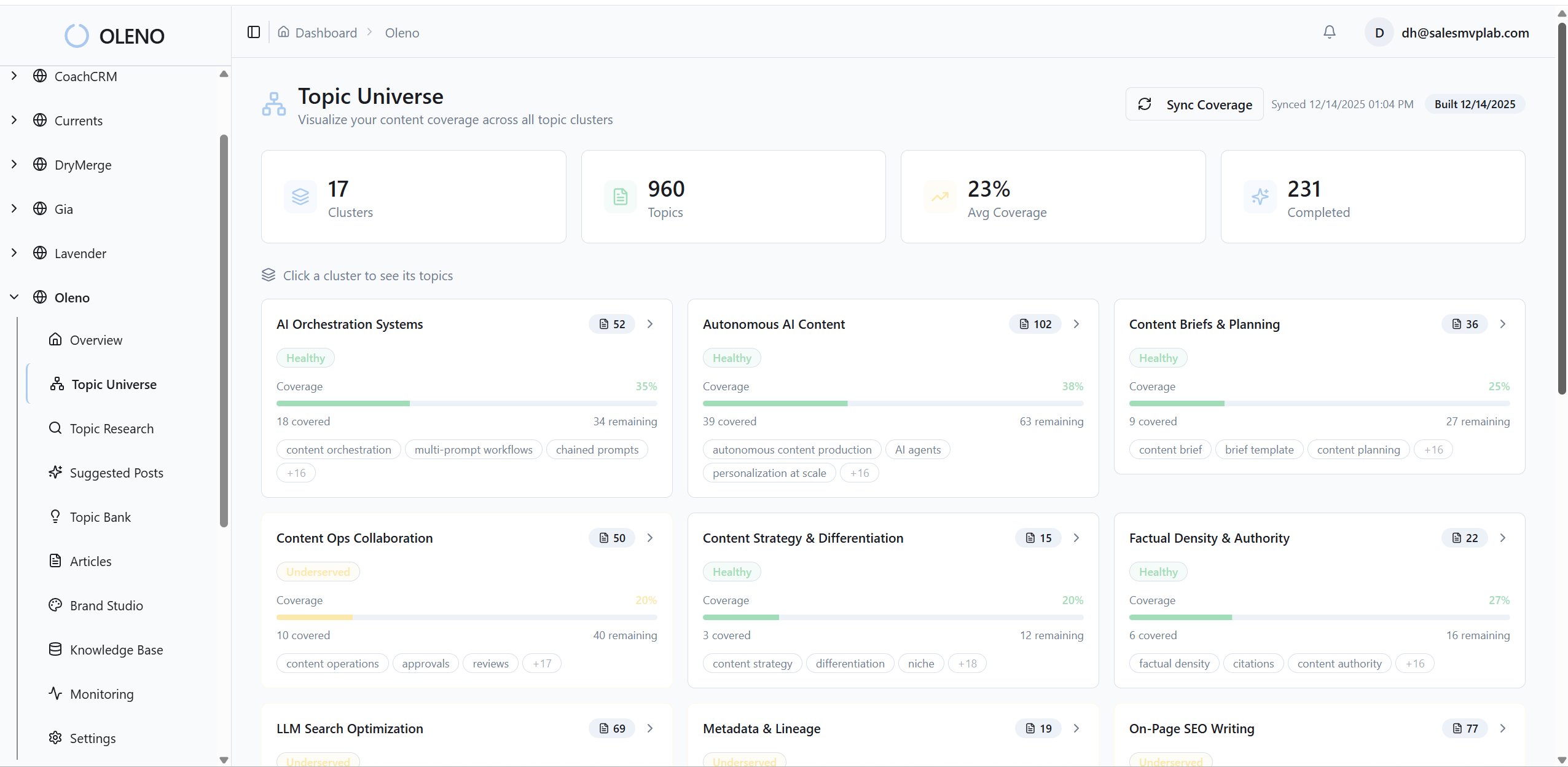
In practice, that means planning two sections the SERP misses—decision thresholds, remediation playbooks, or buyer-specific nuance. Oleno’s process demands evidence in the brief, not optimism in the edit. This directly addresses the ceiling problem we talked about earlier—no more spread-thin clusters that dilute internal signals.
Test 6: Visual evidence that carries meaning
Evidence earns trust. Oleno’s Visual Studio generates brand-consistent images and matches product screenshots to the right sections using semantic context. The goal isn’t decoration; it’s clarity. Charts, workflow diagrams, and annotated screenshots appear where they strengthen a claim, with alt text and filenames handled automatically.
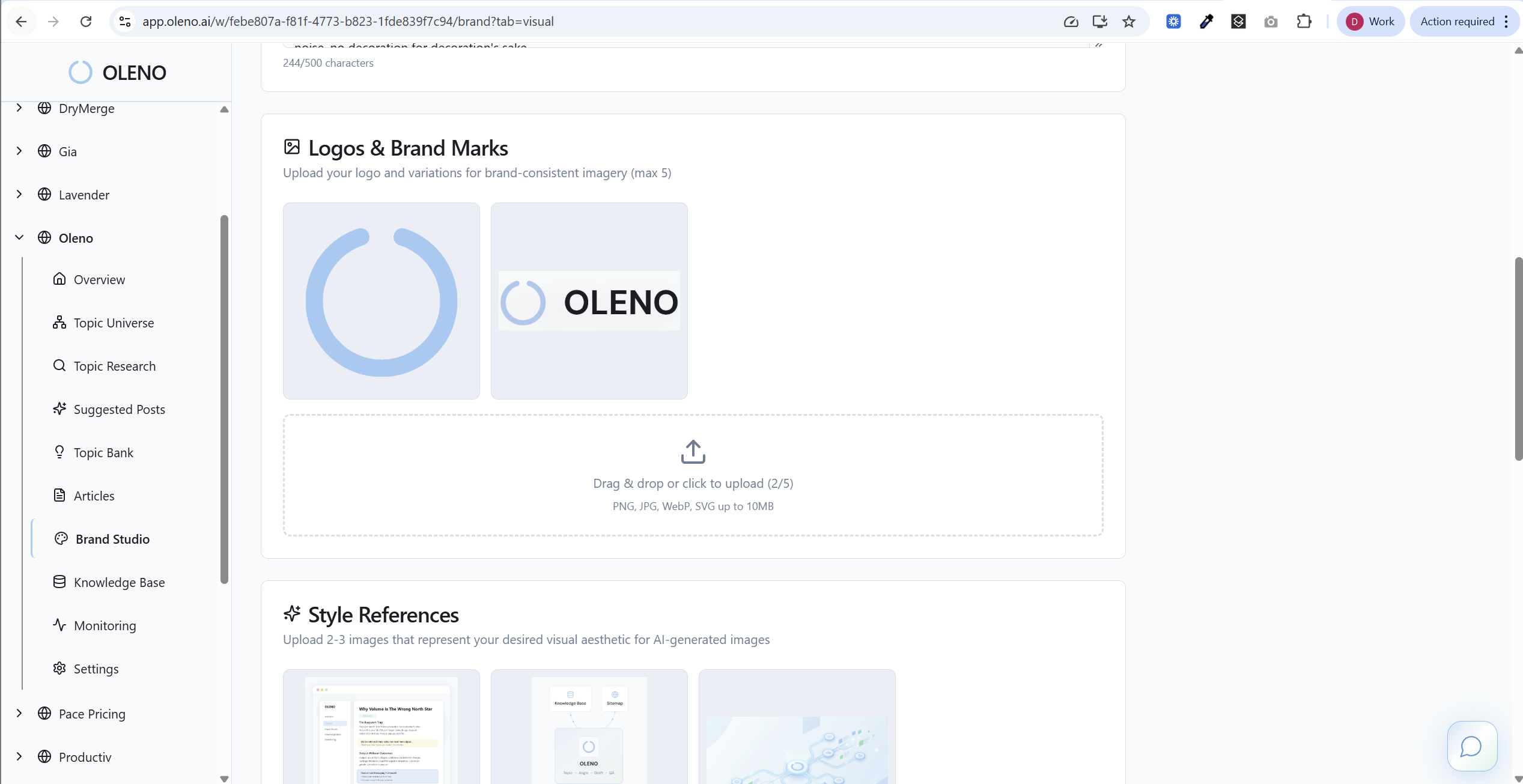
Because visuals are prioritized in solution sections, your proof shows up where it matters most. You don’t need a designer on standby to do the right thing. The system places images intentionally and keeps your brand consistent, which reduces post-publish fiddling and protects your team’s time.
Test 7: Target audience fit and intent alignment
Intent fit is enforced structurally. Oleno’s Topic Universe maps clusters, tracks saturation, and prevents over-publishing angles that would cannibalize your own authority. Snippet-ready structure ensures each H2 opens with a direct answer in 40–60 words, making intent crystal clear for readers and assistants.
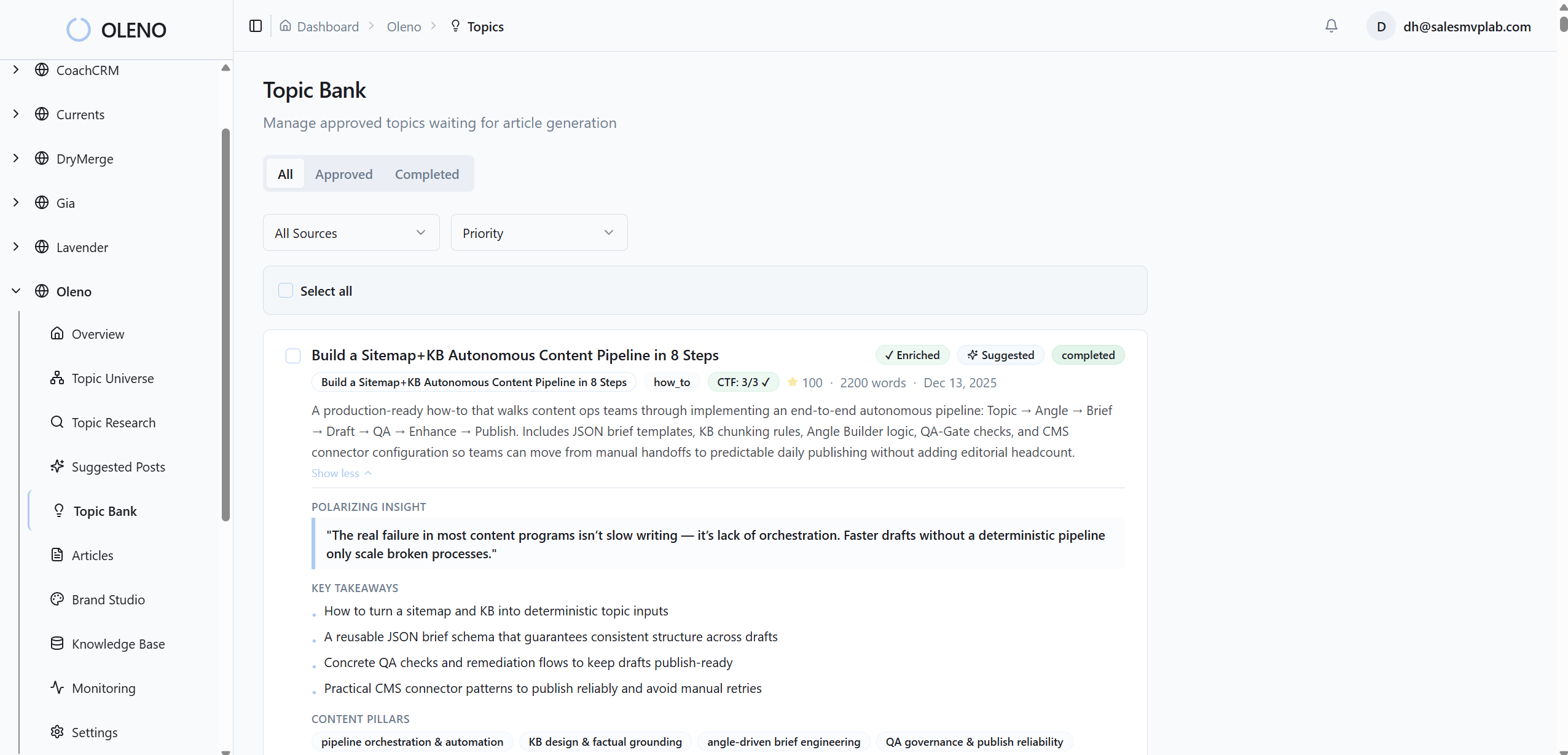
Deterministic internal linking and JSON-LD schema are injected programmatically, reducing ambiguity about what should rank for what. You’re not promised performance; you’re given cleaner decisions and fewer accidental duplicates. If you want to see this flow end to end, from brief to publish, Try Oleno For Free. Oleno handles strategy (Topic Universe), research and Information Gain Scoring in briefs, draft generation with brand voice, Visual Studio for meaningful evidence, 80+ QA checks, deterministic internal linking, schema, and direct publishing. Fewer rewrites. Clearer clusters. More time for the work only your team can do.
Conclusion
You don’t need more pep talks about originality. You need a gate that makes duplication hard. Score seven tests, set thresholds, and block topics until they pass. It’s fast, teachable, and kind to teams. Whether you build it yourself or let a system like Oleno run it, the outcome is the same: fewer debates, fewer rewrites, stronger assets.
About Daniel Hebert
I'm the founder of Oleno, SalesMVP Lab, and yourLumira. Been working in B2B SaaS in both sales and marketing leadership for 13+ years. I specialize in building revenue engines from the ground up. Over the years, I've codified writing frameworks, which are now powering Oleno.
Frequently Asked Questions