Information Gain Roadmap: Prioritize Topics by Coverage Gaps

If you’re spending more time arguing about keywords than advancing your narrative, you’re not alone. I’ve been in those rooms. Smart people, great intent, and a calendar packed with content that somehow still doesn’t move the needle on authority or demand. It’s not laziness. It’s the wrong lead metric steering the ship.
Here’s the shift: measure what’s new, not what’s searched. When every draft is scored for net-new signal before it’s written, you publish fewer repeats, cover gaps that matter, and build credibility faster. It feels slower at first. It isn’t. It’s focus.
Key Takeaways:
- Replace keyword volume with information gain as your lead metric
- Label clusters by saturation so your pipeline stops repeating angles
- Enforce cooldowns and rules to prevent déjà vu drafts and cannibalization
- Score every idea on uniqueness, intent fit, and business relevance
- Turn scores into a queue that ships predictably without last-minute debates
Prefer to see this working end to end? Try Generating 3 Free Test Articles Now.
Why Keyword Volume Keeps You Busy, Not Credible
Keyword volume sounds objective, but it prioritizes sameness over substance. It nudges teams to mirror the SERP, which is the safest path to derivative content. The alternative is scoring each draft for what it adds, not what it echoes, so you protect authority while still serving demand.

The lead metric that causes repeat content
Teams chase volume because it feels concrete. But volume is a lagging cue for what people already know to type, not what they need next. When the SERP is consensus, copying consensus reinforces it and buries your angle. You get busier, not braver, and the site accumulates near-duplicates that split equity.
I’ve seen the pattern on small teams and at scale. Writers hit the same definitions, the same headings, the same “best practices,” because that’s what’s ranking. Editors don’t love it either; they’re stuck merging overlaps and negotiating internal links later. You can break the loop by promoting originality to a gate, not a hope. Make “what’s new here?” a scored field, not a hallway conversation.
What is information gain and why does it matter?
Information gain is a simple idea: score how much new, useful signal a draft contributes compared to your own library and the SERP. The score blends uniqueness, search intent alignment, and business relevance. If those three don’t clear a threshold, it doesn’t enter the pipeline. You cut waste before it starts.
This isn’t academic. It’s operational. When you score before drafting, ideation becomes less about opinions and more about thresholds you can defend. Writers know why a brief was greenlit and what “net-new” means in context. And you can tune the weighting as strategy evolves without rewriting the rules every quarter.
How volume-chasing dilutes authority
When three posts say the same thing, you fragment signals. Crawlers see overlap. Internal links pull in different directions. Humans feel déjà vu and bounce. Authority spreads thin because your site argues with itself for the same term and intent.
Let’s pretend you publish 40 articles in a quarter and 30 percent repeat angles. That’s 12 pieces siphoning attention from the one article that should own the topic. Each one carries editing overhead, cannibalization risk, and support questions later. A simple information gain threshold makes those 12 obvious and easy to cut.
For context, Google’s own guidance emphasizes original, people-first content and warns against thin repetition, which is entirely avoidable when originality is enforced up front. If you need a north star on what “original” looks like in practice, start with the Google Search Central guidance on helpful, reliable content.
The Real Bottleneck Is Coverage, Not Ideas
The backlog isn’t your problem. Coverage is. Without saturation labels per cluster and sensible cooldowns, you’ll keep over-serving loud topics and starving quiet winners. A coverage-first map turns ideation from roulette into strategy.

What traditional ideation misses
Most ideation sessions are blind to coverage saturation. You see a hot search term, you draft ideas, you ship. What you don’t see is how often you’ve already hit that cluster, how recently, and whether you’ve meaningfully progressed the narrative. So you repeat, mistakenly, because the backlog looked full.
A baseline changes that. Group topics into clusters, label each cluster’s state, and give yourself a cooldown timer at the topic level. Now you can answer the only question that matters: where does another article help the most, right now? You’ll still have ideas. You’ll just stop publishing them in the wrong order.
The hidden costs of not tracking saturation
When you don’t track saturation, you accidentally reward the easiest pitch. The “we know this one” topic gets the green light, again. Meanwhile, real gaps wait because they’re not screaming for attention. The cost is subtle: frustrated writers, repetitive briefs, and content that sounds safe but doesn’t earn citations.
I’ve watched teams burn cycles on safe drafts that never get referenced by sales or product. It’s not because the writers lack skill. It’s because the system has no brakes. Add labels like Underserved, Healthy, Well-covered, Saturated, and enforce cooldowns. You’ll reduce rework and unlock the topics your buyers actually need next.
Where should scores come from?
Scores should be grounded in your world, not a generic keyword list. Use three inputs: your knowledge base, your sitemap, and a competitor snapshot. Embed them all, cluster semantically, and compute information gain at the idea level. Now you’re scoring against reality, not guesses.
This is straightforward to implement with off-the-shelf tooling. Sentence embeddings let you compare ideas to what exists. Clustering reveals coverage patterns. A simple rules layer converts those signals into yes/no decisions. If you want an on-ramp to the cluster concept, this primer on topic clusters and pillar content is a useful visual reference.
The Hidden Costs Draining Your Content Budget
Content waste is sneaky. Redundant drafts, cannibalized topics, and ad hoc approvals burn time and credibility. Quantify the drag and you’ll get the air cover to fix it.
The silent waste in redundant drafts
Redundant drafts don’t just waste a writer’s day. They create a tail of operational work. Editors merge angles, PMs ask which link to share, and SEO folks re-map internal links to patch cannibalization. None of that builds authority. It’s expensive housekeeping.
Let’s pretend each redundant draft consumes six hours across writer and editor at a blended $100/hour. Ten redundant drafts this month: $6,000 gone. No lift in rankings, no new citations, no clearer sales narrative. A pre-draft information gain score would have killed those ideas at intake. That’s not harsh. That’s respectful of everyone’s time.
The downstream impact on demand and trust
Publishing lookalikes chips away at trust. Sales links to the wrong post. Product gets paraphrased in three different ways. People inside the company start bypassing the process because they don’t believe it protects quality. It’s death by a thousand paper cuts.
The cost you won’t see on a dashboard is attention. Every redundant piece steals a slot from a gap-closing topic that would help a buyer progress. Over time, your content estate looks busy but lacks a backbone. You can fix this by elevating originality and coverage to first-class gates in the pipeline.
Why ad hoc prioritization stalls teams
When every decision is subjective, velocity suffers. You spend cycles debating “should we write this?” instead of “does it clear the bar?” Calendars slip because preferences win over thresholds. Leadership loses patience because output looks random.
A rules engine changes the conversation. If the cluster is Saturated and the score is below the threshold, it doesn’t ship. If Underserved and high-gain, it jumps the queue. Debates shift from taste to criteria. You bring speed back without arm-wrestling every topic.
Still fighting these arguments weekly? It might be time to let a governed queue make the call. Try Using An Autonomous Content Engine For Always-On Publishing.
When Publishing More Still Feels Like Less Progress
Publishing more without a coverage map feels like running on a treadmill. You’re moving, but you’re not going anywhere. The symptom is familiar: déjà vu briefs, last-minute fills, and topics you already covered last quarter.
The frustration of déjà vu briefs
Writers can feel when an outline echoes last month. Confidence drops. They push through anyway, knowing the piece won’t stand out. Editors sense it too, but the calendar needs a slot filled. That’s a morale drain you can prevent upstream.
A system that blocks déjà vu briefs at intake saves time and energy. It also makes green lights feel earned—writers know the idea cleared a hard originality bar. Over time, that changes behavior. People start pitching angles that push the narrative forward because that’s what gets approved.
The 3am scramble to fill the calendar
We’ve all pulled the “we need something Friday” move. Someone proposes a safe topic, you ship it, and later realize you already have two similar posts. That’s not a process; it’s a fire drill. And it creates a trail of cleanup work that lasts months.
A daily queue fed by deterministic rules ends the scramble. The system decides what’s eligible based on coverage and information gain. Humans still review, but they’re reviewing a short list of qualified options. Consistency beats heroics every time.
When your best idea is already on your site
Happens all the time. You pitch a great angle, and then remember you covered 80 percent of it last quarter. That doesn’t make it a bad idea. It makes it bad timing. Cooldowns solve this without drama.
When the cluster cools and the information gain climbs again, republishing becomes intentional, not reactive. You write less and say more. It’s better for readers, better for rankings, and frankly, better for your team’s sanity.
Build An Information Gain Roadmap That Ends The Guessing
An information gain roadmap is a simple, defensible system: ingest your sources, cluster coverage, score ideas, and enforce rules. It removes guesswork and replaces it with a queue that refreshes daily. You’ll still have creativity. You’ll just aim it where it counts.
Map your inputs: KB, sitemap, competitor corpus
Start with three inputs: your knowledge base, your sitemap, and a snapshot of competitor content. Normalize everything to text or Markdown. Compute sentence embeddings and store them as vectors with document IDs. Now you can compare any candidate idea to both your estate and the market.
Keep it lightweight. Daily incremental updates are sufficient. The goal isn’t analytics; it’s fast comparisons at idea time. If you want a solid library for embeddings, the Sentence-Transformers documentation is a practical place to start without over-engineering.
Compute baseline coverage with clustering and saturation labels
Cluster your documents using k-means or HDBSCAN. The choice depends on how noisy your corpus is; HDBSCAN handles variable density better in my experience. For each cluster, quantify how much you’ve covered relative to query intents and competitor density, then label the cluster state.
These labels are your steering wheel: Underserved, Healthy, Well-covered, Saturated. Add a 0–1 saturation score and store it. The output becomes a living map that tells you where to publish next and where to pause. For the clustering method, the HDBSCAN documentation is a clear walkthrough of parameters that matter.
Calculate an information gain score that you can defend
Build a weighted score your team can explain. One workable approach: 0.4 for uniqueness versus your KB and competitors, 0.3 for intent fit, 0.3 for business relevance, minus a saturation penalty. Tune weights quarterly as strategy shifts. The point isn’t perfect math; it’s consistent decisions.
Set a floor—say, 65—to enter the queue. Log the components so disagreements end quickly. If a pitch misses the bar, the “why” is visible. If it clears, the writer knows what to emphasize to maintain the gain through the draft and into the final.
Convert scores into a priority queue with rules and cooldowns
Scores need teeth. Wrap them in a rules layer that converts signal into action. Reject Saturated clusters unless the score is unusually high. Cap how many pieces you ship per cluster per month. Enforce a 90-day cooldown per topic so re-coverage is intentional.
Add capacity windows so you don’t overload one pillar in a week. Refresh the queue every morning. You’ll still make judgment calls, but they’ll be exceptions, not the process. That’s the difference between a content calendar and an operating system.
How Oleno Turns Scores Into A Ready-To-Publish Roadmap
Oleno operationalizes everything above without adding headcount or dashboards. It discovers topics from your KB and sitemap, labels saturation, scores ideas for information gain, and enforces cooldowns. Drafts, visuals, links, schema, and publishing are handled in one continuous run so you don’t carry the handoff tax.
Topic Universe prioritization with coverage labels and cooldowns
Topic Universe ingests your knowledge base and sitemap, groups topics into clusters, and assigns saturation labels that actually guide decisions. It enforces a 90-day cooldown before re-covering the same topic so you don’t accidentally ship déjà vu. The practical result is simple: fewer redundant drafts and a queue that respects capacity and spread.
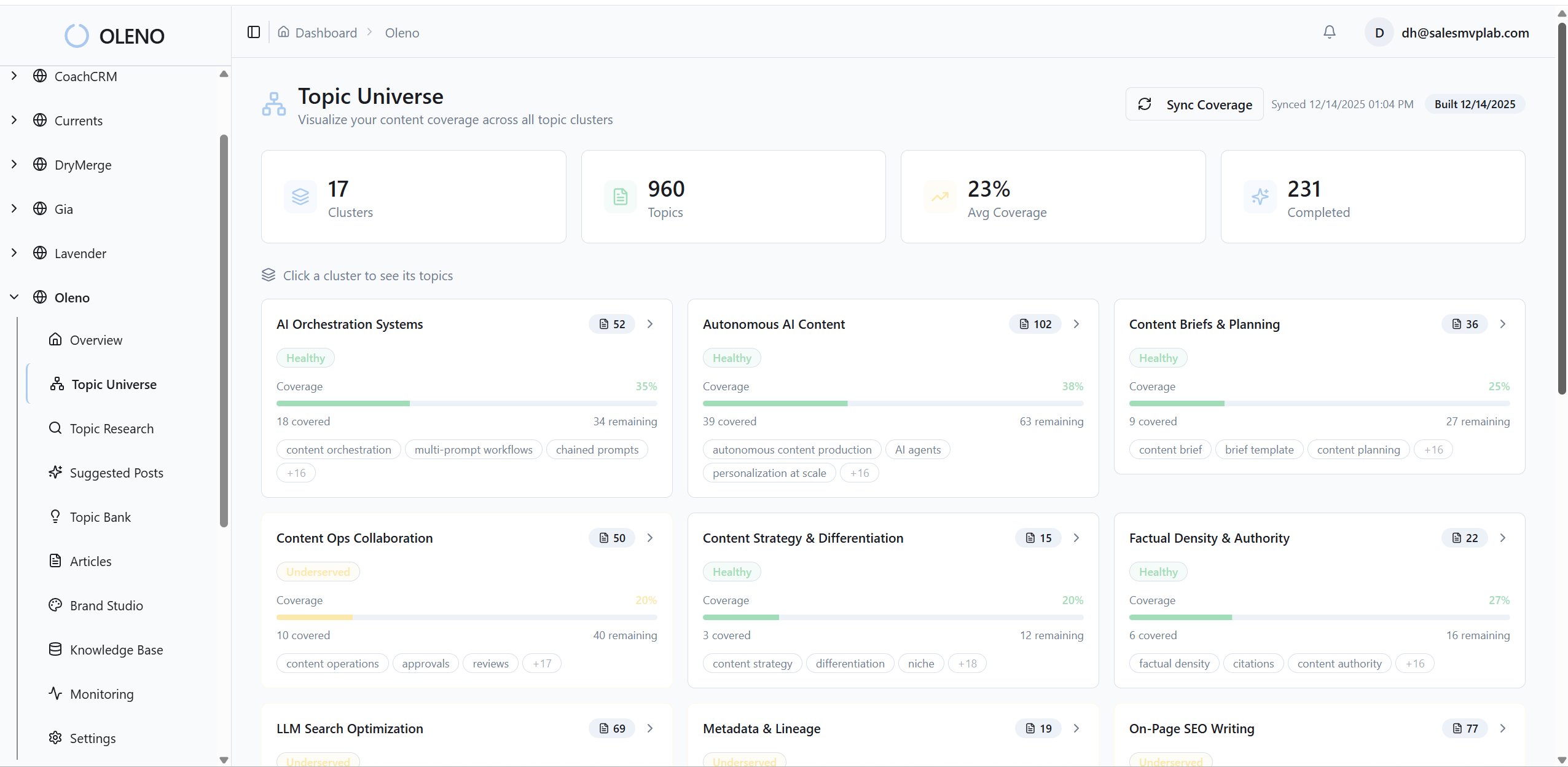
Because coverage and saturation are tracked in real time, priorities reflect where authority is thin, not where keywords are loud. You stop spiking one area because it’s easy to write about and start building balanced pillars. That’s the foundation authority needs.
Brief generation with Information Gain Scoring and differentiation checks
Every approved topic becomes a structured brief with competitive research included during brief generation. Oleno calculates an Information Gain Score from 0–100 and flags low-differentiation outlines before writing starts. Writers get clarity on the angle and the “net-new” expectation. Editors stop policing originality after the fact.
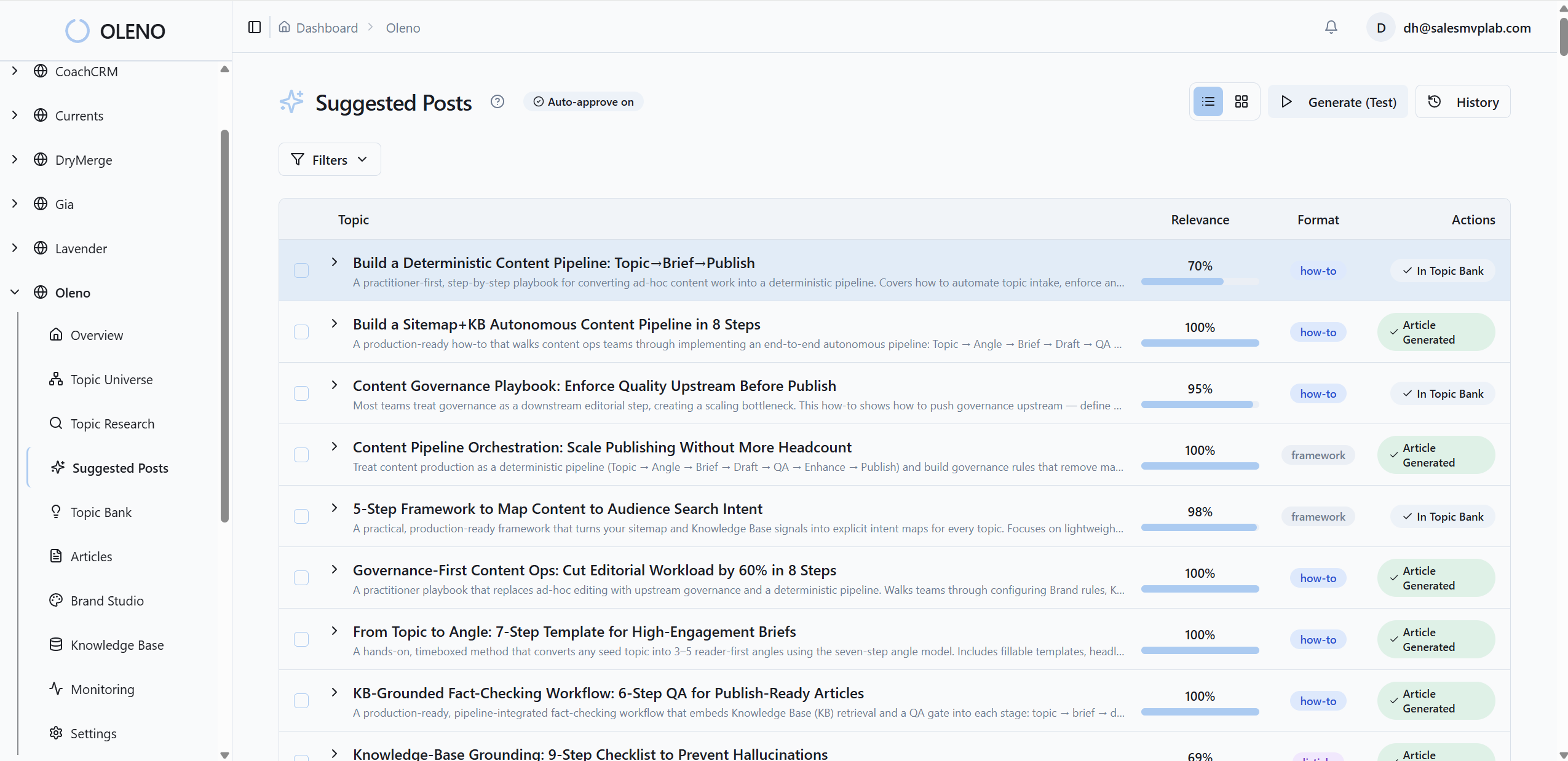
When a brief doesn’t meet the bar, it doesn’t go forward. That single decision removes hours of frustrating rework and the downstream cannibalization fixes that usually follow. You write less, add more, and avoid the $6,000-per-month drag we walked through earlier.
QA gate, visuals, and deterministic publishing remove manual drag
Drafts are generated to your brand voice with snippet-ready structure, then pass an automated QA gate with 80+ checks across structure, tone, snippet readiness, and KB grounding. Visual Studio generates brand-consistent hero and inline images, prioritizes the solution section for product visuals, and creates alt text and filenames automatically. Internal links are injected deterministically from verified sitemaps, and schema is attached programmatically.
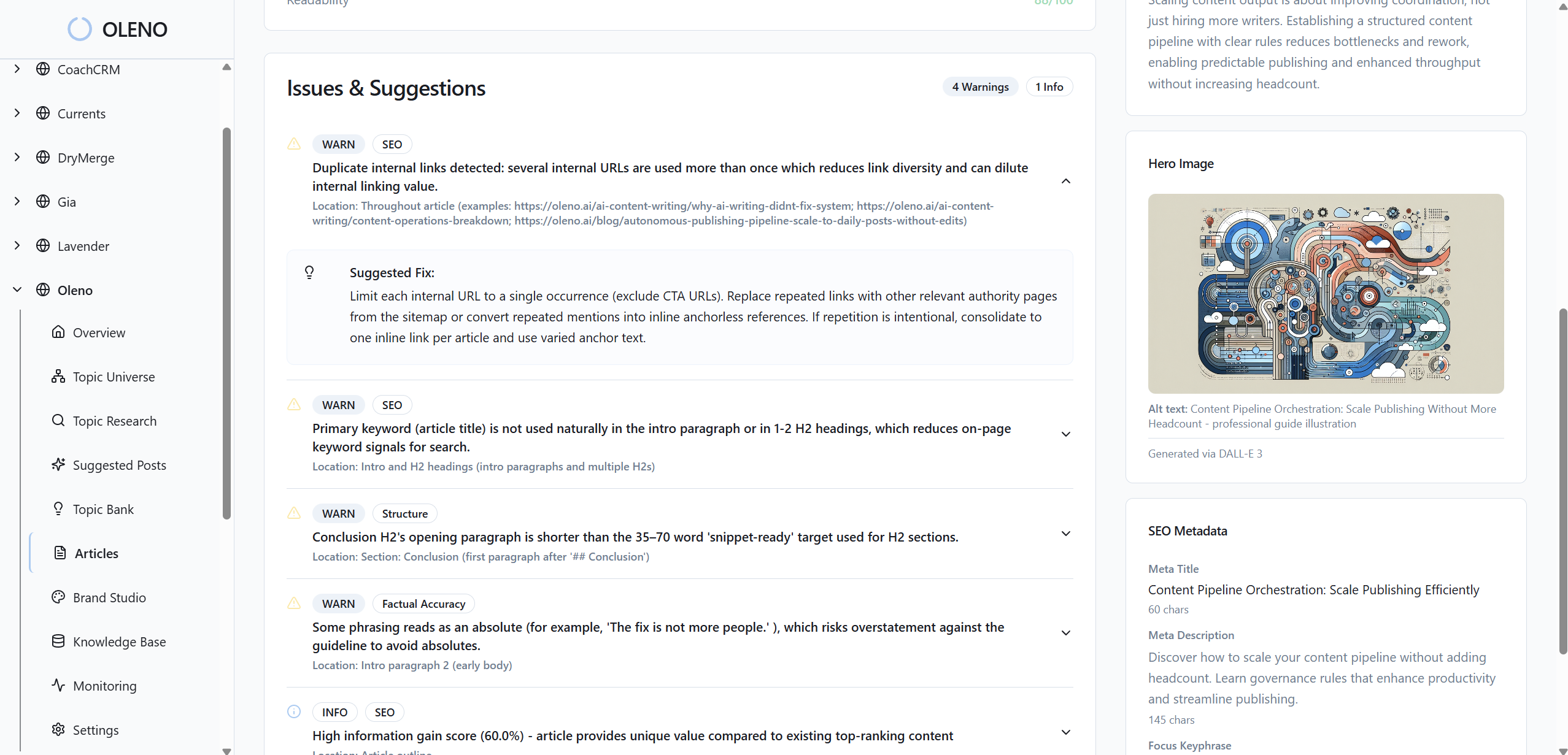
Publishing connectors handle WordPress, Webflow, or HubSpot delivery without copy-paste or broken embeds. No prompt chains. No design handoffs. No link guessing. Oleno ties back to the exact costs we quantified earlier by preventing redundant drafts, avoiding cannibalization, and eliminating calendar scrambles with a queue that refreshes daily. Ready to see the pipeline run on your content? Try Oleno For Free.
Conclusion
Keyword volume isn’t evil; it’s just not a steering wheel. Information gain is. When you map coverage, score originality before drafting, and enforce rules with cooldowns, publishing shifts from guesswork to compounding authority. You’ll feel the difference quickly—fewer repeats, clearer pillars, and content your team is proud to share.
About Daniel Hebert
I'm the founder of Oleno, SalesMVP Lab, and yourLumira. Been working in B2B SaaS in both sales and marketing leadership for 13+ years. I specialize in building revenue engines from the ground up. Over the years, I've codified writing frameworks, which are now powering Oleno.
Frequently Asked Questions