Information Gain Scoring: Enforce Differentiation Before Drafting

When content is your pipeline, the real cost isn’t a slow writer—it’s a weak idea that sneaks through and burns the team. I’ve lived it. At PostBeyond, I could crank out 3–4 strong posts a week solo. As we scaled, drafts looked “fine,” but originality slipped. We shipped words, not new answers. Painful.
Back at Steamfeed, we grew to tens of thousands of pages because we paired volume with fresh angles. Every topic had multiple credible takes, so we earned long-tail demand. Later, at LevelJump, founder-led content moved fast, but structure lagged. The pattern shows up everywhere: no gate on originality, lots of late-stage rework. It doesn’t have to be that way.
Key Takeaways:
- Treat Information Gain Score (IGS) as a pre-draft gate that blocks low-differentiation ideas
- Measure overlap at the claim and entity level, not just keywords or headings
- Quantify rework costs—time, morale, and diluted authority compound fast
- Enforce thresholds in your brief template with clear pass/fail paths and cooldowns
- Use a lightweight rollout: prototype in Python, connect to your brief, train editors
- Systematize with a QA gate and deterministic publishing so originality choices stick
Why Originality Must Be Gated Before Drafts
Originality needs a binary gate before any drafting happens. Define an Information Gain Score that answers one question: will this add net-new value beyond what already ranks and what you’ve published. If the score is below threshold, it waits. That one rule saves hours, budget, and credibility.
The metric that decides whether you should write at all
Make originality a yes/no decision, not a vibe. Give every brief an IGS, a single number that approximates “would a reader learn something they didn’t already know.” If it’s below the bar, you don’t write. Teams think this slows velocity; in practice, it eliminates false starts and frustrating rework.
It also creates shared language. Instead of arguing taste in meetings, you point to the score and the gaps behind it. Editors stop negotiating micro-edits for a draft that never had an angle. Writers get clarity before they invest hours. Leadership sees a cleaner pipeline. Less subjective, more predictable.
What is information gain and why should you enforce it pre-draft?
Information gain, put simply, is reduction in uncertainty. You measure how much new ground a piece covers relative to what already exists—competitors and your own library. Enforce it pre-draft by analyzing overlap and novelty before anyone opens a doc. It’s faster to kill weak ideas than to fix sameness later.
If you want the search lens on this, a practical primer from Search Engine Land on information gain lays out why engines reward new information. The upshot for teams: don’t bet on “we’ll make it unique in edits.” You won’t. Put the gate upstream.
Why post-publish uniqueness checks fail
Post-publish checks arrive when deadlines and sunk costs distort judgment. Someone adds a stat. Another person swaps a heading. It looks different, but it isn’t different. The core assertions haven’t changed, and neither will your outcomes.
Pre-draft gating avoids that trap. If originality isn’t present in the brief—angle, sources, new claims—no line edit will conjure it later. The discipline feels strict at first. It turns into relief when your team notices fewer “can we rewrite this” threads.
Ready to validate the approach on your stack without a big process change? You can move fast and still be selective. Generate 3 Free Test Articles Now.
The Real Reason Teams Repeat The Same Ideas
Teams repeat ideas because their checks look at surface features—keywords and headings—instead of the substance of claims. Real differentiation shows up in assertions, evidence, and entities. If your brief reproduces the same answer pattern with different words, it’s still redundant.

What traditional overlap checks miss
Keyword overlap is easy to measure and mostly useless for originality. Two articles can look different on the surface yet deliver the same take, the same examples, the same advice. That’s a content twin, and search engines spot it. Readers do too. They bounce.
Focus on claims and evidence types. Are you making a new assertion? Are you bringing a source others didn’t? Are you adding a constraint others missed? This is closer to how information gain in decision trees works—less about words, more about reducing uncertainty with new splits.
The hidden complexity behind semantic redundancy
Redundancy lives in latent space. Paragraph embeddings with high cosine similarity. Identical TL;DRs. Near-matching sequence of subheadings. You can feel it when two pieces collapse into the same take. Your process should catch it before drafting, not after.
Cluster competitor paragraphs by claim type—definitions, frameworks, data points, case examples. If your outline sits inside that cluster, you’ll struggle to earn a snippet or a citation. Push out of the cluster by sourcing different datasets, reframing the job-to-be-done, or going deeper on implementation detail.
When should you consider topical novelty vs SERP sameness?
A brand-new topic and a new angle on a saturated topic are different bets. If the SERP is uniform—everyone says the same thing—novelty can work if it answers an overlooked question, plugs a data gap, or debunks a common assumption with evidence.
If the SERP is already diverse, originality needs stronger proof. Proprietary benchmarks, a worked-through implementation example, or a constraint-aware “this only works if…” take. The bar for gain isn’t “sounds fresh.” It’s “adds something concrete that wasn’t available.”
The Cost Of Redundant Content You Never See Coming
Redundant content taxes teams in quiet ways: hidden hours, diluted authority, confused crawlers, and editorial fatigue. You don’t notice it in a single sprint. You feel it over quarters as throughput looks busy but surface area of answers barely grows.
Engineering hours lost to manual rework
Let’s pretend you ship 20 posts a month and 40 percent require “make it original” edits. At two hours of editor time and one hour of writer revisions per post, you burn 60 hours monthly on avoidable clean-up. That’s nearly two additional publishable pieces lost every month.
Those hours also land in the worst places—Friday afternoons, pre-launch weeks, end-of-quarter pushes. Teams pay with context switching, which carries a cognitive tax you won’t see on a budget line. The fix isn’t more editing. It’s fewer low-gain briefs entering the system.
The cascading impact on authority and crawl budget
Redundant pages cannibalize each other. Internal link equity splinters. Crawlers hesitate on which URL to treat as canonical. You end up with softer snippet eligibility and slower indexation. The result is diluted authority even as the content count climbs.
A lean set of high-gain pages does the opposite. Clear signals. Consistent internal anchors. Less duplication for crawlers to wade through. The compounding effect shows up as faster citations and steadier rankings—again, not guaranteed, just more likely when your corpus is cleaner.
A simple math example, let’s pretend your team publishes 20 posts monthly
Assume 20 posts, $600 fully loaded cost per post, 40 percent redundancy, and a 25 percent “we fixed it” rate that still ships low-gain content. You’re spending $4,800 monthly on material that doesn’t expand your answer surface. That’s budget you could point at high-gain research or product content.
If you want a search perspective on why redundancy gets discounted, this SEJ explainer on Google's information gain is a helpful read. For operations, an IGS threshold of 70 trims waste without adding headcount.
Seeing these costs in your own workflow and want a simpler path forward? Try Using An Autonomous Content Engine For Always-On Publishing.
The Human Side Of Rework And Approval Fatigue
The rational costs are real. The emotional ones are what derail sprints: late edits, confused approvals, SMEs going dark. Gating originality early protects energy—yours and the team’s—and keeps momentum intact.
The 3pm rewrite request that derails your sprint
You know the thread. Draft is “pretty good,” but the angle is generic. Now you’re negotiating edits, re-recording quotes, and chasing SMEs for sharper examples. By 5pm, the team is doing cleanup instead of the work they planned. That’s how calendars fill up with work that shouldn't exist.
When we were three people at LevelJump—CEO, VP Product, me—I couldn’t afford these detours. We recorded founder videos and turned them into posts to save time. It shipped content, sure. But without a structure for originality, we still missed what search and assistants cite. The lesson stuck: fix it upstream.
When your experts stop volunteering source material
Experts smell repetition. If every request feels like “that same piece, again,” they go quiet. Not out of spite—because there’s no leverage. A pre-draft IGS threshold builds trust: when you ask for a quote or dataset, it’s for a brief that already clears the bar.
That confidence changes the relationship. Your subject matter experts become co-authors, not last-minute fact-checkers. They bring the good stories and the nuanced caveats because they know the piece won’t disappear into a pile of similar takes.
Who benefits most from pre-draft gating?
Editors get fewer fix-it passes. Writers get clearer briefs. SMEs get targeted asks tied to a real angle. Design spends time on pieces worth shipping. Leadership sees predictable throughput and a cleaner narrative. One rule, many relief points.
If you’ve ever watched a lively brainstorm turn into a “make it different” slog, this is your exit. Move originality decisions to the moment that’s cheapest to change: the brief.
For an editor’s take on this shift, MarketMuse on writing for information gain offers useful prompts you can adapt.
A Practical System To Compute And Enforce Information Gain
You don’t need a research team to compute IGS. Start with a simple scoring model that evaluates overlap, semantic similarity, and novelty. Normalize to 0–100. Gate at thresholds. Store scores with the brief so decisions are transparent and repeatable.
Define your signals for IGS, overlap, semantics, novelty
Start simple. Use three buckets and assign weights you can explain. First, text overlap on headings and bullets. Second, semantic similarity on paragraph embeddings. Third, topical novelty—unmentioned entities and claim types. Weight them 30, 40, 30 to begin. Adjust as you see where false positives creep in.
The question behind the math stays the same: would a reader learn something new? The scoring exists to proxy that answer consistently across topics and editors. Keep the model explainable enough that a writer can improve a brief and re-submit with confidence.
How do you calculate and normalize IGS?
Workflow looks like this. Fetch the top 5–10 ranking URLs for the topic. Chunk them into paragraphs, embed with a common model, and compute cosine distance against your outline paragraphs. Add a gap-extraction pass to list missing claims and sources. Then normalize to 0–100 where 100 represents entirely new coverage.
Store the component scores alongside the total. That way, if a brief fails on novelty but passes on overlap, the remedy is clear: source new evidence or introduce an overlooked constraint. Decisions become actionable, not mysterious.
Integrate thresholds, templates, and auto-flagging in briefs
Put IGS right in the brief template next to angle and sources. Define pass at 70-plus for net-new articles and 60-plus for updates. If it’s below threshold, the topic cools for 90 days or requires one of: proprietary data, a defensible contrarian stance, or implementation depth.
Auto-flag briefs that miss the bar before any drafting begins. The point isn’t to block content; it’s to prevent rework from entering the system. When a brief passes, teams can write quickly and confidently. When it fails, you’ve saved hours.
Lightweight tooling and a 3 week rollout plan
Week 1: prototype in Python using sentence-transformers, cosine similarity, and a simple entity diff. Week 2: connect the scorer to your brief form, store scores, and add a Notion or Airtable rule that blocks low scores. Week 3: train editors on gap prompts and codify pass/fail reasons and cooldown rules.
No specialized tools required to start. You’re building a policy with teeth—not a research lab. Once the habit sticks, iteration is easy: better embeds, refined weights, smarter gap prompts. The structure does the heavy lifting.
For the search perspective behind this approach, this SEMrush guide to information gain outlines practical implications you can cross-check with your editorial rules.
How Oleno Operationalizes Information Gain From Brief To QA
Oleno bakes information gain into the pipeline from the first brief to the final publish. Briefs get scored and flagged early. QA enforces the bar later. Topic Universe prevents saturation. Publishing is deterministic, so upstream decisions carry through without manual cleanup.
Brief generation computes IGS and flags low-differentiation
During brief generation, Oleno analyzes top-ranking content, calculates an Information Gain Score from 0–100, and flags low-differentiation outlines. Weak briefs don’t enter drafting. Writers receive plans that already clear the bar, with angle and source guidance aligned to your brand voice.
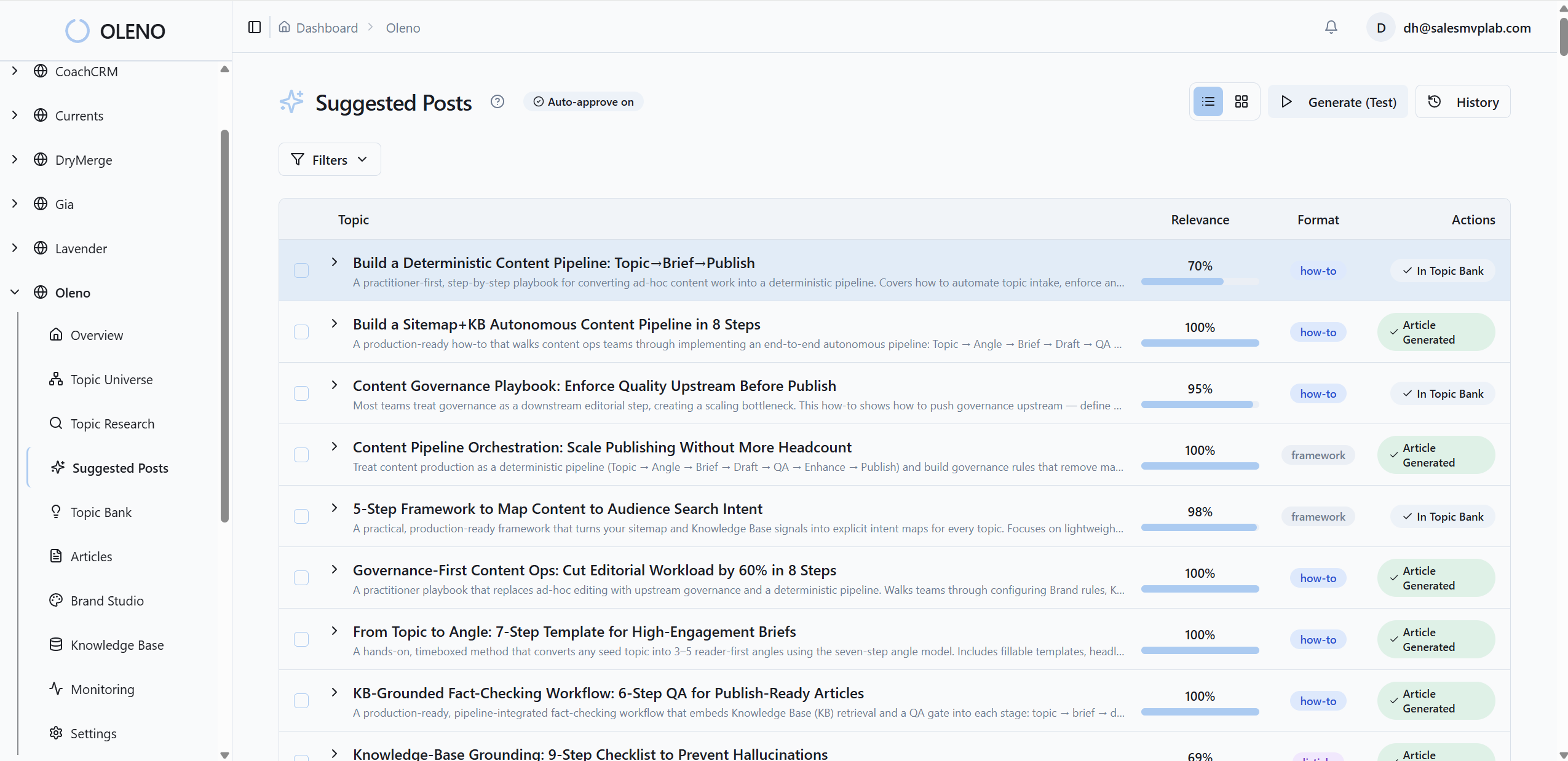
Because differentiation is enforced before writing, you avoid the “we’ll fix it in edits” trap. The score isn’t a guess; it reflects overlap, novelty, and missing claims surfaced during research. That’s how you stop redundant content before it burns hours.
QA gate rewards high gain and blocks weak drafts
Oleno’s automated QA evaluates drafts against 80+ checks, including information gain and snippet readiness. If a draft underperforms, refinement loops kick in; strong pieces proceed. Quality isn’t a Slack thread—it’s a gate the system enforces consistently every time.
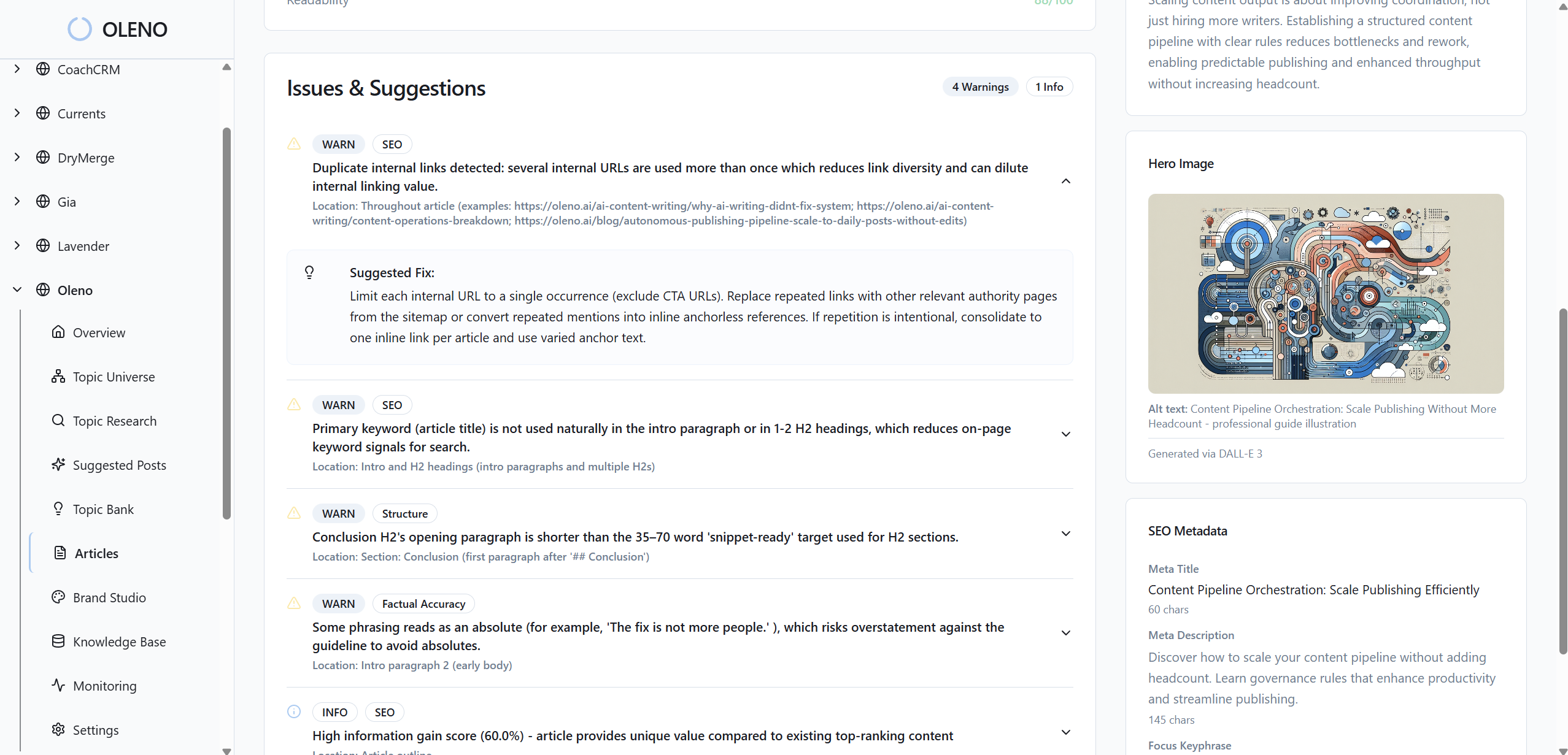
This closes the loop on the costs we covered earlier. Fewer 3pm rewrite requests. Less cannibalization. Clearer structure that’s easier for assistants and search to cite. You’re not promising outcomes; you’re improving odds by removing structural mistakes.
Cooldowns and Topic Universe prevent saturation
Topic Universe tracks cluster coverage and enforces a 90-day cooldown before re-covering the same topic. Paired with IGS gating, it reduces cannibalization and repetitive angles. You publish when coverage needs it, not when a calendar slot opens.
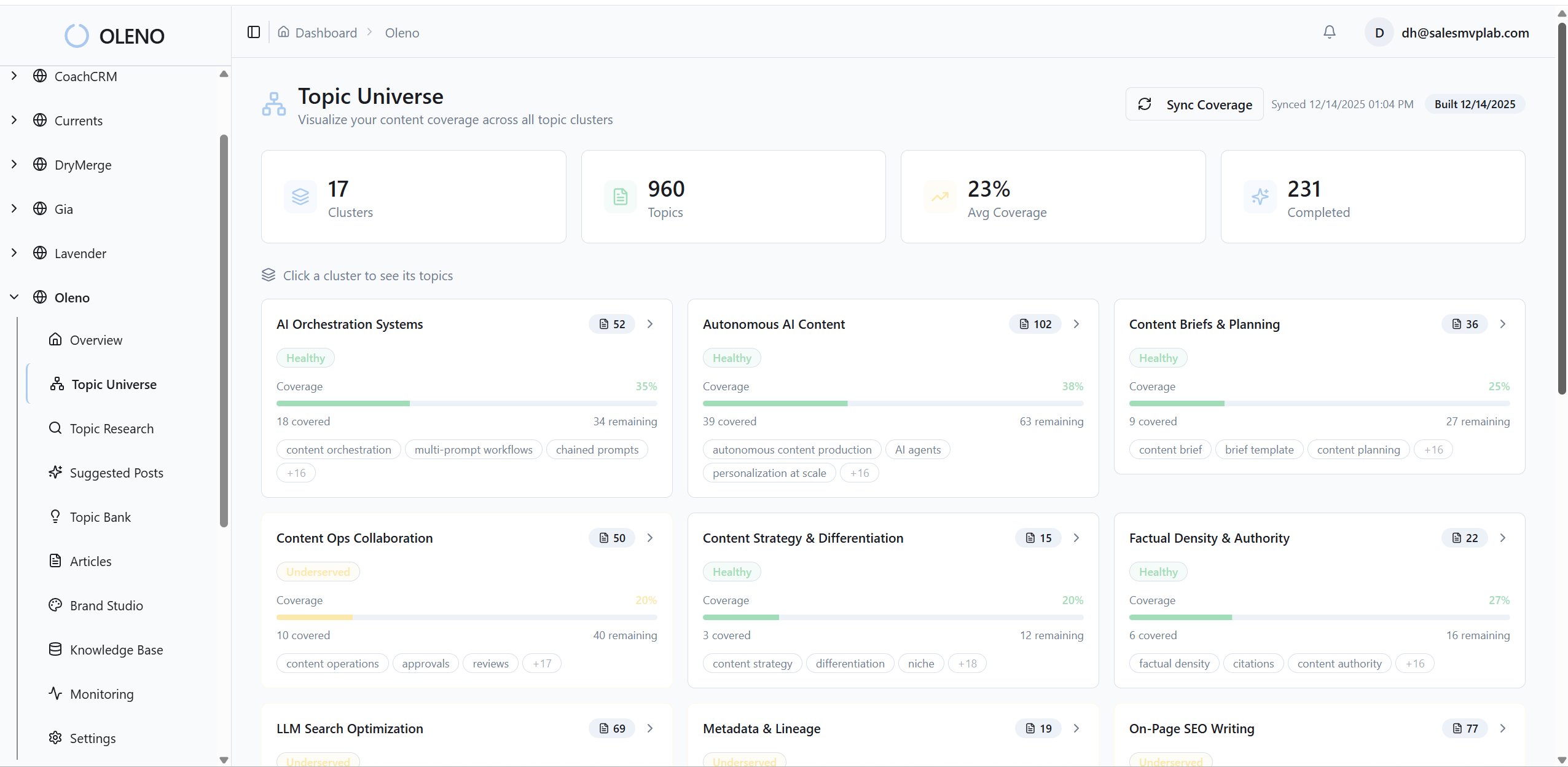
This also clarifies priorities. Underserved clusters get attention. Well-covered areas pause until there’s a legitimately new angle—proprietary data, novel constraints, or implementation depth worth documenting.
Publishing remains deterministic, links and schema handled after
Once a draft clears QA, Oleno injects verified internal links, generates valid JSON-LD, and delivers CMS-ready HTML through connectors like WordPress, Webflow, or HubSpot. Deterministic publishing means no fabricated URLs, no broken markup, and no manual embedding of assets.
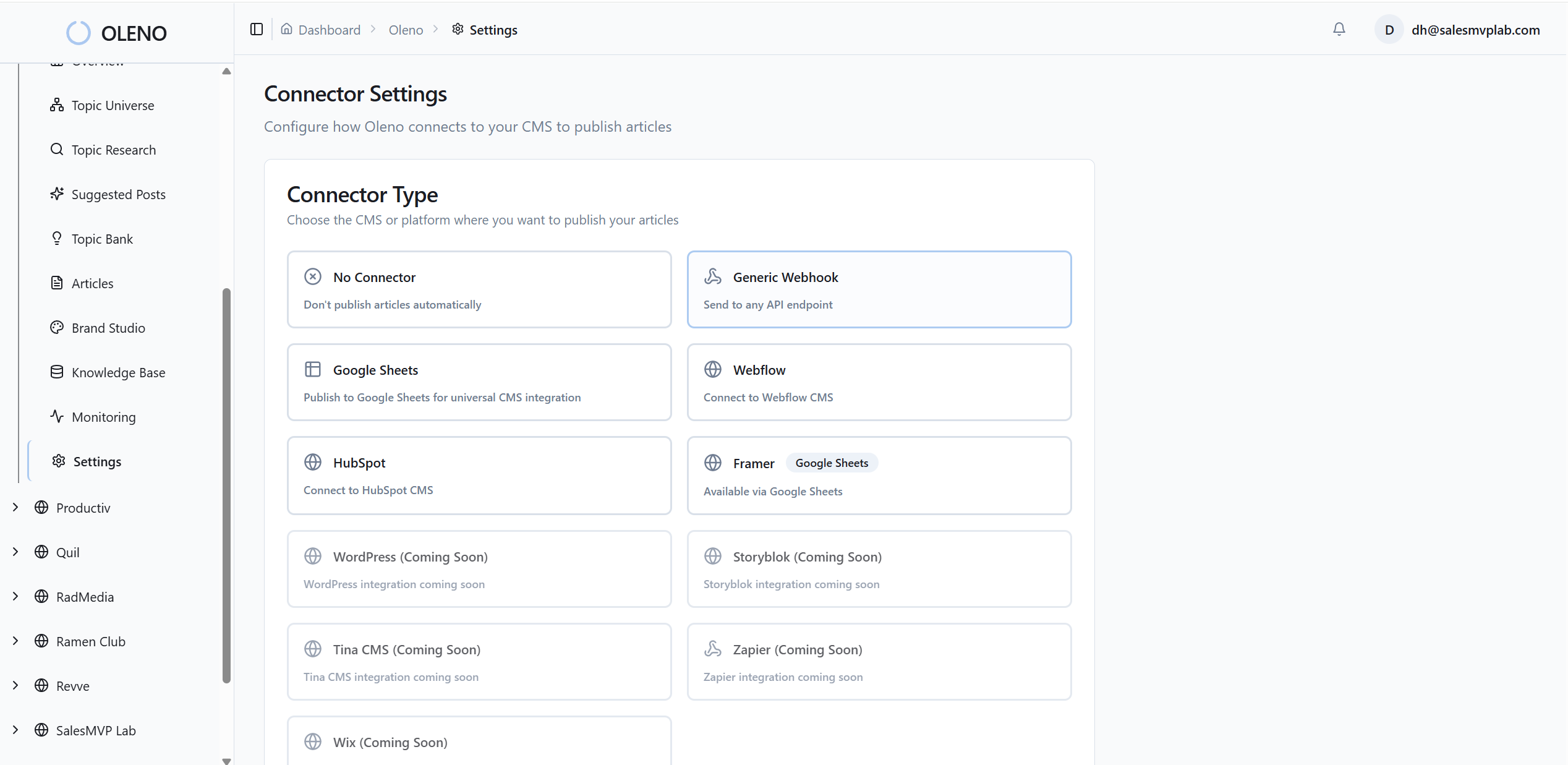
The result is a clean pipeline: originality decided early, quality enforced midstream, and accuracy handled by code at the end. That’s how teams reclaim hours and reduce the hidden cost of redundancy without hiring more editors.
Want this system running without building it yourself? Try Oleno For Free.
Conclusion
You don’t need more editing energy. You need a rule that stops sameness before it starts. Gate originality at the brief with an Information Gain Score, enforce it with a QA gate, and prevent saturation with cooldowns. Do that, and your writers move faster, your experts engage, and your content compounds instead of colliding.
About Daniel Hebert
I'm the founder of Oleno, SalesMVP Lab, and yourLumira. Been working in B2B SaaS in both sales and marketing leadership for 13+ years. I specialize in building revenue engines from the ground up. Over the years, I've codified writing frameworks, which are now powering Oleno.
Frequently Asked Questions