Innovative Product Marketing Content Ideas for 2023

72% of teams that add more content contributors get slower, not faster. If you're a PMM, you've probably felt this this week: more briefs, more drafts, more review cycles, and somehow less confidence that the final piece is even saying the right thing.
Innovative product marketing content usually doesn't break because your team lacks ideas. It breaks because strategy gets diluted at every handoff, then everybody pays the editing tax on the back end.
Key Takeaways:
- Innovative product marketing content fails when execution is fragmented, not when strategy is weak.
- If your PMM team touches more than 3 review rounds per asset, you don't have a writing problem. You have a system problem.
- The fastest way to improve content quality is to encode product truth, audience context, and messaging rules before drafting starts.
- PMM teams should separate creative judgment from repetitive workflow. Humans own the stance. Systems own the repetition.
- In the GEO era, consistent narrative expression across scale matters more than random bursts of content volume.
- Oleno fits teams that already know what they want to say but need a reliable way to get that into publish-ready content.
If you want to see what that looks like in practice, you can request a demo.
Why Innovative Product Marketing Content Breaks as Teams Grow
Innovative product marketing content breaks when more people touch the work but nobody owns the full system. The issue isn't effort. It's translation loss between strategy, drafting, review, and publish.

The handoff tax gets expensive fast
A lot of teams assume scale means adding contributors. More writers. More freelancers. Maybe an agency. Maybe a few AI tools layered in for speed. On paper, that sounds reasonable. In practice, it creates what I call the 4-Handoff Drift: strategy doc to brief, brief to draft, draft to review, review to publish. At each handoff, a little context falls out.
Back at PostBeyond, I watched this happen in slow motion. At 8:14 AM on a Monday, our writer would open a Google Doc from a launch brief, Slack me two clarifying questions, then wait because I was already in leadership meetings. By 2:30 PM, the draft was moving again, but now it had missed product nuance, softened a core claim, and picked up a generic intro from a previous post pattern. Nothing catastrophic. Just enough drift to guarantee another review cycle. That's how innovative product marketing content gets slower without anyone obviously doing a bad job.
I saw some version of this years ago when I was the sole marketer on a SaaS team. I could put out 3-4 strong posts a week because all the context lived in my head. Then the team grew. Output should have increased. It didn't. The writer had less product context than I did, I had less time to write, and review cycles got heavier. Same company. More people. Slower system.
That pattern is common with scaling SaaS teams past 200 employees. The PMM owns the product narrative, the content person owns production, demand gen wants campaign fit, and leadership wants polish. Nobody is wrong. But the work starts bouncing around like a pinball machine inside a launch board: every stakeholder adds force, nobody controls the table, and the asset lights up everywhere except the right slot. More motion. Less progress. So if speed isn't the real win, what actually is?
AI speed hides a quality problem
AI made drafting faster. It didn't make innovative product marketing content more reliable. That's the part a lot of teams miss.
A PMM pastes in a launch brief. The model returns something clean enough to feel useful. Then review starts. Claims are a little off. Positioning is too generic. The examples don't sound like your buyers. Competitive framing is soft. So the team edits. And edits. And edits. What looked like leverage turns into cleanup.
One experienced SEO consultant who reviewed Oleno output used a phrase I liked a lot: it passed the slop test. That's actually a high bar. Because most people working in content know slop the second they see it. They don't need a rubric. They feel it in 10 seconds.
To be fair, raw speed does matter in launches, especially when the team is under a date they can't move. That's valid. But if the first draft arrives 40 minutes faster and the PMM still spends 95 minutes rebuilding positioning, speed didn't save you; it just moved the labor downstream. Fast drafting with weak governance is like shipping a feature with QA turned off. The calendar looks good right until support lights up.
The pain is operational, but it feels personal
What makes this messy isn't just the workflow. It's that broken systems make competent people look flaky.
The PMM thinks, "Why am I still rewriting this intro at 9:30 PM if we already aligned on messaging?" The content lead thinks the PMM is a bottleneck. The exec team thinks content is taking too long. Nobody says the obvious thing out loud: the workflow is broken, so the people inside it look slower than they really are.
And that's why this issue lingers. Teams turn a systems problem into a people problem, then try to solve it with nudges, more meetings, or better prompts. Wrong layer. If the workflow keeps stripping context, even good writers will produce unstable innovative product marketing content. Which brings us to the real issue: what governance is missing before the draft even starts?
The Real Problem Isn't Writing Quality. It's Missing Governance
The root cause isn't that your writers can't write or your PMMs are too picky. The real problem is that innovative product marketing content is being produced without a governed operating model.
Strategy lives in docs, not in execution
Strategy living in ten places is the same as strategy living nowhere.
Most companies actually do have decent strategy. They have messaging docs. Positioning decks. Launch briefs. Persona notes. Sales call recordings. Competitive notes. Product docs. The issue is none of that gets applied consistently once work starts moving.
That's the Strategy-Execution Gap. Strategy exists. It just doesn't survive contact with execution.
A PMM updates the positioning. A freelance writer never sees the latest nuance. An AI tool gets a stripped-down prompt version. A reviewer catches the miss two days later. Then the same correction gets repeated next week on another asset. That's not a talent problem. That's a missing system.
The Warehouse Rule is useful here: if your core product truth exists in more than 3 places, it effectively exists nowhere. Spreadsheets, Notion docs, Slack threads, launch decks, old briefs. It's like storing launch inventory in five separate rooms with no master SKU list. The parts are technically in the building, but good luck assembling the same message twice. And once you see that, the next question gets sharper: where does innovative product marketing content actually fail first?
Product marketing content fails when product truth is loose
What happens when the draft knows the topic but not the product? You get copy that sounds smart, reads clean, and quietly says the wrong thing.
For PMMs, this is the really painful part. You're usually the one accountable when a feature claim is wrong, when a use case is fuzzy, or when the narrative sounds detached from how the product actually works.
And to be fair, manual review does catch a lot. There's a case to be made for keeping humans tightly involved, especially when launches are sensitive or the product is evolving fast. I agree with that. But human review only works well when it's validating governed inputs, not rebuilding the asset from scratch every time.
If a team needs 4+ substantive PMM edits per draft, use the 4-Edit Rule: stop optimizing prompts and go fix the source governance. At that point, the work is telling you it doesn't know what "right" looks like before generation begins. The mechanism is simple: loose product truth creates soft claims, soft claims trigger rewrites, and rewrites eat the very time AI was supposed to save. That matters even more now because consistency isn't just an internal quality issue anymore.
GEO raises the bar on consistency
Two decent pages that say different things about your product can now do more damage than one mediocre page ever did.
In the old SEO playbook, you could get away with some inconsistency if the page still matched a query and ranked. That's less true now. AI engines synthesize across many pages and brands. They look for signals of consistent expertise, not isolated good paragraphs.
So innovative product marketing content now has a second job. It has to help the buyer understand the product, and it has to help AI systems understand what your company consistently stands for. That's a surprising connection a lot of teams haven't internalized yet: brand governance is now a discoverability issue.
One team I knew had excellent rankings on a lot of topics. Great writers. Strong design. Real traffic. But the content drifted too far from the actual product and demand-gen story, so it didn't do much for pipeline. Good SEO. Weak commercial alignment. That's a painful combo because it feels like success while you're living it.
So if fragmented execution is the disease, what does a better model actually look like?
How Strong Teams Build Innovative Product Marketing Content Systems
Strong teams don't rely on heroic PMMs or one magical writer. They build a system where strategy is encoded once, then reused across every asset. That's how innovative product marketing content becomes repeatable instead of fragile.
Start with a diagnostic before you change the workflow
Before you add another process, diagnose the kind of problem you actually have. I use a simple model here called the PMM Drift Spectrum. It has three levels.
Level 1 is Input Drift. Messaging exists, but briefs are inconsistent. Level 2 is Review Drift. Briefs are okay, but drafts still need major rewrites. Level 3 is System Drift. Every asset depends on one or two people carrying context manually. If you're at Level 3, hiring another writer won't fix much.
Ask yourself four questions:
- Does the same product claim get corrected in multiple drafts?
- Do different writers describe the same feature in different ways?
- Does the PMM rewrite positioning after the first draft more than half the time?
- Can a new contributor produce an accurate piece without a 45-minute briefing call?
If you answered yes to 3 or more, your issue isn't creative talent. It's governance debt. Honestly, that's better news than it sounds, because governance debt is fixable. Before: every missed draft feels random. After: you can name the failure mode, assign the fix, and stop treating innovative product marketing content like a mysterious craft problem.
Encode audience, use case, and product truth before drafting
Most teams brief around topics. Better teams brief around intersections. That's a big difference.
The Content Triangle is the model I prefer: audience, use case, product truth. If one side is weak, the whole piece collapses. A generic audience gives you generic examples. A vague use case gives you abstract copy. Loose product truth gives you risky claims and soft differentiation.
So if you're writing for a Senior PMM at a scaling SaaS company, the article should reflect their actual world: launch content pressure, competitive pressure, accuracy pressure, too many stakeholders, not enough time. Then tie that to a concrete use case like content workflow automation. Then ground the piece in what the product actually does and does not do.
Here's the conditional rule: if your brief can't answer who it's for, what job they're trying to get done, and what claim is safe to make in under 90 seconds, the draft is not ready to start. Before, the writer gets a keyword and vibes. After, they get a bounded assignment with narrative edges. That's how innovative product marketing content stops sounding like it was written for everybody and nobody.
Separate judgment from repetition
Here’s the split that matters: humans should own the thinking, and systems should own the repeatable motions.
A PMM should decide category framing, core claims, supported use cases, unsupported use cases, and how to talk about the product. A system should handle repetitive workflow like pulling the right context into drafts, maintaining structure, applying voice constraints, and enforcing consistency checks. If you reverse that split, quality falls apart. Fast.
I learned this the hard way in founder-led environments. We had strong ideas. Strong opinions. Solid expertise. But getting those ideas into SEO-friendly, repeatable, structured content was hard. Especially when the same person was doing sales, marketing, and product work. Thought leadership without structure doesn't compound. It just ships sporadically.
The 70/30 Rule works well here. Let humans own the top 30% of judgment, POV, and exception handling. Let the system own the bottom 70% of repeatable execution. If you try to automate judgment, quality tanks. If you insist humans manually handle repetition, output stalls. And yes, that does feel a little more rigid at first. Fair. But rigidity in the right layer is what gives innovative product marketing content room to be sharper in the layers buyers actually notice.
Build for compounding, not one-off wins
Contrast the two models. One ships isolated wins. The other builds a library that gets smarter every month.
Back when I ran a high-volume marketing site, traffic spikes came at 500 pages, 1000 pages, 2500 pages, 5000 pages, then 10000 pages. Most pages didn't get huge traffic on their own. But the breadth and depth created a network effect. That's how coverage works. The system compounds even when individual pieces are modest.
Product marketing content works similarly, especially now. One launch article won't carry the whole story. One feature page won't fix positioning confusion. You need repeated, accurate, audience-aware expression of the same core truths across many assets. That's what gives buyers confidence. And increasingly, that's what gives AI systems confidence too.
If you want the midpoint test, use this one: if your team disappeared for two weeks, would your content system still know what to create, how to frame it, and what claims are safe to make? If no, you don't have a system yet.
If you'd like to pressure test that with your own workflow, you can request a demo.
Accept the tradeoff, then design around it
Loose workflows feel faster at the beginning. Governed workflows are faster by the end.
There is a real tradeoff here. Governed systems can feel more restrictive than ad hoc writing at first. Some teams don't like that. Fair enough. Loose processes feel faster in the first 10 minutes.
But that's the earned pivot. What feels faster locally is often slower globally. You save 20 minutes on the brief, then lose 2 hours in review. You skip documenting a use case, then spend three meetings debating examples. You let every writer freestyle the narrative, then wonder why the market can't tell what makes you different.
For pre-product startups, this advice doesn't fit as cleanly. If you still don't know your positioning, no system can encode what doesn't exist yet. Same goes for solo creators or teams using content as a checkbox. But for scaling SaaS teams with real demand-gen intent, governance isn't bureaucracy. It's what keeps the machine from slipping. So what does that look like when the operating model is built into the tooling itself?
How Oleno Turns Governance Into Publish-Ready Output
Oleno is built for teams that already have strategy but can't reliably get that strategy into content at scale. It doesn't replace PMM judgment. It gives that judgment a system to run through.
It grounds the message before the draft exists
Oleno starts with governance, which is the part most AI content tools skip. Marketing Studio encodes your positioning, key messages, category framing, and narrative structure so every draft starts from your point of view instead of neutral internet mush. Product Studio keeps approved product descriptions, feature boundaries, supported use cases, and pricing context in one place, which matters a lot for PMMs who are tired of cleaning up invented claims. Audience & Persona Targeting and Use Case Studio shape the angle so the same topic doesn't get treated like it was written for everybody and nobody.
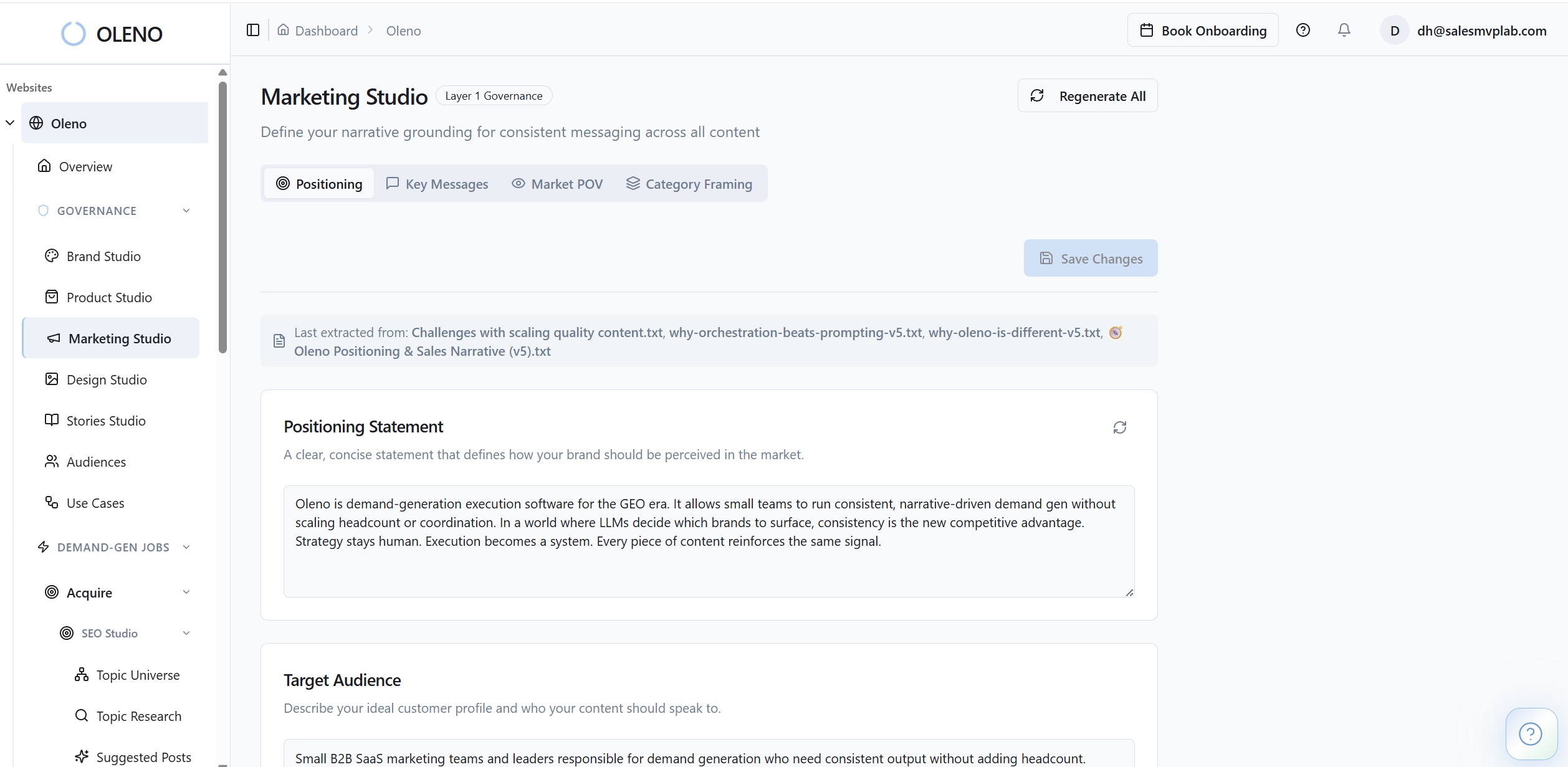
That matters because the real problem isn't drafting speed. It's pre-draft alignment. When the system already knows who the piece is for, what outcome matters, and what the product can honestly claim, review gets lighter. Not perfect. But lighter in the right way.
It makes scale less chaotic and quality more defensible
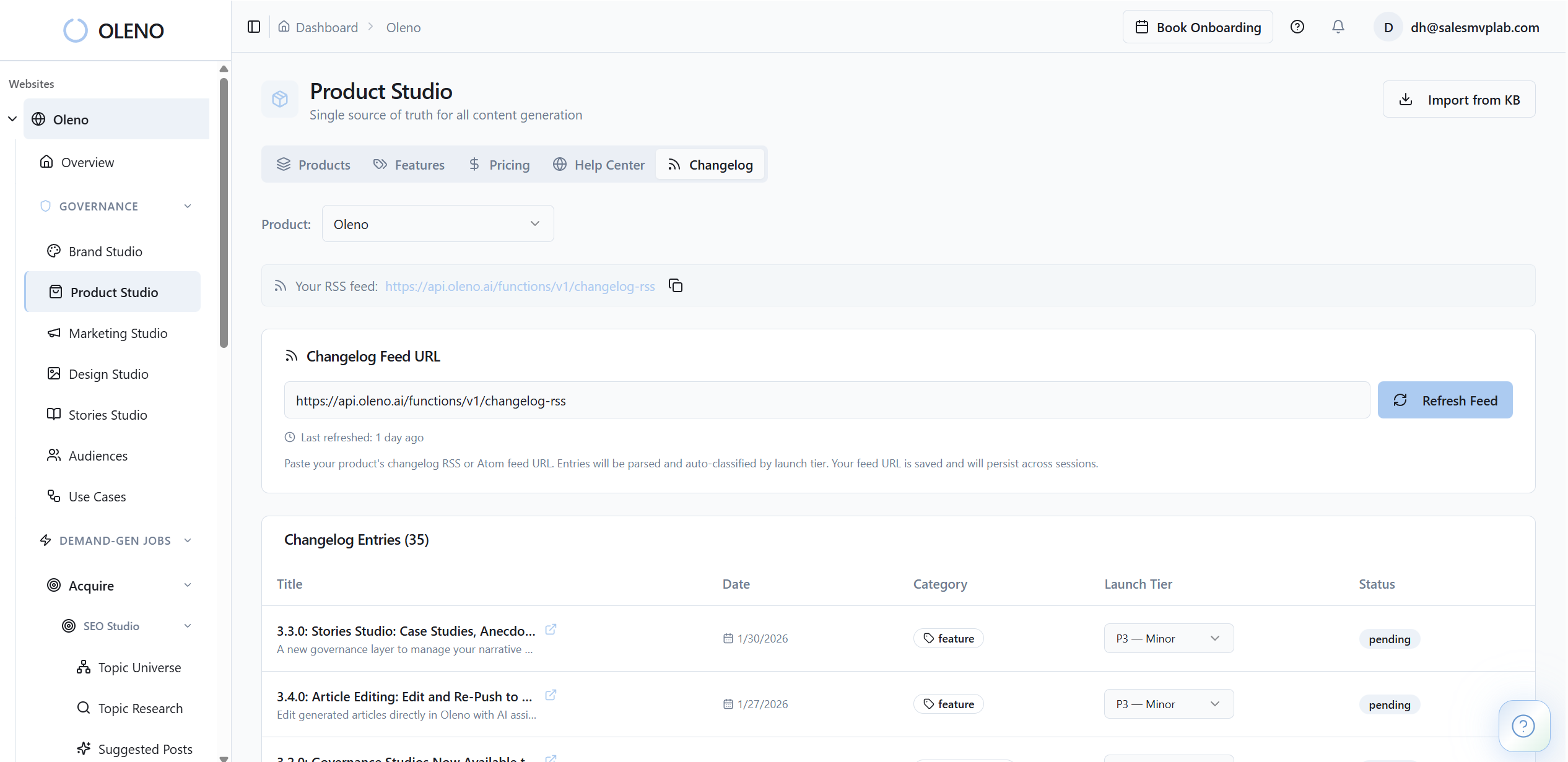
Once governance is set, Oleno uses job-specific studios to execute against it. Product Marketing Studio handles product-led content like feature deep dives, use case walkthroughs, workflow guides, and launches. Programmatic SEO Studio supports higher-volume acquisition content with a locked-outline pipeline and topic discovery through the Topic Universe. Stories Studio helps teams bring in founder stories, customer anecdotes, and sales insights so the output feels lived-in instead of generic.
Then Quality Gate checks the work against voice, structure, grounding, and product accuracy through 80+ automated checks before it reaches review. That's a big deal. Because the editing tax usually shows up when there are no guardrails until the end. Oleno flips that. Guardrails come first, output comes second.
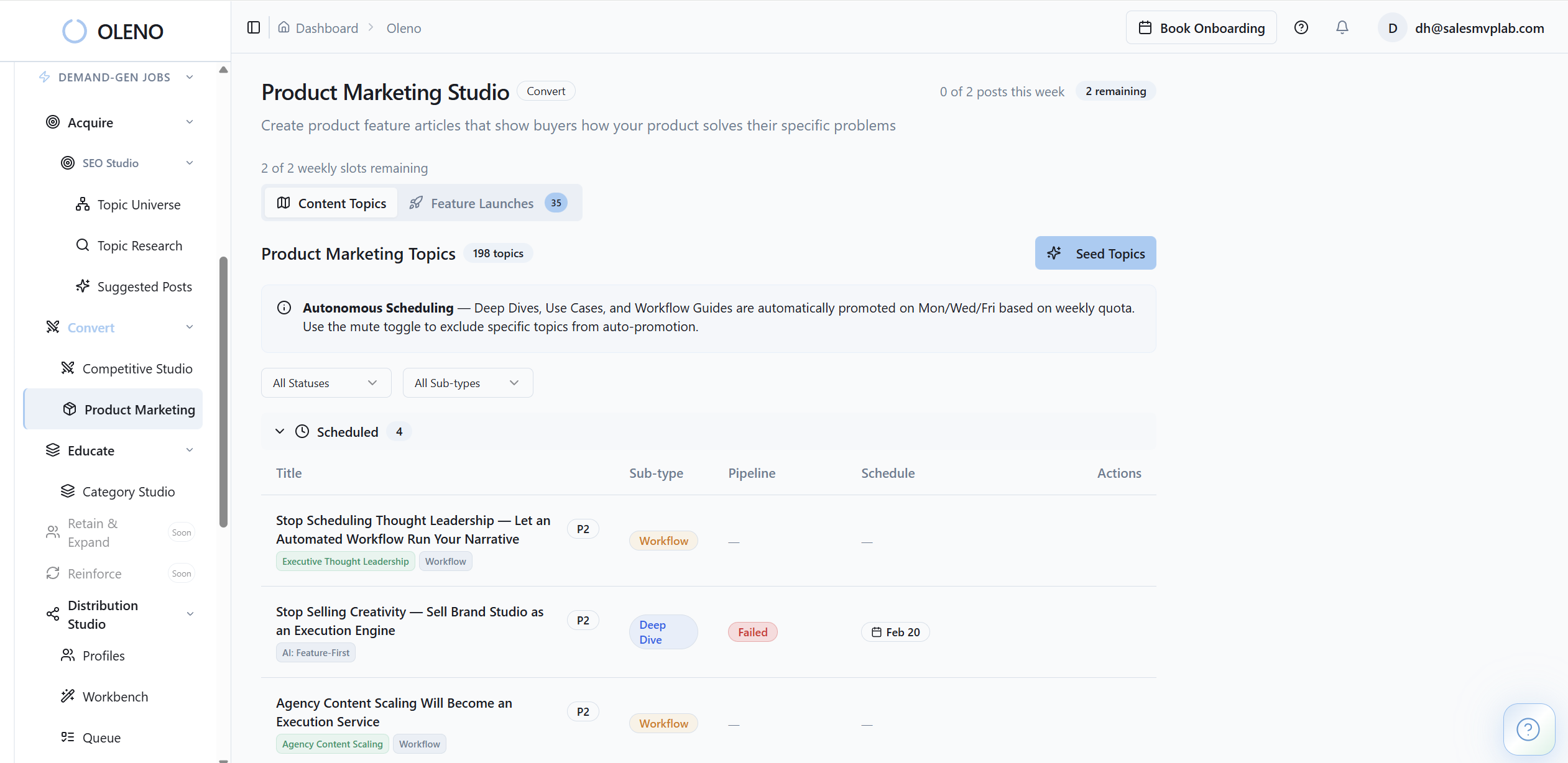
The broader point is simple. Oleno is not your technical SEO stack, your analytics layer, or your campaign planner. It doesn't replace PMM judgment or user research. It replaces the fragmented content execution loop that keeps PMMs and content teams stuck doing the same cleanup over and over.
If your team already knows what it wants to say, but can't get consistent product marketing content out without heavy coordination, that's where Oleno fits. Want to see how the workflow looks in your environment? book a demo
Why This Matters More Now
Innovative product marketing content used to be a nice-to-have layer on top of demand gen. Now it's part of the infrastructure. Buyers see it. Sales uses it. AI engines read it. And your team pays for every inconsistency whether you track it or not.
The old patchwork still "works" in the sense that content gets published. But activity isn't the same as execution. And execution isn't the same as compounding.
If you're scaling, the move isn't more prompts. It's a system. Encode the truth once. Enforce it everywhere. Then let your team spend its time on the hard part: strategy, judgment, and better decisions.
About Daniel Hebert
I'm the founder of Oleno, SalesMVP Lab, and yourLumira. Been working in B2B SaaS in both sales and marketing leadership for 13+ years. I specialize in building revenue engines from the ground up. Over the years, I've codified writing frameworks, which are now powering Oleno.
Frequently Asked Questions