Map Content Coverage Gaps: KB + Sitemap Signals for Action
Most teams chase keyword gaps because they’re easy to see. I’ve done it. At Proposify, we ranked for a mountain of terms that looked great on the weekly report. But some of those winners didn’t point to our product or our story. Traffic without coverage discipline becomes noise. It’s frustrating.
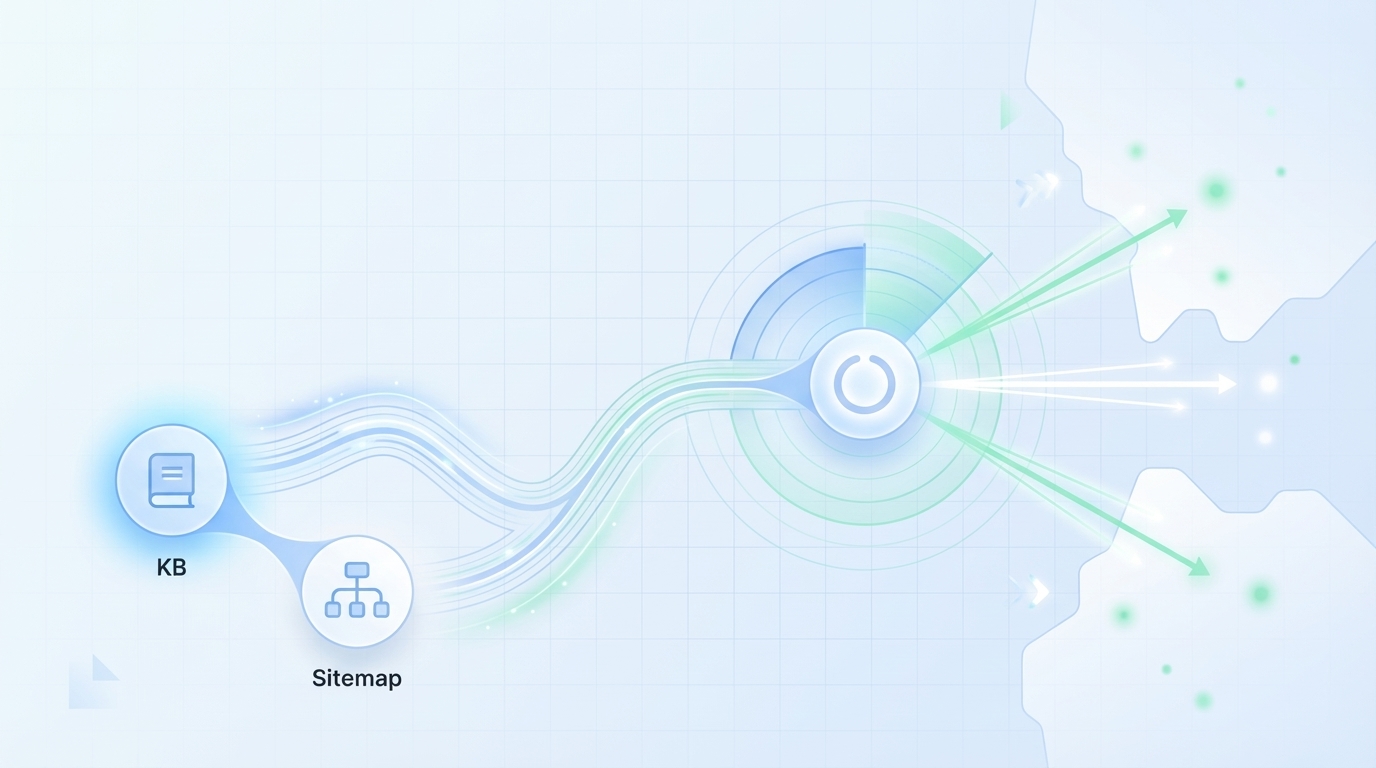
Here’s the thread worth pulling: keyword gaps aren’t the real gaps. Coverage gaps are. The distance between what your audience needs and what your site actually answers, with novelty, in the right cluster. That’s a sitemap + knowledge base problem, not a keyword tool problem. And it’s fixable if you measure the right things and enforce information gain before anyone drafts a word.
If you’re a small team, you don’t have time for spreadsheet archaeology. You need a light system that finds the holes, stops duplication, and makes publishing predictable. Not pretty. Predictable.
Key Takeaways:
- Map coverage by clusters, not isolated keywords, and include freshness and originality signals
- Use information gain scoring to block repetitive briefs before they become redundant articles
- Merge sitemap structure with your knowledge base to see where authority should live
- Quantify the cost of duplication: cannibalization, rework, and confused internal links
- Run an upstream pipeline: embed your KB, cluster topics, score saturation, then brief
Why Keyword Gaps Miss the Real Coverage Problem
Keyword gaps miss the real coverage problem because they track market demand, not your site’s authority structure. Coverage health shows up in clusters—breadth, depth, and freshness across related topics. For example, you might “win” a term while leaving five adjacent subtopics thin or outdated, which weakens the whole cluster.

The metrics that actually show coverage health
Coverage health isn’t a spreadsheet of keywords. It’s a picture of your clusters: what you’ve covered, how recently, and whether each page adds something new. When you look at clusters instead of terms, you’ll see uneven branches, stale pages, and copycat angles. That’s the stuff that quietly drags authority down over time.
We use a simple scorecard when we do this with teams. Coverage ratio (how many subtopics exist vs. covered), time since last update (by node), and originality per page (does this add net-new examples, data, or counterpoints?). The point isn’t to turn content into math. It’s to make gaps visible quickly so decisions are faster and less opinionated.
Once you’ve got the picture, prioritization gets sane. Thin branches in high-intent clusters jump to the top. Overgrown areas with lookalike pages get a “do not write” flag until we consolidate or differentiate. You stop arguing about the next post and start filling the right holes.
After you map those holes, track three signals consistently:
- Coverage ratio across each cluster
- Time since last update per node
- Uniqueness per page (measured against your own corpus)
What is information gain and why does it matter?
Information gain is a simple idea with outsized impact: measure how much a draft adds beyond what your site already says. Compare each proposed outline to your own corpus with semantic similarity. Penalize overlapping claims. Reward net-new details, examples, and counterpoints. You’re not trying to say it again. You’re trying to say what’s missing.
When you bake this into briefs, repetition gets blocked upstream. You don’t “discover” duplication after the draft is written. You never start it. That matters for authority because clusters decay when you ship repeats. It also matters for sanity. Nothing kills morale like publishing a clean, well-structured duplicate.
If you’ve never scored drafts for information gain, start lightly. Flag outlines that score low, then ask: what’s the new angle, data point, or example that would clear the bar? Sometimes the fix is a single, better example. Sometimes it’s “we shouldn’t write this.”
At a practical level, information gain scoring prevents:
- Duplicate coverage of the same claims
- Lookalike intros and conclusions across a cluster
- Updates that don’t actually update anything
A quick story: ranking without revenue is a trap
At Proposify, we ranked like crazy. Beautiful content. Strong voice. But some high-traffic posts sat too far from the product and the problem we solved. We helped send proposals and get e-signatures. Meanwhile, a few posts were about managing SDR teams—useful, sure, but detached from our core narrative.
The result? Rankings without relevance. They drove impressions, not intent. Leads were thin. Sales couldn’t connect the dots because there weren’t any. We learned the hard way: coverage must support your demand story, not just the impressions graph. Authority over time, not isolated wins.
What would I change? Tie every cluster to a product-relevant problem. Score for information gain. And enforce a “why us, why now” checkpoint in the brief. It’s not anti-SEO. It’s pro-outcome.
Ready to skip theory and see coverage mapping in practice? Start small and score one cluster. If you want help, you can Try Generating 3 Free Test Articles Now.
The Real Root Cause of Missed Opportunities
Missed content opportunities come from disconnected inputs: your sitemap knows your structure; your knowledge base knows your truth. When you merge them, real gaps appear. You’ll see thin hubs, orphan answers, and clusters that don’t reflect how your product solves problems. For example, a strong feature page with no adjacent how-tos.

What your sitemap and KB already know
Your sitemap is first-party evidence of how your site is organized—canonical pages, hub-and-spoke patterns, and URL clusters you’ve already committed to. Your knowledge base contains product facts, sales angles, and differentiators that won’t show up in keyword tools. Combine both, and you stop guessing what “should” exist. You can see it.
There’s a helpful analogy from research. Evidence gap maps work because they chart what’s known vs. unknown across a structured landscape. Content is no different. Map your landscape first, then fill the holes. If you want a primer on why mapping beats chasing, read 3ie’s overview of evidence gap maps. Different field, same principle.
When teams do this merge, they quickly find “authority orphans”—pages with heavy intent but no supporting articles—alongside duplicated, low-value pieces clustered around safe topics. You don’t need a dashboard to see it. You need one merged list that ties product truth to site structure.
How cluster structure makes gaps visible
Cluster structure forces you to choose. Each node is a subtopic; edges represent proximity. When you build this, underserved branches are obvious and overgrown branches glare back at you. It’s uncomfortable the first time, because the pattern shows where you’ve repeated yourself. That discomfort is your roadmap.
Visualization helps, but a simple table works too. For each cluster, list members, freshness, and uniqueness. Label them Underserved, Healthy, Well-covered, or Saturated. The label isn’t decoration. It’s your publishing throttle. Saturated means “no new posts until we add new information or consolidate.”
When structure is visible, the conversation changes. You stop asking “what should we write this week?” and start asking “what would improve this cluster?” It’s faster. It’s more defensible. And it aligns writing with how your site earns trust.
When should you trust internal signals over external tools?
Short answer: earlier than you think. External tools show market demand and competitor footprints. Useful. But when your product is niche or your architecture is opinionated, your internal signals carry context those tools can’t see. A sitemap’s hubs tell you where authority should live. Your KB tells you what only you can add.
Use external data to inform the market lens—search interest, adjacent queries, competitor breadth. Then let internal signals gate what you’ll say, and where it should live. That’s how you prevent dilution: the kind where you chase volume at the expense of coherence. You can do both, but internal guardrails go first.
When in doubt, ask: does this topic strengthen a cluster that matters to our product narrative? If the answer is no, park it or turn it into a social post. Don’t inject it into your authority map.
The Hidden Costs Draining Your Content Budget
Hidden costs show up in time, cannibalization, and cleanup. Manual audits eat calendars. Duplicated articles diffuse authority and force consolidations. Skipping information gain means shipping repeats that “look” fresh but add nothing. For example, 24 hours a month on spreadsheet audits that could’ve been code.
Hours lost to spreadsheet audits
Let’s pretend your team spends 8 hours pulling sitemaps, 6 hours cleaning exports, and 10 hours diffing topics against existing pages every month. That’s 24 hours of non-creative work. Multiply by 12 and you’re at 288 hours a year—roughly seven workweeks—not generating or improving a single story.
The bigger hit isn’t the time itself. It’s the stalled cadence. While spreadsheets get cleaned, drafts don’t move. Visuals don’t get placed. Publishing slips. Authority compounds with consistency, and spreadsheets quietly rob you of that compounding effect. The worst part? Most of this can be automated once and reused.
If you must run audits, put the rules in code and the outputs in a simple scorecard. Your writers shouldn’t live in CSVs. They should live in briefs.
The cascading impact of duplicated coverage
Duplication looks harmless. Two articles on similar angles. Same cluster. Slightly different intros. But it creates cannibalization and confused signals. Readers bounce between lookalike pages. Search engines don’t know which one’s the canonical answer. Your internal links point in circles. And the fix is always more expensive than prevention.
There’s no reason to guess here. Guidance from Google on avoiding duplicate content is plain: consolidate where appropriate, and be clear about your primary page. In practice, that means fewer, stronger pages, and upstream gates that flag repetitive ideas before they’re written.
Consolidations, redirects, and narrative cleanup burn hours across marketing, product marketing, and sometimes engineering. None of that work builds new authority. It’s the tax you pay for not gating duplication early.
What happens when you skip information gain scoring?
You publish a well-structured repeat. It reads clean. It adds nothing. No new examples. No fresh data. No clarifying visuals. It’s the worst kind of content because it checks the formatting boxes while dragging down your cluster’s originality. Over time, your “SEO updates” become edits to the same ideas in slightly different words.
The fix is cheap: score the outline before you write. If it’s low, either find the missing angle or don’t write it. I’m not against rewriting—sometimes the old page needs it. But rewrites should be a strategy, not a bandage for avoidable duplication.
If your team keeps bumping into this, you’re not alone. It’s a system problem, not a writer problem. The system needs a gate.
Seeing the patterns already and want to move faster? You don’t need to rebuild your ops to try this approach. Try Using an Autonomous Content Engine for Always-On Publishing.
The Frustration of Rework and Cannibalization
Rework shows up at the worst times—night before launch, or the Monday after a big publish. A missing schema block. A misrouted internal link. Suddenly your clean plan turns into a fire drill. Picture the 3am Slack ping because a release broke a template, and now the article looks off.
The 3am incident no one saw coming
Publishing is fragile when rules live in people’s heads. One manual link to the wrong URL, or a missing schema type, and your release degrades. Then the late-night triage, the quick fix, and all the “we should automate this” messages. You don’t need more reminders. You need deterministic steps for the parts that shouldn’t vary.
Mapped fields and programmatic schema reduce these incidents. Not to zero—nothing’s perfect—but enough that midnight surprises become rare. When something does break, it’s obvious where, and easy to fix. That’s the point. Let humans focus on narrative. Let machines enforce structure.
If you’ve lived this, you know: prevention beats heroics. Every time.
When your best article cannibalizes a proven page
You finally ship a piece readers love. It climbs. It steals traffic—from the page that converts. Now you’ve got a narrative fork: redirect the new one and sacrifice momentum, or refactor the old one and risk losing conversions. Either path costs. The better path is upstream control.
Briefs should reference cluster saturation and required novelty before drafting begins. If a cluster is saturated, the new piece must clear a higher bar of information gain—or the assignment doesn’t start. That one rule prevents a shocking amount of cannibalization.
You won’t catch every collision. But you’ll avoid most.
Who pays for the rewrite?
Not the copy budget. Product marketing gets pulled in for positioning. SEO owns the redirect plan. Engineering touches templates or schema. It’s a hidden tax, and it adds up fast. The single best way to avoid paying it is to bake guardrails into the brief stage.
Use saturation labels, information gain thresholds, and internal-link targets as part of the assignment. When constraints are clear up front, rewrites become the exception, not the plan. Everyone sleeps better.
A Practical Pipeline to Map Coverage Gaps with KB + Sitemap
A practical pipeline for mapping coverage gaps merges your knowledge base with your sitemap, clusters topics, and enforces information gain at the brief stage. Embed your KB, import the sitemap, build clusters, score saturation, then generate briefs only when novelty clears your threshold. For example, Underserved clusters get priority with a minimum gain score.
Step 1: Extract and embed your knowledge base
Scope your KB to product docs, sales narratives, and past briefs. Don’t embed everything. Focus on the sources that represent how you actually talk about the problem and your solution. Chunk by semantic units—sections, not arbitrary paragraphs—so retrieval can pull the right slices during comparison.
Once embedded, store vectors with doc IDs and anchors. This lets you score candidate outlines against your own corpus for overlap and novelty. When an outline looks too similar to an existing page, you’ll know exactly where and why. That’s the difference between “feels repetitive” and “is repetitive.”
Start small. Embed core docs first. Expand as you see value. The goal is useful memory, not a perfect index.
Step 2: Import sitemap and derive coverage signals
Fetch your sitemap, normalize URLs, and tag each page with cluster labels from paths or headings. Derive signals like canonical intent, last modified, and anchor density. Mark thin pages, orphans, and hubs. This becomes your coverage ledger—the baseline for saturation and internal-link logic downstream.
You don’t need fancy tools to start. The sitemaps.org protocol gives you the shape. A quick pass through your pages with a few rules will surface 80% of the signals you need. The goal is a consistent ledger you can update without pain.
Once you have the ledger, link opportunities get obvious. So do consolidation candidates.
Step 3: Cluster into a topic universe and prune noise
Combine KB embeddings and page vectors to cluster into a topic universe. Use community detection or HDBSCAN—anything that groups related content without forcing you to pick the number of clusters up front. Then prune. Singletons that don’t map to strategic pillars should be parked, not published around.
Make this reproducible. Keep parameters in code and preserve the cluster snapshot each run. That way, decisions are traceable. When an exec asks “why that topic next?” you can show the map, not a hunch. It’s hard to argue with a clear structure and thresholds you set ahead of time.
You’ll get faster, too. Fewer debates. More movement.
Step 4: Score saturation, compute information gain, and generate prioritized briefs
Label each cluster as Underserved, Healthy, Well-covered, or Saturated using simple thresholds. Propose candidate angles, then compare each to your KB for an information gain score. Combine gain with business impact in a lightweight matrix. Only auto-generate brief skeletons when gain and impact clear your bar.
This is where the waste disappears. Low-gain ideas either get a sharper angle or get dropped. High-gain, high-impact ideas move straight into structured briefs. You can publish with confidence because you know what’s new, where it lives, and how it supports the cluster.
That’s the difference between content as a project and content as a system.
How Oleno Operationalizes This, From Discovery to Publish
Oleno operationalizes coverage mapping by turning your KB and sitemap into a Topic Universe, enforcing information gain in briefs, and automating the deterministic parts—internal links, schema, and snippet-ready structure. The result is a consistent pipeline from idea to publish. For example, cooldowns prevent over-publishing the same cluster.
Topic Universe with saturation tracking
Oleno builds your Topic Universe from your knowledge base and sitemap, then labels each cluster as Underserved, Healthy, Well-covered, or Saturated. Priorities reflect coverage reality, not opinions. Cooldowns ensure you don’t pile on one idea because it feels urgent while starving another area that actually needs coverage.
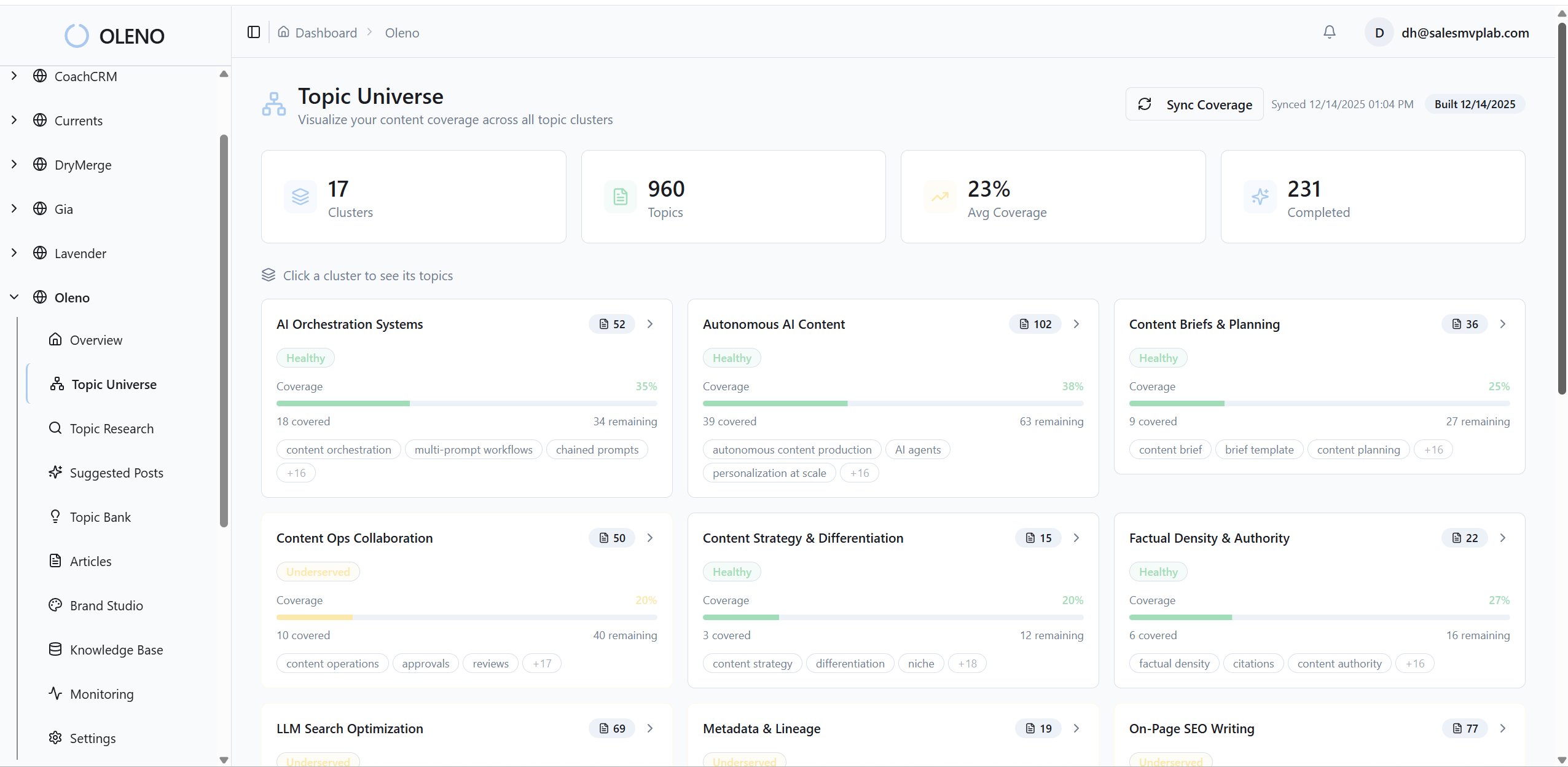
This matters because authority compounds when clusters are balanced. Oleno keeps that balance by preventing duplicate topic assignments and by keeping a live view of coverage. The output isn’t a dashboard. It’s a system that knows what to write next and what to leave alone until there’s something new to add.
You can still override. You stay in control. The defaults just nudge you toward better decisions.
Information gain scoring baked into briefs
During brief generation, Oleno analyzes what your site already says and scores proposed outlines on uniqueness. Low-differentiation outlines get flagged and refined before drafting. That’s how Oleno prevents the “well-written repeat” problem that drags down clusters.
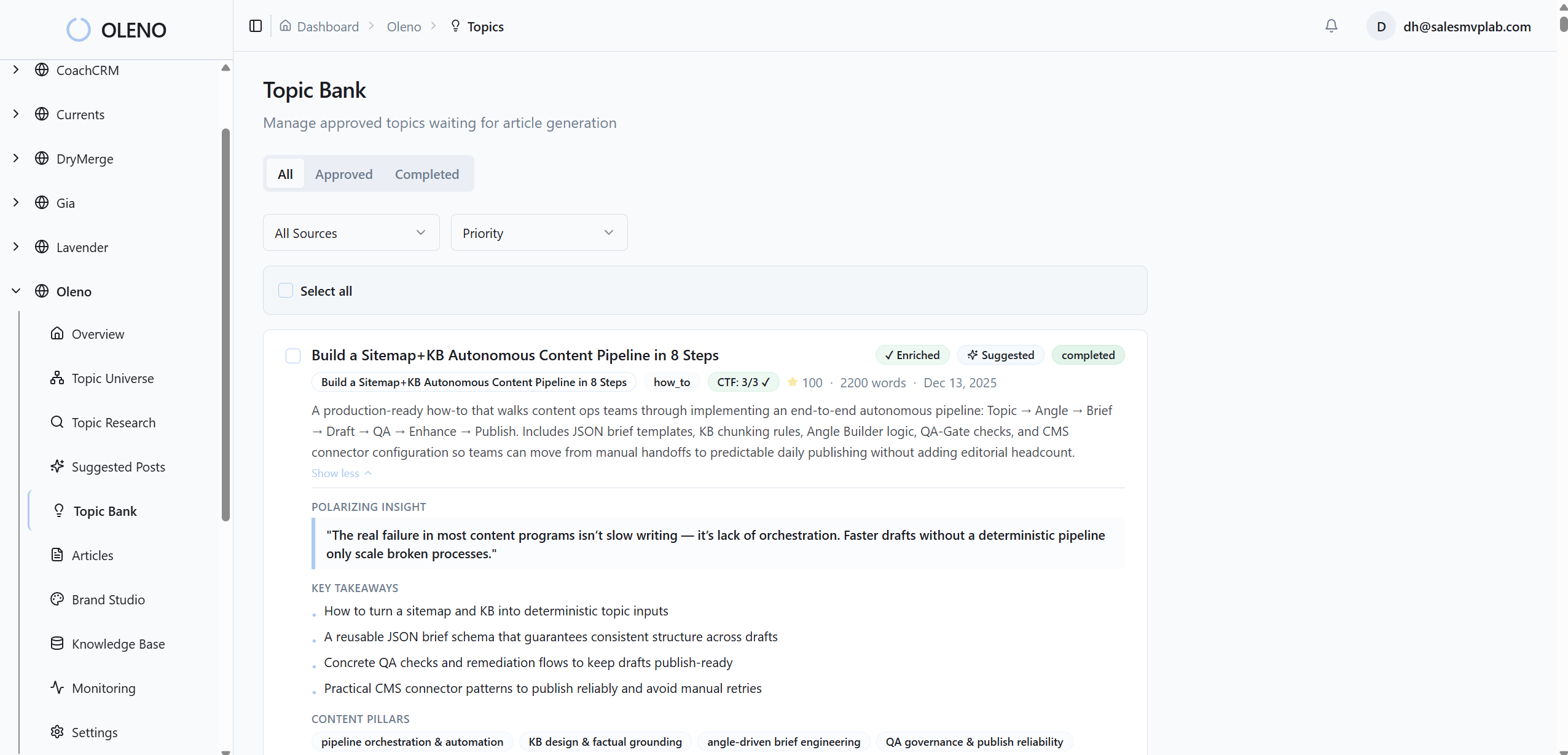
Because the score is grounded in your own corpus, it reflects your reality, not a generic web view. Oleno’s process asks for the missing example, a counterpoint, or a fresh angle before a writer ever starts. The result is fewer rewrites, fewer consolidations, and stronger clusters over time.
You’ll feel the difference in the edits. They shift from cleaning duplicates to improving narrative.
Deterministic internal linking and schema, fewer manual fixes
After drafting and visuals, Oleno injects internal links from verified sitemap URLs and generates JSON-LD schema programmatically. Anchor text matches page titles. Placement is code-based, not vibe-based. Publishing uses mapped fields to prevent duplicate posts or broken layouts.
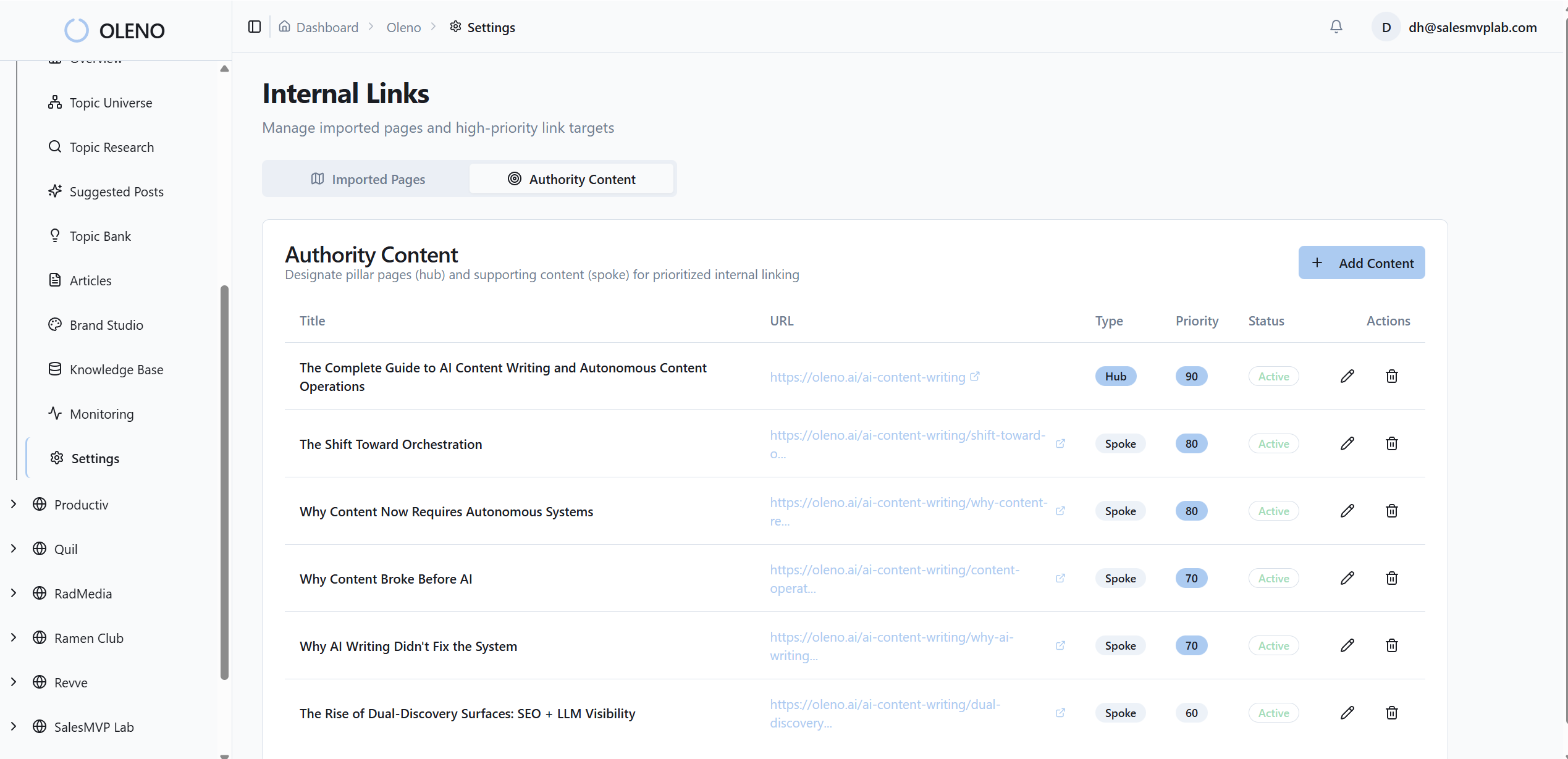
This is why 3am incidents drop. The fragile steps become deterministic. If something fails, it’s specific and recoverable. Your team stops policing structure and gets back to telling better stories, with fewer hotfixes and less rework across product marketing and engineering.
Let the machines handle structure checks. Your team should focus on story, not commas.
Snippet-ready structure and Visual Studio for credible coverage
Every H2 opens with a direct, snippet-ready paragraph so sections can stand alone and be cited cleanly by search engines and assistants. Oleno’s Visual Studio generates brand-consistent hero and inline images, and matches product screenshots to relevant sections using semantic similarity, with alt text and filenames handled automatically.
It’s not decoration. It’s credibility. Articles read cleanly, look like your brand, and make it easier for humans and machines to understand the point. This design reduces back-and-forth with designers and cuts the time from draft to publish without sacrificing quality.
Want to see the full pipeline run on your own site? Try Oleno for Free.
Conclusion
Keywords show demand. Coverage builds authority. When you merge your sitemap with your knowledge base, cluster topics, and enforce information gain at the brief stage, the noise falls away. You publish fewer repeats, fix less at midnight, and point every article toward the story that actually drives demand. That’s the job. Build the system once. Let it compound.
About Daniel Hebert
I'm the founder of Oleno, SalesMVP Lab, and yourLumira. Been working in B2B SaaS in both sales and marketing leadership for 13+ years. I specialize in building revenue engines from the ground up. Over the years, I've codified writing frameworks, which are now powering Oleno.
Frequently Asked Questions