Marketing Job Prioritization Matrix: What to Run When Understaffed

Most small teams don’t miss because they lack ideas. They miss because they try to run eight jobs with two people and a hungry sales inbox. I’ve lived that. At PostBeyond I could write 3 to 4 solid posts a week when it was just me. When we added a writer without the same context, output slowed and quality slipped. My calendar filled with reviews, edits, and meetings. Volume dropped, the voice drifted, and the pipeline felt it.
At LevelJump, three of us tried to do everything. Launch support. Sales decks. Events. SEO. Thought leadership. We recorded the CEO, transcribed, and shipped posts. It was faster than nothing, but the structure wasn’t there for search, and the topics didn’t map to how we sold. We were active, not compounding. That’s the trap. Busy weeks that don’t add up.
Key Takeaways:
- Focus on 2 to 3 compounding jobs per week, not eight scattered tasks
- Build a job ledger that maps to Acquire, Educate, Convert, Retain, with real effort ranges
- Score jobs by impact times compounding divided by effort to avoid novelty bias
- Budget coordination tax up front so your plan survives reviews and legal
- Set Run, Defer, Delegate thresholds and lock weekly SLAs before Monday
- Use quality gates to cut rework and keep narrative tight as volume grows
Why Most Small Teams Ship More By Doing Fewer Jobs
Small teams ship more when they run fewer, repeatable jobs that compound week over week. Context switches and one-off requests create busy calendars that don’t move pipeline. A simple rule helps: prioritize work that still pays you next month without extra effort. Example, an evaluation page that sales reuses beats a one-off social thread.

The hidden trap behind busy calendars
When you’re under-resourced, the worst move is spreading hours across eight different jobs. It feels industrious, then nothing compounds. You bounce between ad hoc requests, edits, and quick wins that evaporate by Friday. Output looks busy, not additive, which is why you feel exhausted without progress.
The fix isn’t more formats or brainstorming. It’s fewer jobs that repeat. One Acquire job with programmatic SEO. One Convert job with a comparison or product explainer. One maintenance slot for refreshes. Pick them, defend them, and let the work stack. If you need a simple lens, think about the quadrant that separates urgent from important. The Eisenhower Matrix got popular for a reason. Most small teams live in urgent. The compounding work sits quietly in important until you choose it.
A quick pattern that works for lean teams:
- Lock two compounding jobs each week, non-negotiable
- Allow one wildcard slot for reactive needs
- Hold one maintenance slot for refreshes and distribution
Why impact alone misleads under constraint
A “big impact” idea can be a bad trade when you’re constrained. If it arrives once, needs six handoffs, and never repeats, the real cost is coordination plus opportunity. Under constraint, you flip the usual order. Compounding and reliability first, then impact, then effort. That ordering keeps your story tight and your calendar sane.
Most teams rank ideas by potential upside. That’s fine in rooms with headcount. It breaks when two people have to execute. Instead, weight the ability to repeat. If an asset can be refreshed in 45 minutes and feeds sales for months, it outperforms a one-time hero piece that deserves a design sprint and a week of reviews. You’ll still chase big swings sometimes, but you’ll do it without starving the base.
A useful gut check:
- Will this earn for 90 days with a light refresh?
- Does it reduce future sales requests or create them?
- Can we ship version one without three reviewers?
What should small teams care about most?
Ask one question each Monday. Which two or three jobs will still pay us next month without extra work? Acquisition articles that keep bringing targeted clicks. Evaluation pages that buying committees reuse. Systematic refreshes that keep rankings and reduce inbound confusion. This bias to compounding beats novelty when headcount is thin.
The answer isn’t glamorous. It works. The week gets calmer because you’re not chasing every shiny thing. Sales gets more dependable enablement. Your content becomes a system, not a set of heroics. And when the reactive stuff hits, your base doesn’t crumble, because those compounding jobs already have a slot. Over a quarter, this is the difference between a narrative that grows and one that resets.
If you want to see what a two-job weekly cadence looks like in practice, with real guardrails, we can walk you through it live. When you’re ready, Request A Demo.
Prioritization That Maps To Real Demand-Gen Jobs
Prioritization works when it maps to real demand-gen jobs across the funnel. Build a simple ledger by stage, list typical assets, and encode effort and dependencies honestly. The point is to prevent random side quests from stealing your week. For example, Acquire includes programmatic SEO and distribution. Convert includes comparisons and product explainers.

What is the job ledger and why does it matter?
A job ledger is an inventory of the work you actually run, organized by the flywheel: Acquire, Educate, Convert, Retain. For each job, you list the asset types, the inputs you need, the review path, and where it lands after publishing. It becomes your source of truth, not a wish list. This is how you say no to work that doesn’t fit, without sounding unhelpful.
Here’s why it matters. It removes ambiguity and makes coordination predictable. Sales wants a one-pager? That’s a Convert job, not a net-new format. It rolls into the comparison update slot or the product explainer slot. Someone asks for a thought leadership piece? That’s Educate, and it competes with your framework work, not your evaluation content. You stop improvising priorities in meetings and start pulling from a ledger that reflects how demand-gen compounding actually happens.
Use this structure to get started:
- Acquire: programmatic SEO articles, distribution and repackaging
- Educate: POV articles, frameworks and guides
- Convert: comparisons, alternatives, product explainers
- Retain: customer stories, adoption content, reinforcement assets
Estimate effort and dependencies without guesswork
Underestimate coordination, and your calendar will punish you at 4 pm. The way out is to time-box each job based on how your pipeline actually runs. Draft, visuals, QA, and publishing. Then add coordination tax for SME review, product sign-off, or legal. You’re not guessing. You’re encoding reality so your SLAs are honest.
Let’s pretend a comparison page update takes four hours to draft, one hour for visuals, and one hour for QA and publishing. If product and legal both review it, add 2 to 4 hours of coordination for waiting, revising, and chasing approvals. Now that “quick update” lives as a 7 to 9 hour job on the ledger. When you plan your week with those numbers, your schedule starts to hold. And you avoid the Friday scramble that causes rework and resentment.
If you need a reference for building the method, this breakdown mirrors classic project approaches. The point is steady capacity, not perfection. The project prioritization guide from Runn has solid heuristics you can adapt to your ledger without overcomplicating it.
The Cost Of Spreading Thin Across The Funnel
Spreading yourself across five jobs in a 40-hour week creates hidden debt. Each “small” job costs 6 to 8 hours door to door once you include QA, visuals, publishing, and reviews. Add one sales request, and the plan slips. One late task triggers rework across the board, which means nothing ships cleanly.
Let us pretend your week is 40 hours
Let’s pretend you have 40 hours. You try to run five jobs. Each one takes 6 to 8 hours door to door when you include drafting, visuals, QA, and publishing. You just built a 30 to 40 hour plan with zero buffer. Now add a launch review, a sales request, and a “quick edit.” You slip, then everything slips. You carry three half-done things into next week and restart the scramble.
The math isn’t hard. The discipline is. If you never leave buffer, your plan is fiction. Worse, your future work gets more expensive. Every slip creates rework. Every handoff introduces context loss. And by the end of the quarter, the assets that could have compounded are still draft-only. This is how busy teams underperform calm ones with fewer jobs.
A simple adjustment avoids the spiral:
- Plan to 70 to 80 percent of capacity, not 100
- Cap weekly jobs at two compounding plus one wildcard
- Roll anything else into a clearly dated Defer or Delegate list
Coordination taxes you never budgeted
Meetings, edits, and approvals add up. If a job needs product review plus legal, you’ll pay 2 to 4 extra hours in handoffs and waiting. That’s the hidden cost that kills small teams. Encode it into effort. If you don’t, your calendar will. And it will overrule you when everything becomes urgent at 4 pm.
Coordination tax isn’t a failure of process. It’s how organizations manage risk. The trick is to acknowledge it early rather than eat it late. For example, bake 24 hours of review window into your ledger for any claim-controlled page. Protect that window in your plan. If you’re looking for a primer on the leadership side of this, the summary on task prioritization in management hits the same point: prioritization fails when you pretend dependencies don’t exist.
If you’re reading this and thinking, “We’re living this,” you’re not alone. There’s a calmer way to run this every week without hiring immediately. If seeing a live version would help, Request A Demo.
The Human Side, And Why It Breaks Consistency
Consistency breaks when launches collide with sales needs and subjective edits land late in the day. The pain is delayed, which makes it easy to ignore. Your matrix exists to block those silent losses by making tradeoffs visible, and your governance exists to avoid rework when people disagree.
When a launch collides with sales' urgent request
It’s Thursday. A rep needs a one-pager. Product wants a last-minute blog to support next week’s ship. You cut the comparison update you planned. Nobody complains today. Conversion falls quietly next month. The hurt is delayed, which is why it’s so easy to justify.
I’ve been on both sides. At Proposify we ranked for all kinds of topics, but some weeks the work drifted away from the product story that closed deals. Sales kept asking for content that answered buying questions. If your matrix doesn’t defend the compounding jobs, launch weeks become drift weeks. The fix is visible tradeoffs tied to SLAs, not heroics.
The 3 pm edit that blows up your evening
Frustrating rework usually isn’t about talent. It’s unclear rules. Two reviewers disagree on tone. Visuals are off-brand. Now you’re rewriting in the last good hours of your day. That’s a process problem. Define the governance once, encode checks, and stop subjective edits from consuming your calendar.
A simple shared baseline reduces the pain. Language rules. Claim boundaries. What “good” looks like structurally. You’ll still get opinions, you’ll just catch them before they derail the plan. The urgent-versus-important lens applies here too. A last-minute tone opinion might feel urgent, but updating the comparison page that improves conversion is important. Frameworks like the Eisenhower Matrix give you the words to push back respectfully.
An SLA-Driven Matrix You Can Run On Monday
An SLA-driven matrix turns judgment into a weekly system. Build a ledger, score jobs with a simple formula, and lock thresholds that decide Run, Defer, or Delegate. Then set SLAs by team size so your plan survives crunch weeks. You’ll update it every Monday, but the structure stays steady.
Build and calibrate your job ledger
Start with four columns: job name, effort range, dependencies, and compounding score. Seed the jobs by flywheel stage: Acquire, Educate, Convert, Retain. Pull real timings from past work if you have them. If not, start with conservative bands and tighten after two weeks. The ledger is living. It gets sharper every Monday as you learn.
For effort, include everything. Draft, visuals, QA, publishing. For dependencies, add SME time, legal steps, and required assets. For compounding, estimate half-life. Does the asset drive value for 7 days, 30 days, or 90 days? That estimation is rough early, but it gets accurate quickly with a small sample size. The benefit is obvious. Your plan stops lying to you.
If you want another perspective on prioritization mechanics, the overview from AgileSherpas aligns neatly with this approach. The difference here is you’re mapping it to demand-gen jobs, not generic tasks.
Score every job with impact × compounding ÷ effort
Use a simple formula to rank jobs each week: impact times compounding divided by effort. Impact is pipeline proximity or revenue potential. Compounding is your half-life rating. Effort includes coordination tax. The result is a score you can compare across jobs without re-litigating priorities in every meeting.
Calibrate the inputs with past metrics. If comparisons historically drive higher assisted pipeline, they get a higher impact score than top-of-funnel think pieces. If a framework article supports sales discovery for months, its compounding score should beat a social thread that dies in a day. Over time, your scores will predict results closely enough to plan with confidence.
A few practical guardrails:
- Cap effort per job at a week’s worth, or break it into phases
- Re-score jobs if dependencies change mid-week
- Review the top five scores with sales once a month
How do you set thresholds and SLAs that hold up when priorities collide?
Set three thresholds from the score: Run, Defer, Delegate. For example, 2.5 and above runs this week. 1.5 to 2.49 defers to next week. Below 1.5 delegates or drops. Then set SLAs by team size. Solo, 2 jobs with a weekly refresh cadence. One FTE, 3 jobs plus one maintenance slot. Two people, 4 jobs with a shared buffer.
Lock the rules before the week starts. Publish your slate to stakeholders. When new asks arrive, you don’t relitigate priorities. You show the matrix and ask which item to swap. You’re not saying no. You’re saying yes to the right jobs at the right level of service so demand keeps compounding. And when you do add a wildcard, you add it with eyes open and adjust the rest.
As you adopt this, write the playbooks in plain English for your context. Solo founder, 15 hours? Monday, ledger and scoring. Tuesday, Acquire article. Wednesday, Convert page update. Thursday, distribution and repackaging. Friday, refresh and metrics. One FTE? Add an Educate framework. Two people? Split by stage and share a buffer.
How Oleno Automates SLA-Driven Job Execution For Small Teams
Oleno runs demand-gen execution as a system so small teams can stick to SLAs. Work is organized by jobs, not formats, and everything moves through a deterministic pipeline with quality gates. Publishing control and optional distribution make cadence predictable. You decide direction. Oleno handles execution.
Job-led studios keep work aligned to the funnel
Oleno organizes work by jobs aligned to the flywheel, not one-off content types. Acquire, Educate, Convert, and Retain studios each run a consistent pipeline with clear inputs and structured outputs. You’re not guessing how a “comparison” gets made this week. It always follows the same flow: Discover, Angle, Brief, Draft, QA, Enhance, Visuals, Publish.

That alignment prevents random tasks from slipping in. A last-minute one-pager request becomes a Convert job that either fits the current slate or gets deferred by rule. Your weekly SLAs become predictable because drafting, QA, visuals, and publishing are scoped up front. You still control what runs. The system makes it repeatable at a high bar.
Examples of job types inside Oleno:
- Programmatic SEO for Acquire
- POV and frameworks for Educate
- Comparisons, alternatives, and product explainers for Convert
Quality gates reduce rework and prevent narrative drift
Nothing publishes in Oleno without passing quality checks you define. Voice and tone alignment. Narrative structure compliance. Clarity and logical flow. Grounding and accuracy constraints. SEO and LLM-readability structure. If something fails QA, Oleno remediates until it passes. This replaces endless subjective edits with guardrails based on your governance.
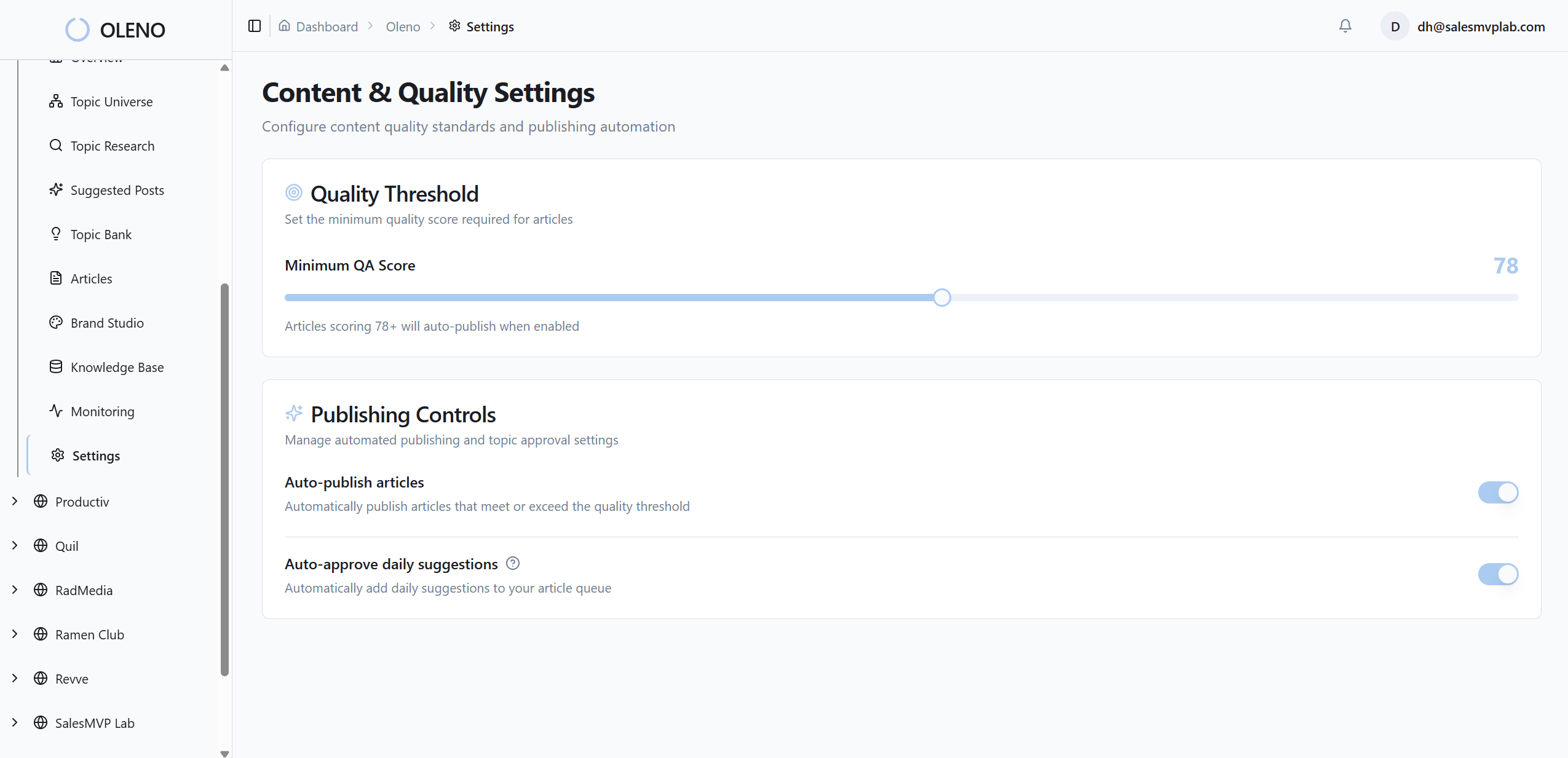
The payoff is fewer late-day rewrites and less risk that off-brand or inaccurate claims sneak through. You stop arguing over tone at 3 pm because the rules already caught the outliers. Over a quarter, that means fewer surprises, fewer “we need to fix this” weekends, and a narrative that strengthens instead of drifting as volume increases.
Operational scheduling maps SLAs to a steady cadence
Oleno runs deterministic pipelines with publishing control so you can keep a steady cadence. Draft or live publishing to WordPress, Webflow, HubSpot, and others. Idempotent publishing to avoid duplicates. Reuse rules for distribution so approved content shows up where it should without inventing new messaging. You pair this with your Run, Defer, Delegate thresholds, and suddenly the calendar holds.
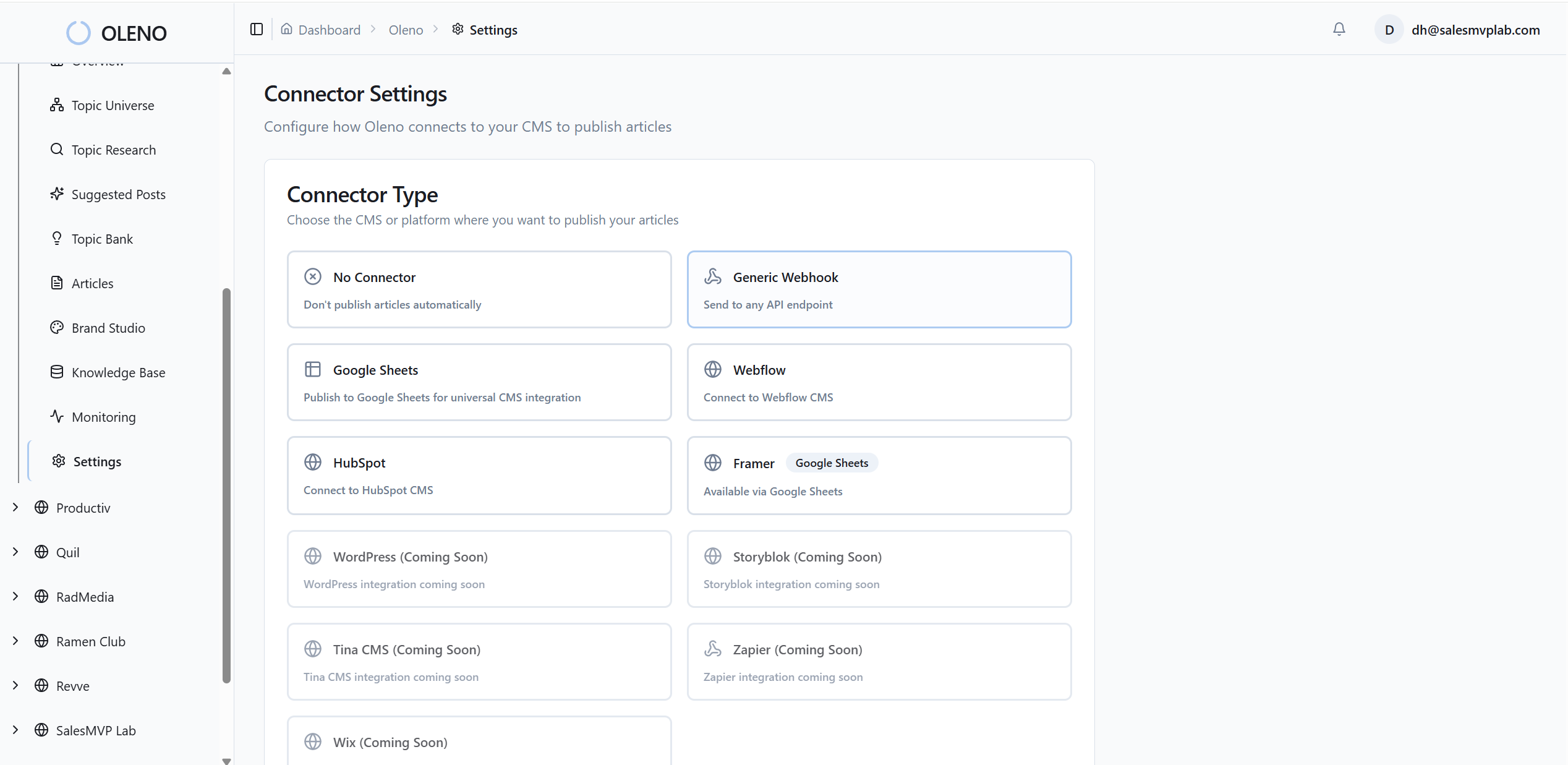
You can also see where execution is slowing down. Output volume, cadence, and quality trends surface gaps so you can rebalance monthly. If Convert jobs are under-covered, you shift a slot next week. If an Educate asset is compounding, you schedule a refresh. It’s a light operational touch that keeps your matrix honest without becoming an analytics project.
If you want the short version: Oleno protects the compounding work you chose on Monday and absorbs the coordination overhead that used to break your week. When you’re ready to see how that looks end to end, Request A Demo.
Conclusion
Small teams don’t win by doing more. They win by picking a few jobs that compound, scoring them honestly, and defending the plan with SLAs that survive real life. I’ve seen the reactive version. It burns time and erodes the story. The systematic version isn’t glamorous, but it works. Define the rules once, run the work weekly, and let the assets stack. That’s how you get leverage without adding headcount.
About Daniel Hebert
I'm the founder of Oleno, SalesMVP Lab, and yourLumira. Been working in B2B SaaS in both sales and marketing leadership for 13+ years. I specialize in building revenue engines from the ground up. Over the years, I've codified writing frameworks, which are now powering Oleno.
Frequently Asked Questions