Micro-Moment Signals: 5-Step Playbook to Align Content to Intent

Most teams sit on a mountain of signals—search queries, zero-click patterns, in-site behavior, social spikes—and then… they make decks. Smart decks. Pretty decks. Not articles. I’ve done it. We were “data informed,” but nothing made it into the brief schema, so nothing shipped when it mattered.
Here’s the shift that actually moves the needle: stop treating signals like insight, start treating them like inputs. Inputs have fields, owners, and downstream effects. You can wire them into your brief generator in days, not quarters. When you do, your cadence moves from reactive commentary to consistent, intent-matched publishing.
Key Takeaways:
- Treat signals as structured inputs with fields that map directly to brief templates
- Translate behavior into four intent archetypes and enforce template rules per intent
- Prioritize by closeness to action, recency, frequency, and information gain
- Enforce coverage governance (clusters, saturation, cooldowns) to avoid cannibalization
- Build briefs that open with 40–60 word direct answers for snippet readiness
- Close the loop with QA checks upstream, not edits downstream
Stop Treating Signals As Insight, Start Treating Them As Inputs
Signals become useful when you define them as instrumentable behaviors with consistent fields and owners. The job isn’t to interpret every blip; it’s to wire signals into a brief schema that drives publishing. Think in timestamps, sources, context—and push a ready-to-generate payload, not a slide.

What Are Micro-Moment Signals, Really?
Micro-moment signals are the observable breadcrumbs people leave when intent spikes—search phrases, answer-box patterns, on-site events, and social chatter you can capture in near real time. The trick is fielding them consistently: source, timestamp, query, context, and session path. That structure turns noise into a usable feed you can ship against.
You don’t need an enterprise data warehouse to start. Pull query logs from GSC, scrape People Also Ask weekly, instrument on-site actions like pricing visits and docs views. Give every signal a name, a field schema, and a place in your pipeline. As Think with Google’s Micro-Moments Guide shows, intent windows are short. Your system can’t be.
Governance matters more than volume here. Create a shared dictionary for signal names and thresholds so everyone tags the same way. Consistency is what lets your generator parse a payload at 3 p.m. and publish by tomorrow morning. No heroics required.
Why Your Trend Deck Does Not Ship Anything
Trend decks stall because they’re not wired to your brief schema or your publishing cadence. Insight is interesting; payloads are shippable. Map each signal type to a brief field, and map briefs to calendar slots. Then enforce a simple rule: no payload, no meeting.
Make the payload boring and complete: working title, TL;DR, intent type, H2 outline with direct-answer openers, example, sources. If you want prioritization, bake it in. Weight searches and in-site events over social spikes, score recency and repeat frequency, and add information gain as the tie-breaker. If your library already answers it, it drops.
Ready to move from slides to shipping? Try getting the engine to do the heavy lifting. Try Generating 3 Free Test Articles Now.
The Real Bottleneck Is Translating Behavior Into Brief Fields
The real bottleneck isn’t data scarcity; it’s translation. Teams tag keywords instead of mental states and hand off screenshots instead of structured fields. Move to four intent archetypes, wire them to templates, and require JSON payloads that your brief generator can read without a meeting.
Where Does Intent Translation Break Down?
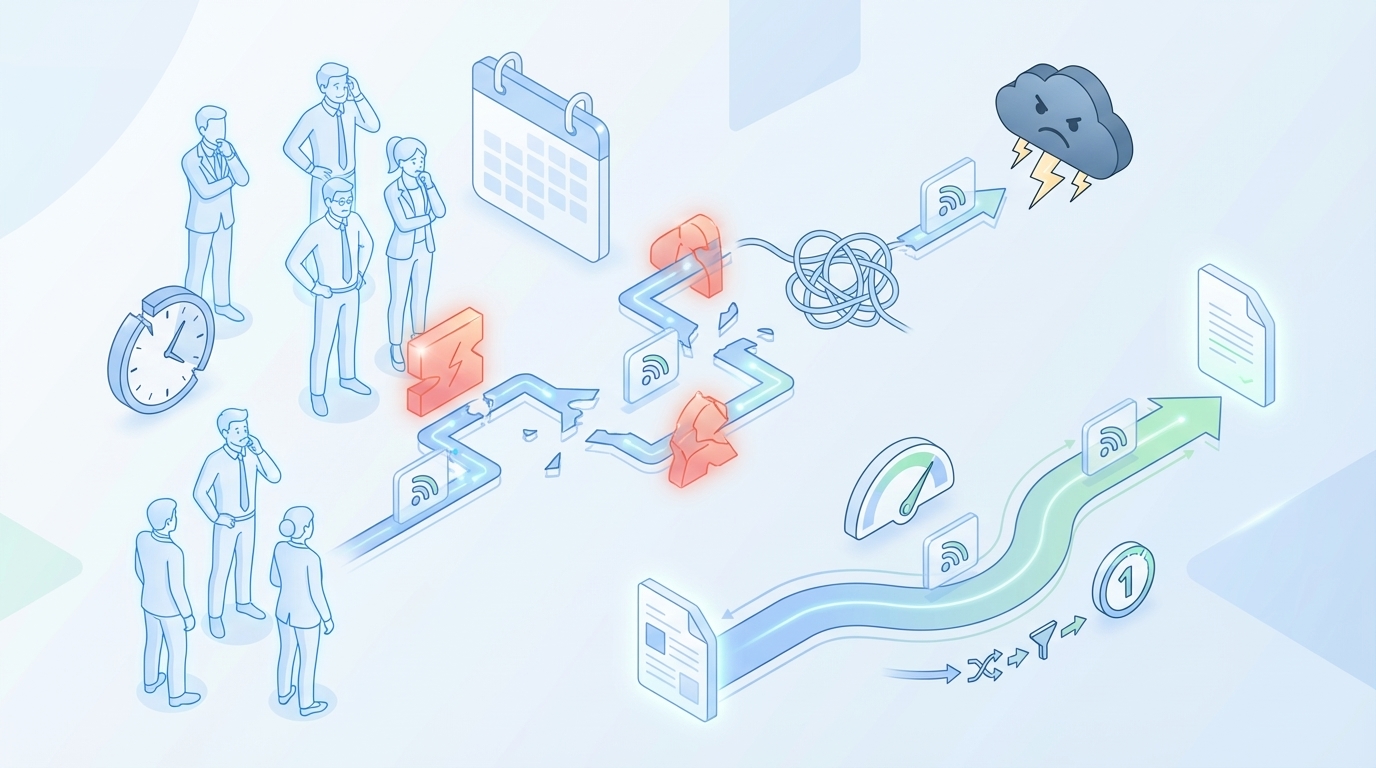
Translation breaks at two levels. First, the taxonomy. Tagging “pricing tiers” as a keyword misses the mental state. Is it buy (pricing page, comparison) or evaluate (features, alternatives)? Recode everything to four archetypes—learn, evaluate, do, buy—and give each its own brief template: H2 rules, CTA type, schema notes, and visual guidance. This prevents teaching when the reader is trying to transact.
Second, the handoff. Analysts ship screenshots, not structured data. The writer builds a Franken-brief from tabs. Instead, package every finding as fields your generator accepts: intent type, target queries, TL;DR, outline, examples, internal link targets, and citations. Use simple rules to map signals to archetypes—“what is” patterns go to learn; “vs”/“alternatives” to evaluate, setup/errors to do, pricing/demo to buy. If you need more nuance, use triggers like those in Bruce Clay’s Micro-Moment Triggers.
Zero-click is not “no intent.” Answer boxes and People Also Ask reveal the “known questions” graph. Treat them as subheads-in-waiting, not trophies to chase. Scrape on a schedule, distill into definitional openers and concise lists, and update your patterns. You’re not chasing the box; you’re earning reference value.
The Cost Of Reports That Never Become Articles
The cost shows up in hours, morale, and missed windows. Reports that don’t convert to briefs waste analyst cycles, and drafts without intent templates create rework. Stack enough of that, and your team throttles itself before the market does.
Let’s Quantify The Waste You Feel But Do Not Track
Let’s pretend your analyst spends six hours weekly assembling decks. If only 20 percent become briefs, you burn 4.8 hours on non-shipping work. Multiply by five teams and you’re at roughly 100-plus hours a month in slide churn. That’s two full workweeks of effort with zero pages live.
Add writer rework. Without intent templates, first drafts miss the moment. If each fix costs 45 minutes across 20 drafts a month, that’s 15 hours of frustrating rework you didn’t scope. None of this shows up in a dashboard. It shows up in slipped dates and tired editors.
There’s also the timing penalty. Micro-moments are short. If your window is 48 hours and your process takes 72, you’re publishing post-peak. Behavior Patterns in Micro-Moments highlight how quickly intent spikes fade. A system that lags by a day might as well be a week behind.
The Cascade Effect On Topic Coverage And Authority
Publishing around the same idea repeatedly cannibalizes your library. Readers split attention, internal links lose precision, and your cluster looks noisy. Traffic might hold; authority growth slows. You’re feeding a duplicative machine.
Two controls help. First, cluster saturation. Label clusters as underserved, healthy, well-covered, or saturated. Second, cooldowns. Use a 90-day window before re-covering the same angle. To re-qualify inside the window, mandate new information gain or a different intent type. No new angle, no slot.
This is less about “more content” and more about coordinated coverage. When every article adds something unique and sits where it should in the cluster, authority compounds. When it doesn’t, you’re just rearranging chairs.
Why It Hurts The Funnel More Than Ranking
Rank without intent match is a vanity metric. If a buy-moment lands on a learn-first page, bounce increases, qualified traffic evaporates, and sales never sees it. The wrong page can be worse than no page—it burns the only click that mattered.
Fixing alignment upstream costs less than fixing it post-publish. Structured briefs remove ambiguity before words hit the page. Writers focus on examples and clarity, not figuring out the job of the page after the fact. You’ll still optimize post-publish, but you won’t be patching fundamental mismatches.
When Signals Do Not Ship, Teams Feel It Fast
When signals don’t convert to briefs, you feel it in missed moments and stressful nights. The fix isn’t heroics; it’s prebuilt templates, routing rules, and a one-line SLA for speed. You can run this with three people if the system does the heavy lifting.
The 3 A.M. Incident You Could Have Avoided
Picture this: a social spike hits at 4 p.m., competitors publish by 6, and your draft slips because nobody converted the spike into a brief-ready outline. You wake up to a trend your brand didn’t shape. I’ve been on a three-person team—CEO, VP Product, and me—trying to sell, market, and write. We could record a founder video and transcribe it in an hour. What we lacked was structure. No intent template, no snippet-ready H2s, no slot. So we missed windows we could’ve owned.
The other version is quieter but costlier. Your biggest prospect searches “pricing tiers” and lands on a definitional guide. They’re ready to buy, you’re ready to teach. Misalignment is subtle, but it stalls deals. The fix is simple. Map intent to page types. Buy pairs with pricing, comparison, integration proof. Do pairs with setup checklists. Learn pairs with definitional guides. Evaluate pairs with feature breakdowns. Then route signals to templates with those shapes.
Ownership matters too. If you’re three people, you still need a handoff rule. One owner per stage, no group approvals. Analyst fills the payload, marketer schedules the slot, writer drafts the same day. Speed becomes a policy, not a hope. If you want help taking this off your plate, Try Using an Autonomous Content Engine for Always-On Publishing.
5-Step Playbook To Turn Signals Into Snippet-Ready Briefs
Turning signals into briefs is a five-step flow: instrument feeds, map to intent, score opportunities, generate snippet-ready briefs, then QA and close the loop. Each step can be implemented in days, and each one reduces rework later. Start small, standardize, then scale.
Step 1: Instrument Your Signal Feeds
Your inputs need fields, not flair. Capture query logs from Google Search Console and on-site search, schedule scrapes for answer boxes and People Also Ask, stream social spikes that meet a threshold, and log in-site events like docs viewed, pricing visits, and feature clicks.
Standardize the schema per feed. Use source, timestamp, canonical query, session path, and landing page. Store as append-only records so you can audit changes over time. Add a weekly “coverage and freshness” review to prune stale triggers and confirm your instruments still fire as expected. This is boring work. It’s also what makes everything else fast.
Step 2: Map Signals To Four Intent Archetypes
Define learn, evaluate, do, and buy. Then write the simplest mapping rules you can live with. “What is” patterns and glossary hits go to learn. “Versus,” “best,” and alternatives go to evaluate. Setup, how-to, and errors go to do. Pricing and demo go to buy. It’s not perfect, but it’s consistent.
Each archetype maps to a brief template with preloaded H2 patterns, CTA type, schema options, and visual guidance. You’re removing guesswork at the exact point where drafts typically go sideways. It also creates a shared language between analysts and writers—no more arguing about what the page is for.
Step 3: Score Opportunities With A Prioritization Matrix
Not all signals are equal. Compute an intent score from signal strength and recency. Layer in coverage gaps from your topic universe. Then add information gain from competitive research or your library. That third input keeps you from rewriting what you already have.
A simple weighted sum is enough: 0.4 intent, 0.3 gap, 0.3 info gain. Sort daily, pick the top five, and route immediately. Introduce a 90-day cooldown per angle to avoid saturating one cluster. You don’t need perfect math. You need consistent decisions that bias toward shipping.
Step 4: Generate Snippet-Ready Briefs Automatically
Populate required fields, every time: working title, TL;DR, target query set, intent type, H2 outline with 40–60 word openers, examples, internal links to pillars, external citations, visuals plan, and schema notes. This is the difference between “ideas” and “ready.”
Apply snippet rules: direct answer first, then context, then example. Keep H2 openers tight. Use lists and tables when they create clarity, not decoration. Structure like this tends to earn snippets and LLM mentions, as outlined in Single Grain’s Featured Snippet Tactics. Don’t overthink it—just be consistent.
Step 5: Run QA And Close The Loop
Pass briefs through a QA checklist before anyone writes. Check intent match, duplication, information gain score, snippet readiness, and internal link targets. If something fails, refine the brief—not the draft later. You’re eliminating the most expensive edits with a 10-minute gate.
Close the loop with thresholds. If a buy template underperforms, adjust the rules or the H2 patterns. Update your topic universe coverage so the next prioritization pass reflects reality. The system gets smarter, and your calendar gets easier to run.
How Oleno Converts Micro-Moment Signals Into Publishable Briefs
Oleno takes this playbook and makes it daily and deterministic. Topics flow from coverage gaps, briefs enforce information gain and snippet structure, and publishing ships with visuals, schema, and links handled. You don’t manage steps; you get complete articles that match intent.
Topic Universe Turns Signals Into Coverage Decisions
Oleno’s Topic Universe maps your landscape into clusters, tracks saturation, and enforces cooldowns so you don’t re-cover the same angle because a graph spiked. Signals point to gaps; Topic Universe confirms priority. Approved topics move straight into generation—no manual juggling.
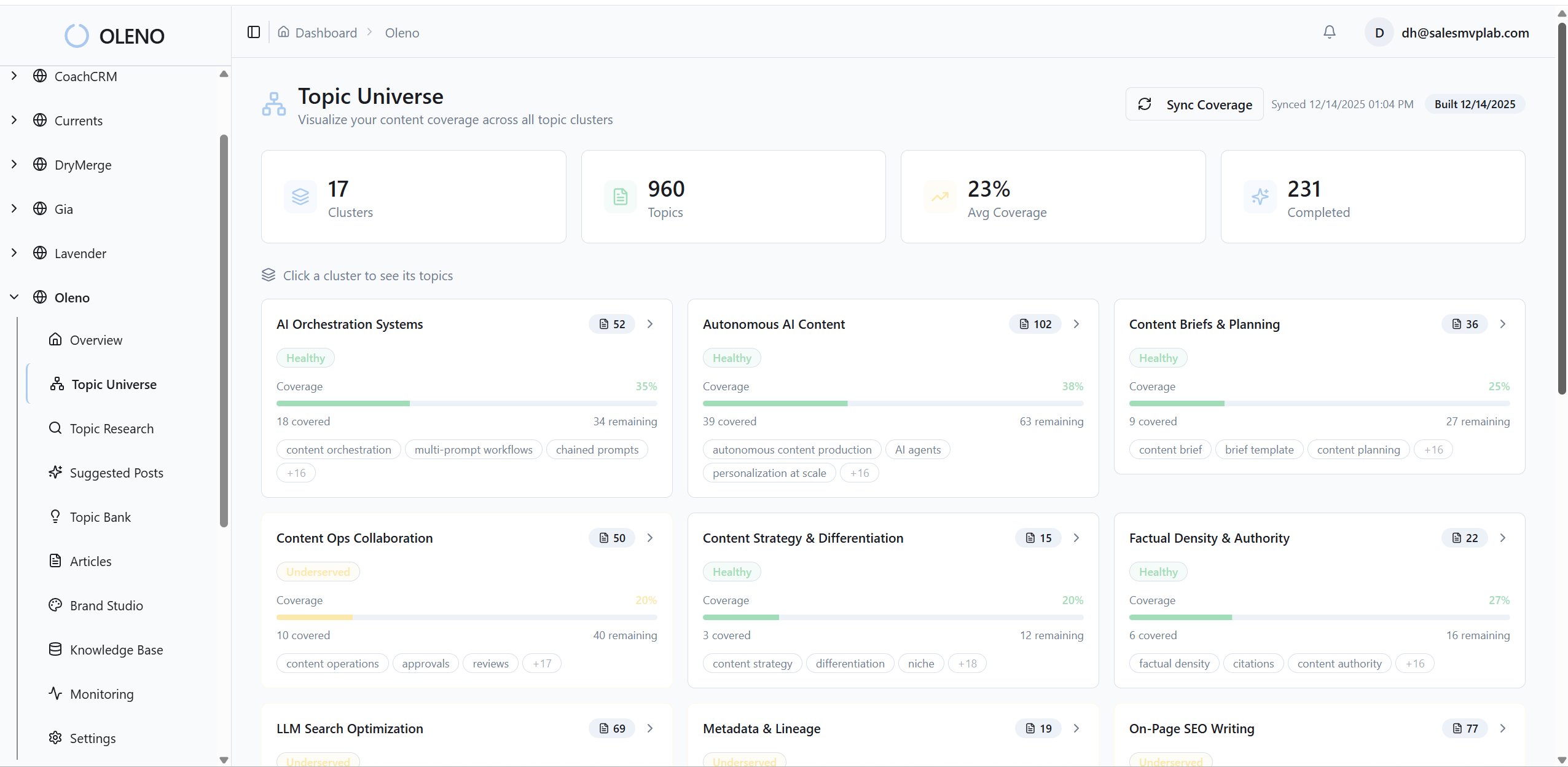
This alignment prevents the cannibalization we walked through earlier. Instead of five “almost the same” articles, you get one high-information piece and a plan for when to revisit. That’s how authority compounds over time, not in bursts.
Brief Generation With Information Gain Scoring
Every approved topic becomes a structured brief with competitive research, an Information Gain Score, and H2 openers sized for snippet capture. Low-differentiation briefs are flagged before writing, which is where most rework starts. Oleno enforces differentiation and structure up front, not in the edit pass.
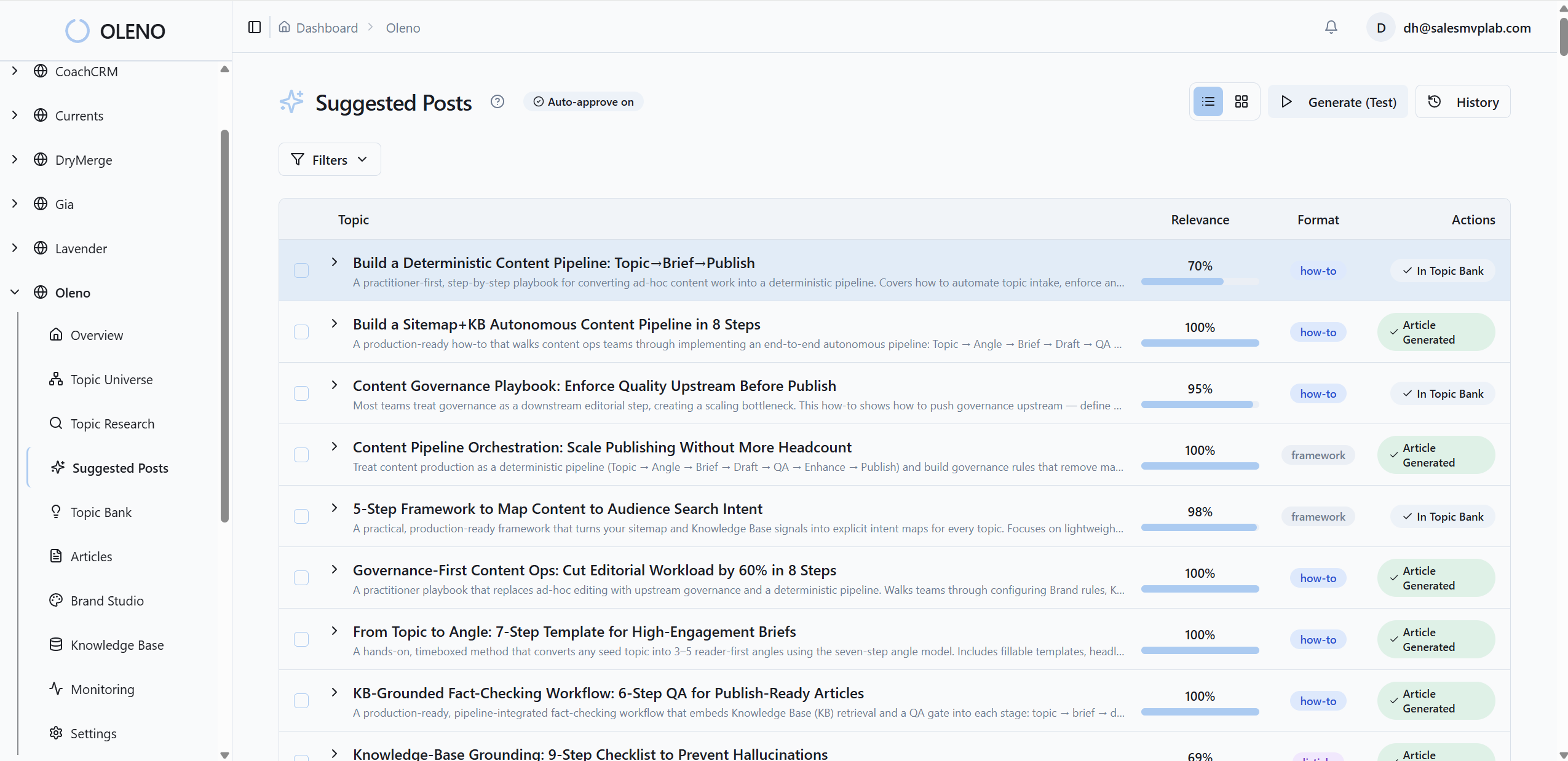
The practical effect is simple. Writers receive exact inputs aligned to intent, with examples, external link candidates, and internal link targets already in place. Rework drops, and the “did we really need this piece?” conversation disappears. You’re shipping intent-matched content on a consistent cadence.
Snippet-Ready Structure, Enhancements, And One-Click Delivery
Oleno ensures drafts follow snippet-ready formatting, then adds the non-negotiables deterministically: Visual Studio generates brand-consistent images and places product visuals where they matter; internal links are injected from verified sitemaps only; and JSON-LD schema is generated and validated before publish. The QA gate evaluates structure, voice, and information gain against 80-plus criteria. Publishing connectors deliver CMS-ready HTML with visuals and metadata mapped correctly.
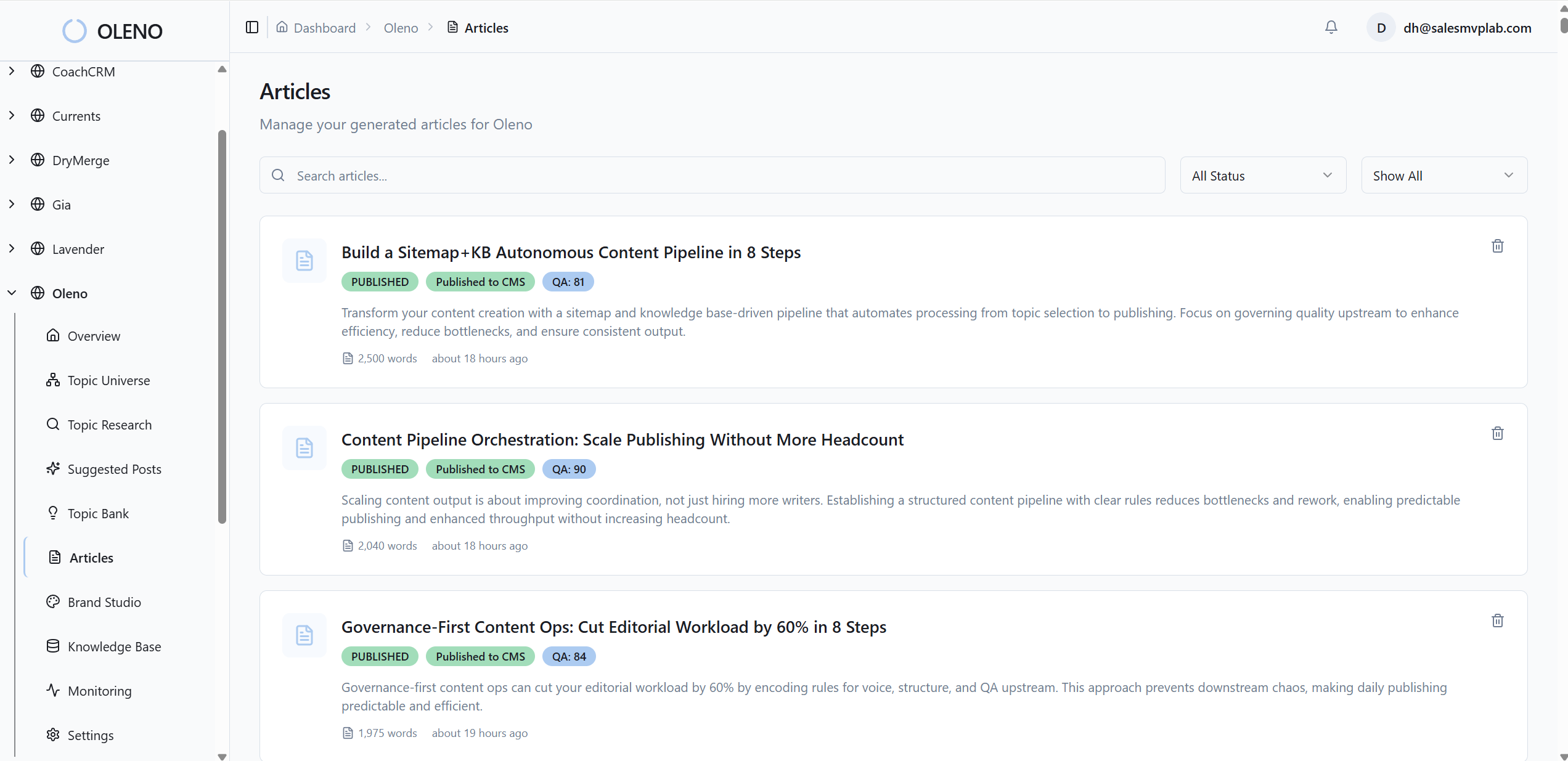
This is how the costs we quantified earlier get addressed. Less “frustrating rework” on drafts. Fewer publishing fumbles. More pages live when the window is open. If you’re ready to see this system run for your team, Try Oleno for Free.
Conclusion
Signals don’t create outcomes. Systems do. When you treat micro-moment signals as inputs, translate them into intent-specific briefs, and enforce coverage governance, you stop guessing and start shipping. The work shifts from interpretation to execution. Less slide churn. Fewer mismatches. More pages that meet people in the moment they’re actually in. That’s the quiet advantage teams feel within a month, and the compounding one they see all year.
About Daniel Hebert
I'm the founder of Oleno, SalesMVP Lab, and yourLumira. Been working in B2B SaaS in both sales and marketing leadership for 13+ years. I specialize in building revenue engines from the ground up. Over the years, I've codified writing frameworks, which are now powering Oleno.
Frequently Asked Questions