Modular Content Component Library: Produce 5× Articles Without More Writers

If you’ve shipped even a dozen articles, you’ve already rewritten the same sections ten times. New intro hook. Slightly tweaked problem framing. A CTA that legal rewords again. You feel the drag. It’s not your writers. It’s the lack of reusable parts and rules for how they snap together.
When we ran content with tiny teams, this was the bottleneck every time. I could write fast because I had the structure in my head. The moment I handed work off, speed died and quality slipped. Not because people were bad at writing, but because we kept starting from a blank doc. That’s fixable. And when you fix it, your output jumps without sacrificing your voice or truth.
Key Takeaways:
- Componentize the 60% of your articles that repeat and pre‑approve them
- Shift the unit of work from “write an article” to “assemble blocks with rules”
- Add metadata to blocks so reviewers check the delta, not the whole page
- Encode slot rules in your CMS to prevent structural drift and duplicates
- Measure reuse, approval rate, and time to publish at the component level
- Use governance to enforce voice, positioning, and product truth across volume
Stop Rewriting The Same Pieces, Start Reusing What Repeats
Most teams can ship 5× more by turning repeatable sections into components with rules. You already reuse intros, CTAs, and evidence blocks informally, which invites inconsistency and review debt. Formalize it into a parts library, then assemble pages from those parts. Think LEGO, not clay.

What Is The Repeatable Anatomy Of Your Articles?
Inventory your last 20 posts. You’ll see patterns immediately: intro hooks, problem frames, evidence blocks, examples, CTA placements, FAQs, data callouts, TL;DRs. Name each pattern, define where it belongs, and capture two to four variants that fit your brand. Now you’ve got a parts bin you can pull from without opening a blank doc again.
The goal isn’t to sterilize your content. It’s to stop paying fresh-draft prices for sections that don’t need to be original. Intro hooks are a great example. You probably rotate between three: a number-led hook, a short story, or a counterintuitive insight. Lock those as components with voice notes and length guidelines. If you want a shared definition of modular content for your team, point them to the Sanity glossary on modular content. It’s simple and useful.
Why Drafting End To End Burns Time
Full drafts force writers to recreate standard sections that haven’t changed in months. Then those sections get re-reviewed. Then re-litigated in comments. That’s where review debt hides. Pre-approve the stable parts so writers focus on the 20 percent that’s truly new: the angle, the unique example, the updated data point.
I’ve watched teams spend 30 minutes arguing over a CTA sentence that’s been “final” three times already. Pull that CTA into a component, mark it approved with context notes, and you never have that thread again. For practical guidance on writing modular blocks without losing clarity, the Kontent.ai best practices for modular writing break it down cleanly.
Where Reuse Does Not Belong
Don’t componentize your hot takes, nuanced analysis, or time-sensitive claims. If a paragraph persuades because it’s timely, it should be written fresh. A good rule, if a block appears in three or more articles with similar wording and the same intent, make it a component. If it relies on recency or deep context, keep it custom.
I’ve bent this rule and regretted it. We tried to template a market-opinion section once. It aged poorly and read generic a week later. Use your components to support the core story, not to replace it.
Ready to formalize the parts you already reuse? You can see how this looks in a real system. If you’re curious, we can walk you through it live. Request a Demo.
The Real Bottleneck Is Assembly Rules, Not Writer Talent
Content velocity stalls because teams lack assembly rules, not because writers are slow. When you define slots in your templates and map approved components to those slots, publishing becomes ordering parts with judgment. The result is predictable output that still sounds like you.

What Traditional Approaches Miss
Most teams optimize drafting speed, throw more freelancers at the calendar, or buy another writing tool. The work unit stays the same: write a full article. That keeps the cognitive load high and pushes consistency onto reviewers. What changes the game is changing the unit of work.
Define your page structure upfront. Create slots for hook, setup, evidence, example, CTA, and FAQ. Then specify which component types can go in each slot. Now your writers aren’t starting from zero. They’re choosing the right part for the right slot, then customizing the 20 percent that needs a fresh take.
How A Component Library Changes The Unit Of Work
Shift from “write an article” to “assemble eight to twelve blocks.” Each block carries metadata like audience, stage, evidence type, last verified date, and claim sources. Your CMS enforces slot rules. Editors review the delta only, not the whole page. That’s how throughput climbs without diluting quality.
This also changes incentives. Writers get judged on the clarity and strength of the new angle, not on how closely they mimicked last month’s CTA tone. Editors spend time where it counts. Everyone feels the lift because review cycles shrink.
When Should You Componentize Vs Write Fresh?
Componentize evergreen elements: intros, product claims, benefit bullets, FAQs, and common objections. Write fresh for opinions, case narratives, and timely data. When a block requires SME input every time, capture the canonical version, then add an annotation field for per-article context. You keep reuse without losing nuance.
Some teams worry this will flatten their voice. It won’t if you enforce governance and limit components to the parts that repeat. And if you’re curious about managing tone and governance at scale, the Acrolinx guide on managing modular content covers helpful guardrails.
The Hidden Cost Of Full‑Article Drafting
Full-article drafting wastes hours on repeatable sections and multiplies review cycles. For small teams, that cost blocks growth. You can reclaim 20 to 30 hours a month just by replacing repeatable blocks with pre-approved modules. That’s without touching deeper process upgrades.
Let’s Pretend The Math For A 3‑Person Team
Let’s pretend you publish eight posts per month at five hours of net work each. That’s 40 hours. If 60 percent of each post is standard, you’re spending 24 hours rewriting repeatable blocks. Replace that 60 percent with components and you free 20 to 24 hours. That’s four to five more posts, before editing efficiencies.
Now add review gains. If editors stop re-reading the same intro and CTA, your approval cycles shorten. You won’t get all those hours back instantly. But even a 25 percent cycle reduction is meaningful for a small team.
Review Overhead And Compliance Rework
Re-approving the same CTA text or claim language creates frustrating rework and risk. Pre-approved components cut legal loops and reduce off-label drift. Tag each block with claim IDs and last verification date so reviewers spot what changed instantly. Less redline churn, fewer back-and-forths, faster time to publish.
If you work in a regulated space, this matters even more. A modular approach with provenance and verification dates aligns with how platforms like Veeva Vault define modular content concepts. The principle is simple: attach truth to the component, not the page.
How Much Throughput Are You Leaving On The Table?
Without component-level visibility, you miss easy wins. If a specific intro variant consistently drives better engagement, you want to know. Track usage and approval rates at the component level, then retire low performers and promote proven variants. Small, compounding changes add up over a quarter.
You don’t need a heavy analytics suite for this. Start with basic counts: component reuse rate, time to publish by template, percent of single-cycle approvals. As the library matures, you’ll see patterns you can’t unsee.
Still spending Fridays chasing edits on repeatable sections? There’s a simpler way to run this. We can show you the assembly flow and QA gates in practice. Request a Demo.
The Pain Feels Personal, But It Is Process
Missed deadlines feel like a writer problem. It’s usually a process problem. When stable parts aren’t locked into modules, a late change cascades into a full rewrite. Fix the process, and those 3pm headaches stop wrecking your week.
The 3pm Rewrite That Breaks Your Week
You planned to publish today. Then a late edit rewired your intro, CTA, and product claim. Now the whole piece slips. Not because the writer is slow, but because the system treats stable parts as ad hoc. Lock stable parts into modules, so a last-minute change doesn’t ripple across the page.
I’ve been in those last-minute calls. Tensions rise, everyone’s tired, and the fix looks bigger than it is. A component library turns that cascade into a quick swap. Swap the intro component. Re-run QA. Publish.
A Founder Story That Set Off A New Approach
Last summer I tried to brute-force this with prompting. I was copy-pasting into the CMS for hours. It worked, until it didn’t. So I hard-coded an engine in the CMS that queued topics, wrote with defined structures, ran checks, and posted on its own. Output stabilized fast. Buyers noticed. That experience shaped how we think about components today, and why process beats heroics.
Looking back, the big unlock wasn’t “more content.” It was encoding the rules once, so execution stayed steady even when my attention shifted. That’s what small teams actually need.
Why Small Teams Stall When Priorities Shift
When launches hit or sales needs spike, full-article drafting pauses. A component library keeps progress alive. You can assemble from stock parts and reserve human energy for the angle that moves the story forward. It’s not perfect, but it beats going dark for two weeks.
I’ve watched teams keep publishing during a launch because 70 percent of the work was already approved. That’s the hidden advantage. It gives you slack when you need it most.
A Practical Shift To Components, Metadata, And Assembly
You don’t need a giant taxonomy project to start. Define a minimal set of components, add basic metadata, wire slot rules in your CMS, and pilot on one cluster. Improve weekly. Expand. This is iterative, not a big-bang rewrite of your editorial process.
Component Design Patterns You Can Standardize
Start simple. Define two to three intro hooks, three evidence block types, two example patterns, two CTA variants, one to two FAQ modules, and two data callout types. For each, document inputs, length, tone rules, and allowed placements. Store canonical versions with variant IDs so you can promote winners over time.
Get picky about tone. Add notes like “use numbers up front,” “avoid qualifiers,” or “include one sentence under eight words.” These little rules protect your voice as volume rises. For a solid primer on block-level patterns, the Kontent.ai best practices for modular writing map well here.
- Don’t overbuild the set on day one. Add as you learn.
How To Tag Components For Trust And Reuse
Add metadata that reduces rework: purpose, audience, funnel stage, allowed slots, claim IDs, last verified date, source links, and owner. Require provenance for any factual statement. Set review intervals for compliance-sensitive blocks. This lets editors assemble confidently without re-reviewing every sentence.
Ownership matters. If a component ties to product truth, assign a PMM owner. If it’s a thought leadership block, assign the exec or content lead. Simple owners prevent orphaned components that drift over time. As a reference point, the governance mindset is similar to how platforms structure components in regulated content, which you’ll see echoed in the Acrolinx guidance on managing modular content.
CMS Templates And Slot Rules That Do The Heavy Lifting
Create templates with named slots: hook, setup, evidence, example, CTA, FAQ. For each slot, define allowed component types, length constraints, and count rules. Encode simple checks like “at least one evidence block and one CTA” and “no more than one data callout per 400 words.” Add idempotent publishing to prevent duplicates on retries.
You’re baking structure into the system, not people’s memories. That’s the whole point. If you need a neutral definition to align your team, the Sanity glossary on modular content is a clean reference.
The Rollout Checklist That Avoids Drift
Pilot with one cluster. Build the library, wire the template, define QA acceptance tests, and set three to five KPIs like time to publish, percent single-cycle approvals, and module reuse rate. Review weekly, prune weak components, and expand to the next cluster. Keep a change log so the library stays trustworthy.
Two weeks later you’ll wonder why you didn’t do this sooner. Not because it’s flashy. Because it reduces friction in places that used to burn your time.
How Oleno Operationalizes Componentized Content At Scale
Oleno runs this play by turning your rules into a repeatable system. You define voice, positioning, and product truth once. Oleno generates the right components and assembles pages through a deterministic pipeline with QA gates, then publishes to your CMS without duplicates. The result is steady output with fewer surprises in review.
Governance‑First Component Library
Oleno starts with governance, not output. You encode brand voice, positioning, and product truth up front, including CTA style, banned terms, and claim boundaries. That setup becomes the guardrail for your components, so volume doesn’t erode voice. Reviewers focus on meaningful changes, not policing phrasing drift.
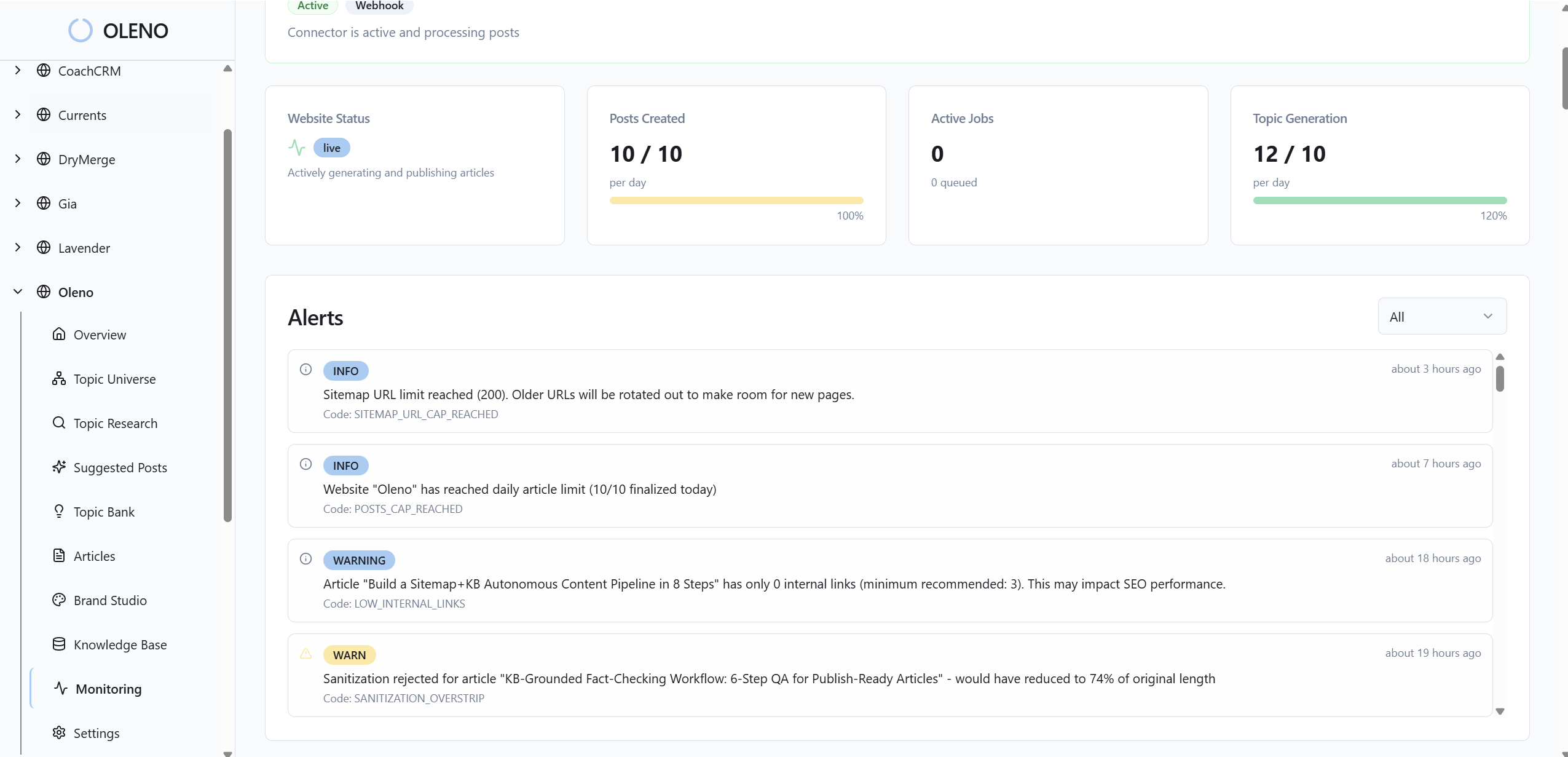
Because governance applies everywhere, you don’t rely on tribal knowledge. Oleno enforces rules across studios and jobs, so a product claim in a FAQ block matches the claim in a comparison page. Consistency is built in.
Deterministic Pipelines And QA Gates Tied To Components
Content moves through Discover, Angle, Brief, Draft, QA, Enhance, Visuals, and Publish. Oleno’s QA checks block anything that violates narrative structure, strays from approved claims, or breaks slot rules. Nothing ships unless each assembled page passes. You feel that as fewer headaches from rework and clearer standards for “ready.”
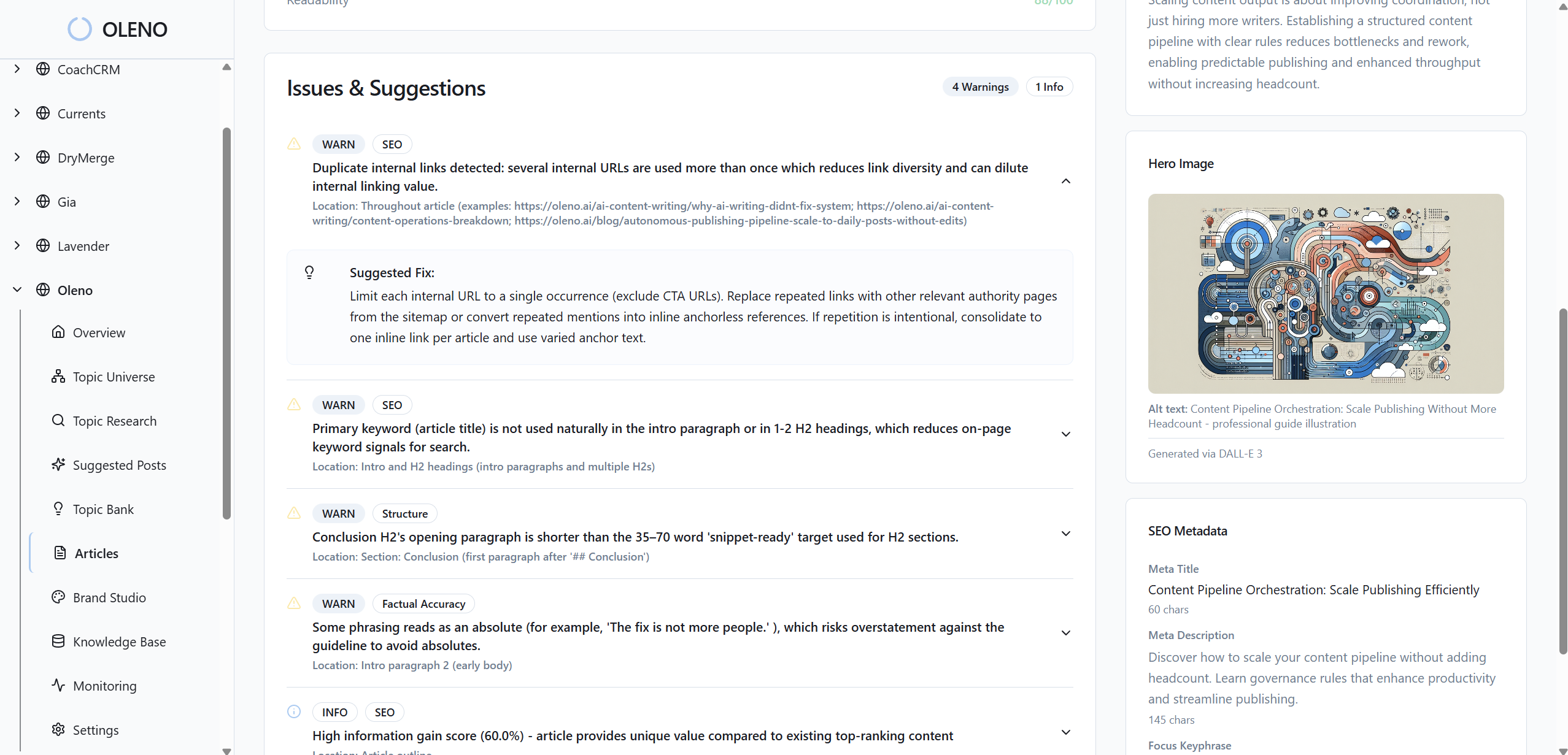
The practical effect is less coordination. Strategy stays human. Execution becomes predictable.
CMS Publishing With Templates And No‑Duplicate Safeguards
When a page is approved, Oleno publishes directly to WordPress, Webflow, HubSpot, Storyblok, Framer, and others. Publishing is idempotent, so retries don’t create duplicates. Editors stop babysitting uploads and spend time improving the library and angle instead.
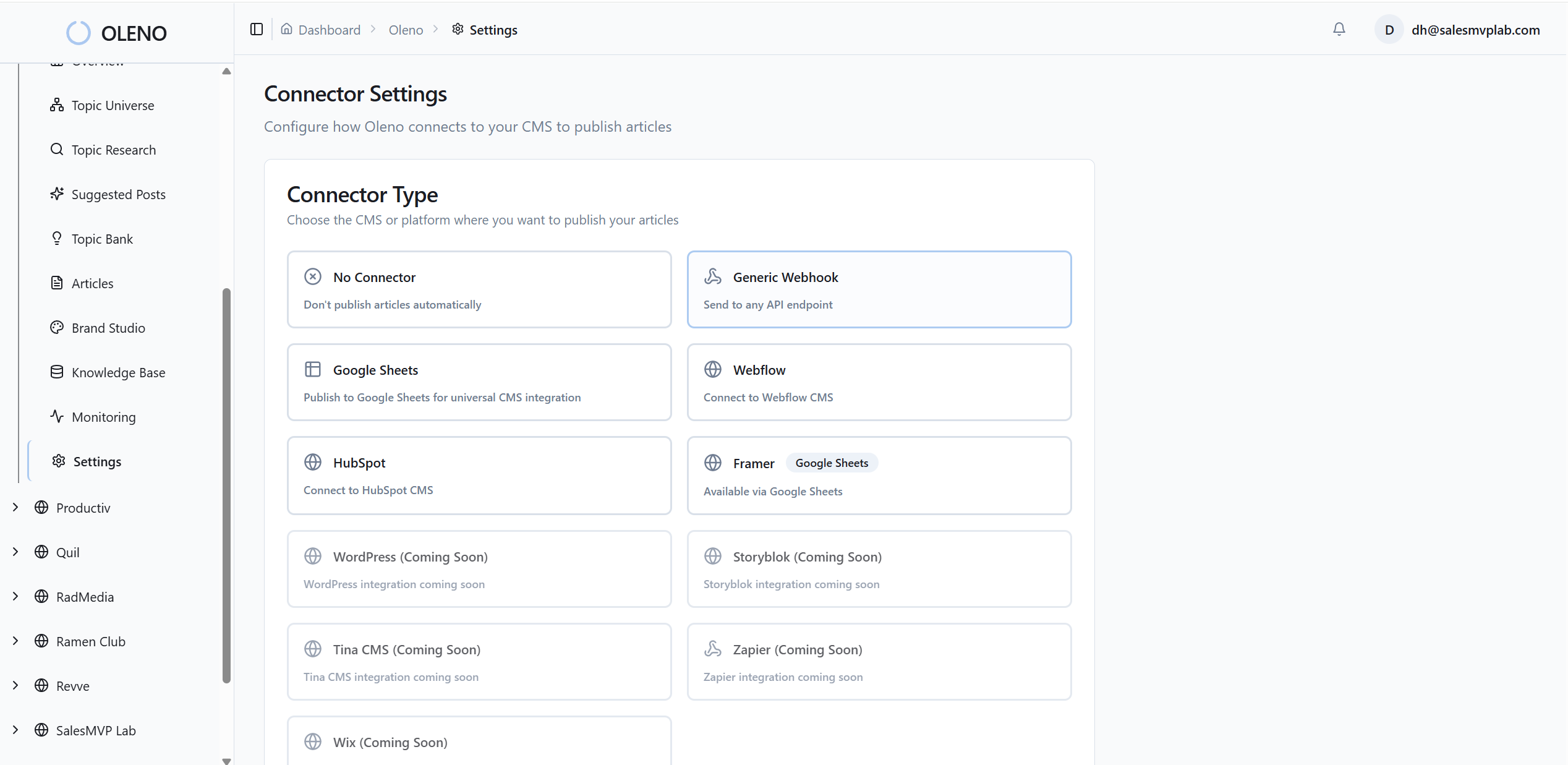
This is where small teams feel leverage. The system handles the mechanics so people can handle the thinking.
Measurement And Feedback Loops To Tune Modules
Oleno gives visibility into output and cadence, quality trends over time, and common failure patterns as volume grows. You can sample outputs to catch edge cases QA might miss and track reuse and approval rates. Over a quarter, you’ll see which components carry their weight and which ones should be retired or refreshed.
Ready to cut review cycles and publish more without hiring? That’s what Oleno is built to run. If you want to see your rules encoded into a working pipeline, we’ll show you. Request a Demo.
Conclusion
If you want 5× the output without 5× the people, stop treating every article like a fresh build. Componentize the parts that repeat, tag them with truth, enforce slot rules in your CMS, and let a system run the assembly. Writers focus on the angle. Editors review the delta. And your calendar finally moves from scramble to steady.
About Daniel Hebert
I'm the founder of Oleno, SalesMVP Lab, and yourLumira. Been working in B2B SaaS in both sales and marketing leadership for 13+ years. I specialize in building revenue engines from the ground up. Over the years, I've codified writing frameworks, which are now powering Oleno.
Frequently Asked Questions