Why Deterministic vs Prompt-Based Workflows Flip the Cost Script

Most people arguing about deterministic vs prompt-based workflows are really arguing about typing speed, not demand gen execution speed. Demand-generation execution software is a marketing platform category that delivers consistent, narrative-aligned content across the funnel with predictable quality by encoding brand, product truth, and messaging into deterministic workflows that plan, create, QA, and publish on a steady cadence so small teams can run demand gen as a system without adding headcount. Unlike AI writing assistants or SEO point tools, this category is about running the full system end to end, not just generating drafts faster.
I learned this the annoying way. Last summer I built a bunch of GPTs for a side project and I was cranking out drafts, sure. But I was still copy-pasting into the CMS, fixing tone, catching weird claims, rewriting intros, and doing the human QA loop for hours a day. It felt like speed. It was actually manual labor with better autocomplete.
Key Takeaways:
- Prompting speeds up drafts, but it often increases review cycles and coordination, which is where the real cost lives.
- Past about 20 pieces a month, the “cheap” prompt stack usually turns into token spend plus human-review overhead plus meeting tax.
- Deterministic workflows win by locking rules once (voice, POV, truth, structure), then reusing those rules across every asset so quality doesn’t drift week to week.
- “More content” isn’t demand gen. Full-funnel coverage plus repetition without drift is what compounds.
- If you want compounding, you need a system that survives quarterly planning, launches, and staff changes.
Why Prompting Feels Fast While Demand Gen Stays Slow
Prompting looks fast because it compresses the piece you can see, the draft, while hiding the stuff that actually eats your week: judgment, coordination, QA, and publishing. Fragmented, prompt-based demand-gen execution is the default, and it’s a problem because it creates output volatility without fixing the weekly system.
Fast Drafts Hide Slow Systems
Fast drafts are a bit of a magic trick. You get a page in 90 seconds, you feel momentum, you forward it to someone for a “quick review,” and then the real timeline starts.
Because now someone has to answer questions like:
- Is this actually our voice, or does it sound like generic advice?
- Is the POV consistent with what we’ve been saying for six months?
- Are we accidentally making a claim we can’t back up?
- Does this fit the funnel, or is it just a nice blog post?
- Who’s publishing it, and where does it get repurposed?
That’s the hidden work. Prompting doesn’t remove it. It pushes it onto humans.
And humans don’t scale linearly. You add a few more assets per week and suddenly you’re in review hell, your calendar fills up, and you’re doing “quick edits” at 10:30pm because someone noticed the tone drifted again.
Output Volume Isn’t Demand Generation
Demand gen is a system, not a task. You need a steady cadence. You need repetition without the message warping. You need different assets for different stages of the funnel. And you need the whole thing to hang together so a buyer can consume three pieces and feel a clear point of view, not three different writers arguing with each other.
Prompting treats each asset like a standalone event. New prompt. New draft. New vibe. New set of judgment calls.
That’s why “we published a lot” so often turns into “we published a lot… and nothing changed.”
I’ve seen the other side too. Back in 2012-2016 I ran a site called Steamfeed. At peak we hit 120k unique visitors a month. Most posts got under 100 views per month, but the library compounded because we had both breadth and depth, and it was consistent enough that Google and readers could trust what they were getting over time. Volume worked because the system behind it was stable.
If People Carry The Workflow, Speed Decays With Scale
Here’s the scaling law nobody wants to hear. If people are the system, every extra unit of output creates more coordination than the last unit did.
One article a week? You can kind of brute force it. Two a week? Still manageable. Five a week? Now you’re adding reviewers, you’re adding handoffs, you’re adding “who owns final say,” you’re adding process arguments.
It’s not because your team is bad. It’s because fragmented, prompt-based demand-gen execution has no memory and no enforcement. Every piece is a fresh negotiation.
And that negotiation is the cost.
Why Deterministic Vs Prompt-Based Workflows Is A Category Question, Not A Tool Question
If you treat this like a “content tool” decision, you’ll keep buying faster keyboards for a broken assembly line. That’s why most stacks end up as a pile of point solutions plus a bunch of humans glueing it together.
Demand-generation execution software is the category lens that fixes the real problem. The outcome is consistent, narrative-driven execution that compounds. The mechanism can be AI, humans, or both. But the system has to hold.
Stop Buying Faster Keyboards For A Broken Assembly Line
If your assembly line is jammed at QA, approvals, and publishing, buying a faster writing tool doesn’t unjam it. It just makes the pile of drafts bigger.
Most breakdowns show up in boring places:
- no shared acceptance criteria for voice and structure
- no consistent brief quality
- no clear “what should exist” plan across the funnel
- no controlled way to do persona variants
- no reliable publishing cadence
- no way to prevent the same topic getting written three times by accident
You can patch these with meetings. Most teams do. It’s the default.
But meetings are not a system. They’re a band-aid.
Define The Category By The Outcome, Not The Mechanism
The winning categories aren’t named after the tech. They’re named after the outcome buyers actually want.
“Prompting” is a mechanism. “SEO tool” is a mechanism. “Agency” is a staffing model.
The outcome is: run demand gen week after week with predictable quality, without needing a bigger team every time you want more output. That outcome forces you to think in workflows, not drafts.
And it forces you to care about boring things like consistency, QA gates, and cadence. That stuff is what compounds.
Deterministic Beats Prompt Entropy
Prompts drift. People drift too. Even if you swear you have a template, it mutates. One person adds a paragraph. Another person changes the tone. A week later the “same prompt” produces a different output anyway, so you compensate with more edits and more reviewer judgment.
That’s entropy. And the cost shows up as rework.
Deterministic workflows fight that by locking in rules and checks that don’t change every week. Not to make content robotic. To make the system reliable.
You still get creativity. You just stop paying for chaos.
Where The Money Actually Goes In Prompt-Based Demand Gen
Prompt-based systems look cheap because the draft is cheap. Token spend is visible; the human cost hides in rework, QA loops, and “quick syncs.” That’s the trap. When you measure the whole cycle, the cost curve flips, especially once you try to publish at a steady, real cadence, especially when evaluating deterministic vs prompt-based workflows.
Coordination Cost Compounds Nonlinearly With Volume
Let’s pretend you want to publish 20 assets a month across the funnel. Not just SEO blogs. A mix. Some education, some evaluation, some product-led stuff, maybe a customer proof asset or two, plus repurposed social.
In a prompt-based setup, every asset creates its own little universe:
- someone prompts
- someone reviews
- someone corrects voice
- someone checks product accuracy
- someone asks “does this match our POV”
- someone formats it
- someone publishes it
- someone repurposes it
Now scale that to 40 assets a month.
You don’t just double the work. You multiply the coordination points. More reviewers. More “quick syncs.” More context loss. More back-and-forth. More chance of something shipping wrong.
That’s why teams feel like they’re moving fast, while lead time quietly gets worse.
Quarterly Resets Erase The Compounding You Think You’re Building
Most demand gen programs reset every quarter. New theme. New messaging tweak. New campaign. New priority. It feels strategic. It often kills compounding.
Because compounding requires repetition. Not mindless repetition. But consistent reinforcement.
If you change the narrative every three months, you force your buyers to re-learn who you are. You also force your content library to become a museum of old positions. Then you spend time rewriting, consolidating, or just ignoring half your site because it doesn’t match the current story.
That’s wasted work. And it’s super common.
Headcount-Heavy Execution Gets Expensive Fast
The other “fix” people reach for is headcount. Or agencies. Or a freelancer bench.
It works, up to a point. But you’re not scaling a system. You’re scaling dependencies.
The benchmark that matches what I’ve seen in the real world is pretty simple: one strategic writer plus AI, inside a deterministic workflow, can often do the work for under 10 percent of the cost of a multi-writer or agency-led model. Not because they type faster. Because they aren’t paying the meeting tax, the re-briefing tax, and the rework tax on every asset.
When I was at PostBeyond, I could crank out 3-4 high quality posts a week because I had the context and a structured framework. When we added a writer, output slowed down. Quality dipped. Not because they weren’t good. They just didn’t have all the context in their head, and I didn’t have time to transfer it every week.
That’s the same failure mode as prompting. The system relies on a human brain holding the rules.
What Prompt-Based Execution Feels Like When You’re Living In It
Life on prompts feels busy but brittle. You ship, then you notice the tone is off, sales pings you about muddy positioning, product corrects a claim, and CS flags an implied feature you don’t support. So you patch it, apologize in Slack, and promise tighter prompts next time. Then next week repeats.
Every Meeting Is A Patch For Yesterday’s Drift
Recurring meetings are a signal. They’re not evil. They’re just evidence that the workflow isn’t encoded.
If you have a weekly “content calibration” meeting, plus a “final review” meeting, plus a “distribution planning” meeting, it’s usually because the system can’t enforce standards on its own. So humans do it. Repeatedly.
And the worst part is you start normalizing it. You start thinking that’s just what demand gen costs. It’s not. It’s what fragmented execution costs.
You Publish, Then Apologize In Slack
This one is painfully real. You hit publish, you feel relief, and then the pings start.
“Hey, small thing, can we tweak this?” “Hey, this isn’t how we say it.” “Hey, this isn’t accurate.” “Hey, this feels off brand.”
It’s not catastrophic. It’s just constant. Death by a thousand edits.
That constant patching is what “cheap prompting” actually buys you.
How Deterministic Vs Prompt-Based Workflows Changes When You Run Demand Gen Like A System
Deterministic pipelines beat prompts when you optimize for the entire program, not just the draft. And yes, you can start without buying anything. You need discipline, a few docs, and the will to encode decisions so they stop living in people’s heads.
Demand-generation execution software is designed for small, resource-constrained B2B SaaS teams who need full-funnel content with stable voice and product accuracy, but can’t afford to add headcount every time the roadmap gets busy.
The basic shift is simple: decide the rules once, then enforce them every time.
- Encode Governance: Centralize brand voice, approved product truth, and messaging rules into enforceable criteria that travel with every asset.
- Orchestrate Execution: Standardize content jobs by funnel stage and automate handoffs, QA checks, and publishing to cut coordination cost.
- Compound The Flywheel: Maintain cadence, refresh and reuse systematically, and measure coverage so work builds on itself instead of resetting quarterly, especially when evaluating deterministic vs prompt-based workflows.
Decide Once, Encode Forever
You want fewer subjective debates. That’s the goal.
So instead of “does this sound right,” you create acceptance criteria:
- voice rules (tone, phrasing you do and don’t use)
- structural rules (headings, paragraph length, CTA placement)
- POV rules (what you believe, what you don’t)
- product truth rules (claims you can and can’t make)
Then you use that at three points: brief, draft, final.
This is where most teams go wrong. They only review at the end. So the draft is a mess, the review is emotional, and the rework is big.
If you encode early, the review becomes boring. Pass or fail. Fix the failures. Ship.
If you want to see what this looks like in a real system, request a demo and I’ll walk you through how deterministic checks get defined and reused across assets.
Separate Knowledge From Generation
Your team shouldn’t have to remember what’s true every time you create something.
So you build a simple knowledge pack:
- approved product descriptions
- approved claims and boundaries
- supported and unsupported use cases
- pricing and packaging notes
- customer story snippets you can safely reference
Then every creator, human or AI, uses that as input. No guessing. No inventing.
This is a big deal because it lets you swap contributors without losing quality. That’s how you scale without paying the coordination cost.
Automate Handoffs And Standardize Content Jobs
Most demand gen teams accidentally treat every asset as a custom project. That’s why they struggle.
Instead, define content jobs:
- SEO acquisition article
- category education piece
- competitive comparison page
- product education page
- customer proof asset
- social repurpose set
Each job has inputs, acceptance criteria, and publishing steps.
Then you automate the handoffs lightly. Could be templates. Could be a workflow tool. Could be checklists. The point isn’t the tooling. The point is removing “who owns this now” from your brain.
And you track a couple system metrics, not vanity metrics:
- cadence (did we publish what we said we would)
- revision count (how many loops per asset)
- QA failure rate (how often we break our own rules)
- coverage (are we actually covering the funnel)
What The Category Fixes That The Old Way Can’t for Deterministic vs prompt-based workflows
Deterministic vs prompt-based workflows is a comparison of cost curves and reliability, not creativity. The category exists to turn messy, person-dependent production into repeatable, rule-driven execution that compounds. Not more drafts, but more dependable delivery. That’s the difference that shows up in pipeline.
| Dimension | Old Way | Category Way |
|---|---|---|
| Compounding | Work resets every quarter, so gains don’t stack | Cadence and reuse keep the library building month after month |
| Cost Curve | Human review and meeting load rises as output rises | Rules and checks get reused, so marginal QA cost drops |
| Consistency | Voice and narrative drift week to week | Voice and POV stay stable across assets and contributors |
| Accuracy | Product truth gets policed after the draft, causing rework | Approved knowledge is used before and during drafting |
| Funnel Coverage | Random bursts of top-of-funnel content | Standard content jobs cover acquire, educate, convert, retain |
How Oleno Runs Deterministic Demand Gen Without The Usual Headaches
Oleno operationalizes deterministic workflows by starting with governance, running job-based pipelines, and enforcing quality checks before anything publishes. It’s built for lean B2B teams that want steady, opinionated content across the funnel without babysitting prompts or turning their calendar into a review factory.

Studios Turn “Decide Once” Into Enforced Rules
Oleno’s brand studio and marketing studio capture how you sound and what you believe, so you’re not re-litigating voice and POV in every review. Then product studio and knowledge archive grounding keep claims tied to approved truth, which cuts down on the “wait, is that accurate” loop that burns PMM time.
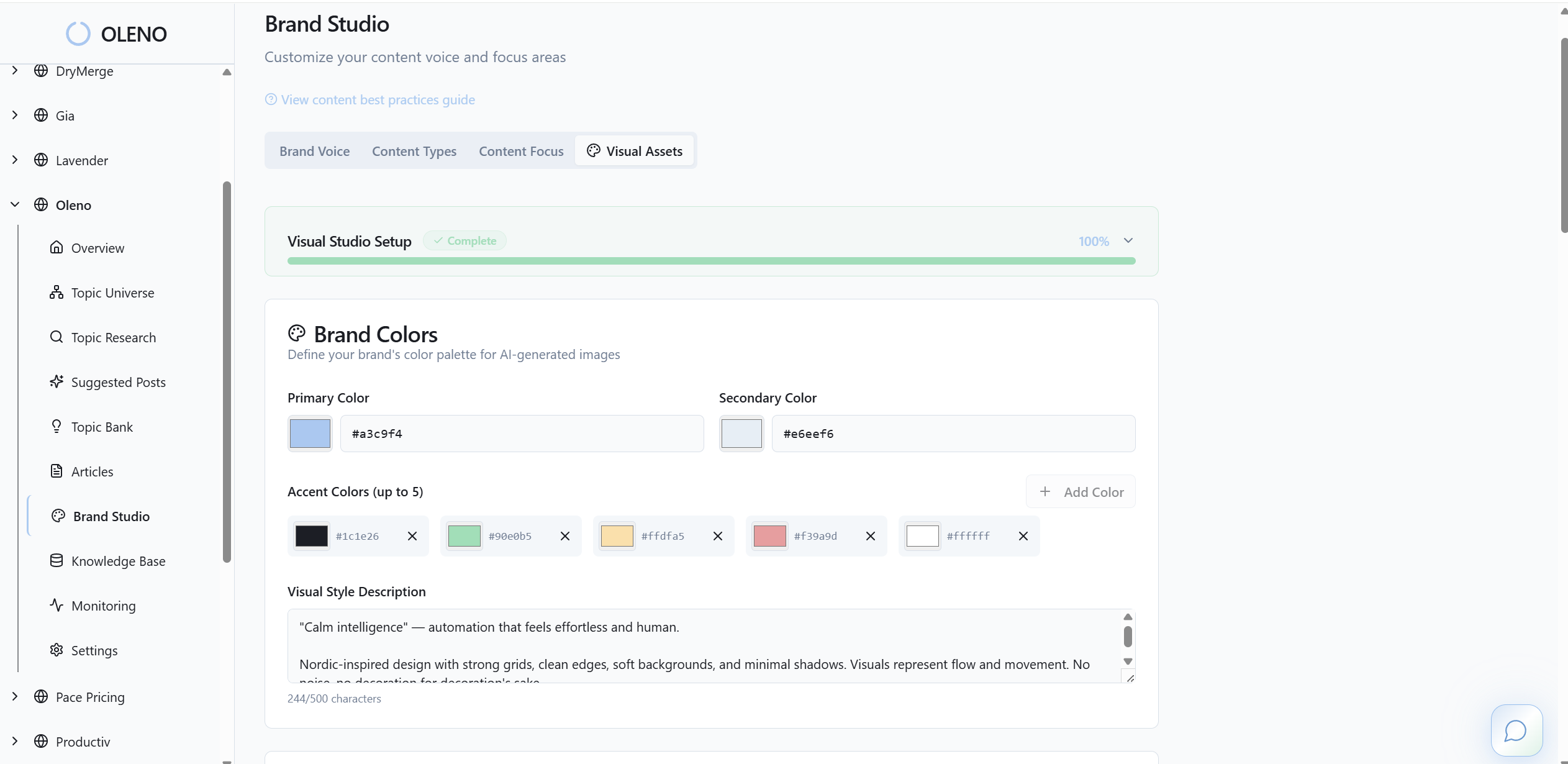
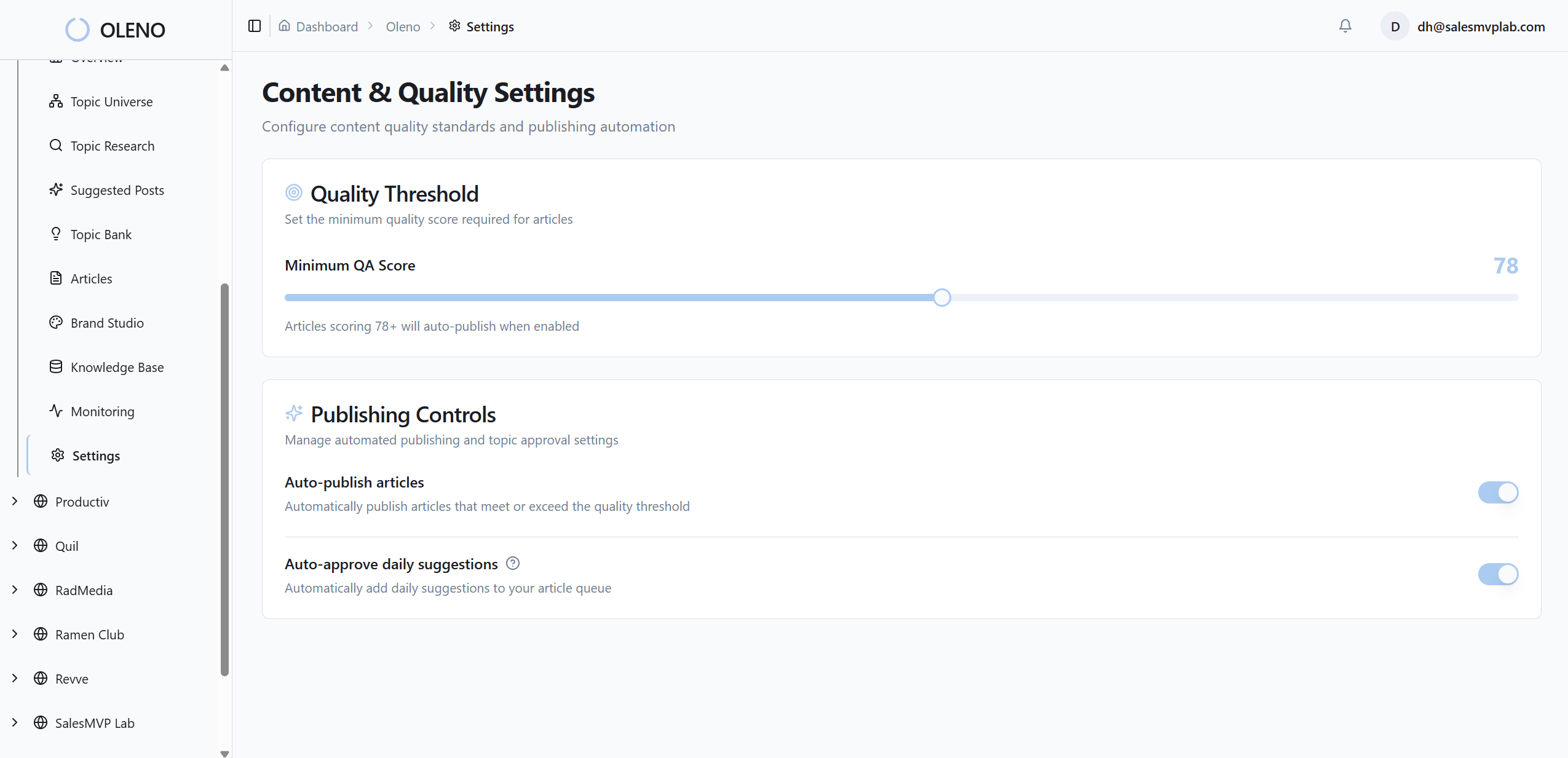
Quality control (qa gate before publishing) is the part I wish more teams had in their stack. Not as a human checklist that someone forgets, but as a real gate that blocks publishing until the output meets the standards you defined.
If you want to see the workflow in the product, request a demo. I’ll show you how the governance inputs flow into briefs, drafts, QA, and publishing without turning it into a science project.
Execution Pipelines Replace Copy-Paste And Slack Routing
On the execution side, Oleno runs deterministic pipelines from discover to publish, with variation layer & topic universe to expand and schedule what should exist, cms publishing to push content live, and distribution to turn approved articles into platform-specific social posts without inventing new messaging.
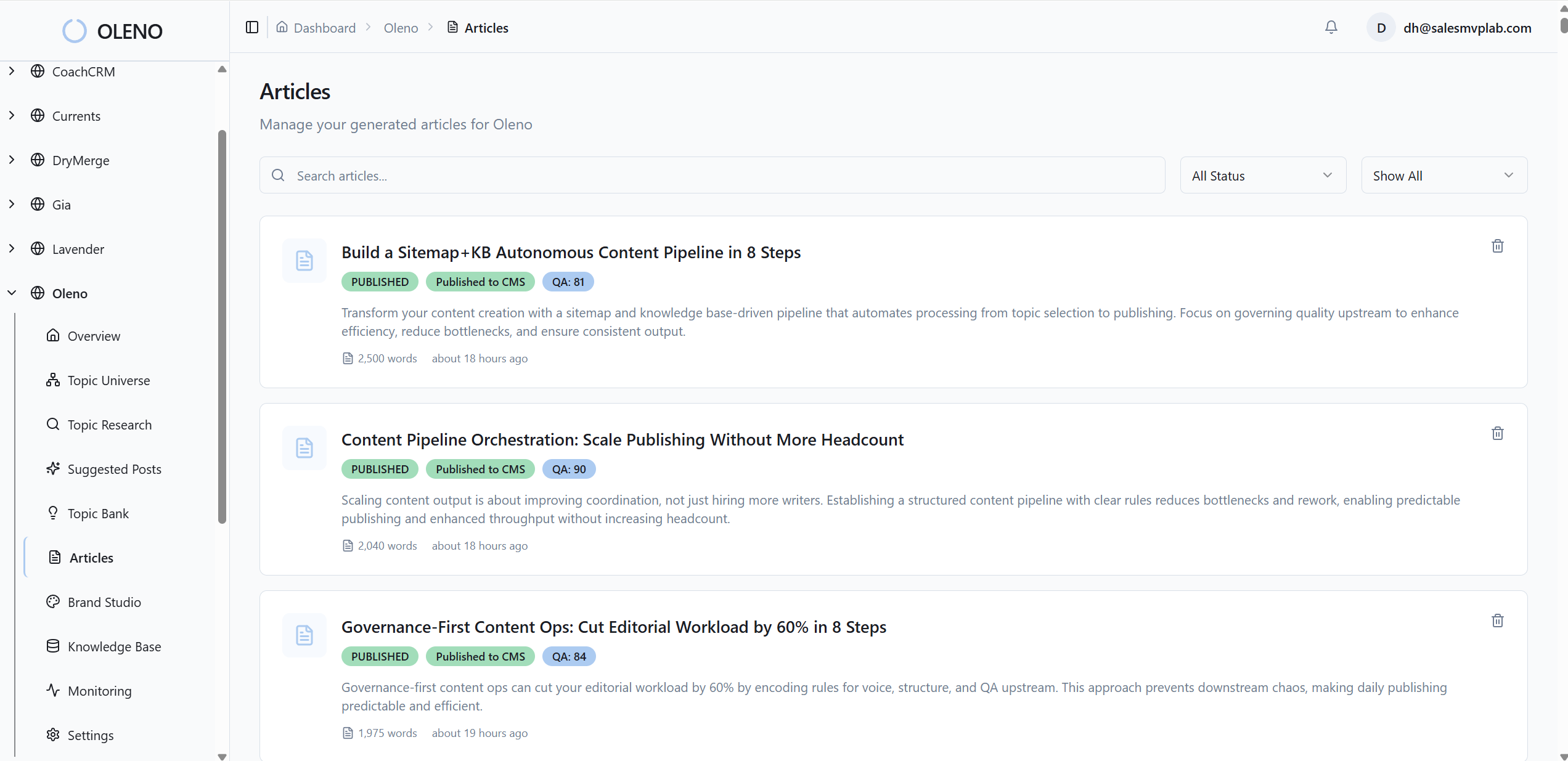
That combo matters because it pulls work out of Slack and out of people’s heads. You stop relying on “who remembers the process,” and you start relying on a system that runs the same way every time, even when priorities shift.
The Cost Script Flips Once You Measure Total Cycle Time
Prompting is faster for the draft. True. But total cycle time tells the real story: revision loops, meeting hours, QA failures, and narrative resets. Measured that way, “cheap and flexible” turns expensive and fragile. Not faster keyboards, but a better assembly line.
If you’re a CMO trying to justify migrating away from prompt-dependent ops, the argument isn’t philosophical. It’s a cost model and a reliability model. Show the coordination tax. Show the revision count. Show the QA failure rate. Then show what happens when those checks get encoded and reused.
If you want help building that model and seeing what a deterministic execution engine looks like in practice, book a demo.
About Daniel Hebert
I'm the founder of Oleno, SalesMVP Lab, and yourLumira. Been working in B2B SaaS in both sales and marketing leadership for 13+ years. I specialize in building revenue engines from the ground up. Over the years, I've codified writing frameworks, which are now powering Oleno.
Frequently Asked Questions