Narrative Backbone: Map Story Elements to Templates and QA

Most teams think a style guide will save their story. Fonts, tone, banned words, check. Then two weeks later, your blog argues with your sales deck. I’ve seen it too many times. At Steamfeed we scaled to 120k monthly visitors, not because we had pretty sentences, but because the story was consistent across thousands of pages.
As head of sales at Proposify, I watched great posts pull the wrong traffic. Rankings looked fine, pipeline stayed flat. At PostBeyond, I could ship 3–4 strong articles a week, but as the team grew, context scattered and edits ballooned. Style rules kept the voice steady. They didn’t stop drift. The fix was never more reviewers. It was locking the story into templates and QA so it survives volume and handoffs.
Key Takeaways:
- Style guides control tone, not meaning. Lock story atoms into templates and QA to stop drift.
- Define a small set of narrative atoms, then map them to specific fields by funnel stage.
- Make briefs carry governance, claim boundaries, and examples so editors enforce rules, not opinions.
- Quantify rework. If 40% of assets fail narrative checks, you’re losing a day a week to fixable edits.
- Encode the schema as JSON so humans and machines read the same rules at draft and publish.
- A backbone lets small teams scale with AI and freelancers without hiring an army of editors.
Why Style Guides Do Not Stop Narrative Drift
Style guides set how content sounds. They don’t decide what gets said or in what order. Without explicit story elements bound to template fields, teams default to memory and taste, which introduces drift. Narrative atoms, placed in specific slots, keep meaning intact as volume grows and roles change.

The Difference Between Style And Story
Style rules control rhythm, vocabulary, and tone. Story rules define problem, insight, consequence, proof, and the pivot to action. You can have perfect grammar and still argue three different problems across five posts. That’s the real risk, and it shows up as inconsistent messaging that quietly slows growth and confuses buyers.
When teams rely on copy tone alone, reviewers catch commas, not contradictions. The fix is structural. Name your atoms, decide where each lives in the template, and write acceptance criteria. Each atom needs examples and constraints, so the same idea shows up consistently across formats. That is how meaning composes, not just prose.
There’s a reason consistent narrative structures guide behavior. The research on story structure shows that clarity of beats shapes recall and action, not sentence flair. The Interaction Design Foundation’s storytelling overview explains how predictable patterns reduce cognitive load, which is exactly what your buyers need when they’re evaluating.
What Most Teams Try And Why It Breaks
When drift creeps in, teams add prompts, reviewers, and longer checklists. It feels rigorous. It stays fragile. Without binding story atoms to template fields, you’re enforcing preferences, not policy, and the system collapses under deadlines and parallel work. Meetings become re-explanations. Edits multiply. Launch weeks slip.
I’ve run that loop. You think more eyes will reduce risk. In practice, more eyes add delay while meaning still drifts. Lock the story, then scale writing. That sequencing matters. Treat story as a system artifact, not oral tradition. When the atoms are pinned to fields, the edit becomes binary. On-policy or not.
Templates without story fields are boxes without rules. Writers fill them with whatever sounds good. Automation repeats the mistake faster. The alternative is deterministic. Bind problem and insight to the opening blocks, proof to evaluation sections, and CTA to one allowed action. Shrink choice where it introduces inconsistency.
What Is A Narrative Backbone And Why Does It Matter?
A narrative backbone is a small schema of atoms, like problem, insight, consequence, proof, role, and CTA, that you map to specific template fields across funnel assets. Think of it as a shared grammar that guarantees recognizable beats. Writers, SMEs, and automation pull from the same atoms, so content compounds instead of fragmenting.
Backbones force clarity. If you can’t name the problem atom in a sentence, you don’t understand it yet. If you can’t source the proof atom from an approved list, it doesn’t ship. That pressure is healthy. You pay the thinking tax once and reuse it everywhere, which speeds up later work without losing coherence.
The idea maps cleanly to how narrative is taught. Structure beats fancy language. Tools like bibisco’s explanation of narrative elements capture the parts, but the key for marketing is operationalizing those parts in templates and QA. That’s the leap most teams miss.
Want to see how this gets encoded in practice instead of more theory? If you’re evaluating systems to make this real, you can Request A Demo.
The Real Root Cause Of Fragmented Stories
Fragmented stories don’t come from weak writers. They come from missing structure. When atoms live in slide decks and heads, each asset reinterprets the story. The fix is a canonical schema with policies, examples, and boundaries that tools and templates can enforce at draft and publish.

Where Narrative Atoms Should Live But Do Not
Atoms usually live in scattered places. A slide here, a doc there, a Slack thread that everyone swears they’ll remember. Under volume, this fails. Move atoms into a canonical schema with field names, acceptance criteria, and examples. Give each atom allowed lexical variants and banned phrases. Store once, reuse everywhere.
Consistency becomes durable when the rules are embedded, not referenced. Make the schema visible in the brief, reflected in the CMS template, and checked in QA. This kills a lot of avoidable edits. It also gives new contributors a safe path, so they don’t invent their own take on the problem and insight.
If you need a simple model to start, adapt a story spine. Beats translate well to atoms. The Story Spine framework shows how a sequence creates momentum. You are not writing fiction, but the principle holds. Define beats, then constrain where they appear by asset type.
What Traditional Approaches Miss In Briefs And Templates
Most briefs describe topics, not atoms. Most templates define layout, not meaning. That’s the gap. Add atom fields to briefs and lock them in your CMS templates. Define which atoms are required by funnel stage, the allowed length, and the origin of proof. If fields are empty or off-policy, the asset does not ship.
This reduces debate. Editors check atom fields first, prose second. If a draft introduces a new problem that isn’t approved, it either gets proposed and reviewed upstream, or it waits. That gate protects your positioning from slowly unraveling as individual contributors do their best under pressure.
I prefer brief generators that read the schema, not the other way around. Humans set direction, the system enforces it. That separation lowers cognitive load and makes review faster. It also avoids the trap where every writer re-derives your story in a slightly different way.
The Hidden Costs Of Drift And Rework
Narrative drift looks harmless until you quantify it. Rework stacks, legal slows you down, and traffic decouples from pipeline. Once you put numbers to the delays and missed windows, the cost of not having a backbone gets hard to ignore. Structure is the cheap fix compared to more headcount.
Editorial Thrash And Delay Math
Let’s pretend you ship 16 assets a month. If 40 percent fail review due to inconsistent atoms and each fix takes 90 minutes, you’re burning 9.6 hours per week on avoidable rework. That is a full day of senior attention. During launch weeks, it doubles, because reviewers context switch and meetings multiply.
This is not theoretical. I’ve lived it. At PostBeyond, as soon as the writing moved away from the person with the most context, speed collapsed and edits spiked. The irony is that we were trying to move faster. Without a backbone, “more” just meant more revisions and missed windows.
Cut the loop by enforcing atoms at brief time. Make the edit a policy check instead of an exploratory rewrite. The result is fewer rounds, predictable timelines, and less reviewer fatigue. Structured narrative improves clarity, which reduces ambiguity in review. The same logic shows up in research on scientific writing. Anna Clemens’s breakdown of story structure in papers is a useful parallel.
The Cascade On Acquisition And Conversion
Random stories rank, but they rarely convert. If a high traffic article points to a different problem than your product solves, the session looks healthy and pipeline stays flat. Worse, sales now fights your content narrative on calls. You pay for clicks that argue with your deck. That is an expensive mistake.
When atoms align by funnel stage, discovery content sets up evaluation content. The problem and insight match how your product is positioned. Proof comes from allowed sources. The CTA asks for the one action you actually want. Now your SEO and your sales narrative support each other instead of pulling apart.
I’ve seen both sides. At Proposify, we ranked for topics that didn’t ladder up to proposals and signatures. The content was good. The story was off. Fixing that required pulling the narrative back to the core use case and binding proof to features buyers actually cared about.
What Happens When Claims Slip Past Review?
Drift is not just tone. It is truth. If an unapproved claim sneaks into a post, legal slows things or takes it down. Trust erodes quietly. Prevent this with a claim boundary whitelist, product truth fields in briefs, and a QA gate that blocks publishing when copy deviates from allowed claims. Small rules, big impact.
Legal becomes faster when your schema encodes proof sources and claim limits. Editors stop guessing. Writers stop improvising language that triggers review. You reduce risk and speed reviews at the same time. That trade is worth making, especially if your team is small and deadlines are tight.
You do not need to become rigid. You need to be explicit. New claims go through an upstream review, get added to the whitelist with source and scope, then flow into templates and drafts. The result is a living system, not a static rulebook that nobody reads.
If this math is hitting home and you want to cut revision hours, it might be time to look at automation that enforces the rules for you. You can Request A Demo and see how teams reduce rework without hiring more editors.
The Frustration Of Re-Explaining Your Story Every Week
The emotional cost is real. You know the story. Your team knows parts of it. Yet every week you find yourself re-explaining the same problem, the same proof, the same CTA. It drains energy, stalls momentum, and quietly undermines confidence. A backbone turns repetition into a system, not a meeting.
A Small-Team Story You Might Recognize
I’ve been the sole marketer and the head of sales. I’ve watched content rank that I couldn’t tie to deals. We moved fast, shipped good posts, then watched the narrative drift. Review meetings turned into therapy sessions, mostly me repeating the core problem and the proof. It’s a headache that never ends.
When we finally encoded the story, things changed. Writers could open a brief and see the exact atoms to use. Reviewers stopped arguing style and started checking policy. Sales calls sounded like the blog, which sounded like the website. Nothing fancy. Just less friction, fewer backtracks, and less rework.
If you’re small and juggling priorities, the backbone becomes a manager in the background. It enforces what you already decided, so you don’t spend Thursdays reasserting the same rules to different people under different deadlines.
When The Loudest Draft Wins And Consistency Loses
Without a schema, the best sounding draft often wins, not the most on-strategy one. That’s how smart teams drift. A great take can still be off-policy. Lock atom fields into briefs. Make reviewers check fields first, prose second. Loud takes get heard, but the backbone decides what ships, and why.
This is not about stifling voice. It’s about protecting meaning. Give your team room to write, within clear boundaries on the atoms that carry strategy. You’ll still get good writing, you’ll just stop shipping content that undercuts your positioning or makes claims you cannot support.
Over time, this quiet discipline is what compounds. Your narrative feels familiar to buyers because they’ve encountered the same beats across channels. Familiarity builds trust. Trust makes evaluation smoother. The soft stuff starts to look like hard outcomes.
Build A Narrative Backbone You Can Operate
A usable backbone is small, explicit, and encoded where work happens. Start with a handful of atoms, define examples and bans, express the schema in JSON, then bind it to templates that reflect funnel jobs. If a draft is missing required atoms or violates boundaries, it stops. That is the operational bar.
Inventory Your Narrative Atoms With Examples
Start by naming 6 to 8 atoms you’ll use everywhere. Problem, insight, consequence, proof, role, CTA, plus optional objection and mechanism. For each, write a one sentence definition, three sample lines in your voice, and banned phrasings. Keep it short. Specific beats vague every time.
Collect these examples in a place your brief can read. If you work across regions or segments, add allowed lexical variants. Someone has to own updates, or the glossary goes stale. Version changes, and track where examples are used so you can update downstream assets without surprises.
When you get stuck, borrow a scaffold. The bibisco overview of narrative elements is a simple checklist to adapt. You’re creating constraints, not poetry. The goal is reusable building blocks that reduce friction and protect meaning.
- What to produce: Atom glossary with examples, banned terms, and owner.
- Where to use it: Briefs, CMS templates, and messaging docs.
- Acceptance rule: Any new asset must reference an existing atom example or propose replacements with rationale.
Design The Narrative Schema And Metadata
Turn atoms into a canonical schema. Name fields. Set max length. Add metadata like funnel stage, allowed lexical variants, required source for proof, and claim boundaries. Represent it as JSON so your briefs and QA systems can read it. Keep it versioned, and plan how updates roll out to templates.
Make the schema practical. Include field level tooltips for rationale, and link to examples. Decide what is required by template and stage. Acquisition usually locks problem and insight, evaluation locks proof and claim boundaries, education sits in the middle and carries the argument. Codify those rules.
Schema drift is a risk, so give someone authority to approve changes. Quarterly narrative sprints work well. You review atoms that underperform, update examples, and retire language that confuses. The goal is a living backbone that adapts without losing consistency.
- What to produce: JSON schema with field names, types, and constraints.
- Where to use it: Brief generator and pre publish QA gate.
- Acceptance rule: Drafts missing required fields do not move to publish.
Bind The Schema To Funnel Templates
Create three base template families, acquisition, education, and evaluation. For each, map atoms to specific H2 or block slots. Lock which fields are editable. For evaluation, bind proof to an approved snippet list. Make the locked fields visible to writers so they understand the why, not just the what.
Your CMS should reflect these locks. If a required atom field is blank or off policy, the template fails to render. No exceptions during launch week. The template is the guardrail that keeps deadlines from eroding standards. Better to slip a day than to ship a story that creates three months of confusion.
When you need flexibility, introduce optional atoms with clear conditions. Objections in evaluation assets, mechanism in education pieces, for example. Flex with intent, not preference. That balance keeps your voice human and your story consistent.
- What to produce: Template specs with atom to slot mapping and lock states.
- Where to use it: CMS templates and brief exports.
- Acceptance rule: Template renders fail if required atoms are blank or off policy.
How Oleno Turns Narrative Rules Into Templates And QA
Oleno turns your narrative backbone into something the system can run. Governance becomes structured inputs, templates carry atom fields, and QA blocks off policy drafts automatically. The result is fewer meetings, faster approvals, and a story that holds together as volume grows.
Governance Rules Become Locked, Reusable Fields
Oleno lets you define voice, positioning, product truth, and claim boundaries as structured inputs. Those rules become locked fields in briefs and templates across acquisition, education, and evaluation jobs. Writers see which atom goes where and what language is allowed, which cuts ambiguity and reduces rounds.
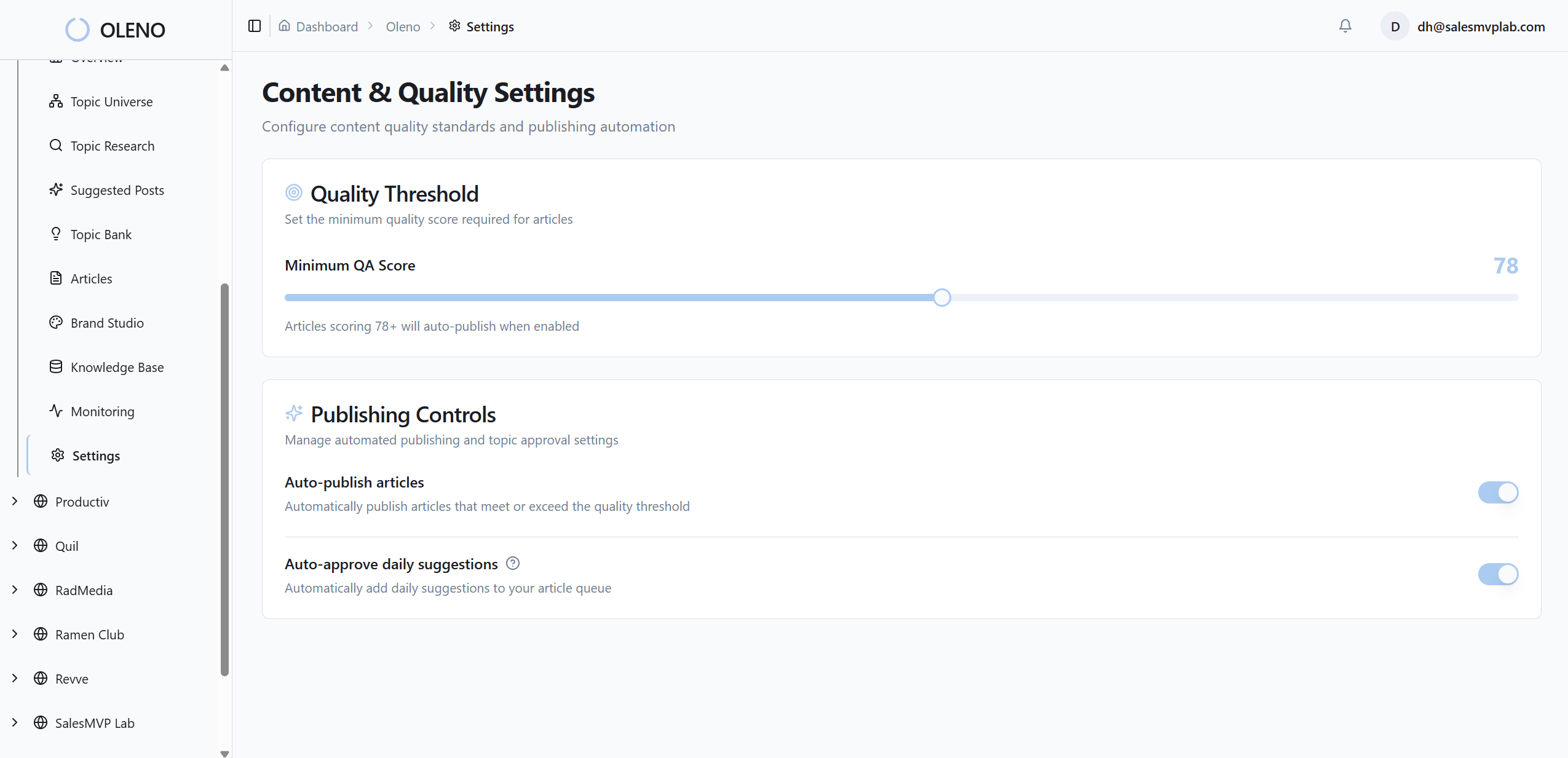
I like this because it shifts decisions upstream. You set the rules once, then let execution repeat. The guardrails show up where people work, not buried in a brand book. Editors stop policing style, and start enforcing policy. Production gets faster without sacrificing accuracy.
- Connected pain: rework from unclear guidance.
- Feature mapping: brand voice and writing rules, positioning and market POV, product truth and claim control.
- Outcome: repeatable briefs that do not drift under volume.
The QA Gate Enforces Narrative Structure And Safety
Nothing publishes unless it passes pre configured checks for voice, narrative structure compliance, grounding, and accuracy. If a draft violates claim boundaries or skips a required atom, Oleno blocks it and triggers revisions. Enforcement moves out of meetings and into the pipeline, which protects deadlines.
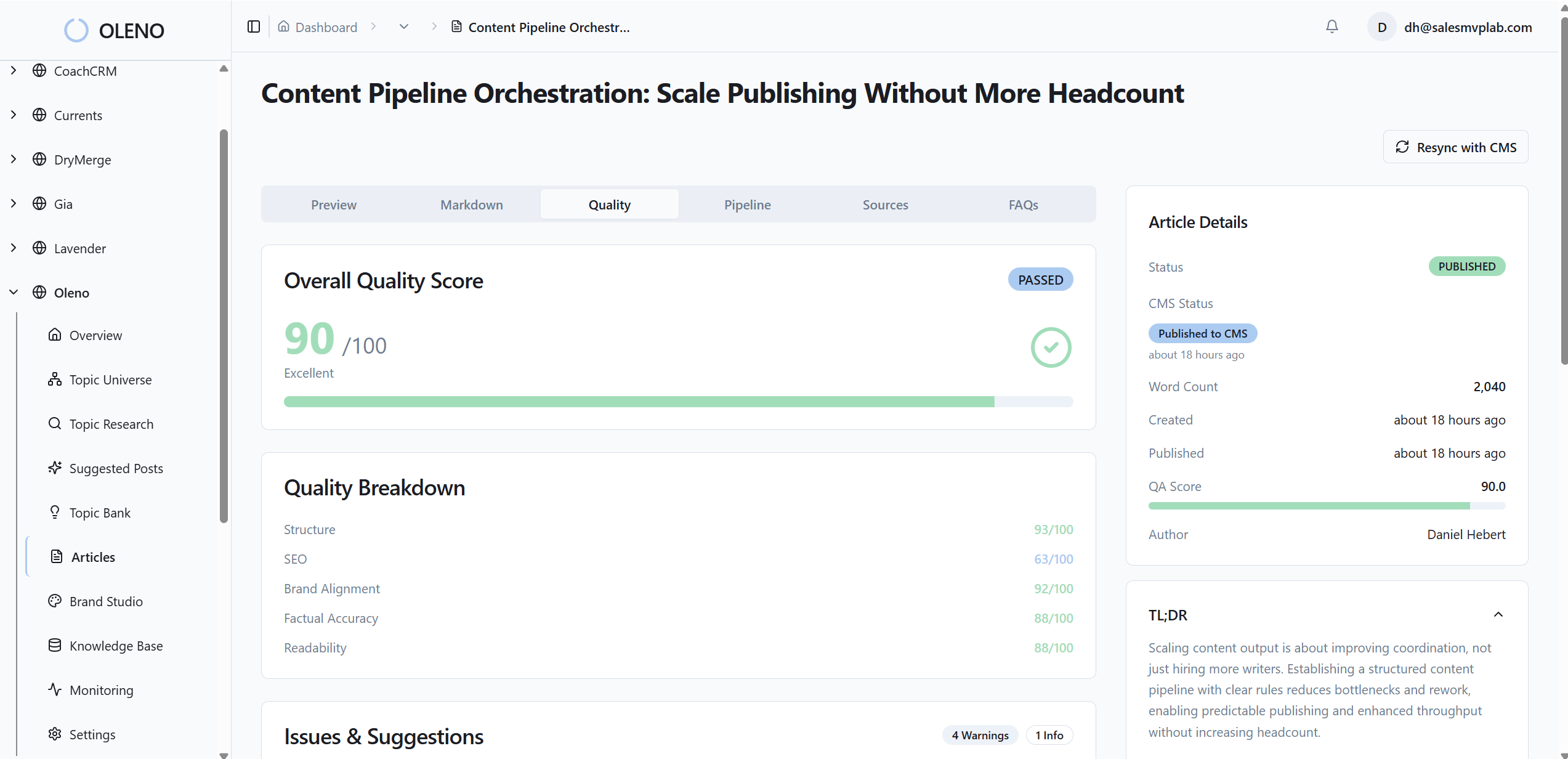
This is where many teams feel the biggest relief. Legal review speeds up because proofs and claims are already in policy. Reviewers focus on substance. Writers get clearer signals on what to fix. Over time, the system catches patterns and you update the schema, not just individual drafts.
- Connected pain: inconsistent claims and slow legal.
- Feature mapping: QA gate before publishing, grounding and accuracy constraints, repetition and filler detection.
- Outcome: fewer last mile edits, less risk.
Deterministic Pipelines Bind Templates To Execution
Every job runs through the same pipeline, Discover, Angle, Brief, Draft, QA, Enhance, Visuals, Publish. Governance applies at each stage. CMS publishing is idempotent, no duplicates. This is how atom rules carry from idea to URL without relying on memory or throwing more people at review during crunch time.
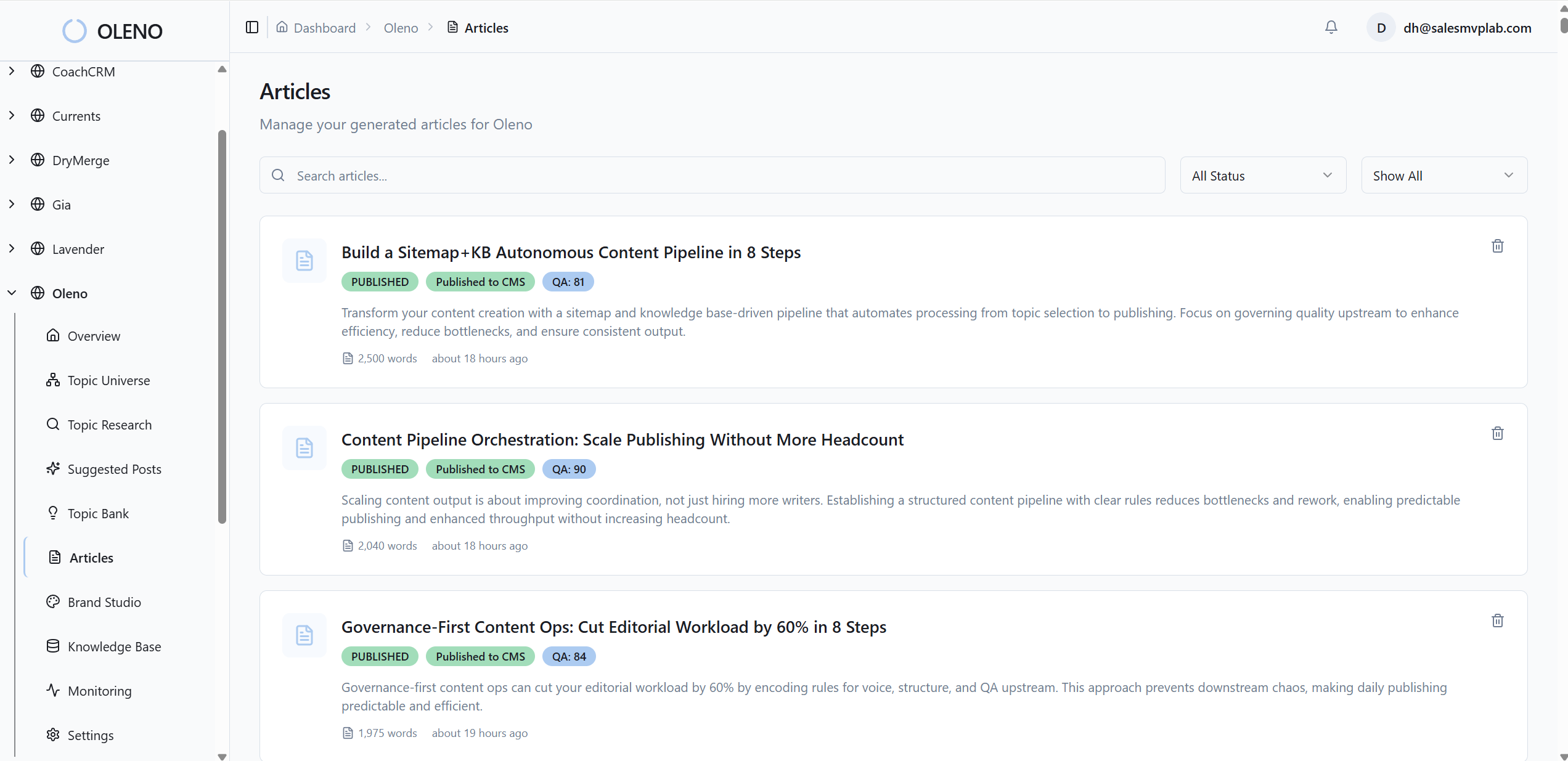
Operational visibility matters as volume grows. Oleno’s system health signals and sampling catch subtle drift in specific categories that QA can miss. You see quality trends and failure patterns, then update examples or tweak constraints. Improvement becomes part of the cycle, not an ad hoc meeting series.
- Connected pain: fragmentation and missed windows.
- Feature mapping: deterministic pipeline, CMS publishing with draft or live options, no duplicate guard, system health visibility.
- Outcome: reliable cadence and fewer surprises at publish.
If you want to evaluate whether this fits your team’s size and stack, we can walk through governance setup, job selection, and the QA gates in a short session. Request A Demo and we’ll map it to your current process.
Conclusion
Style guides keep voice consistent. Narrative backbones keep meaning consistent. If you define atoms once, encode them in a schema, bind them to templates, and enforce them in QA, you stop re-explaining the story every week. You also stop paying the rework tax that eats launch windows and morale. Whether you operationalize this manually or with a system like Oleno, the principle holds. Lock the story, then scale the writing. That’s how small teams compound.
About Daniel Hebert
I'm the founder of Oleno, SalesMVP Lab, and yourLumira. Been working in B2B SaaS in both sales and marketing leadership for 13+ years. I specialize in building revenue engines from the ground up. Over the years, I've codified writing frameworks, which are now powering Oleno.
Frequently Asked Questions