Oleno vs AirOps: Complete AI Content Platform Comparison 2026

If you’re choosing between Oleno and AirOps in 2026, you’re not really choosing “features.” You’re choosing an operating model. Do you want a system that runs content end to end, or do you want a platform where your team designs the workflows, instruments the outputs, then iterates?
I’ve lived both sides. I’ve been the person cranking out content fast. I’ve also been the person stuck in review cycles, watching weeks go by while everyone “aligns” on a draft that ends up looking like the other ten posts in the SERP anyway. That difference, operating model, is what tends to decide whether this stuff scales.
Oleno vs AirOps: Which Platform Fits Your 2026 Content Strategy?
Oleno and AirOps can both help you produce AI-assisted content, but they’re built for different styles of teams. AirOps leans into customizable workflows, AEO, and analytics, while Oleno focuses on autonomous long-form creation that goes from topic selection to publishing. A quick scan across autonomy, setup effort, and measurement usually makes the choice obvious.

| Criteria | Oleno | AirOps | Buyer Note |
|---|---|---|---|
| Creation Model | Autonomous system determines topics, structure, voice, and when to publish | No-code workflows and templates you configure for research, briefs, generation, and updates (AirOps Official Site) | Prefer set-and-publish vs. build-and-run? |
| Differentiation Control | Blocks topics with no information gain; enforces originality and structure pre-draft | Brand Kits and governance to align outputs; differentiation depends on configured process (AirOps Official Site) | Do you want enforced differentiation or governed templates? |
| Quality & Editorial Overhead | Creates publish-ready long-form content without prompting, manual coordination, or editing | Often benefits from internal review, especially for technical thought leadership (AirOps Official Site) | How much editorial time can you commit? |
| AI Search Optimization (AEO) | Not positioned as an AEO tracking platform | AEO features to monitor extractability and citations/share-of-voice (AirOps Official Site; AirOps Secures $40M For AI Search Optimization) | Is AEO tracking core to your KPI stack? |
| Publishing | Publishes without manual coordination once configured | Workflow-driven; integrates with CMS/CRM via APIs (AirOps Official Site) | Hands-off publishing vs. integrated ops |
| Setup Effort | Configure once; system operates autonomously afterward | Requires workflow design, governance setup, and integrations (AirOps Official Site) | Do you have a content-ops owner? |
Key Takeaways:
- Teams that want AEO dashboards, citation tracking, and custom workflows tend to prefer AirOps, assuming they can own setup and iteration.
- Teams that want consistent long-form output without daily prompts or coordination overhead tend to lean toward Oleno’s autonomous publishing model.
- If you’ve been burned by generic “AI slop,” prioritize enforcing differentiation before drafting, not just editing after the fact (AirOps Blog: AI Slop).
- The real cost usually isn’t software. It’s review cycles, stakeholder alignment, and rework when content lacks a clear angle.
Quick Comparison: Autonomy Versus Workflow Builder
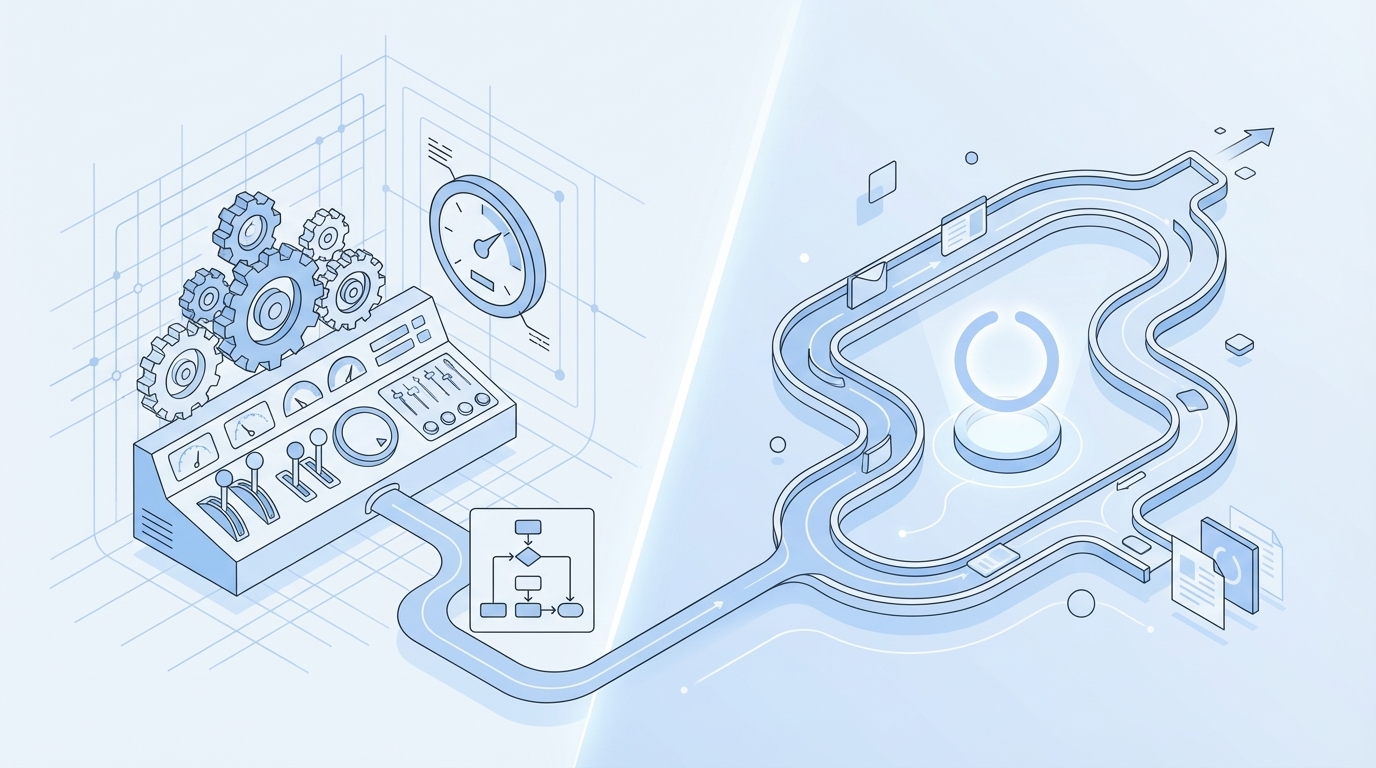
Oleno is built to run a governed, end-to-end pipeline that decides what to write, drafts in your voice, verifies quality, and publishes to your CMS. AirOps is built to let you design the pipeline yourself using no-code workflows, governance, and AEO measurement. One is a system you configure, the other is a platform you operate.
In practice, this shows up fast when you ask a simple question: “Who on the team owns content ops?” If the answer is “we don’t really have that person,” workflow-builder platforms can turn into a slow-moving internal product. If you do have that person, AirOps can be a strong fit because you can tune every step and measure AEO outcomes (AirOps Official Site).
I also think the “control vs autonomy” framing gets misunderstood. Control isn’t free. Control means meetings, docs, approvals, and someone catching edge cases. Autonomy means you trade some flexibility for repeatability and cadence.
A useful way to think about it:
- If you want to design custom processes and instrument performance, AirOps leans that way (AirOps Official Site).
- If you want content to ship without a human project managing every step, Oleno leans that way.
Why This Decision Matters For SEO And AI Answers
This decision matters because SEO and AI answers reward consistency and clarity, and most teams struggle to sustain both at scale. AirOps targets AI Search Optimization with workflows plus measurement, while Oleno targets always-on publishing with enforced structure and knowledge grounding. In 2026, the team that wins is usually the one that can publish differentiated content repeatedly without drowning in coordination.
The Hidden Time Tax Of Complex Content Ops
The hidden cost in content isn’t “writing.” It’s everything around writing.
Briefs. Reviews. Stakeholder drive-bys. The legal comment that shows up on day nine. The SEO person who wants a new section. The PM who wants a different positioning angle. All reasonable individually. Brutal collectively.
Let’s pretend you publish 8 articles a month. Each one needs 2 review cycles. Each cycle burns 1.5 hours of meeting time and async back-and-forth per stakeholder. If you’ve got 2 to 4 stakeholders who reliably comment (marketing lead, product, sales, maybe a founder), you’re at 48 to 96 hours a month of coordination overhead. That’s 1 to 2.5 weeks of someone’s working time, and it’s rarely clean time.
This is where workflow tools can go either way. If you’ve got strong process ownership, workflow automation can reduce some chaos and make quality more predictable (AirOps Official Site). If you don’t, you risk turning “content” into a mini Jira program where nothing ships.
Risk Of Generic Content In 2026
Generic content is a real problem now, and it’s getting worse, not better. AirOps has been pretty explicit about fighting low-quality “AI slop,” and I agree with the premise: the web is filling up with content that says nothing new (AirOps Blog: AI Slop).
Here’s a quick story. A few years back, I watched a team ship 30+ articles in a quarter. Good writers. Solid SEO basics. Clean on-page. Traffic stayed flat. Not tanked. Just flat. The painful part? Everyone thought the “output” was the win. But the content didn’t have a point of view, didn’t have information gain, didn’t have differentiation.
If we could rewind that quarter, the move wouldn’t be “edit more.” It would be: enforce originality before drafting. Block topics where you have nothing new to say. Force an angle that’s actually yours, not a remix of what’s already ranking.
AirOps approaches this by giving teams workflows, governance, and measurement that can highlight what’s working in AI answers and what isn’t (AirOps Official Site; AirOps CMO Series: The New Content Era). Oleno approaches it by preventing repetitive topics and enforcing structure and originality before the draft even exists.
What Teams Really Need To Publish Consistently
Most teams don’t need “more AI.” They need fewer handoffs.
You need a reliable system that answers:
- what to publish next
- what the angle is
- what the structure is
- what “good” looks like before it goes live
AirOps is strong when you want to build that system yourself and track AEO outcomes like extractability and citations (AirOps Official Site; AirOps Secures $40M For AI Search Optimization). That’s a real advantage for teams where “AI answer visibility” is a first-class KPI.
Oleno is strong when you want the system to run without daily human coordination. Configure it once, then it keeps publishing on a cadence.
Interjection: most marketing teams are already overloaded.
So “consistent publishing” usually isn’t a motivation problem. It’s an operating problem.
AirOps Deep Dive: Workflows, AEO, And Trade-Offs
AirOps is a strong option if your team wants an AI content operations platform with AEO focus, configurable workflows, and measurement. It tends to fit organizations that can invest in setup and ongoing iteration, because the platform rewards teams who design tight processes. If you want dashboards for AI visibility and the ability to customize each step, AirOps is built for that (AirOps Official Site).
Key Strengths
AirOps’ biggest strength is that it treats content like an operational system you can build, measure, and improve. That sounds obvious, but a lot of tools stop at drafting. AirOps pushes into workflow design, governance, and AEO, which matters if you’re trying to show the business something more concrete than “we published some posts” (AirOps Official Site).
The other thing worth calling out is positioning. AirOps is very explicit about AI Search Optimization and the realities of low-quality content flooding the web. Their writing on “AI slop” reflects a real market concern, and it’s aligned with how buyers are thinking right now (AirOps Blog: AI Slop).
Strengths that tend to matter in practice:
- No-code workflow builder for custom pipelines (AirOps Official Site)
- AEO emphasis, including extractability and citation/share-of-voice concepts (AirOps Official Site; AirOps Secures $40M For AI Search Optimization)
- Brand governance via Brand Kits and knowledge bases (useful when multiple people touch content) (AirOps Official Site)
- Schema and knowledge graph automation positioned to improve extractability (AirOps Official Site; AirOps CMO Series: The New Content Era)
If your world is “we need a measurable system for AI answers,” that’s the AirOps lane.
Key Limitations
AirOps can be a lot of platform, which is both good and bad.
The trade-off with a workflow builder is you have to build the workflows. Someone needs to own that. Someone needs to maintain it. And when priorities change (they will), you need to refactor the system, not just write a different prompt.
For deep thought leadership and technical content, most teams still keep a human in the loop. That’s not a knock, it’s just reality. You’re usually validating nuances, claims, and positioning. AirOps can help you get farther faster, but it doesn’t remove the need for editorial ownership in higher-risk categories (AirOps Official Site).
A few limitations teams should plan for:
- Setup and configuration can be non-trivial, especially if you’re trying to connect governance, workflows, and integrations (AirOps Official Site).
- Output quality can depend heavily on how well your processes and brand inputs are configured (AirOps Official Site).
- Some teams report uneven self-serve support and documentation. I’d treat that as something to validate during evaluation, not as a universal truth (AirOps Official Site).
None of this is disqualifying. It just means you should be honest about whether you want to operate a platform.
Pricing And Value Lens
AirOps appears to offer a hybrid pricing approach with a free tier and paid plans, with enterprise pricing available depending on needs (AirOps Official Site). You’ll also see discussion of AirOps in the market as an AEO-focused platform, which helps explain why pricing can vary based on what you’re instrumenting and who’s using it (AirOps Secures $40M For AI Search Optimization).
Value-wise, AirOps tends to pay off when:
- AEO measurement is a core KPI, not a “nice to have” (AirOps Official Site).
- You’re willing to invest in workflow design and continuous improvement.
- You have enough content velocity that automation and dashboards actually reduce chaos, not add another layer.
The risk is paying for a platform you don’t fully operationalize. If you only use 15 percent of the workflow capability, you’re basically buying optionality.
How Oleno is Different: AirOps gives you a powerful workflow builder and AEO measurement, but it assumes your team will design and run the system. Oleno is built as an autonomous content creation platform that determines what to write, defines the angle and structure before drafting, grounds claims in your knowledge base, runs automated quality checks, and publishes to your CMS without prompting or coordination. If you’re trying to eliminate coordination overhead, the model is fundamentally different.
Decision Criteria: Control Versus Autonomy
The simplest way to decide is this: AirOps is better when you want control through configurable workflows and measurement, and Oleno is better when you want autonomy through an end-to-end publishing system. AirOps tends to reward teams with content ops maturity, while Oleno tends to reward teams that want consistent output without building internal machinery. You’re choosing who does the work, your team or the system.
Do You Want A Builder Or A System?
A builder is great when you have strong opinions and the internal capacity to express those opinions as repeatable processes. You can encode your approvals, your briefs, your refresh cycles, your schema steps, your measurement loops. AirOps is clearly designed for that mode, especially with its AEO and workflow positioning (AirOps Official Site; AirOps CMO Series: The New Content Era).
A system is great when you already know what “good” looks like and you’d rather configure it once than re-run it forever.
This is where Oleno’s model is just different. The promise isn’t “we help you write faster.” It’s “you don’t have to coordinate the writing process.” The pipeline is fixed and governed: topic discovery, angle definition, briefing, drafting, QA, enhancements, image, publish. That consistency matters when you’re trying to publish at a reliable cadence without someone pushing tickets around.
One nuance: some teams hear “autonomous” and assume “hands off equals risky.” That can be true for generic AI writing. But autonomy with constraints, grounding, and QA checks is a different thing. It’s less about creativity and more about repeatability.
So ask yourself:
- Do we want to design the process? Or do we want the process to run?
- Are we optimizing for measurement and visibility? Or output and cadence?
- Do we have an operator for this?
Team Structures That Benefit From Each
AirOps tends to fit teams with a dedicated content ops owner, or teams working with an agency that can build and maintain the workflows. The AEO layer is also a strong fit for orgs where “AI answer visibility” is a board-level narrative, not just an SEO tactic (AirOps Official Site; AirOps Secures $40M For AI Search Optimization).
Oleno tends to fit leaner teams that still need to publish a lot of long-form content, and can’t afford the constant coordination tax. Think: one marketer, maybe a contractor editor, and a bunch of stakeholders who are already busy.
If you’re not sure which bucket you’re in, here’s a practical diagnostic:
- If you can name the person who will maintain the workflows, AirOps is on the table.
- If that person doesn’t exist, autonomy starts looking less like a luxury and more like survival.
Why Oleno For Autonomous Long-Form Content
Oleno is a better fit when your goal is to publish differentiated long-form content continuously without prompting, editing loops, or cross-team coordination. It works by using your sitemap and knowledge base to choose topics, define angles and structure up front, draft in your voice, run quality checks, and publish to your CMS. Compared to workflow platforms like AirOps, the value is that the system executes end to end instead of requiring your team to operate it.
Before getting into a bigger grid, here’s the fair caveat. If your #1 KPI is AEO measurement and dashboards, AirOps is built for that lane (AirOps Official Site). Oleno is not positioned as an AEO tracking platform.
Core Differentiators That Matter
The main differentiation is autonomy plus determinism. Oleno runs a fixed pipeline every time: topic, angle, brief, draft, QA, enhancements, image, publish. That sounds simple, but it removes a lot of the messy human coordination that usually slows content down.
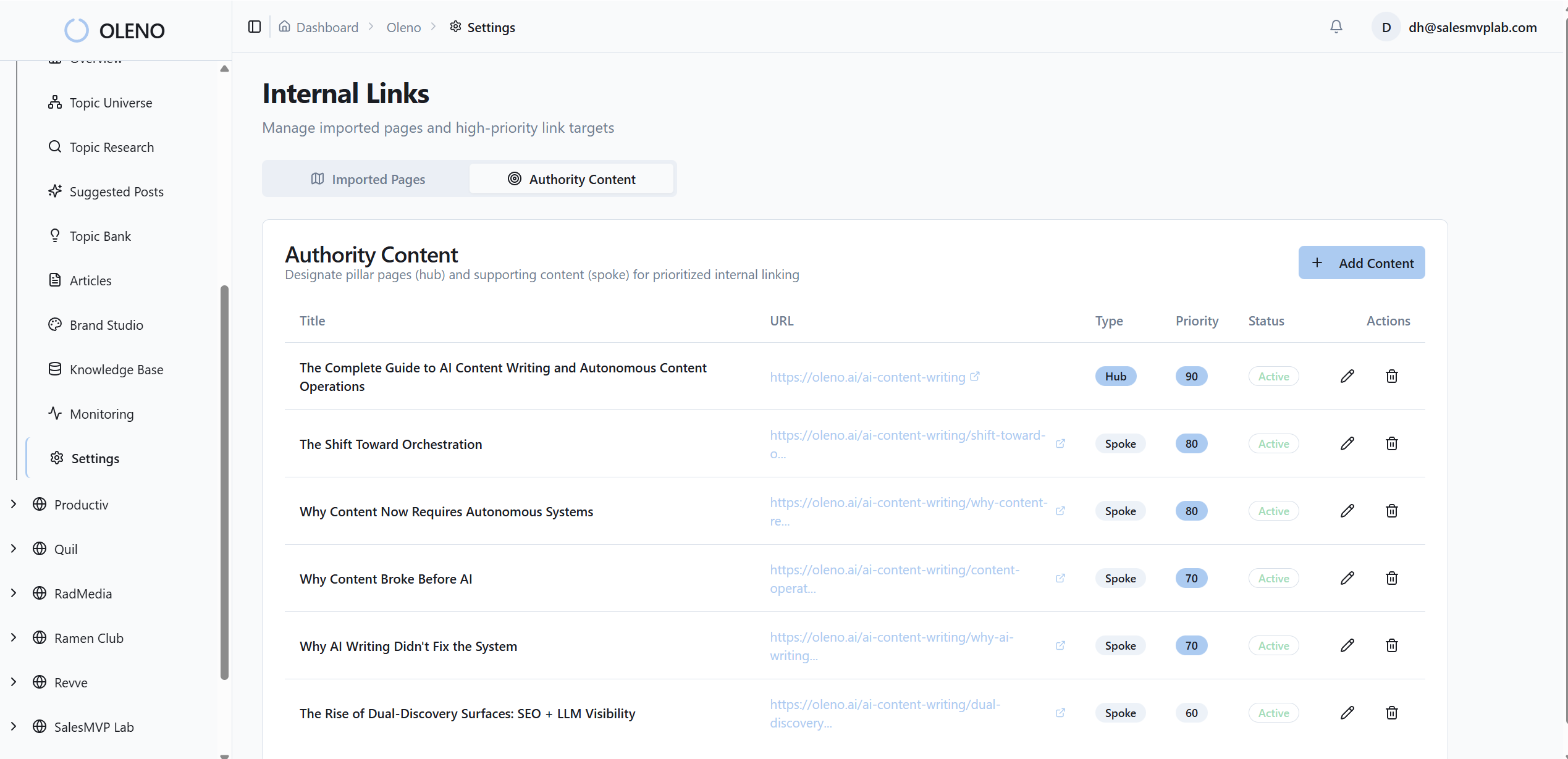
The second differentiator is grounding. Oleno uses your knowledge base as the factual backbone, which reduces the risk of random unsupported claims showing up in drafts. This matters more than people think. Every time an AI draft slips an incorrect claim into a paragraph, you don’t just fix that claim. You lose trust. Then you add another review layer. Then velocity dies.
The third differentiator is quality enforcement as a system, not as “someone edits it.” Oleno has an internal QA gate with a minimum passing score (85), and if the draft fails it iterates and retests automatically until it passes. That’s a different model than “generate draft, hope your editor catches issues.”
If I had to summarize the practical impacts:
- You spend less time coordinating.
- You get more consistency in structure and voice.
- You reduce rework caused by generic angles and factual wobble.
When Oleno Fits (And When It Doesn’t)
Oleno fits when you want always-on long-form publishing, and you want the machine to handle the full workflow, not just drafting. It’s especially useful when you’re trying to scale content without hiring a content ops manager, without building an internal prompt library, and without turning content into a weekly meeting marathon.
Oleno might not fit when:
- Your main priority is AEO dashboards, citation tracking, and analytics. AirOps is built for that (AirOps Official Site; AirOps CMO Series: The New Content Era).
- You want extremely custom workflows that change every week, across many different content types, with lots of human approvals. That’s builder territory.
This is also where you should be honest about risk tolerance. If you’re in a regulated category or publishing medical-grade claims, you probably still want human review, regardless of platform. Oleno can reduce the amount of human time required, but you may still choose to add oversight.
Getting Started
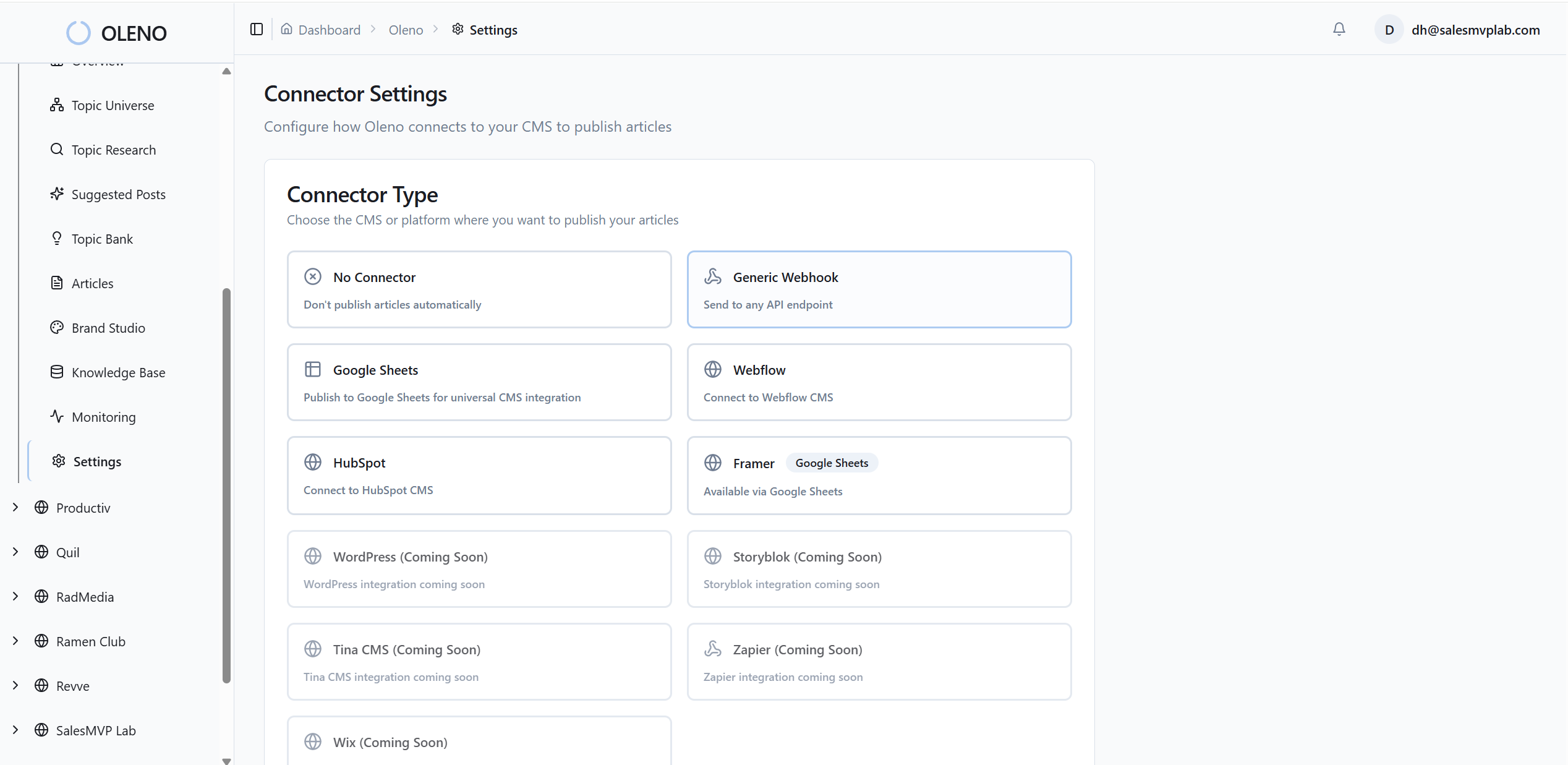
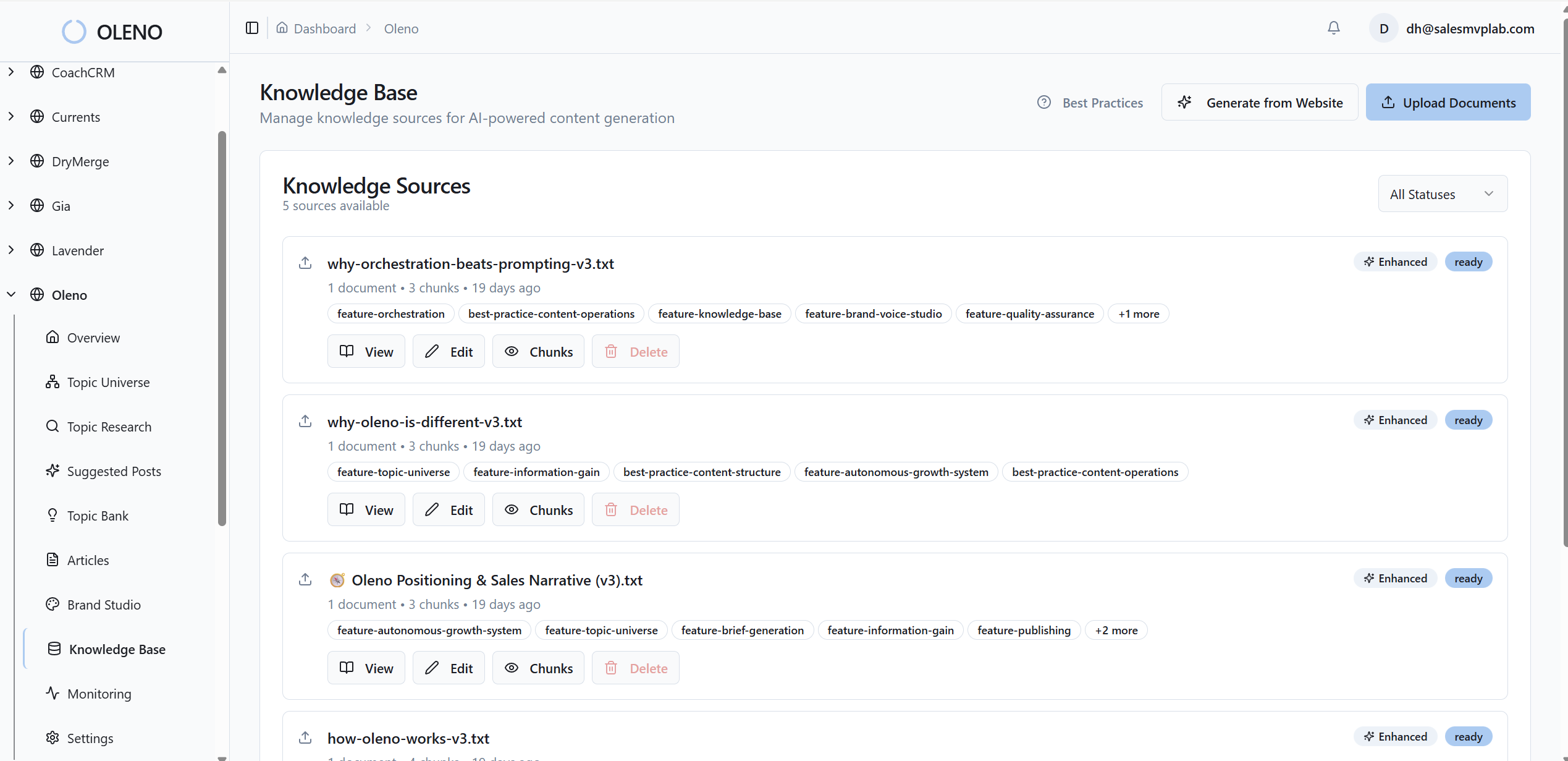
Getting started with Oleno is less about prompt training and more about configuration. You connect your sitemap and your knowledge base, define the narrative and voice constraints, then let the system run the pipeline.
The best way to pilot it is not “one article.” One articles tells you almost nothing.
A better pilot looks like:
- Configure once (voice, knowledge base, narrative constraints).
- Generate a small batch so you can evaluate topic selection, angle differentiation, and structure consistency across multiple posts.
- Review what the QA gate passes and what it retries, because that shows you where your inputs need tightening.
- Then decide cadence.
If you want to see that in practice, you can Request a demo now. It’s a fast way to tell if the operating model matches how your team actually works.
Conclusion: Choose Based On Operating Model, Not Features Alone
You should pick AirOps if you want to build custom content workflows and you care deeply about AEO visibility, measurement, and iteration loops. You should pick Oleno if you want an autonomous system that continuously publishes differentiated long-form content in your voice without prompting, manual coordination, or editing cycles. Most teams feel the difference in week two, when the real constraint shows up: time and attention, not “AI capability.”
Before you decide, here’s the comprehensive grid to make the trade-offs explicit.
| Decision Criterion | Oleno | AirOps | Source(s) |
|---|---|---|---|
| Primary Approach | Autonomous content creation system for long-form, publish-ready articles | AI content operations platform with AEO and customizable workflows | Oleno first-party; AirOps Official Site; AirOps Secures $40M For AI Search Optimization |
| Topic Selection | Determines what to write based on your site and knowledge base | User-driven research workflows and templates | Oleno first-party; AirOps Official Site |
| Differentiation Handling | Blocks low-information-gain topics; defines structure before drafting | Brand Kits/governance; uniqueness depends on setup | Oleno first-party; AirOps Official Site |
| Editorial Overhead | No prompting, manual coordination, or editorial overhead | Often requires internal review for expert content | Oleno first-party; AirOps Official Site |
| Publishing | Publishes once configured, without prompting or coordination | Integrations and workflows manage publishing | Oleno first-party; AirOps Official Site |
| AEO/Citations Tracking | Not focused on AEO metrics | Tracks extractability and citations/share-of-voice | Oleno first-party; AirOps Official Site; AirOps Secures $40M For AI Search Optimization; AirOps CMO Series: The New Content Era |
| Schema/Knowledge Graph | Not claimed | Schema and knowledge graph automation for extractability | Oleno first-party; AirOps Official Site; AirOps CMO Series: The New Content Era |
| Workflow Customization | Fixed autonomous pipeline with configurable brand inputs | Highly customizable no-code workflow builder | Oleno first-party; AirOps CMO Series: The New Content Era |
| Brand Voice & Grounding | Uses your sitemap and knowledge base; writes in your voice | Brand Kits and knowledge bases for alignment | Oleno first-party; AirOps Official Site |
| Setup & Time To Value | Configure then run autonomously | Setup can be steeper; value depends on configuration | Oleno first-party; AirOps Official Site |
| Ideal Team | Lean teams needing consistent long-form output without ongoing ops | Teams with content-ops capacity that want granular control and AEO metrics | Oleno first-party; AirOps CMO Series: The New Content Era |
| Pricing Lens | Not disclosed here; evaluate based on autonomy value and publish-ready scope | Free tier; paid and enterprise options vary | Oleno first-party; AirOps Official Site |
| Risk Profile | Prevents repetitive content via enforced differentiation pre-draft | Risk of rework if workflows are loosely governed | Oleno first-party; AirOps Official Site |
| Best For | Autonomous, differentiated long-form content in your voice | AEO visibility, analytics, and custom content workflows | Oleno first-party; AirOps Official Site; AirOps CMO Series: The New Content Era |
If your current reality is “we keep starting content initiatives, then they stall,” you’re probably dealing with coordination debt more than writing speed. That’s the exact scenario where an autonomous engine tends to be the cleaner bet. If you’re ready to test that model, you can try using an autonomous content engine for always-on publishing. and evaluate a pilot batch instead of arguing about hypotheticals.
One last thing, and it’s the part people skip. Whatever you choose, set a constraint: either you’re committing to operating a workflow platform (and staffing for it), or you’re committing to configuring an autonomous system (and letting it run). Half-and-half is where tools go to die.
If you want to get concrete quickly, Request a demo. Then compare the outputs to your current process, not to a marketing page.
You’ll know which operating model you actually want.
About Daniel Hebert
I'm the founder of Oleno, SalesMVP Lab, and yourLumira. Been working in B2B SaaS in both sales and marketing leadership for 13+ years. I specialize in building revenue engines from the ground up. Over the years, I've codified writing frameworks, which are now powering Oleno.
Frequently Asked Questions