Oleno vs Blaze: Complete Comparison Guide

If you’ve ever tried to scale content, you already know the dirty secret. Writing isn’t the hard part. Coordination is.
Back in 2012 to 2016, I ran a marketing site that grew because we shipped a lot of pages, fast, without losing the plot. The moment you go from “me writing” to “a team producing,” your output starts getting eaten by briefs, reviews, revisions, CMS chores, and random Slack debates about tone. That’s the backdrop for this comparison.
This guide breaks down Oleno vs Blaze with a simple lens: are you trying to run an all-in-one marketing suite, or are you trying to get publish-ready long-form articles out the door with less operational overhead?
Oleno vs Blaze: Which Platform Delivers Publish-Ready Content With Less Overhead?
Oleno is built to produce publish-ready long-form articles end-to-end, while Blaze is positioned as an all-in-one marketing platform that spans creation, design, scheduling, and analytics. Blaze tends to work best when you want one workspace for many marketing tasks. Oleno tends to fit when you measure success by “published articles per week” and you don’t want the coordination tax.
| Feature | Blaze | Oleno |
|---|---|---|
| Primary focus | All-in-one marketing suite (content, design, scheduling, analytics) (Cyble Listing) | Autonomous, long-form, publish-ready content |
| Publishing autonomy | Assisted: scheduling and cross-posting, typically set up by a human (Blaze Homepage) | End-to-end: determines topics, structure, voice, and publishes once configured |
| Brand voice & differentiation | Brand kits and brand setup via inputs like site/social signals (SaaSGenius Review) | Uses your site and knowledge base, enforces differentiation via angle and structure rules |
| Content formats | Multi-format generation across marketing content types (Cyble Listing) | Long-form articles across multiple workflows |
| Starting price | Reported around $34/month with a free tier, plan details vary (SaaSGenius Review) | from $449/mo (SEO + Social). |
| Best fit | Solo founders and small teams wanting creation-to-distribution in one place (Blaze Homepage) | Teams that want publish-ready long-form content without ongoing coordination |
Key Takeaways:
- Blaze is a strong fit when you want one tool for content, design, scheduling, and analytics, not just long-form publishing (Cyble Listing).
- Oleno is purpose-built for publish-ready long-form output, especially when editorial coordination and revision cycles are your biggest bottleneck.
- Blaze pricing is reported as starting around $34/month with a free tier, but plan signals vary, so you’ll want to verify before committing (SaaSGenius Review).
- If your team already has a CMS workflow and mostly needs consistent article throughput, Oleno’s autonomous pipeline tends to map more directly to that goal.
What Teams Actually Need From AI Content Platforms
Most teams need an AI content platform that reduces operational overhead, not one that just makes drafts faster. The expensive part is usually the back-and-forth: topic selection, briefs, rewrites, approvals, formatting, and publishing. If the platform doesn’t shrink those handoffs, you often just move the headache around.

Who This Guide Is For
If you’re a solo creator, the main question is usually, “Can I make more assets this week without hiring help?” Blaze is clearly trying to be that kind of home base, with a wide scope across marketing outputs and workflows (Blaze Homepage).
If you’re a marketing lead (or the accidental content ops person), your question is different. It’s, “Can we publish consistently without me quarterbacking every step?” That’s where Oleno’s positioning hits. It’s not about having more templates. It’s about removing the need to manage the process day-to-day.
Here’s the quick way to self-sort:
- If you want one place to generate, design, schedule, and review lots of marketing formats, Blaze is in the conversation (Cyble Listing).
- If you want long-form publishing to run like a system, with minimal ongoing human coordination, Oleno is the more direct bet.
Publish-Ready Vs Draft-Only Outcomes
Publish-ready means the output is structured, grounded, quality-checked, and formatted so you can actually hit “publish” without a human rescue mission. Draft-only means you still have to do the hard parts: rewrite for voice, fact-check, clean up structure, add SEO formatting, and then push it through your CMS workflow.
Blaze is marketed as an AI-first marketing platform with workflows that include content creation plus downstream steps like scheduling and analytics, which is useful, but it doesn’t automatically mean the long-form output is “hands-off publish-ready” every time (Cyble Listing).
Oleno’s entire framing is the opposite: it’s designed to run the content creation system end-to-end, including topic discovery, structure, QA, and publishing to your CMS, without prompting, editing, or coordination once configured.
A practical way to think about it:
- Blaze helps you produce and distribute a broader set of assets.
- Oleno tries to eliminate the gap between “draft exists” and “article is live.”
Coordination, Revision, And Rework Costs
Coordination cost is the silent budget killer. And it shows up as meetings, Slack threads, and frustrating rework.
Let’s pretend you want to publish 20 long-form articles per month. Not a content farm, just a solid cadence. If each article takes:
- 30 minutes to pick a topic and align on angle
- 20 minutes to brief
- 45 minutes to edit
- 15 minutes to format and publish
That’s 110 minutes of human time per article, before you count review delays. Now multiply by 20. That’s 36+ hours a month. One full work week. Gone.
Some suites help with breadth (more asset types), but they can still leave you with the “someone has to run the machine” problem. Oleno’s bet is that the machine should run itself, and humans should configure it, not operate it daily.
Blaze AI Deep Dive
Blaze is best understood as an all-in-one marketing suite that combines AI content generation with workflow steps like design, scheduling, and analytics. It’s positioned toward solopreneurs, small teams, and agencies that want many marketing tasks in one platform. If you like a single cockpit view for multi-channel output, that’s Blaze’s lane (Blaze Homepage).

Strengths That Stand Out
Blaze’s biggest strength is scope. It’s not pretending you only do blog posts. It’s trying to cover the day-to-day sprawl of marketing output.
From public materials and listings, Blaze is positioned around generating content across many formats and supporting distribution workflows like scheduling, with a suite-style approach (Cyble Listing). Their updates page reinforces that they ship features and iterate like a platform company, not just a prompt box (What’s New).
Two practical upsides:
- You’re not stitching together five different tools for basic workflows.
- If you’re repurposing content across channels, that “one place” model can save context-switching.
Strengths commonly highlighted in third-party coverage include:
- Broad creation-to-distribution workflow coverage (Cyble Listing)
- Brand kits and brand alignment inputs (as described in reviews and listings) (SaaSGenius Review)
- Frequent product updates and new capabilities shipping over time (What’s New)
If you’re a tiny team, that matters. You’re trying to survive the week, not build a perfect editorial machine.
Limitations To Consider
Blaze’s breadth is also where the trade-offs show up.
First, validation and clarity. Compared to larger, more established platforms, Blaze appears to have fewer public reviews and less third-party signal to lean on, depending on where you look (SaaSGenius Review). That doesn’t mean it’s weak. It just means you’ll want to do your own trial and verification.
Second, pricing and plan ambiguity. Third-party sources report Blaze starting around $34/month and offering a free tier, but those same sources also note that plan details can vary and can be hard to compare cleanly without checking the site directly (SaaSGenius Review).
Third, suite complexity. When a platform does content plus design plus scheduling plus analytics, you might end up configuring more than you actually need. If your only KPI is “publish high-quality articles consistently,” suite features can become clutter instead of leverage.
Limitations you should pressure-test:
- How “publish-ready” the long-form output feels without heavy editing, for your specific niche
- How much setup is required to get the brand voice outputs consistent
- Whether you’re paying for breadth you won’t use
Pricing And Value (Blaze)
Blaze is reported to have a hybrid model with a free tier and a starting price around $34/month, but you should verify current tiers and what’s included on Blaze’s site before buying (SaaSGenius Review). That price point tends to be attractive for solo creators and early teams who want an all-in-one workspace.
Value here depends on usage. If you actually use the suite (creation plus design plus scheduling plus analytics), a lower starting point can feel like a good deal. If you only need long-form publishing, you may find yourself paying in time instead of dollars, because you still have to manage quality and coordination.
How Oleno is Different: Blaze aims to be a broad marketing suite, while Oleno focuses tightly on autonomous long-form publishing. Oleno runs a fixed pipeline (topic to publish) grounded in your knowledge base and enforces quality with an internal QA-Gate before it ever hits your CMS. That tends to matter when your bottleneck is editorial overhead, not asset variety.
Oleno Deep Dive
Oleno is designed to autonomously generate and publish long-form articles with minimal ongoing human involvement once it’s configured. It’s not positioned as a suite for every marketing task, it’s positioned as the system that runs content creation end-to-end. If your team is drowning in briefs, edits, and publishing chores, that’s the pain it’s built around.
Where It Fits Best (Oleno)
Oleno fits best when you’re serious about long-form publishing cadence and you’re tired of the process tax.
This tends to show up in a few scenarios:
- You’ve got a site with real products, real positioning, and real expertise, but content output is inconsistent.
- You have writers, but they don’t have the context, so quality drifts and you end up rewriting anyway.
- You’re trying to scale beyond a handful of posts per month and it starts turning into a coordination project.
I’ve lived this. When I was the only marketer, I could crank out content quickly because I had all the context in my head. The moment you add handoffs, quality goes down and cycle time goes up. It’s frustrating rework. Oleno’s approach is to bake the context into the system via your sitemap and knowledge base, then run the same pipeline every time.
Pricing And Value (Oleno)
Oleno pricing starts at from $449/mo (SEO + Social), scales up to $449/mo (Full-Funnel GEO) to $1,349/mo (Narrative Control), and has an Enterprise tier for 11+ posts/day. The value equation is straightforward: you’re paying for consistent publish-ready output, not seats, templates, or a bundle of adjacent marketing features.
The important part is what you replace. If Oleno reduces the need for editorial calendars, briefing docs, prompt libraries, revision loops, and manual publishing workflows, you’re not just buying content generation. You’re buying back time.
Still, you should be realistic. Oleno relies heavily on the quality of your knowledge base. If your internal docs are thin or outdated, you’ll feel it.
Head‑to‑Head: Oleno vs Blaze on the Details
Oleno and Blaze differ most on scope and operating model: Blaze is a broad marketing suite, while Oleno is a focused autonomous long-form publishing system. Blaze emphasizes multi-format content plus scheduling and analytics workflows (Cyble Listing). Oleno emphasizes deterministic, grounded, publish-ready articles pushed to your CMS on a reliable cadence.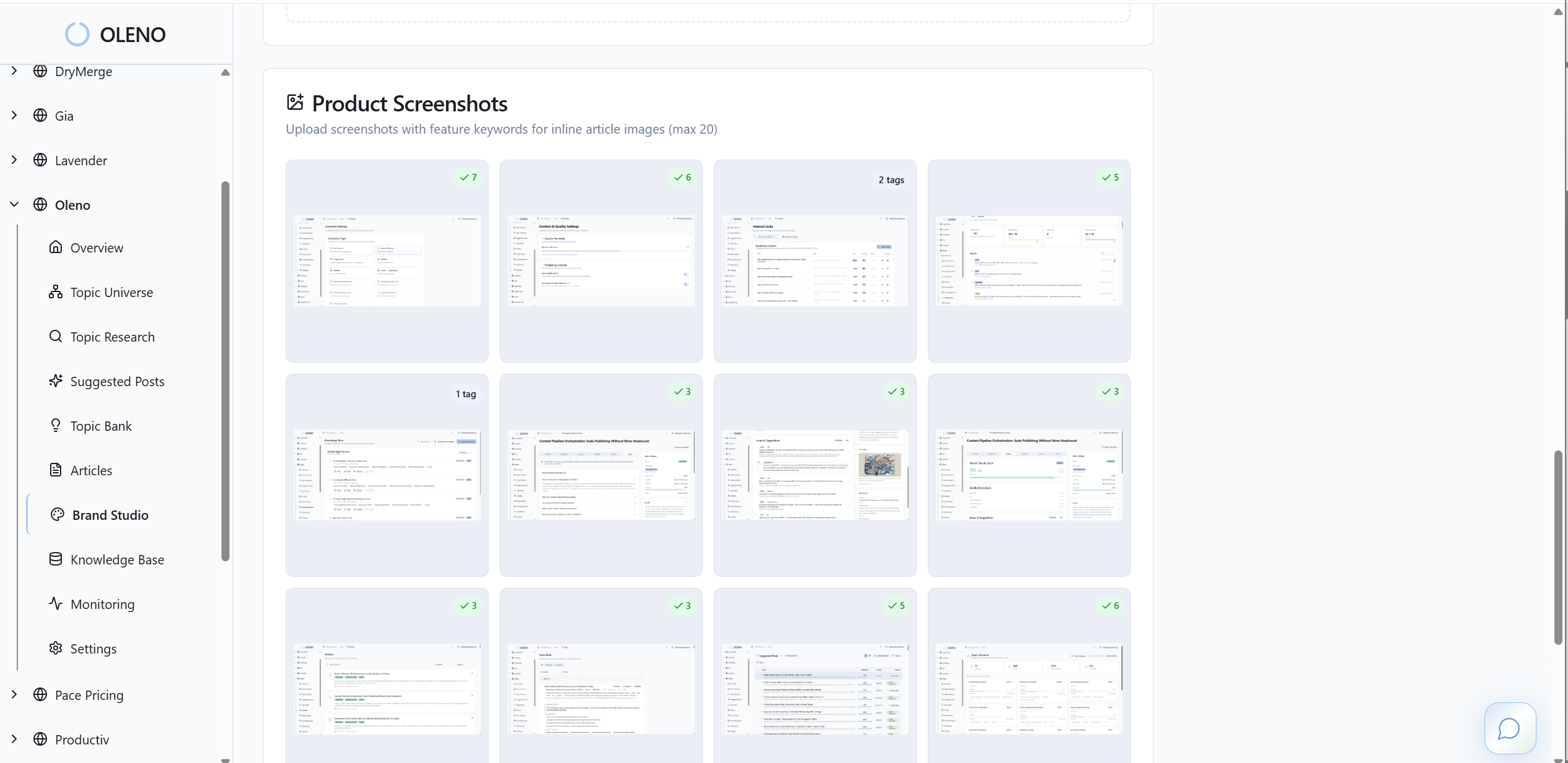
Content Quality And Originality
Blaze’s public positioning emphasizes creation across formats, brand kits, and workflow breadth, but public sources do not strongly emphasize originality enforcement for long-form content (Cyble Listing). That’s not a knock. It just means you shouldn’t assume the tool blocks generic angles by default. You’ll likely do that work in review.
Oleno takes a stricter stance because it’s designed for long-form publishing at scale. Before drafting, it defines angles and structure, checks for differentiation, and blocks topics with no information gain. Then it runs QA-Gate checks (minimum passing score: 85) across structure, voice alignment, knowledge base accuracy, SEO formatting, LLM clarity, and narrative order. If a draft fails, it improves and re-tests automatically.
If you’ve ever been stuck in the “this is fine but it sounds like every other article” loop, this is the difference. Blaze can help you generate quickly across many formats. Oleno tries to prevent you from publishing yet another generic page that needs a human to rewrite it into something credible.
Workflow And Publishing
Blaze is explicitly positioned around workflows that include scheduling and cross-channel distribution, which can be valuable for small teams trying to show activity everywhere (Blaze Homepage). That said, a suite workflow often still assumes a human is coordinating what gets created, reviewed, and scheduled.
Oleno’s workflow is built as a fixed pipeline: Topic to Angle to Brief to Draft to QA to Enhancements to Image to Publish. The point is repeatability. Same steps. Same standards. Less human babysitting.
Here’s the nuance I’d keep in mind:
- If you want a marketing workspace where you do a bunch of different tasks, Blaze’s model makes sense.
- If you want publishing to happen without you pushing it forward every day, Oleno is the cleaner fit.
Core Differentiators That Matter
The biggest differentiator is what each tool believes the real problem is.
Blaze treats the problem like, “Marketing teams need a unified suite to create and distribute lots of content.” That’s consistent with how it’s described as an all-in-one AI marketing platform that includes content, design, scheduling, and analytics (Cyble Listing).
Oleno treats the problem like, “Content breaks because humans are coordinating too many steps.” So the platform runs the entire system, grounded in your knowledge base, with deterministic quality enforcement and CMS publishing. No prompts. No editors. No coordination.
If you’re evaluating with a team, ask this blunt question: Do we want a platform where people do marketing work faster, or do we want a platform that removes the need to manage long-form content production day-to-day?
Why Teams Choose Oleno for Long‑Form Publishing
Teams choose Oleno when they want a reliable system for publishing long-form content, not another tool that produces drafts. Oleno determines what to write using your sitemap and knowledge base, differentiates topics before writing, enforces quality through QA-Gate, and publishes to your CMS. Blaze can cover more marketing surface area, but Oleno stays narrow so the long-form pipeline can run continuously.
Before we wrap, here’s a more comprehensive side-by-side. It’s not meant to be cute. It’s meant to help you decide quickly.
| Feature Category | Blaze | Oleno |
|---|---|---|
| Product type | All-in-one AI marketing platform (Blaze Homepage) | Autonomous content creation platform for long-form publishing |
| Primary output | Multi-format marketing content (Cyble Listing) | Long-form articles |
| Generation approach | Template and workflow driven across formats (Cyble Listing) | Fixed pipeline: topic, angle, brief, draft, QA, enhancements, image, publish |
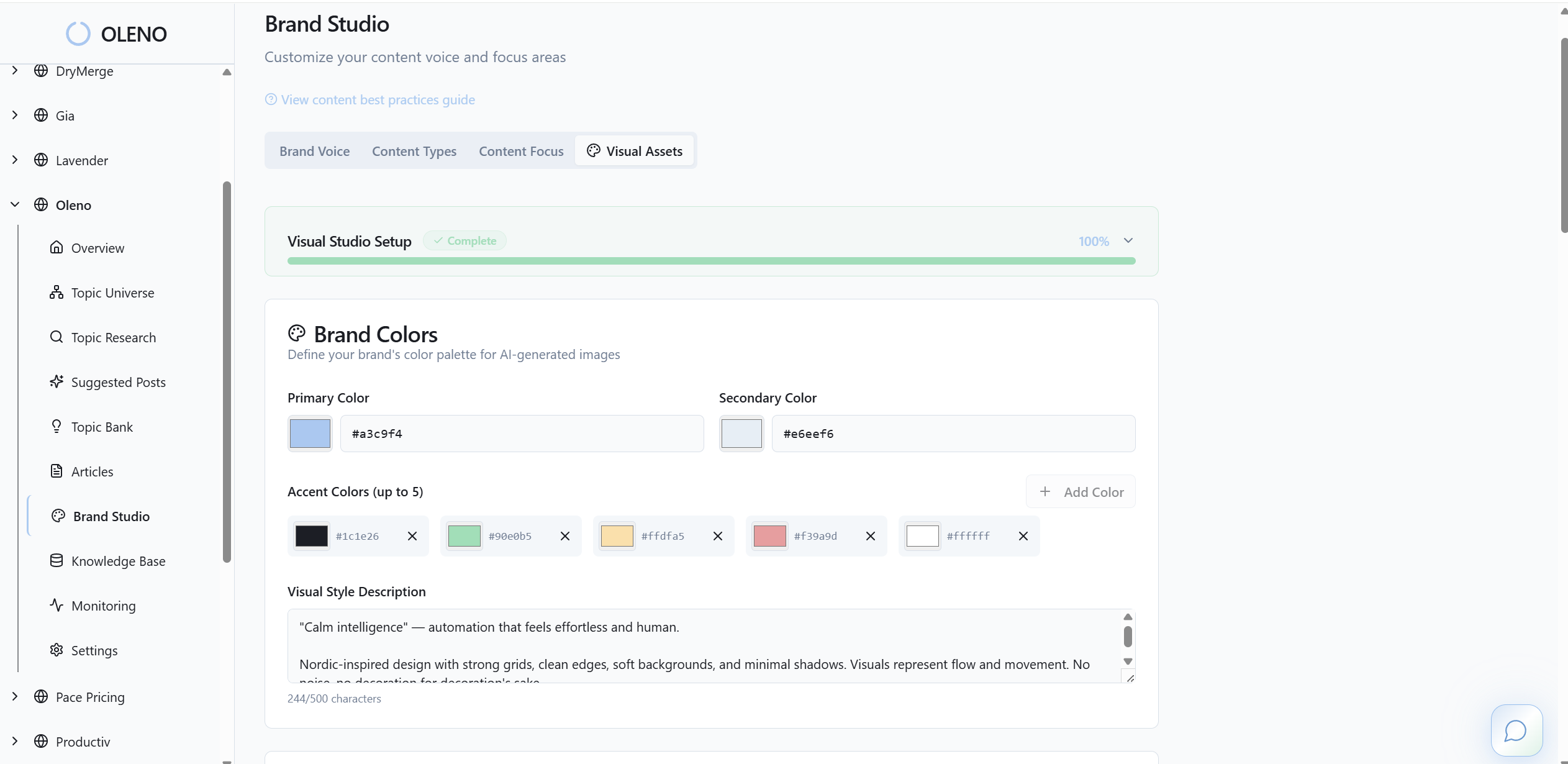
| Brand voice inputs | Brand kits and brand setup (as described in reviews/listings) (SaaSGenius Review) | Brand Studio enforces tone, phrasing, structure, banned terms |
| Knowledge grounding | Not clearly positioned as KB-grounded in public listings (Cyble Listing) | Knowledge Base grounding used throughout drafting and checks |
| Quality enforcement | Human review and workflows emphasized in suite model (Cyble Listing) | QA-Gate (85 minimum), auto-improve and re-test if failing |
| Topic selection | Suite positioning does not emphasize autonomous topic discovery (Blaze Homepage) | Topic discovery from sitemap and knowledge base |
| Differentiation controls | Not emphasized in available public sources (Cyble Listing) | Blocks low information gain topics, checks angle originality before drafting |
| Publishing | Scheduling and distribution positioned as core feature (Blaze Homepage) | Publishes to CMS via connectors, once configured |
| Scheduling | Native scheduling highlighted (Blaze Homepage) | Not the focus (publishing cadence driven by the pipeline) |
| Analytics | Analytics positioned as part of suite (Cyble Listing) | No analytics (by design) |
| Best for | Solopreneurs, small teams, agencies wanting one platform (Blaze Homepage) | Teams prioritizing consistent long-form publishing with minimal handoffs |
| Starting price | Reported ~$34/mo, free tier mentioned (verify current plans) (SaaSGenius Review) | from $449/mo |
| Scaling | Multiple plans, details vary by tier (SaaSGenius Review) | Up to $449/mo (Full-Funnel GEO) to $1,349/mo (Narrative Control), Enterprise for 11+ posts/day |
If you’re in evaluation mode and you want to see what autonomous publishing looks like in practice, you can Request a demo now. It’s usually the fastest way to know if the “publish-ready” bar matches your standards.
Getting Started
If you pick Blaze, your “getting started” work is usually about setup and workflow design. You’ll configure brand kits, decide which channels matter, and build a repeatable process for turning ideas into scheduled posts, emails, pages, whatever your mix is. That aligns with Blaze’s platform framing as an all-in-one suite (Blaze Homepage).
If you pick Oleno, the setup work is different. You’re configuring the system that will run content creation. That means getting your sitemap and knowledge base in shape, then letting the pipeline handle discovery, structure, QA, and publishing. Less daily effort, more upfront clarity.
One practical recommendation: don’t over-scope week one. Start with one content area where you already know what “good” looks like, then expand.
Conclusion: Picking The Right Tool Without Regretting It Later
If you want a broad marketing cockpit where you can generate lots of asset types, design them, schedule them, and track activity, Blaze makes sense as a suite-style option, and its reported entry pricing can be attractive for smaller teams (SaaSGenius Review). Just go in with your eyes open on plan differences and validate the long-form quality you need.
If your goal is simpler, publish high-quality long-form content consistently, without the constant coordination tax, Oleno is built for that narrower mission. It determines what to write, structures it before drafting, grounds it in your knowledge base, runs QA checks, then publishes to your CMS once configured.
If you’re leaning that direction and want to pressure-test the workflow, you can try using an autonomous content engine for always-on publishing. Or, if you just want the quickest possible start, Request a demo.
At the end of the day, pick the tool that matches your bottleneck. If the bottleneck is “we need a suite,” choose the suite. If the bottleneck is “we can’t ship long-form without a lot of human glue,” choose the system that removes the glue.
About Daniel Hebert
I'm the founder of Oleno, SalesMVP Lab, and yourLumira. Been working in B2B SaaS in both sales and marketing leadership for 13+ years. I specialize in building revenue engines from the ground up. Over the years, I've codified writing frameworks, which are now powering Oleno.
Frequently Asked Questions