Oleno vs Jasper: Complete Comparison Guide

If you’re comparing Oleno vs Jasper, you’re really choosing between two different philosophies: a governed content production system (Oleno) versus a flexible AI writing environment (Jasper). Both can produce good copy, but they behave very differently once you try to scale beyond a few pieces a week, involve more stakeholders, and ship content directly into your CMS.
I’ve been on both sides of this. When you’re small, you can brute force quality with a sharp editor and a couple of prompts. When you’re trying to publish 20, 50, 200 pages and keep voice consistent, facts correct, and approvals sane, the “just prompt it” approach starts to cost you.
Ready to get started? request a demo.
The Real Choice: A Governed Content System vs a Flexible AI Writer
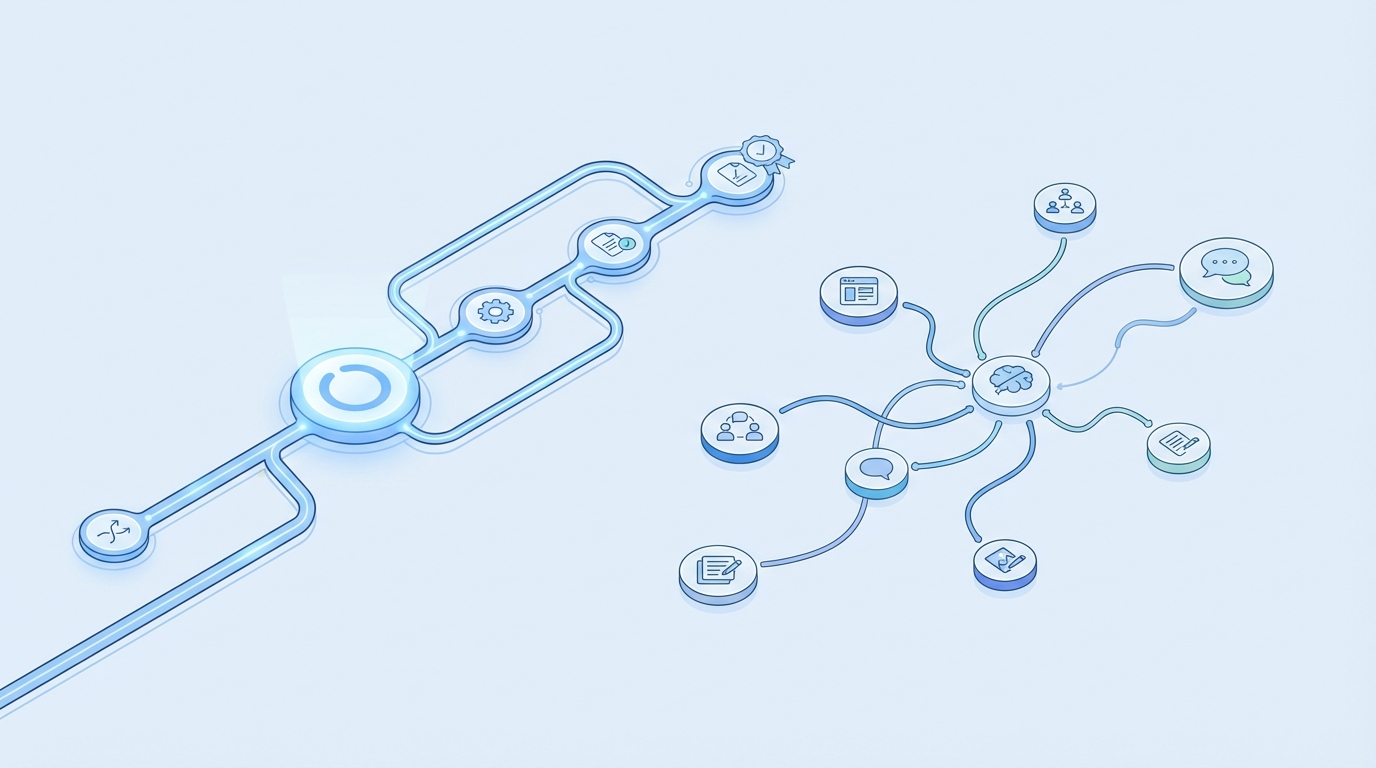
Oleno is built to run content like a production line with rules, QA, and publishing baked in, while Jasper is built to help teams create content flexibly with templates and collaborative editing. Jasper shines when you want a creative workspace that your team can shape around different campaigns and formats. Oleno shines when you want a repeatable pipeline that keeps quality stable at higher volume.
| Attribute | Oleno | Jasper |
|---|---|---|
| Who It’s For | Teams needing governed, on-brand, fact-grounded demand-gen at scale | Teams needing flexible, on-brand creation across many formats |
| Starting Price | from $449/mo (SEO + Social); $449/mo (Full-Funnel GEO); $1,349/mo (Narrative Control) | From ~$49/mo (Creator plan; see pricing page) (Jasper Pricing) |
| Primary Strength | Deterministic pipeline with QA Gate and Knowledge Archive grounding | Brand Voice controls with collaborative Canvas and 100+ templates (Jasper Canvas) |
| Biggest Trade-Off | Upfront configuration to encode governance and knowledge | Heavier reliance on manual review for factual accuracy and SEO research |
| Ideal Output Types | Programmatic SEO, comparisons, alternatives, best-of lists, long-form education | Blogs, ads, emails, social, landing copy, images; broad marketing collateral (Jasper) |
| Publishing Workflow | Idempotent direct CMS publishing (WordPress, Webflow, Storyblok, HubSpot, Framer) | Export/copy workflows; integrations vary by plan and setup (Jasper Pricing) |
Key Takeaways:
- Jasper is a strong pick if you want a flexible workspace with templates, Canvas collaboration, and brand voice features across many content formats.
- Oleno is built for governed demand-gen content at scale, with a deterministic pipeline and a QA Gate that blocks low-quality publishing.
- Jasper’s entry price is lower on paper (Creator from about $49/month), while Oleno’s pricing tracks output volume starting at from $449/month (Jasper Pricing).
- If review cycles and rework are already killing you, governance and pre-publish QA usually matter more than “can it write a nice paragraph.”
Why This Comparison Matters for B2B Marketing Teams
For B2B marketing teams, the real bottleneck usually isn’t writing, it’s coordination and risk. You need content that’s on-message, doesn’t hallucinate product details, and doesn’t turn every publish into a mini fire drill. Jasper and Oleno both touch content creation, but they reduce pain in different parts of the process.
Back when I was doing SEO seriously, the pattern was always the same. You can ship a few strong posts with hustle. Then you try to scale. Now you’re chasing approvals, rewriting sections because someone says “that’s not how our product works,” and your editorial calendar turns into a graveyard of half-finished drafts.
What to Evaluate Beyond Output Quality
Output quality is table stakes, but it’s not the deciding factor once content becomes part of revenue operations. A tool can write “good enough” copy and still be a bad fit if it creates hidden work downstream. That downstream work is where budgets quietly bleed.
What tends to matter more for B2B teams is the stuff nobody brags about in demos: how content gets grounded in real product truth, how QA happens before publishing, and whether the workflow keeps working when five people have opinions and two people have veto power.
A practical way to think about it is to ask: are you buying a writing surface, or are you buying a production system?
Here’s what I’d put on the checklist:
- How voice rules get enforced across many writers and many outputs
- How factual accuracy is handled when the model is “confidently wrong”
- How briefs get created and locked (or not)
- How QA is done and whether anything actually blocks publishing
- How content gets into your CMS without copy-paste chaos
Evaluation Criteria: Governance, QA, Publishing, and Scale
Governance is the difference between “we can generate content” and “we can ship content every week without surprises.” In Jasper, governance is mostly a set of features you apply during creation, like Brand Voice, templates, and shared assets (Jasper Brand Voice (BrandIQ)). In Oleno, governance is the starting point, you encode rules once and every job runs through the same controlled pipeline.
QA is similar. Jasper can absolutely produce high quality work, but the tool doesn’t force a release gate by default. It’s up to your team to do the right checks every time. Some teams are disciplined. Lots aren’t. That’s not a moral judgment, it’s just what happens when the quarter gets busy.
Publishing and scale are where the gap usually becomes obvious. Copying drafts between tools works fine until you’re doing it daily. Then you start missing steps. Or publishing duplicates. Or forgetting to update a comparison page from three months ago.
Feature-by-Feature: Oleno vs Jasper
Oleno is oriented around a deterministic pipeline with governance and QA, while Jasper is oriented around flexible creation with templates and a collaborative Canvas. Jasper has clear, documented strengths in brand voice tooling and collaboration features like Canvas (Jasper Canvas). Oleno’s differentiation is that it’s designed to keep output consistent and publishable at scale, with fewer “human memory” steps.
Brand Voice and Governance Controls
Jasper’s Brand Voice (BrandIQ) is designed to help teams keep tone and messaging consistent by training on brand context and applying it during generation (Jasper Brand Voice (BrandIQ)). If you’ve got multiple marketers producing content in parallel, this matters. It’s one of Jasper’s strongest positioning points, and it’s a real feature, not hand-wavy.
The catch is that brand voice alone doesn’t solve governance. Governance is broader than tone. It’s also product claims, “what we can and can’t say,” approved comparisons, legal constraints, and the stuff that gets you yelled at by Product or Compliance. In Jasper, you can support that with process and templates, but your team still owns enforcement.
Oleno approaches this differently. The expectation is you encode Brand, Marketing, and Product rules once (Studios), and those rules are applied across the pipeline consistently. That’s less flexible, but it’s also less reliant on everyone remembering the rules on a Wednesday night at 11 pm.
If you’re asking, “Which one is better,” I won’t play that game. It depends what you’re optimizing for. Flexibility or control.
Knowledge Grounding and Accuracy
Jasper supports bringing in context through brand assets and brand voice inputs, and teams often use those to steer outputs toward what’s true and usable (Jasper Brand Voice (BrandIQ)). But Jasper is still a flexible environment. You can absolutely produce grounded work, you just need a tight workflow and editors who know what to check.
This is where a lot of B2B teams feel pain. Not because Jasper is doing something wrong, but because language models are probabilistic and can be wrong in a way that looks convincing. When you’re writing about your own product, or a competitor, a small factual miss turns into rework, delays, and sometimes a public correction.
Oleno leans into grounding by design, via its Knowledge Archive and QA Gate approach. The idea is you treat your docs, help content, playbooks, and proof as the source of truth, then enforce checks before anything ships.
That kind of setup takes work up front. No way around it. But it’s the difference between “we caught it in review” and “we prevented it from ever being drafted that way.”
Programmatic SEO and Comparison Content
Jasper can generate comparison and alternative pages like “X vs Y” using templates and Canvas workflows, and teams do this all the time (Jasper). It’s fast, and if you’ve got an SEO who knows what they’re doing, you can build a solid production rhythm.
Where Jasper is less explicit is in making programmatic SEO a first-class workflow with enforced QA and publishing gates. It’s more like a marketing platform that you can adapt. That’s a strength for a lot of teams, especially if you’re producing more than SEO blog posts.
Oleno’s focus is narrower: long-form demand-gen and SEO content, including comparisons, alternatives, and best-of pages. The platform is built around taking those job types and producing them consistently, at volume, with governance controls and direct CMS publishing.
A quick gut-check question: are you trying to become a content machine for high intent organic acquisition pages, or are you trying to support the entire marketing org’s content needs? That answer usually points you to the right tool.
Oleno vs Jasper Pricing and Total Cost of Ownership
Jasper’s entry pricing is lower than Oleno’s, with a Creator plan advertised from about $49/month, while Oleno starts at from $449/month for 1 post per day. Jasper’s pricing details and tiers change over time, so you should verify on the official pricing page before you decide (Jasper Pricing). The bigger story is total cost of ownership, which includes the review cycles and operational overhead you pay every month.
Subscription Costs vs Time-to-Ship
Jasper’s pricing is widely summarized by third parties and aligns with the idea that the Creator plan starts around $49/month, with higher tiers for teams and advanced features (Wise – Jasper Pricing Overview; Samantha North – Jasper Pricing Review). That lower entry point is attractive, especially if you’re a smaller team or you want to test quickly.
Oleno’s pricing is output-based. The entry tier is from $449/month for 1 post per day, scaling up to $449/mo (Full-Funnel GEO) to $1,349/mo (Narrative Control)nth for 10 posts per day, with Enterprise beyond that. It’s a different model. You’re paying for throughput in a governed system, not seats and word counts.
The real question is time-to-ship. If Jasper produces a draft in minutes but your team spends two hours fact-checking and rewriting, your “cheap plan” gets expensive in human time. If Oleno requires upfront configuration but reduces review overhead later, it can be cheaper in practice for teams publishing at high volume.
I’ve seen both outcomes. Teams underestimate the review tax. Almost every time.
Hidden Review and Rework Costs
Most teams don’t budget for rework, they just absorb it. That’s why content feels like a treadmill. The writer ships a draft. The editor fixes voice. The PMM corrects product claims. Someone asks for “a more confident tone.” Then the SEO wants it restructured. Then you publish two weeks late.
Jasper doesn’t create that problem, but it also doesn’t eliminate it by default. It gives you a strong creation surface with brand controls and collaboration features (Jasper Canvas). Your process determines how much rework you incur.
Oleno’s bet is that if you govern inputs, enforce QA checks, and standardize the pipeline, you reduce the amount of downstream cleanup. You still need humans. You just stop paying humans to fix the same class of problems over and over.
If you’re trying to justify spend to a VP Marketing or CMO, that’s usually the framing that lands. Not “how many words can it write,” but “how many cycles did we kill.”
Quality, Governance, and Risk Management
If you’re in a B2B SaaS org, governance isn’t some abstract “nice to have,” it’s risk management. Jasper gives you controls like Brand Voice and shared assets to steer quality (Jasper Brand Voice (BrandIQ)). Oleno is designed to enforce a release gate, which is a different level of control when you care about factual accuracy and consistent product claims.
QA Checkpoints and Release Gates
Jasper can fit into a rigorous QA process, especially if you already have one. The tool gives you a workspace. You can build checklists. You can do approvals. You can use Canvas to collaborate (Jasper Canvas). But it’s still your process doing the heavy lifting.
That’s fine for plenty of teams. Some teams want that flexibility. Critics of governed systems aren’t entirely wrong when they say, “I don’t want another rigid process.”
The problem is enforcement. When the process lives in people’s heads and Notion pages, it gets skipped. That’s when you ship the wrong claim, or publish an outdated comparison, or accidentally overpromise. Those mistakes don’t always explode, but they erode trust.
Oleno’s approach is to treat QA as a gate. If checks fail, publishing doesn’t happen. That’s the whole point. It’s boring. And boring is good when your brand is on the line.
Integrations and Workflow Fit
Oleno is optimized around direct CMS publishing and a production pipeline, while Jasper is optimized around creation workflows that can integrate via higher-tier plans and team processes. Jasper’s site and pricing indicate that plan level affects what you can do, so you need to map your desired workflow to the right tier (Jasper Pricing). The deciding factor is usually where you want work to happen, inside the tool or in your existing stack.

CMS Publishing and Distribution Workflows
A lot of teams still treat publishing as “copy it into the CMS and format it later.” That works. Until it doesn’t.
Jasper’s common workflow is drafting in Jasper, collaborating in Canvas, then exporting or copying into your CMS, and letting the CMS be the final step (Jasper Canvas). This is totally reasonable if your editorial volume is moderate and your team has clean handoffs.
Oleno is built around publishing as part of the system. It supports direct, idempotent publishing to CMS platforms like WordPress, Webflow, Storyblok, HubSpot, and Framer. The idempotent part matters more than it sounds. It prevents duplicates and weird publish-state bugs when you’re doing this daily.
Distribution is similar. Jasper can help you create repurposed assets, and it also has Jasper Art for image generation (Jasper Art). Oleno’s repurposing approach is more rules-based and cadence-driven, meant to systematize how one piece turns into multiple channel outputs.
Which is “better” depends on your org. If you want a marketing creative suite, Jasper’s breadth can be a real advantage. If you want a factory for governed demand-gen content, the pipeline approach will feel more natural.
Who Should Choose Oleno vs Jasper
Oleno tends to fit teams that want control, repeatability, and a system that enforces publishing quality, while Jasper tends to fit teams that value flexibility, collaboration, and lots of templates across different content types. This isn’t about one being “stronger,” it’s about which trade-off you can live with. I’d decide based on your current bottleneck, not based on feature checklists.
Signals You’re a Fit for Oleno
If you’re feeling the pain of scale, you’ll recognize the signs pretty quickly. You have content demand from SEO, demand gen, product marketing, and sales enablement, but a small team can’t keep up. Or you can keep up, but quality slips and the rework is brutal.
You also probably have a governance problem disguised as a writing problem. Voice consistency isn’t stable. Product truth isn’t consistently enforced. And competitive pages age like milk.
Signals that point toward Oleno:
- You publish frequently (or want to) and manual review is the bottleneck
- You care about governed claims, not just tone and style
- You want comparisons, alternatives, and best-of pages produced in a repeatable way
- You want publishing handled as part of the workflow, not as a manual afterthought
- You’re willing to do upfront configuration to encode how your brand should write
Signals You’re a Fit for Jasper
Jasper is a very reasonable choice if your team wants a flexible creation environment that supports lots of formats and collaboration. If you’re producing ads, emails, landing pages, blog posts, and social, Jasper’s template-first approach is built for that breadth (Jasper).
Jasper also makes a lot of sense if your team already has strong editorial discipline. If you trust your review process and you want a tool that accelerates draft creation without dictating your entire pipeline, Jasper’s flexibility is a feature, not a bug.
Signals that point toward Jasper:
- You need lots of different marketing formats, not primarily long-form SEO pages
- You want a collaborative writing surface (Canvas) for teams and stakeholders (Jasper Canvas)
- You want brand voice support but prefer to enforce governance via process (Jasper Brand Voice (BrandIQ))
- You’re okay with export/copy workflows into your CMS if it keeps your process flexible
- You want image generation inside the same tool (Jasper Art) (Jasper Art)
Jasper at a Glance
Jasper is a flexible AI marketing platform centered on templates, collaboration, and brand voice controls, and it’s priced starting around $49/month for its Creator plan. It’s positioned for teams that need fast content creation across many formats, not just SEO articles. The combination of Canvas, Brand Voice (BrandIQ), and Jasper Art makes it feel like a creative workspace rather than a strict production pipeline (Jasper Pricing).
Jasper’s strengths are pretty straightforward once you use it for real work. Templates reduce blank-page time. Canvas gives you a shared space to plan and refine. Brand Voice helps keep things on-message. That’s why Jasper shows up in so many “what should I buy” lists.
It’s also why teams sometimes get surprised later. Flexibility pushes governance onto humans. And humans get tired.
Jasper’s strengths (with sources)
Jasper publicly positions and documents several core capabilities that B2B teams consistently look for:
- Brand voice training and controls through Brand Voice (BrandIQ) (Jasper Brand Voice (BrandIQ))
- Collaborative creation inside Canvas (Jasper Canvas)
- A large library of templates and team-oriented plans (Jasper Pricing)
- Image generation via Jasper Art (Jasper Art)
- General AI content generation positioning on Jasper’s own site (Jasper)
Jasper’s limitations (in practice)
A fair limitation isn’t “Jasper is bad at X,” it’s “Jasper requires you to solve X with workflow and discipline.”
In most orgs:
- Fact-checking and product-claim verification still happens in manual editorial review, because the tool doesn’t enforce a deterministic release gate by default.
- SEO research and technical SEO workflows often live in other tools, because Jasper is a marketing creation platform, not a specialized SEO research suite.
- Governance depends on how you configure Brand Voice, templates, and team process, which can drift over time if nobody owns it.
How Oleno is Different: Jasper gives you a flexible environment to create on-brand content, then your team enforces governance through process. Oleno flips that, you encode Brand, Marketing, and Product rules up front, run every job through a deterministic pipeline, and a QA Gate blocks publishing until checks pass against your Knowledge Archive.
Feature-by-Feature: Oleno vs Jasper (Comprehensive Grid)
Oleno and Jasper overlap on “can it generate marketing content,” but they diverge on governance, QA enforcement, and production workflow. Jasper documents features like Brand Voice, Canvas, and Jasper Art, which support flexible creation across formats (Jasper Brand Voice (BrandIQ); Jasper Canvas; Jasper Art). Oleno is built as a governed demand-gen system, so the comparison comes down to how much you want the tool to enforce versus how much you want your team to manage.
| Capability | Oleno | Jasper | Notes / Source |
|---|---|---|---|
| Governance (Voice, Messaging, Product Claims) | Brand, Marketing, Product Studios apply rules platform-wide | Brand Voice (BrandIQ) trains style and tone | Jasper Brand Voice (Jasper Brand Voice (BrandIQ)) |
| Knowledge Grounding | Knowledge Archive for docs, help, playbooks, customer proof | Custom knowledge and context via brand voice training and assets | Jasper product positioning (Jasper) |
| Deterministic Pipeline | Discover → Angle → Brief → Draft → QA → Enhance → Visuals → Publish | Flexible Canvas, templates, and agents; process defined by team | Jasper Canvas (Jasper Canvas) |
| QA Before Publishing | QA Gate blocks release until checks pass (voice, grounding, clarity, SEO/LLM) | Manual review best practice; no enforced release gate by default | Jasper workflow depends on team setup |
| Programmatic SEO | SEO Studio with topic discovery, locked briefs, scheduled publishing | Available via templates/workflows; not positioned as programmatic SEO first | Jasper positioning (Jasper) |
| Competitive Content Jobs | Competitive Studio for X vs Y, alternatives, best-of with fairness & safety rules | Can create such content via templates/Canvas; governance depends on team setup | Jasper templates and Canvas (Jasper Canvas) |
| CMS Publishing | Direct, idempotent publishing to major CMSs | Export/copy, integrations vary by plan | Plan details (Jasper Pricing) |
| Images and Visuals | Design Studio rules; brand-consistent generated visuals | Jasper Art image generation | Jasper Art (Jasper Art) |
| Audience/Persona Targeting | Audiences, Personas, Use Cases drive variation and content angle | Brand Voice + templates; persona targeting via prompts/process | Jasper Brand Voice (Jasper Brand Voice (BrandIQ)) |
| Distribution & Repurposing | Repurpose across channels with formatting, cadence, reuse rules | Repurpose via templates/agents; team-defined workflows | Jasper positioning (Jasper) |
| Measurement & System Health | Tracks output volume, cadence, quality trends, failure patterns | Performance tracking depends on connected tools/workflows | Jasper positioning (Jasper) |
| Pricing Model | Three tiers: $449/mo (SEO + Social), $449/mo (Full-Funnel GEO), $1,349/mo (Narrative Control) | Subscription tiers; Creator from about $49/mo | Jasper pricing (Jasper Pricing) |
| Team Collaboration | Agency multi-client mgmt; roles; shared templates and rules | Seats/roles and shared assets; team features by plan | Jasper tiers (Jasper Pricing) |
| Best For | B2B teams needing repeatable, on-brand, fact-grounded output at scale | Teams wanting flexible, fast creation with strong voice controls | Fit summary based on documented positioning |
Why Oleno for Governed Demand Generation
Oleno is the better fit when your goal is governed demand generation at scale, meaning your content needs to be on-brand, grounded in real product truth, QA’d before publishing, and shipped into your CMS without a bunch of manual steps. Jasper can absolutely support demand gen content, but it’s a flexible creation environment, so governance lives in your process instead of being enforced by the system. A simple example is comparisons and alternatives: those pages create real risk if you publish inaccuracies, and that risk grows with volume.
This is basically how Oleno happened. I built a B2C app, tried to do SEO/GEO the “normal” way with a bunch of GPTs, and I was spending 3 to 4 hours a day prompting, copy-pasting, formatting, publishing. Total waste of time. So I hard-coded an autonomous engine into my CMS to queue topics, write, QA, then post. It started indexing fast, started getting traffic, and it kept working without me babysitting it.
Oleno takes that same production mindset and turns it into something B2B teams can use. The parts that matter, in practice:
- The Studios (Brand, Marketing, Product, SEO, Competitive) act as governance. You set rules once, then stop re-teaching the tool every time.
- The Knowledge Archive is where you put your truth, docs, help center content, proof, the stuff you actually want the model to stick to.
- The deterministic pipeline runs the same way every time, Discover to publish, so you don’t end up with five different “writer processes” inside one team.
- The QA Gate blocks publishing until checks pass, which is the difference between “we hope this is right” and “this won’t ship if it’s wrong.”
Want to see what that looks like with your own CMS and content goals? request a demo and we’ll walk through your current workflow, then map where governance and QA would remove the most rework.
Conclusion and Next Steps
Oleno vs Jasper isn’t a “which AI writes nicer” comparison, it’s a workflow decision. Jasper is a strong choice if you want a flexible content creation environment with templates, Canvas collaboration, and brand voice features across formats (Jasper Canvas; Jasper Brand Voice (BrandIQ)). Oleno is a strong choice if you want a governed production system that standardizes how content gets created, checked, and published at volume.
If you’re still unsure, do this exercise. No spreadsheets required. Just be honest.
- Count how many pieces you want to publish per month.
- Estimate how many hours of review and rework you’re currently paying for.
- Ask whether your quality problems are “writing” problems or “governance” problems.
- Decide whether you want flexibility or enforcement as the default.
If you’re leaning toward a governed system and you want to see whether Oleno matches your reality, book a demo. We’ll talk through what you publish, how your approvals work, and where the current process is quietly costing you time.
If you’re leaning toward Jasper, validate the tier you’d need, validate how Brand Voice would be configured, and make sure you’re comfortable owning governance in process. For some teams, that’s exactly the right call.
Either way, pick the system you can actually run every week. That’s the whole game.
About Daniel Hebert
I'm the founder of Oleno, SalesMVP Lab, and yourLumira. Been working in B2B SaaS in both sales and marketing leadership for 13+ years. I specialize in building revenue engines from the ground up. Over the years, I've codified writing frameworks, which are now powering Oleno.
Frequently Asked Questions