Optimizing Content Workflow Automation for Better Results

72 hours a month. That’s what a lot of Heads of Content quietly lose to briefing, reviewing, rewriting, and fixing content that should have been right the first time. If you’re trying to figure out optimizing content workflow automation, there’s a good chance your real problem isn’t speed. It’s the pile of context that breaks somewhere between strategy and draft.
I’ve seen this a bunch of times. A team grows, more people touch content, and somehow output should go up. But what usually happens is the opposite. More handoffs. More edits. More drift. More meetings about why the thing “doesn’t sound like us.”
Key Takeaways:
- Optimizing content workflow automation starts with reducing handoffs, not adding more prompts
- If review cycles hit 3 or more rounds per article, you have a governance problem, not a writing problem
- The Strategy-Execution Gap and the Quality-Trust Gap are the two bottlenecks that break scaling teams
- Good content systems encode audience, voice, product truth, and use cases before draft generation
- A simple 3-layer model works best: governance, execution, and operations
- In GEO, consistency across 100 pages beats random quality across 20 pages
- The fastest path is not “more AI.” It’s governed automation with clear review thresholds
A lot of teams start by trying to fix this with a better writer, a better agency, or a better prompt stack. Fair point. That can buy you a little time. If you want to see what a system-first approach looks like in practice, you can request a demo.
Why Content Workflow Automation Usually Breaks as Teams Scale
Optimizing content workflow automation breaks when more contributors are added without a shared system for voice, product truth, and editorial judgment. The symptom looks like slow production. The cause is fragmented execution. That distinction matters because it changes what you fix first.

More contributors usually means more context loss
Back in 2012-2016, I ran a digital marketing site that hit 120k unique visitors a month. We had 80 regular contributors and 300+ guest contributors. That worked because we had both breadth and depth, and we saw traffic spikes at 500 pages, 1000, 2500, 5000, then 10000. Volume mattered. But quality mattered just as much.
That’s the part people miss. They see the volume and think the lesson is “publish more.” It isn’t. The lesson is that volume only compounds when the system can hold quality steady. Without that, extra contributors don’t create leverage. They create noise.
And this shows up fast in scaling SaaS teams. A Head of Content brings in a freelancer, then a PMM adds edits, then demand gen wants a different angle, then leadership says the positioning feels off. Four people touched the draft. Nobody actually owns the narrative system. That’s where optimizing content workflow automation usually goes wrong.
The bottleneck isn’t writing, it’s translation loss
At PostBeyond, I could write 3-4 solid posts a week because I had all the context in my head. Then the team grew. The writer didn’t have the same product depth or customer nuance, so output got slower and weaker at the same time. And I had less time to jump in because I was in meetings, managing, doing executive stuff.
That’s the trap. People call it a writing problem. It’s really a translation problem.
I use a simple threshold here. If one strategic idea has to be translated through more than 2 human handoffs before it becomes a draft, quality drops hard. Deck to brief to writer to editor to exec is too many jumps. Every jump strips away intent, tone, and buyer nuance.
Honestly, this is the exhausting part. Not the writing itself. It’s opening a doc and realizing you’re on revision four, and somehow the piece is getting safer instead of better.
AI made drafting faster, but trust got worse
AI tools changed the speed of drafting. They didn’t solve trust. In a lot of teams, they made the trust problem more visible.
You can get text in five minutes. Great. But if that text is generic, slightly wrong, off-voice, or disconnected from product reality, the editing tax eats the gain. A practical benchmark: if AI saves 60 minutes on drafting but creates 45+ minutes of review and rewrite, your workflow automation isn’t actually optimized. It’s just moving labor downstream.
There’s good research behind the need for structured, clear systems too. Google’s own guidance on creating people-first content keeps coming back to expertise, originality, and trust signals, not just output volume, Google Search guidance. Same story with how search engines and AI systems use structured, trustworthy information, Google Search Central on structured data.
That’s the pivot. If the old way creates more drafts but less trust, what does a better system actually look like?
The Real Problem Behind Broken Content Automation
The real problem behind broken content automation is not weak tooling. It’s missing governance. When strategy lives in decks and product truth lives in people’s heads, every draft starts half-blind. That’s why teams feel busy but still miss consistency.
The Strategy-Execution Gap is what kills consistency
A lot of leadership teams think they’ve done the hard part because positioning exists somewhere. There’s a messaging doc. Maybe a brand deck. Maybe a sales narrative in Notion. Maybe some call recordings. It’s all there. Sort of.
But strategy sitting in documents is not execution. That’s a very different thing. If your writer, freelancer, PMM, or AI tool has to guess how to apply that strategy in the moment, then the strategy is not operational. It’s reference material.
I think of this as the 3-layer disconnect. Layer 1 is leadership intent. Layer 2 is the brief or instruction set. Layer 3 is the final draft. If drift happens at any layer, the output misses. If you want a rule: when your team says “we already have messaging” but still rewrites intros, positioning, and CTAs every week, the Strategy-Execution Gap is live.
The Quality-Trust Gap is why review cycles multiply
You can’t optimize content workflow automation if nobody trusts the first draft. That sounds obvious, but it’s where most systems fail.
A Head of Content usually feels this first. Monday morning, they open a draft from a writer or AI tool. The structure is decent. But the product framing is a little fuzzy. The buyer pain is too generic. The tone is close, but not close enough. So they fix it. Then PMM fixes it again. Then leadership tweaks the story. This happens article after article, week after week.
The metric I like here is Review Loop Count. If your average piece needs 3+ meaningful review rounds, you don’t have an automation win. You have a confidence deficit. And confidence deficits create queue backups.
Some teams prefer heavy review because they think it protects quality, and that’s valid up to a point. But after round three, review is rarely improving strategy. It’s compensating for missing inputs.
GEO rewards the teams that stay consistent at scale
SEO used to let you get away with more tactical content. GEO is less forgiving. LLMs don’t just look for a page that mentions the keyword. They look for brands that repeatedly express a clear point of view, clear product definitions, and clear audience framing across a lot of content.
That’s why consistency now matters more than random spikes of brilliance. A content program is a lot like a sales team message. If every rep explains the product differently, the market never gets a stable picture. Same thing here. If every article sounds like a different company, you won’t build authority that compounds.
There’s a strong case to be made for manual craftsmanship on every big piece. I get it. For flagship articles, that still makes sense. But for ongoing demand gen, you need a system that can repeat the right truths without drifting. Otherwise, your content engine is really just a rewrite factory.
So if fragmented execution is the disease, the next question is simple: what does healthy content workflow automation actually require?
A Better System for Optimizing Content Workflow Automation
Optimizing content workflow automation works when governance is decided once, execution runs inside those rules, and operations keep the machine moving. That’s the system. Not prompts. Not random freelancers. Not one heroic editor holding the whole thing together.
Start with the 3-Layer Control Model
The cleanest model I’ve seen is what I call the 3-Layer Control Model: Governance, Execution, Operations. If one of those layers is weak, the workflow starts leaking quality.
Governance is where you define voice, category framing, product truth, audiences, personas, and use cases. Execution is where briefs and drafts get produced. Operations is where scheduling, QA, refreshes, and reporting happen. Simple. But not easy.
Most teams collapse all three into one messy loop. Somebody writes a prompt, gets a draft, edits it, then asks what should come next. That’s not optimizing content workflow automation. That’s improvising every step. If governance isn’t explicit before execution begins, then operations just moves bad assumptions faster.
Diagnose your current maturity before you automate more
Before adding more automation, you need to know what kind of problem you actually have. I’d use a quick red-flag checklist here.
Ask yourself:
- Do most drafts need repositioning, not just editing?
- Are PMMs or founders rewriting product sections every week?
- Do different contributors describe the same feature in different ways?
- Are briefs inconsistent depending on who created them?
- Does your content sound strong in some posts and bland in others?
If you answered yes to 3 or more, you’re in what I’d call Stage 2 Chaos. That means you have output capacity, but no stable system behind it. Stage 1 is underproduction. Stage 2 is inconsistent production. Stage 3 is governed scale. And the move from Stage 2 to Stage 3 is where most value sits.
We were surprised by how often teams think they’re stuck in Stage 1. They’re not. They can produce. They just can’t produce reliably.
Encode audience and use case before you touch the draft
One big mistake is treating every topic like it has one obvious angle. It doesn’t. The same topic should land differently for a Head of Content, a VP Marketing, and a founder. Same goes for different use cases.
That’s why I like the Audience-Use Case Matrix. For every topic, define who the piece is for and what job they’re trying to get done. If the audience is a Head of Content at a scaling SaaS company, the pain is rework tax, contributor alignment, and quality control. If the use case is brand voice governance, the outcome is fewer rewrites and fewer factual misses. That should shape examples, language, objections, and CTA logic.
If you skip this step, the draft defaults to generic. Always. The conditional rule is simple: if a piece could be sent to three different personas without changing anything, it’s too vague to perform. This is where most “content workflow automation” efforts quietly fail, because they automate format before they automate relevance.
Build a review system with hard thresholds
Review needs rules. Otherwise, every piece becomes a negotiation.
I’d use the 1-2-3 Review Rule. One pass for structure and clarity. Second pass for strategic accuracy. Third pass only if the article crosses a factual or positioning line. If you’re doing four or five rounds, something upstream is broken. Usually inputs. Sometimes ownership. Often both.
This matters because open-ended review creates a weird culture tax. Writers get tentative. Editors get overloaded. Leaders start feeling like they have to touch everything. Then nobody trusts the machine.
A mid-market SaaS team I’ve seen this with had strong writers and solid traffic, but content was too detached from the solution. They ranked well, but it didn’t support demand gen. That’s a useful caution. Even good content can miss if the narrative doesn’t point anywhere. Review shouldn’t just ask “is this good?” It should ask “does this connect the problem to our solution category in a credible way?”
Treat content like a catalog, not a campaign
This one is underrated. A lot of teams still think article by article. That’s too small.
When we scaled that earlier site, the gains came from catalog depth. Most pages got under 100 views a month. Didn’t matter. The catalog as a whole created authority and long-tail reach. That same principle matters now, maybe more. GEO doesn’t just reward one great page. It rewards a body of work that sounds coherent.
So the system has to think in coverage, not isolated wins. You need topic breadth, yes. But also narrative consistency across that breadth. I’d argue this is the hidden connection between editorial ops and GEO performance: a stable content catalog is not just easier to manage, it’s easier for AI systems to trust.
That’s why optimizing content workflow automation isn’t only about shaving time per draft. It’s about building a catalog that compounds. If you want to see what that kind of governed pipeline looks like, you can request a demo.
Separate workflow automation from the rest of the stack
Worth saying clearly: content workflow automation is not your whole marketing system. It’s one layer.
You still need keyword research to validate demand. You still need technical SEO so pages get crawled and rendered properly. You still need analytics to know what converts. And you may still need paid, email, PR, or social teams to distribute what gets created. Content production is the engine block, not the entire car.
That said, if the engine block is broken, the rest doesn’t matter much. A smooth analytics setup won’t rescue inconsistent content. A great SEO lead won’t fix a narrative that changes every week. Get the production system right first. Then the rest of the stack has something worth amplifying.
How Oleno Turns Content Workflow Automation Into a System
Oleno turns optimizing content workflow automation into a governed system by separating what should be true from what gets produced each week. That matters because most teams don’t need more text. They need fewer rewrites, fewer context gaps, and more reliable output from the same team.
Governance first, so the draft starts with context
Oleno starts with governance, not generation. Brand Studio defines how the content should sound. Marketing Studio defines the market point of view, key messages, and category framing. Product Studio keeps product descriptions and boundaries accurate. Audience & Persona Targeting shapes the piece for the right buyer, and Use Case Studio keeps examples tied to real workflows.
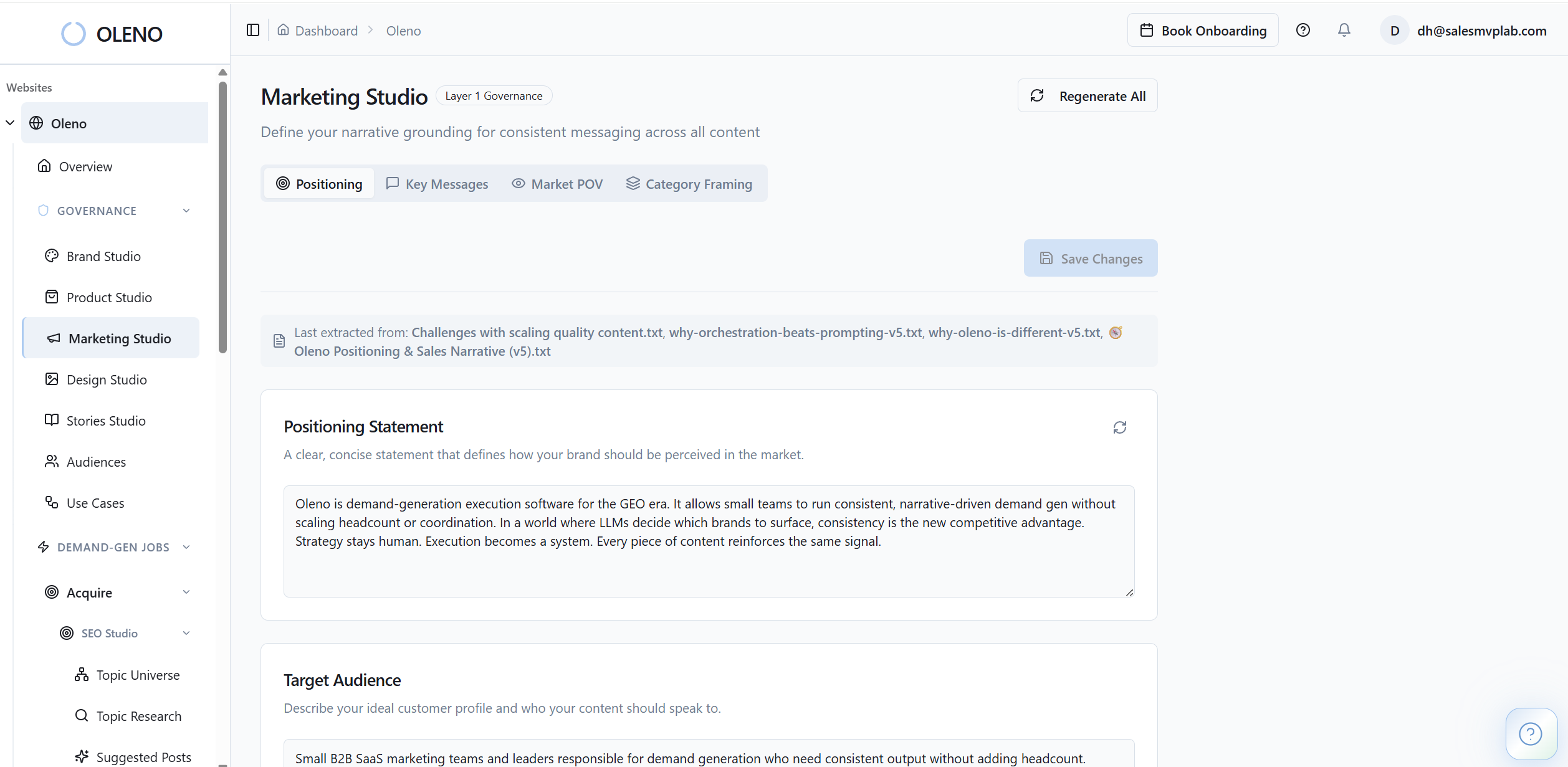
That changes the first draft in a big way. Instead of handing a writer or AI tool a loose prompt and hoping they interpret the strategy correctly, Oleno loads that context into the brief and draft stages. The practical benefit is obvious: fewer “this doesn’t sound like us” edits and fewer factual rewrites from PMM or leadership. Product Studio is especially important here because it acts like a product truth boundary. If your current automation setup invents details or drifts on claims, that’s where trust collapses.
The pipeline runs continuously, not article by article
Programmatic SEO Studio creates acquisition content at scale, and the Orchestrator runs the pipeline on a regular cycle by selecting approved topics and pushing them through the blueprint. That means teams aren’t manually rebuilding the same workflow every week. Storyboard adds planning discipline by allocating coverage across audiences, personas, products, and use cases, which is how content stops feeling random.
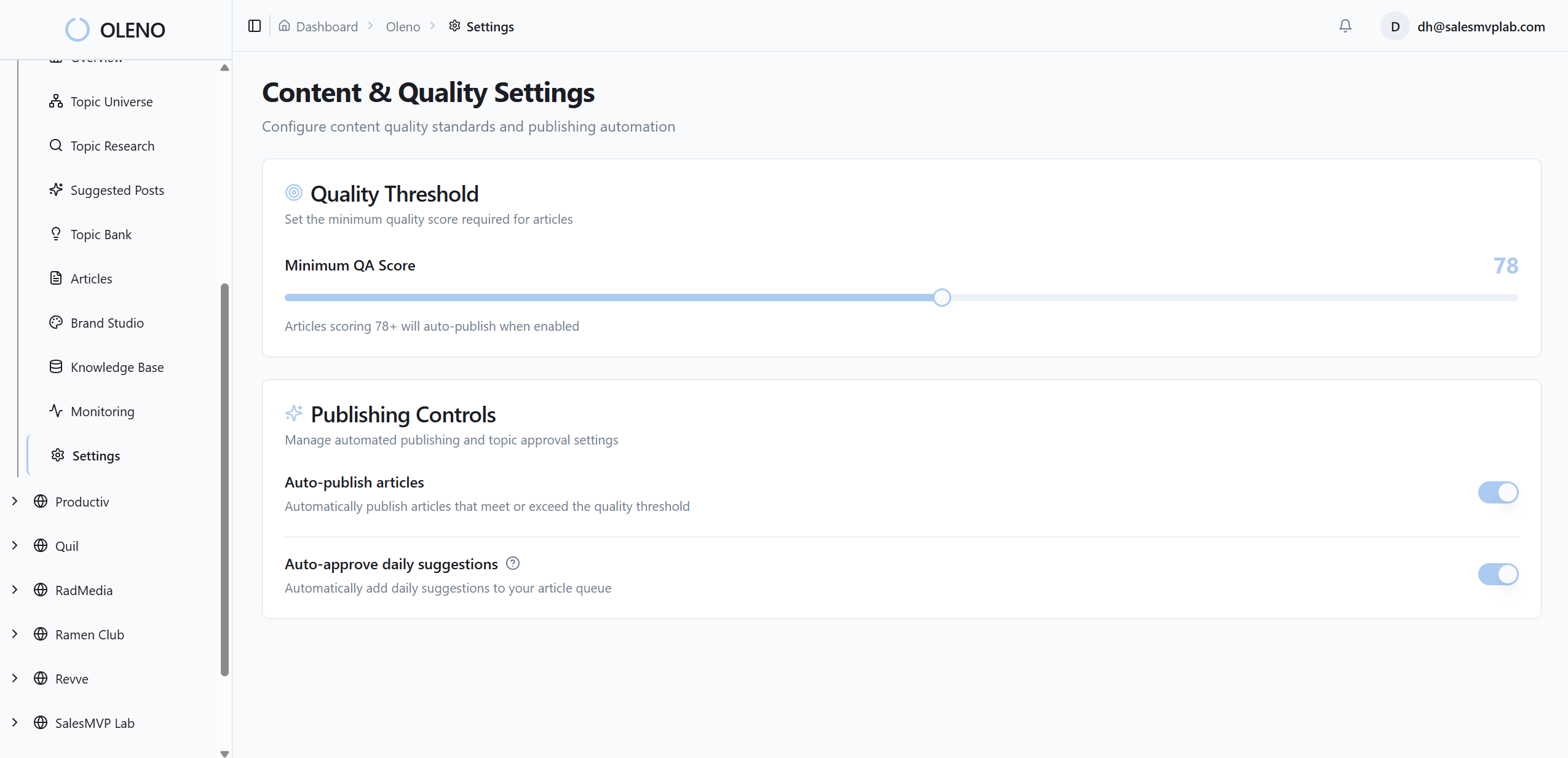
Then Quality Gate checks the output through 80+ automated checks for voice, structure, grounding, and quality thresholds before it reaches review. If it doesn’t pass, it gets revised or blocked. I like this a lot because it flips the normal review model. Instead of humans catching every issue manually, the system screens for the obvious misses first. That’s how you reduce the editing tax without lowering the bar.
This is also where the headcount argument gets real. If your team is spending hours every week briefing, reviewing, coordinating, and fixing drift, Oleno is replacing a chunk of that invisible labor. Not strategy. Not judgment. The operational load around execution.
It keeps the catalog clean over time
Publishing is only half the job. Drift is the other half.
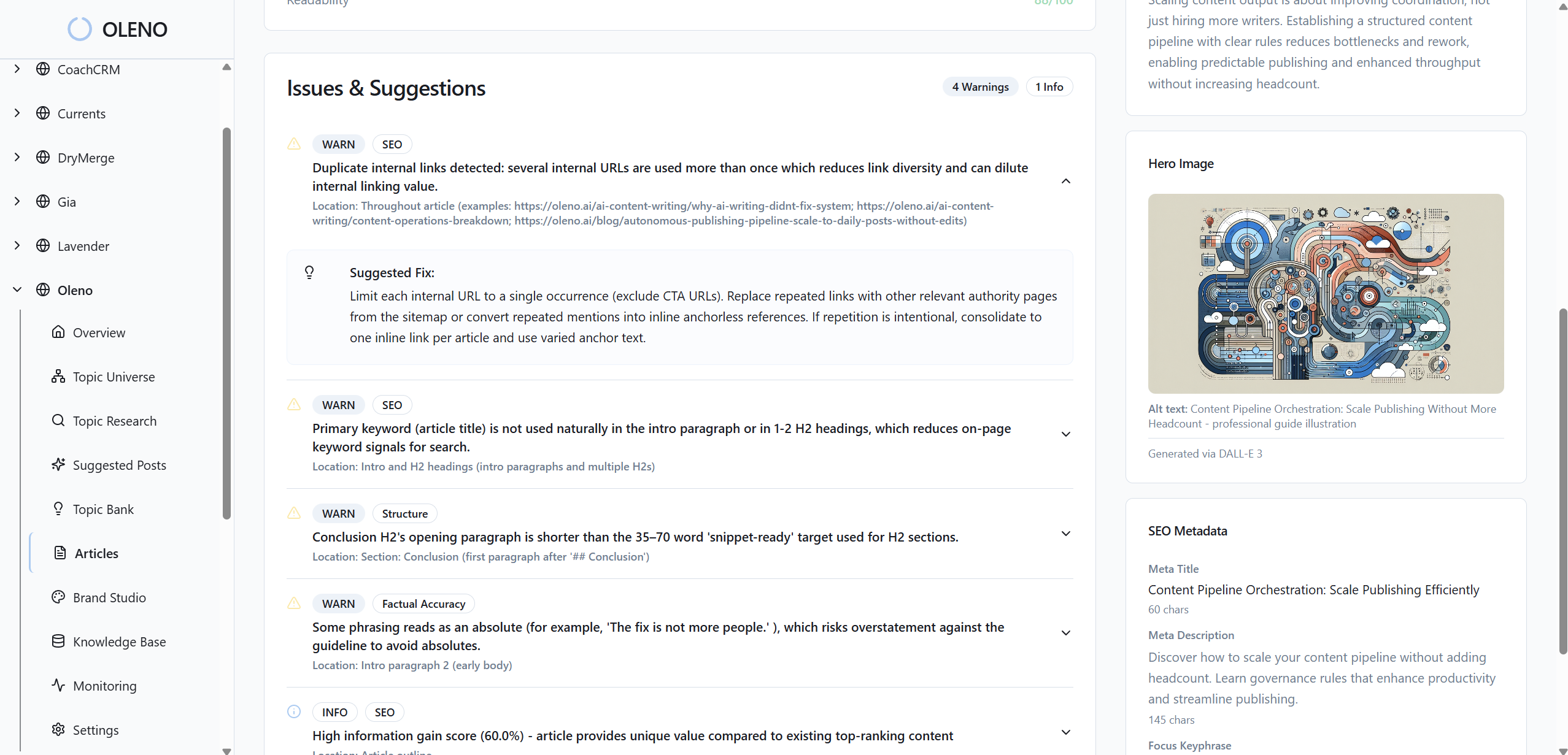
Content Refresh & Drift Monitoring watches for stale claims, outdated messaging, and positioning gaps in published content. That’s a huge deal because a lot of teams publish a page once and then forget it until it’s wrong. Oleno also gives leadership visibility through the Executive Dashboard, so a Head of Content or VP can actually see output cadence, quality trends, and coverage gaps without chasing updates.
And just to be clear, this doesn’t replace your whole stack. Oleno doesn’t do technical SEO, rankings, backlinks, or paid media management. It handles the governed creation and operation of content. That’s the lane. A strong one. If your team is trying to get the output of three more content hires without actually adding them, this is the kind of system that makes that possible. If you want to see how that would fit your workflow, book a demo.
Where to Go From Here
If your content workflow automation still depends on heroic editors, endless rewrites, or a founder fixing tone late at night, it isn’t really automated. It’s partially outsourced confusion. The fix is not more prompts. It’s a governed system that keeps strategy, execution, and quality connected.
That won’t matter for everyone. If you’re pre-product, purely outbound, or treating content like a checkbox, this probably isn’t the right problem to solve yet. But if you’re a scaling SaaS team with real content ambitions and too much coordination drag, the path is pretty clear. Encode the truth once. Then let the system run.
About Daniel Hebert
I'm the founder of Oleno, SalesMVP Lab, and yourLumira. Been working in B2B SaaS in both sales and marketing leadership for 13+ years. I specialize in building revenue engines from the ground up. Over the years, I've codified writing frameworks, which are now powering Oleno.
Frequently Asked Questions