Orchestrated AI Content Pipeline: Publish Fact-Checked Articles Daily

Most teams think they have a writing problem. They don’t. They have a coordination problem that shows up as missed publish dates, tone rewrites, and too many late-night fixes in the CMS. I’ve lived this. I’ve been the solo marketer who can ship fast, and the exec who watches the machine slow to a crawl the minute more people touch it.
Here’s the punchline. You can’t edit your way to daily output. You need a pipeline that remembers your voice, grounds claims in facts, and finishes the last mile — visuals, links, and schema — without begging for human heroics. Treat content like a system, not a task list.
Key Takeaways:
- Replace prompt-first drafting with an orchestrated pipeline that runs in the same sequence every time
- Persist brand voice and KB grounding from topic to draft so accuracy is a first-mile rule, not a last-mile edit
- Use deterministic systems for finishing steps: internal links, JSON-LD, screenshots, and CMS mapping
- Track topic coverage and saturation to avoid over-publishing and cannibalization
- Enforce quality with automated gates and refinement loops to reduce rework and “3pm scramble” fixes
If you want to see what this looks like without a long briefing, test it yourself: teams often learn faster by trying. When you’re ready, Try Generating 3 Free Test Articles Now.
Why Prompt-First Workflows Stall Out When You Need Daily Output
Prompt-first workflows stall because they reset context every time, which forces humans to fix voice, structure, and accuracy after the fact. The overhead compounds as you add visuals, links, schema, and CMS steps. Daily publishing needs a governed sequence where those rules are baked in, not patched on.

The hidden coordination tax
Prompt-first runs look fast until handoffs start. You brief a model, get a decent draft, then realize the voice is a shade off, the structure shifts between sections, and nobody set up snippet-ready openers. Now someone sources images. Someone else fixes internal links. And the CMS fields are wrong again.
I used to paper over this with hustle. Then the team grew and the tax got visible. Every draft needed a voice pass, a fact pass, a links-and-schema pass, and a CMS pass. That’s four passes per article before anyone talks headlines or visuals. The work isn’t writing. It’s stitching steps together that should have been automated rules.
The escape hatch is simple in concept and hard in practice: move decisions upstream and make them deterministic. Lock voice, phrasing constraints, and banned terms. Retrieve KB facts with intent. Enforce a layout that machines and humans can parse. If your pipeline can’t remember these decisions, your calendar will.
What breaks when context resets every draft
When every run starts at zero, tone drifts. Facts wander. Sections open with different rhythms. You’ll see missing FAQs and paragraphs that can’t be cited cleanly by search or assistants. That inconsistency gets expensive. It’s not a one-off mistake; it’s a system producing variance by design.
The fix is to stop treating memory like a prompt and start treating it like policy. Persist brand voice rules. Persist KB grounding and retrieval logic. Persist structure that forces snippet-ready openers and clear hierarchies. When the system holds those constraints, any new topic inherits the same guardrails by default.
Do this and you eliminate the “rewrite from scratch” loop. Drafts show up aligned enough to debate the narrative, not commas. You spend time on the story. Machines handle structure checks.
What is an orchestrated pipeline and why should you care?
An orchestrated pipeline is a fixed sequence: topic selection, brief generation, KB retrieval, brand voice enforcement, structured drafting, quality gates, then finishing steps — visuals, internal links, JSON-LD, and CMS delivery. Same order, same rules, every time. It’s not a template. It’s an operating system.
Why care? Predictability beats heroics. With orchestration, drafts don’t surprise you with tone shifts or missing schema. Factual drift is contained by design. Visuals arrive on-brand, where they should, with alt text ready. Publishing becomes the default outcome, not a race against your calendar. If you publish daily, that difference keeps you sane.
For a deeper look at coordination patterns across agents and steps, see this arXiv paper on multi-agent orchestration.
The Real Bottleneck Is Disconnected Steps, Not Writing Speed
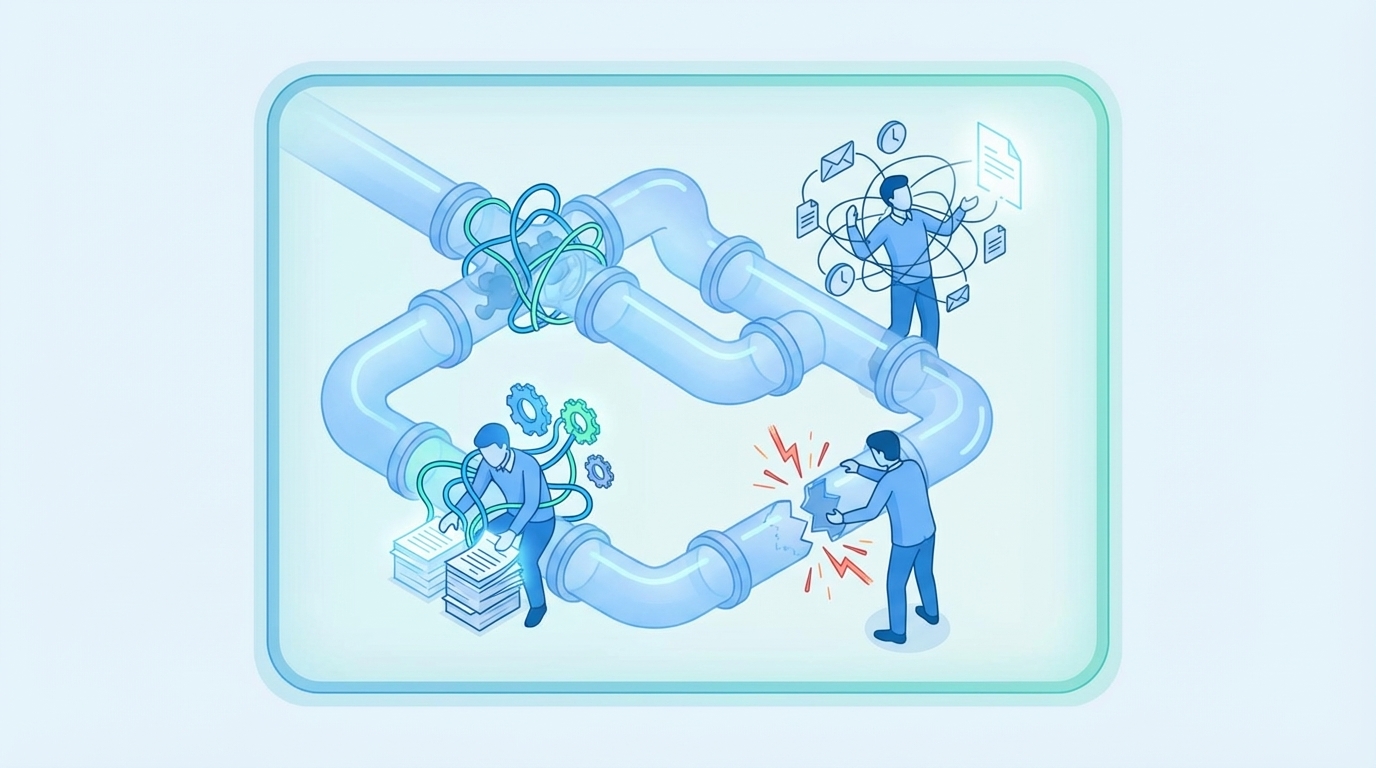
The real bottleneck isn’t how fast you write; it’s how many disconnected steps sit between idea and publish. Strategy in one tool, drafting in another, visuals in a third, and manual QA everywhere. Orchestration reduces friction by connecting these steps into one governed sequence.
What traditional approaches miss in topic selection
Keyword lists aren’t a strategy. They’re a backlog without context. You need a living map of your topic clusters that tracks coverage and saturation, then enforces cooldowns so you don’t flood the same angle out of habit. That’s how authority compounds and cannibalization slows down.
The practical version looks like this: ingest your sitemap and knowledge base, cluster the topic landscape, label each cluster from underserved to saturated, then prioritize gaps. When a cluster is healthy, pace it. When it’s underserved, make it a focus. The winner here isn’t volume. It’s coverage that ladders back to your product narrative.
Do this long enough and you’ll notice fewer “we already wrote this” debates. You’ll also see heavier lift pieces land where they matter. Picking topics turns from guesswork into policy. Your team can make faster calls with less opinion-swapping in meetings.
The KB and brand memory gap
Accuracy isn’t a last-mile edit. It’s a first-mile rule. If you let drafts invent facts, your review cycles explode and trust erodes. Persist brand voice and KB grounding throughout angle, brief, and drafting so claims draw from the same source of truth every time.
Treat voice like code. Enforce phrasing constraints. Enforce banned terms. Enforce structure. During drafting, retrieve KB facts intentionally and block claims you can’t source. The goal isn’t to be robotic. It’s to avoid “sounds good” lines that blow up later when a prospect checks your math.
When this memory is real, reviewers stop plugging leaks. They evaluate the story while the pipeline polices structure and factual grounding. That’s where speed shows up — not from typing faster, but from deleting entire rounds of avoidable edits.
Determinism where correctness matters
Let prose be creative. Let finishing steps be code. Inject internal links only from verified sitemaps with exact-match anchors. Generate JSON-LD programmatically. Place screenshots where they match section semantics, not where someone had time. Map CMS fields with idempotent behavior that prevents duplicates.
These are the areas where a deterministic system outperforms people every time. It’s not that humans can’t do it. It’s that they shouldn’t have to. Free your team from repetitive correctness work and they’ll grow the narrative instead of babysitting structure.
When you do this, small failure modes vanish: broken anchors, inconsistent schema, duplicate posts, and oddly placed visuals. The content looks more trustworthy because the plumbing is consistent.
The Costs of One-Off Prompts Compound Fast
One-off prompts create hidden costs that add up across a month: voice rewrites, fact checks, link fixes, schema gaps, image sourcing, and CMS cleanup. The draft feels “done,” but shipping still takes a village. A pipeline turns those steps into rules so the cost curve bends down.
Let’s pretend you scale to 60 posts a month
Let’s pretend you publish 60 articles this month with prompt-first drafting. Each draft needs 45 minutes of voice fixes, 20 minutes of fact checks, and 15 minutes of CMS cleanup. That’s 80 minutes per article. You just spent 80 hours on rework that a governed pipeline could prevent.
The writing wasn’t the time sink. The stitching was. Multiply that by visuals, internal linking, and schema, and your calendar will show you the truth: most “content work” is predictable. Which means it should be automated. Not every piece will fit the mold, but the majority will. That’s where the throughput gains live.
I’ve watched teams reclaim entire days per week by turning these edits into rules. It isn’t flashy. It works because consistent tasks want consistent systems.
The rework, link rot, and schema misses you do not see
The big misses are obvious. The small ones accumulate. Fabricated URLs. Broken anchors. Duplicate pages. Inconsistent JSON-LD. Missing FAQs in sections that should have them. Individually, minor. Together, costly. Machines misread intent. Humans feel the wobble.
Code-based internal linking eliminates unverified URLs and guarantees anchor accuracy. Programmatic schema generation keeps your JSON-LD clean and consistent. If you need a reference for Article markup, here’s Google’s Article structured data guidelines. The point isn’t the spec. It’s that specs should be implemented by code, not checklists.
When you automate these finishing steps, your QA focuses on the narrative. Not whether the FAQ shows up with the right schema every time.
When over-publishing erodes authority
Publishing more on a saturated angle can feel productive. It usually dilutes. Without cooldowns and cluster tracking, you cannibalize yourself and teach search engines that you have 12 shallow takes instead of one strong stance.
A Topic Universe with saturation labels prevents this. Information gain checks block outlines that add nothing new. The result isn’t less content. It’s better-timed content that compounds authority in the clusters that matter to your product. That’s the difference between noise and momentum.
If this friction sounds familiar, you don’t need a bigger team. You need a pipeline to shoulder the coordination. When you’re ready to offload that lift, Try Using an Autonomous Content Engine for Always-On Publishing.
The Human Friction You Feel Every Week
The human pain isn’t abstract. It’s the 3pm scramble to salvage a draft, the prospect catching a factual miss, and the “who owns quality” debate when everything is a one-off. Put the pipeline in charge of standards and those frictions start to fade.
The 3pm scramble to find a publishable draft
You know the moment. It’s late afternoon, the calendar says publish, and you’re diffing two half-ready drafts. Voice is off by a click. Links are messy. Schema is missing. You patch what you can and hope it ships. It’s stressful. It’s also avoidable.
Let the system enforce voice, KB claims, snippet-ready openers, links, and schema before the draft hits your hands. That way, your “review” is about whether the argument lands, not whether the internal links mapped to verified URLs. Same time slot. Less panic.
Once teams see this once or twice, they stop romanticizing the scramble. Calm predictability beats adrenaline. Every time.
When a small factual miss burns trust
At Proposify and later roles, I watched a single incorrect stat derail a sales call. It wasn’t malicious. It was a well-meaning paragraph written under deadline pressure. The prospect flagged it. We ate the apology. It’s a headache, and it lingers.
Build KB-grounded checks up front. Require citations for sensitive statements. Fail the draft if a claim can’t be matched to the knowledge base. That doesn’t kill creativity. It reduces risk. Forward progress is easier when you’re not worried about a Tuesday thread correcting a blog post.
The emotional payoff is real. Fewer corrections. Fewer “hey, is this true?” pings. More time spent shaping a point of view worth publishing.
Who owns quality when everything is a one-off?
If quality is everyone’s job and no one’s responsibility, standards slip. People are busy. Meetings pile up. Edits wait. Appoint the pipeline as the gate. Define a pass threshold — say, 85 — and encode checks for structure, voice, KB accuracy, snippet readiness, visuals, links, and schema.
If it passes, it ships. If it fails, it refines and re-tests automatically. Ownership becomes policy, not a person’s calendar. That single move changes how the team feels about reviews. Less policing. More narrative work.
A Repeatable Way to Go From Topic to Published, Daily
A repeatable process starts with strategy, carries memory through drafting, and ends with deterministic finishing steps. Map coverage. Enforce information gain. Draft with snippet-ready structure. Then let code handle links, schema, visuals, and publishing. That’s how daily output becomes realistic.
Map your topic universe with coverage and saturation
Start by ingesting your sitemap and knowledge base. Cluster related topics, then label clusters as underserved, healthy, well covered, or saturated. Enforce 90-day cooldowns to prevent redundancy. This ensures you always know what to write next and why it advances authority, not just activity.
In practice, this removes two common meetings: the “what should we write?” brainstorm and the “didn’t we already cover this?” postmortem. The system tells you where gaps are and when a fresh angle is worth it. You decide how to tell the story, not whether it belongs on the calendar.
When clusters are paced intentionally, you stop cannibalizing. You also make stronger internal links later because clusters have clear centers of gravity.
Ground every draft with KB retrieval and brief generation
Generate briefs with competitive research and an information gain score. Block outlines that fail uniqueness before you write a word. During drafting, retrieve KB facts with explicit rules for phrasing, banned terms, and claim boundaries. Open every H2 with a 40–60 word snippet-ready paragraph.
This structure helps both humans and machines. Humans can skim, then dive deep. Search engines and assistants can cite sections cleanly. If you want a reference on how featured snippets work, here’s Google’s featured snippets documentation.
The point is consistency. Each section stands on its own while the article holds together. Reviewers can focus on the argument, not the scaffolding.
Deterministic finishing steps, links, schema, visuals, and CMS delivery
After text, run code-based finishing. Inject five to eight internal links from verified URLs with exact-match anchors. Generate JSON-LD for Article, FAQ, and BreadcrumbList programmatically. For the format spec, the W3C JSON-LD specification is the standard reference.
Produce one hero and two to three inline visuals from a brand asset library, with alt text and filenames generated automatically. Map fields to your CMS and publish in draft or live mode with idempotency to prevent duplicates. These steps shouldn’t require opinions. They should run the same way every time.
When the pipeline does this reliably, publishing isn’t an event. It’s a byproduct of a system that already made a hundred small decisions correctly.
How Oleno Automates This Pipeline End to End
Oleno automates the entire sequence — strategy, differentiation, drafting, visuals, QA, links, schema, and publishing — so daily output is realistic without adding headcount. It doesn’t do analytics or monitoring. It focuses on shipping complete, on-brand articles that build authority over time.
Topic Universe plus information gain scoring reduces wasted drafts
Oleno discovers topics from your knowledge base and sitemap, clusters them into pillars, tracks saturation, and prioritizes gaps. Cooldowns prevent over-publishing. Briefs include competitive research and an information gain score to flag repetition before writing starts.
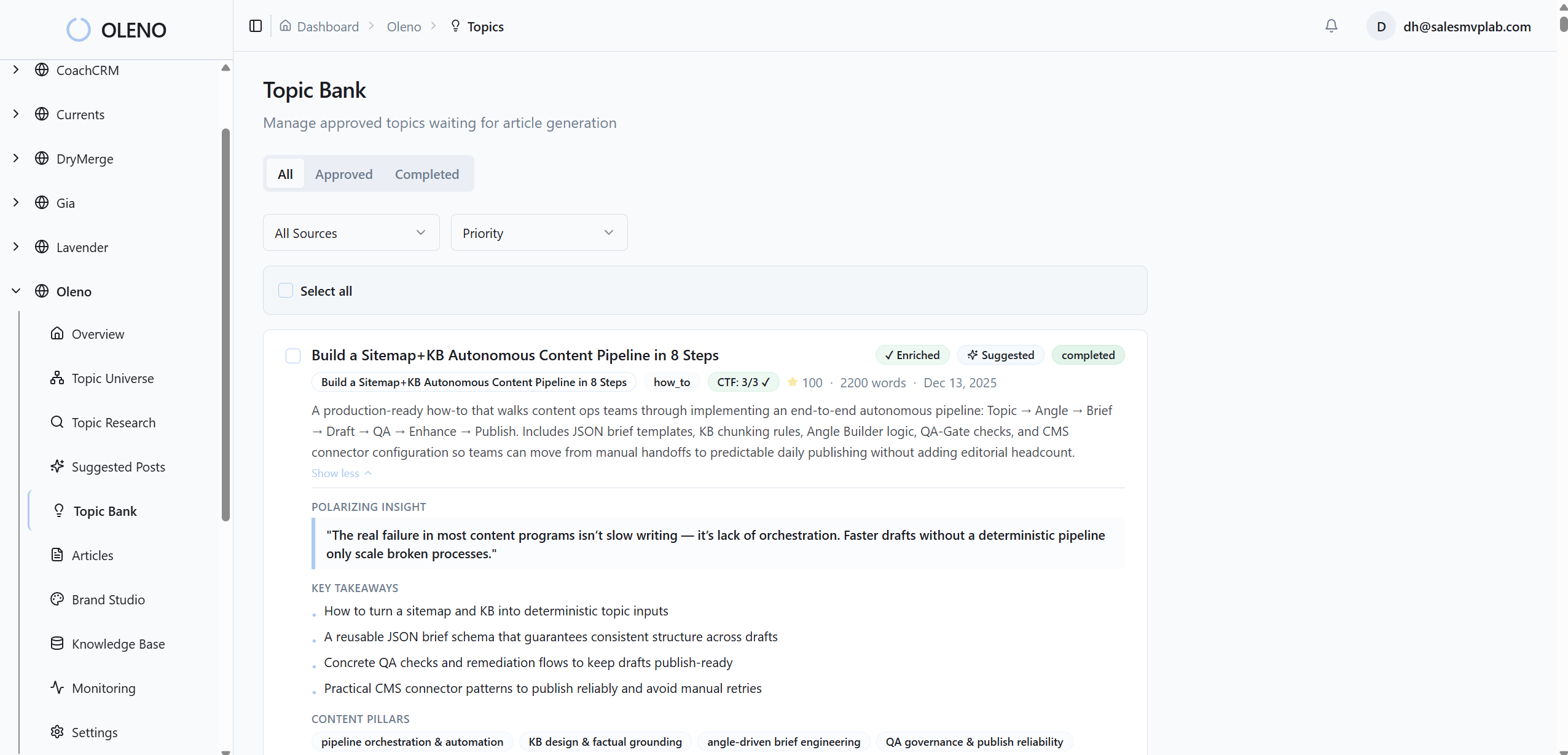
The result is obvious in your backlog. Fewer low-value drafts. A steadier queue of publishable ideas aligned to your core narrative. Authority compounds because coverage is intentional, not accidental. Oleno handles the mapping and guardrails; you focus on the point of view.
This is how teams avoid the “we already wrote this” moment and shift time from picking topics to shaping arguments worth reading.
Quality gates, snippet-ready structure, and refinement loops
Drafts in Oleno are written to your brand voice with KB facts injected. Every H2 opens with a snippet-ready paragraph. Then Oleno’s QA-Gate runs 80+ checks across structure, voice alignment, KB accuracy, snippet readiness, visuals, links, and schema. Minimum passing score is set — for example, 85.
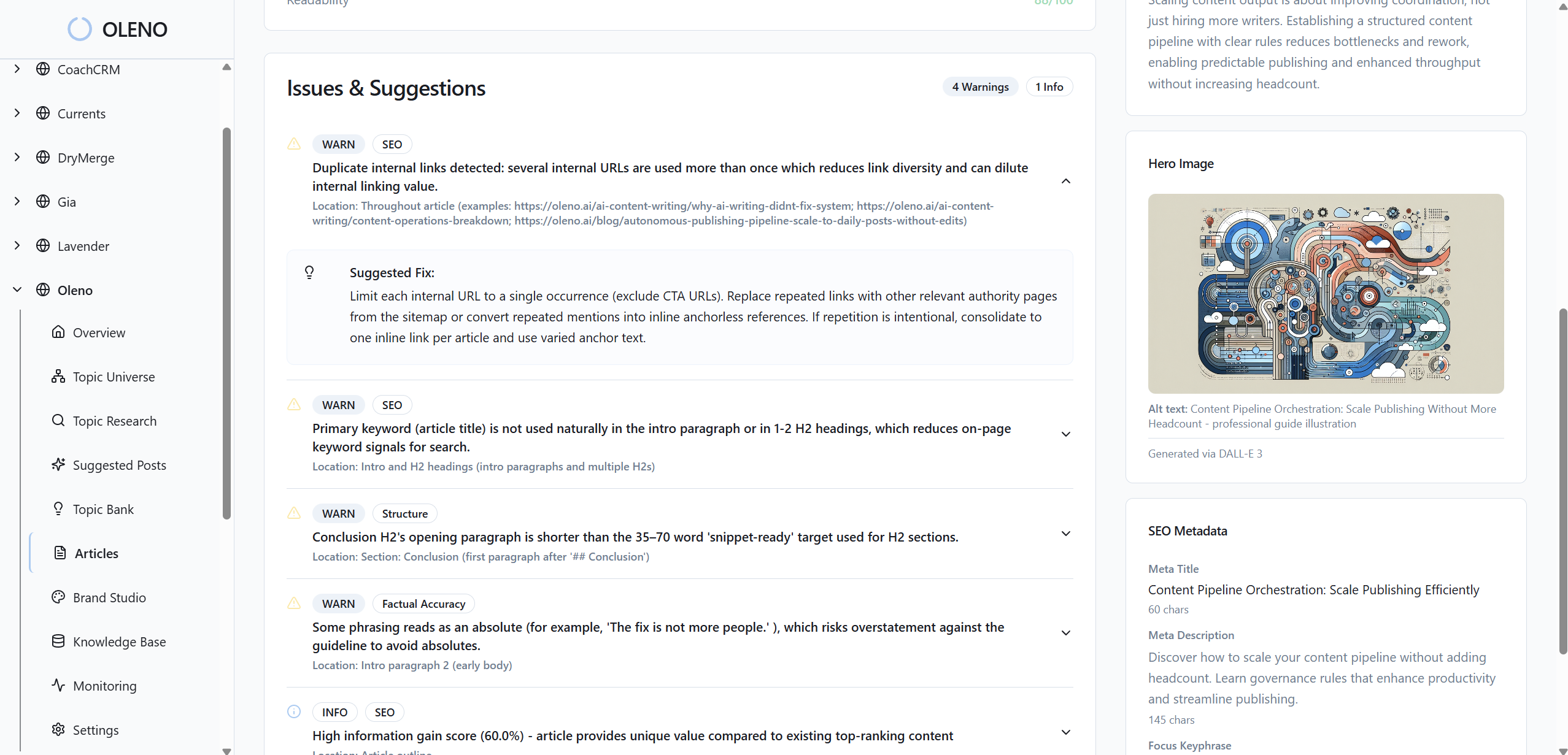
If a draft falls short, Oleno refines and re-tests automatically. No waiting for someone’s calendar. No spreadsheet of edits. The pipeline owns standards so your team can debate narrative choices. Over time, this replaces firefighting with reliable cadence.
The payoff is fewer reviews, fewer surprises, and more consistent shipping windows — the stuff you feel on Thursdays at 3pm.
Visual Studio, deterministic linking, and connectors that publish reliably
Oleno’s Visual Studio generates a brand-consistent hero plus two to three inline images using your color palette, logos, and style references. It matches product screenshots to relevant sections and prioritizes solution areas. Alt text and SEO-friendly filenames are generated automatically.
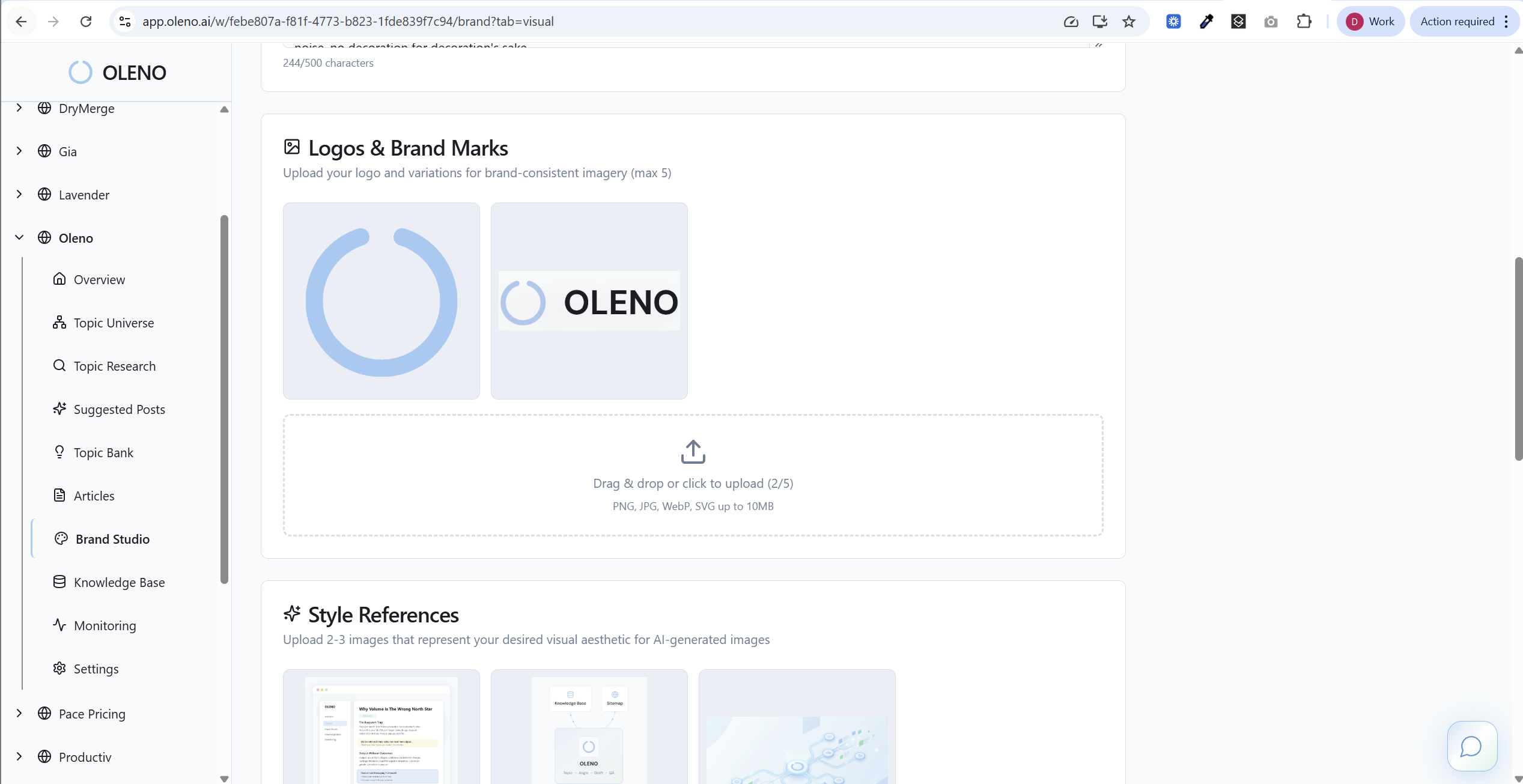
Internal links are injected deterministically from verified sitemaps with exact-match anchors. JSON-LD for Article, FAQ, and BreadcrumbList is generated programmatically. CMS connectors for WordPress, Webflow, HubSpot, and Google Sheets map fields and prevent duplicates, with draft or publish modes supported.
Put simply, Oleno handles the structure and finishing steps you shouldn’t be doing by hand. If you’re ready to see the sequence end to end, Try Oleno for Free.
Conclusion
Daily publishing isn’t about typing faster. It’s about removing friction between steps so work flows from topic to publish without stalling. When topic selection, differentiation, structure, visuals, links, schema, and CMS delivery run as one governed pipeline, your team stops patching drafts and starts shaping the narrative.
You can build that system yourself. Or you can let a tool built for this do the heavy lifting while you keep the voice and the story. Either way, treat content like infrastructure. The consistency pays for itself.
About Daniel Hebert
I'm the founder of Oleno, SalesMVP Lab, and yourLumira. Been working in B2B SaaS in both sales and marketing leadership for 13+ years. I specialize in building revenue engines from the ground up. Over the years, I've codified writing frameworks, which are now powering Oleno.
Frequently Asked Questions