Orchestrated AI Content Pipelines: From Topic to Publish Automatically

Most teams think writing speed is the blocker. It isn’t. I’ve been the solo marketer cranking out four posts a week and the exec with no time to write. Drafts were never the problem. The seams were. Handoffs. Rework. Publishing weirdness. That’s where quality and momentum go to die.
Here’s the shift. Stop treating content like a set of disconnected tasks. Treat it like a pipeline with memory, rules, and predictable delivery. When every stage knows the brand, enforces structure, and ships without cleanup, you get authority, not just output. That’s the whole play.
Key Takeaways:
- Draft speed isn’t the bottleneck—repeatable pipelines are
- Fragmented tools create invisible failure points you can’t manage
- Deterministic QA and pass thresholds prevent late-stage chaos
- Topic coverage tracking avoids saturation and cannibalization
- Visuals and internal links should be code-governed, not vibes-driven
- Idempotent publishing with logs and retries keeps operations boring—in a good way
Why Prompts Are Not Your Bottleneck, The Pipeline Is
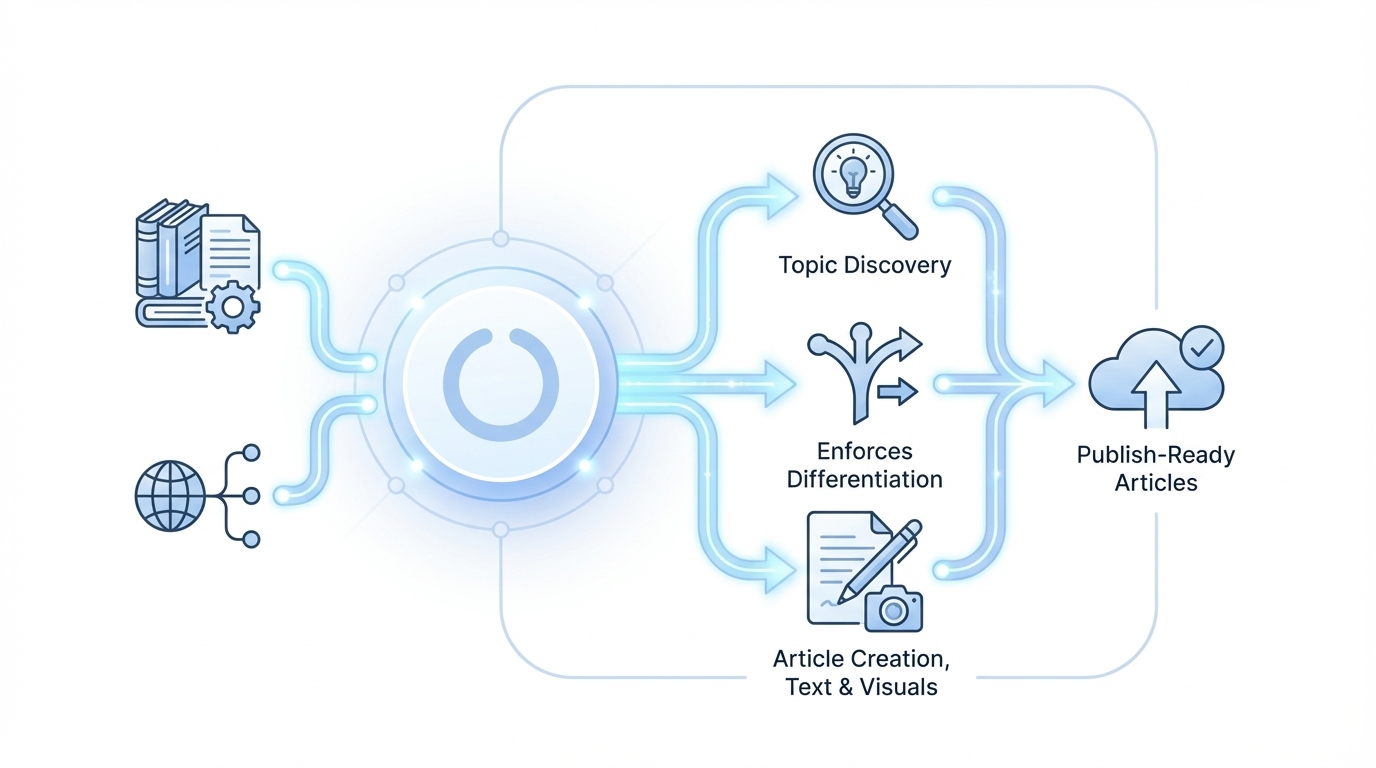
Drafting faster won’t fix inconsistency, rework, or fragile publishing. What fixes it is a governed pipeline that keeps brand memory, enforces deterministic structure, and blocks low-signal work with QA gates. You don’t need more prompts. You need a system. Think operations, not ad hoc creativity.
The inconsistency tax of one-off prompts
If every draft starts from zero, you pay a compounding tax. Voice drifts, structure wanders, facts wobble. I’ve seen it across teams—great writers, but no shared memory. The result is a stack of “good enough” posts that don’t add up to authority. You feel it when editing turns into weekly triage.
Here’s what changes when memory is persistent. Brand voice isn’t a suggestion, it’s a constraint. Claims aren’t invented, they’re grounded in what your company actually says. Structure isn’t a preference, it’s enforced so every section can stand alone. That’s the difference between a fast draft and a reliable output. Big difference.
It also aligns with how modern systems work. Agentic patterns and pipelines reduce variance by turning steps into governed stages. Even outside content, that’s the pattern you see in resilient AI operations, as described in Microsoft’s AI agent design patterns. The punchline: consistency is an architectural choice.
What breaks when writing is disconnected from publishing?
When writing, visuals, QA, and CMS are separate, the cracks appear quickly. Fabricated links slip in because no one verified the URL. Screenshots are dropped wherever they fit. Schema gets missed entirely. Then someone burns a morning cleaning HTML, remapping fields, and begging the CMS not to duplicate slugs.
I’ve been that person. It’s not a content problem; it’s a workflow problem. When no one owns the full path, the outcome is luck. And luck doesn’t scale. You need the path stitched end-to-end so structure and rules can be enforced upstream and delivery becomes predictable downstream. Boring in the best way.
This is why “orchestration” matters. Not as a buzzword, but as a practical approach to reduce variability. Teams that move from tool silos to governed pipelines consistently report fewer surprises. If you want a broader view of how orchestration reduces friction in AI workflows, see this overview of AI orchestration concepts.
Why deterministic QA beats after-the-fact editing
Manual edits chase symptoms. Deterministic QA sets rules once and enforces them every time. Structure checks, brand voice lints, KB-grounded claims, snippet-ready openers, and pass thresholds that block publishing until issues are fixed. No more “we’ll catch it in editing.” The system won’t let mistakes through in the first place.
And when a draft fails, it doesn’t trigger a Slack thread—it triggers remediation loops. Automatic, targeted fixes against the exact criteria that failed. You reduce late-stage chaos because the guardrails live inside the pipeline, not in a style guide doc no one has open. Less noise. More signal.
Ready to skip the theory and see it run daily? Try Using an Autonomous Content Engine for Always‑On Publishing.
The Real Root Causes Of Content Failure In Production
Content fails in production because the “middle” is ungoverned. Briefs talk strategy; CMS wants precise fields, schema, and safe retries. In between, structure gets lost and visuals get bolted on. The fix is mapping those middle steps as first-class pipeline stages with policy as code, not wishful checklists.

What traditional workflows miss between brief and CMS?
The brief sets intent. The CMS enforces reality. The gap is where errors multiply. Drafts show up with the right ideas but the wrong shape—no snippet-ready openers, inconsistent headings, missing alt text. Someone tries to fix it in the CMS, which is the most brittle place to manipulate content. Things break.
Production wants determinism. That means the draft must already be structurally sound, visuals must be placed by rules, internal links must be precise, and schema must be attached programmatically. When those steps are pipeline stages, “what we meant” actually becomes “what we shipped.” If they’re not? You’re back to duct tape.
It’s the same logic data teams use. Reliable pipelines minimize manual touchpoints and treat transformations as code. See how data pipelines formalize these expectations in IBM’s guide on building dependable data flows. Different domain, same principle—govern the middle.
How saturation and cannibalization creep in without coverage tracking
Without cluster-level coverage and saturation labels, teams over-publish what feels familiar. You write the fifth version of a topic because the last one “did well,” then wonder why rankings blur and conversions slide. Cannibalization hides in plain sight. The numbers don’t scream; they whisper.
The solution is unglamorous and effective. Track coverage per cluster. Label states—Underserved, Healthy, Well-covered, Saturated. Enforce a re-coverage cooldown so you don’t pile on the same idea every month. When you pace depth and breadth deliberately, every new piece adds authority instead of diluting it. Simple. Not easy.
This reframes success. It’s not “Did we ship three posts this week?” It’s “Did we advance authority in the clusters that matter?” That’s a different conversation in your leadership meeting. And a healthier one.
The Hidden Costs Of Manual Handoffs And Rework
Manual handoffs drain time through retries, cleanups, and duplicate prevention that never quite sticks. At small volumes you can absorb it. At daily cadence, the glue work quietly becomes a sprint. Codify link injection, schema generation, and idempotent publishing so your team focuses on strategy, not spelunking in a CMS.
Engineering hours lost to fixes and retries
Let’s pretend you publish daily. Two failed uploads a week isn’t unheard of—wrong field mapping, missing images, inconsistent slugs. Each one costs two to three hours to unwind. Over a quarter, you’ve lost a sprint to glue work. No one budgeted for it, but everyone felt it.
The fix sits inside the pipeline. Convert markdown to CMS-ready HTML predictably. Map fields once and reuse. Generate JSON-LD, don’t hand-write it. And make publishing idempotent with duplicate prevention so retries are safe. You get your hours back without hiring. That matters.
This is how mature automation teams think. The workflow is the product. If you want a parallel outside content, the AWS example of orchestrating document workflows shows how upstream decisions eliminate downstream toil in an end-to-end process, not a single tool. Worth a skim: intelligent document workflow orchestration.
The credibility hit when visuals and links are random
Readers notice when images don’t match the narrative or when alt text is missing. So do AI assistants that prefer citing tight, structured chunks. Random screenshots erode trust. Fabricated links? That’s worse. Credibility takes a hit you might not see in a dashboard, but prospects feel it.
Rules fix this. Visuals should be generated and placed based on brand inputs and semantic relevance—especially in solution sections. Alt text and filenames should follow consistent patterns. Internal links should come only from a verified sitemap with exact-match anchors. It sounds rigid. It reads as trustworthy.
One more thing. Rules don’t limit creativity; they protect it. When structure and accuracy are handled, your team can focus on insight and story. That’s the job humans are great at.
Still wrestling with fix-after-the-fact edits each week? Try Generating 3 Free Test Articles Now and see what a governed pipeline feels like.
The Moment Everything Clicks For Teams
The moment content turns from chaos to calm is when publishes stop being incidents and start being routine. You sleep, because retries and duplicate prevention exist. You ship less noise because differentiation is enforced upfront. The system handles structure. You handle narrative. That’s the turn.
The 3am publish that fails, then ruins your morning
We’ve all had it. A failed CMS push at 3am that duplicates slugs, breaks image paths, and spams your alerts. You lose the morning to triage. Then meetings start, and the real work slips. It’s not dramatic, it’s just draining. And it keeps happening.
When a pipeline owns retries, idempotency, and field mapping, those incidents fade. Nights are quiet, mornings are focused, and posts go out as drafts or live based on policy, not habit. You’ll still have edge cases. But they’re edge cases, not “every Thursday.”
This changes how you plan. Confidence is a productivity multiplier. It’s hard to quantify, but you feel it immediately.
You ship more, but build less authority
I’ve led teams that hit the publishing cadence and still didn’t move trust. Why? We repeated what already existed. The volume looked good in a report, but the market didn’t care. It’s a tough pill to swallow when you’re hitting your numbers and missing the point.
Enforce information gain upfront. Reward high-differentiation briefs. Block thin angles. You might publish a bit less. You’ll grow trust a lot more. Authority isn’t a single spike; it’s compound interest on coherent coverage and original ideas. Measure your work against that, not just a calendar.
And yes, that takes discipline. But rules make discipline easier.
A Production-Ready Pipeline You Can Run Daily
A production-ready pipeline treats memory, structure, visuals, QA, and publishing as code-governed stages. Start by embedding your Knowledge Base and importing your verified sitemap. Then use coverage labels to prioritize topics and enforce cooldowns. Finally, ship through QA gates and idempotent publishing so retries are safe and logs explain every decision.
Create persistent brand memory with KB embeddings and sitemap import
Brand memory starts with your Knowledge Base. Embed it so facts can be retrieved at angle, brief, and draft time. That way claims are grounded in what you actually say, not what a writer thinks you might say. Accuracy follows from access. We learned that the hard way, so you don’t have to.
Bring in your verified sitemap early too. That’s your source of URL truth for internal links after drafting. No fabricated links. No stale paths. Just exact-match anchors from pages you own. When those two foundations are set—KB for facts, sitemap for links—everything downstream gets safer.
Keep KB chunks clean. Update often. Reject unverified sources at retrieval time. It’s not exciting, but it’s pivotal.
Map the topic universe with coverage metrics and saturation thresholds
Cluster topics from your KB, sitemap, and focus areas. Track coverage per cluster. Label saturation states—Underserved, Healthy, Well-covered, Saturated. Enforce a 90-day re-coverage cooldown so you intentionally pace depth and breadth. That’s how you reduce cannibalization and make each piece additive.
Daily topic suggestions should flow from these labels. Not from keyword wishlists. Not from hunches. From the reality of your coverage. It’s how you answer a better question: “What should we write next to build authority?” That question, asked consistently, transforms output quality over a quarter.
If you want a practical framing of knowledge pipelines in adjacent domains, this walkthrough on knowledge pipeline orchestration shows how governed flows keep inputs consistent and outputs dependable.
Design QA gates and idempotent publishing
QA gates are where you prevent late-stage chaos. Score drafts against criteria that matter: information gain, structure, brand voice, KB grounding, snippet-ready openers, and visual placement. Set a minimum pass (for example, 85) and block publishing until it’s met. If a draft fails, trigger targeted refinements, not a rewrite.
Publishing should be boring—convert to CMS-ready HTML, map fields once, prevent duplicates, and support draft or live modes by policy. Add retries with audit logs for attempts and versions so operations are explainable later. When you push every day, this is the difference between “we hope it works” and “it works.”
Yes, it’s a lot of plumbing. That’s the point. The work disappears when the rules carry it.
How Oleno Automates Topic To Publish For Your Team
Oleno runs a closed-loop system that turns strategy into publish-ready articles—text and visuals—without manual handoffs. It discovers topics from your KB and sitemap, enforces differentiation before writing, generates drafts to your brand voice, places visuals intentionally, injects internal links deterministically, and publishes safely with retries and logs.
Topic Universe prioritizes what moves authority
Oleno’s Topic Universe maps your topic landscape, organizes clusters, and tracks coverage and saturation in real time. It labels clusters Underserved, Healthy, Well-covered, or Saturated, and enforces a 90-day cooldown before re-covering a topic. Daily suggestions align with gaps so you build breadth and depth deliberately, not by guesswork.
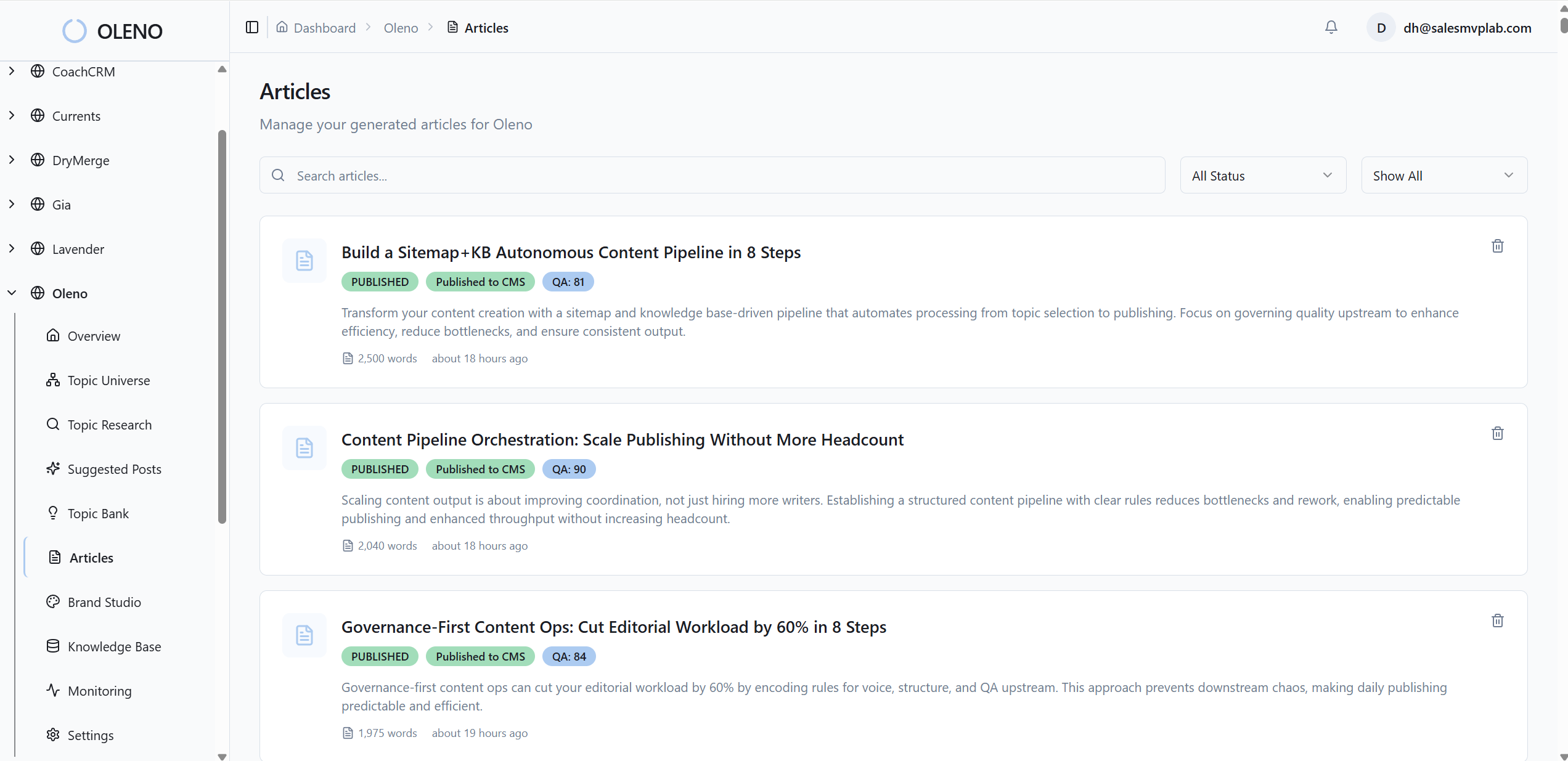
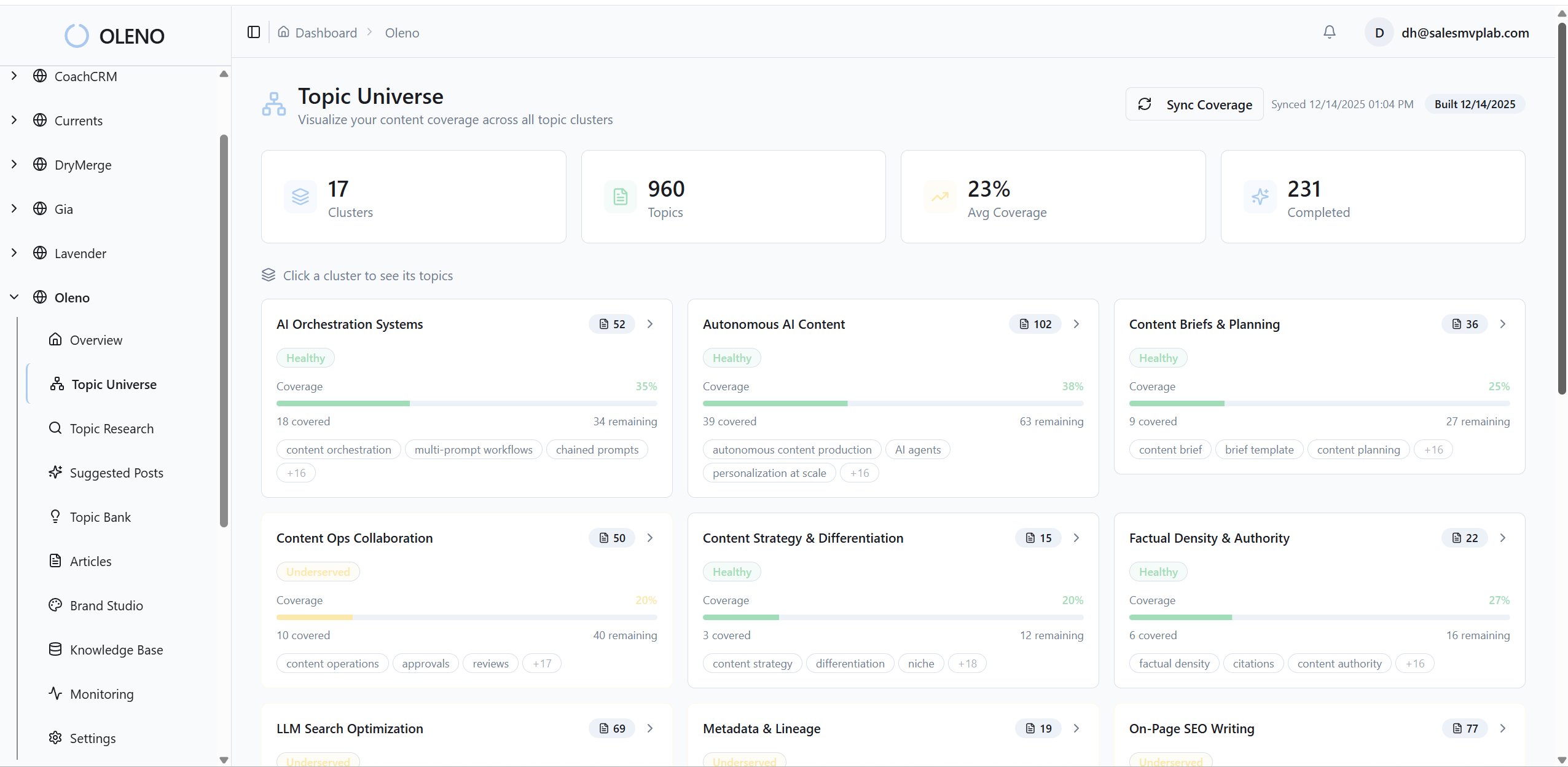
This fixes the upstream cause of cannibalization and duplicated effort. Instead of chasing keywords, you build authority where it’s thin and sustain it where it’s strong. Over time, that compounds. Oleno’s job here is simple: answer “what should we write next?” with context, not conjecture.
And it does that every day. Quietly, predictably, and without spreadsheets.
Visual Studio and semantic screenshot matching
Most tools stop at text. Oleno includes Visual Studio so your articles look like your brand by default. It references your colors, marks, and style, generates a hero image plus two to three inline visuals, and prioritizes solution sections for product visuals that actually help readers understand.
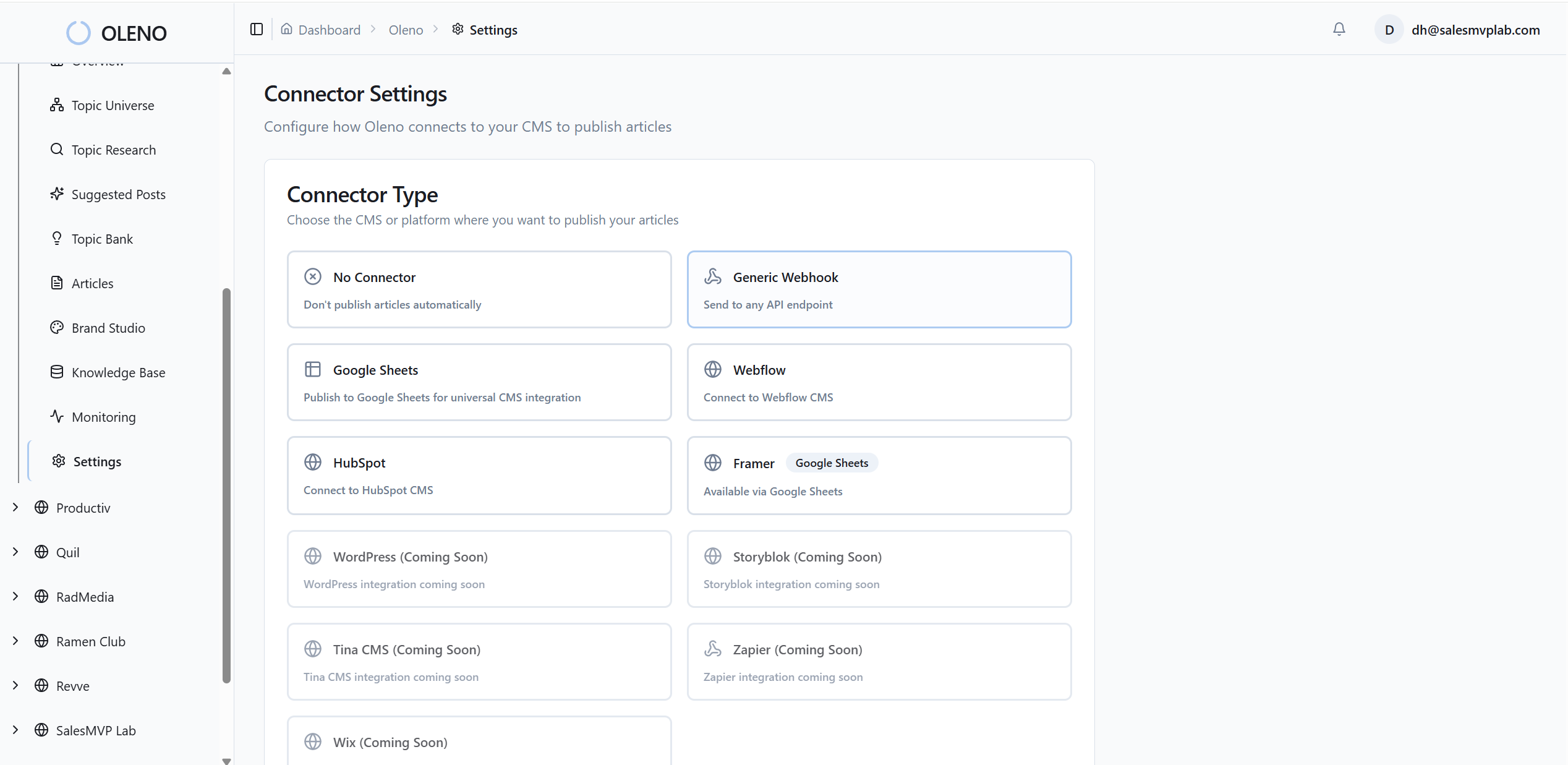
Screenshots aren’t random. Oleno matches product screenshots to relevant paragraphs using semantic similarity. It generates SEO-friendly alt text and filenames automatically. Placement follows rules, not vibes. This is where credibility grows—readers see the product in context, and machines see consistent, descriptive signals.
Less design queue. More on-brand clarity. That’s the point.
CMS connectors deliver safely with retries and logs
When it’s time to ship, Oleno maps fields to WordPress, Webflow, or HubSpot, converts markdown to CMS-ready HTML, and prevents duplicates by design. You choose draft or live modes by policy. Publish attempts are logged with retries, so delivery is reliable and explainable when something does go sideways.
Internal links and schema aren’t afterthoughts. Oleno injects internal links from your verified sitemap with exact-match anchors and generates valid JSON-LD for Article, FAQ, and BreadcrumbList automatically. No fabricated URLs. No missed markup. Just consistent, machine-readable structure that reduces fragility at scale.
If the costs above sounded familiar—lost mornings, duplicate slugs, off-brand visuals—this is where they get addressed systematically. Oleno isn’t promising perfection. It’s giving you a pipeline that behaves.
Curious if this would work in your stack? Try Oleno For Free and publish a few test articles end to end.
Conclusion
You don’t need more prompts. You need a production pipeline that remembers your brand, enforces structure, places visuals intentionally, and publishes without drama. When that exists, quality stops depending on heroics and starts depending on rules. You’ll publish a bit less noise and build a lot more authority. That’s the shift.
About Daniel Hebert
I'm the founder of Oleno, SalesMVP Lab, and yourLumira. Been working in B2B SaaS in both sales and marketing leadership for 13+ years. I specialize in building revenue engines from the ground up. Over the years, I've codified writing frameworks, which are now powering Oleno.
Frequently Asked Questions