Orchestrated Content Pipelines: Publish Engaging Articles Daily
Daily publishing doesn’t break teams. Rework does. You hit “ship,” then spend the afternoon patching tone, fixing links, hunting screenshots, and begging someone to add schema. That’s not publishing faster. That’s moving the chaos earlier in the week.
I’ve tried all the hacks, CEO transcripts, freelancer armies, my own late-night marathons. You can push volume for a quarter. Maybe two. But without a system that holds strategy, structure, visuals, and publishing together, speed just multiplies the mess. You don’t need more hands. You need fewer handoffs.
Key Takeaways:
- Speed without a governed pipeline creates rework and missed opportunities
- Originality has to be enforced at the brief with information-gain checks
- Topic coverage needs a map, saturation rules, and cooldowns
- Draft-first, then deterministic links, schema, and visuals. No bolt-ons
- Automate QA with pass/fail gates before anything hits your CMS
If you’d rather see a working pipeline than read another playbook, you can get a feel fast. Generate three articles and watch the system run end to end. Generate 3 Free Test Articles Now
Why Publishing Faster Still Fails Without a System
Publishing faster fails when strategy, writing, visuals, and publishing don’t share one pipeline. You get drafts, not decisions, so every post becomes a one-off rescue mission. The fix is orchestration: a defined sequence with dependencies, much like AWS’s pipeline definition model, where each step hardens the one before it.

The hidden cost of speed without coordination
Speed exposes gaps. When research happens in five tabs and links get added “at the end,” quality depends on who remembers what, and whether they had coffee. You don’t feel the cost immediately, it shows up as edits that never end, a brand voice that drifts, and a calendar that slides because two images are still missing.
What you want is a flow that reduces decisions upstream. Strategy isn’t a doc; it’s an input the writer can’t ignore. Visuals aren’t a scavenger hunt; they’re generated and placed by rule. Internal links aren’t a guessing game; they’re injected from a verified list. When every stage depends on the last, the output becomes predictable. Not perfect, predictable.
Why does prompt-level writing break at scale?
Prompts reset context. Every time. That means tone wobble, structure shifts, and a slow erosion of rules. You can muscle through a handful of posts because you remember the constraints. At daily volume, that memory leaks. Prompts write words; pipelines run work.
A pipeline preserves intent. It carries your topic decision into the brief, enforces differentiation before a sentence is written, and structures the draft so sections stand alone and can be cited cleanly. It’s not glamorous. It’s reliable. Which is exactly what daily cadence needs.
What does “orchestrated” actually mean here?
Orchestration means one governed path from topic to publish that runs the same sequence every time. Topic selection, competitive checks, information gain, draft structure, visuals, internal links, schema, QA, and CMS delivery, each reading from the same knowledge base and brand rules. No rogue steps. No silent changes. No “we’ll fix it later.”
Think of it like a controlled dependency graph, more like pipeline orchestration with defined control flow than a clever prompt. When a step fails, it retries or stops, and you know why. That’s how you scale quality without meetings.
What Breaks When Strategy, Drafting, and Publishing Are Disconnected
Disconnected workflows break because the brief loses teeth, originality becomes a hope, and the last mile turns into a scramble. Strategy needs to be an input to drafting. Differentiation must be enforced automatically. Visuals, links, and schema should be deterministic, not optional. It’s the difference between guidance and governance.
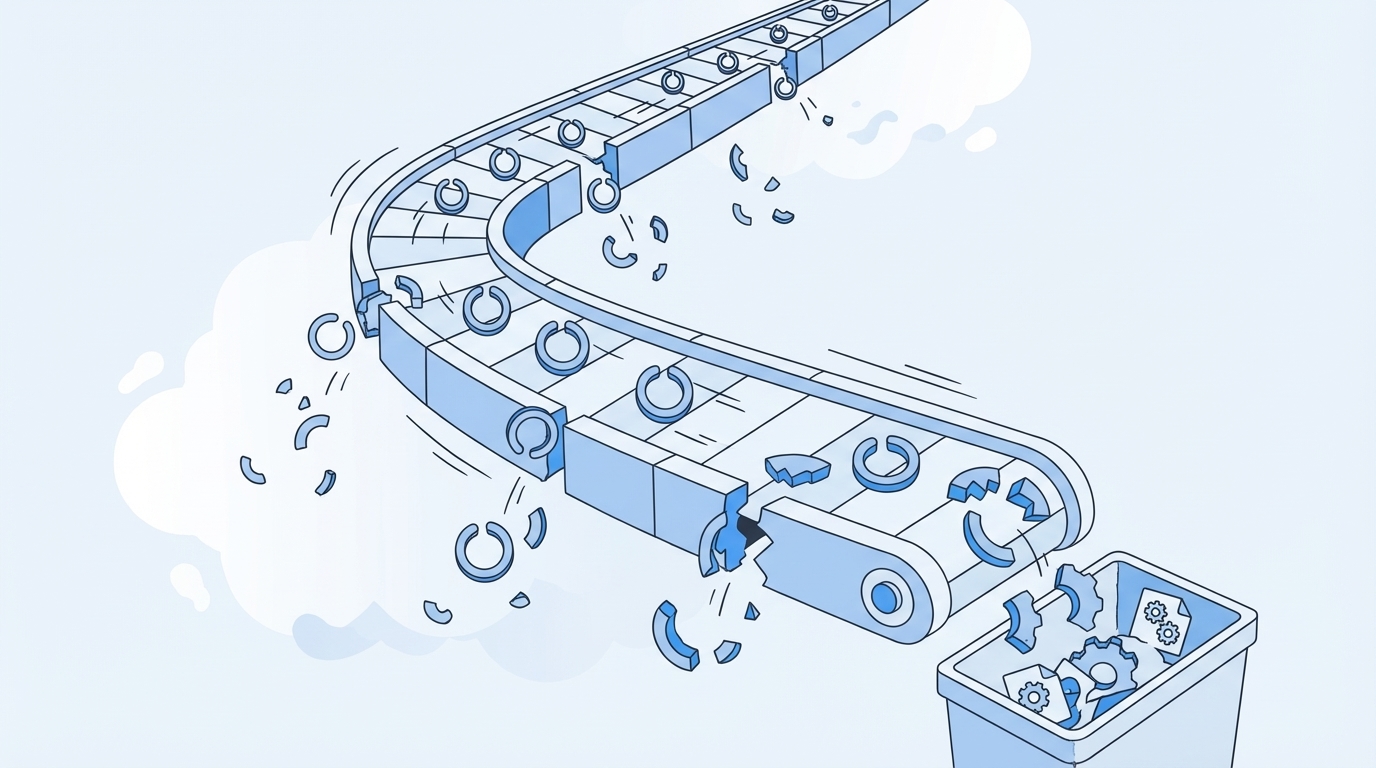
Coverage decisions made in spreadsheets never survive drafting
You’ve seen this. The brief says “serve this gap, avoid re-covering onboarding,” and the draft meanders back to onboarding because the writer didn’t have the cluster view staring at them while they wrote. Not their fault. The system didn’t carry the constraint forward.
When coverage lives in spreadsheets, you lose control in motion. A pipeline that maps topics to clusters, labels saturation, and enforces cooldowns preserves that intent. Drafts don’t get to wander. Publishing validates the mapping before anything goes live. You don’t “hope” the post fits your plan; you confirm it.
Originality is hoped for, not enforced
Most teams trust the writer to add something new. Sometimes they do. Sometimes they don’t. That’s a risky bet at scale. You need information-gain scoring during the brief. If the outline adds nothing distinct versus what’s already ranking, you flag it before writing begins.
This isn’t about perfection. It’s about catching redundancy early. A brief that quantifies what’s common coverage, what’s missing, and where your point of view actually contributes saves hours of editing. It also protects your brand from repeating the market in slightly friendlier words. Don’t rely on hope. Gate it.
Visuals and links bolt on at the end
Last-mile tasks create silent delay. Screenshots get dropped in because they “look right.” Alt text gets skipped. Internal links point to unverified URLs. Worse, schema is forgotten until QA catches it, or doesn’t. The fix is simple: bake these rules into the pipeline after the text stabilizes.
Deterministic rules beat taste. Images attach to the right sections programmatically. Links come from a verified sitemap with exact-match anchors. JSON-LD is generated automatically and validated. That turns the end of the process from “maybe” to “done,” and your calendar stops slipping by a day for reasons that feel embarrassing.
The Compounding Cost of Rework and Redundancy
Rework compounds because little fixes stack, voice tweaks, link audits, alt text, schema, screenshot swaps, and they rarely happen all at once. Redundancy compounds because unsupervised coverage leads to saturated clusters and cannibalization. The combined cost isn’t theoretical. It burns days and dilutes authority. You feel it in pipeline, not just pageviews.
Let’s pretend you publish daily with light edits
Say you ship 20 articles this month. Five need 90 minutes of cleanup each, voice, headings, stray claims. That’s 7.5 hours. Add two rewrites at 3 hours each for originality problems. Now 13.5 hours. Missed alt text and a link audit? Call it 5 more. You just lost three workdays. And that was a quiet month.
Here’s the kicker. Those hours don’t scale linearly. They arrive in clumps, Friday afternoons, right before a launch, when someone’s out. A pipeline with pass/fail gates spreads the work out and blocks unready content early. It’s boring in the best way.
Still living in fix-it mode? There’s a simpler way to see the difference. Spin up a controlled run and watch what doesn’t land on your plate. Use an Autonomous Content Engine for Always-On Publishing
Repeating saturated topics dilutes authority
Publishing more on topics you’ve already covered doesn’t always strengthen your position. It can cannibalize traffic across your own pages, confuse readers, and waste crawl budget. What you want is a coverage map that labels clusters as underserved, healthy, well-covered, or saturated, and enforces a cooldown before you revisit them.
This is where strategy becomes code. When the map is integrated into the pipeline, topic suggestions prioritize gaps that build authority and throttle areas that are overfed. You’re not chasing keywords. You’re engineering coverage, intentionally.
Fragmented tools create avoidable fail states
Drafts drift from the knowledge base. Visuals look off-brand. Schema gets skipped. Duplicate publish attempts hit your CMS. These aren’t edge cases; they’re normal outcomes of disconnected steps. Each one forces an 8pm “quick fix” that isn’t quick and always costs trust somewhere.
Governed pipelines reduce these incidents with simple mechanics: pass/fail gates, retries, and validated inputs. Knowledge retrieval is deterministic. Visual placement follows rules, not vibes. Links come from verified sources. If a step fails, it stops. You don’t need more reminders; you need fewer chances to forget. Concepts like knowledge gating in Dify’s pipeline approach illustrate this nicely.
When Teams Chase Daily Cadence Without Safety Nets
Chasing daily cadence without safety nets creates an illusion of progress. You publish more, but the narrative drifts from your product, and tiny mistakes slip into production. The visible cost is a missed image or weird link. The real cost is trust and misaligned demand. I’ve been there. It’s not worth it.
The founder story we all recognize
I’ve been the only marketer. We recorded CEO videos, transcribed them, and published. Fast, scrappy, good enough. It worked, until it didn’t. Structure slipped, and we ranked for topics that barely pointed back to what we sold. That’s the subtle tax: traffic without narrative alignment. Feels productive. Doesn’t move pipeline.
At Proposify, I saw the other side. Fantastic content that brought leads, just not the right kind. When content drifts too far from the product, sales inherits a mismatch. Not a writing problem. A system problem. The fix isn’t “write better.” It’s “connect strategy to shipping.”
The 3am incident no one saw coming
You push five articles in a week. On Friday, a duplicate publish sneaks through, or a solution section gets the wrong screenshot. Your best customer sees it. Now trust needs a bandage and Monday’s cadence is in question. This isn’t about perfection; it’s about guardrails.
Safety nets are the price of consistency. Simple things help: validated fields on publish, exact-match anchor rules, screenshot-to-section matching by semantics, and a QA gate that refuses to pass “almost.” It’s a lot less dramatic than heroics. That’s the point.
A Production Pipeline That Turns Topics Into Publish-Ready Articles Daily
A production pipeline turns “what should we write” into shipped, on-brand articles every day by enforcing sequence and rules. Start with a coverage-first topic universe, enforce originality in the brief, write grounded drafts with snippet-ready structure, then inject links and schema deterministically. It’s standard orchestration, like control flow in task graphs, applied to content.
Map a coverage-first topic universe
Start by importing your sitemap and knowledge base to build a topic universe. Cluster related themes, calculate coverage, label saturation, and set cooldowns to prevent revisiting the same angle too soon. The result is not a backlog; it’s a living map that answers one question: what should we write next to build authority.
When this exists, planning stops being a meeting and becomes an input. Suggestions roll up from gaps, not guesses. Writers don’t chase keywords in isolation; they serve the map. Over time, clusters move from underserved to healthy, intentionally. Authority compounds because coverage is coordinated.
Automate briefs with information-gain checks
Every approved topic should generate a structured brief with competitive research baked in. Identify common coverage across top results, highlight missing perspectives, and quantify differentiation with an information-gain score. If it’s low, change the angle before drafting. If it’s high, proceed.
This moves originality from a pat on the back to a policy. You’ll still get strong writing, but now you catch thin angles early. It reduces rewrites, protects the brand from repeating the market, and gives writers a sharper target. Editing becomes refinement, not rescue.
Generate grounded drafts in your brand voice
Drafts should pull from your knowledge base and follow brand voice constraints, archetypes, and structure rules. Open every H2 with a 40–60 word snippet-ready paragraph: direct answer, supporting context, clear example. Keep sections clean and citable. No links, visuals, or schema yet, text first, then enrichment.
This sequence matters. When you stabilize text before enrichment, every downstream step gets easier. Visuals attach to the right sections. Links flow into the right sentences. QA evaluates structure and voice before judging everything else. The draft becomes the foundation, not the battleground.
Deterministic links and schema, not guesswork
After the draft stabilizes, inject internal links from a verified sitemap with anchor text matching page titles. Generate JSON-LD for Article, FAQ, and Breadcrumbs programmatically and validate it. Avoid fabricating URLs or hand-coded schema that goes stale. Deterministic injection beats subjective decisions every time.
This approach also simplifies QA. You’re verifying rules, not taste. The benefit is subtle but real: fewer broken links, fewer accessibility misses, clearer meaning for machines, and a faster path to publish. It’s the unglamorous work that keeps your calendar honest.
How Oleno Automates the Pipeline End to End
Oleno automates the full path from topic to publish by turning strategy, differentiation, drafting, visuals, links, schema, QA, and CMS delivery into one governed system. Think orchestration, not prompting, similar in spirit to orchestration pipelines with defined dependencies, but built for content instead of data jobs.
QA gates and refinement loops keep quality high by default
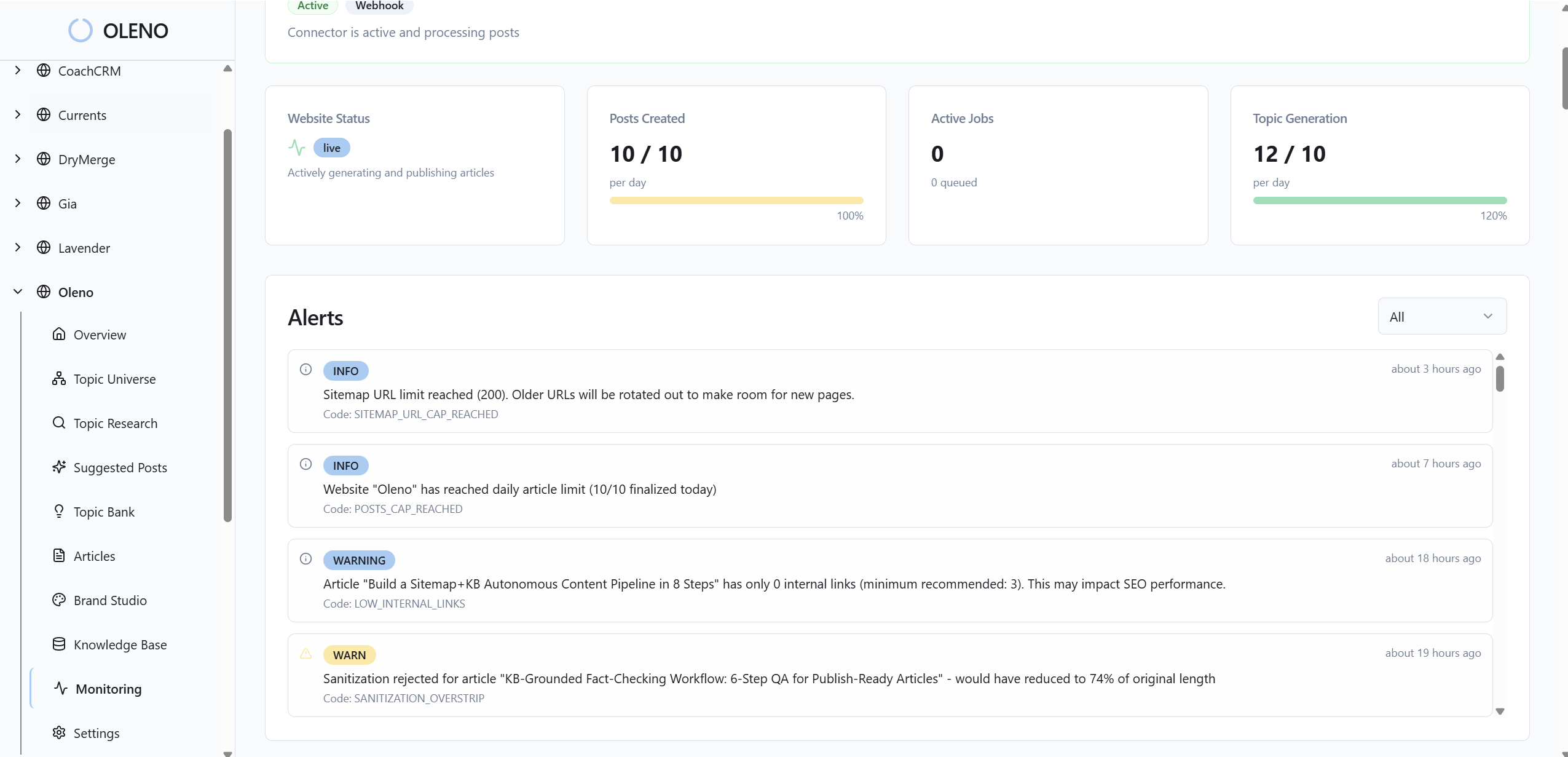
Oleno enforces quality with an automated QA gate before anything reaches your CMS. Drafts are evaluated against 80-plus checks: structure, brand alignment, knowledge grounding, snippet readiness, visual placement, internal link rules, and schema validity. Minimum passing score is required. If a draft falls short, Oleno refines the exact weak areas and re-tests.
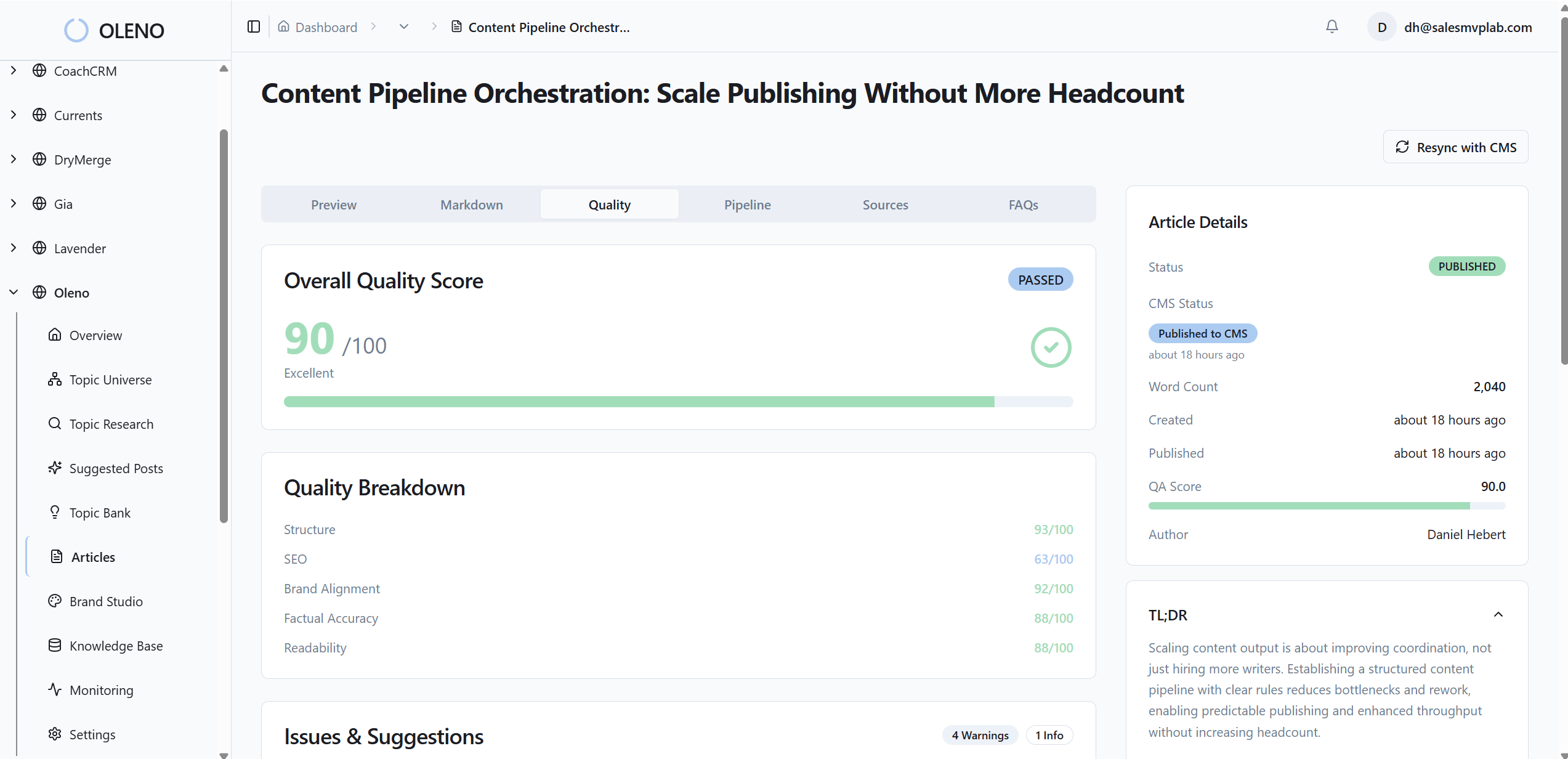
This is where the rework cost from earlier evaporates. Instead of spreading fixes across people and days, Oleno concentrates them inside the pipeline. You get fewer Friday surprises and more consistent Tuesday publishes. No heroics. Just rules that hold.
CMS connectors publish safely with duplicate prevention
Oleno converts markdown to CMS-ready HTML, maps fields automatically, and delivers to WordPress, Webflow, HubSpot, or Google Sheets based flows as draft or publish. It prevents duplicate posts by design and sends notifications on success or failure so you’re never guessing what shipped.
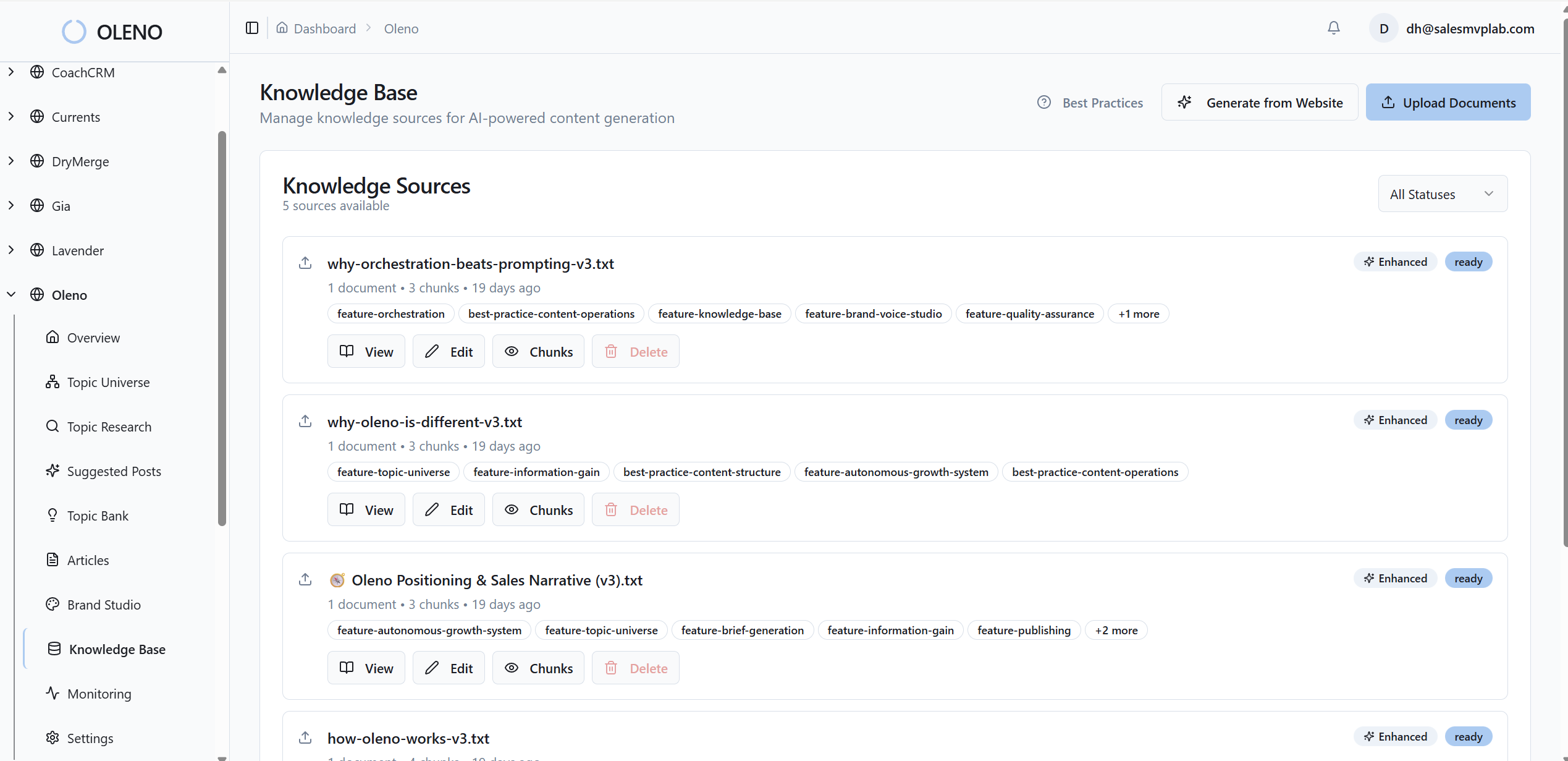
Publishing becomes a step, not a project. The important part isn’t speed; it’s confidence. When content leaves QA, it lands where it should, once, with schema, visuals, and links intact. That’s how you sustain a daily cadence without babysitting.
Visual Studio places brand-consistent images where they matter
Oleno’s Visual Studio maintains a brand asset library, generates hero and inline images, and matches product screenshots to relevant sections using semantic similarity. Solution sections get priority, and alt text plus filenames are generated automatically. Image sizes and ratios are handled without manual design work.
This nudges your credibility up a notch. Not via flashy graphics, but by eliminating mismatched screenshots and generic images that quietly erode trust. It’s part of the same idea: creativity in the writing, accuracy in the code.
Here’s the simple takeaway: when you want the pipeline to carry the weight, you need a system built for it. Oleno was designed for exactly that. If you’re ready to see how it feels to ship daily without the 8pm fixes, start a run. Try Oleno For Free
Conclusion
Speed is easy. Consistency is earned. The difference is a pipeline that preserves strategy, enforces originality, structures drafts for citation, and automates the last mile, links, visuals, schema, and publishing, under one roof. You don’t need bigger teams to publish daily. You need fewer handoffs and better rules. When the system carries the work, your team can focus on the story that actually moves pipeline.
About Daniel Hebert
I'm the founder of Oleno, SalesMVP Lab, and yourLumira. Been working in B2B SaaS in both sales and marketing leadership for 13+ years. I specialize in building revenue engines from the ground up. Over the years, I've codified writing frameworks, which are now powering Oleno.
Frequently Asked Questions