Orchestrating AI Content: Build a Publish‑Ready System in 7 Steps

Most teams think their content problem is output. More words. Faster. Cheaper. Been there. When I was the sole marketer at a SaaS, I could crank 3–4 posts a week, but the second we added a writer, the wheels wobbled. Different tone. Shaky structure. More rework than we had time for. Speed without a system just creates cleanup.
Here’s the shift. Prompts aren’t a workflow. They’re a starting pistol with no race plan. When we treated prompts as the unit of work, every draft felt like a new team learning our voice for the first time. The fix wasn’t better prompts. It was a governed pipeline that moves context, rules, and structure from topic to publish—so we stop doing hero edits and start shipping consistently.
Key Takeaways:
- Treat content as a system, not tasks; move from prompting to orchestration
- Enforce differentiation before writing with briefs and information gain
- Make quality a gate, not a vibe—80+ checks, not opinions
- Generate visuals and internal links deterministically after text
- Publish with retries, idempotency, and audit logs to reduce firefighting
- Measure first-pass QA rates and clean publishes, not draft speed
Prompts Are Not A System, They Are Random Starts
Prompts create drafts; systems create outcomes. A system carries brand voice, KB facts, structure, and checks across every step so output is predictable and shippable. The difference shows up in fewer hero edits and more first-pass QA clears. For example, a 90-day cooldown and snippet-ready sections enforce consistency across months.

Why One-Off Prompting Keeps Failing Your Brand
One-off prompting resets context every time, which is why your tone changes on Tuesdays and structure drifts on Fridays. The prompt writer becomes the bottleneck and the variability source. You don’t want that. You want rules that outlive any one person and keep drafts inside guardrails.
When I was at PostBeyond, I could hit the voice because the rules lived in my head. The moment I had to scale, our drafts slowed and quality dipped. Not because the writer wasn’t talented—because the system wasn’t codified. We had no shared constraints, no single source of truth, and no way to prevent predictable errors before writing started.
Here’s the thing. You can’t review your way to consistency at scale. You need standards upstream: ban lists, preferred phrasing, KB retrieval, structure by default. That’s how you stop firefighting tone and start improving narrative. Prompts can help, but prompts don’t govern.
What Is Orchestration In Practical Terms?
Orchestration is a governed flow that runs the same sequence every time, enforces rules at each gate, and logs what happened. Think Topic → Brief → Draft → QA → Visuals → Linking → Publish. Each stage has inputs and checks. If something fails, the system retries or triggers a specific remediation—no fresh prompt adventure, no “who owns this?” Slack thread.
Industry uses this pattern everywhere else. In AI terms, orchestration matches how agents coordinate specialist skills and pass state forward, which is why patterns like planner–executor exist in practice, not just theory. If you want a primer, see IBM’s overview of AI orchestration for how enterprise teams structure these flows.
The value shows up in boring predictability. Internal links always appear where they should. Visuals look like your brand. Schema is present. Articles publish cleanly. When the pipeline is deterministic, your team can focus on narrative and product positioning, not commas and CMS fields.
Ready to skip theory and see results? Try a constrained system, not a new prompt. If you want a jumpstart, Try Generating 3 Free Test Articles Now.
The Real Bottleneck Is Fragmentation Between Steps
Fragmentation—not writing speed—kills authority. When strategy, briefs, drafts, visuals, QA, and publishing live in different tools and minds, context leaks at every handoff. That’s where off-brand sentences, missing schema, and duplicate topics come from. A single deterministic flow reduces drift. For example, a shared KB and cooldowns prevent accidental overlap.

Why Governance Must Start Before Writing
Governance is codified rules that prevent bad drafts from existing, not redlines after the fact. If you wait until the draft to enforce voice and facts, you’re too late. Upstream gates—information gain checks, KB retrieval, ban lists, snippet-ready structure—turn “editing” into verification. Editors should decide narrative, not fix structure.
I learned this the hard way at LevelJump. We’d record founder videos and transcribe them. Fast, yes. Structured for search and snippet capture? Not really. We were shipping opinion without the scaffolding machines cite. The content had heart, but it forced humans to rescue structure, and that doesn’t scale.
If you need a second opinion on the orchestration pattern, enterprise ops folks have been formalizing it for years. Pega’s framing of AI orchestration as governed flows with guardrails maps cleanly to content ops: design your gates, define success criteria, log outcomes, and keep state between steps. Same principles. Different domain.
The Cost Of Manual Handoffs And Rework Adds Up Fast
Rework compounds faster than traffic. If each piece needs 90 minutes of edits, 30 minutes of image wrangling, and 20 minutes of manual linking and schema, you’ve burned 2 hours 20 minutes per article. At 20 articles, that’s roughly 47 hours of glue work. One week lost to handoffs instead of publishing momentum.
Let’s Pretend You Publish 20 Posts A Month
Let’s pretend you’re a lean team shipping 20 posts. Each draft takes 90 minutes of editing because structure drifts and voice wobbles. Images add 30 minutes because screenshots are missing or off-brand. Linking and schema cost another 20. You’re at 2 hours 20 minutes per piece for cleanup alone—nearly a full week every month.
Here’s where it hurts. Those hours don’t produce new coverage or deeper insights. They fix preventable issues. And because they’re reactive, they never reduce future rework. Without deterministic linking and schema, you’ll rebuild that time sink next month. This is why “draft speed” is a vanity metric if nothing ships clean.
Engineering-Grade Reliability Beats Ad-Hoc Fixes
Publishing reliability isn’t a “nice to have.” It’s your margin of error. One bad field mapping or duplicate slug can turn an afternoon into a fire drill. Build idempotent publishing so retries don’t double-post. Add duplicate prevention. Preserve audit logs for inputs, outputs, QA events, and publish attempts. Debug with facts, not memory.
We did this at a previous company after a webhook hiccup pushed broken links to production. Not dramatic, but it stole hours. Adding idempotency keys and retry logic paid for itself the first time a CMS API hiccuped. You don’t need fancy dashboards. You need safeguards that make failure boring and recovery automatic.
Still dealing with this manually every month? There’s a calmer way to operate. Try Using An Autonomous Content Engine For Always-On Publishing.
The Emotional Toll Of Publishing Roulette Is Real
Quality drift isn’t just a metric problem. It’s trust. When voice is off or claims aren’t grounded, you feel exposed, especially with big customers reading. Systems help here. QA gates block weak drafts, visuals stay on brand, and publishing becomes predictable. That reduces second-guessing. And saves weekends.
When Your Biggest Customer Reads An Off-Brand Piece
You know the feeling. The copy sounds like a stranger. The image could be from any competitor. You worry less about clicks and more about credibility. That anxiety slows teams and invites committee edits. When quality gates enforce voice, structure, and facts before you ever see the draft, reviews shift from “fix this” to “does this move the narrative?”
At Proposify, we ranked for big keywords—but some content sat too far from the product. Great writing, wrong neighborhood. Sales couldn’t use it to start conversations because it didn’t point back to what we solved. Governance earlier in the process—tying topics to product pillars and enforcing cooldowns—would’ve kept us close to demand, not just traffic.
Who Benefits Most From A Governed Pipeline?
Small teams that can’t afford rework. Regulated orgs that can’t publish inaccuracies. Multi-site brands that need distinct voices. If you’re scaling production or want authority to compound, a system pays off fast. If you’re publishing twice a quarter, maybe not today. But if volume increases, the pain shows up. Better to build the rails now.
The 7-Step Operating System To Go From Topic To Publish
A reliable content system runs a fixed sequence with checks at each stage. Start with topics mapped to product pillars, enforce differentiation before writing, and make quality a gate. Then add visuals, deterministic linking, and bulletproof publishing. For example, a 90-day cooldown and 80+ QA checks protect quality without slowing cadence.
Step 1: Define Your Topic Universe With Cooldowns
Map your topic clusters to product pillars. Import your sitemap. Label each cluster’s saturation: underserved, healthy, well-covered, saturated. Enforce a cooldown—say 90 days—before re-covering the same idea, so you avoid cannibalization and keep coverage expanding. The outcome is a pipeline driven by gaps, not gut feel.
When we ran a contributor network years ago, we saw traffic spikes at 500, 1,000, 2,500, 5,000, and 10,000 pages. Most pages did under 100 views, but breadth plus depth created long-tail coverage and authority. A Topic Universe with cooldowns engineers that pattern deliberately. It ensures you don’t pile five “what is” posts on the same angle while neglecting the money pages.
The mechanics are simple: track coverage and saturation per cluster, prioritize underserved areas, and require unique angles for re-coverage. It’s not fancy. It’s disciplined. Interjection. It also eradicates “we wrote that already” debates because the system shows you why this angle is new.
Step 2: Build Knowledge Base And Brand Memory
Centralize your docs, product notes, and positioning into a living Knowledge Base. Add brand voice constraints, ban lists, and preferred phrasing. Then make a rule: if a claim isn’t in the KB, it doesn’t go in the draft. That single constraint slashes factual drift and keeps outputs grounded in what you actually sell.
Brand memory matters. At small teams, the “voice” lives in the founder’s head until… it doesn’t. Meetings eat writing time, someone new steps in, and quality wobbles. Encoding voice and facts into a KB plus Brand Studio–style constraints means anyone (or any model) can produce on-brand work without guessing.
Treat the KB as a dependency across steps, not just drafting. Briefs reference it to choose angles you can support. QA checks against it to block ungrounded lines. Publishing includes it in metadata for consistency. Same source of truth, different uses.
Step 3: Automate Brief Generation With Information Gain
For every approved topic, generate a brief that includes competitive retrieval, gap analysis, and an Information Gain score. If the score’s low, don’t write. Change the angle or deepen the outline until it adds something new. Include 3–5 authoritative external link candidates. Plan snippet-ready H2 openings so each section can stand alone.
This is where you prevent sameness. Most teams “differentiate” during editing. That’s late. A good brief forces novelty before a sentence exists. It gives writers constraints and space: here’s what exists, here’s what’s missing, and here’s the angle we’ll cover. Now write to that.
If you’re curious how orchestration patterns structure agent roles for tasks like research and planning, Microsoft’s guide to AI agent design patterns is a useful mental model. Planner, researcher, writer, reviewer. Each with inputs and outputs. Same idea in content.
Step 4: Run Guarded, Promptless Draft Generation
Use model presets tied to your brief, not freestyle prompts. Inject KB facts and voice constraints automatically. Enforce hierarchy and chunking so sections can be cited independently. The draft should follow the brief exactly. No chat-based edits. No tone experiments mid-stream.
When drafts follow an approved blueprint, reviewers debate the story, not the scaffolding. And because structure is consistent—snippet-ready H2s, paragraphs sized for capture, clear subheads—your content is built to be referenced by both humans and machines. That’s the point: readable and citable.
Guarded doesn’t mean robotic. It means the creative energy goes into explaining the idea, not rediscovering format. The system handles structure, you handle the argument.
Step 5: Enforce QA Gates And Snippet-Ready Structure
QA should be a gate with a pass threshold (for example, 85), not a suggestion box. Score structure, voice alignment, KB accuracy, snippet readiness, and clarity. If a draft fails, trigger remediation loops that fix what failed and re-test automatically. Open every H2 with a 40–60 word direct-answer paragraph, built for snippet capture.
This removes guesswork. Editors stop arguing commas and start shaping narrative. And because the system re-tests failures, you don’t need a human to shepherd fixes across multiple drafts. Quality becomes the pipeline’s job. Editors focus on what only they can do: make the story sharp and useful.
I’ve seen this flip team dynamics. Less defensive editing. More collaborative improvement. When the rules are clear and automatic, the conversation moves up a level.
Step 6: Automate Visuals And Deterministic Internal Linking
Generate a hero and 2–3 inline visuals that use your brand palette and style references. Place product screenshots by semantic match to relevant sections. After visuals, inject 5–8 internal links using only verified sitemap URLs with exact-match anchor text. No fabricated links. No random placement. Code decides, not vibes.
Visual consistency compounds trust. Generic AI art does the opposite. By pulling from a Brand Asset Library and prioritizing solution sections for screenshots, every article looks like it came from you. Then, deterministic linking makes sure content supports content—reliably, and without broken or invented URLs.
This is how you scale without breaking your site map or diluting your brand. Visuals and links are first-class outputs, not an afterthought for someone to fix at 5 p.m.
Step 7: Publish With Connectors, Retries, And Audit Logs
Map CMS fields once. Prevent duplicates by design. Publish as draft or live through connectors. Add idempotency keys and retry logic to handle delivery hiccups. Keep audit logs for inputs, outputs, retrieval events, QA scores, and publish attempts. These aren’t dashboards. They’re operational breadcrumbs for quick recovery.
Publishing should be boring. If a webhook times out, retries should resolve it without human intervention. If a field mapping changes, logs should tell you what failed and why. This isn’t analytics. It’s how you keep shipping daily without wearing the team down.
For broader context on orchestrating complex flows with reliability, enterprise docs cover similar patterns. The point stands: guard the edges, log the states, and make failure uneventful.
How Oleno Automates The Pipeline End To End
Oleno turns this 7-step system into an autonomous pipeline. It maps your Topic Universe, enforces information gain before writing, structures drafts for citation, generates brand-consistent visuals, injects deterministic internal links, adds JSON-LD, and publishes with retries and logs. That doesn’t guarantee performance, but it does reduce rework and prevent preventable mistakes.
Topic Universe, Information Gain, And Briefs That Prevent Repetition
Oleno includes Topic Universe to map clusters to your product pillars, track saturation in real time, and enforce cooldowns. Suggestions prioritize underserved gaps so coverage compounds. When a topic is approved, Oleno generates a brief with competitive research and assigns an Information Gain score to stop lookalike outlines early.
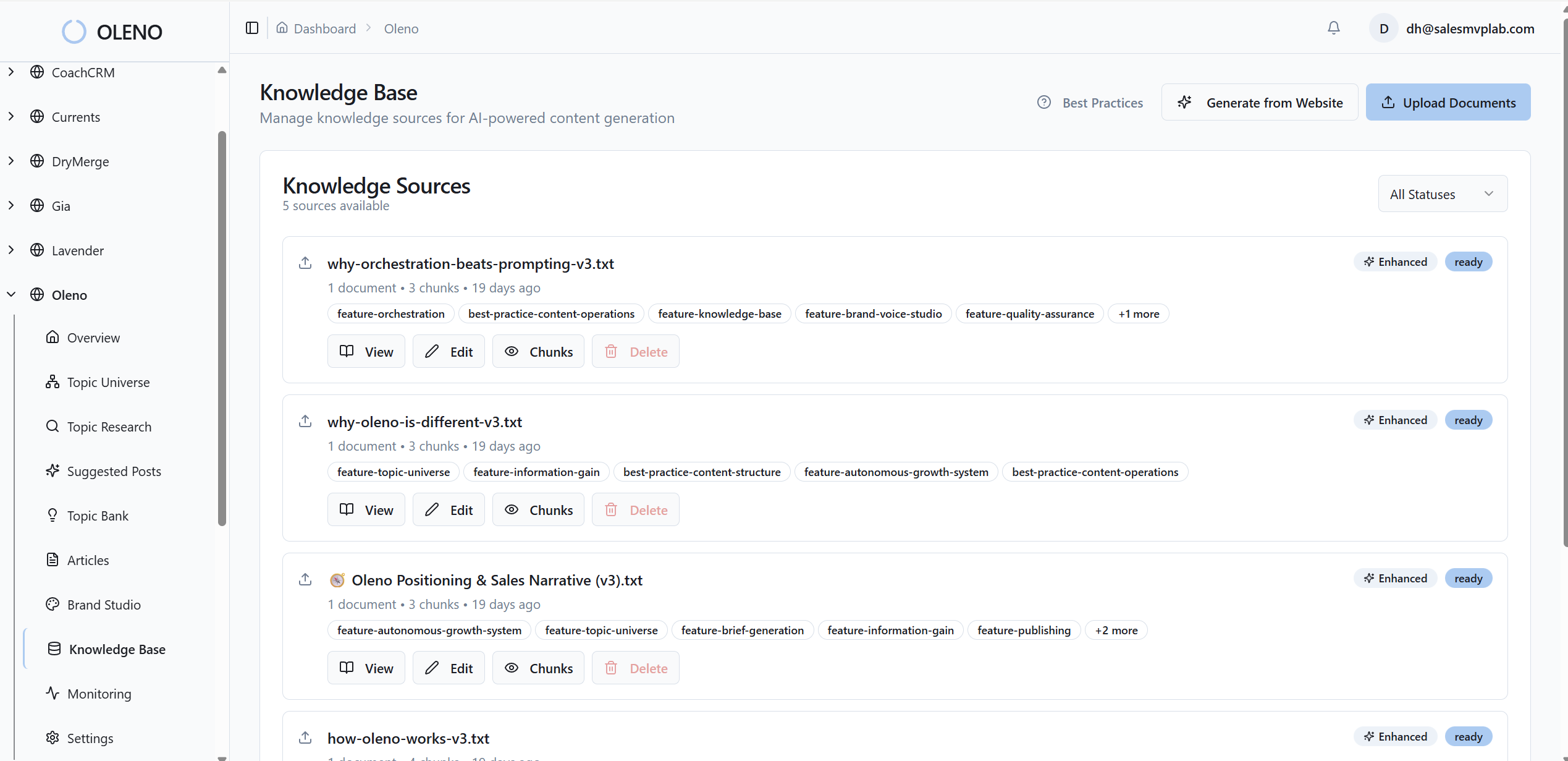
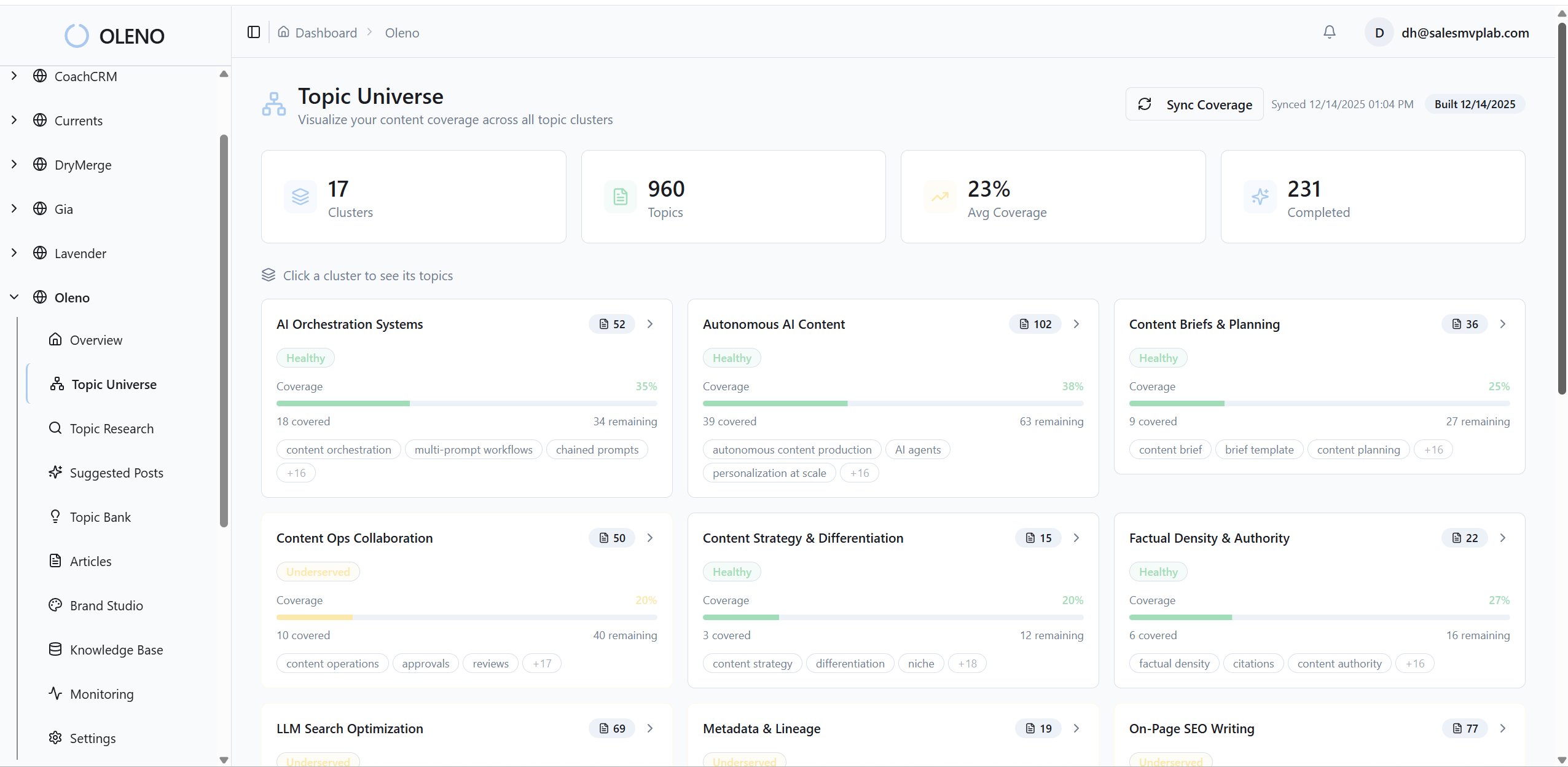
Differentiation is enforced before writing, not hoped for in editing. Briefs spell out what’s already said in the market, what’s missing, and how your piece will add new information. Oleno’s snippet-ready plan ensures every H2 opens with a direct answer, so sections stand alone cleanly and are eligible for featured snippets and AI citations. That’s how you move away from “more words” and toward “more authority.”
Visuals, Deterministic Linking, Schema, QA, And Publishing That Ship Clean
Oleno’s Visual Studio generates a hero and 2–3 inline images with your colors, logos, and style references. It matches product screenshots to relevant sections using semantic similarity and writes alt text automatically. After text and visuals, Oleno injects 5–8 internal links using only verified sitemap URLs with exact-match anchor text—no fabricated links—then generates JSON-LD for Article, FAQ, and BreadcrumbList schemas.
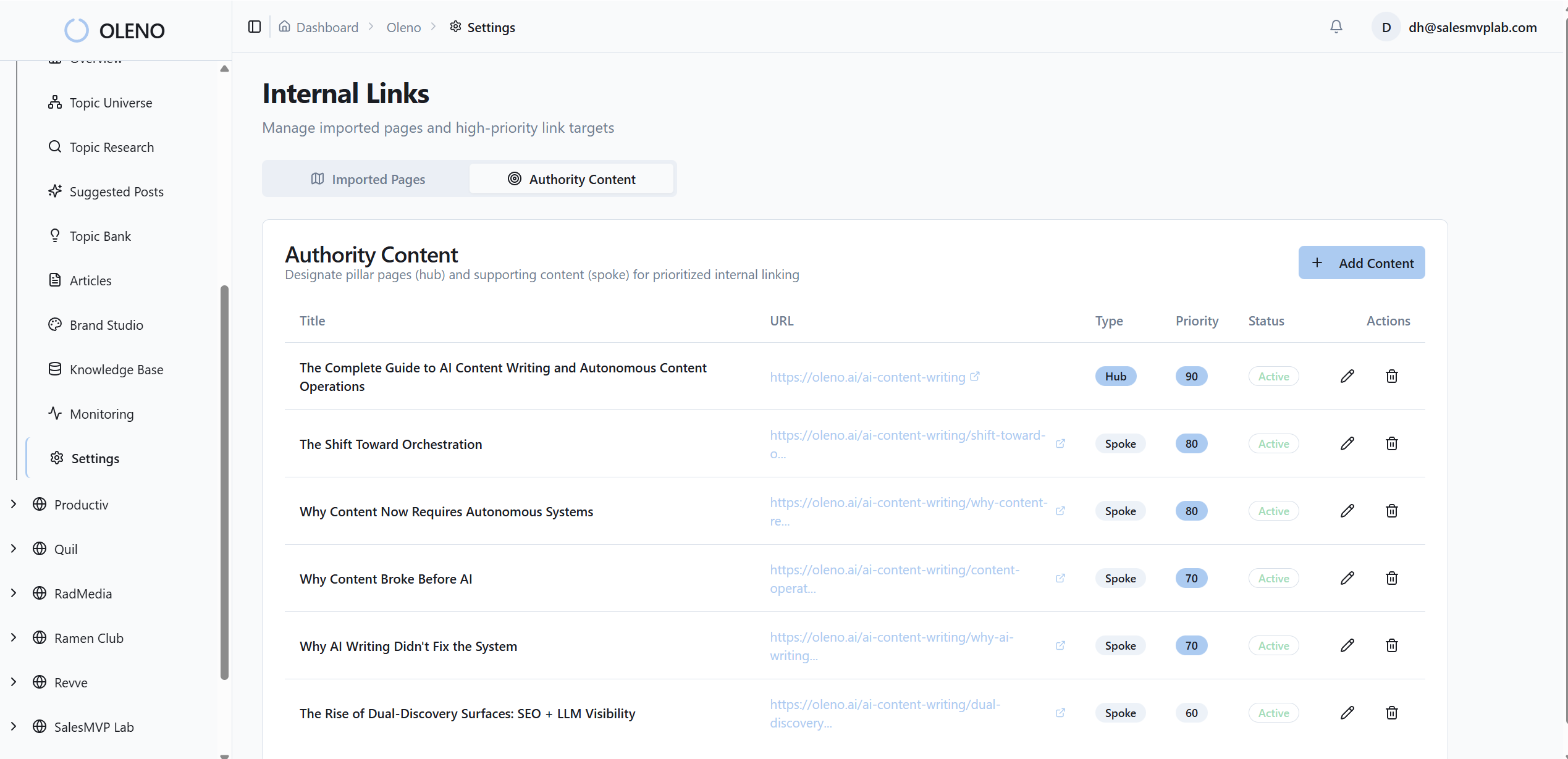
Quality gates check 80+ criteria across structure, voice, information gain, snippet readiness, and visual placement. Low scores trigger refinement loops until standards are met. Publishing runs through connectors to WordPress, Webflow, HubSpot, or Google Sheets, with duplicate prevention, retries, and idempotency keys. Pipeline logs capture retrieval events, QA scoring, and publish attempts so you can debug without guesswork. If the cost of manual cleanup hit you earlier, this is where Oleno earns its keep by eliminating recurring failure modes.
If you want to see a governed pipeline do the heavy lifting—strategy through publish—without hiring an army, that’s what Oleno is built to handle. Try Oleno For Free.
Conclusion
Here’s the point. You don’t fix content with better prompts. You fix it with a system that enforces strategy, structure, voice, and correctness before humans ever touch a red pen. Do that, and you’ll publish more cleanly, argue less about commas, and spend more time on narrative and product.
We’ve stitched this together by hand in the past—sheets, prompts, Slack approvals, last‑minute images—and it worked until it didn’t. Orchestration makes the work reliable. Whether you build it yourself or let Oleno run it for you, the result is the same: fewer rescues, more authority, and a team that ships without worrying about the next 3 a.m. incident.
About Daniel Hebert
I'm the founder of Oleno, SalesMVP Lab, and yourLumira. Been working in B2B SaaS in both sales and marketing leadership for 13+ years. I specialize in building revenue engines from the ground up. Over the years, I've codified writing frameworks, which are now powering Oleno.
Frequently Asked Questions