Orchestrating AI Content Pipelines: Brief to Publish Without Handoffs
Most teams celebrate faster drafting, then wonder why publishing still drags. You get a decent draft, and then the parade of handoffs begins, images, links, schema, CMS formatting, approvals. It’s not one big delay. It’s a dozen small ones. Each creates friction, latency, and inconsistent quality.
I’ve lived both sides. At Steamfeed, we scaled to tens of thousands of pages through structure and volume. At PostBeyond, I could crank out content alone, until I couldn’t. As the team grew, edits grew. Context drifted. I spent more time fixing than writing. The problem wasn’t “writing.” It was the lack of a governed path from brief to publish.
Key Takeaways:
- Drafting faster doesn’t fix publishing bottlenecks, govern the pipeline end to end
- Move correctness into code: links, schema, visuals, and CMS mapping should be deterministic
- Enforce differentiation and voice upstream with information-gain briefs and brand rules
- Add a QA gate that blocks low scores and retries automatically to stabilize cadence
- Track topic coverage and cooldowns to prevent duplicate angles and cannibalization
- Treat content as a system that ships reliably, not tasks that hope to align
Ready to skip the theory and see how this looks in practice? Try a real pipeline: Try Oleno For Free.
Why Faster Drafting Still Creates Bottlenecks
Faster drafting helps, but it doesn’t remove post-draft chaos. The bottleneck is the chain of manual decisions after the draft, images, links, schema, CMS mapping. Those are fragile handoffs, not creative work. The fix is a single, governed pipeline that turns “draft” into “publish-ready” by default.
The Hidden Cost of Handoffs
Even when an AI draft is decent, the work piles up after. Designers swap hero images. Writers add links. Someone backfills alt text. Schema gets “added later.” Ops tweaks the CMS fields. Every handoff is an opportunity for drift, voice drift, structure drift, formatting drift. And when drift happens, teams compensate with edits. A lot of them.
The pattern is predictable: work-in-progress doc, comment storm, conflicting feedback, then a last-minute scramble to hit the calendar. What you need instead is a fixed path where the handoffs aren’t ad hoc, they’re codified. Images aren’t a debate; they’re placed by rules. Links aren’t guessed; they’re drawn from a verified list. Schema isn’t an afterthought; it’s generated and validated before anything ships.
Why Prompts Break at Publish Time
Prompts create words, not publishing systems. A clever prompt won’t set alt text policies, match anchors to real pages, or produce valid JSON-LD. So teams fix everything by hand. That’s slow and error-prone. Better approach: keep creativity in the writing, then enforce accuracy with deterministic post-processing and a QA gate that blocks low scores.
You don’t need more prompt tricks, you need a controlled flow. Agent frameworks and task graphs are useful metaphors, but the real gains come from codifying the steps after the draft. If you want a reference point for controlled task flows, scan IBM’s LangChain and Granite tutorial. The principle holds: isolate creativity, automate structure, validate before ship.
What Is an AI Content Pipeline and Why Does It Matter?
An AI content pipeline is a fixed sequence with constraints: topic mapping, information-gain briefs, KB-grounded drafting, deterministic enhancements, QA, and publishing. It matters because you get predictable, explainable outputs that actually pass quality gates. Less rework. Fewer surprises. A cadence you can keep without heroics.
Here’s the shape: decide what matters (not just keywords, coverage gaps), ensure each piece adds new information, write inside brand and KB constraints, then move structure checks into code. If you want a practical overview of how teams structure this work, the ScoutOS guide to AI workflow orchestration trends outlines common patterns you can adapt.
The Real Root Cause Of Editing Hell
Editing hell isn’t about weak writers. It’s fragmentation. Strategy lives in one tool, research in tabs, writing in prompts, visuals in a separate flow, and publishing somewhere else. No single layer owns the outcome. The fix is upstream: make differentiation, voice, structure, and delivery rules part of one governed system.

What Traditional Approaches Miss
Most stacks optimize one slice. SEO tools suggest topics, writers churn drafts, designers bolt visuals on at the end, and someone in ops wrangles the CMS. The system depends on humans catching everything late. That’s a brittle way to ship. The work looks busy. The results feel uneven.
Reframe it. The real job is to prevent problems upstream. Enforce differentiation before writing. Enforce brand voice and KB grounding during drafting. Enforce internal links, visuals, and schema in code. Then enforce publishing rules with mapping and duplicate protection. If you want a governance lens, skim Pega’s AI orchestration overview. The principle translates cleanly to content: systems beat one-off fixes.
Where Hallucinations and Drift Start
Hallucinations rarely appear out of nowhere; they start when drafts aren’t grounded. If your process doesn’t retrieve KB facts at angle creation and drafting, the model fills gaps creatively. It’s doing its job. Your job is to constrain it. Apply brand rules as hard constraints and validate claims during QA. Don’t try to fix drift with late edits, fix the source.
We’ve seen this in founder-led content too. Great ideas, fast drafts, thin guardrails. The fixes are boring and effective: retrieval at key steps, brand voice enforcement all the way through, and a QA gate that checks facts, structure, and snippet readiness. You reduce hallucination risk and editing time in one move.
The Operational Debt You Can Measure
Operational debt shows up as time you can’t defend. It’s the 90-minute “quick fix” that ate your afternoon and the publish you missed because schema broke quietly. Quantify it, and you’ll see why moving accuracy into code pays back quickly. Here’s how to measure the waste and reclaim the hours.
Engineering Hours Lost to Rework
Let’s pretend you ship 20 posts a month. Each needs 45 minutes of image fixes, 30 minutes of linking, 20 minutes of schema, and 25 minutes of CMS cleanup. That’s two hours per post, roughly 40 hours a month, on avoidable work. It’s not creative time. It’s glue work.
Move those checks into code. Inject links from a verified sitemap. Generate JSON-LD for each article type and validate it. Place visuals using rules and semantic matching. Normalize tone and structure. When the final assembly is production-ready by default, “publish” becomes a button, not a hope.
The Cascading Impact on Cadence
Miss one handoff, you miss your calendar. When cadence slips, authority compounds more slowly. Your weekly schedule turns into a “we’ll catch up next sprint” plan. And the team starts budgeting extra time for “edits,” which is really code for “our system isn’t a system.”
A QA gate that blocks low scores and triggers automated refinements stabilizes throughput. It’s not perfectionism; it’s predictable flow. The gate also protects your brand from tail risks, duplicate posts, malformed schema, broken links, without dragging humans into every check. Throughput improves when you stop firefighting avoidable issues.
What It Feels Like When Quality Depends On Luck
When quality relies on heroic effort, you feel it in your weekends. You publish, then cross your fingers. Sometimes it works. Sometimes it breaks in subtle ways that only show up after crawlers or customers notice. This isn’t about being careful; it’s about building a system that doesn’t roll dice.
The 3am Rollback Nobody Wants
You queue a publish, wake up to broken templates. Wrong hero, no alt text, stray links. Slack pings. People scramble to hotfix and roll back. Nobody did “bad work.” The process allowed variance to sneak through. That’s the tell.
Set a pass threshold and block delivery when sections fail structural checks. Let the system retry with targeted refinements until it clears the bar. You’re not slowing down, you’re preventing risky tail events. Confidence goes up when publishing isn’t a leap of faith.
When Your Best Article Ships Without Schema
No schema means missed eligibility for rich results and weaker machine understanding. Worse, it often fails silently. The fix is simple: generate JSON-LD programmatically for Article, FAQ, and BreadcrumbList, validate it, and attach it during delivery. Pre-publish validation kills the “we’ll add it later” excuse.
If you want to understand how teams implement pre-publish checks in real workflows, browse the Kestra documentation on orchestration patterns. Different domain, same idea: validate before you ship, and you’ll ship cleaner.
Still dealing with this manually? It doesn’t have to be that way. If the goal is fewer late-night fixes, start directing structure with rules and let the system handle the repetitive parts. When you’re ready to test a governed flow, Try Using An Autonomous Content Engine For Always‑On Publishing.
A Practical Pipeline From Brief To Publish Without Handoffs
A practical pipeline turns strategy into consistent output. It starts with topic coverage, adds information gain, constrains drafting with KB and brand rules, and ends with deterministic enhancements plus a QA gate. Build it once, then run it daily. This is how you protect differentiation at scale.
Design the Topic Universe Layer
Start by ingesting your KB and sitemap. Cluster topics, label saturation, and set cooldowns so you don’t re-cover the same angle too soon. When a cluster is well-covered, pause it. Route production to underserved clusters. You’ll reduce cannibalization and keep publishing net-new value that compounds.
This turns planning into coverage management, not guesswork. You know what to write next because the system tells you where your authority is thin. And you can explain those choices to stakeholders without waving at keyword volume charts.
Automate Information‑Gain Briefs
Generate briefs that include competitive scans and score uniqueness before writing. If the score is low, adjust the angle, structure, or examples, before anyone sinks hours into drafting. Attach 3–5 authoritative external sources with suggested anchors to speed research without bloating the narrative.
Briefs aren’t paperwork; they’re guardrails. When differentiation is enforced upstream, drafts read fresher, edits shrink, and your team stops rewriting thin takes. The point isn’t speed for its own sake. It’s quality that ships on time.
Constrain Drafts With KB Retrieval and Brand Voice
Write inside constraints. Retrieve KB facts during angle creation and drafting. Apply voice rules, banned terms, and narrative patterns so structure stays consistent. Open each H2 with a direct, snippet-ready paragraph. Creativity thrives inside a clear frame; it doesn’t need to improvise the frame itself.
You’ll notice two effects quickly: hallucinations drop because the model isn’t guessing, and editing time falls because the draft already sounds like you. Guardrails don’t box you in, they keep you from wandering.
How Oleno Runs This End To End
Oleno executes the system for you. It maps topics, enforces cooldowns, generates information‑gain briefs, drafts inside brand and KB constraints, and then handles visuals, links, schema, QA, and publishing. The outcome is a publish‑ready article that looks and sounds like your brand, without manual handoffs.
How Oleno Maps Topics and Enforces Cooldowns
Oleno’s Topic Universe discovers and clusters topics from your KB and sitemap, labels saturation, and enforces a 90‑day cooldown. That prevents over‑covering familiar angles while gaps expand elsewhere. Capacity gets routed to underserved clusters where authority can grow.
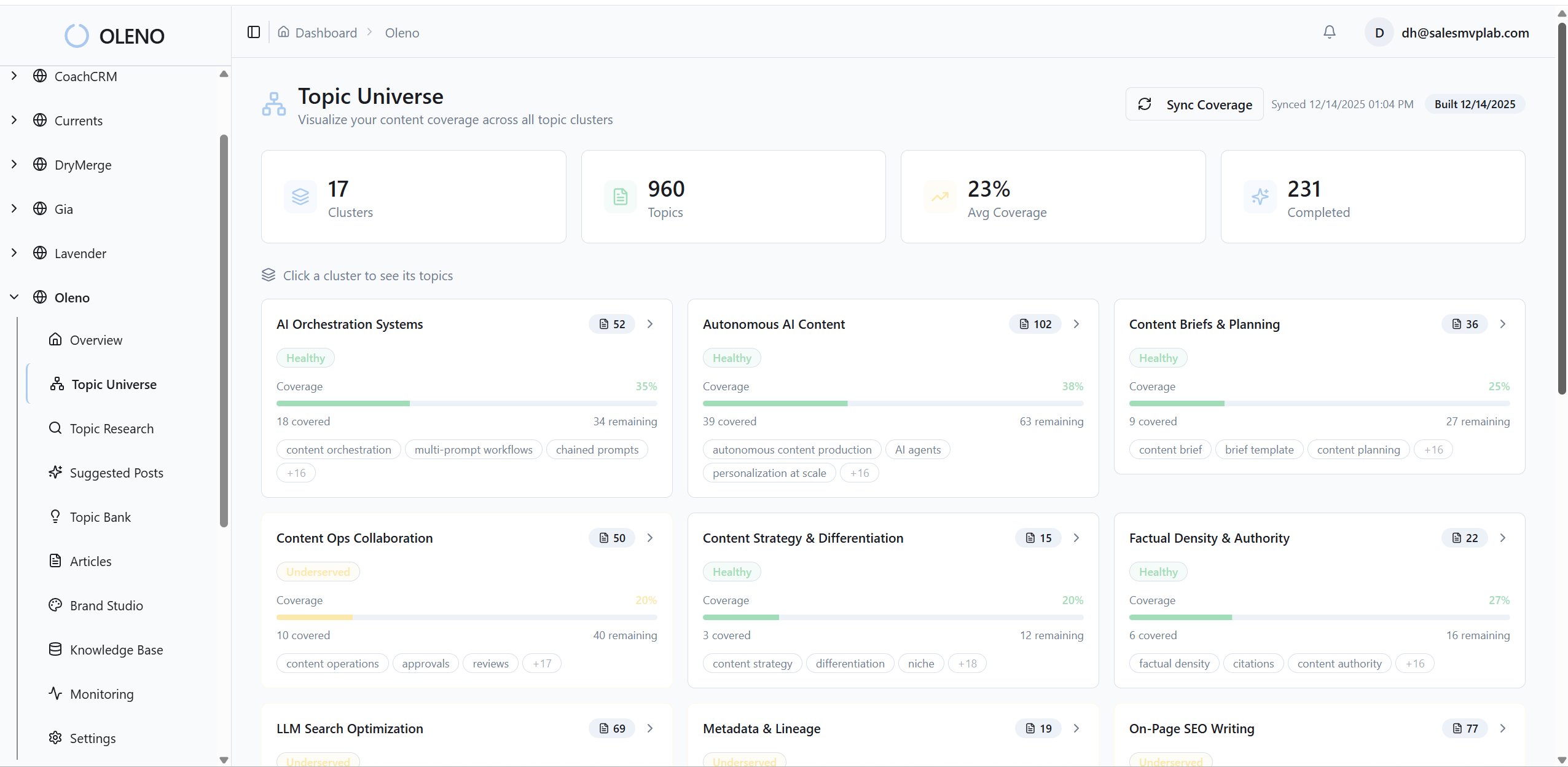
This is strategy baked into operations. As coverage improves, priorities shift automatically. You don’t babysit a calendar; you steer a system that keeps your mix healthy over time.
How Oleno Drafts, Enhances, and QA Checks Deterministically
Drafts align to your brand voice and KB facts, with snippet‑ready openers per H2. Enhancements are code‑first: internal links come from a verified sitemap list with exact‑match anchors, schema is generated and validated for Article/FAQ/BreadcrumbList, and Visual Studio places brand‑consistent hero and inline images using rules plus semantic matching.
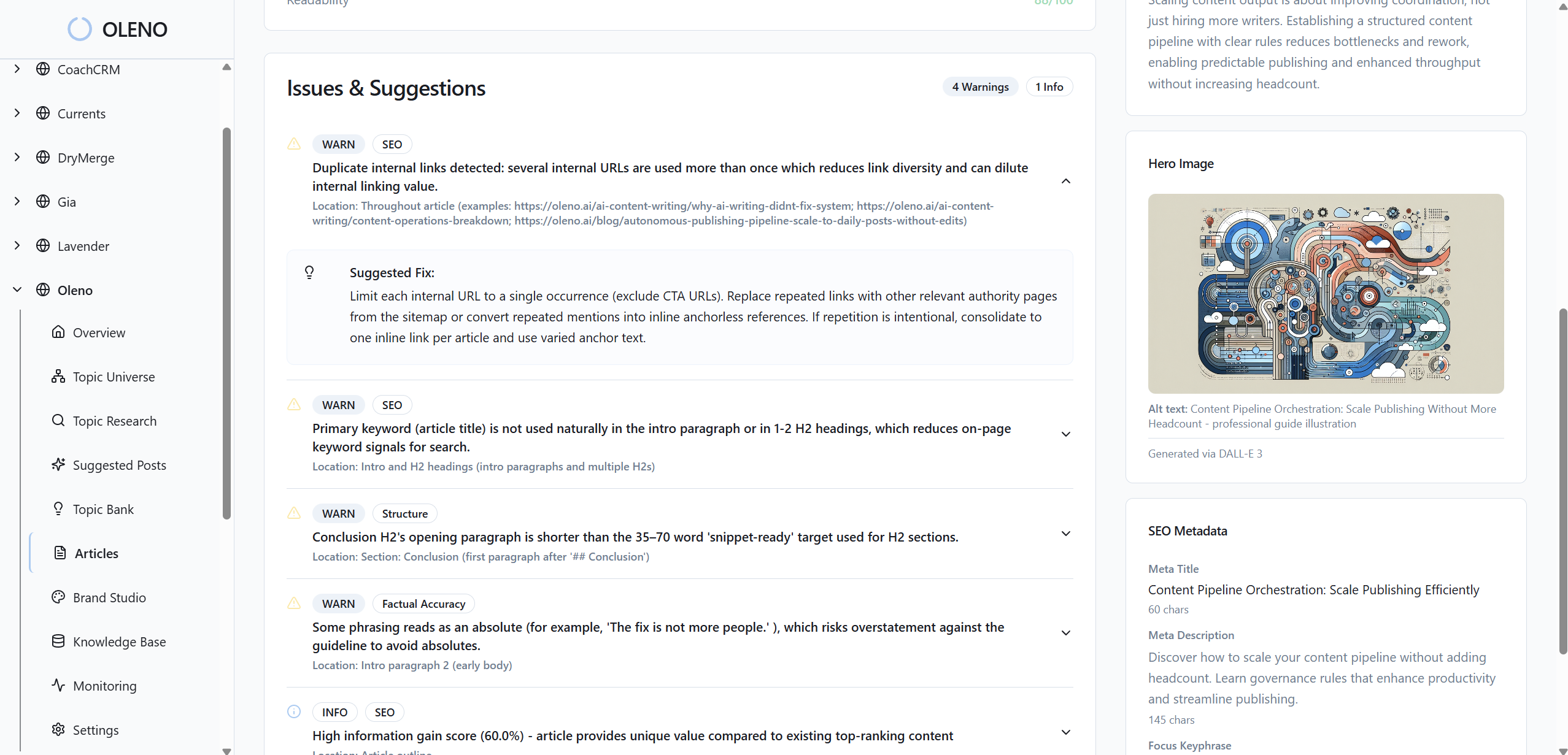
A QA gate evaluates 80+ criteria, structure, clarity, brand alignment, snippet readiness, visual placement, and loops refinements until the minimum score is met. This reduces the manual edits you used to accept as normal and protects against the tail risks that erode trust.
How Oleno Publishes Safely and Recovers From Delivery Failures
Publishing connectors convert markdown to CMS‑ready HTML, map fields, embed metadata, and prevent duplicate posts. Schema travels with the content. If a delivery fails, Oleno sends notifications and retries cleanly. System‑level logs capture inputs, outputs, retrievals, QA scores, publish attempts, and version history so you can audit or roll back when needed.
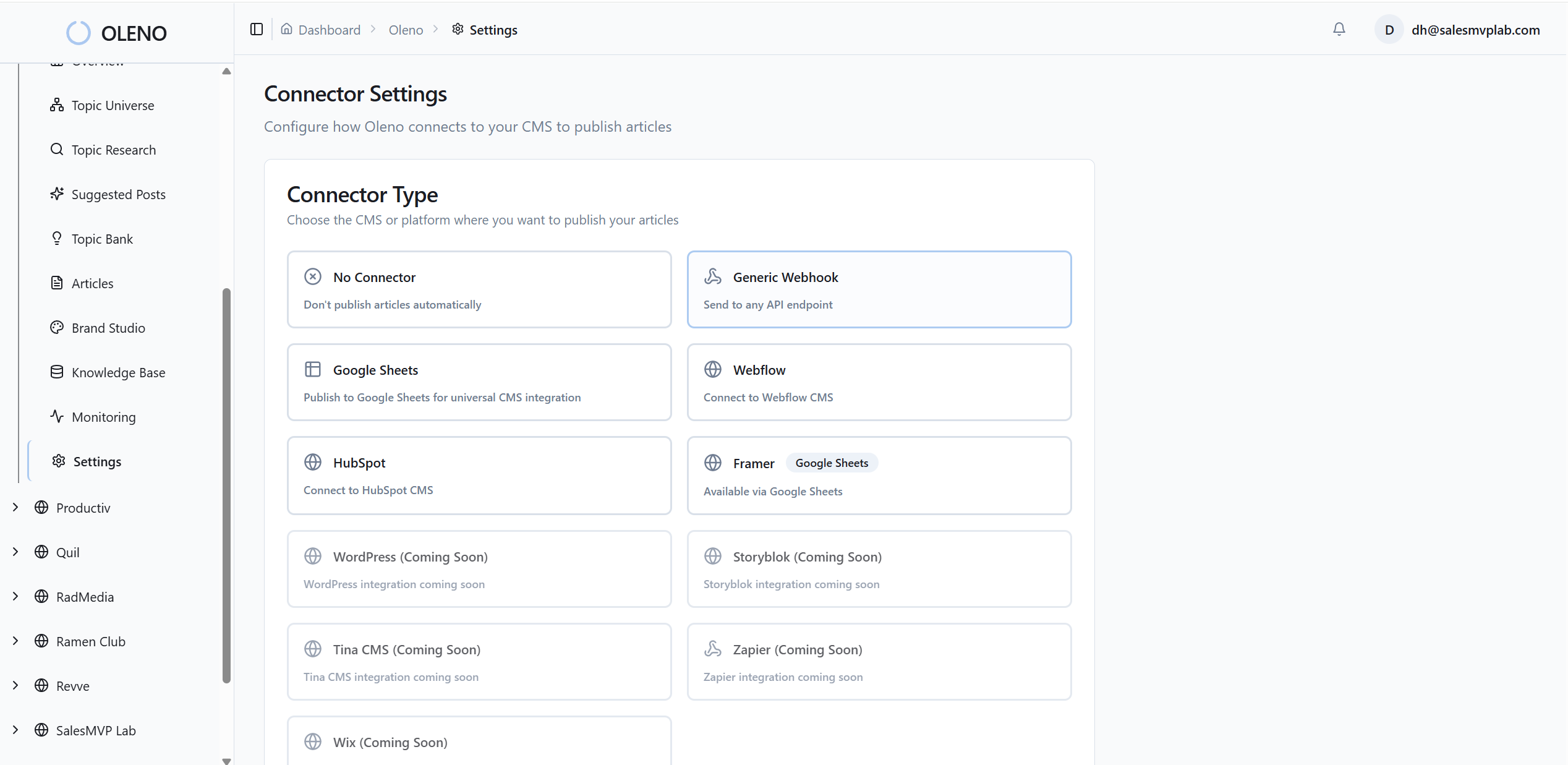
The point isn’t to make publishing flashy. It’s to make it predictable, so your team focuses on story and examples while Oleno handles the mechanical parts you shouldn’t be debating.
If you want to see how this feels with your content and brand voice, you can spin up test runs quickly. Try Generating 3 Free Test Articles Now. You’ll see the downstream lift in hours saved and a steadier cadence, without promising perfection.
Conclusion
Here’s the thing. You don’t need heroics to scale credible content. You need a governed pipeline that makes correctness boring: differentiation upstream, drafting inside constraints, deterministic enhancements, a hard QA gate, and safe publishing. Do that, and “publish” stops being a cliff. It becomes a habit your team can sustain.
About Daniel Hebert
I'm the founder of Oleno, SalesMVP Lab, and yourLumira. Been working in B2B SaaS in both sales and marketing leadership for 13+ years. I specialize in building revenue engines from the ground up. Over the years, I've codified writing frameworks, which are now powering Oleno.
Frequently Asked Questions