Orchestration vs Prompting: A Comparison for CMOs Scaling Content Marketing at SaaS Companies
Speed feels productive. Drafts fly. Slack lights up. But your pipeline still slips. I’ve been in that loop. At a sales-led SaaS, our content volume grew nicely, yet pipeline didn’t. We ranked for topics the product didn’t solve. Hard truth: quick words without coordinated execution just create more editing and brand risk later.
I’ve also lived the other side, the volume game. Years back at Steamfeed, we hit 120k monthly uniques by publishing at scale. It wasn’t just velocity though. It was structure plus breadth, across hundreds of unique voices, every week. When the work is governed, volume compounds. When it isn’t, volume multiplies rework.
Key Takeaways:
- Stop optimizing for “draft speed” and start optimizing for “time-to-publish a complete, on-brand article”
- Treat content as a system with rules, gates, and ownership, not a pile of prompts and preferences
- Quantify the edit tax and normalize it with a governed pipeline before you scale output
- Encode accuracy and voice upstream so you’re enforcing standards, not begging for them
- Use prompts for experiments, use orchestration for production
- Migrate in 30–60–90 day phases, then codify what works as rules, not meetings
Why Draft Speed Alone Won’t Scale Your Pipeline
Draft speed is not your constraint. Production reliability is. Rework hides downstream in voice fixes, structure patches, image hunts, schema, and publishing mechanics. That is where hours disappear. When you codify voice, accuracy, and publishing rules before writing, you convert speed into scale without a rework treadmill.

The real choke point in your pipeline
If all you optimize is drafting, you push complexity to the tail of the process. Editors normalize tone, fix structure, and retrofit links and visuals while deadlines creep. At 10 articles, this is annoying. At 50, it is a full-time problem. The bottleneck isn’t words per hour, it is finished, publish-ready assets per week.
- Editing, restructuring, and compliance checks soak time that was never budgeted.
- Visuals, internal links, and schema get handled manually, which guarantees variance.
- Publishing turns into a scramble, then a backlog.
That “last mile” is the mile that decides whether you scale or stall. For the strategic shift that turns drafts into assets, see the orchestration shift and how autonomous content operations reduce that tail work.
Prompting pushes costs downstream
Prompts start from near-zero context each time, so tone, structure, and accuracy wobble. You save 45 minutes on a draft and spend 2 to 3 hours fixing it. Imagine you plan 20 posts this month. That is 15 hours drafting and roughly 50 hours editing. Leadership gets dragged into triage, and your “fast month” becomes a traffic jam.
If you want a broader lens on orchestration versus operations, compare how production governance differs from coordination in Content Marketing Institute’s take on orchestration vs. operations.
Curious what this looks like in practice? Try using an autonomous content engine for always-on publishing.
Treat Content As A System, Not A Set Of Prompts
Content scales when the pipeline is designed, not when the prompts are clever. A modern system maps strategy to publish with rules for voice, structure, accuracy, visuals, links, and schema. Each stage enforces standards so drafts already look like your brand and ship on time with minimal touch.

What a modern content system includes
Map the full flow and encode rules at each stage. Topic selection aligns with your product story, not random keywords. Briefs include competitive research and an information gain target. Drafts follow snippet-ready section patterns. Then visuals, deterministic internal links, and schema are added programmatically. The result: words are not the workflow, the workflow produces the words.
- Strategy to brief: identify gaps and set information gain targets
- Draft to QA: enforce voice, banned terms, and snippet-ready structure
- Enhancement to publish: add visuals, internal links, and schema deterministically
If this mindset is new to your org, these two primers help set the frame: why you need autonomous systems and a content operations breakdown of legacy failure points.
Who owns what (and why it matters)
Ownership prevents blame-shifting. Marketing owns themes and coverage priorities. Brand owns voice and banned terms. Product owns knowledge base fidelity. Ops owns CMS connectors and delivery fields. Pair this with gates that reject subpar outputs automatically. Your team coaches the system rather than hand-editing every article.
- Clear RACI reduces variance and speeds diagnosis when quality dips
- Gates, not meetings, enforce standards and cut the edit tax
- Exceptions become rules in the pipeline, not folklore in Slack
Where prompting still fits
Keep a sandbox for ideation, experiments, and quick outlines. Prompts are great when speed-to-insight beats polish. They are risky for production because they do not enforce governance. The line is simple: orchestration for repeatable publishing, prompts for low-stakes exploration. Mixing them without rules creates variance you will pay for later. For adjacent context, see how journey orchestration differs from basic automation in CMSWire’s comparison.
The Hidden Costs Of Prompt-Only Workflows
Prompt-only workflows create invisible friction that compounds at volume. The edit tax shows up as tone fixes, structure rewrites, link and schema retrofits, and screenshot hunts. None of these tasks are hard individually. Repeated 40 times, they devour a sprint and push launches out.
Let’s pretend: the edit tax
Imagine 40 posts in a month. Prompts cut drafting to 45 minutes each. Nice. Now add 90 to 150 minutes per piece to normalize voice, restructure sections, add visuals, inject internal links, generate schema, and publish. Micro-delays multiply into missed goals. Track rework hours per article and time-to-publish from brief to live. You will see the bottleneck before traffic data catches up.
- Rework hours rising? Update rules, not headcount.
- Low QA pass rate on first attempt? Tighten standards earlier in the flow.
- Time-to-publish slipping? Automate enhancements, then enforce gates.
If you want a primer on the operational side of orchestration, this short overview on prompt orchestration from Moody’s is a helpful contrast.
Failure modes to expect
Without knowledge base grounding, hallucinated facts sneak in. Without persistent voice rules, tone drifts post by post. Without deterministic enhancements, links, visuals, and schema are manual and inconsistent. These are not catastrophic once. They are expensive when repeated a hundred times.
Push accuracy and structure into policy, not guidance. Prompts cannot enforce guardrails reliably. Pipelines can. If you are still unconvinced that faster drafting alone fails, here is a deeper look at AI writing limits and how an automated QA gate cuts reviews by focusing on enforceable thresholds.
CMO Concerns: Brand Risk, Rework, And Slipping Deadlines
This feels brittle because it is. I have been on teams where volume looked great in a dashboard yet did little for pipeline. Content ranked, but the narrative drifted from the product story. When strategy, facts, and voice are not enforced upstream, “good writing” misses the mark and rework shows up late.
Why this feels brittle
The brittleness shows up in rewrites to match the offer, screenshot hunts that slow publishing, and compliance edits that arrive after you already shipped. You are managing variance, not scale. It is frustrating rework that steals time from campaigns that actually change the quarter.
I saw this at a proposal software company that ranked for keywords far from the core product. Great traffic, weak demand-gen. You need a system that ties coverage to the product narrative before writing begins.
What you should protect
Define non-negotiables and treat them as policy as code. Brand voice and banned terms. KB-grounded claims. Deterministic section patterns that open with direct answers. Programmatic schema and verified internal links. When these are baked into the pipeline, you protect credibility while moving faster.
- Voice rules and KB alignment enforced before drafts leave the gate
- Snippet-ready sections and schema applied consistently
- Internal links injected from verified sitemaps, not memory
The governance part matters. Translate standards into gates with a simple governance playbook and connect structure to SEO and LLM quote-ability with dual discovery. For a broader market perspective, see Content Marketing Institute on orchestration vs. operations.
A Decision Framework To Move From Prompting To Orchestration
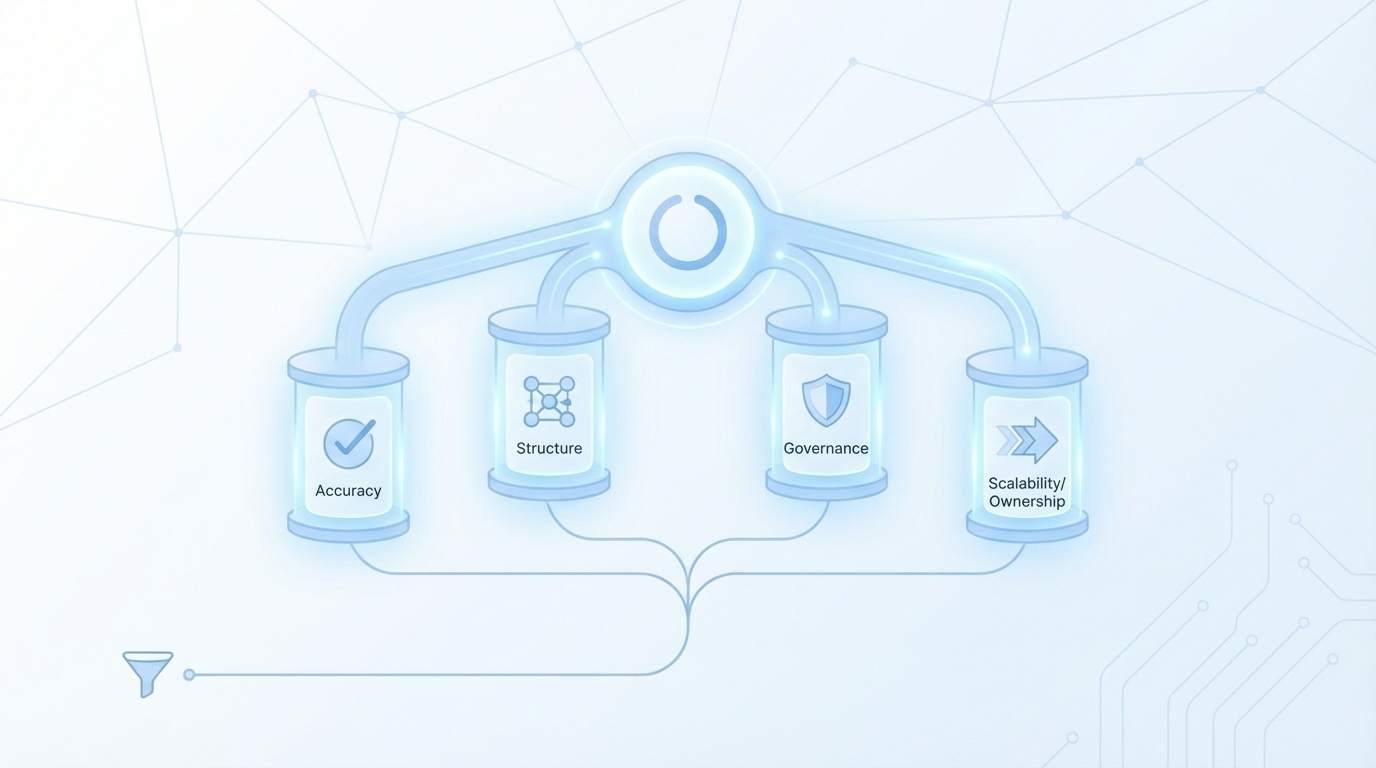
Choose governance when the cost of variance beats the savings from fast drafts. Evaluate accuracy, structure, governance, scalability, and ownership. If you need strong marks on three or more, orchestration earns its keep even if setup takes longer. The simplest proof is time-to-publish and rework hours trending the right way.
Decision matrix: accuracy vs cost vs governance
Score five axes honestly. Accuracy means knowledge base grounding across brief, draft, and QA. Structure means deterministic sections and snippet-ready openings. Governance means voice, banned terms, and non-negotiables enforced as rules. Scalability means hands-off publishing with images, links, and schema. Ownership means a clear RACI and gates.
- If time-to-publish falls and first-pass QA rises, you are on track.
- If rework hours flatten or drop, governance is working.
- If exceptions repeat, encode a new rule.
You can also compare how orchestrators complement creators in ContentGrip’s view on marketing teams with AI orchestrators and creators.
30–60–90 migration plan
Start small, then expand with rules, not more meetings.
- 30 days: Pilot one topic pillar. Success equals reduced rework hours and a higher first-pass QA rate, not traffic.
- 60–90 days: Expand to two more pillars, connect CMS publishing, and automate schema plus internal links. Document exceptions and convert them into rules.
If you are still editing most outputs at day 90, upgrade governance, not the people. To compare approaches head to head, here is a practical prompting vs orchestration overview and a blueprint for an autonomous content engine.
How do you maintain flexibility?
Keep a prompt sandbox for experiments. When something works, codify it into production. Avoid hard-coding every rule so you can iterate on voice and knowledge base scope as the market shifts. Flexibility comes from clean configuration, not ad-hoc prompting in production.
Ready to eliminate rework hours you keep paying for? Try generating 3 free test articles now.
How Oleno Implements An End-To-End Content Operations Platform
Oleno runs a fixed, repeatable pipeline that turns strategy into publish-ready articles. The sequence is deterministic where accuracy matters and configurable where creativity belongs. Articles only ship after quality gates pass, so you trade random fixes for predictable outcomes.
What Oleno runs every time
Remember the downstream tax we walked through? Oleno removes it by running the same sequence for every article: Topic, Angle, Brief, Draft, QA, Enhancements, Image, Publish. Brand voice rules and knowledge base facts apply at every stage. After text is strong, enhancements are added deterministically.
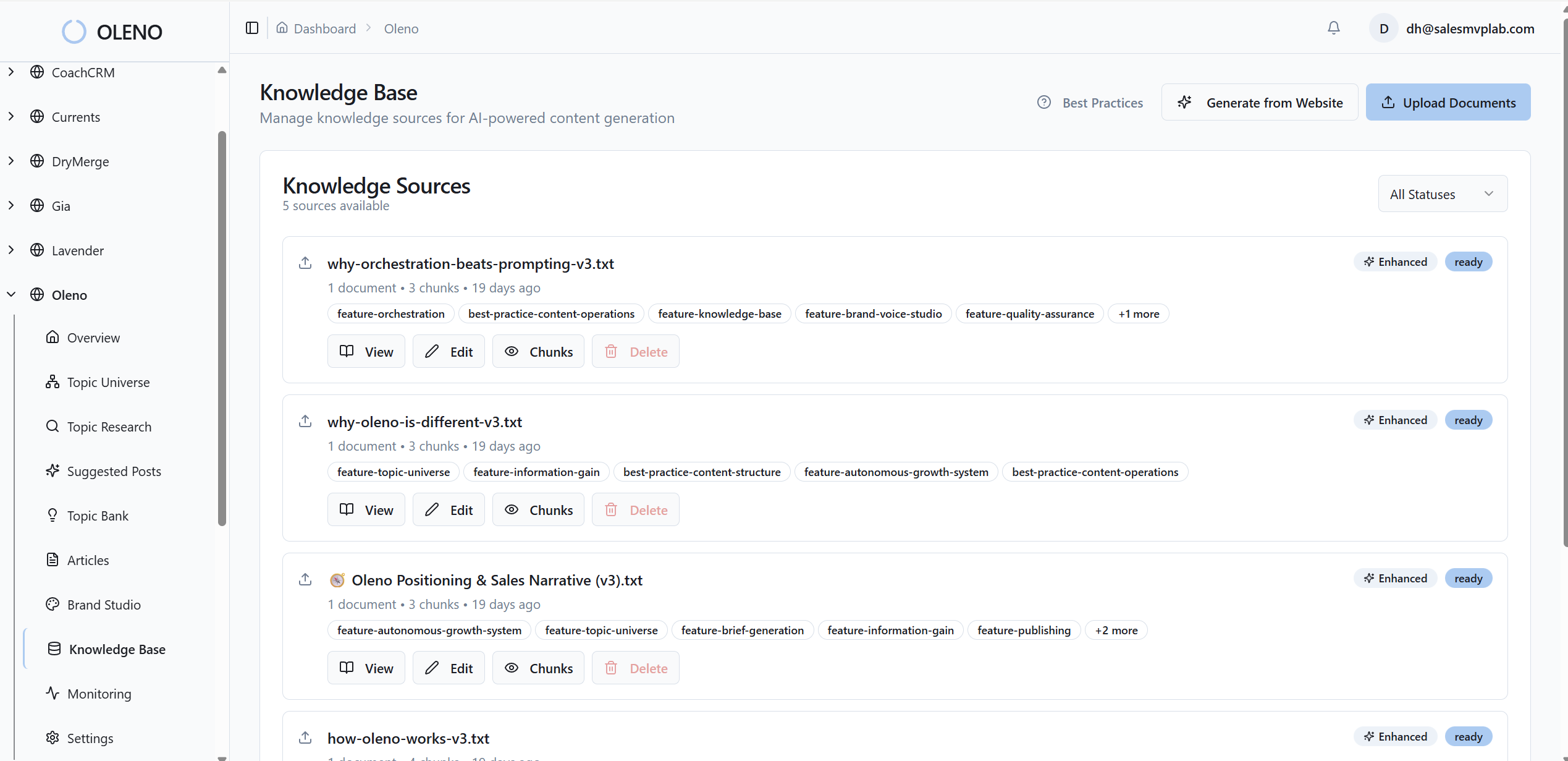
- Topic Universe selects and prioritizes coverage based on gaps and saturation
- Information gain is enforced in the brief to avoid restating the internet
- Visual Studio generates brand-consistent hero and inline images using your assets
- Internal links are injected from verified sitemaps, with anchor text matching titles
- Schema markup is generated as JSON-LD for Article, FAQ, and BreadcrumbList
- CMS connectors deliver to WordPress, Webflow, or HubSpot without duplicate posts
Explore how this supports autonomous content operations, why the orchestration shift matters, and how structure improves dual discovery. For market context, here’s a quick primer on orchestration practices.
Governance and accuracy by design
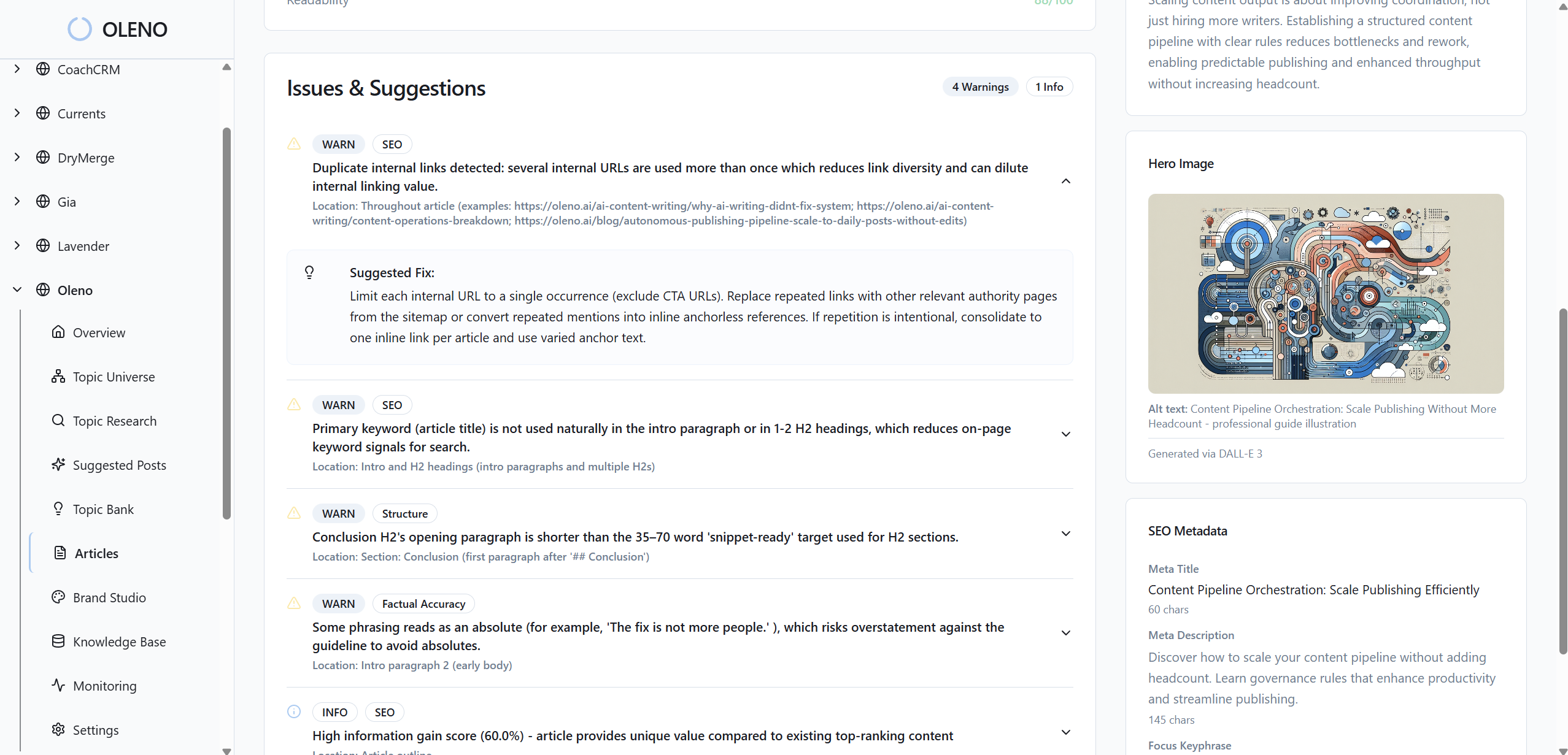
This is where the edit tax disappears. Accuracy is grounded in your knowledge base during brief, draft, and QA. The QA gate checks 80 plus criteria, including voice alignment, information gain, snippet-ready openings, visual placement, alt text, and schema. Low-scoring drafts trigger automated refinements until they meet thresholds. Then connectors map fields and publish as draft or live, while preventing duplicates.
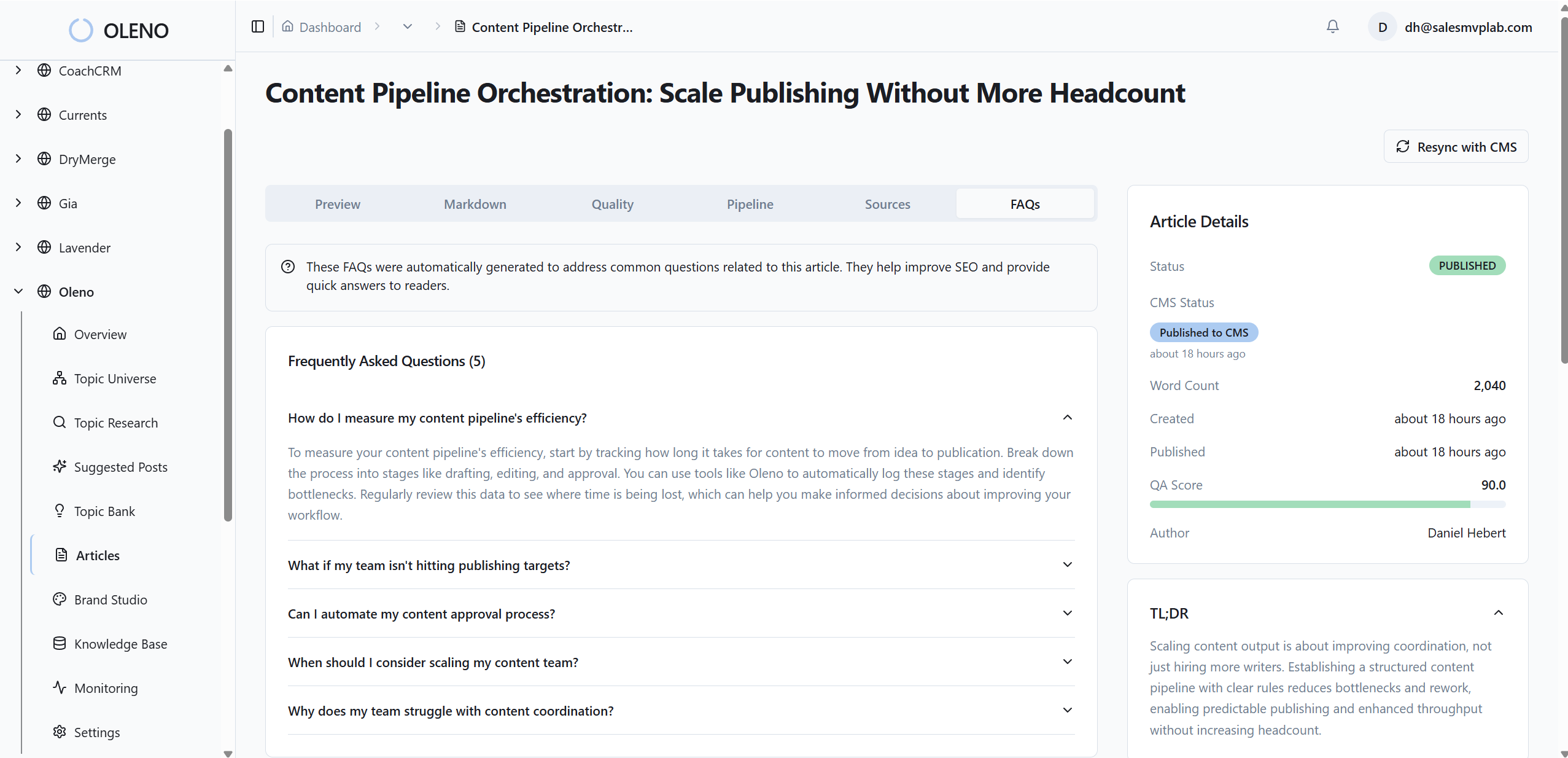
In practice, teams see first-pass quality improve and rework hours flatten because the pipeline enforces the rules. Visual Studio applies your color palette and style, and matches product screenshots to relevant sections. Internal links use only verified URLs, which means no fabricated links to pages that do not exist. Schema publishes with the article, so you stop patching markup after the fact. That is the shift from “busy” to “scalable.”
Getting started is light. The Quick Start Wizard builds an initial knowledge base from your site, extracts brand voice, imports your sitemap, and initializes topic suggestions. Multi-site management keeps brands isolated, each with its own voice and KB. Notifications let you know when drafts are ready or when delivery needs a retry. If your team wants a deeper contrast with legacy workflows, this content operations breakdown shows where old processes slow you down.
Want to see the pipeline run end to end without handoffs? Try Oleno for free.
Conclusion
Here is the call. Stop asking “How fast can we draft?” and start asking “How reliably can we ship something we are proud of, at scale?” When you treat content as a system, the choke points move upstream and the edit tax fades. Prompts still have a place, just not as your production backbone.
Orchestration is how you protect brand, reduce rework, and keep deadlines honest while you grow output. The shift is not flashy. It is practical. A governed pipeline turns strategy into publish-ready articles, day after day, without the Friday scramble. If you want to feel that change in your process, the simplest next step is to run a pilot and measure rework hours and time-to-publish. Then scale what works.
About Daniel Hebert
I'm the founder of Oleno, SalesMVP Lab, and yourLumira. Been working in B2B SaaS in both sales and marketing leadership for 13+ years. I specialize in building revenue engines from the ground up. Over the years, I've codified writing frameworks, which are now powering Oleno.
Frequently Asked Questions