Orchestration vs Prompting: Which Approach Actually Preserves Your Marketing Message?

Most teams compare orchestration vs prompting as if it’s a taste test. Fast drafts on one side, “more process” on the other. I’ve been on both sides. When you’re under pressure, prompts feel like relief. But demand generation isn’t a single task you check off. It’s a system you have to run week after week, across channels, with the same voice and the same product truth.
When speed outruns structure, your message breaks. Not right away. It shows up as minor edits, awkward claims, and a sales team asking why this article “sounds off.” I’ve lived those small cuts. They add up. The fix isn’t more effort. It’s making the system carry the weight you’re putting on people.
Key Takeaways:
- Fast prompting creates output, but coordination and rework erase the gains
- The real problem isn’t ideas, it’s fragmented execution across tools and people
- Orchestration encodes voice, claims, and cadence so quality repeats reliably
- The hidden costs are editing time, brand risk, and missed cadence under pressure
- A hybrid works: use prompts inside guardrails, let orchestration run the pipeline
- Oleno turns governance and job-based execution into publish-ready output at scale
Your Message Breaks When Speed Outruns Structure
Fast prompts feel productive because text appears instantly, but demand generation is a system that needs consistent rules, not one-off drafts. When voice, claim boundaries, and cadence aren’t defined upfront, each prompt becomes a fresh gamble. You gain speed, then pay it back in edits, meetings, and missed deadlines.
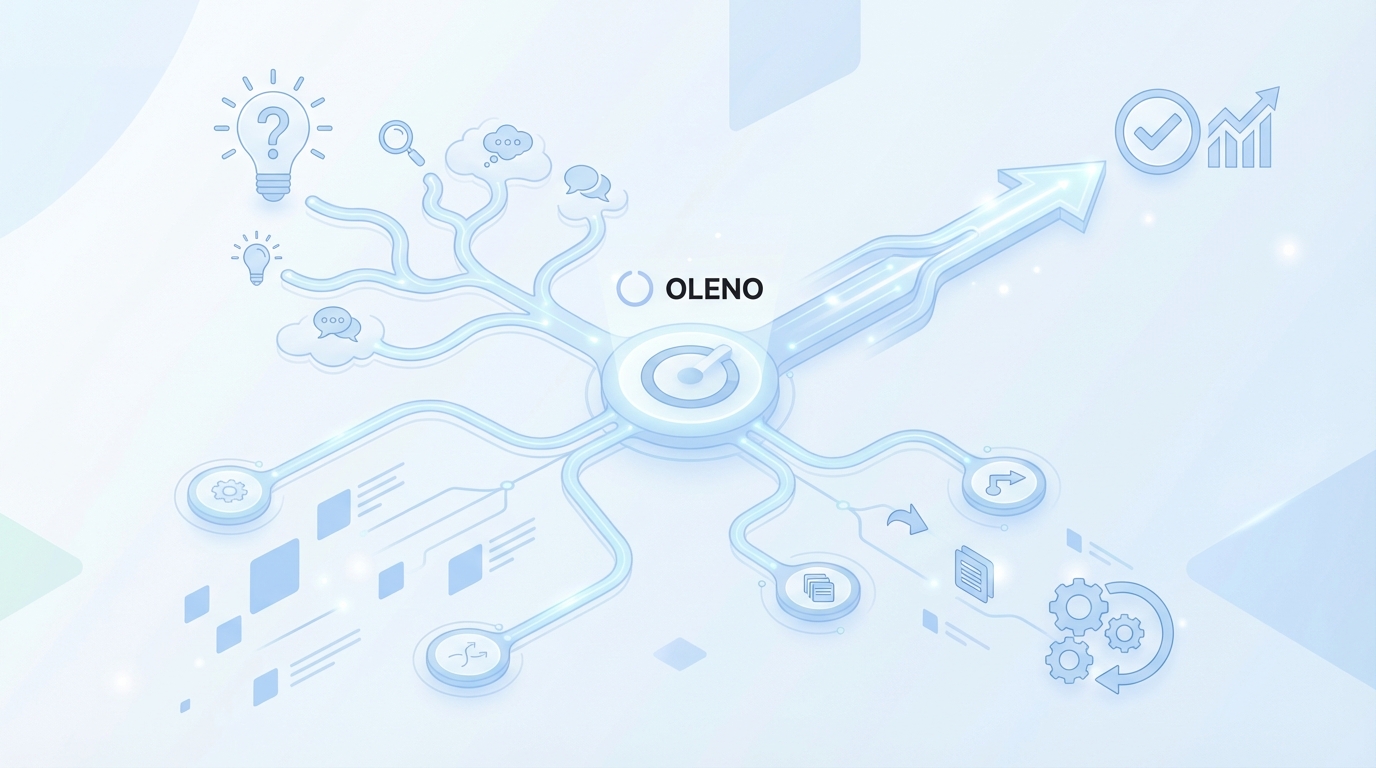
The dangerous illusion of progress from fast drafts
Prompts give you velocity on first pass. No debate there. The illusion is that first pass equals progress for demand gen. It doesn’t, because demand gen stacks work: structure, voice, product truth, funnel fit, and publishing discipline. When those aren’t encoded, output spikes while reliability tanks. That’s operational debt.
You see it most in the publish step. That’s where things get stuck. Drafts linger because someone has to reconcile tone, claims, and intent. That’s why orchestration matters. A system that encodes the rules lets you push more volume without corroding the narrative. It’s not anti-speed. It’s speed that survives review. If you want a broader view on why teams are moving this way, Marketers Are Drowning In Tools And Content And Only Orchestration Can Pull Them Out is a good overview and Marketing Orchestration lays out how rules beat ad hoc execution.
Why most teams underestimate consistency risk?
Two prompts a week apart won’t sound the same. That variance creeps in quietly. You don’t notice it in the draft. You notice it when sales forwards a post with “is this how we’re describing onboarding now?” Or support flags a feature that isn’t quite right. Or you burn Friday night fixing voice drift you thought you solved last quarter.
That risk increases with volume. The more you publish, the more tiny misalignments pile up. And the more your team starts compensating with heavier reviews, more meetings, and tighter controls. It feels like a process win. It’s actually a throughput loss. A system that applies shared rules at creation avoids the slow erosion. It keeps your floor higher without you babysitting it.
Prompting shifts judgment and coordination back to people
Prompt-first pipelines offload the hard work onto humans. People write prompts, evaluate voice, verify accuracy, spot repetition, decide what ships, and fix structure. That’s a lot of judgment. As output rises, so does the coordination tax. You get fast drafts, then lose the week to comments and alignment.
This is predictable. As soon as your calendar loads up, quality becomes reactive. Orchestration flips the sequence. Do the thinking upfront, encode it once, then let the pipeline run. You still exercise judgment, but at the exceptions, not every single piece. If you’re comparing approaches, this distinction matches what you’ll see in journey orchestration vs one-off automation. Good primers here: Journey Orchestration Vs Marketing Automation and Modern Customer Journey Orchestration.
Ready to cut the edit pile in half without losing voice? Request a Demo.
The Real Root Cause Of Drift Is Fragmented Execution
Drift isn’t a writing problem, it’s a system gap. Most teams stack tools that each do a slice—writing, SEO, CMS, analytics—but nothing runs the narrative end to end. Without a layer that applies voice, claims, and structure everywhere, you rely on memory and meetings. That’s where messaging starts to wobble.
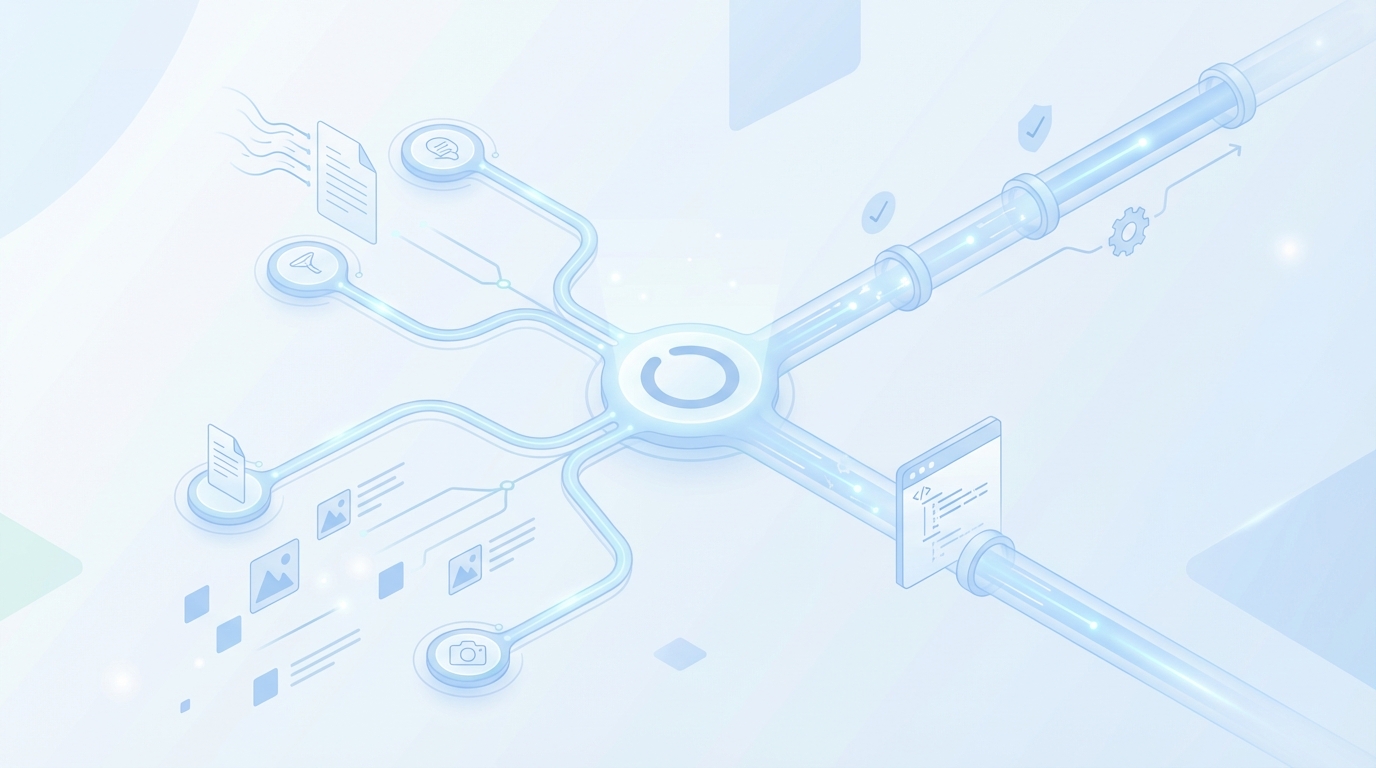
What traditional workflows miss about system design
A lot of stacks are optimized for parts. Copy here, briefs there, CMS elsewhere. Each step makes sense locally. Together, they’re fragile. The handoffs are where you lose cohesion. The fix is a system that takes in your narrative rules and product truth, then runs the work with those rules turned on all the time.
When that “always-on” layer exists, people stop re-litigating decisions. Voice doesn’t drift. Claims don’t expand accidentally. You stop resetting the content machine every quarter. If you want a broader lay of the land, see Marketing Orchestration for how rules and sequencing turn chaos into flow.
How orchestration evaluates signals and resolves conflicts
As campaigns overlap, conflicts appear. Two offers, one segment. Competing headlines, limited attention. Orchestration doesn’t just queue tasks. It encodes priorities and decision rules. It looks at lifecycle stage, recent actions, and your own constraints, then picks the next best asset or angle. Automation alone can’t adjudicate that. It runs the queue.
That judgment matters for tone too. A first-touch explainer shouldn’t read like a comparison page. Encoding those distinctions reduces tone-deaf touches and inconsistent asks. It also reduces the “wait, who approved this?” moments that torch trust with buyers and your own team.
Where SEO traffic falls short without conversion narrative
I’ve seen teams hit ranking goals and still miss pipeline. The content was helpful, sure, but detached from product truth and next steps. It brought attention with no path. Orchestration fixes the glue. It threads your positioning into the article outline, ensures claims are correct, and enforces CTA patterns. Traffic starts to convert.
Prompts can produce helpful text. They don’t enforce narrative continuity. That’s the miss. When the system handles continuity, your SEO library compounds instead of scattering. If you’re sorting through choices here, this overview from Pega on Marketing Orchestration maps well to how governed execution stabilizes the journey across touchpoints.
The Costs You Actually Feel When Prompt‑First Runs The Show
You don’t pay for fast drafts at the start, you pay at publish. Production reliability beats draft speed, because publish is where truth meets calendar. When claim control, QA rules, and structure are baked into the flow, the publish step stops being a fire drill. That’s how you actually scale.
Production reliability beats draft speed
Draft speed is a sugar high. It looks like progress and feels great. What scales is a repeatable flow that survives busy weeks. Quality gates, claim boundaries, narrative checks, and a steady cadence. When those live in the system, publishing becomes routine. It’s boring in the best way.
I get why this feels slower at first. You’re pushing effort upstream. But your weekly payback shows up in fewer escalations, fewer rewrites, and fewer “we need to pull that post” moments. If you need context on the shift many teams are making, two helpful reads: Marketers Are Drowning In Tools And Content And Only Orchestration Can Pull Them Out and Marketing Orchestration.
The coordination tax and rework nobody budgets for
Let’s pretend you ship 15 prompt-led drafts this month. Each needs 45 minutes of voice fixes, 30 minutes of claim checks, and 20 minutes of CMS formatting. That’s 23 hours right there. Add meetings and review cycles, and you’re closer to 30 hours. If two pieces get pulled after publish for inaccuracies, add more time and some brand risk.
Those hours are real. They come from your best people. They also hit the week you’re busiest. Orchestration takes the editing pile and turns it into rules that run every time. You still review, but you review exceptions. That’s a different cost profile. And a calmer one.
How inconsistency slowly bleeds brand trust
Buyers notice when your voice shifts post to post. Your team notices when product claims wander. None of it blows up in a day. It’s the slow bleed that hurts. Orchestration enforces approved claims, preferred terms, and CTA patterns. The effect feels simple. Fewer corrections, fewer apologies, fewer worried about moments.
If you’ve ever had to explain why two articles disagree on a feature name, you know the pain. Governing the basics isn’t exciting. It’s how trust compounds. For a practical angle on how rules bring order, CMSWire’s take on Marketing Automation Vs Customer Journey Orchestration is useful.
The Human Toll When Work Resets Every Week
Work resets when you rely on people to hold the system together. Launch weeks collide with content deadlines. Reviews stack up. Energy drops. Orchestration absorbs the spikes by keeping cadence and quality inside the pipeline, not inside someone’s calendar.
When your biggest launch collides with content needs?
You plan a launch. Sales wants a new deck. Support needs macros. Content still has to ship. With prompt-first ops, you rally the team and hope. Some weeks you hit it. Some weeks you don’t. The cost is stress and missed cadence. Orchestration keeps the machine running through the noise.
That’s the difference between effort and structure. When cadence and standards are encoded, you don’t ask everyone to white-knuckle the week. The system handles the routine work while people handle the special work. It’s a better use of attention.
The 3pm edit pile that never ends
You know the pile. Comments, rewrites, alignment tweaks. Editors spend their day policing tone. Leaders get pulled into late edits. The energy cost is real. Orchestration turns those edits into rules once. Then the rules do the work. You still review, but you review what’s unusual.
This is where a lot of teams get hours back. You’re not saving time by skipping quality. You’re saving time by moving quality into the pipeline. It’s less personal. And it’s much more reliable than memory or taste.
A quick story from a small team
We were three people running marketing and sales. We used video-to-text to move faster, which helped, but we missed structure. SEO needed formats we didn’t have. The content didn’t tie back to the product cleanly. Great ideas, weak glue. An orchestrated pipeline would’ve preserved cadence, grounded claims, and cut the frustrating rework.
I’ve also seen the opposite. At a company that ranked like crazy, our best content didn’t point back to the solution. We got attention with no path to evaluation. Orchestration would’ve threaded the narrative through the entire library. That’s the compounding effect you want.
Still optimizing by calendar and good intentions? There’s an easier way to run this. Request a Demo.
A Practical Way To Choose And Combine Both Approaches
Choosing orchestration vs prompting isn’t all or nothing. Use prompts for exploration. Use orchestration for repeatable jobs that must stay on message. Team size, launch frequency, and claim sensitivity are good thresholds to guide the mix.
Decision matrix to pick your path
Three signals tell you what to do:
- Team size: under 3 can start hybrid, over 5 benefits most from orchestration.
- Launch frequency: monthly launches suggest orchestration to protect cadence.
- Tolerance for drift: regulated or claim-sensitive? Orchestrate immediately.
Prompts are fine for one-off creative work. Orchestration is safer where repetition and consistency create the upside. This mirrors how journey orchestration outperforms one-off automation when interactions stack. If you want to sanity-check this framing, these overviews on Journey Orchestration Vs Marketing Automation and Marketing Orchestration are helpful context.
Where prompts fit safely inside an orchestrated system
Prompts aren’t the enemy. They just need guardrails. Start from structured briefs. Lock claims to approved language. Generate section-level drafts, not entire pieces, to reduce hallucinations. Push everything through a QA gate before publish. That keeps ideation flexible while execution stays predictable.
Think of it as lanes. The system controls the highway. Prompts handle exits and on-ramps. Your team gets the best of both without fighting the machine.
Consistency, speed, coordination cost, and compounding benefits
Prompting favors first-draft speed. Coordination and rework chip away at that win. Orchestration sets rules once, reduces variance, and creates compounding effects. Over a quarter, the library feels cohesive. Over a year, it becomes an asset that keeps paying off.
You can drive a hybrid. Orchestrate the pipeline. Prompt for examples and small lifts inside it. The compounding effect comes from the system, not the tool you used to generate paragraph three.
How Oleno Orchestrates Demand Gen So Your Message Stays Intact
Oleno turns your narrative, claims, and voice into rules that run across the entire pipeline. You choose the demand-gen jobs, and Oleno executes them on a cadence with built-in QA, visuals, and CMS publishing. The result is publish-ready work that sounds like you and stays accurate.
Governance and claim control keep output honest
You define voice, banned terms, and product truth one time. Oleno enforces those rules everywhere, so copy stays within approved claims and tone. That means fewer surprises at review, and far fewer “can we even say this?” moments. Knowledge grounding keeps content aligned to what’s actually true for your product and customers.
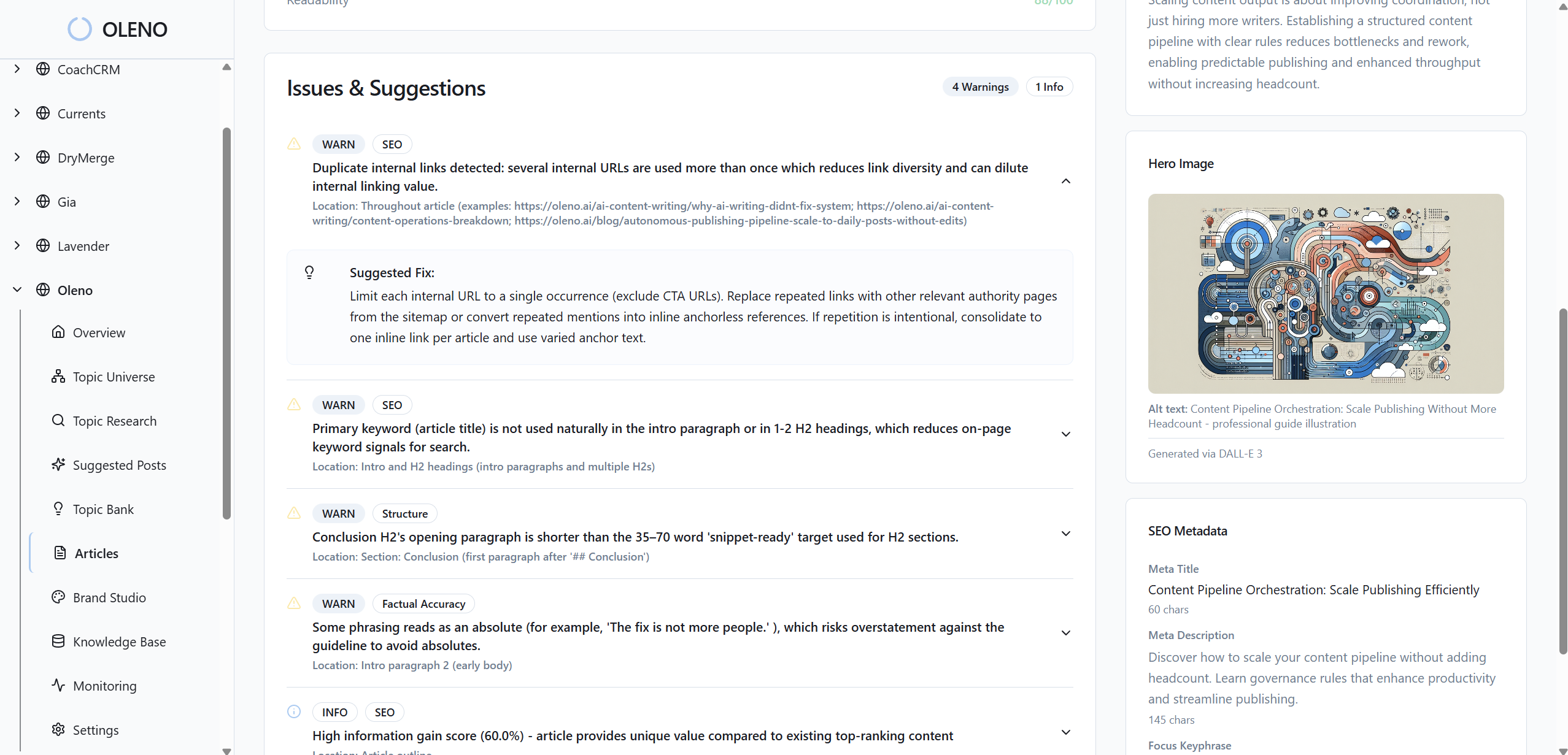
This is where teams usually save time first. Accuracy stops being a side quest. It’s part of the flow. If it isn’t approved, it doesn’t ship. Simple, and safe.
Job-based execution runs the right work on a cadence
Oleno is organized around demand-gen jobs across the funnel: acquisition, education, comparisons, product education, and customer proof. You enable the jobs you need. Each job runs a consistent flow with briefs, drafting, QA, visuals, and publishing. Cadence becomes predictable even when the rest of the company is busy.
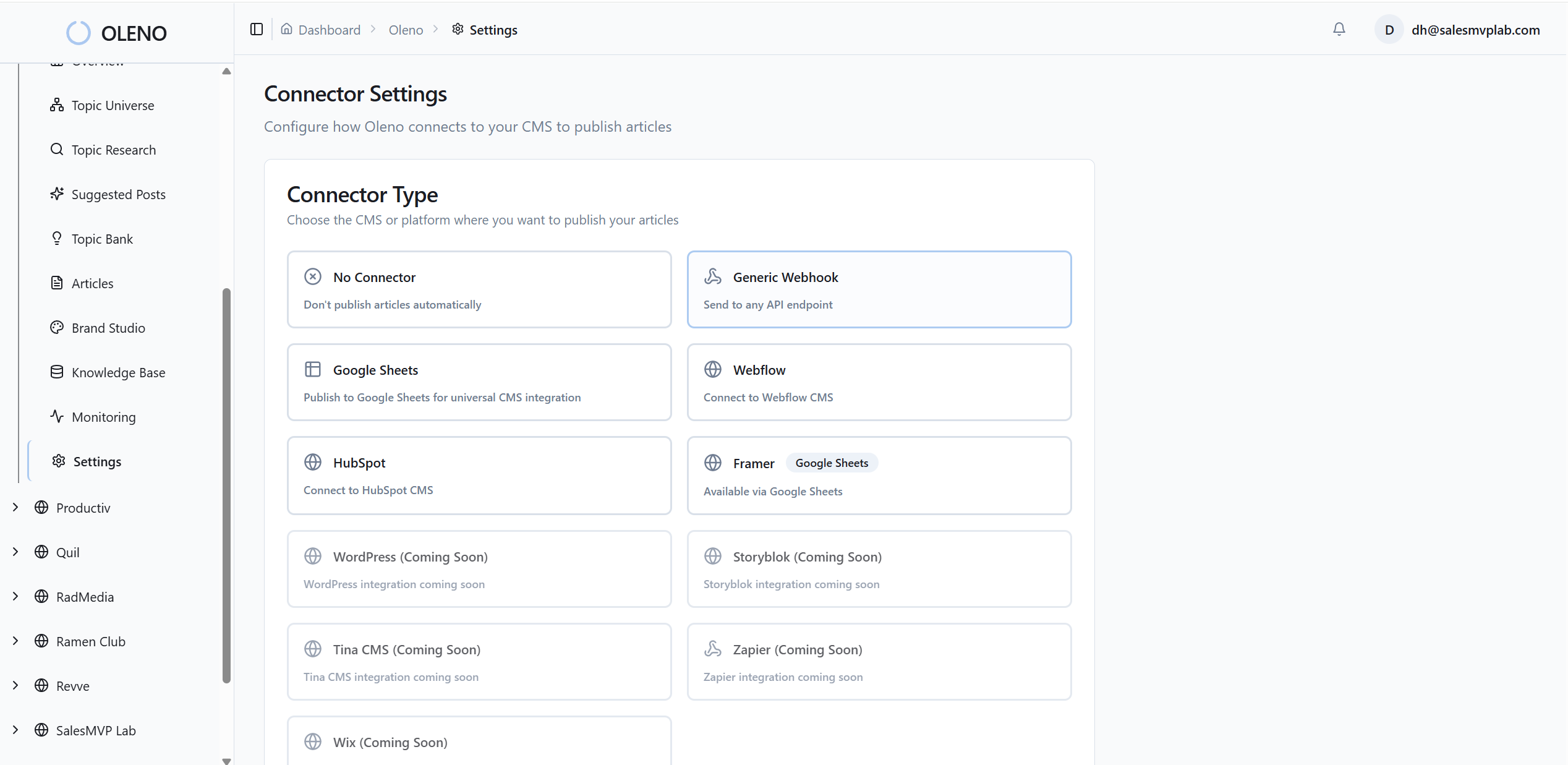
I like that jobs exist for a reason. You’re not pushing random content. You’re producing assets that tie to acquisition, education, conversion, or retention goals. That’s how output compounds.
QA gates, visuals, and CMS publishing reduce rework
Nothing ships unless it passes quality checks for voice, structure, grounding, clarity, and SEO/LLM readability. Visuals follow your design rules. Publishing goes straight to your CMS, avoids duplicates, and can push drafts or live. That’s where production reliability shows up in your week. Fewer last-minute edits. Fewer publishing errors.
This is the boring part that high-output teams value. When publishing is routine, you focus on better ideas, not fixing the basics.
Optional distribution and system health align channels
When you enable distribution, Oleno schedules and formats reuse across channels using your approved messaging. It doesn’t invent new positioning. It applies the rules you set. System health gives you a read on output volume, cadence, common failure patterns, and quality trends. It’s operational visibility, not traffic analytics, so you know the engine is actually running.
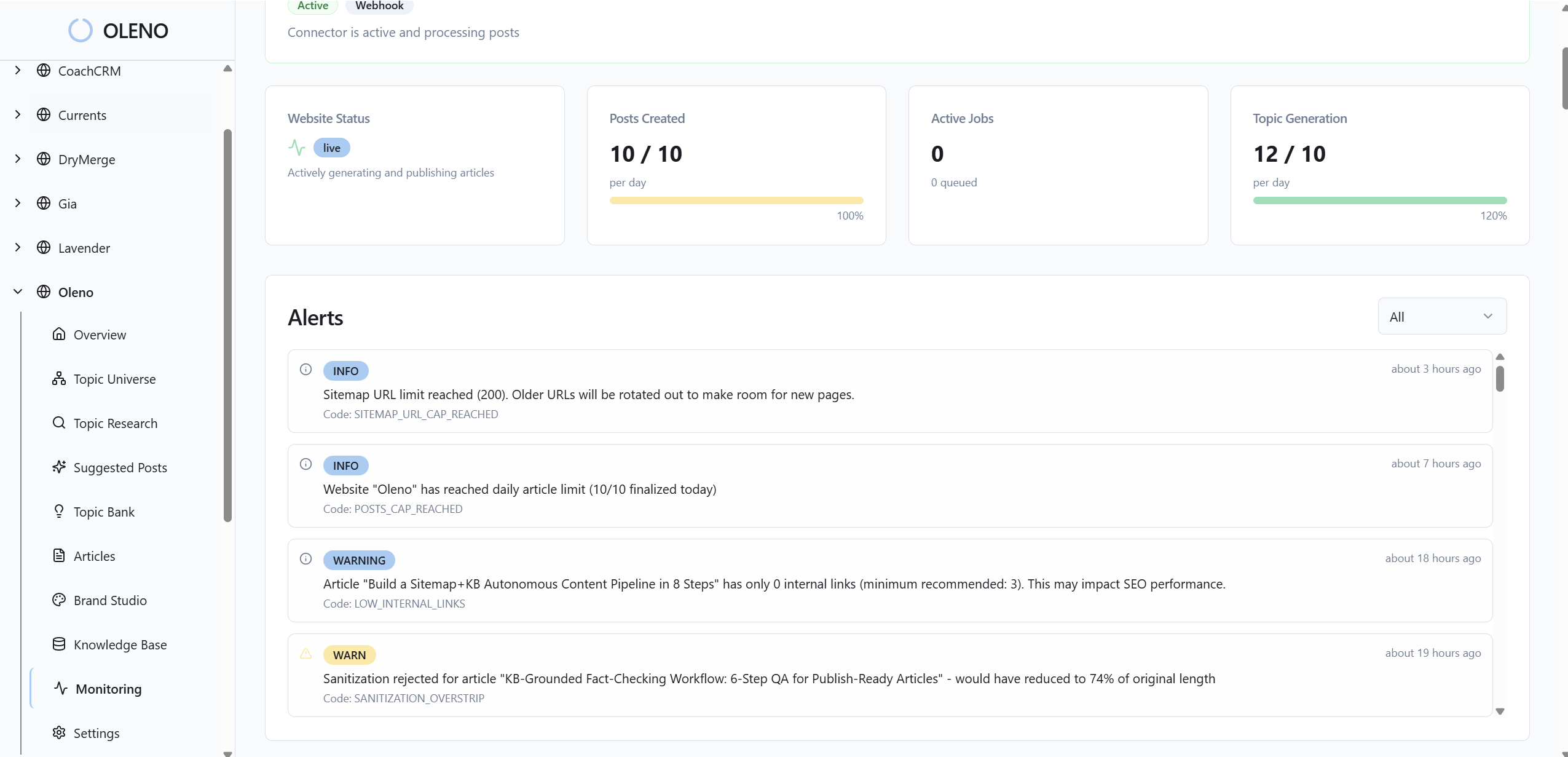
Ready to see the pipeline run end to end with your rules? Request a Demo.
Conclusion
Prompting creates drafts. Orchestration runs demand generation. If you need a one-off, prompt away. If you need steady, accurate, on-message content that compounds, you need a system to carry the load instead of people. Set the rules once, let the pipeline handle the routine, and keep your team focused on the work that actually moves the market.
About Daniel Hebert
I'm the founder of Oleno, SalesMVP Lab, and yourLumira. Been working in B2B SaaS in both sales and marketing leadership for 13+ years. I specialize in building revenue engines from the ground up. Over the years, I've codified writing frameworks, which are now powering Oleno.
Frequently Asked Questions