Outrank vs Writer.com: Which Should You Choose?

Outrank and Writer.com solve different problems, even though they both sit in the “AI content” bucket. Outrank is built for shipping lots of SERP-aligned drafts quickly, while Writer.com is built for governed, on-brand writing across an organization with stronger security and controls. If you’re an SEO-led team, your choice usually comes down to volume and speed versus governance and rollout.
Outrank vs Writer.com: How They Compare for SEO-Led Content Teams
Outrank is a better fit when you want an SEO assembly line (keyword to brief to draft to publish), while Writer.com is a better fit when you need company-wide brand control, security, and repeatable standards across many kinds of writing. Outrank leans into SEO workflows and publishing speed (Outrank product overview). Writer.com leans into governed creation with an enterprise posture (Writer.com security overview).

| Factor | Outrank | Writer.com | What it means |
|---|---|---|---|
| Primary use case | Programmatic, high-volume SEO articles | On-brand, governed content across teams | Choose based on whether you need SERP-led volume or enterprise-wide governance |
| Content type focus | Long-form SEO (drafts, metadata, publishing) | Multi-format marketing and documentation with guardrails | Writer.com spans more teams; Outrank goes deeper on SEO drafting |
| Governance and accuracy | Basic brand voice options; human review recommended | Deep governance (style guides, knowledge grounding, Palmyra LLM) | Governance reduces rework and brand risk at scale |
| Workflow scope | Keyword research → SERP brief → long-form draft → publish | Governed creation and rollout across teams and tools | Automation trade-off: SEO pipeline vs org-wide enablement |
| Integrations | Publishing connectors for popular CMSs (e.g., WordPress/Webflow) and an API; other connectors vary | Enterprise integrations and admin/security controls | Consider where content lives and how it’s reviewed |
| Starting price | $49 to $99 per month (plan dependent) | Per-seat pricing (see pricing page) | Small teams may favor flat plan pricing; per-seat scales with headcount |
Pricing and features change. Verify before you buy. For Writer.com pricing, start with their published tiers (Writer.com pricing).
Key Takeaways:
- Outrank is usually the pick for small SEO teams that want SERP-driven briefs and fast draft production, then do human editing after.
- Writer.com is usually the pick for orgs that care about governance, security, and rolling standards out across multiple teams and content types.
- If you need both “publish lots of SEO pages” and “repurpose approved content into a steady social cadence,” you’ll likely add a second system, not swap.
- The hidden cost isn’t the subscription, it’s the editing and coordination time you burn when quality and voice drift show up mid-process.
What Matters Most When Choosing Between Outrank and Writer.com
If you’re choosing between Outrank and Writer.com, the decision should follow your operating model: SEO production line versus governed writing system. Outrank is opinionated around generating and publishing SEO articles quickly (Outrank AI SEO content generator). Writer.com is opinionated around controlled AI use with security and standards (Writer.com security overview).
Most teams say they want “quality.” Sure. What they really mean is they don’t want to babysit the process. They don’t want to be stuck in that loop where you generate a draft, fix the voice, correct facts, rewrite the intro, then realize the angle doesn’t match the SERP anyway.
So I like to reduce it to three questions.
Content Type Fit: Programmatic SEO vs. Governed, Multi-Format Output
Outrank is designed around producing long-form SEO drafts at volume, while Writer.com is designed around producing many types of content with consistent standards and controls. Outrank’s positioning centers on SEO content generation and publishing workflows (Outrank product overview). Writer.com’s positioning centers on enterprise-grade AI writing for broader business use cases (Writer AI HQ press release).
If your roadmap is “publish 100 pages that each target a specific query,” Outrank’s mental model lines up with that. You’re drafting from SERP patterns, pushing content out, and cleaning it up with an editor.
If your roadmap is “every team is creating content, and we keep losing control of how we sound,” Writer.com is closer. It’s built for the reality that marketing, sales, support, and product all create copy, and a one-off prompt in a chat window doesn’t keep you safe.
The trade-off shows up fast:
- Outrank tends to win when SEO throughput is the core metric.
- Writer.com tends to win when consistency, compliance, and rollout are the core metric.
Brand Governance, Accuracy, and Risk Management
Writer.com generally goes deeper on governance and risk controls than SEO-first drafting tools, because it’s built for enterprise AI usage and compliance needs. Writer.com publishes security and governance positioning directly (Writer.com security overview). It also positions Palmyra as a proprietary model within its platform approach (Writer.com Palmyra).
Outrank isn’t trying to be your enterprise governance layer. It’s trying to help you ship SEO content. That’s not a moral judgment. It’s product strategy. And it changes what you should expect from it.
Where this bites teams is factual drift. If you’re writing generic “how to” content, the risk is lower. If you’re writing competitive comparisons, product pages, or anything regulated, your tolerance for made-up details goes to zero.
I’ve seen teams do the same dance a hundred times. They “save time” generating drafts, then spend the savings on review meetings and rewrites because nobody trusts what came out.
Operational Model: Automation Level, Setup Effort, and Team Fit
Outrank is typically faster to get value from if your goal is producing drafts immediately, while Writer.com typically requires more configuration and enablement to roll out properly. Outrank’s own content emphasizes SEO content generation and workflow automation (Outrank AI SEO content generator). Writer.com positions itself as an enterprise platform, which usually implies more rollout work (Writer AI HQ press release).
This is where the “small team vs big org” thing becomes real.
If you’re a two-person content team, you probably don’t want a six-week internal rollout plan. You want drafts, now. Outrank is built for that vibe.
If you’re a larger org, speed is nice, but governance is survival. Writer.com is built for that vibe.
And there’s a third vibe too, the one nobody wants to admit. You’re a small team, but you still need consistency across channels, and you can’t afford coordination overhead. That’s the gap we’ll come back to when we talk about Oleno.
Outrank: Strengths, Limitations, and Best-Fit Use Cases
Outrank is a strong fit for SEO teams that want an end-to-end workflow from keyword discovery to SERP-driven brief to long-form draft and publishing. Its product positioning focuses on generating SEO content at scale and streamlining the publishing loop (Outrank product overview). If your goal is volume, Outrank is trying to remove steps between “idea” and “live URL.”
I’ve got a soft spot for tools like this because I’ve lived the “we need more pages” phase. Back in the Steamfeed days, the step-function traffic gains came when we crossed page count thresholds, not when we argued about commas. Volume mattered. A lot.
But volume without control gets messy. Fast.
Where Outrank Excels (SERP-Driven Briefs, Volume, Publishing)
Outrank’s core strength is that it’s built around an SEO workflow, not generic writing, with SERP-led generation and publishing positioned as first-class parts of the product. Their own materials describe AI SEO content generation and SEO tool positioning for small businesses (Outrank AI SEO content generator, Outrank best SEO tools).
If you want a practical view, it usually shows up like this in a team’s weekly rhythm.
You pick a keyword. You generate a brief. You generate the draft. You publish. You move on.
That’s the dream. And for a lot of SEO-led content, that’s enough.
Outrank is most useful when:
- You’re building out long-tail coverage and need lots of pages.
- You’re okay with an editing pass as the price of speed.
- You want a tighter loop to publishing than “export to doc, copy into CMS, format headings, add metadata.”
A bunch of teams also like that it’s framed for smaller businesses and operators, not only enterprises (Outrank best SEO tools). That matters if you don’t want to feel like you’re buying a plane cockpit when you just need a car.
Where Teams Hit Limits with Outrank (Quality, Accuracy, Depth)
Outrank can hit limits when the content needs deeper expertise, stronger brand POV, or higher factual precision, because the workflow is optimized for speed and SERP alignment more than governance. Outrank’s positioning is clear that it’s an AI SEO content generator, which is different than “enterprise knowledge-grounded writing system” (Outrank AI SEO content generator). If you need hard controls on what can be said, you’ll still rely on human review.
The failure mode looks like this.
You publish a bunch of pages. They’re fine. Then you re-read them a month later and realize they all sound like they were written by the same polite robot. Worse, they say things that are technically true in the abstract, but wrong for your product, your market, or your differentiation.
And you can patch it. You can rewrite. You can layer on internal guidelines. But the tool isn’t primarily designed to enforce those rules.
So you end up with a new kind of bottleneck: editorial QA for higher-stakes pages.
A few common “we hit the wall” moments:
- Your writers need to inject real-world examples and the drafts don’t have them.
- Your product claims need to be precise and the drafts go fuzzy.
- Your comparisons need restraint and sourcing, and you end up rewriting whole sections anyway.
None of this means Outrank is bad. It just means it’s doing the job it was built to do.
Outrank Pricing and Value for Money
Outrank is often marketed in the $49 to $99 per month range depending on plan and discounting, which can make it appealing for small teams trying to buy speed without adding headcount. This pricing range is reflected in third-party comparison coverage and Outrank-focused writeups (Outrank alternatives comparison). Outrank’s own site is still the place to confirm current plans and limits (Outrank product overview).
If you’re publishing at volume, the math can work quickly. Even if you assume you still need editing, you’re shifting your team’s time from blank-page drafting to review and improvement.
Still, don’t ignore the “total cost” part.
If your process becomes “generate 20 drafts, rewrite 15,” the tool isn’t saving you what you thought it would. It’s just moving effort around.
This is where you should be honest about your team:
- Do you have an editor who can keep up?
- Do you have subject matter support to validate technical claims?
- Are you okay with content that’s good enough for a long-tail query, but not your sharpest thinking?
How Oleno is Different: Outrank is built to generate and publish SEO pages quickly. Oleno is built to take approved long-form content and turn it into a repeatable distribution system, using the Orchestrator, Quality Gate, and Distribution Studio to generate, review, and schedule platform-specific social posts without constant manual coordination.
Writer.com: Strengths, Limitations, and Best-Fit Use Cases for Outrank vs writer.com: which should you choose?
Writer.com is a strong fit when you need governance, security, and consistent standards for AI writing across a company, not just an SEO pod. It positions an enterprise-grade approach with security and controls (Writer.com security overview). It also highlights its proprietary Palmyra model as part of its platform story (Writer.com Palmyra).

If Outrank feels like “SEO production,” Writer.com feels like “enterprise writing infrastructure.”
Different category feel. Different expectations. Different problems solved.
Where Writer.com Excels (Governance, Security, Enterprise Rollout)
Writer.com’s core strength is governance, especially when multiple teams need to generate content while staying within brand, legal, and compliance boundaries. Their security posture is described publicly (Writer.com security overview). Their product and newsroom content positions Writer.com as a broader AI platform, not only a marketing tool (Writer.com newsroom).
This matters more than people think.
Because content chaos doesn’t start with the blog. It starts when every department begins shipping words. Sales decks, help docs, release notes, emails, landing pages, internal enablement. Now you’ve got five voices, all slightly different.
Writer.com is trying to be the place you centralize that.
It’s also easier to justify in orgs where security is a gating factor. If procurement and legal are going to be involved no matter what, you might as well pick a tool that’s built for that reality.
What it’s good for:
- Company-wide standards, not “every writer does their own thing.”
- Higher control environments.
- Multi-format output where brand consistency matters more than raw speed.
Where Teams Hit Limits with Writer.com (Complexity, Cost, Speed)
Writer.com can feel heavy for small teams, because enterprise governance usually means configuration, rollout, and ongoing management. Their pricing is per seat and published by tier, which can change the cost profile as more people adopt the tool (Writer.com pricing). And if your core need is SERP-driven programmatic SEO, you may still rely on separate SEO tooling and processes.
I’ve watched this happen in real life.
A team buys an enterprise platform. They do the kickoff. They set up governance. Then… the day-to-day marketers still need to ship. The platform is strong, but the workflow might not be optimized for “I need 30 SEO briefs this month and 30 pages shipped.”
So they either:
- Don’t use it fully, because it’s too much overhead for the immediate need.
- Use it for some things (governed copy), and keep the SEO machine elsewhere.
That’s not failure. It’s just fit.
Common constraints you’ll want to think through:
- Internal rollout time and training expectations.
- Whether per-seat pricing makes sense for your adoption curve.
- Whether your SEO team still needs a separate SERP and topic planning flow.
Writer.com Pricing and Value for Money
Writer.com uses per-seat pricing, which tends to map well to enterprise adoption and admin controls, but can add up for smaller teams that only need a narrow SEO workflow. Their pricing tiers are public (Writer.com pricing). If you’re evaluating ROI, you want to model not just the subscription, but how many users will realistically need access.
Per-seat pricing isn’t good or bad. It’s just a shape.
If you’re rolling it out to many teams, per-seat can be a clean way to align cost to usage. If you’re a three-person marketing team, it can feel like you’re paying for a bigger vision than you need.
The bigger value question is usually editing and risk.
If governance reduces rewrites and keeps you out of trouble, the cost can be easy to justify. If you only need drafts, it can be harder.
How Oleno is Different: Writer.com gives you enterprise governance and a strong security posture, but it’s not primarily built as an always-on distribution engine for small teams. Oleno puts governance into execution, then uses the Orchestrator, Quality Gate, and Distribution Studio to turn one approved asset into a steady cadence of scheduled social content.
When Neither Is Enough: Where Oleno Fits in Your Stack
Oleno fits when you’ve got approved long-form content, but you’re losing time and consistency turning that into a steady multi-channel presence. Outrank focuses on producing SEO articles from keywords (Outrank AI SEO content generator). Writer.com focuses on governed creation across teams with security controls (Writer.com security overview). It sits in the “post-publication” gap: it operationalizes repurposing and distribution so small teams can keep cadence without constant manual work.
This is the part nobody tells you when you’re buying SEO tools.
Publishing the blog post is not the finish line. It’s the starting line.
If you’re serious about demand gen, you need the content to travel. Social, snippets, variations, schedules, approvals. That’s where time goes to die. I’ve watched content managers spend their week doing formatting and reformatting, not thinking.
So you end up with a stack that looks like:
- One tool to produce SEO drafts at scale.
- One tool to govern enterprise-wide writing.
- Then a messy human process to turn “published” into “distributed.”
The platform is aimed squarely at that messy human process.
Core Differentiators of Oleno (Governance-First + Structured Execution)
It’s different because it’s built as an end-to-end content operations and distribution system that repurposes approved long-form assets into platform-specific social content, with governance and QA embedded into the workflow. It uses a governance layer (Brand, Product, Design Studios) plus an Orchestrator, Quality Gate, and Distribution Studio to generate, review, and schedule content in a repeatable way. The practical result is fewer manual handoffs and less “who’s doing this today?” energy.
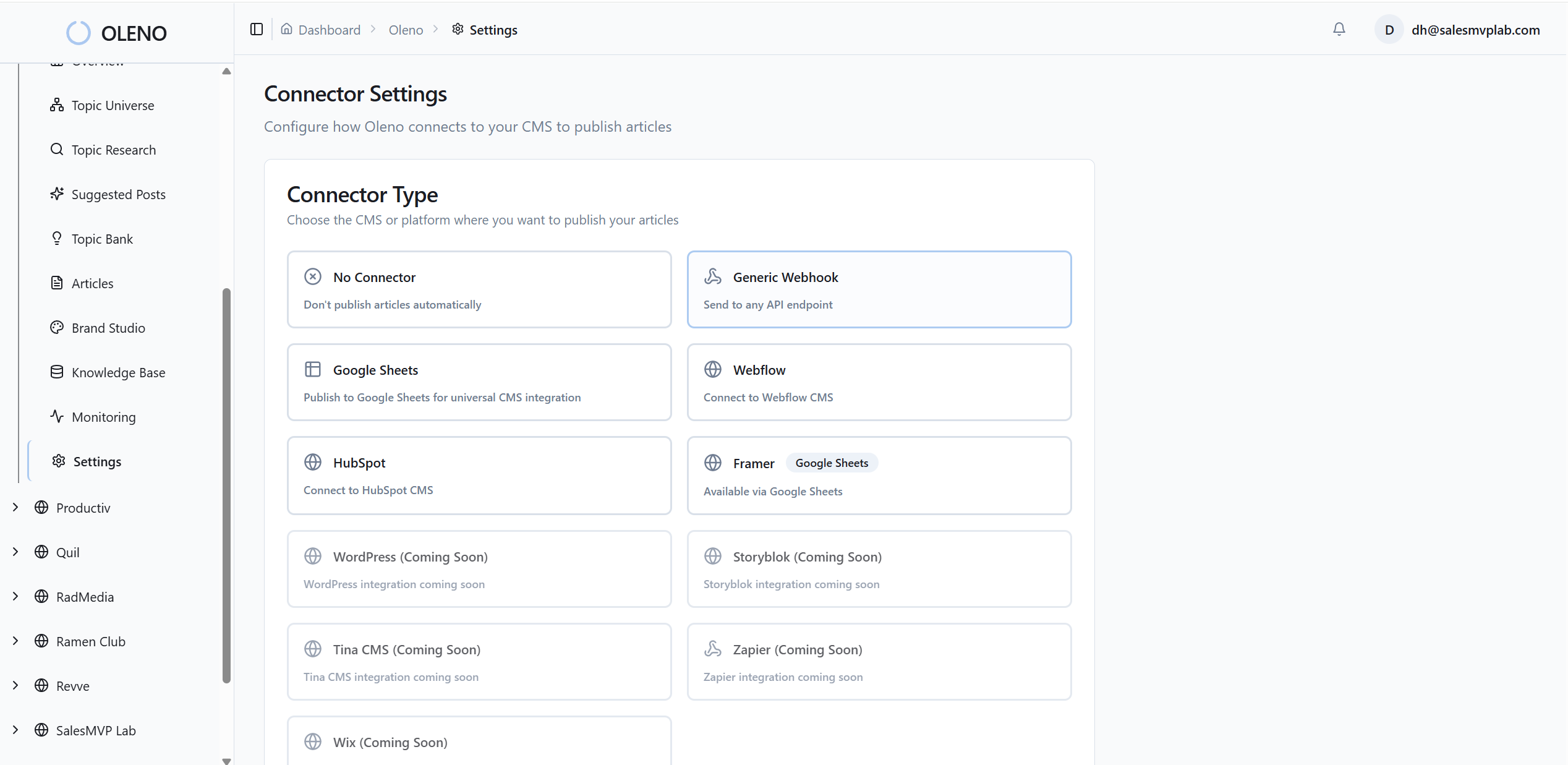
Let me translate that into plain operator language.
Most teams don’t fail because they can’t write. They fail because the process is broken.
Someone writes. Someone edits. Someone approves. Someone posts. Someone forgets to repurpose. Then next week you do it again.
The system is trying to make that repeatable without you playing project manager.
A few things that matter in practice:
- The Orchestrator drives the workflow so the system moves content forward without you nudging every step.
- The Quality Gate catches issues before you publish or schedule, so you aren’t relying only on someone’s memory at 10 pm.
- The Distribution Studio turns one approved asset into multiple social posts and lets you manage review and scheduling in one place.
Who Should Choose Oleno (Use-Case and Team Scenarios)
Oleno is a good fit when you’re a small B2B SaaS marketing team that needs consistent output, but you can’t keep hiring writers, editors, and coordinators just to maintain cadence. That’s the typical “we need more content, but we’re already maxed out” situation.
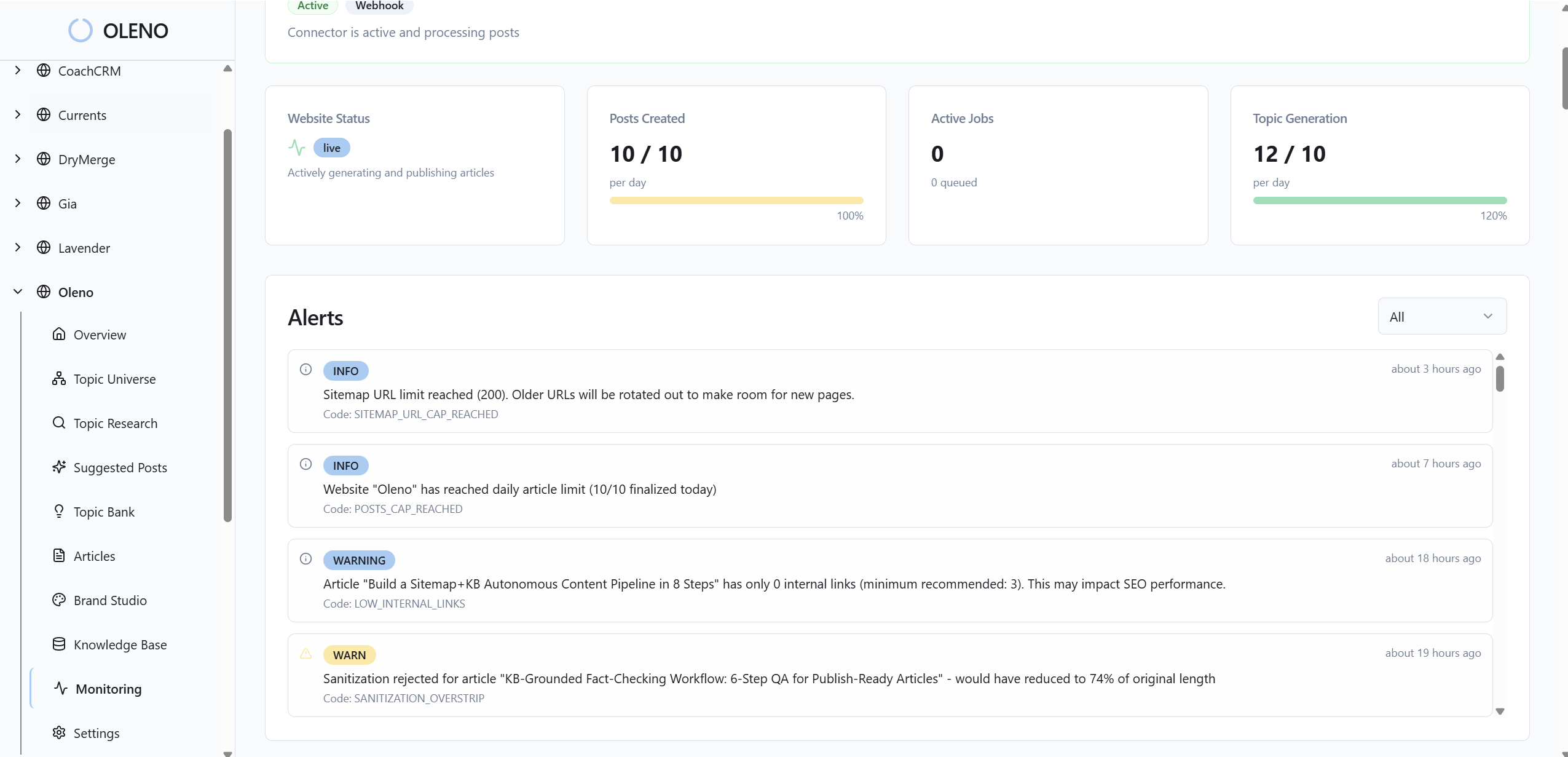
This is also where my own bias comes in. I built the first version of this because I was sick of the manual grind. Prompt. Copy. Paste. Format. Post. Repeat. Hours every day. Total waste.
If your situation looks like any of these, you’ll feel it:
- You have a blog that’s decent, but your social presence is inconsistent because repurposing never happens on schedule.
- You have a couple good pieces a month, and you want them to turn into a week of distribution without someone doing it by hand.
- You want your content to sound like your company, not like whoever had time to post that day.
And if you’re thinking “can’t we just do this with docs and a checklist?” You can. For a while. Then the checklist becomes a graveyard.
Getting Started with Oleno (From Setup to First Published Run)
Getting started usually looks like picking one approved long-form asset and running it through the repurposing and distribution loop end to end, so you can see cadence and QA in action quickly. The fastest way to get value is to start narrow, prove the workflow, then expand the set of assets you repurpose as you build confidence.
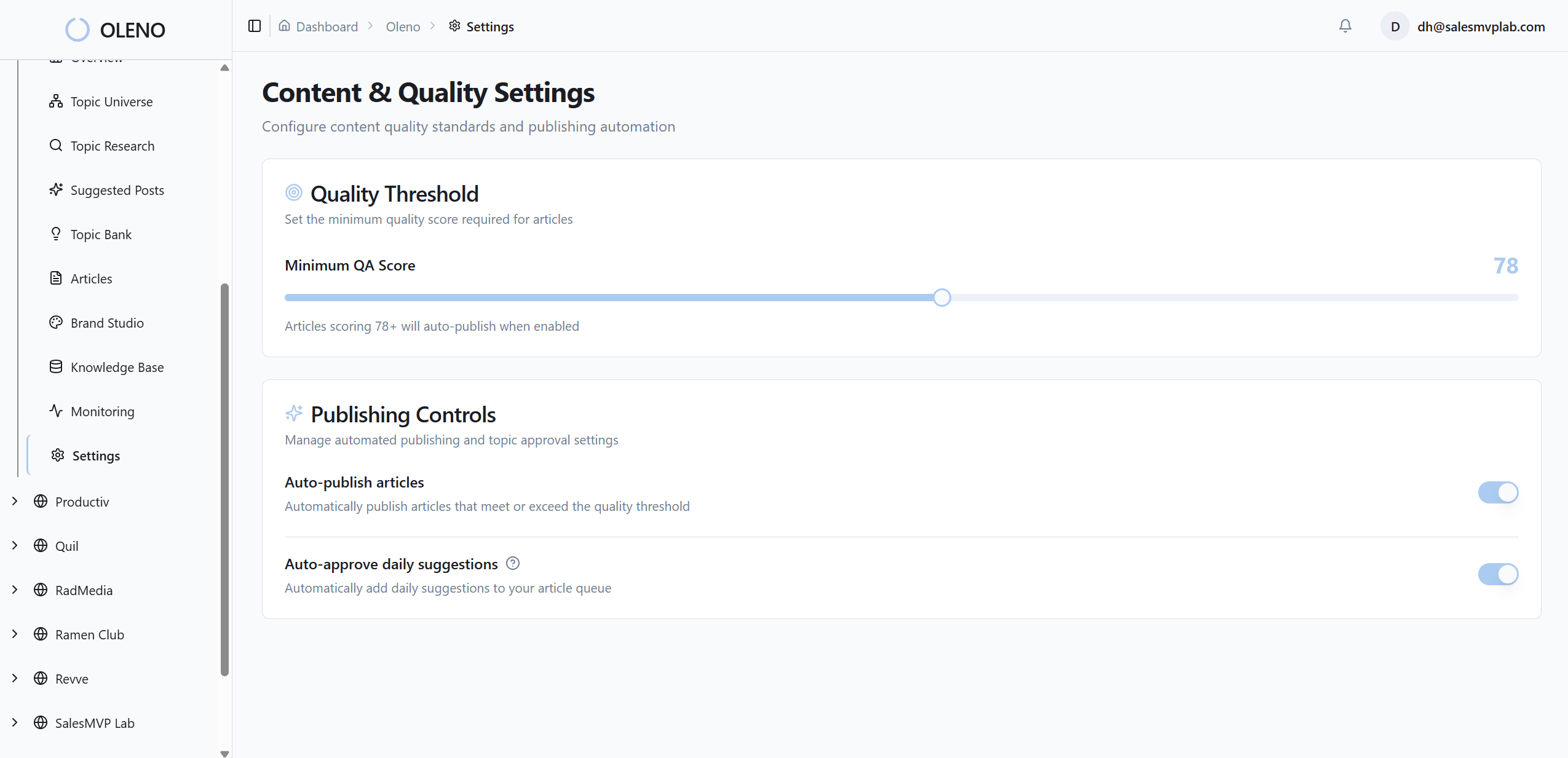
I’d do it like this, especially for a small team:
- Pick one blog post you already trust, ideally something that reflects your positioning well.
- Run it through the Distribution Studio to generate multiple platform-specific social posts.
- Use the review flow and the Quality Gate checks to tighten up voice and accuracy.
- Schedule a full week of posts, then measure what actually gets engagement.
- Repeat weekly until it’s boring. Boring is good.
Want to see what that looks like with your own content? request a demo
Decision Grid: Who Should Choose Which?
Most teams should pick Outrank for SERP-driven SEO volume, Writer.com for enterprise governance, and Oleno when the real bottleneck is turning approved content into a consistent distribution cadence. Outrank’s positioning is SEO workflow automation and publishing (Outrank product overview). Writer.com’s positioning is governed AI writing with security and controls (Writer.com security overview).
| Decision criterion | Why it matters | Outrank | Writer.com | Edge |
|---|---|---|---|---|
| Monthly volume of SEO articles | Determines ROI of automation-heavy drafting | Optimized for generating many SERP-aligned posts | Capable but not specialized for programmatic SEO scale | Outrank |
| SERP-driven brief and outline depth | Aligns content to ranking patterns | Real-time SERP analysis and brief generation (Outrank AI SEO content generator) | Typically relies on other SEO tools or separate research | Outrank |
| Brand governance depth | Prevents tone drift and reduces subjective edits | Basic voice controls | Centralized governance, knowledge grounding, proprietary model (Writer.com Palmyra) | Writer.com |
| Security and compliance posture | Critical for regulated industries and enterprises | Standard for SMB tools | Enterprise-grade security, governance, admin (Writer.com security overview) | Writer.com |
| Cross-functional rollout | Adoption beyond marketing and SEO | Focused on SEO team use | Built for company-wide enablement (Writer AI HQ press release) | Writer.com |
| CMS publishing automation | Closes the loop to live content faster | One-click publishing positioned as part of workflow (Outrank product overview) | Enterprise integrations vary by stack | Outrank |
| AI model approach | Impacts governance, controls, and roadmap | General AI approach positioned around SEO outcomes | Palmyra positioned as proprietary LLM (Writer.com Palmyra) | Writer.com |
| Collaboration and seats | Determines cost and adoption | Often positioned for small teams | Per-seat pricing and admin controls (Writer.com pricing) | Depends on team size |
| Time-to-value | Setup effort versus immediate output | Fast start for SEO drafts (Outrank AI SEO content generator) | More enablement and configuration | Outrank |
| Post-publication distribution cadence | Whether content actually gets seen | Not the primary focus | Not the primary focus | Oleno |
If you’re stuck deciding because you want parts of all three, that’s normal. You’re probably describing a real-world marketing team, not a tool category.
If you want to see how Oleno plugs into your current workflow without ripping everything out, book a demo
A practical way to decide in 30 minutes
You can decide between Outrank and Writer.com by mapping them to one workday, not by reading feature lists. Outrank is built for producing and publishing SEO content (Outrank product overview). Writer.com is built for governed AI writing across teams with an enterprise security posture (Writer.com security overview).
Here’s the quick exercise I’d run with a team.
First, write down what you’re actually trying to ship in the next 60 days. Be literal. “40 SEO pages” or “roll out brand-safe AI writing to marketing and support” or “we need to stop wasting Fridays turning blog posts into social posts.”
Then answer these questions:
- Where do we lose the most time today, drafting, reviewing, or coordinating?
- What’s the real risk, off-brand content, incorrect claims, or just never publishing?
- Who needs to use the tool daily, one SEO manager, or half the company?
- What’s the one workflow you’d pay to make boring?
If the honest answers are “drafting” and “SEO pages,” start with Outrank. If the honest answers are “risk” and “many teams,” start with Writer.com. If the honest answer is “coordination and distribution,” that’s Oleno’s lane.
One more thing. Don’t buy the tool you aspire to use. Buy the tool your team will actually use on a Tuesday. That’s the only day that counts.
Before you wrap, if you want to sanity-check fit with your stack, request a demo and we’ll map it to your current workflow and capacity.
About Daniel Hebert
I'm the founder of Oleno, SalesMVP Lab, and yourLumira. Been working in B2B SaaS in both sales and marketing leadership for 13+ years. I specialize in building revenue engines from the ground up. Over the years, I've codified writing frameworks, which are now powering Oleno.
Frequently Asked Questions