Pillar Page Modularization: Build Evergreen Hubs That Convert
Most teams treat "pillar page" like a euphemism for “very long blog post.” It’s not. A pillar should route attention, not absorb it. It’s infrastructure. When pillars turn into essays, you get traffic with nowhere to go, CTAs stranded in text walls, and a sales team that shrugs.
I’ve seen both sides. At one company, we cranked out beautiful long-form. Ranked great. Didn’t move pipeline. At another, we published quickly from founder riffs. Fast to ship, brutal to maintain. The fix wasn’t more words or faster drafting. It was architecture. Templates, blocks, canonicals, and clear handoffs.
Key Takeaways:
- Coverage beats volume when pillars route readers to the next best step
- Treat pillars as modular hubs: definition, problem, mechanism, proof, outcomes
- Map each block to buyer intent, a target cluster page, and a specific CTA
- Consolidate duplicates, set canonicals, and focus link equity toward money pages
- Use block libraries and templates so refreshes take minutes, not weeks
- Run governance up front so pillar content stays true to your product and POV
Ready to skip the theory and see it built properly? Try Generating 3 Free Test Articles Now.
Why Publishing More Long-Form Posts Does Not Create Coverage
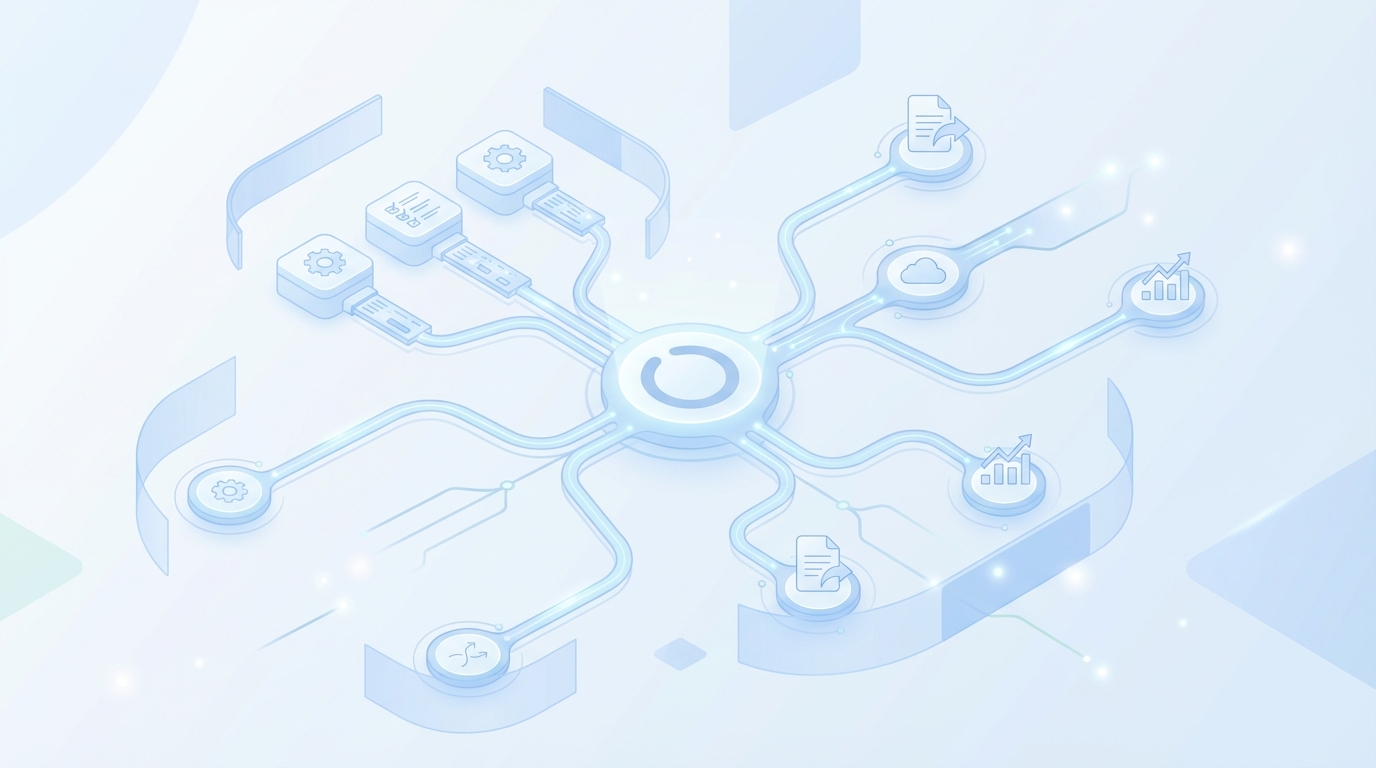
Publishing more long-form doesn’t create topic coverage; structured hubs do. Coverage means you resolve multiple intents, route readers to deeper answers, and point to product when appropriate. Think of a pillar like a well-signed airport: it gets people to the right gate fast, not wandering concourses.
The Metrics That Actually Matter For Pillars
Traffic is a vanity metric when it sits in isolation. The signal you want is coverage: how well the pillar satisfies navigational (where am I), informational (what is it, how it works), and transactional (what next) intent. When a pillar does its job, users don’t linger—they move with purpose to the right cluster or product page.
If you only track time on page, you’ll misread success. Better: instrument internal click paths. Which anchors get clicks? Which in-body links move people to feature explainers, pricing, or integration pages? Where do they stall? That’s how you learn whether the structure is doing its job or creating dead ends.
Let’s get practical. Score each block by “completion” (did the reader click the handoff?) and “conversion adjacency” (did they approach a high-intent page). Over time, this beats optimizing for dwell time. You’re optimizing for decisions.
- Coverage metrics to track:
- Click-through from pillar anchors to cluster pages
- Assisted conversions attributed to pillar sessions
- Paths from pillar → feature explainer → demo/pricing
What Is A Pillar Page Supposed To Do?
A pillar is an index with opinions. It orients the reader, defines the topic, surfaces jobs to be done, and points to deeper resources. Think clear sections, anchor links, and consistent “next best action.” It’s not a 4,000-word monologue. It’s a guided tour that consolidates authority and link equity.
If you need a formal definition, the gist aligns with most credible write-ups on what a pillar page is. But here’s the nuance teams miss: your pillar must carry the story of your product. Not a pitch. A path. From definition to mechanism to outcomes—then a fork: learn more or see how it works in your world.
Done right, your pillar is the canonical front door for a topic. Everything else—clusters, demos, docs—branches off and returns. That’s how you build authority without bloating content or splitting intent.
Why “10x Long-Form” Often Misses Conversion
“10x long-form” often blends multiple intents into one wall of text. Definitions sit next to deep how-tos. CTAs show up once, far below the fold. The result: cannibalization across your own articles, weak internal link signals, and a reader who can’t find the next step.
Modular sections fix this. Each block has a job: define, problem, mechanism, evidence, outcomes. Each block resolves a micro-intent, then hands off to a logical next action. You reduce cognitive load and make it obvious what to do next.
One more benefit: teams can refresh the “evidence” block with new stats without rewriting the whole page. That’s how you sustain quality at speed.
- Make it modular:
- Anchor-linked table of contents
- Block-level CTAs that match intent
- Bidirectional links between pillar and cluster
The Real Bottleneck Is Architecture, Not Writing Speed
The bottleneck isn’t drafts per week; it’s the absence of rules that bind content to product truth and buyer need. Architecture—templates, blocks, and claims control—creates reliability. Speed comes after. Otherwise, faster writing just accelerates drift.
Why Long-Form Assets Drift From Product Truth
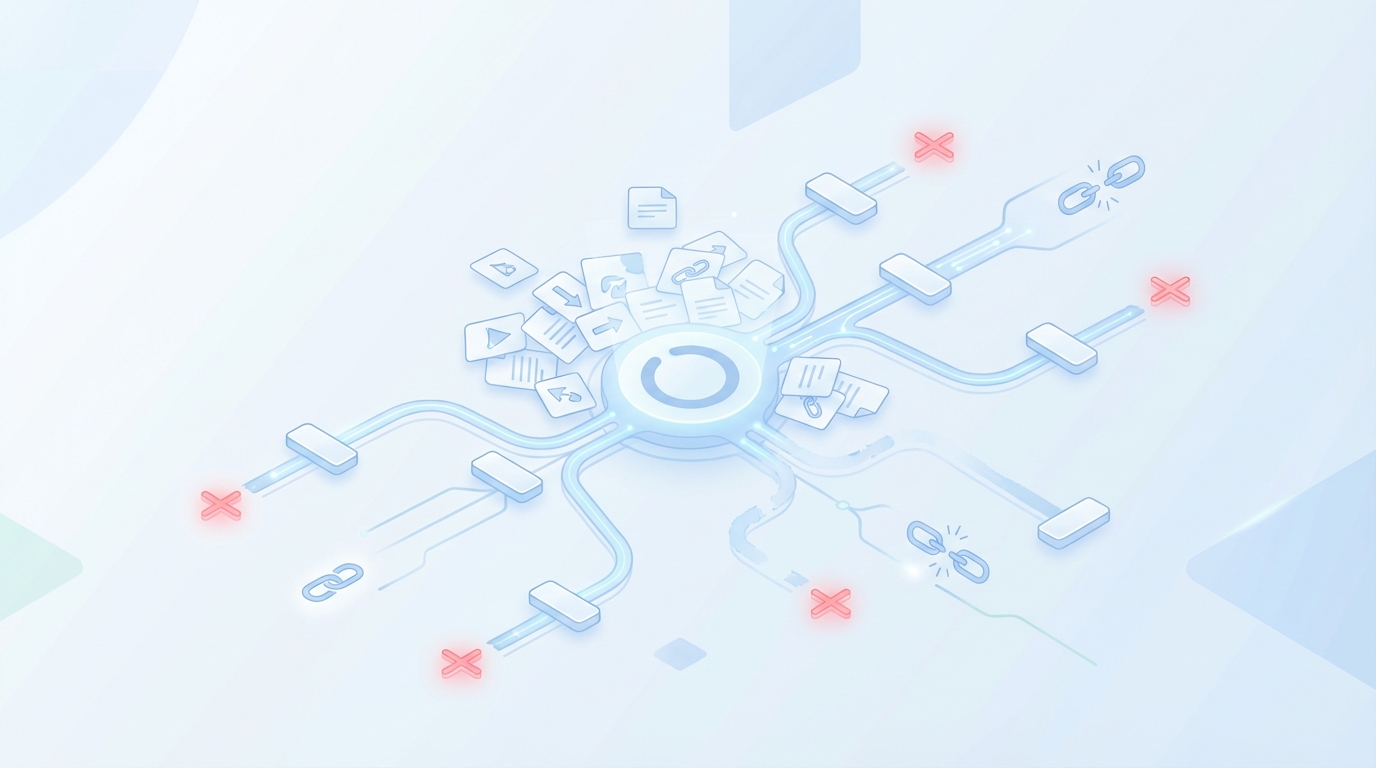
When drafting outruns structure, subtle drift creeps in. A paragraph at the edge of your use case here. A claim that stretches reality there. Multiply that across a dozen posts and your narrative fragments. Sales notices first. Then prospects. Finally, your own team.
The fix is upstream. Encode what’s in bounds, what language to avoid, and which claims are approved. Treat the pillar as a template with required blocks and “handoff rules” baked in. No more “we’ll fix it in editing”—that’s where consistency goes to die.
You’ll publish slower for a week while you build the template. Then you’ll publish faster forever because refreshes are surgical and safe. That’s how small teams keep their content honest without adding headcount.
How Architecture Binds Intent, CTA, And Navigation
Think in blocks, not paragraphs. Map each module to a buyer job, a specific CTA, and a target cluster page. A “Definition” block should end with “See core concepts” or “Compare approaches.” A “Mechanism” block should hand off to “How it works in product.” You’re creating lanes with exits.
Use consistent section names so your internal links are predictable and your analytics are apples-to-apples. If “Outcomes” always includes an in-body link to case evidence, you can measure which anchors perform across topics. Nothing fancy. Just rules applied relentlessly.
This is also how you de-risk refreshes. A stale “Proof” block? Swap it. New integration? Update the “Mechanism” block and its link bundle. The rest of the pillar stays stable.
For more detailed approaches to structuring, frameworks like building high-performing content pillars are directionally sound—just remember to include product-adjacent handoffs.
How Do You Map Buyer Stages Without Reinventing Content?
Start with what you already have. Inventory your long-form pieces, webinars, docs. Tag each asset by primary intent (learn, compare, decide), secondary questions, and funnel stage. Most teams are sitting on a block library—they just don’t know it yet.
Pull the best paragraphs into reusable blocks: definition, problem framing, mechanism, outcomes, evidence. Link back to the originals for depth and authority. Now you’re not rewriting; you’re rerouting and reusing.
This approach unlocks maintenance. When a stat changes, you update it once in the “Evidence” block source and republish. No re-drafting. No “Who owns this?” Slack threads.
- Practical tagging fields:
- Primary intent and stage
- Target cluster page
- Approved claims and sources
- Block type and refresh date
The Hidden Costs Of Bloated Pillars And Cannibalized Clusters
Bloated pillars and near-duplicate posts don’t just confuse readers; they split equity, waste crawl budget, and bury CTAs. The costs show up as diluted rankings, lower internal CTR, and content ops debt. Clean architecture fixes what brute-force writing speed can’t.
Traffic Without Pipeline Is A False Positive
You can rank and still miss revenue. I’ve lived it. When content drifts from product jobs, sales can’t use it and visitors don’t convert. You’ll see the trap in analytics: lots of sessions, flat assisted conversions, minimal movement to pricing or feature explainers.
Diagnose by tracing internal paths to money pages. If readers aren’t reaching feature explainers, integration pages, or pricing from the pillar, your structure is leaking. And if the only link to “book a demo” is in the footer, you’ve buried intent behind effort.
A simple test: ask sales which URL they drop in calls. If they hesitate, you already have the answer. The pillar isn’t a tool. It’s a brochure.
Pillar layout matters too. Patterns from credible examples of pillar page design highlight how navigation, scannability, and in-body links change behavior.
Let’s Pretend You Have 20 Near-Duplicates
Let’s pretend you’ve got 20 posts around the same head term with minor variations. You’ve split clicks across pages, diluted backlinks, and confused crawlers about which page should rank. Meanwhile, your best content is buried on page two of your own site.
Consolidate. Choose one canonical pillar, fold thin pages into clusters, and set 301 redirects from duplicates. You’ll reduce index bloat, concentrate link equity, and give readers one front door to everything they need. Expect rankings to stabilize and internal CTR to improve.
Put numbers on it. If those 20 pages drew 10,000 combined monthly views at 1.2% assisted conversion, consolidation that raises path clarity to 2.0% is worth 80 extra assisted conversions a month. Even half that is material for a small team.
The Link Equity Leak You Do Not See
Random internal links are expensive. They waste equity and send readers on detours. Use descriptive anchors, consistent bidirectional linking between pillar and cluster, and breadcrumbs that reinforce where you are in the hub. Prioritize in-body links over nav bars.
Your link graph should tell a story: pillar → cluster → product-led pages → conversion. If a block resolves a question and doesn’t hand off to the next best answer, that’s a leak. Fix it. Then measure it again. Keep ranking, sure. But route intent to outcomes.
One more nuance: avoid over-linking. Two or three purposeful links per block beats a dozen scattered ones. Choice fatigue is real.
For broader context on why pillars matter to outcomes, guidance like using pillar pages for better SEO results aligns with this operational view—just make sure the “results” include assisted conversions, not only rankings.
What It Feels Like When Your Pillar Strategy Stops Converting
When pillars stop converting, you feel it before you can prove it. Sales asks for “the one link,” and you wince. Updates stall because no one owns canonicals. CTAs feel generic. The page looks busy but behaves quietly. That’s the tell: activity without movement.
The Founder-Led Post That Never Gets Updated
We’ve all done it. CEO riff, quick draft, publish. It gets early traffic, then becomes a maintenance headache. No schema, no canonical logic, no refresh plan. It lives on your top-nav by inertia alone.
Modularizing turns that liability into an asset. You add a definition block, anchor links, a “Mechanism” handoff to product, and a “Proof” block that you can keep fresh. Now updating the page takes 20 minutes instead of a week, and sales finally has something they can use consistently.
One owner. One template. Clear rules. That’s the difference between “we should update that” and “it’s already done.”
When Search Wins, But Sales Cannot Use The Page
At Proposify, we ranked incredibly well. Great writers. Strong design. Tons of personality. But some content sat too far from what we sold. Sales couldn’t use it in calls. The disconnect hurt more than any ranking drop. It felt like cheering for yardage and ignoring the end zone.
Pull the pillar toward the product with outcomes, workflows, and stage-matched CTAs. Add in-body links to feature explainers where the “Mechanism” block ends. Tie examples to actual use cases. You’re not turning content into a pitch; you’re giving the reader a bridge.
This is where marketing and sales stop arguing. The pillar becomes a shared artifact both teams trust.
Who Owns Canonical Rules When Everyone Is Busy?
Ownership breaks when everyone is underwater. That’s when duplicate posts slip through and internal links point to outdated pages. You don’t need a committee. You need a single owner for pillar templates and canonical rules with a 30-minute playbook.
Document when to redirect, when to consolidate, how to pattern internal links, and how to request updates. The payoff is fewer 🔁 Slack threads and far less frustrating rework. Small teams can’t afford ambiguity. Clarity is an efficiency multiplier.
Write it once. Apply it everywhere. That’s governance.
Still feeling the drag of manual fixes? Try Using An Autonomous Content Engine For Always-On Publishing.
A Modular Pillar Framework That Captures Multi-Stage Intent
A modular pillar framework captures multi-stage intent by structuring content into reusable blocks, each tied to a buyer job and a specific handoff. You plan exits before you write intros. The result: scannable pages, consistent CTAs, and cleaner paths to product-led pages.
Audit And Map Long-Form Assets To Buyer Intent
Start with an inventory: URLs, titles, top queries, target personas. Tag each asset by stage—learn, compare, decide—plus secondary questions. Note overlaps and thin content. Identify where you already have strong “Definition,” “Mechanism,” and “Proof” paragraphs. That’s the start of your block library.
Once tagged, prioritize consolidation around a single pillar for the head term. Position clusters to answer deep-dive questions. Keep the pillar broad by design, and resist the urge to write everything there. The pillar’s job is routing. The clusters do the heavy lifting.
This audit unlocks fast wins. You’ll see immediate opportunities to redirect duplicates, strengthen anchors, and attach better CTAs to high-intent blocks.
- Audit fields to capture:
- Stage and primary intent
- Block type (definition, problem, mechanism, outcomes, proof)
- Target CTA and target cluster
- Refresh date and owner
Design Reusable Content Blocks That Travel
Create portable blocks with a clear purpose and consistent structure. For example: “Definition” (100–150 words, terms clarified, anchor ID), “Problem” (150–250 words, stakes and mistakes), “Mechanism” (how it works), “Outcomes” (results and workflows), “Proof” (stats, examples).
Each block gets 1–2 target CTAs and 2–3 internal links to clusters or product-led pages. Add anchor IDs for deep linking and snippet-ready formatting so blocks stand on their own. Store source links and references per block so refreshes are quick and safe.
Now, blocks can travel across related pillars. That’s how you maintain consistency without copying drift.
Architect The Hub: Pillar Vs Cluster, Canonicals, And URLs
Pick a clear root URL for your pillar. Use short, descriptive slugs for clusters. Add breadcrumbs, an anchor-linked table of contents, and schema where appropriate. Set canonicals from near-duplicates to the pillar. Redirect thin or overlapping posts into the right cluster.
Consistency is your friend. Keep URL patterns predictable so future pages slot in cleanly. This reduces editorial decisions and lowers the chance of link rot. If you need a starting template, frameworks like how to structure a pillar page can help, then layer on your product handoffs.
The result is a hub-and-spoke that both search engines and humans understand immediately.
Pattern Internal Links To Funnel Authority To Money Pages
Use descriptive anchors. Prefer in-body links. Enforce bidirectional paths: pillar to cluster, cluster back to pillar, and both to product-led pages. Reserve 2–3 links per block for the next best action. Don’t let navigation carry the load. Put links where readers decide.
Track anchors that drive clicks to demos, pricing, and feature explainers. Iterate the copy. Adjust placement. Your goal is a link graph that tells a coherent story. When “Mechanism” resolves, the obvious next step is “See how this works in the product.”
One interjection: cut vague anchors. “Click here” is a conversion tax.
For a perspective on mapping topics to subtopics and clusters, resources like pillar pages topics and subtopics are useful as a baseline.
How Oleno Operationalizes Modular Pillar Hubs
Oleno turns this methodology into a runnable system by encoding rules, enforcing structure, and publishing directly to your CMS with guardrails. You define how you want to show up—voice, claims, block types, CTAs—and Oleno keeps it consistent as volume grows. Small team, enterprise discipline.
Encode Block And CTA Rules In Brand Voice Settings
First, set the rules. In Oleno, brand voice and writing settings hold tone, preferred terms, banned phrases, CTA style, and placement constraints. You can define block types—definition, problem, mechanism, outcomes, proof—plus which CTAs appear by funnel stage and where they belong in each block.
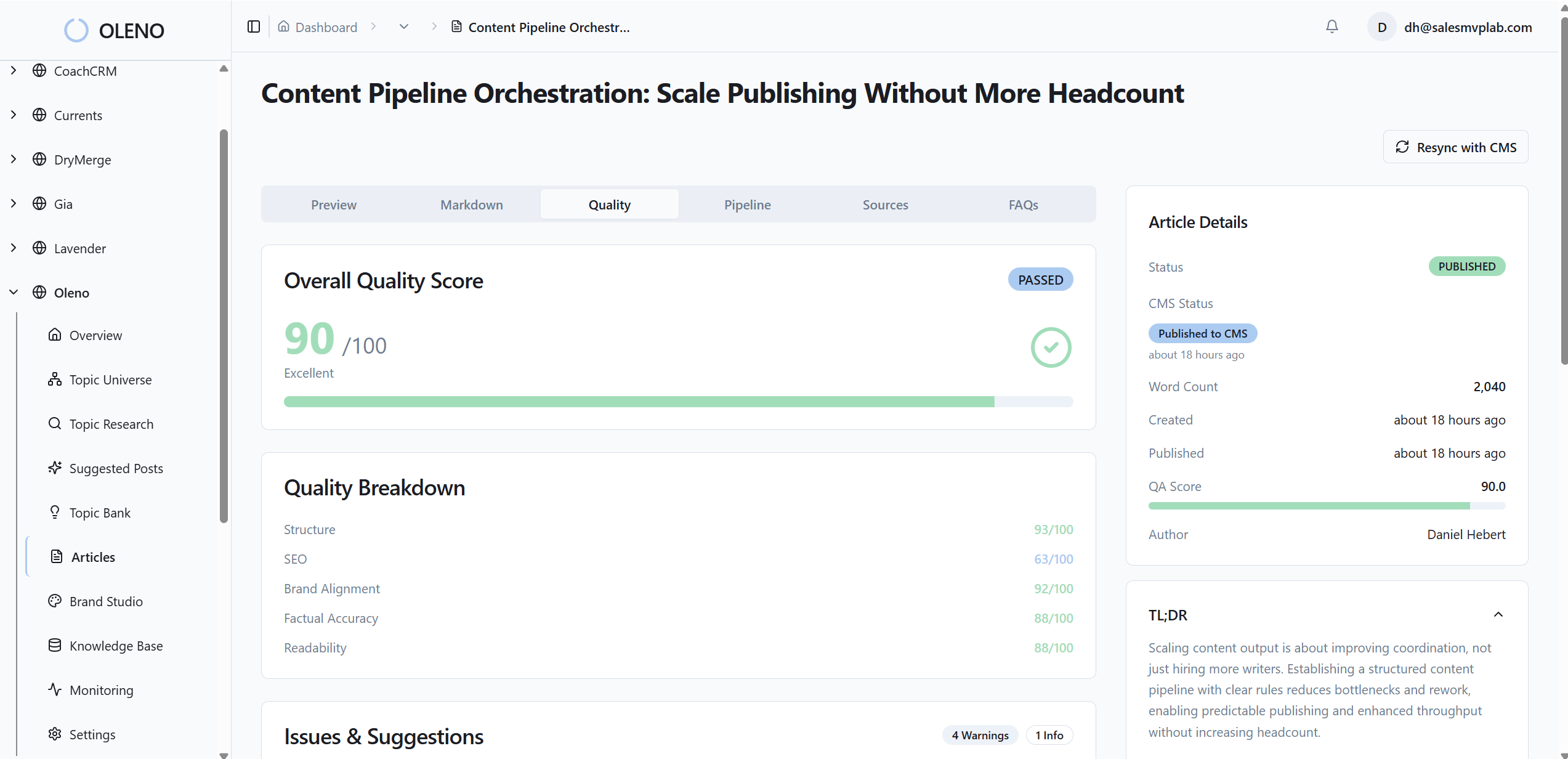
This turns “remember to add a CTA” into “the system adds the right CTA, in the right place.” It also prevents one-off edits from drifting language or overstepping product claims. Strategy stays human. Execution becomes consistent.
Because rules apply everywhere, new pillars inherit the same structure. That’s how you scale without losing the plot.
Publish With Canonical, Schema, And No-Duplicate Guarantees
When content passes checks, Oleno publishes directly to your CMS—WordPress, Webflow, Storyblok, HubSpot, and more. Canonical tags, metadata, and schema can be included so your hub structure lands exactly as intended. Publishing is idempotent, which means no accidental duplicates.
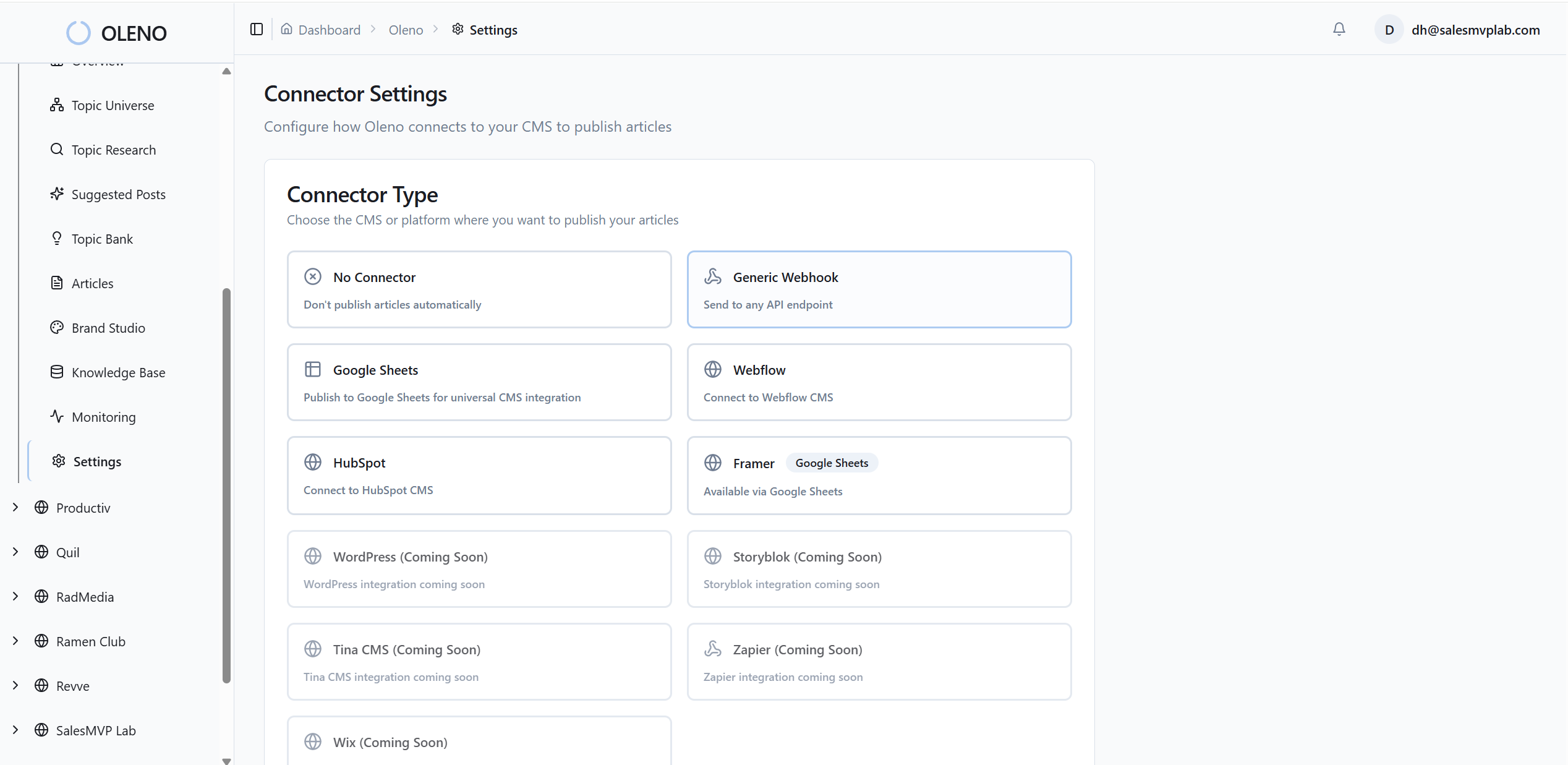
You also enforce URL patterns and templates on publish, not after the fact. Editors stop firefighting. Pages stay consistent. And if something fails a check, the system blocks it, notifies you, and nothing breaks in production.
Publishing shouldn’t be a surprise. It should be a button you trust.
Enforce Structure And Accuracy With A QA Gate
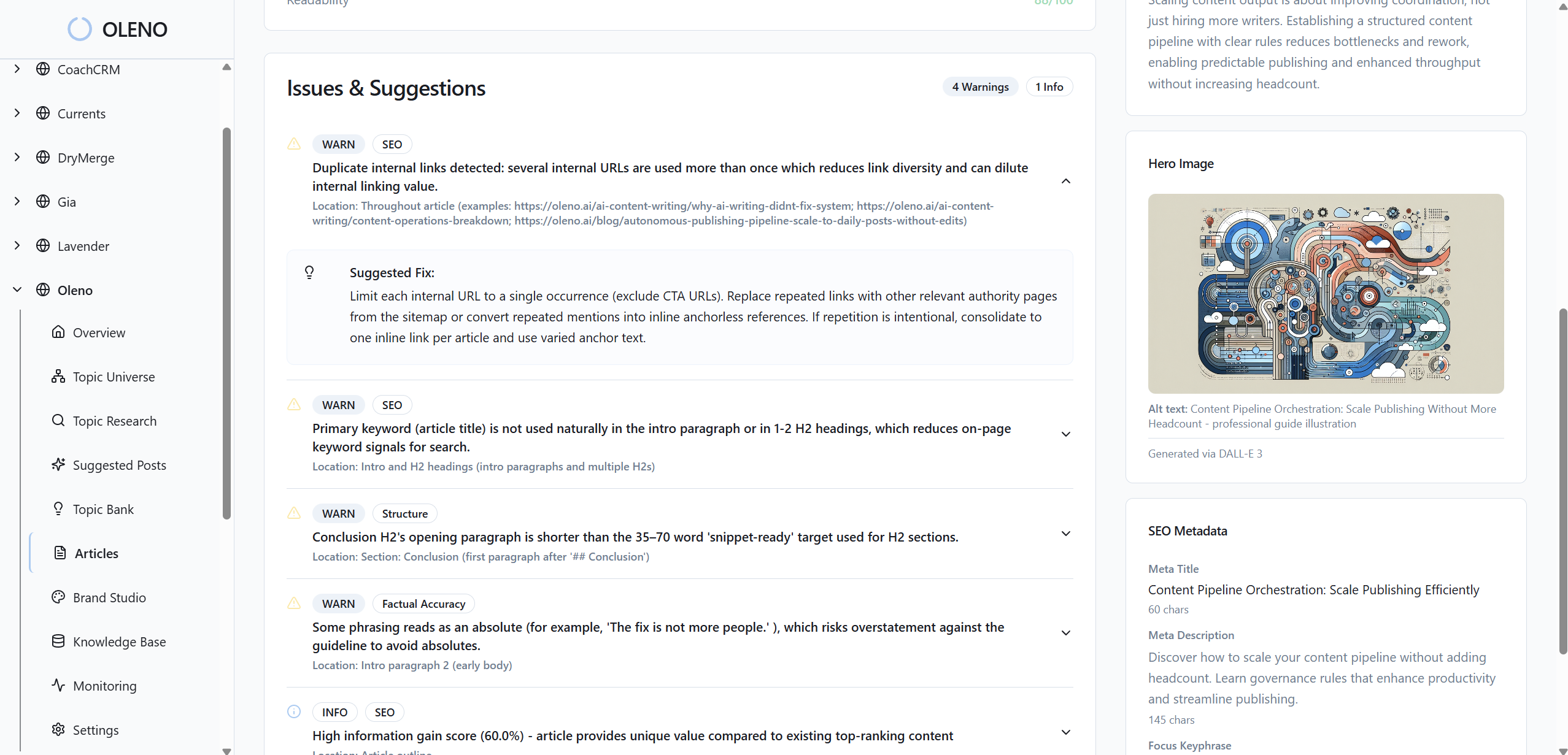
Before anything goes live, Oleno runs a QA gate: voice alignment, narrative structure compliance, clarity, grounding to your knowledge base, and claim boundaries. If a block is missing required components, or a claim is out of bounds, it doesn’t publish. Simple guardrails. Big impact.
Interjection. Governance beats rework.
This is where small teams gain leverage. Editors spend time on narrative and examples, not checking whether headings follow the template or whether the CTA matches the stage. The system handles structure; your team steers the story.
Set A Refresh Cadence With Content SLOs And Ownership
Evergreen doesn’t mean untouched. Give each pillar an owner and a refresh SLO. Track output cadence and quality trends over time, not just traffic spikes. Use light system health views to spot failure patterns—missed cadences, recurring structure issues, drift in claims.
Then work a small backlog by block, not page. Refresh the “Proof” block with updated stats this week. Update “Mechanism” when a feature ships next week. This keeps content fresh without kicking off full rewrites. It also creates a predictable rhythm the rest of the org can rely on.
If this is the execution layer you’ve been missing, let the system do the heavy lifting. Try Oleno For Free.
Conclusion
You don’t need more 4,000-word posts. You need pillars that act like airports—clear gates, short lines, and obvious exits to the next best action. Architecture creates that: blocks, canonicals, anchor patterns, and product-adjacent handoffs. Speed follows structure.
When you modularize, you fix the two problems that quietly kill pipeline: drift and dead ends. You also give sales a page they actually use. Build the template once. Encode the rules. Then let the system run while you focus on the story only you can tell.
About Daniel Hebert
I'm the founder of Oleno, SalesMVP Lab, and yourLumira. Been working in B2B SaaS in both sales and marketing leadership for 13+ years. I specialize in building revenue engines from the ground up. Over the years, I've codified writing frameworks, which are now powering Oleno.
Frequently Asked Questions