Pillar Pages vs Cluster Content: 7-Step Implementation Playbook

Most teams don’t have a pillar problem. They have a scope and intent problem that keeps turning pillars into bloated landing pages and clusters into look‑alikes. You publish more, but authority stalls. Same questions, new URLs, and the crawl budget goes to pages you plan to merge later anyway. Frustrating rework.
Let’s fix the system, not just the pages. Pillar vs cluster works when you enforce one outcome per pillar, make information gain your prioritization rule, and wire internal links with intent, not habit. You’ll stop fighting duplication and start shipping a stable graph that LLMs and search engines can cite cleanly.
Key Takeaways:
- Treat each pillar as a single outcome, then hand depth to clusters by design
- Score clusters by information gain to prevent duplicates before they exist
- Enforce a 90‑day cooldown on topics to avoid saturating one idea
- Structure H2s for snippet capture, then reinforce with schema and visuals
- Use deterministic internal linking to train consistent anchors and flow
- Route updates, merges, and canonicals early to protect crawl equity
- Let a governed system produce consistent outputs, not one‑off hero drafts
Define Pillar Scope And Intent As A Single Outcome
A strong pillar answers one specific outcome and routes everything else to related clusters. Map top queries to a measurable objective, set acceptance criteria before drafting, and lock a “won’t cover” list. If a subtopic needs depth or has different intent, move it to your cluster backlog and link out.

Map top queries to one measurable objective
Collect top queries and group them by intent, not by superficial keyword overlap. Tie the pillar to a single business outcome, like qualifying buyers or educating evaluators. That north star stops scope creep. If a query does not move the outcome, route it to its own cluster and give it a distinct job to be done. For a refresher on search intent mapping, see Ahrefs on mapping search intent.
Write one‑line acceptance criteria to keep the team honest. “This pillar is done when a reader understands X, can evaluate Y, and knows next actions Z.” Simple, testable, and easy to review. If we can’t say the same sentence out loud after a draft, we’re drifting.
As you fill the map, connect it to your planning system. A system mindset beats ad‑hoc sprints. If you need a primer on why, this overview of the content orchestration shift frames why coordination, not speed, keeps pillars and clusters aligned.
Choose what the pillar answers vs. what clusters answer
Pillars handle breadth and navigation. Definitions, frameworks, decision criteria, and clear links to depth. Clusters handle depth and specificity. Comparisons, how‑tos, checklists, and nuanced use cases. Most confusion fades when you write the handoff sentence for each section before drafting.
Build a simple handoff matrix. For every H2 in the pillar, write “If the reader wants more on ____ → link to [cluster topic].” That forces real decisions. If you need practical research flow to map queries to pillars and clusters, use this breakdown of topic clusters research.
Avoid wedge topics inside the pillar. If a process is needed, push it into a cluster guide. The pillar should orient and route, not teach every step. That’s how you protect readability and snippet eligibility.
Build acceptance criteria for scope lock
Scope lock sounds stiff, but it saves weeks. Document a must‑include and must‑exclude list before writing, then hold the line. If something new becomes essential, promote it to a cluster page and link. Do not keep bolting it into the pillar.
A word budget per section helps you make tradeoffs. Constraints create clarity, especially when multiple stakeholders are involved. After the first draft, run a fast scope check with sales or product. Ask, “What decision should the reader make now?” If the answer is vague, you wrote a landing page. Reset, then ship.
Prioritize Cluster Topics By Information Gain
Information gain is your filter for what to write next. Inventory subtopics, score the delta versus the current SERP, then merge, defer, or elevate based on that score. High‑gain pages earn new URLs. Low‑gain ideas belong inside updates or not at all.

Inventory subtopics and score delta vs SERP
List every potential cluster idea under the pillar. For each, note the gap between what exists and what you can add. Call it a 0–100 score. Anything above 60 is promising. Anything below 40 probably belongs inside an update to an existing page.
Look for thin SERPs and outdated coverage. Those are your fast wins. Capture missing perspectives while you research. If three competitors skip implementation detail X, lead with it. That is how you build distinct value worth linking to.
Use system rules to keep this consistent. If you’re building a durable engine, you will want policy, not memory. The rationale behind that approach is in why autonomous systems need rules for prioritization, not taste or guesswork.
Decide what to merge, defer, or elevate
Merge near‑duplicates into one canonical angle. Keep the higher‑performing URL, fold in the best sections, and redirect the rest. Defer medium‑gain ideas until the pillar ships. Elevate high‑gain items into a short series to build early authority that ladders back to the pillar.
If a cluster overlaps the pillar’s core question, reframe it. Go narrower with a specific use case, or shift the intent to a comparison, checklist, or troubleshooting guide. Small intent changes prevent cannibalization later.
A short “why now” note on each topic prevents knee‑jerk motions. If you cannot defend the gain in one sentence, do not write it yet. Your backlog will thank you.
When should you create vs update?
Create when intent is distinct and information gain is meaningful. Update when the new angle is close and your current page can absorb the detail without losing focus. If a page ranks but lacks one critical section, add the section and re‑link internally. Do not spin a new URL just to feel productive.
Set a 90‑day review reminder for medium‑gain drafts. If competitors catch up during that window, update the existing page instead of shipping another thin variant. You keep crawl equity intact and stop the copy‑paste treadmill before it starts.
The Hidden Costs Draining Your Cluster Effort
Mis‑scoped pillars and ungoverned clusters create quiet costs that compound. Duplication, cannibalization, and scope creep burn time without building authority. Quantify the waste, then turn off the tap with simple rules like 90‑day cooldowns, merge policies, and single‑outcome pillars.

What goes wrong when pillars act like landing pages?
When a pillar tries to be everything, it becomes nothing. You dilute intent, confuse readers, and bury the actual decision they came for. You also set yourself up to re‑write sections as separate clusters later. More editing, more redirects, more meetings. Not more authority.
Start by saying exactly what the pillar will answer and what it will not. Build a short “won’t cover” list before drafting. If it is not essential to the pillar’s outcome, push it to the cluster backlog. Then sanity check with sales or product. Ask what decision the reader should make after reading. If the answer sounds like “learn more,” you are still writing a landing page, not a pillar.
The duplication trap you don’t see coming
Duplication hides in near‑match ideas. “Guide vs checklist.” “Strategy vs framework.” You ship both, then wonder why neither sticks. Assign one owner page per intent and list the canonical angle in your tracker. That single move prevents most cannibalization.
When overlap appears, pick a primary and consolidate. Fold the best sections into the stronger URL and set redirects. If timing or stakeholders block it, use a canonical while you plan the merge. The idea is to resolve the fight, not let two weak pages linger. For background, skim Moz's guide to keyword cannibalization.
Quick diagnostic: are you over‑publishing one idea?
Plot your last 90 days of content against your topic universe. Let’s pretend you shipped 12 articles on one subtopic and 3 on everything else. Expect crawl equity leakage, weaker snippet eligibility, and internal links that point in circles. You will feel busy. You will not look authoritative.
Add a simple cooldown rule. Do not re‑cover the same topic for 90 days unless you are merging or updating. That pause gives your team breathing room and your site clarity. It also lines up with guidance to avoid duplicates at the source, not after the fact, see Google Search Central guidance on duplicate content.
Curious what this looks like in practice? Try using an autonomous content engine for always-on publishing. Try using an autonomous content engine for always-on publishing.
Internal Linking Rules That Prevent Cannibalization
Clean internal links train both readers and machines on what lives where. Use descriptive anchors, set link floors and ceilings, and resolve conflicts with canonicals or noindex while you merge. Your goal is predictable flow from pillar to clusters and back.
Anchor text constraints and placement rules
Use concise, descriptive anchors that match the destination’s core topic. Two to five words is plenty. Place links at natural sentence boundaries after the claim they support. That pattern reads well and avoids clutter.
Guaranteed link counts and distribution
Set a floor and a ceiling per article. Five to eight internal links usually covers navigation without noise. Distribute links across sections. Not just in the intro or the outro. Each section should send the reader to the most relevant next step.
When to add noindex or canonicals instead?
If two pages fight for the same query and intent, pick a primary. Canonical the secondary while you merge content into the primary. Cleaner than competing. Use noindex on thin, temporary, or overlapping pages you plan to consolidate. Then re‑run internal links to push equity to the primary URL when the merge completes.
Build A Snippet-Ready Pillar Outline That Gets Cited
If you want citations, write for them. Draft H2s as questions or crisp statements, open with 40–60‑word direct answers, then support with context and an example. Add schema and visuals where they help decisions. You are making each section portable and understandable on its own.
How do you draft snippet-ready H2s and answers?
Write each H2 to be citable. Open with a three‑sentence pattern: direct answer, supporting detail, quick example. Keep it under 60 words so it fits snippet constraints. If the opening paragraph cannot stand alone, it is not ready.
Section-level TL;DRs and schema hooks
For complex sections, add a one‑line TL;DR. It improves skim speed and chunk retrieval accuracy. Pair that with schema. Use Article schema for the page, FAQ schema for Q&A sections, and BreadcrumbList to clarify hierarchy. The official references are here: Google's structured data documentation.
Breadcrumbs matter. Pillar at the top, clusters underneath. Machines infer relationships faster when you make hierarchy explicit. Humans do too.
Visual and example placement to reduce ambiguity
Place simple diagrams or product screenshots next to decision sections. Tie each visual to a specific claim. Label images with alt text that describes the decision or workflow, not just the picture. A consistent cadence helps, hero plus two or three inline visuals is usually enough.
Examples work like visuals. Put them where hesitation lives. Comparisons, evaluation criteria, and “how it works” sections benefit most. More images do not equal more clarity. Precision does. For formatting inspiration, skim Backlinko's featured snippets study.
Want to see these outlines generated consistently with snippet‑ready openers and visual slots pre‑planned? Try Oleno for free. Try Oleno for free.
How Oleno Automates The Pillar–Cluster Workflow
Remember the duplicate pages, the late merges, and the scope drift we walked through? Oleno replaces those manual choices with system rules. Topic Universe maps pillars and clusters, cooldowns prevent over‑publishing, and deterministic internal linking keeps anchors and destinations consistent. You get a pipeline that ships complete, on‑brand articles without juggling tools.
Topic Universe, cooldowns, and daily suggestions
Oleno’s Topic Universe maps your content landscape from your sitemap, site content, and configured focus areas. It groups topics into clusters, tracks coverage and saturation, and enforces a 90‑day cooldown before re‑covering the same topic. That single rule would have prevented the 12‑vs‑3 imbalance we discussed earlier.
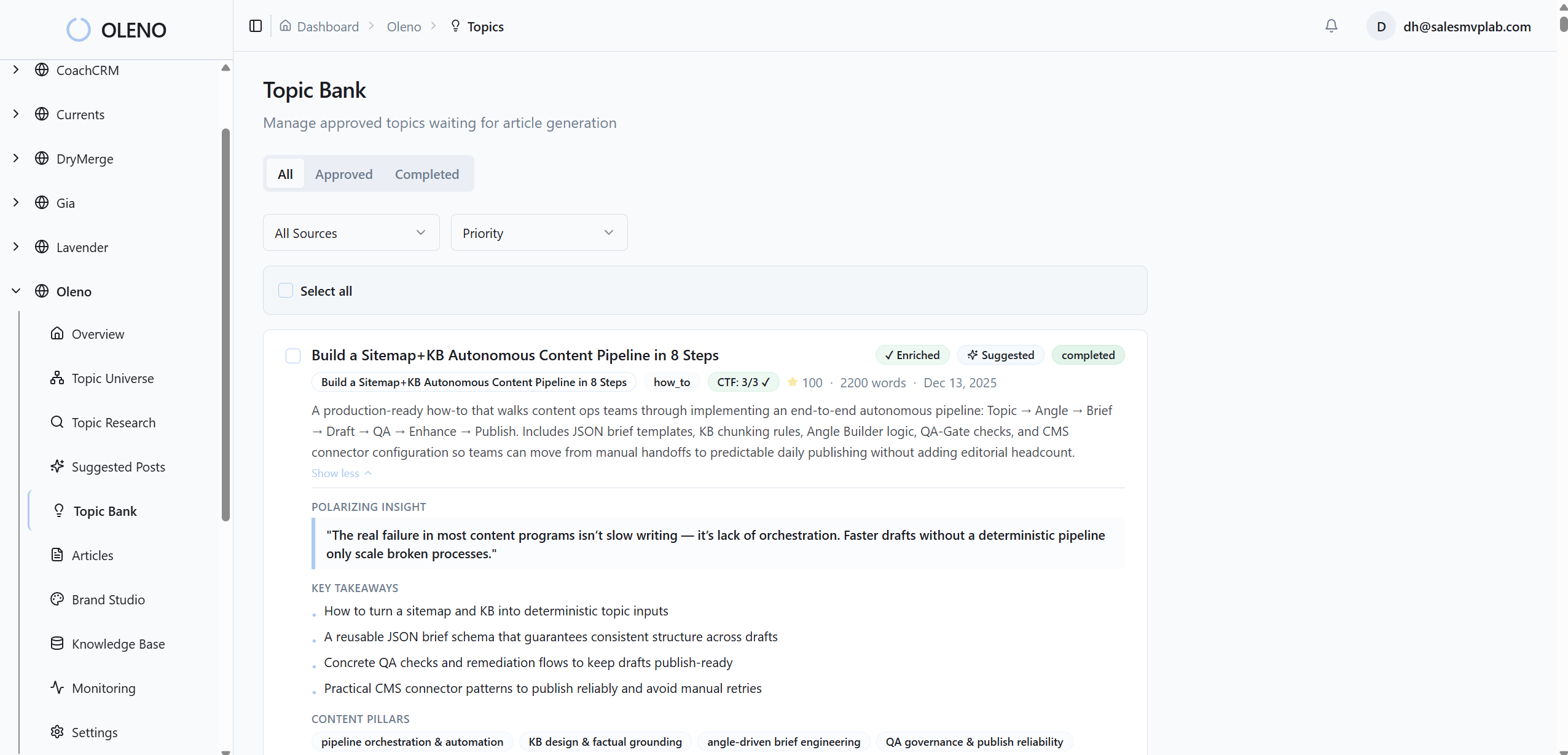
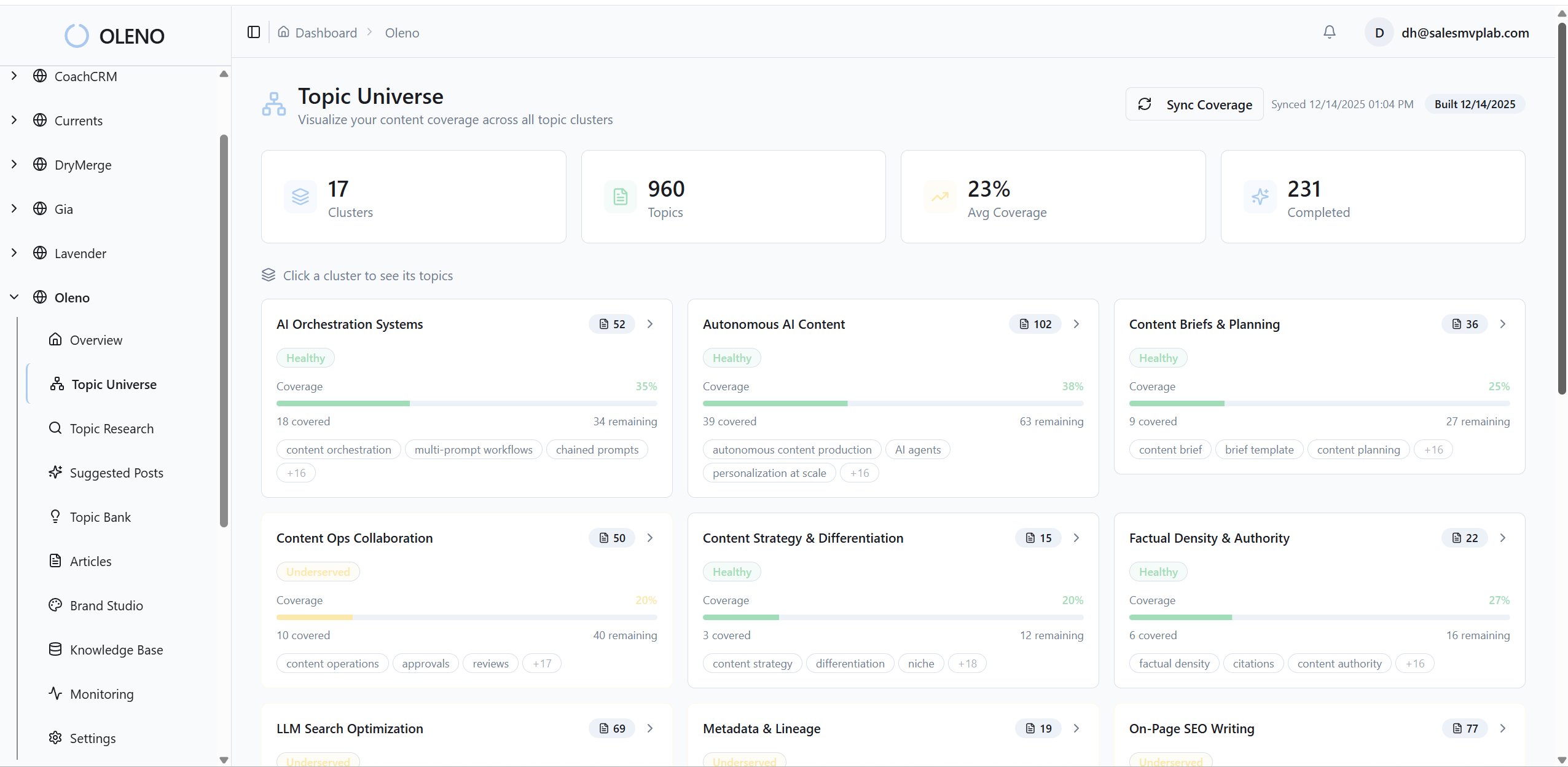
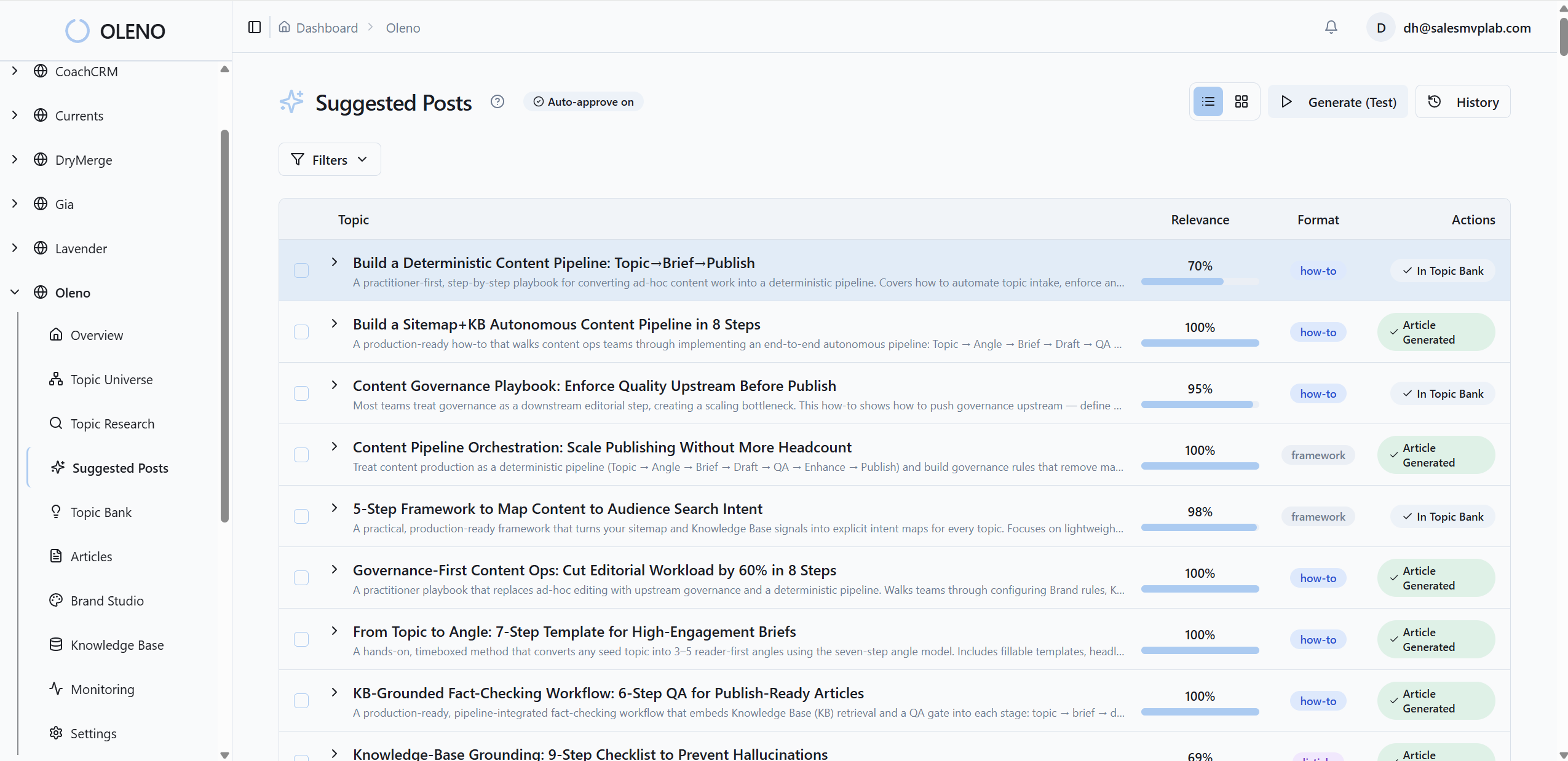
Daily topic suggestions fill the pipeline based on gaps and saturation, not gut feel. Approve a suggestion and it moves forward. No keyword dashboards. No spreadsheet archaeology. As a result, you maintain a balanced calendar across clusters and stop saturating one idea by accident.
Deterministic links, schema, visuals, and QA gates
Oleno injects 5–8 internal links per article using only verified URLs from your sitemap. Anchors match page titles and links land at natural sentence boundaries, so they read cleanly and stay auditable. Structured data is generated programmatically, including Article, FAQ, and BreadcrumbList JSON‑LD, then validated before publishing.
Visual Studio generates brand‑consistent hero and inline images using your colors, logos, and style references. Product screenshots are matched to relevant sections using semantic similarity, with solution sections prioritized. QA evaluates drafts against 80+ criteria, including structure, information gain, snippet readiness, and brand alignment. Low‑scoring areas trigger refinement loops before publish.
Ready to eliminate rework and the week‑to‑week publishing headache with a governed pipeline? Try generating 3 free test articles now. Try generating 3 free test articles now.
Conclusion
Pillar vs cluster is not about writing more. It is about enforcing one outcome per pillar, publishing only what adds information gain, and wiring links that clarify, not confuse. When you set those rules, you stop chasing duplicates and start building a structure that earns citations naturally.
You can run this by hand for a while. Spreadsheets, reviews, and gentle reminders. Or you can let a governed system do the boring parts perfectly every time. Either way, the win is the same: fewer overlapping pages, clearer decisions for readers, and content that compounds instead of spinning in place.
If you want to see the system running end to end with text and visuals handled together, without analytics distraction or manual cleanup, there is a simple next step. Try using an autonomous content engine for always‑on publishing. Try using an autonomous content engine for always-on publishing.
About Daniel Hebert
I'm the founder of Oleno, SalesMVP Lab, and yourLumira. Been working in B2B SaaS in both sales and marketing leadership for 13+ years. I specialize in building revenue engines from the ground up. Over the years, I've codified writing frameworks, which are now powering Oleno.
Frequently Asked Questions