Prioritize Content Backlog: 5-Step Framework — Search, Product & Sales Signals

Most roadmaps ship content for traffic, not pipeline. If you prioritize content backlog by keywords or exec requests, you’ll create pageviews that don’t convert. The fix is boring and practical. Pull product and sales signals into your backlog scoring, then publish in that order. It’s the only way the content engine compounds.
I learned this the hard way. We’d stack a backlog full of “growth” ideas, watch sessions climb, then realize pipeline didn’t budge. That was the mistake. The backlog wasn’t wrong because we wrote bad articles. It was wrong because we ignored what buyers actually do before they talk to sales, and what your product uniquely solves.
Key Takeaways:
- Use a 5-factor score for every idea: search intent fit, product proximity, sales signal strength, audience priority, freshness advantage
- Instrument your backlog first, or your scoring will fail: connect CRM notes, win-loss reasons, product usage spikes, and SERP intent
- Run a 12-week pilot with a holdout group to validate pipeline lift before scaling output
- Bake scores into scheduling rules so the top 20% of ideas always hit next
- Add QA rules that block drafts without product truth and buyer intent alignment
- Expect to cut 40% of low-impact work and grow pipeline-attributable content by ~25% in one quarter
Traffic Without Pipeline Is a Broken Goal
Publishing for traffic alone fails because it ignores product and sales signals that drive pipeline. When your backlog is scored by volume or vanity metrics, you produce assets that rank but don’t help buyers decide. The result is wasted hours and a slower funnel, even when analytics look “good.”
Keyword-First Backlogs Create Fake Wins
A keyword-only backlog looks healthy on paper. Clear targets. Predictable cadence. Search volumes that feel exciting. Then you ship ten posts, watch clicks rise, and hear crickets from sales. The content didn’t fail on SEO. It failed on purpose.
The core problem is intent mismatch. If the keyword implies research and your piece tries to sell, readers bounce. If the query signals evaluation and your draft avoids comparisons, buyers leave frustrated. You can rank and still be wrong for the job. That’s the part most teams ignore because traffic growth feels like proof.
I’ve sat in those meetings. Everyone points to graphs, not pipeline. Once you switch the scorecard to pipeline signals, the picture changes fast. You realize half the backlog doesn’t deserve to exist yet. That sounds harsh. It saves quarters.
Tell-tale signs of fake wins:
- Time on page is fine, but assisted opportunities are flat
- High rank on queries with “what is” or “overview,” zero lift in demo requests
- Content shares go up, sales call quality goes down
Signals You Ignore When You Chase Pageviews
When pageviews lead the backlog, you miss buyers’ decision triggers. You miss the real objections. You miss where your product actually shines. That is why “good” content often underperforms.
The missing signals live outside SEO tools. They sit in sales call notes, CRM stages, win-loss reasons, product usage spikes around specific workflows, and common failure patterns in onboarding. Pull these into your backlog and patterns emerge. You stop chasing abstracts and start covering real jobs buyers are trying to get done.
Google’s own guidance pushes you this way. They reward content that clearly serves people first, not search engines, which means intent and usefulness carry weight over keyword stuffing. Review Google’s helpful content guidelines and you’ll see your scoring model needs more than volume and difficulty.
Reframe: Prioritize Your Content Backlog With Product and Sales Signals
The backlog should be ordered by how close each idea sits to buyer intent and product truth. Use product usage, sales objections, and customer narratives to lift high-impact topics to the top. When you prioritize with these signals, you publish fewer low-intent pieces and capture more evaluation moments.
What Should Lead the Backlog
Ideas that mirror real evaluation paths should lead. If buyers always ask “X vs Y,” you need that page. If your product removes a painful step in a common workflow, write the piece that proves it with specifics. If sales keeps battling the same objection, publish the explanation your best rep gives on calls.
You’ll notice this reframe puts your product and buyer behavior at the center without turning every post into a pitch. That balance matters. Teach first, then map to outcomes your product can actually deliver. Skip that, and you risk credibility. Get it right, and you raise close rates because content starts doing real pre-sales work.
Practical examples of what earns the top slots:
- Comparisons that match active deals and shortlists
- Deep dives that validate a unique product capability buyers doubt
- Tutorials that remove a risky step buyers often fail at during trials
Stop Treating All Ideas as Equal
Most backlogs are a pile of “good ideas” with no economic ordering. That’s a cost. A hidden one. If a low-intent explainer blocks an evaluation page in the queue, you lose real money. The fix is ruthless scoring and queue discipline.
Start by dropping any idea that doesn’t serve a funnel job. Education that never points to evaluation is content debt. Evaluation that never answers real objections is content debt. Every “nice to have” pushes a “must have” down the calendar. Once that clicks, the team stops arguing taste and starts debating impact.
Rules that prevent drift:
- No idea gets scheduled without a funnel job and success metric
- No evaluation topic ships without a clear objection it resolves
- No product-adjacent piece ships without verified claims from Product or PMM
The Hidden Cost of a Keyword-Only Backlog
Keyword-only backlogs waste time and budget because they ignore buyer readiness and product fit. Teams spend hours producing and editing pieces that rank but stall evaluation. Surveys show marketers spend large chunks of time on manual work, which compounds when content doesn’t move decisions. That is preventable with better prioritization.
Time, Money, and Morale You Lose
Every low-impact draft takes hours you never get back. Writing, review, approvals, revisions, publishing, and distribution. Multiply that by ten, and you just spent a sprint with no lift in qualified pipeline. People notice. Sales disengages. Writers burn out. Leadership questions content completely, especially when evaluating prioritize content backlog.
Industry data backs the manual overhead problem. Reports like the HubSpot State of Marketing 2024 highlight how much time still goes into production over impact. If your backlog feeds that machine with the wrong inputs, you turn effort into waste.
Costs that stack up quickly:
- 6 to 10 hours per piece on drafting and revisions that don’t affect deals
- 2 to 3 extra review cycles when claims aren’t grounded in product truth
- Weeks of delay on evaluation pages that would shorten sales cycles
Where the Waste Hides in Your Process
Waste hides in handoffs and rework. It shows up when writers guess on voice, when PMM fixes product claims after the fact, when editors try to force narrative cohesion at the end. None of that is creative work. It’s cleanup caused by a backlog that doesn’t encode buyer and product signals up front.
Tie your backlog to CRM and product telemetry, and the fog lifts. You’ll know which topics correlate with opportunities moving from evaluation to commit. You’ll see which objections stall trials. You’ll stop greenlighting posts that can’t influence those points. Even budget decisions get easier when the order of work is defensible.
Want another lens on the risk of chasing volume over value? Spend five minutes with the Gartner CMO Spend Survey. Budgets shift fast. Publishing low-impact content is an easy cut when the numbers tighten.
What It Feels Like When the Backlog Is Wrong for Prioritize content backlog
A bad backlog feels like running in sand. You’re busy, metrics move a bit, but deals don’t. Sales stops asking for links. Leaders skim dashboards and frown. Writers start to question everything. It’s not lack of effort. It’s the wrong work at the wrong time.
The Endless Review Loop
When ideas don’t map to buyer questions, drafts wobble. Editors ask for more examples. PMM asks for product guardrails. Legal flags language. Everyone is right, and still nothing ships. That review loop isn’t a quality culture. It’s a symptom of upstream prioritization being off.
I’ve been in those late-night edits, trying to salvage pieces that never had a clear job. You can polish them. You can’t make them matter. Once teams feel that truth, they stop arguing style and start asking better questions before anything hits a brief.
Common loop triggers:
- Vague audience and intent in briefs
- Unverified product claims that need rewrites
- No single, testable outcome for the piece
Reactive Fire Drills Every Week
Another feel-bad signal is whiplash. One week it’s SEO clusters. Next week it’s a launch. Then sales needs a deck. Without a scored backlog, you react to the loudest voice. That chaos makes people feel busy and behind, which kills strategic work.
Put a simple prioritization model in place and the fire drills slow down. Not because surprises vanish, but because you finally have an operating rhythm. You can say yes to the right interrupts and no to the wrong ones. Morale goes up when the team sees work connecting to revenue.
How to Prioritize Content Backlog for Pipeline Impact
Prioritize content backlog by scoring each idea on intent fit, product proximity, sales signal strength, audience priority, and freshness advantage. Instrument these signals, then schedule the highest scores first. Protect the top 20% from being bumped, and measure impact with a 12-week pilot and a small holdout group.

A Simple 5-Factor Scoring Template
You don’t need a PhD model. You need a repeatable one. Score every idea 1 to 5 on five factors, sum the score, then sort descending. If two ideas tie, ship the one closer to evaluation.
Start with calibration. Score a few recent winners and losers to set your scale. Discuss the why, tighten the definitions, then lock it. From there, the score decides the order. No favorites. No backroom deals. That’s the discipline that stops waste.
Score on these five factors:
- Search intent fit, does the query match the job your piece will do
- Product proximity, how directly the topic maps to a verified capability or outcome
- Sales signal strength, frequency and severity of related objections or deal questions
- Audience priority, segment or persona importance this quarter This is particularly relevant for prioritize content backlog.
- Freshness advantage, speed to capture timely changes or gaps in the SERP
Instrument the Signals Before You Score
Scoring without data is theater. You need evidence. Pull recent win-loss notes, top objections from Gong or call notes, product usage spikes related to key workflows, and current SERP patterns. Map each to your five factors so the numbers mean something.
Do a quick SERP intent check on every idea. If top results are definitions and guides, you’re in educate mode. If they’re comparisons and vendor pages, you’re in evaluate mode. Write accordingly. Google’s guidelines reward usefulness and clarity, so align your format to intent from the start.
Instrumentation checklist to get started:
- Connect CRM stages and reasons to your topic tags
- Tag objections and questions in call notes by theme
- Log product capabilities with allowed claims and boundaries
- Capture SERP intent notes in the brief template
Ready to see this running against your backlog, not as a slide? Request a Demo
How Oleno Makes This Prioritization Repeatable
Oleno turns the scoring approach into an execution system. Governance encodes your voice, POV, and product truths. Studios then produce briefs and drafts that obey those rules. A QA gate blocks anything that drifts. CMS publishing and measurement keep cadence and visibility steady without more meetings.

Governance Locks Voice, POV, and Product Truth
You can’t prioritize well if the work reverts to generic in draft. Oleno’s Brand Studio captures tone rules, preferred terms, CTA style, and structure so everything reads like you. Marketing Studio encodes your narrative and message pillars so the “why the old way fails” throughline never disappears. Product Studio grounds claims in approved descriptions and boundaries so drafts stay accurate.
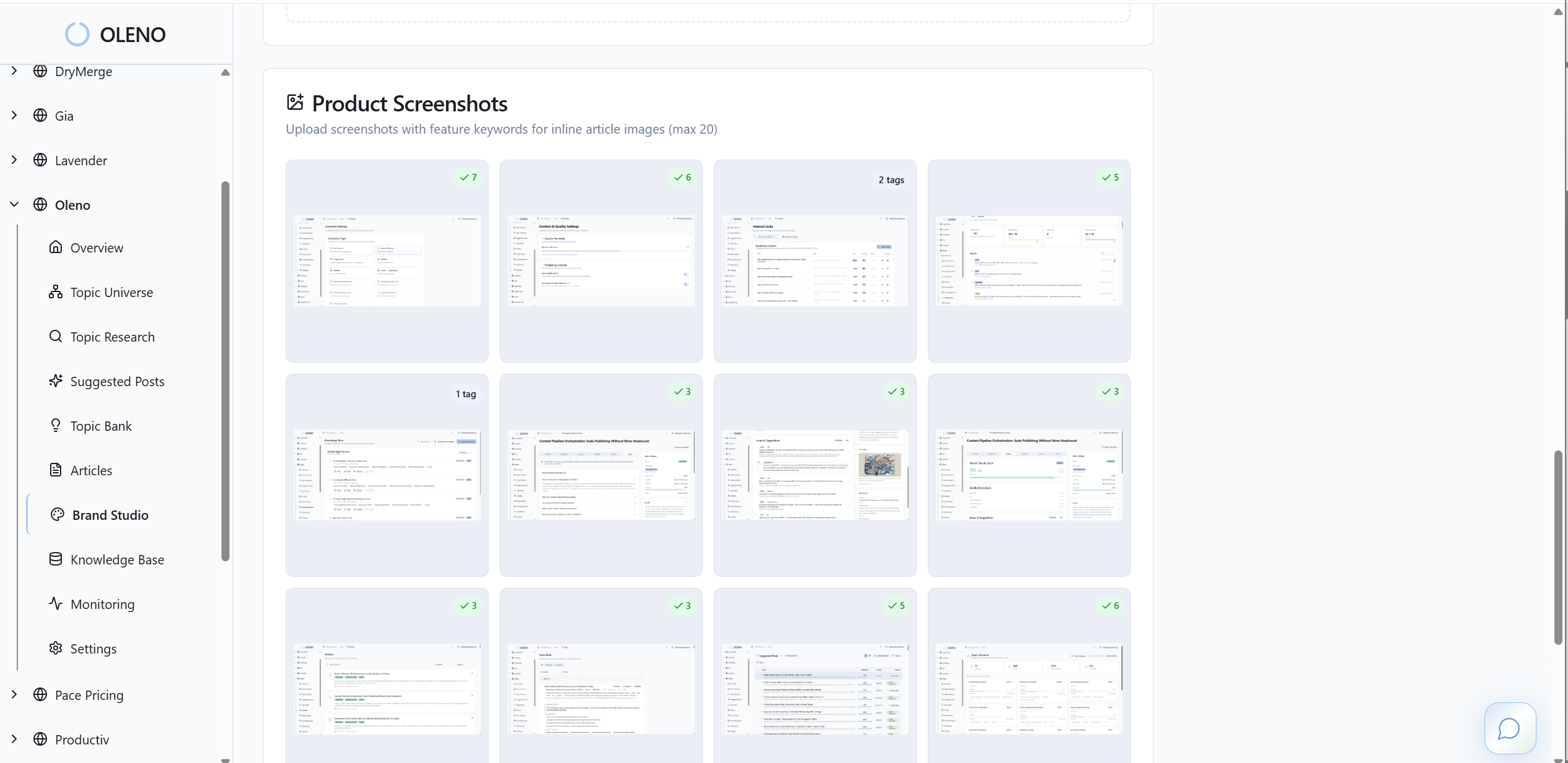
That governance reduces rework and speeds approvals because arguments shift from opinion to rules. Editors stop rewriting for voice. PMM stops fixing invented features. Review cycles get shorter because the draft started in bounds, not out.
Capabilities that make governance practical:
- Brand Studio applies tone and terminology during briefs and drafts
- Marketing Studio injects message hierarchy so the POV is consistent
- Product Studio retrieves allowed claims to prevent risky statements
From Topic Universe to QA Gate to CMS
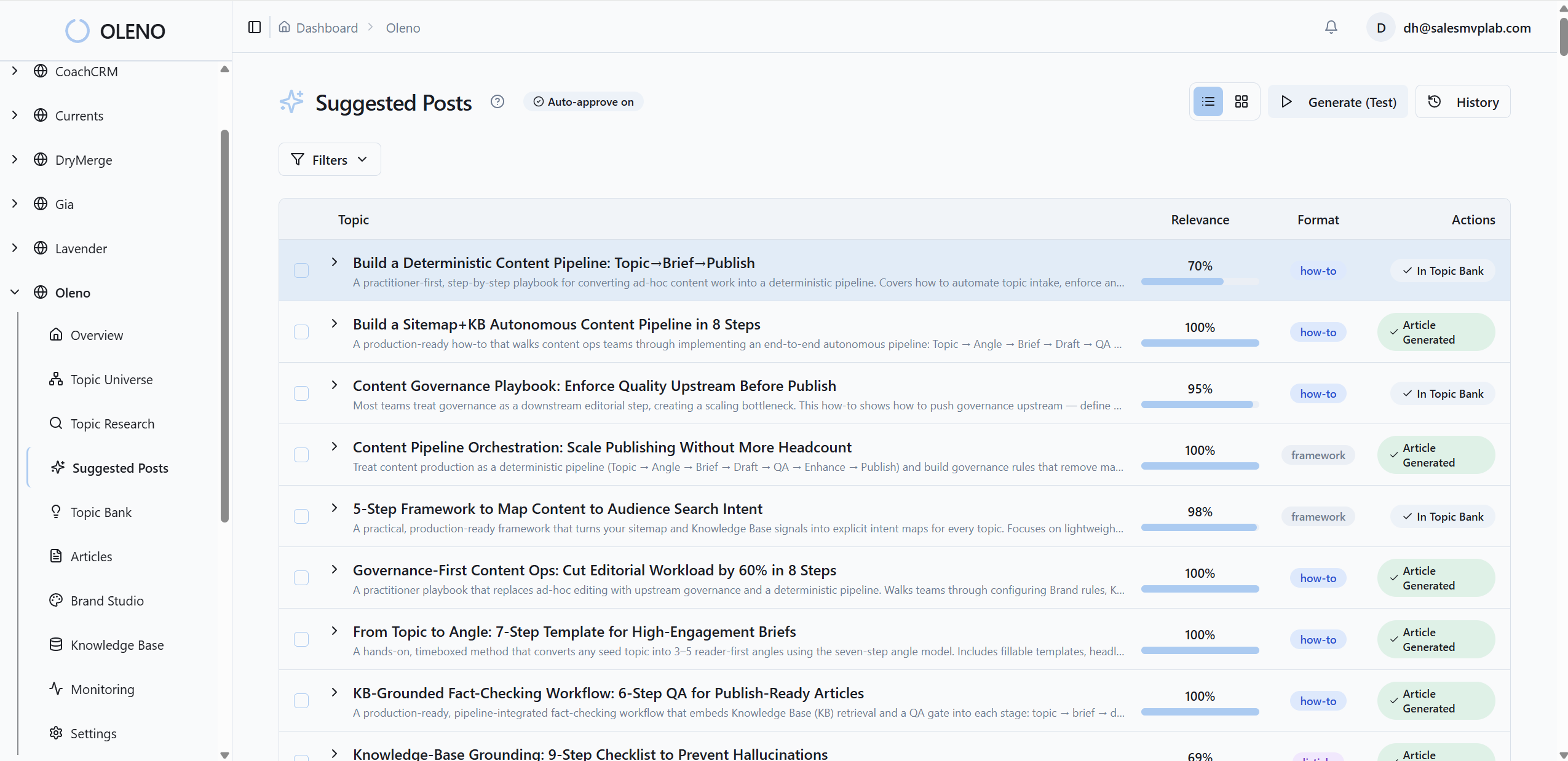
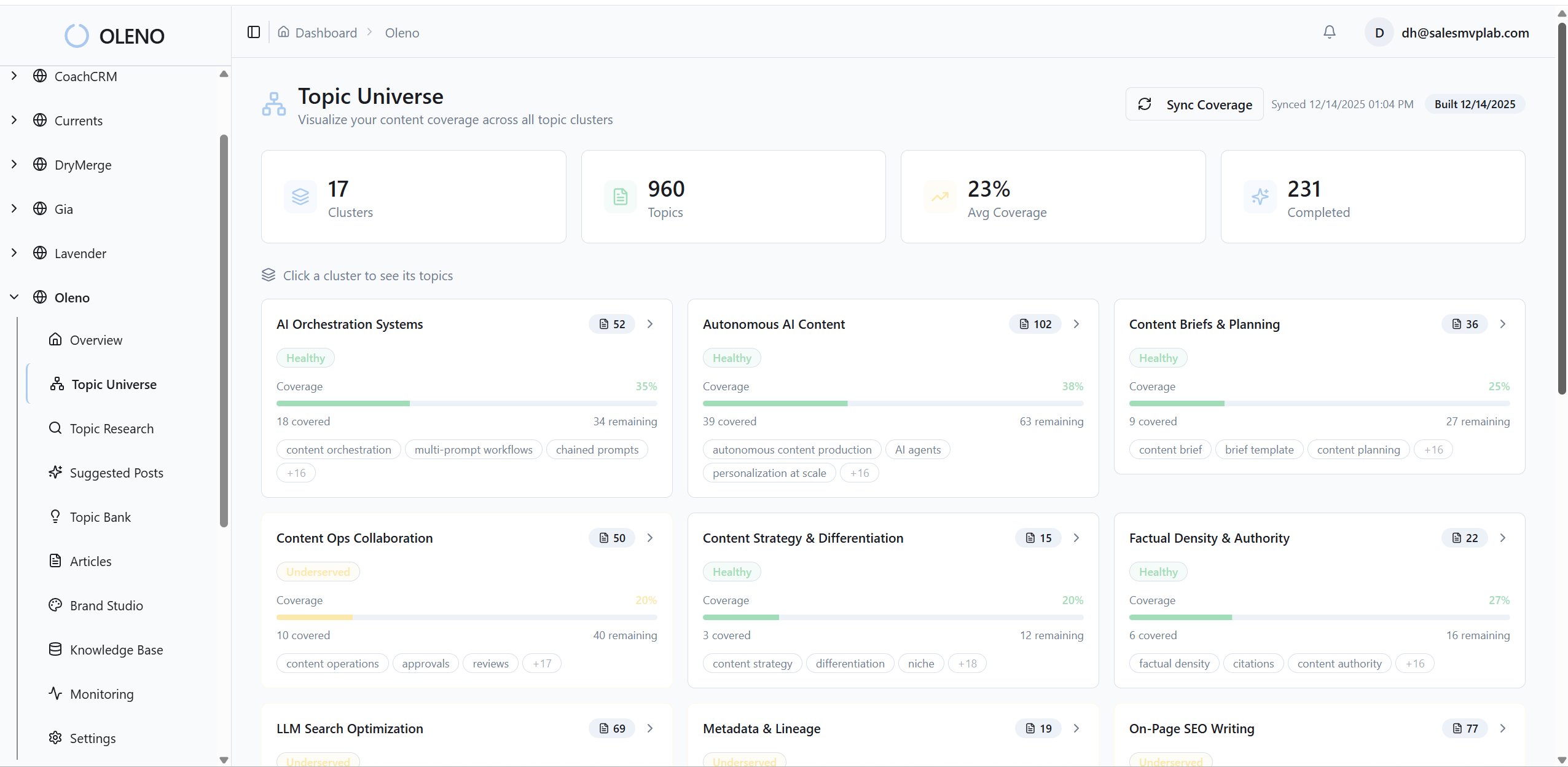
Prioritization needs an engine behind it. SEO Studio expands your Topic Universe, finds opportunities, and generates governed briefs that match search intent. The Variation Layer adapts pieces for target audiences without changing your narrative. A non-negotiable QA gate checks voice, structure, grounding, and readability before anything can publish.
Publishing doesn’t stall either. CMS Publishing pushes approved content as drafts or live posts, and Measurement & System Health tracks cadence and quality trends so you spot bottlenecks early. In practice, that means the 5-factor score translates into scheduled, approved, and shipped work rather than another spreadsheet.
What used to take weeks of back-and-forth, Oleno handles in days with:
- Locked-structure briefs that reflect your scoring and intent notes
- A QA gate that catches voice drift and unsupported claims before review
- Direct CMS publishing that removes copy-paste handoffs
40% less time on low-impact drafts. More evaluation content shipped on schedule. That’s what Oleno delivers. Book a Demo
Want the scoring model, the governance, and the publishing tied together so it keeps running when priorities shift? Oleno is built for that exact job. Request a Demo
Conclusion
If you only remember one thing, remember this, order your backlog by buyer intent and product truth, not keywords or opinions. Score every idea, instrument the signals, run a 12-week pilot with a holdout, then scale. Most teams see about a 40% cut in low-impact drafting and a 25% lift in pipeline-attributable content once the model is enforced. When the backlog is right, the engine compounds.
About Daniel Hebert
I'm the founder of Oleno, SalesMVP Lab, and yourLumira. Been working in B2B SaaS in both sales and marketing leadership for 13+ years. I specialize in building revenue engines from the ground up. Over the years, I've codified writing frameworks, which are now powering Oleno.
Frequently Asked Questions