Prioritize Content with Coverage & Saturation Data: 6-Step Playbook

Most content teams chase traffic like it’s a compass. It isn’t. Traffic tells you what worked last month, not what to write next week. If you want authority to compound, you need earlier signals—coverage and saturation—so you ship work that adds net-new information instead of repeating your greatest hits with a new headline.
I learned this the slow way. Years ago we scaled a community site to 120k monthly visitors with a simple formula: breadth plus depth at volume. Later, inside lean SaaS teams, I watched us slip into reactive topics, duplicate angles, and beautiful drafts that did nothing for pipeline. When we finally mapped clusters, tracked saturation, and enforced cooldowns, the noise dropped. Impact went up.
Key Takeaways:
- Treat coverage and saturation as leading indicators; traffic is a lagging report
- Map a topic universe, assign canonical ownership, and enforce a 90-day cooldown
- Score information gain in the brief to prevent low-differentiation drafts
- Quantify duplication costs in hours, not anecdotes, to change prioritization
- Operationalize weekly reprioritization so your queue adapts as clusters evolve
- Use an autonomous system to enforce rules in production, not just slides
Why Traffic-Only Signals Keep You Publishing The Wrong Work
Traffic is a lagging signal; coverage and saturation predict where the next article will actually move authority. Coverage reveals presence and depth; saturation surfaces overlap and recency conflicts. For example, two near-identical “playbooks” published within 30 days will divide links and attention instead of compounding.

The Signals That Actually Predict Authority
Authority grows when every new piece fills a gap the rest of your library doesn’t cover. That means tracking coverage beyond “do we have a page?” and scoring depth by sections, sources, and specificity. Pair that with saturation—how often you’ve hit the same angle recently and how much semantic overlap exists—and you get a forward-looking view of impact. It isn’t fancy. It’s just earlier.
Once you see the pattern, the biases jump out. Keyword sheets push you toward volume; coverage and saturation steer you toward clarity. That clarity leads to citable pages—clean answers, unambiguous scope, snippet-friendly structure. If you want inspiration on standing out when everything looks the same, the practical guidance in this playbook for standing out in saturated content markets adds useful nuance without overpromising.
What Is Coverage Versus Saturation?
Coverage asks if you have a canonical page for the topic and whether it goes deep enough to be reference-worthy. Think section count, concrete examples, and credible citations. Saturation asks if your recent posts compete with each other or fragment intent across too many similar angles. Different questions. Complementary answers.
Combine them and you start prioritizing net-new information over safe refreshes. A low-coverage, low-saturation topic begs for a flagship piece. A high-coverage, high-saturation topic likely needs a pause and a smarter angle later. That’s where cooldowns earn their keep. Short sentence, big point.
Ready to skip theory and put structure around this? If you want to see what an always-on prioritization layer looks like in practice, you can Request a demo.
The Real Bottleneck Is Fragmented Strategy, Not Headcount
The real blocker isn’t too few writers. It’s scattered systems that don’t agree on what matters or when you should publish it. Spreadsheets capture keywords, but they don’t encode coverage states, recency, or overlap. That’s how teams produce duplicates with new titles.

Why Conventional Keyword Spreadsheets Fail
A spreadsheet can store words, not governance. It rarely knows which page owns a topic, when it was last covered, or whether a “new idea” is just a warmed-over angle from six weeks ago. So the backlog looks full, editorial cycles get consumed, and the needle barely moves. More activity, same authority.
When your strategy lives in tabs—keywords here, briefs over there, editorial somewhere else—you’ll inevitably optimize for what’s easy to count. Volume. It’s not malicious. It’s structural. Tie the entire process to a topic universe, and suddenly “what should we write next?” has a defensible answer grounded in coverage and saturation, not guesswork.
How Do You Define A Topic Universe That Holds Up?
Start from reality: your sitemap and your knowledge base. Group pages into clusters that mirror your pillars. Assign each page to a single canonical topic to avoid internal competition. Track depth, citations, internal links, and last-covered dates in one table. Now you have a living map of authority, not a list of words.
Cool-downs matter here too. Publishing a near-duplicate within 90 days typically fragments signals and wastes hours you won’t get back. A clear universe lets you enforce that rule intentionally. It also surfaces which cluster deserves the next three briefs because it’s underserved and business-relevant. Decision made. Move on.
The Hidden Costs Of Re-Covering Topics You Already Own
Duplicate coverage looks productive on a calendar and expensive in a post-mortem. Every redundant article still consumes planning, writing, editing, images, QA, internal links, and publishing. None of that work compounds if it doesn’t add new information. It quietly taxes your best people.
Engineering And Writing Hours Lost To Duplication
We’ve all seen it. A “fresh” angle sneaks into the queue, passes a quick keyword sniff test, and ships. Weeks later you realize it mirrors something you published last quarter. The sunk time is real—outline, draft, edit pass, screenshot wrangling, QA, and CMS setup. Multiply by the month’s cadence and the math gets uncomfortable.
This isn’t about shaming teams. It’s recognizing that duplication has full-pipeline costs while producing partial value. Editors juggle versions, SEOs reconcile cannibalization, designers swap assets, and engineers or ops folks handle publishing and schema. Consider building measurement around this reality; a simple model like a measurement framework for content teams gives you the vocabulary to negotiate trade-offs.
Let’s Pretend Your Team Publishes 30 Posts A Month
Let’s run the numbers. If 30 percent of those are low-gain recovers, that’s nine posts. At roughly six hours per post across planning, writing, QA, images, and publishing, you’re at 54 hours a month going to work that can’t move coverage. Reclaim half and you’ve got enough time for a new cluster or two high-impact briefs.
Even if your hours per post are off by a bit, the direction holds. The point isn’t precision; it’s intention. Decide what you’ll stop producing so the rest can compound. That’s a leadership job, not a copywriting one.
The Cascading Impact On Search And LLM Visibility
Duplication muddies your best answer. Internal links split between similar pages. Search engines and LLMs prefer clear, well-scoped, non-duplicative content chunks. Repetition makes your snippet less likely to stand out and your page less likely to be cited. It’s not punitive. It’s just how clarity works.
Saturation scoring plus cooldowns help you concentrate signals into fewer, stronger pages. Then your internal linkage reinforces a single canonical answer. If you want a thoughtful view on tailoring content structure to audience and context, this overview of a content personalization playbook for marketers offers helpful framing without overreaching.
Still spending hours on duplicates you don’t need? This is exactly where automation can enforce your rules quietly in the background. If you want to see that pipeline, you can try using an autonomous content engine for always-on publishing.
When Great Writing Still Fails To Move The Needle
A brilliant article can underperform if it doesn’t add new information to an underserved cluster. It’s not the prose. It’s the placement. Without coverage and saturation guiding the queue, even your best work can land with a thud.
The 3am Realization Your Pipeline Did Not Change
You ship something you’re proud of. It’s smart, on-brand, and earns some search love. Pipeline stays flat. The painful truth: the topic didn’t need another piece right now, or the angle didn’t add anything the cluster didn’t already have. I’ve been there. It feels unfair. It’s also fixable.
What changes the arc is how you choose the work, not how fast you write it. When we started scoring information gain during briefing and forcing cooldowns, the empty victories dropped. The queue got leaner. Writers felt less whiplash. Sales started seeing alignment again. Progress felt earned, not accidental.
Who Feels This Most Inside Your Org?
Writers feel the rework. Editors referee overlapping drafts. PMMs worry about narrative drift. SEOs see cannibalization in the wild. Sales wonders why high-traffic posts don’t translate. Everyone’s right from their seat. The antidote is a single scoring system that makes topic choices objective and defends the team’s time.
If you’re looking for a broader lens on aligning AI-assisted content strategy with business goals, this primer on AI content strategy is a useful companion—not a substitute for the governance we’re talking about, but a way to connect dots across teams.
A Coverage Plus Saturation Playbook You Can Run This Week (6 Steps)
You don’t need a massive revamp to start. A simple, six-step routine will surface the right topics, block duplicates, and push only high-gain briefs into production. Make it light-touch, weekly, and boring. That’s the point.
Step 1: Inventory Sources, Build Clusters, And Tag Pages
Start with what you already own. Crawl your sitemap, ingest your knowledge base, and normalize titles and slugs. Cluster pages by pillar and assign each page to one canonical topic to eliminate internal competition. Tag section depth, last updated date, outbound citations, and internal link count so depth isn’t a vibe—it’s a field you can edit.
Put it in one table. Think: topic_id, cluster, page_urls[], last_covered_at, depth_score, citation_score. Keep it simple enough you’ll maintain it after week one. Complexity kills adherence. The win is a single source of truth you can point to when someone pitches yet another “comprehensive guide” with the same outline as last quarter.
Step 2: Define Coverage Signals That Actually Matter
Coverage isn’t binary. Use additive signals with weights you can adjust. Presence is a start. Then normalize section depth, citations, and internal links so you’re not overvaluing a thin page with good luck in backlinks. Introduce recency decay so old coverage erodes gently rather than flipping off a cliff.
A simple formula beats a fragile one. Something like: coverage_score = 0.3presence + 0.3depth + 0.2citation + 0.2recency_decay. Transparent inputs invite editorial debate, which is healthy. If the math feels off, you’ll hear it early and fix it before people stop trusting the score.
Step 3: Calculate A Saturation Score With Overlap And Impact
Saturation tells you when to pause, not when to publish. Measure intra-site overlap using embeddings or title similarity. Track duplicate angles shipped in the last 180 days. Add a low-gain proxy so “we already covered this” isn’t just gut feel. High saturation means: step away, find a smarter angle, or go deeper on a subtopic.
It helps to normalize predicted impact as a tie-breaker. You can use simple proxies—business value, historic conversion propensity, or an internal importance tag. The goal isn’t perfection; it’s a defensible reason to say “not this week” when a duplicate tries to sneak in wearing a different shirt.
Step 4: Apply Prioritization Rules And Cooldowns
Now turn scores into decisions. Define thresholds: underserved if coverage < 0.4 and saturation < 0.4, healthy if coverage 0.4–0.7 with low saturation, saturated if saturation ≥ 0.6 or duplicate_angle_count ≥ 2 in 90 days. Enforce a 90-day cooldown per topic_id. No exceptions without a written information gain rationale.
Make exceptions visible. If someone wants to break the cooldown, ask for the angle delta in one sentence and the sections that justify it. Interjection. Most requests won’t survive that discipline. The ones that do will be worth writing.
Step 5: Convert High-Priority Topics Into Information-Gain Briefs
Don’t draft from a blank page. For each high-priority topic, write a brief that explicitly names the gap you’ll fill. Include must-have facts from your KB, 3–5 credible sources, and section-level claims designed for snippet capture. Add an information gain checkpoint. If it’s below your threshold, send it back for a stronger angle.
A good brief reduces rework later. Writers know what’s new, editors know what to defend, and SEOs get the structure they need without micromanaging. The draft becomes execution, not exploration. Faster for everyone, and higher odds of citation.
Step 6: Operationalize And Monitor Without Adding Busywork
Automate the boring parts. Schedule a weekly job that recomputes coverage and saturation and refreshes the queue. Add alerts for cooldown violations and duplicate angles. Run QA checks that block low-gain drafts before publish, not after. Then keep one script or worksheet as the canonical queue the whole team trusts.
The trick is to keep it lightweight. No new dashboard. No novel framework the org has to memorize. Just a short, consistent loop that protects focus and routes high-value briefs where they belong.
How Oleno Automates Coverage Scoring, Cooldowns, And Information Gain
You can run the playbook manually. Or you can let a system enforce it. Oleno was designed to encode coverage, saturation, and information gain into the pipeline so your rules show up in what ships, not just in a planning doc. It doesn’t replace judgment. It protects it.
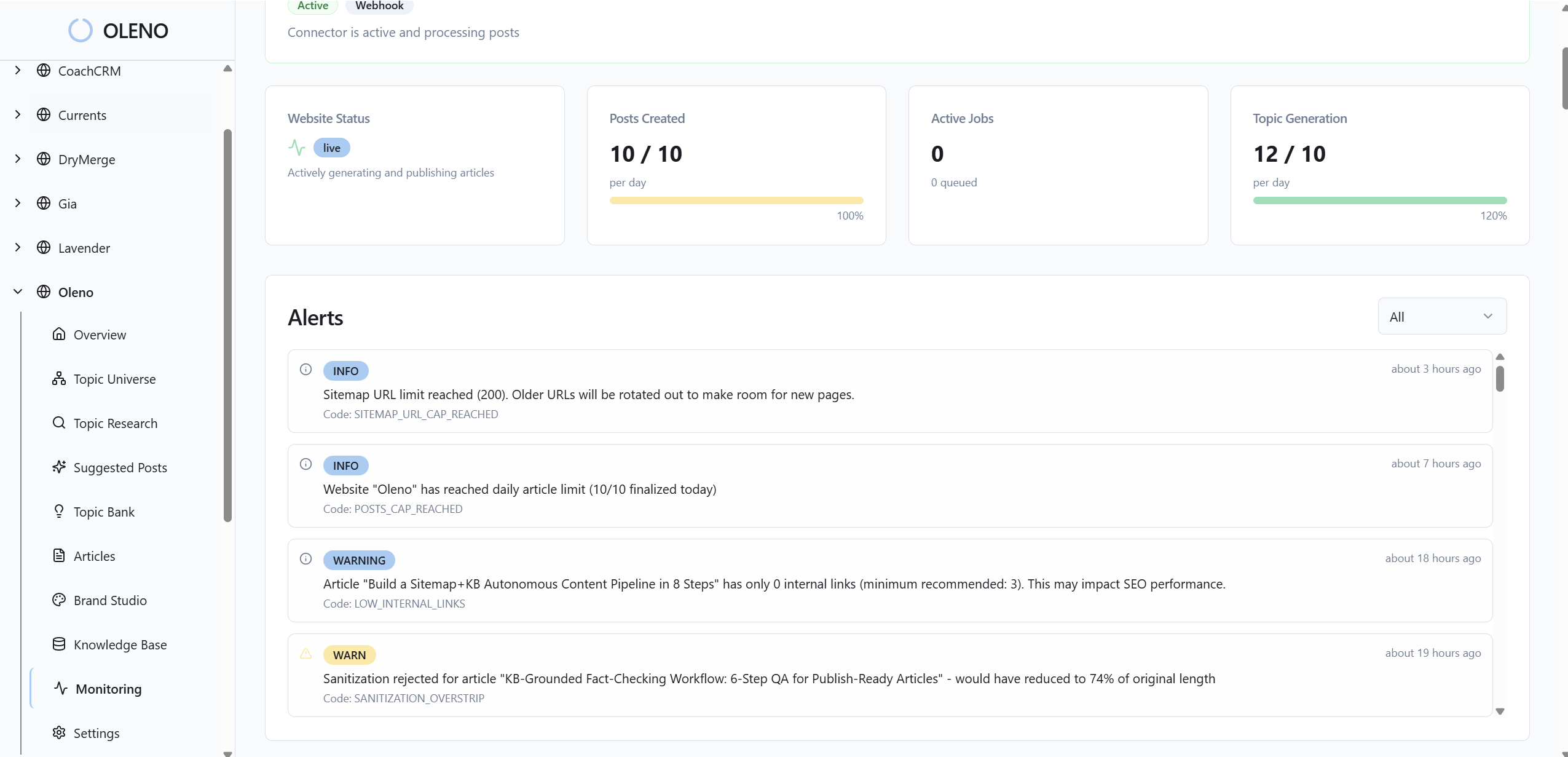
Oleno’s Topic Universe discovers topics from your sitemap and knowledge base, organizes them into clusters, and labels coverage states in real time—underserved, healthy, well-covered, or saturated. It also enforces a 90-day cooldown on re-coverage, so new work piles up where it will help most instead of cannibalizing what you already own. That’s how you stop duplication before it starts.
During brief generation, Oleno analyzes existing content and calculates an information gain score. Low-differentiation outlines get flagged early, and the brief pushes for a clearer gap statement with sources and section intent pre-baked. The result is fewer frustrating rewrites and drafts that are easier to cite by both search engines and assistants.
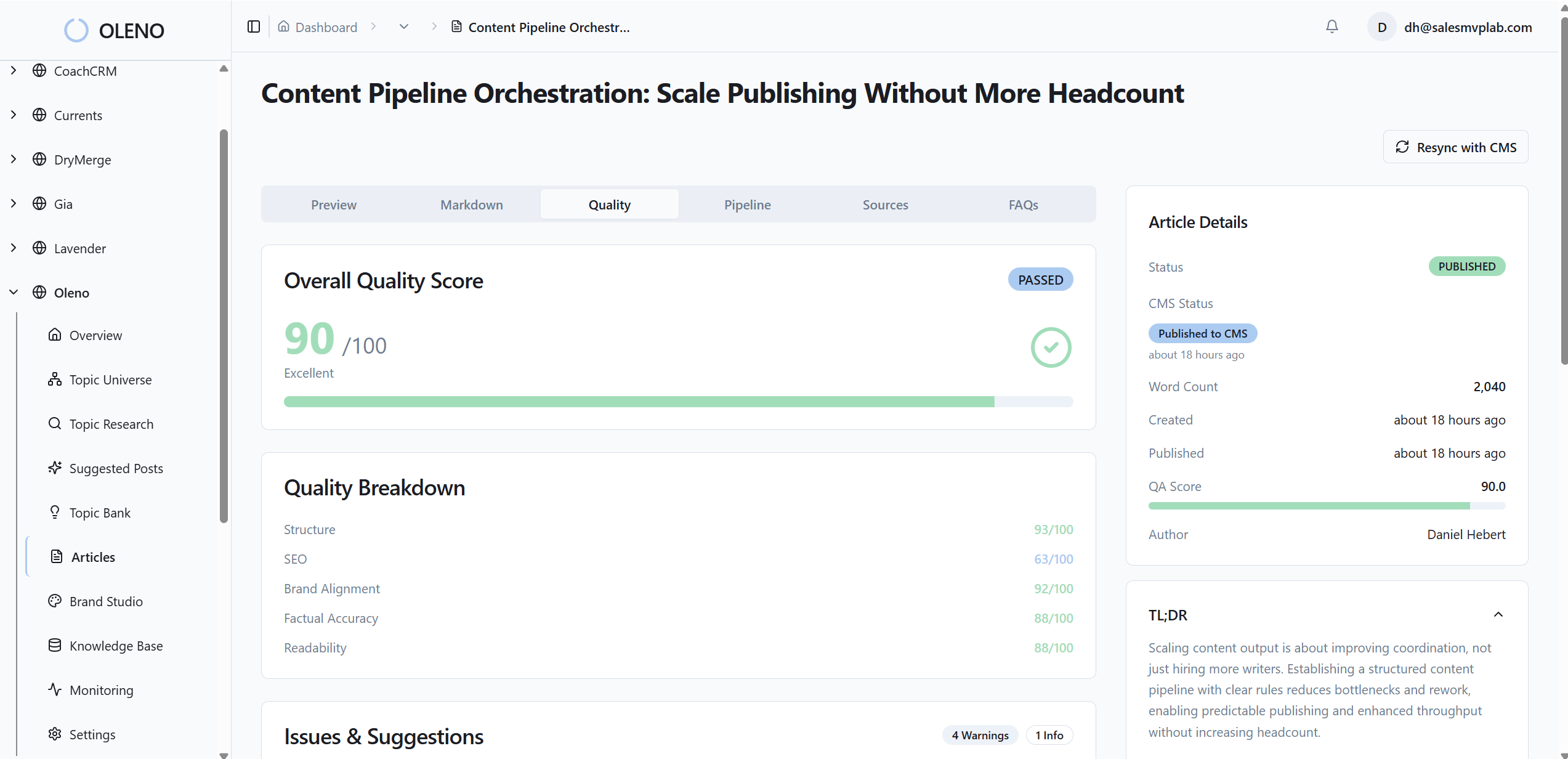
Quality doesn’t get left to chance either. Oleno’s QA gate evaluates drafts against 80-plus checks—structure, clarity, brand voice, KB accuracy, and snippet readiness—then refines and re-tests until thresholds are met. Deterministic internal linking injects links from verified sitemap URLs with exact anchor text. Every H2 opens with a 40–60 word direct-answer paragraph. You get cleaner, more referable pages and fewer edits that drain the team.
If you want to experience the pipeline end to end—strategy to publish—without building it yourself, you can Request a demo now. Oleno won’t promise perfection. It will give your team a consistent system that compounds.
Conclusion
Authority compounds when each article adds new information to the right cluster at the right time. That’s the job. Coverage and saturation make the work visible; information gain keeps drafts honest; cooldowns protect focus. Whether you run the loop yourself or let Oleno enforce it, the outcome is the same: fewer duplicates, stronger signals, and content that actually moves the business.
About Daniel Hebert
I'm the founder of Oleno, SalesMVP Lab, and yourLumira. Been working in B2B SaaS in both sales and marketing leadership for 13+ years. I specialize in building revenue engines from the ground up. Over the years, I've codified writing frameworks, which are now powering Oleno.
Frequently Asked Questions