Prioritizing Topics by Governance Without Re-Arguing the Quarter Every Monday

You probably felt this this week: 40 topic ideas came in, your actual capacity is maybe 4 to 8 pieces, and now prioritizing topics by governance turns into whoever spoke last in Slack. That's usually the real headache. Not topic scarcity. Topic triage.
For a growth-stage SaaS team, this gets expensive fast. One founder wants more product-led content. Sales wants bottom-of-funnel pages. SEO wants cluster depth. And you, somehow, are supposed to make all of that fit into one calendar without resetting the quarter every two weeks.
If you're trying to build a repeatable content engine, this is where it often breaks. Oleno is useful for exactly this kind of problem, but before getting into that, it's worth getting clear on the underlying issue: planning usually fails long before writing does.
Key Takeaways:
- Most lean marketing teams don't have an idea problem. They have a ranking problem, because they can only publish a small fraction of the topics they collect.
- Prioritizing topics by governance works when strategic importance is encoded once, then carried into planning instead of being renegotiated every week.
- Storyboard supports quarterly planning with weighted focus across dimensions, so planning stays tied to audience, use case, and business direction.
- A weighted plan can reduce backlog churn because topic candidates rise or fall based on defined priorities, not recency bias alone.
- This does not replace strategy work. If your audience definitions or product truth are weak, the output of the prioritization layer will be weak too.
Why Prioritizing Topics By Governance Breaks Down On Small Teams
Prioritizing topics by governance usually breaks because the team never had a real prioritization system to begin with. They had a backlog, some opinions, and a lot of urgency. That's not the same thing.
Monday, 9:12 a.m. The head of marketing is in Slack, staring at 17 unread messages across sales, product, and the founder channel. There are 42 active topic ideas in a spreadsheet, 6 realistic publishing slots this month, and 3 of those slots already half-claimed by launch work. By noon, two briefs have been deprioritized, one writer is waiting on direction, and nobody is fully sure whether the quarter is still about pipeline support or traffic growth. That's what prioritizing topics by governance looks like when governance doesn't actually exist.
Most Teams Have More Topic Ideas Than Execution Capacity
The constraint is almost never ideas. It's throughput.
A small SaaS team can gather topics from everywhere. SEO research. Product launches. Sales calls. Customer questions. Competitive pressure. Executive opinions. Pretty soon you've got 150 possible articles and enough real capacity for 6 this month. Maybe 8 if everyone has a good week and nothing catches fire.
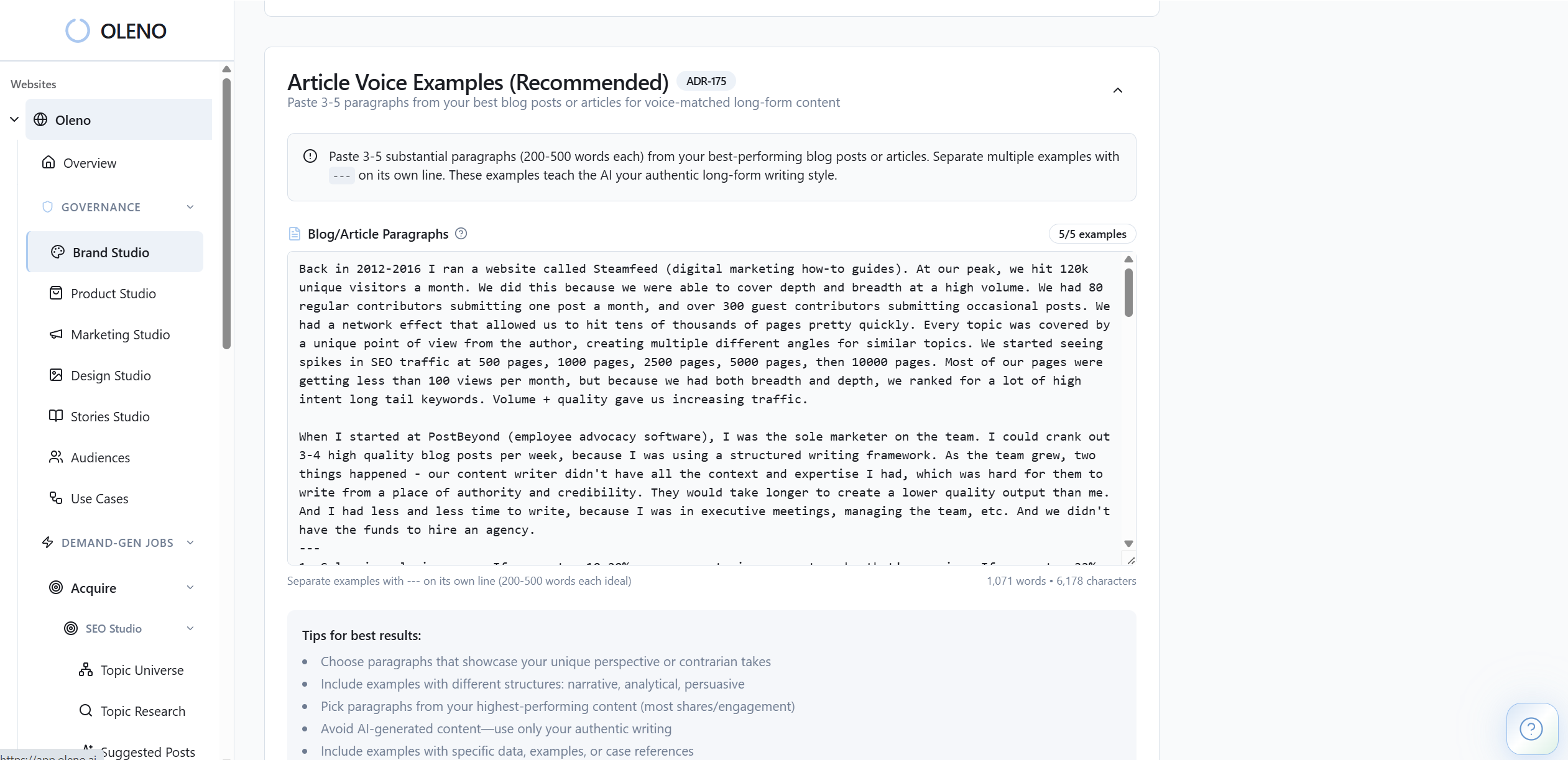
I've lived this from both sides. Back in 2012-2016, I ran a digital marketing site that eventually hit 120k monthly visitors. We had volume. Real volume. 80 regular contributors and 300+ guest contributors over time. In that environment, breadth and depth compounded because we could actually cover a huge topic surface area. Most posts got under 100 visits a month, but the catalog kept stacking, and traffic jumped at 500, 1000, 2500, 5000 pages, then again at 10000. The lesson wasn't "publish everything." It was that coverage works when capacity exists.
Most lean teams don't have that luxury. Not even close.
So what happens? They keep collecting topics as if they're a media company with a full editorial bench, but they execute like a team of one and a half. That's where planning gets distorted. The backlog looks healthy. The quarter doesn't.
A simple threshold helps here: once your backlog is more than 5x your monthly publishing capacity, raw rank-order lists stop being useful. Past that point, prioritizing topics by governance becomes necessary because the human brain starts defaulting to recency, politics, and whoever made the cleanest argument last.
The backlog isn't the strategy. It's just the pile. So what turns the pile into a plan?
Backlogs Become Political When Priorities Are Not Weighted
The moment priorities aren't encoded, they become negotiable.
And negotiated priorities are usually political priorities. The loudest stakeholder wins. The newest request wins. The shiny launch wins. The customer ask from yesterday wins. The actual plan you built three weeks ago slowly gets buried under exceptions.
At PostBeyond, I could write 3 to 4 strong posts a week when I was the only marketer because the framework lived in my head and I had context on everything. As the team grew, that changed. The writer didn't have the same product context or category nuance I had, so output slowed down and quality dipped. At the same time, I had less time to write because I was in meetings, managing people, doing exec stuff. Sound familiar? The friction wasn't just writing. It was translation. Every new shift in priority meant more explanation, more rework, more review.
That's why I don't really buy the idea that content teams mainly need better brainstorming. Usually they need fewer priority arguments.
Let's pretend you've got 60 topics in a quarter and capacity for 12. If you re-rank even 25% of that backlog every two weeks because priorities are fuzzy, you're not just losing planning time. You're creating second-order costs. Briefs get stale. Supporting research gets dropped. Writers lose context. Drafts no longer match the latest push. The editing tax starts before anyone writes a word.
And that's the part people miss. Content planning is less like an idea board and more like air traffic control. Planes can be rerouted, sure. But if every incoming request gets treated like an emergency landing, the tower stops sequencing traffic and starts improvising. That's when delays pile up and trust drops.
To be fair, ad hoc planning has one real advantage: it feels fast. For tiny teams in a true sprint week, that can be valid. But if ad hoc becomes the default for more than one planning cycle, prioritizing topics by governance almost always beats it because it preserves context instead of consuming it. The cost of improvisation shows up later, right when the team can least afford it.
If the problem is political drift, the fix isn't more debating. It's a system that carries the quarter forward.
Weighted Planning Keeps Strategy From Resetting Every Quarter
Weighted planning matters because business priorities change. The teams that handle this well don't avoid change. They encode it.
If the last section was the diagnosis, this is the operating model. Prioritizing topics by governance works when the team decides what matters before the backlog fight starts, not during it.
How To Tell If You Need Weighted Planning
Three questions usually diagnose this faster than a long workshop.
- Are you swapping more than 20% of planned topics mid-quarter?
- Is your backlog more than 5x your realistic monthly publishing capacity?
- Can two stakeholders look at the same 10 topics and rank them completely differently because no scoring logic exists?
If you answered yes to two of the three, you're past the point where a simple spreadsheet sort will hold. You're in weighted-planning territory.
Here’s the before-and-after contrast. Before: every topic review meeting starts from zero, people relitigate funnel stage, audience, and urgency, and the calendar changes because somebody brought a fresh anecdote. After: the team still debates, but the debate happens inside a frame. The frame does the repetitive work.
Not every company needs this. If you're publishing 2 highly bespoke pieces a month for a single audience and a single product line, a lightweight manual process can still work. Fair. But once multiple audiences, use cases, and pipeline goals are competing for a tiny number of slots, prioritizing topics by governance stops being process theater and starts becoming basic operational hygiene.
Once you know you need a weighting model, the next question is obvious: what should the model actually do?
Governance Beats Ad Hoc Planning When Priorities Shift
Good planning doesn't mean frozen planning. It means controlled change.
A lot of teams hear "governance" and think bureaucracy. Fair concern. If governance turns into approvals on approvals, you've just created another problem. But that's not what matters here. What matters is deciding, in advance, what deserves more attention when tradeoffs show up.
That's the whole point.
In my view, ad hoc planning fails because it treats every topic as an isolated decision. It asks, "Should we publish this?" over and over again. A better system asks, "Given what matters this quarter, what kind of content should naturally rise?" Those are very different questions.
The old way is topic-by-topic debate. The better way is portfolio weighting.
If leadership decides this quarter needs more bottom-of-funnel content for one audience and less top-of-funnel content for another, you shouldn't need to manually re-argue 100 topics. You should be able to shift the weighting logic and let the plan reflect that change. That's what keeps strategy from getting trapped in slides while the content calendar drifts somewhere else.
There's also a consistency angle here that a lot of teams underestimate. Visibility across search and AI-assisted discovery doesn't just reward volume. It rewards repeated clarity across category framing, audience specificity, and product truth. If your plan swings wildly based on last-minute inputs, you don't build consistency. You build noise.
Change is inevitable. Re-arguing the entire quarter should not be.
Weighted Planning Turns Strategy Into A Repeatable Scoring System
A weighting system is just strategy made operational.
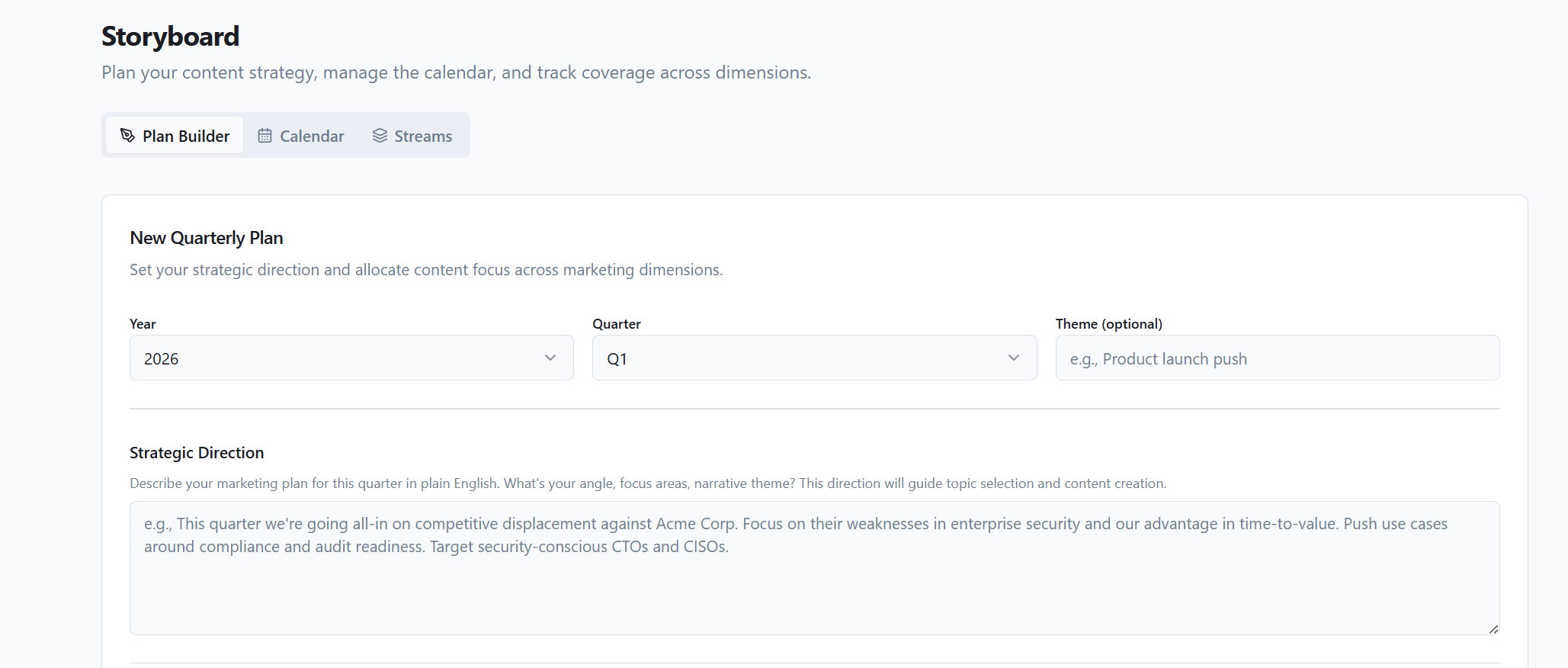
You can think of it like a fund allocation model. Not because marketing is finance. It isn't. But because both require deciding where limited resources go under uncertainty. If a portfolio manager says 40% here, 30% there, 20% there, that doesn't remove judgment. It carries judgment forward. Same idea.
For content, the dimensions might be audience, persona, use case, funnel stage, product focus, or strategic theme. The specific mix can change. But once the team defines those percentages, topic candidates can be evaluated against a stable frame instead of a mood.
That matters more than people think.
Back when we were building content in smaller SaaS environments, one of the recurring problems was quarterly amnesia. You'd get alignment in a planning session, then six weeks later everyone behaved like that conversation never happened. Weighted planning is one way to stop that. Not fully. People are still people. But it gets the strategy out of memory and into the system.
One conditional rule I like here: if your backlog is more than 5x your monthly publishing capacity, stop using simple rank-order lists and move to weighted allocation. Under that threshold, manual sorting might still be fine. Over it, recency bias usually takes over.
And another one: if more than 20% of your planned topics get swapped mid-quarter, the issue is probably not market volatility. It's weak prioritization logic upstream.
Strategy shouldn't need a weekly translator. It needs a scoring model the team can actually use.
How Storyboard Carries Strategic Priorities Into the Calendar
This is where the abstract part ends. The problem with most planning systems isn't that they lack ideas. It's that they don't preserve judgment once the meeting ends.
Storyboard Translates Strategic Focus Into Topic Priority
Instead of leaving strategic priorities inside a kickoff doc, Storyboard gives them a place to shape the plan.
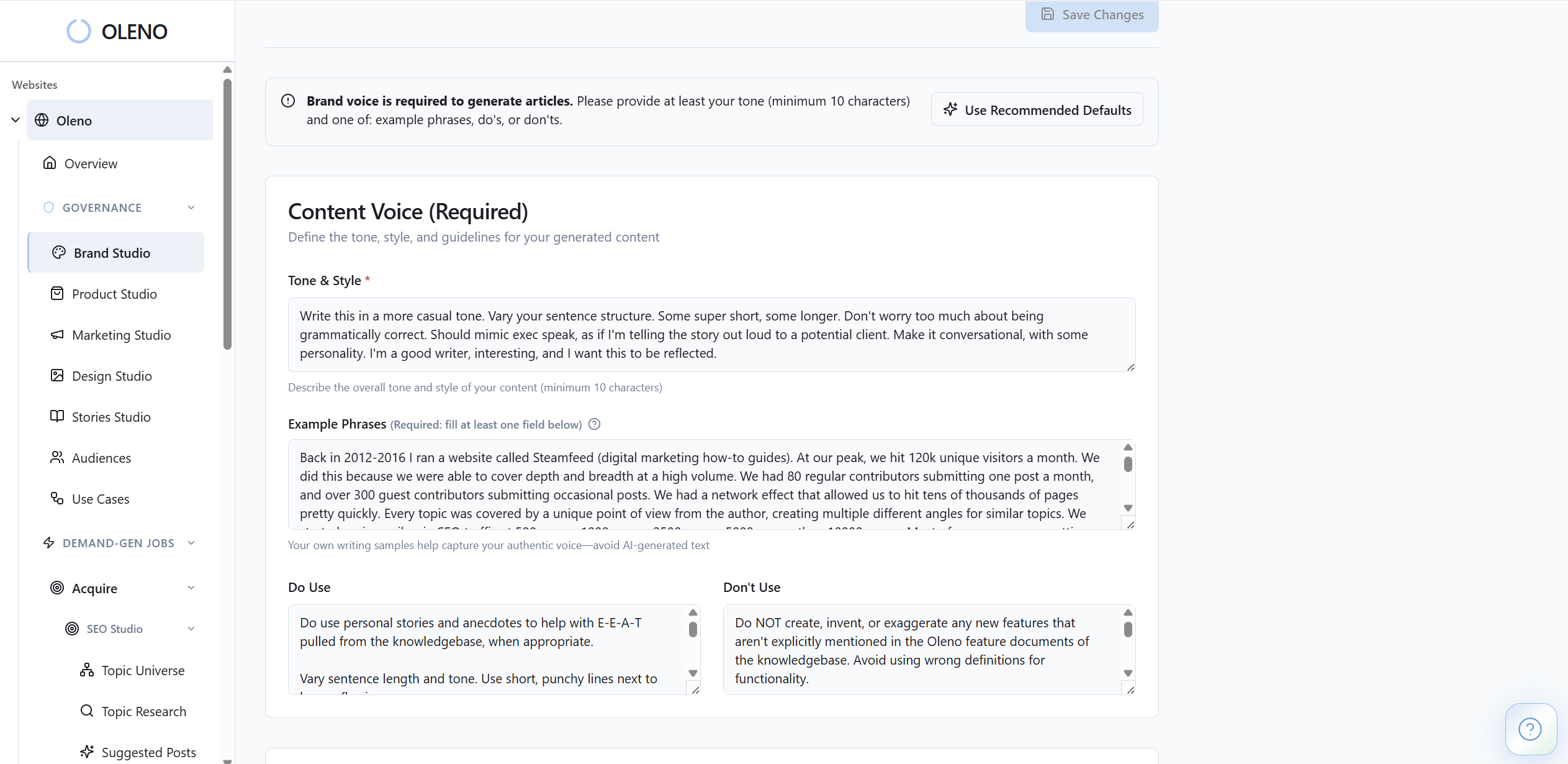
Storyboard reads governance dimensions and their weights, then scores topic candidates against coverage gaps. That's important because most planning tools stop at "here are your ideas." They don't really answer what should rise first. This planning layer is meant to bridge that gap. You define the strategic dimensions that matter, and Storyboard uses that context to prioritize content across the plan.
So let's say you need stronger coverage across growth-stage SaaS teams, product-led education, and bottom-of-funnel evaluation content. That mix becomes part of the planning logic instead of staying trapped in a kickoff doc no one reopens.
The useful part is what happens next. Topics aren't just sitting there as a flat pile. They can be evaluated against the planning frame. Which means the plan has memory.
That sounds small. It isn't.
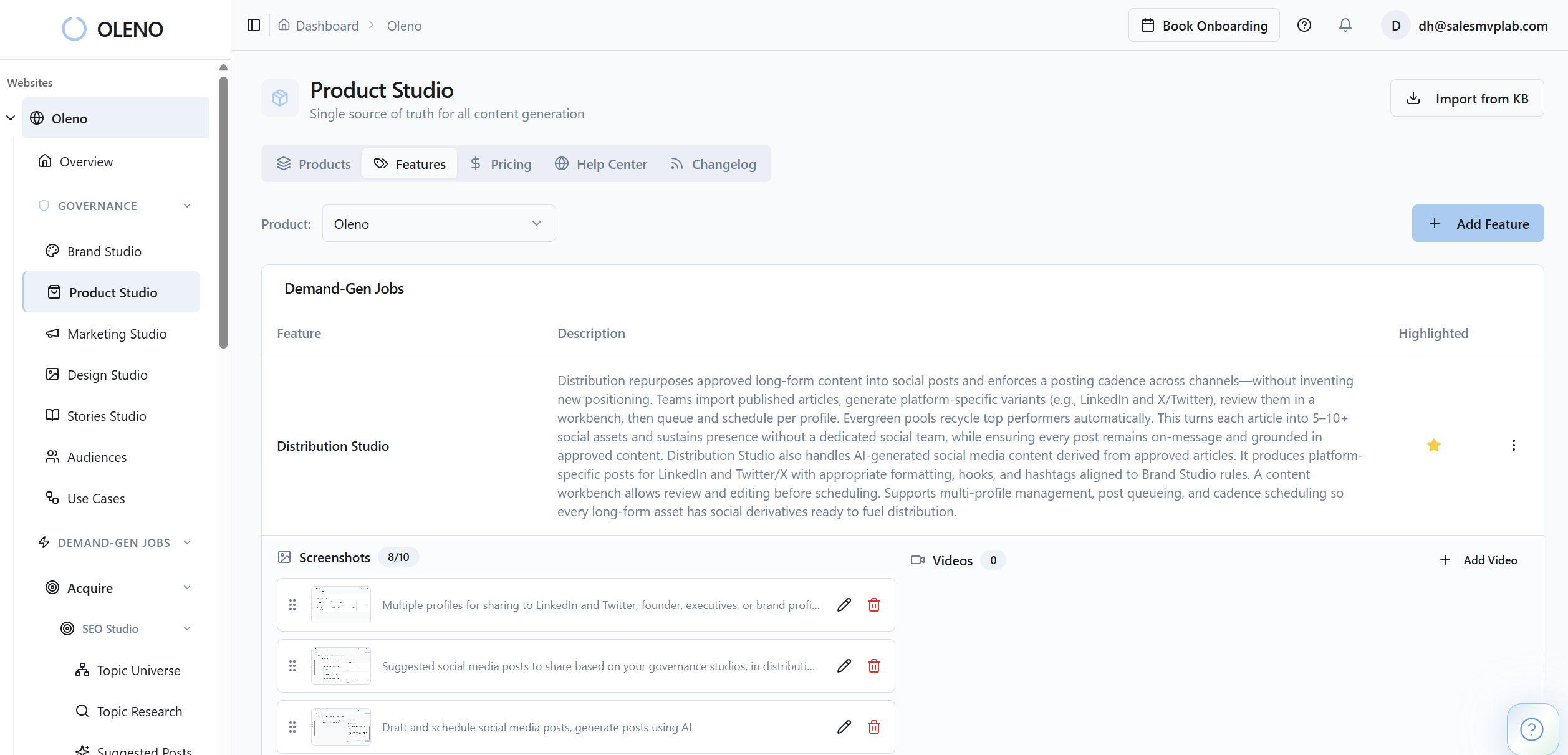
A lot of marketing pain comes from memory loss between strategy and execution. Marketing Studio can hold the market point of view. Product Studio can hold approved product truth and boundaries. Audience and persona targeting can define who matters. Storyboard is where those strategic choices start shaping what gets attention now.
That's the real handoff: from strategy as conversation to strategy as operating logic. But what does that weighting actually look like in practice?
Weighted Inputs Shape What Rises To The Top
The easiest way to think about this is a stack of signals with emphasis attached.
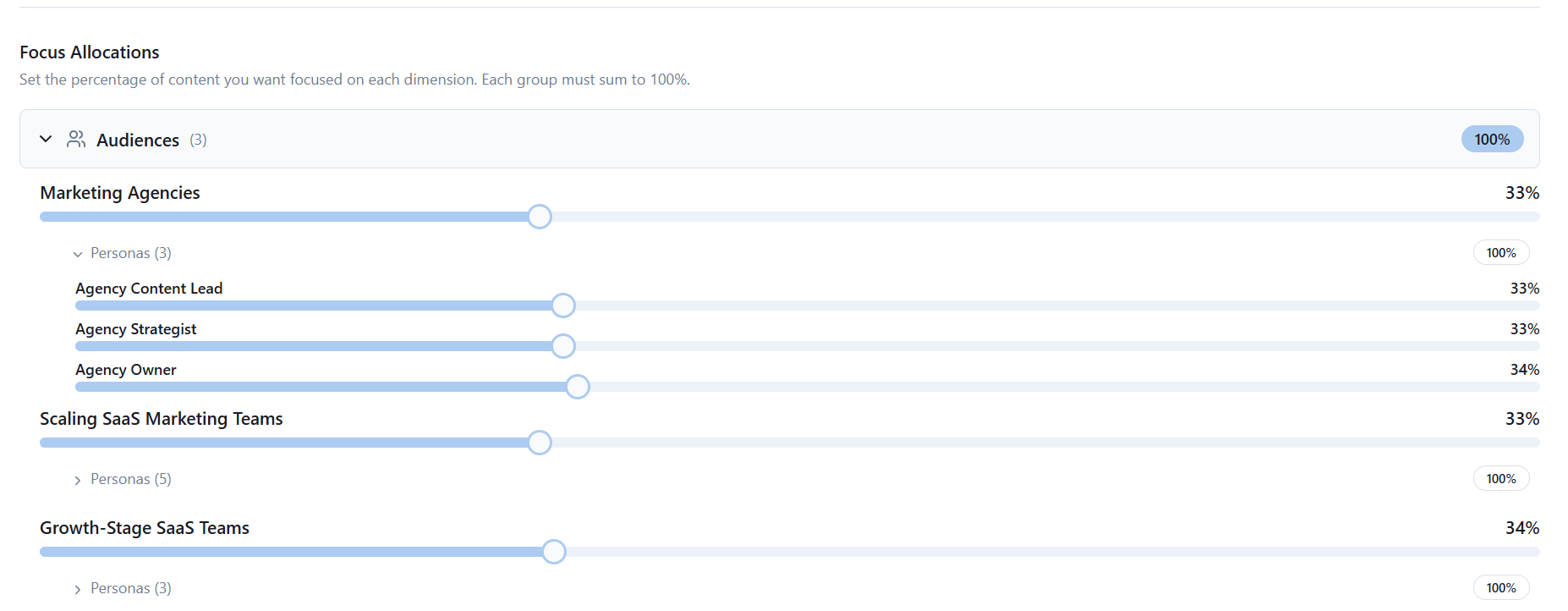
Not literal filters you click through one by one. More like weighted governance.
Storyboard reads audiences, personas, products, use cases, and competitors from governance, then scores topic_bank candidates against coverage gaps and materializes a prioritized, balanced content calendar. So instead of manually sorting a spreadsheet by gut feel, the system can reflect defined emphasis across different content dimensions.
A practical framework here is what I'd call the 40-30-20-10 rule for lean teams. It's not a product requirement. It's just a useful planning benchmark.
- 40% goes to the audience or segment with the biggest revenue relevance
- 30% goes to the use case or workflow with the strongest buying urgency
- 20% goes to funnel-stage balance so you don't starve evaluation content
- 10% stays flexible for launches, reactive opportunities, or executive asks
Here's the before/after. Before: 16 planned pieces slowly drift toward easy SEO topics because those are simpler to justify one at a time. After: the same 16 slots are still debated, but they're debated inside a portfolio mix, so evaluation content and strategic audience coverage stop getting squeezed out by convenience.
And this is the part where many AI-first workflows fall apart. They can draft. Sure. But drafting is downstream of selection. Prompting gives you output. It doesn't give you planning continuity. Different problem.
Weighted signals are useful. But usefulness depends on whether those decisions survive the handoff into actual work.
Planning Decisions Carry Forward Into Execution
A good planning system doesn't end at ranking. It has to carry decisions into a usable calendar.
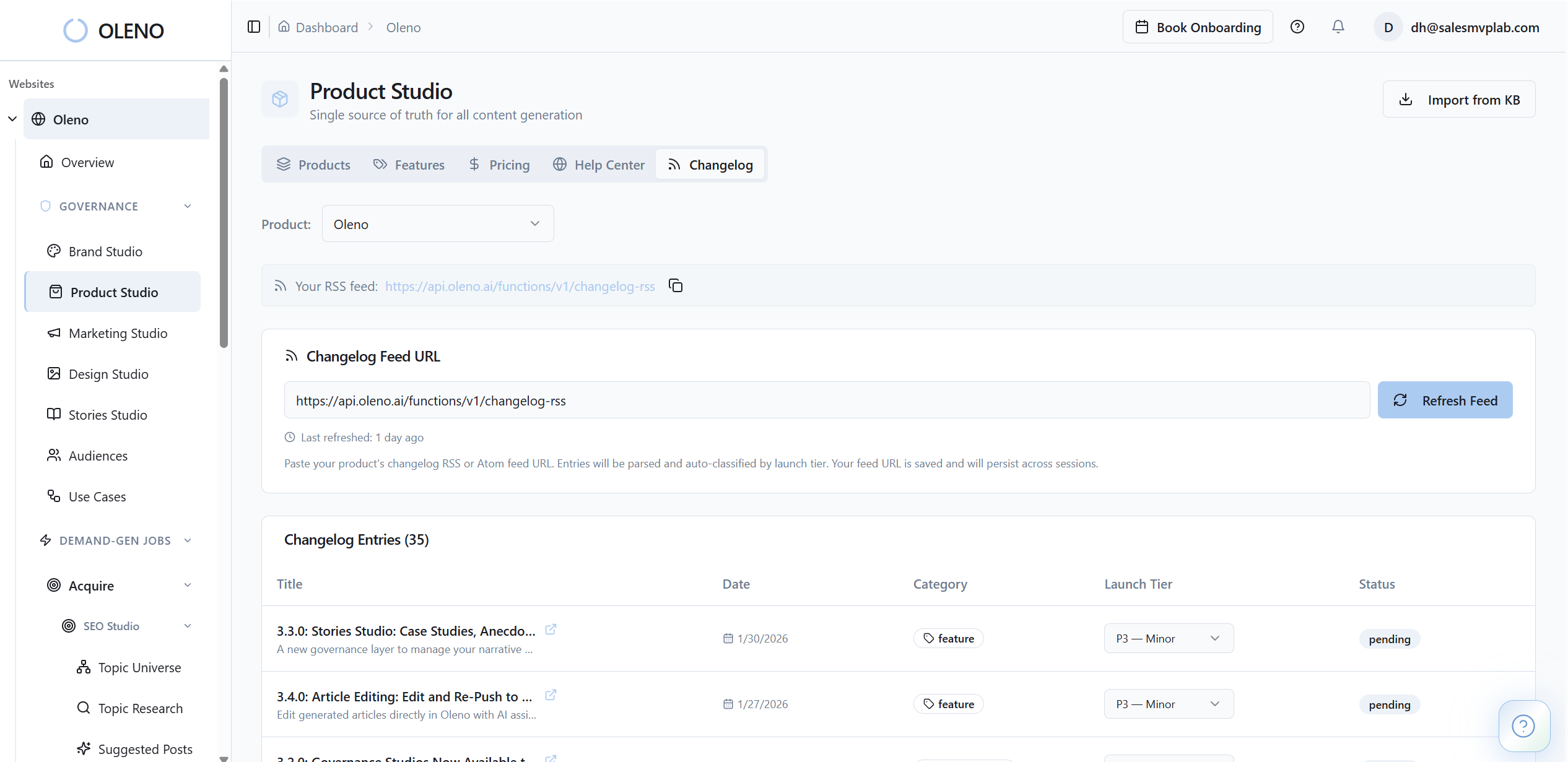
In Oleno, Storyboard materializes a prioritized, balanced content calendar with a visual interface for rescheduling, stream views, status filtering, and dimension-based coverage tracking. That's what keeps topic selection from becoming a detached exercise. The system isn't just surfacing candidates. It's turning them into a plan teams can actually work from.
That handoff matters because it cuts one of the worst failure modes in content ops: strategy says one thing, production produces another.
Oleno is built around a different model. Planning is one layer. Governance is another. Then the studios execute within those boundaries, and the Quality Gate evaluates the work before it reaches review or publishing. Storyboard's allocation is advisory until calendar entries are approved, but once the plan is visible and balanced, teams have a much clearer operating frame for what should get scheduled next.
Now, to be fair, no system completely removes judgment. Nor should it. If a major launch happens tomorrow, you may still override the current balance. That's valid. But override should be the exception. Not the default operating mode.
That's really the value here. Less manual sorting. Less "wait, why are we making this?" Less backlog churn caused by forgetting what the plan was supposed to do.
If you want to see how that planning layer works in practice, request a demo. The interesting part isn't the screen. It's what stops breaking once prioritization logic actually carries forward.
One Planning Change Can Reorder The Quarter Without Derailing It
This is where the feature usually clicks. Not in the abstract. In a real operating scenario.
One Quarterly Shift Can Reorder An Entire Content Roadmap
Picture a growth-stage SaaS marketing lead. Team of two, maybe three if you're lucky. They've got SEO opportunities, feature education needs, comparison content requests, a founder who wants more thought leadership, and sales asking for pages that help close deals. Pretty normal.
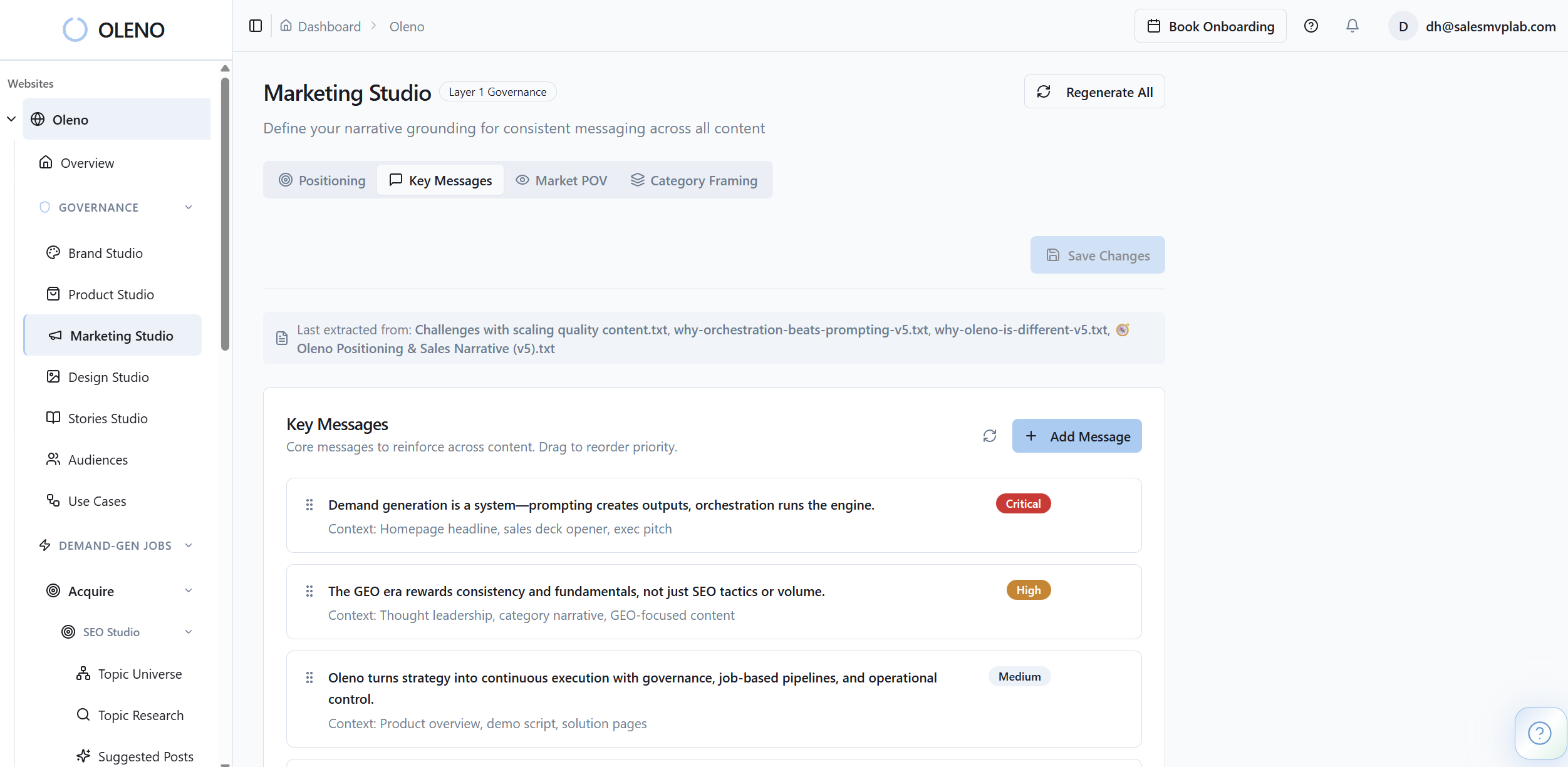
At the start of the quarter, the plan leans heavier toward acquisition. Then leadership shifts the goal. Now the ask is more product-led and bottom-of-funnel content for a specific executive audience. Still important to maintain some broader coverage, but the center of gravity changes.
Without weighted planning, this becomes a spreadsheet surgery project.
You go line by line. Re-rank titles. Move deadlines. Rebuild the calendar. Rewrite briefs. Explain the changes to whoever's writing. Lose half a day. Maybe more. If you do that a few times in a quarter, you start to feel like your job is not marketing. It's backlog rehab.
With prioritizing topics by governance inside a weighted planning model, the shift can be expressed at the planning level instead. The quarter's focus changes. That influences what rises. The team isn't starting from zero each time.
That distinction matters a lot when you're under-resourced. A big team can absorb planning inefficiency. A lean team feels every hour.
When a single planning change can reorder the roadmap without restarting it, that's when the system starts paying rent.
Weighted Priorities Help A Lean Team Publish The Right Mix
The real win isn't more content. It's a better content mix against the goal of the quarter.
Let's pretend a team can publish 16 pieces over the next eight weeks. Before using weighted planning, they might accidentally end up with 10 top-of-funnel SEO posts, 4 loosely related product pieces, and 2 evaluation assets that sales actually needed yesterday. That's not unusual. It happens because top-of-funnel ideas are easier to keep queuing, and nobody encoded the desired ratio.
With weighted planning, the distribution gets more deliberate. Maybe it becomes 6 acquisition pieces, 5 evaluation pieces, 3 product-led education articles, and 2 category pieces targeted to the audience the team actually cares about most this quarter. Same capacity. Better allocation.
I saw a version of this problem years ago at Proposify. The content team was strong. Personality, design, rankings, all of it. But a lot of the content sat too far from the actual solution, so demand-gen alignment was weak. We had traffic, but not enough narrative pull toward the product. That's why prioritization can't just be "what can rank." It has to include what helps the business move.
And yes, there are exceptions. If you're in a pure topic-land-grab phase and just need broad coverage fast, you may temporarily overweight acquisition. Fair. But for most growth-stage SaaS teams trying to support pipeline with limited headcount, balance matters more than a giant pile of loosely related traffic.
The mix is the strategy. The calendar just reveals whether you meant it.
Better Prioritization Still Depends On Clear Inputs
Weighted planning improves ranking quality. It doesn't invent clarity you never defined.
Better Prioritization Does Not Replace Strategy Decisions
This kind of planning system won't create strategy from thin air.
If your audience definitions are fuzzy, your use cases are generic, your product claims aren't grounded, or your market point of view keeps changing every two weeks, the weighting layer can only do so much. It'll still help organize tradeoffs better than pure ad hoc planning, but it can't fix upstream vagueness by itself.
That's worth saying plainly because software gets oversold all the time.
You still need to decide who matters. What use cases matter. What product truth is approved. What the business is trying to move this quarter. Storyboard can carry that logic forward. It can't substitute for having that logic.
A simple rule here: if your team can't answer "who is this quarter for?" in one sentence, don't expect weighted prioritization to rescue the plan. Fix that first.
Good systems amplify clarity. They don't manufacture it. So what inputs actually matter most?
Weights Improve Planning Quality Only When Governance Is Clear
The quality of the output depends on the quality of the setup.
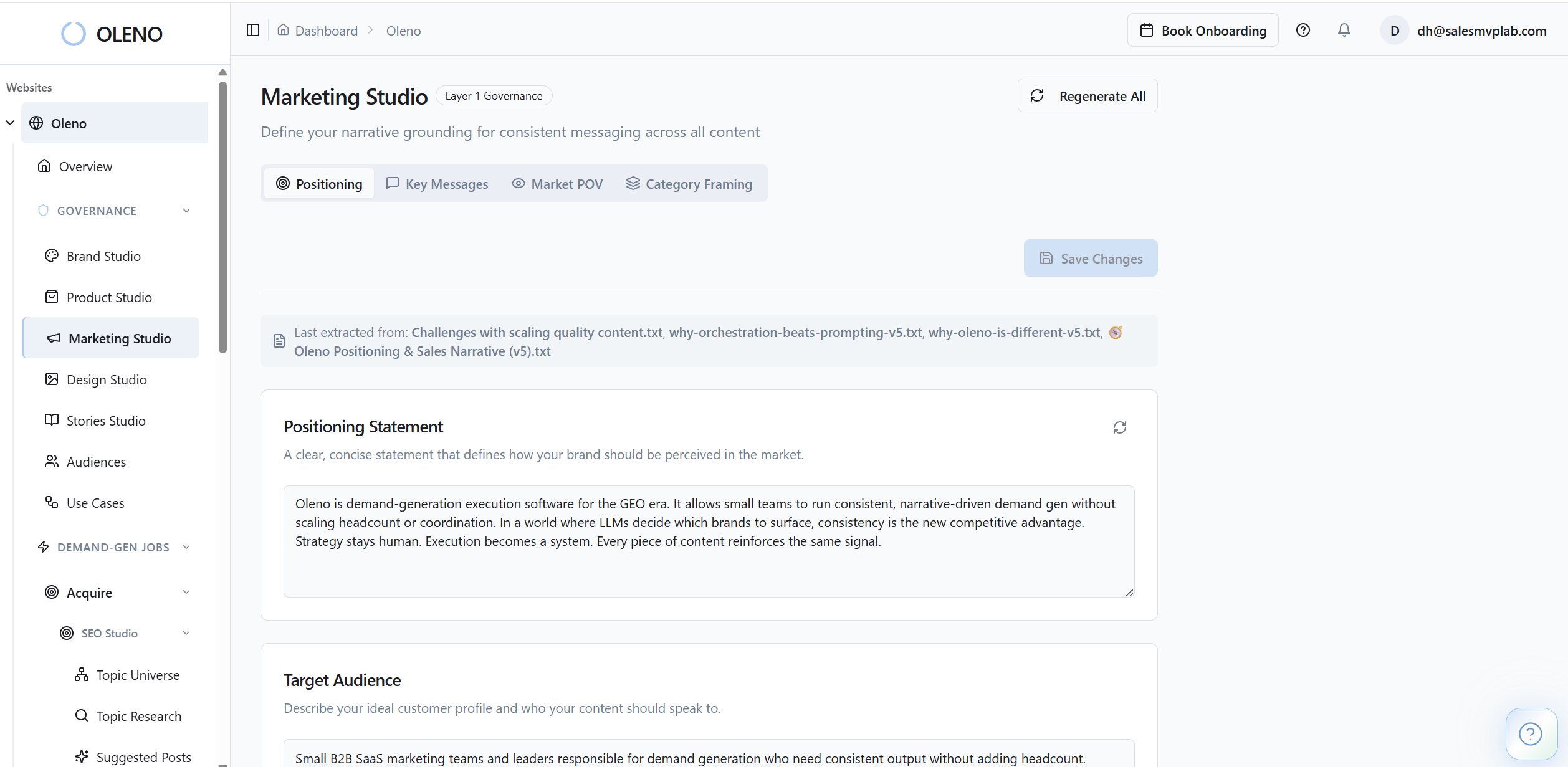
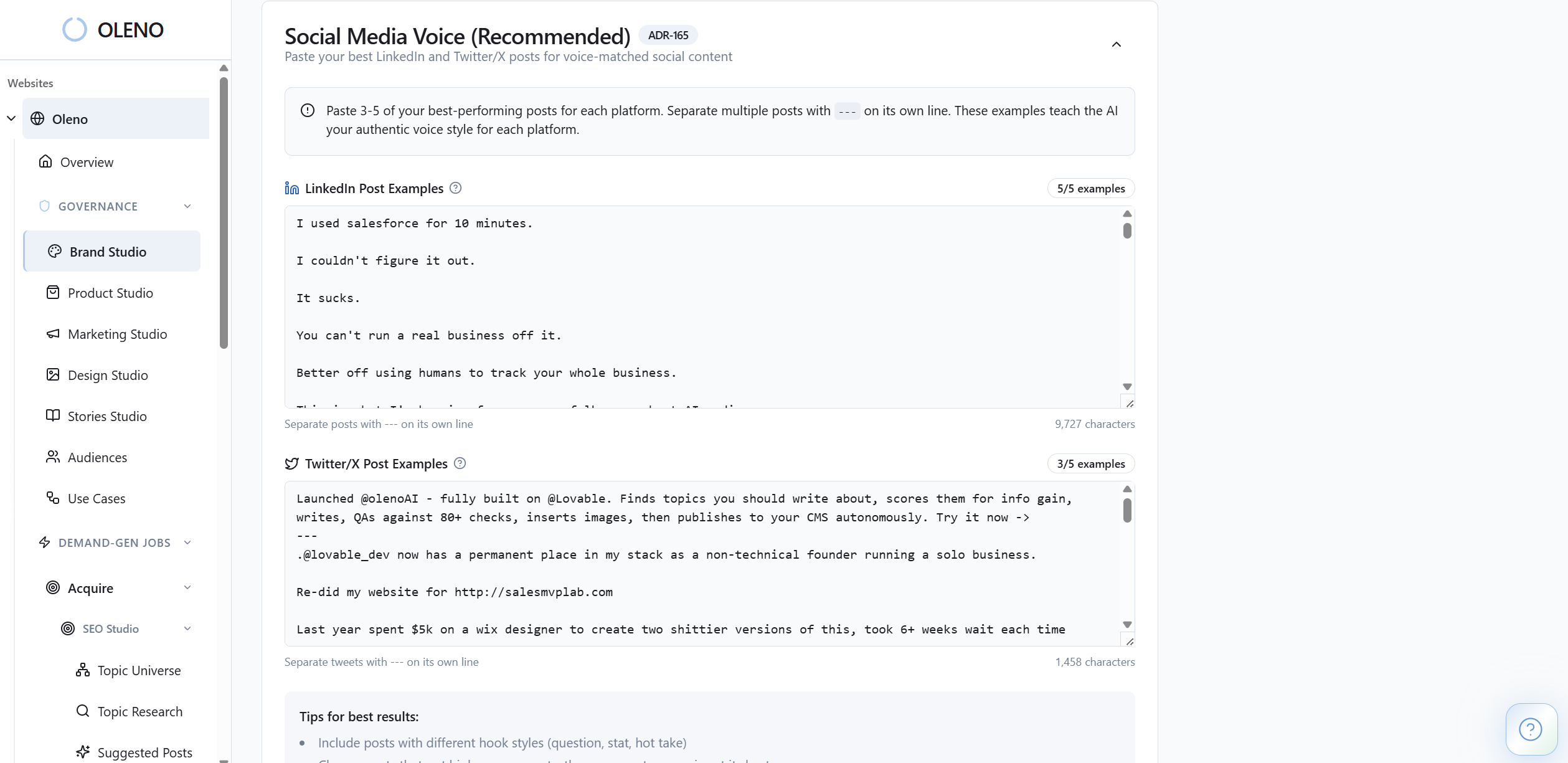
Oleno's broader model is built around that. Brand Studio defines how content should sound. Marketing Studio defines the category framing and message. Product Studio defines what's true and where the boundaries are. Audience and persona targeting define who the content is for. Use Case Studio defines what users are actually trying to accomplish. Storyboard works better when those layers are clear because it has better signals to work with.
If those layers are weak, you can still prioritize. But you'll prioritize on shakier ground.
And human judgment still matters for sudden events. Campaigns. Launches. Competitor moves. A founder with a strong market take that should go out this week. Weighted planning shouldn't block reality. It should reduce routine churn so you have room to handle reality well.
That's the nuance. Systems are there to carry the repeatable parts so humans can focus on the exceptions.
Clear inputs make prioritizing topics by governance useful. Muddy inputs just make the math look more official.
Governed Planning Gives Small Teams More Room To Execute
If your planning process keeps resetting, the problem usually isn't that your team lacks ideas. It's that your priorities aren't encoded in a way the system can carry forward. Storyboard is useful because it gives weighted quarterly planning a place to live, ties it to topic scoring, and helps move those decisions into actual execution across the calendar and downstream jobs.
For lean teams, that's a real shift. Fewer planning arguments. Less backlog churn. Better odds that the content mix actually reflects the quarter instead of the latest interruption. And when that logic is connected to Oleno's broader setup, from product truth to audience context to quality checks, planning stops being a side document and starts behaving more like infrastructure.
Prioritizing topics by governance sounds like a process discussion. It isn't. For small teams, it's really a capacity protection system. Encode the tradeoffs once, carry them forward, and stop spending Tuesday morning re-litigating what the quarter already decided.
About Daniel Hebert
I'm the founder of Oleno, SalesMVP Lab, and yourLumira. Been working in B2B SaaS in both sales and marketing leadership for 13+ years. I specialize in building revenue engines from the ground up. Over the years, I've codified writing frameworks, which are now powering Oleno.
Frequently Asked Questions