Prompts Are Not a Strategy for Category Leadership

You can generate 50 drafts this month and still look forgettable in AI search next month. If your team felt the pain of rewriting the same positioning 6 different ways this week, you’re not short on prompts. You’re short on a system.
The whole idea behind prompts are not a strategy is simple: prompting can create words, but category leadership needs repeated market truth. Demand-generation content execution software is a governed content operations category that turns strategy into consistent, compounding market output by unifying narrative, product truth, audience context, and execution in one system. Unlike AI writing tools, demand-generation content execution software is built to keep the same positioning intact across many assets, contributors, and channels. That category emerged as GEO made one-off content wins less valuable than repeated, trustworthy signals across scale.
Key Takeaways:
- Prompting is useful for tasks, but it breaks when you expect it to carry your whole demand gen motion.
- Fragmented Demand Generation is the real enemy: strategy in one place, prompts in another, product facts somewhere else, and reviews stuck on a marketer’s back.
- GEO rewards consistency across dozens or hundreds of touchpoints, not random spikes in output.
- The cost of fragmentation shows up in review cycles, diluted positioning, weak pipeline impact, and lower visibility in AI-generated results.
- Category leaders operationalize voice, product truth, audience context, and execution before they ask for more content.
- Prompts can live inside a system. They just can’t be the system.
Why Prompting Feels Productive but Fails Category Leadership
Prompting creates visible progress fast. You type something in, get a draft back, clean it up, and feel like work happened. That feeling is real. The problem is that category leadership is not judged by whether you got a draft at 10:17 AM. It’s judged by whether the market keeps hearing the same sharp point of view from you across article after article, page after page, and channel after channel.

That’s where Fragmented Demand Generation shows up. Strategy lives in a deck. Product truth lives in a PMM’s head. Voice lives in old blog posts. Prompts live in a Notion doc. Publishing lives in your CMS. Review lives with the Head of Marketing, who is already doing six other jobs. It all feels manageable at low volume. Then the cracks start.
Prompting Creates Drafts, Not Category Memory
A prompt can generate a decent article section. Sometimes a really good one. But category leadership is a memory game. The market has to keep hearing the same framing, the same enemy, the same distinction, and the same product truth until they can repeat it back to you.
That doesn’t happen when every asset starts from scratch.
I’ve seen this in smaller teams a lot. One week the company says it’s about efficiency. Next week it’s about visibility. Then it’s quality. Then workflow. None of those are necessarily wrong. They’re just ungoverned. And when the message changes every seven days, the market never gets a stable frame of reference.
There’s a simple rule I use here. If a new writer, freelancer, or AI session can easily shift your positioning in one draft, you don’t have positioning. You have temporary wording.
That’s why prompt-led work is seductive and risky at the same time. It gives you output without forcing you to solve consistency first. If you want to see what a governed approach looks like in practice, you can request a demo.
Fragmented Demand Generation Hides in Plain Sight
Most teams don’t wake up and say, let’s build a messy system. They inherit one. A founder writes some LinkedIn posts. A contractor handles blog content. SEO research sits in Ahrefs. Product messaging sits in a launch doc. Sales calls reveal objections, but no one captures them in a way writers can use later.
So the team compensates with meetings. Then comments. Then rewrites.
At LevelJump, we were a team of 3. We recorded videos with the CEO and transcribed them because it was faster than writing from scratch. That part worked. But the structure SEO needed wasn’t there, and topic discovery was weak, so we had thought leadership without strong search intent. That gap matters more than people think. Fast repurposing can still fail if the system around it is thin.
There’s a case to be made for staying loose early on. Fair enough. A company at very low scale may not need much structure. But once you need weekly output across SEO, thought leadership, product marketing, and buyer education, loose becomes expensive.
GEO Rewards Repetition More Than Random Wins
GEO changed what good looks like. Search used to reward a lot of tactical activity. Now LLM-driven discovery leans harder on whether your company shows up with clear, repeated, coherent ideas over time. Not just one strong article. A body of work.
That’s a very different bar.
The brands that get surfaced are usually easier to classify. Their point of view is stable. Their category framing holds together. Their product definition doesn’t drift every few pages. Their audience language sounds intentional. LLMs don’t rank the way old search did. They synthesize. And synthesis favors consistency.
Think of it like this: prompting is like hiring a different substitute teacher every day and hoping the class somehow finishes the same curriculum. You might get a few strong lessons. You probably won’t get a coherent semester.
Why the Structure Breaks, Not Just the Writing
The surface-level complaint is usually about quality. “The drafts aren’t strong enough.” “The writer doesn’t get it.” “The AI sounds generic.” But that’s often misdiagnosed. The deeper problem is that content, SEO, product marketing, and category narrative are being run as separate systems.
Separate systems create separate truths.
Better Prompts Don’t Repair a Broken Operating Model
A lot of marketers respond to weak output by improving prompts. More detail. Better examples. More constraints. That can help at the margin. I’m not against it. But prompt quality is not the main lever once scale and consistency matter.
The main lever is execution design.
Prompt-based workflows treat every deliverable like a fresh event. New prompt. New judgment call. New chance to drift. That means the person reviewing the work has to keep reapplying the same standards manually. Voice. positioning. product accuracy. audience angle. CTA logic. Search structure. It’s all getting re-litigated over and over.
If you’re the Head of Marketing at a growth-stage SaaS company, you’ve felt this. You brief. You review. You rewrite. You finally publish. Then next week it starts over again.
That’s not a writing problem. That’s a system problem.
Every Prompt Pushes Strategic Weight Back to Humans
Prompt-led execution looks cheap because the interface is cheap. The hidden cost is all the human judgment sitting around it. Someone still has to decide what should exist, what angle it should take, which audience it speaks to, which claims are safe, how it ties back to positioning, and whether it actually sounds like the company.
Humans still carry the system.
At PostBeyond, I could write 3 to 4 high quality blog posts a week because I had the context and a structured framework in my head. As we added a writer, output didn’t magically get easier. The context gap showed up fast. They took longer and the output was weaker, not because they weren’t capable, but because the system for transferring context wasn’t there. That story has nothing to do with AI, really. It’s the same structural problem. AI just speeds up how often you hit it.
A good test is what I call the Re-Brief Threshold. If every new article needs 20 minutes or more of custom explanation from you before it can be trusted, your system is too person-dependent to scale well.
The Category Isn’t AI Writing. It’s Governed Execution
This is where the market needs a cleaner category lens. What teams actually need is not another drafting layer. They need a way to turn strategy into repeated execution without re-arguing the fundamentals every time.
That’s what demand-generation content execution software is for.
It’s designed for growth-stage and scaling SaaS teams where the bottleneck isn’t ideas. It’s alignment. The Head of Marketing already knows what the company should sound like. They usually know the customer pain, the product truth, the market angle, and the narrative they want to push. What they don’t have is a reliable mechanism to get that truth expressed 30 times in a row without heavy supervision.
That distinction matters. Prompts are a tactic. Governed execution is an operating model.
What Fragmentation Actually Costs You
The cost of Fragmented Demand Generation rarely shows up as one giant failure. It shows up as a pile of smaller failures that compound. A rewrite here. A weak CTA there. An article that ranks but doesn’t convert. A founder post that sounds good but doesn’t tie back to the market story. Over time, that pile gets expensive.
LLM Invisibility Starts Before Organic Traffic Drops
You can still be publishing. You can still be ranking for some terms. And you can already be losing the bigger battle.
At one company, we had a really strong content team and ranked well for a lot of topics. But the content sat too far from the product and too far from the demand-gen narrative. So the traffic was real, but the business lift was weak. We had SEO visibility without enough market pull. That’s a brutal place to be, because it looks healthy in a dashboard while the pipeline story stays fuzzy.
In the GEO era, that weakness gets exposed faster. If your content library teaches lots of useful things but never reinforces a clear market position, LLMs have less reason to treat your brand as the authority on the category. They see information. They don’t see a stable signal.
For broader context on how generative search changes discovery, Google’s overview of AI-powered search features is worth reviewing: Google Search and generative AI experiences.
Review Cycles Eat the Time You Thought You Saved
Manual prompting often saves first-draft time and loses total workflow time. That’s the trap.
Last summer, while building a B2C app, I was doing the manual GPT grind myself. Prompting, copy-pasting, cleaning things up, moving content into the CMS. It was taking 3 to 4 hours a day. You feel productive because output is moving. But the system is fragile and weirdly exhausting. You’re still the one catching issues, stitching steps together, and making judgment calls every few minutes.
Let’s pretend a Head of Marketing spends 45 minutes briefing and revising each article, and the team ships 12 pieces a month. That’s 9 hours gone right there. Add CMS formatting, factual checks, angle corrections, and social adaptation, and you’re well past a day and a half of senior time monthly. For a lean team, that’s not small. That’s strategy time getting burned on repair work.
Not surprisingly, even workflow research from Asana keeps finding that knowledge workers lose meaningful time to coordination and fragmented tools, not just creation work itself: The Anatomy of Work Index.
More Content Can Weaken Demand if the Narrative Drifts
This part gets overlooked. Volume is not always a win.
Back in 2012 to 2016, I ran a site that hit 120k unique visitors a month. We had 80 regular contributors and 300-plus occasional guest contributors. We saw traffic spikes at 500 pages, 1000, 2500, 5000, then 10000. Most pages got fewer than 100 views a month, but the breadth plus depth gave us strong long-tail coverage.
That story usually gets interpreted as “publish more.” That’s too shallow. The real lesson is volume only compounds when quality and point of view hold together. If those hundreds of pieces had been all over the place, the network effect would’ve been weaker.
So yes, scale matters. But scale without alignment creates noise. And noise doesn’t build category authority.
When the Team Becomes the Glue, the Work Starts to Rot
This is the human part. The part dashboards don’t show well.
The Head of Marketing Becomes the Missing Layer
When there’s no operating model, the marketer becomes the operating model. You are the source of truth. You are the reviewer. You are the bridge between product, sales, SEO, and content. You are the one fixing terminology, soft claims, missing use cases, confused audience framing, and weak calls to action.
That might work for a quarter.
Then you get tired. And worse, the company starts depending on your memory instead of a repeatable system. If you’ve ever thought, “I can’t delegate this because nobody has the full picture,” you already know the headache. Your brain is acting like middleware.
And that’s why smart teams can still feel chaotic. Not because they’re bad. Because they’re carrying too much invisible coordination work.
Resets Kill Compounding
Growth-stage SaaS teams often live quarter to quarter. New goals. New positioning doc. New priorities. New campaign theme. New freelancer. New prompt stack. So each quarter feels like a soft restart.
Nothing compounds that way.
There’s a reason this feels frustrating. Category leadership is cumulative. The market needs repeated exposure to the same idea before it clicks. If your internal resets keep changing the frame, you never get enough repetition to own anything.
You don’t need more activity. You need fewer resets.
How Category Leaders Build a System That Compounds
Category leaders don’t treat every asset like a blank page. They lock in the truths that shouldn’t change, then let execution scale from there. That’s the shift.
For growth-stage SaaS teams, this matters most when the issue is not a lack of ideas but a lack of repeatable execution. You already know the story you want the market to hear. The question is whether your system can tell it consistently across dozens of touchpoints.
Three things matter:
- Governance First: Category leaders define voice, positioning, product truth, and audience rules before generating content so output stays aligned as volume grows.
- Systemic Execution: The category connects planning, knowledge, content creation, and distribution into one operating model instead of treating each asset as a separate event.
- Compounding Consistency: Winning in GEO depends on repeating the same clear market truth across scale, so authority grows stronger with every new piece instead of drifting over time.
That list is the core of it. But it only matters if you can apply it.
Governance Before Generation Changes the Economics
The first move is to stop treating strategy as a briefing task and start treating it as infrastructure. Voice should not need to be re-explained every week. Product truth should not live in Slack threads. Audience nuance should not depend on whoever happens to be writing that day.
What works, in my view, is the Rule of Stable Inputs. Lock four things before you scale output: category framing, approved product truth, audience context, and voice rules. If one of those is still fuzzy, expect rewrites. If two are fuzzy, expect drift.
Some teams will say this sounds rigid. Fair point. Too much structure too early can slow experimentation. But there’s a timing issue here. Once you’re publishing weekly and trying to create a market signal, the cost of staying loose usually exceeds the cost of defining your rules.
That’s why the system starts before the draft.
Repeated Coherence Beats Isolated Hits
Category leadership is not one viral post. It’s the market hearing the same argument from you in enough forms that it starts sounding like common sense.
That means your SEO content, founder POV, product education, and evaluation pages can’t behave like strangers. They need to echo one another without sounding copied. Same market truth. Different entry points.
This is where a lot of teams miss. They celebrate the isolated hit. A strong article. A spike in impressions. A good LinkedIn post. Useful, yes. But if the next 20 assets don’t reinforce the same frame, the impact fades quickly.
The better model is what I call Signal Stacking. If five pieces in a month all reinforce the same enemy, audience pain, and product distinction from different angles, your authority starts to compound. If they all chase different conversations, you stay busy and blurry.
You can see why teams are moving away from prompt-only workflows and toward more system-led execution in B2B marketing operations. Gartner’s recent marketing work keeps circling the same issue: fragmented execution weakens results when buyers expect consistency across channels and touchpoints: Gartner Marketing Research.
Midway through that shift, if you want to see how a governed model is set up, you can request a demo.
The Strongest Systems Connect Truth, Audience, and Execution
The winning setup connects three layers that usually get split apart.
First, narrative truth. What do you believe about the market, and what enemy are you trying to make obsolete?
Second, product truth. What can the product actually do, where does it fit, and where does it not fit?
Third, audience truth. Who is this for, what triggers them, and what language do they actually respond to?
When those three stay connected, execution gets more reliable. Not because the writing engine got smarter. Because the system stopped asking the writer to invent the company every time.
A lot of prompt stacks are like improvisational theater. Fun in bursts. Hard to run a company on.
How Oleno Turns This Into Daily Execution
This is the part where the category becomes concrete. Oleno is what demand-generation content execution software looks like when a team decides to operationalize the model instead of manage it manually.
Oleno Encodes the Inputs That Usually Live in People’s Heads
Oleno starts by separating what should stay stable from what should move. brand studio captures voice rules and writing constraints. marketing studio holds the category framing, messages, and narrative logic. product studio centralizes approved product descriptions, boundaries, use cases, and pricing context. audience & persona targeting and use case studio keep the content tied to who you sell to and what they’re trying to get done.
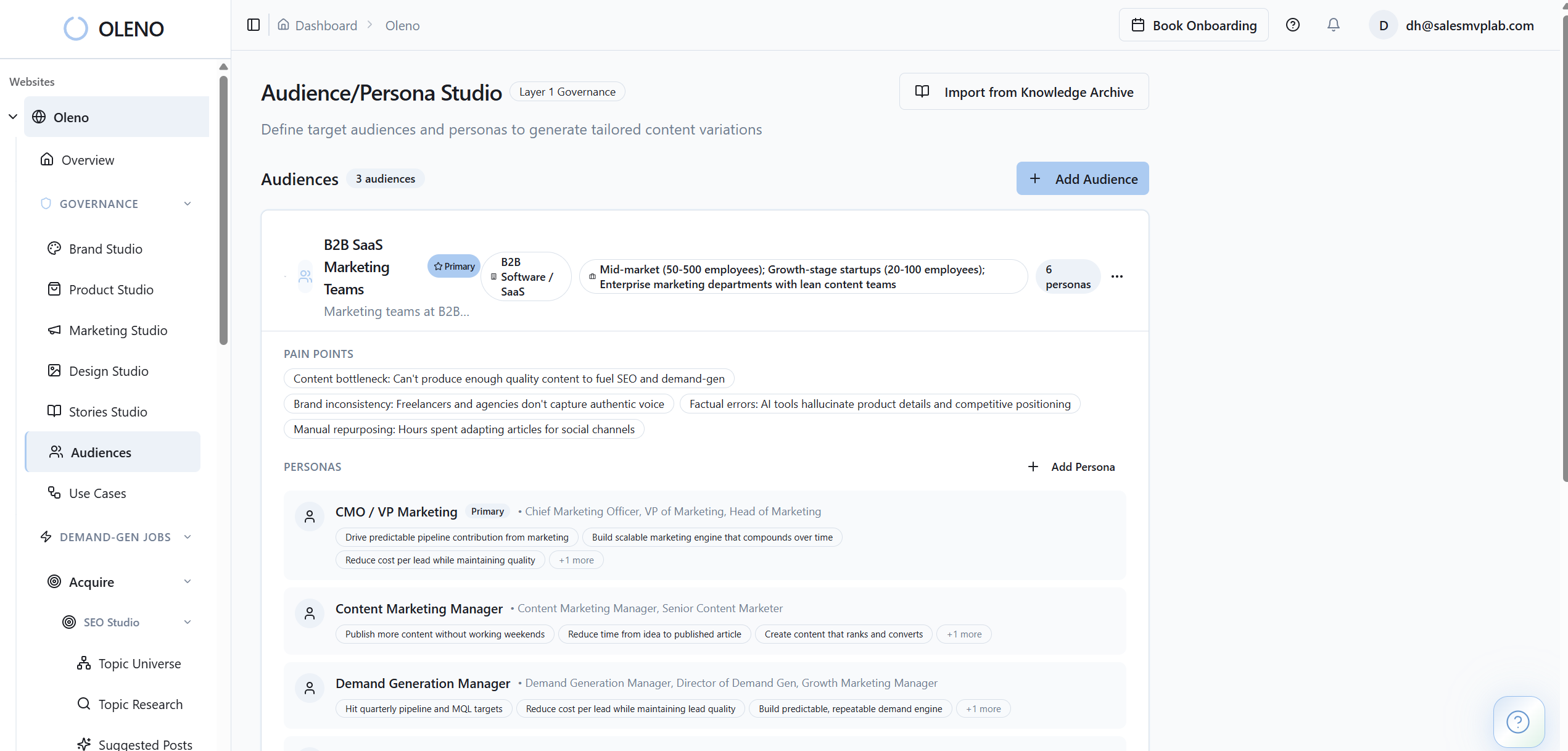
That matters because it addresses the exact failure pattern from earlier. Instead of the Head of Marketing carrying the context in their head and re-briefing everyone manually, the system applies those rules through execution. The point isn’t that drafts appear faster. The point is that the repeated context no longer resets every time a new asset begins.
Oleno Runs the Work as a System, Not a Prompt Thread
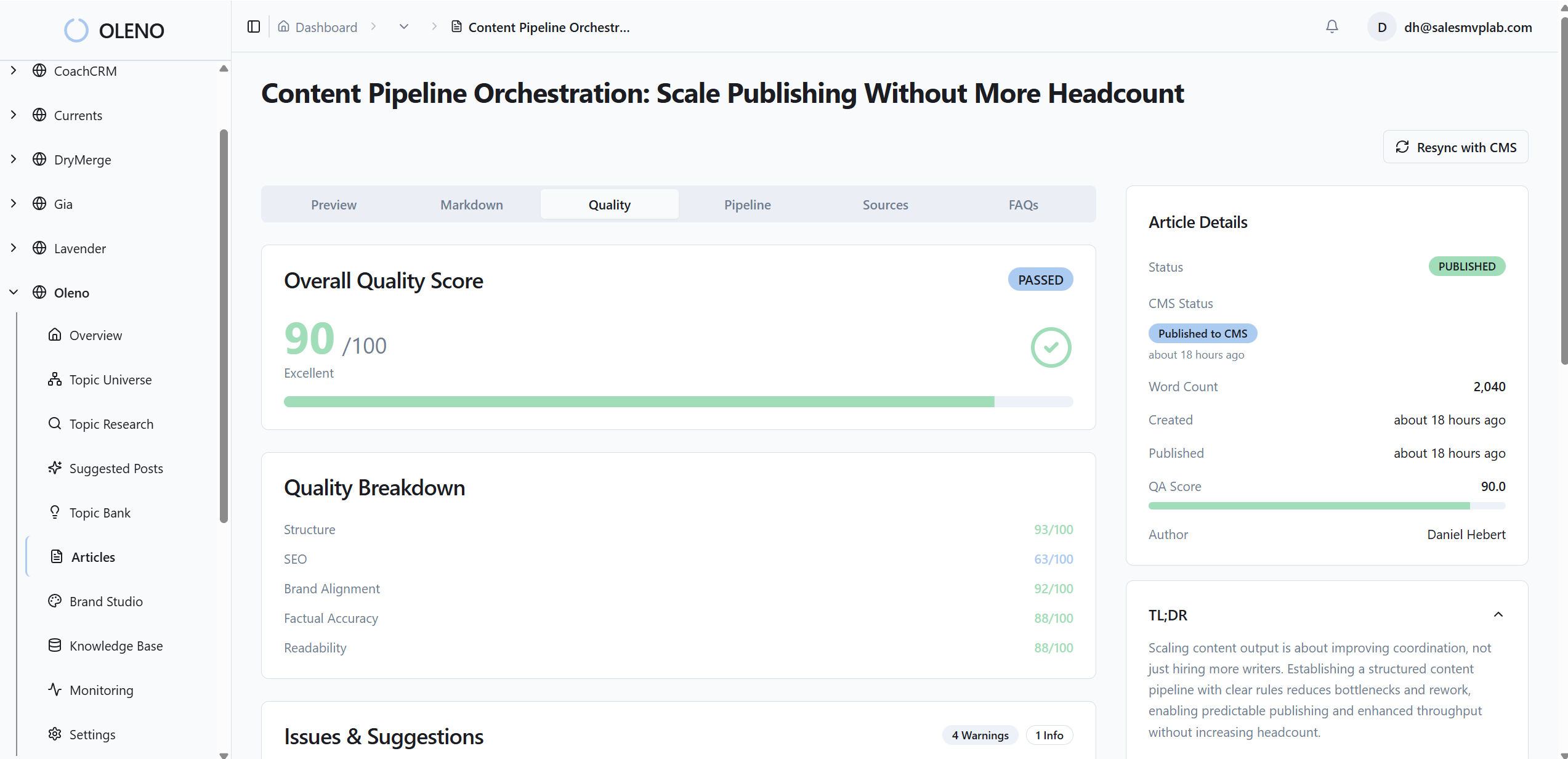
From there, programmatic seo studio, category studio, competitive studio, and product marketing studio handle different demand-gen jobs using the same underlying truth. orchestrator schedules and runs the pipeline. quality gate checks whether output meets the standard before it moves on. cms publishing closes the loop so approved work gets pushed into the CMS without the usual copy-paste mess.
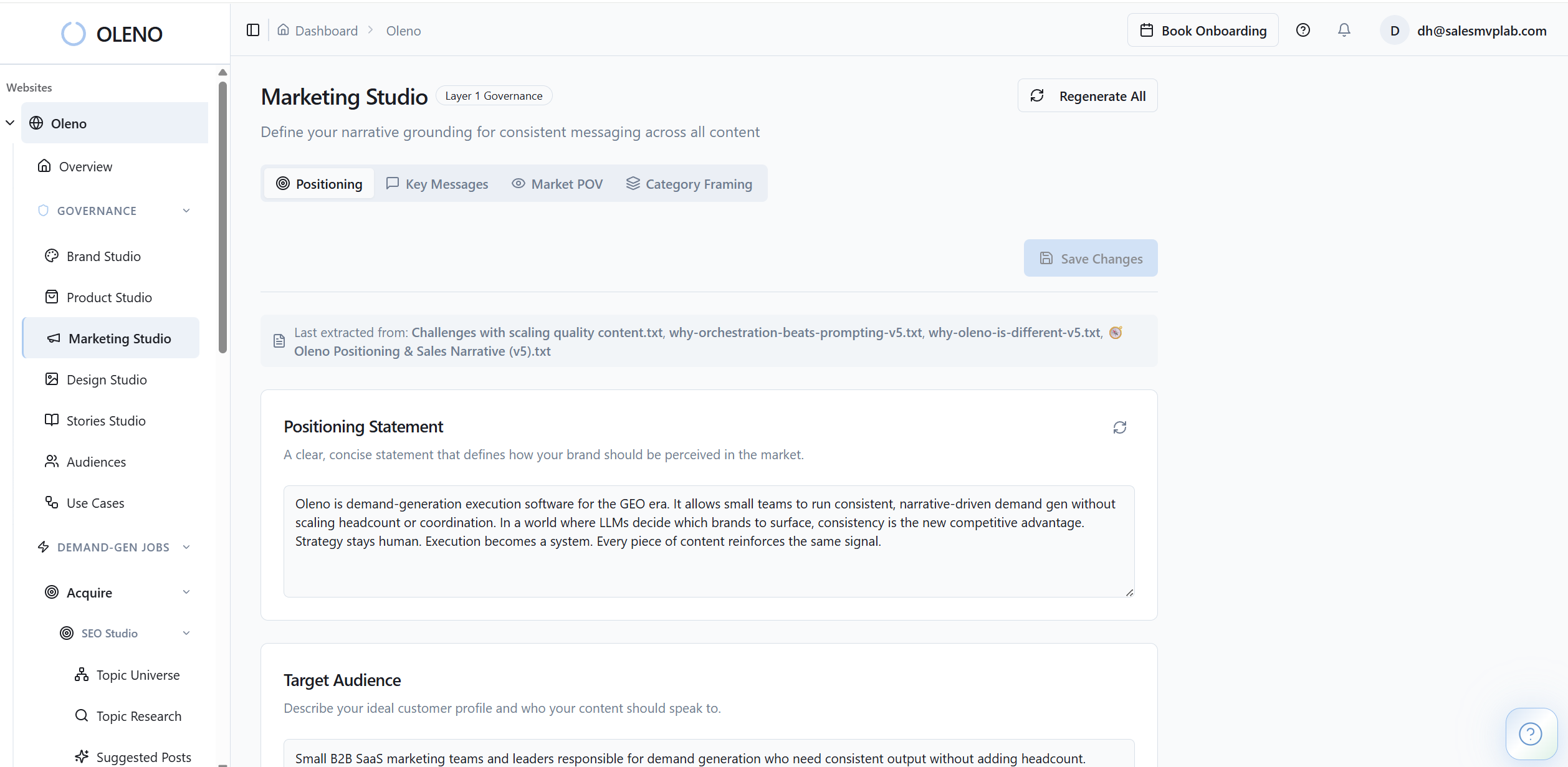
That combination changes the economics for small teams. Review overhead drops because the context is already built in. Narrative drift gets harder to introduce because the same framing carries across content types. Product risk goes down because product studio provides the approved boundaries. And if executive POV matters, stories studio gives that lived-in texture a place to live so the company doesn’t sound like a generic content machine.
Prompts still have a role inside that. Sure. But they’re downstream of the system, not the definition of it.
If you want to see how that model fits your current workflow, especially if your team keeps resetting every quarter, book a demo.
The Shift From Prompt Chaos to Category Authority
Prompts are useful. I use them. Most teams should. But prompts are not a strategy for category leadership, because category leadership is built on repeated coherence, not isolated draft speed.
The real enemy is Fragmented Demand Generation. That’s what creates the rework, the drift, the weak pipeline connection, and the fuzzy signal in GEO. Once you see that, the path gets clearer. Define the truths that shouldn’t move. Connect them to execution. Let the system carry the repetition.
That’s how authority compounds. Not by writing faster. By staying the same in the ways that matter.
About Daniel Hebert
I'm the founder of Oleno, SalesMVP Lab, and yourLumira. Been working in B2B SaaS in both sales and marketing leadership for 13+ years. I specialize in building revenue engines from the ground up. Over the years, I've codified writing frameworks, which are now powering Oleno.
Frequently Asked Questions