Quality at Scale: QA Gates and Automated Checks for Demand-Gen Content

You can publish faster and still lose. I’ve seen it. Speed covers up weaknesses, especially when different people interpret “quality” differently. One post sounds like your CEO. The next reads like a copy machine. Multiply that by 20 or 50 posts a month, and you’re teaching the market to ignore you.
When I was the only marketer at a startup, I could crank 3 to 4 strong posts a week because I controlled the frame and the structure. As soon as more contributors joined, drift crept in. Not because people were bad. Because the system let them guess. If you want consistency at volume, you need rules that hold. Before publish, not after.
Key Takeaways:
- Scale exposes quality gaps, so make quality a system property, not a heroic edit
- Encode five non-negotiables: voice, facts, claims, SEO structure, uniqueness
- Use QA gates that block, auto-revise, and only route edge cases to people
- Measure pass rates before publish and edit rates after to tune thresholds
- Don’t expand review, narrow it, then raise the bar once pass rates stabilize
Publishing More Without Gatekeeping Creates Expensive Risk
Publishing more without gatekeeping creates expensive risk because quality becomes optional under speed pressure. As volume rises, drift hits voice, claims, and structure in ways a single editor cannot catch. A pre-publish gate stops that by enforcing rules automatically, then routing exceptions to people.

Why output speed hides system weaknesses
Speed looks like progress, until it exposes the cracks. When every draft is treated like a one-off, you push judgment onto individuals. People make different calls on voice. They interpret claims differently. They skip schema because the deadline looms. You can’t scale opinion-based quality control.
The fix isn’t another review. The fix is encoding the rules so they run on every draft. Voice rules, approved claims, structure templates, internal link minimums, uniqueness thresholds. If you can’t articulate the checks, you can’t enforce them. If you can’t enforce them, you’ll publish drift.
Most teams are doing activity, not running a system. They string together prompts, docs, and tools, then hope editors catch mistakes late. That approach tops out fast. If you want demand gen that compounds, you need a gate that blocks the wrong stuff before it hits the CMS. Early, not late.
What changes when volume jumps
At five posts a month, a strong editor can catch drift. At fifty, you will not. The failure modes are sneaky. Tone shifts that weaken your point of view. Soft claims that flirt with risk. Missing schema that costs visibility. Internal links that point nowhere useful. These are not big mistakes. They’re costly in aggregate.
I’ve scaled content to thousands of pages. Early spikes look exciting, then the rework tax arrives. The same patterns emerge every time. The volume reveals where your standards are undefined or unenforced. You can’t throw more eyeballs at it. You need a gate that turns soft rules into pass or fail outcomes.
What changes at volume is ownership. You’re not asking editors to fix writing, you’re asking the system to enforce rules. Editors handle nuance and exceptions. The gate handles everything else. That shift is where you regain control.
Who owns quality when everyone contributes?
Quality fails when ownership is fuzzy. If “everyone owns quality,” nobody owns quality. Put responsibility on the gate, not a person. Define pass or fail thresholds, tie them to specific checks, then hold the line. If a draft doesn’t meet the bar, it doesn’t move forward. It is not personal, it is a system decision.
When you do this well, contributors feel safer. They know the bar. They know what passes. They know what gets flagged and why. Review becomes smaller and faster. The gate enforces the boring parts consistently, humans lean in where judgment really matters. That’s how you scale without turning into a committee.
If you need a primer on why demand generation needs system thinking, not just content, the overview from Salesforce on demand generation marketing explains why coordinated execution matters more than isolated outputs.
Ready to inspect your current process with a fresh lens? If you want to see how a gate looks in practice, you can request a demo. Short, focused, and grounded in your setup.
The Root Causes Behind Drift In Voice, Facts, And Structure
Drift in voice, facts, and structure happens because prompting fragments execution and rules live in people’s heads. Governance turns style guides into enforced constraints, and structure templates stop schema and linking from becoming optional. Encode once, apply everywhere, then tune with feedback.
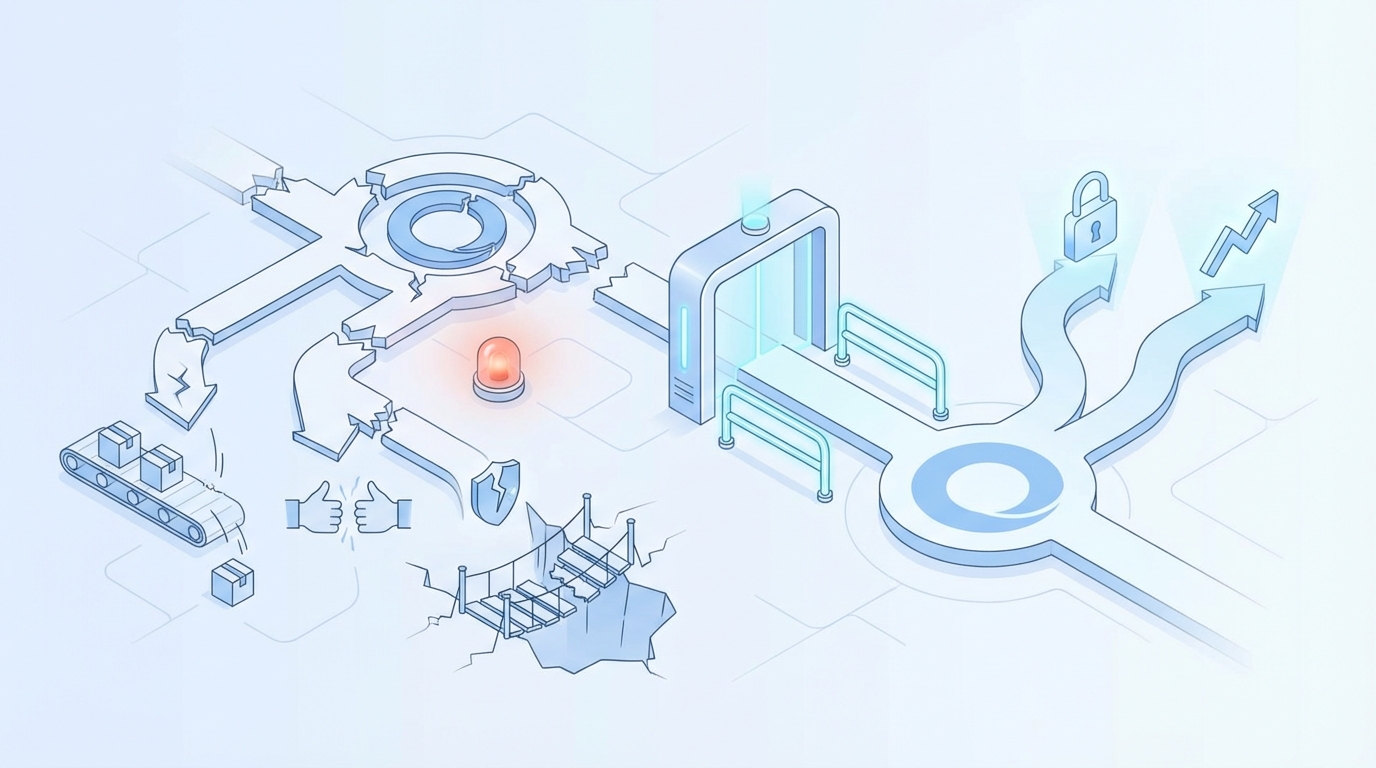
The hidden drift in prompt-led workflows
Prompts push judgment onto humans. Two prompts a week apart produce different tone, different structure, different claims. Even with templates, you’ll see drift. The team compensates with heavier editing, more meetings, and longer cycles. That’s not leverage, that’s overhead.
Demand gen isn’t a single task. It’s a sequence that has to hold together over time. When every draft starts from scratch, you optimize for speed in the moment and pay for it later. Orchestration fixes this by shifting the work up front. Define the rules once, then run them on every draft. Predictability over novelty.
I’ve tried both ways. Prompting looks faster on day one, then slows everything down at volume. Orchestration looks heavier to set up, then runs daily without resets. If you’re curious about the structural difference, the “system, not output” mindset aligns with what you’ll see in practice.
What is governance for narrative and claims?
Governance is not a style guide in a drawer. It is a live set of rules the system enforces. Include approved messages that define what you believe, banned terms that you never want to see, claim boundaries that keep you safe, and product references that anchor the content in reality. Add CTA patterns so the asks stay consistent.
You shouldn’t debate these at publish time. You enforce them. When the market point of view shifts, update governance once. The next outputs comply automatically. That’s the move from “remember the rules” to “the rules run the work.” It’s how you keep voice and narrative tight as contributors multiply.
If you want a broader sense of demand-gen structures that benefit from governance, references like Salesloft’s demand generation overview give you a clean lens on how education, evaluation, and conversion content hang together.
Why SEO structure breaks as contributors multiply
Founder-led posts carry insight, but often miss consistent H2 and H3 skeletons, schema, and internal links. As more people contribute, structure varies wildly. Some posts overuse headings, others bury key sections. Schema gets skipped because “we’ll add it later.” Internal links point to mismatched intent.
The fix is boring and effective. Lock templates. Require schema. Define internal link minimums tied to intent, not vanity. Validate before publish. It’s structure first, polish second. Your content becomes easier to index, easier to navigate, and more likely to earn mentions from LLMs because the bones are predictable.
Governance is what tells the system “this is acceptable structure,” and the pre-publish gate enforces it. When the two are connected, you don’t have to rely on someone remembering a checklist after a long day.
The Cost Of Fixing Quality After Publish
Fixing quality after publish burns hours, erodes credibility, and drags pipeline. The rework tax compounds quickly, even with small edit percentages. You can measure impact with leading checks and lagging engagement signals without perfect attribution, then adjust your thresholds accordingly.
The rework tax adds up faster than you think
Let’s pretend you publish 40 posts this quarter. If 30 percent need post-publish edits for tone, claims, or schema, and each takes 1.5 hours of editor time, you just spent 18 hours on rework. That’s before legal reviews, QA retests, republishing, and the clean-up that pulls people off net-new work.
Now add coordination overhead. Slack threads, ticket updates, re-indexing delays. It’s invisible cost, and it chips away at your team’s energy. When we scaled to thousands of pages on a prior project, these small cuts hurt more than any single big mistake. A gate that blocks common failure modes eliminates most of this tax.
The math doesn’t have to be perfect to see the pattern. As you raise output, the absolute number of fixes goes up even if your percentage is flat. The gate’s job is to bend that curve down, so you protect velocity and quality at the same time. It’s cheaper to prevent than to repair.
What does “quality debt” cost your pipeline?
Every rollback is a credibility hit. Sales shares less because they worry a post will change after they send it to a prospect. Fewer internal shares mean less distribution, both organic and direct. Engagement dips, CTR softens, and you fight to recover attention you already earned. It’s a slow leak.
Tie this to outcomes. If your average blog-assisted deal is 5k and you lose three this quarter to credibility slippage, that’s 15k of avoidable drag. Not catastrophic, but not free. Multiply that by four quarters and the cost looks even less defensible. The gate pays for itself by removing avoidable mistakes.
If CTR is one of your canaries, align on baseline math. The basics in Google Ads’ CTR guide are useful when you standardize expectations with stakeholders. You don’t need a PhD to see whether quality issues correlate with engagement drops.
How do we measure the impact without perfect data?
Blend leading checks with lagging signals. Start with pre-publish pass rate by check, post-publish edit rate under 10 percent, and time-to-publish trend. These are operational truths that tell you whether the gate is doing its job. You’ll feel it in less rework and steadier cadence before you see it in pipeline.
Then watch CTR, time on page, and internal share volume as your canaries. None of this is perfect attribution. It doesn’t need to be. You’re looking for a consistent direction. If pass rates are up, edits are down, and engagement is stable or rising, your system is getting healthier.
For a broader context on aligning content to demand-gen outcomes, the perspective from MarketingProfs on a demand-gen driven approach is worth a read. It reinforces why quality enforcement isn’t vanity, it’s revenue discipline.
If you want to pressure test numbers against your funnel, we can walk through your current edit rates and thresholds together. You can request a demo and we’ll ground the discussion in your reality, not hypotheticals.
The Moments When Quality Failure Hurts Most
Quality failure hurts most when rollbacks break trust, sales stops sharing, or claims flirt with risk. The fix is upstream guardrails and a gate that enforces them. You want fewer full reviews, more targeted interventions, and faster, safer publishing.
The late rollback that breaks trust
You push a post live, it ranks quickly, then legal flags an over-claim. Now you’re editing, re-indexing, and explaining the change to sales. That’s a confidence hit you didn’t need. The cost isn’t just the edit, it’s the trust erosion across teams who already shared the first version.
Set claim boundaries upstream. Define what’s approved, what’s restricted, and what triggers an automatic human review. The gate checks copy against product truth before anything ships. When something new appears, it gets routed, not published. The outcome is faster and safer, which is what legal actually wants.
If you need a clean definition backdrop for demand-gen work, Salesforce’s primer on demand generation is simple and aligned with a system approach. It’s helpful when you’re aligning marketing and legal around why the checks exist.
When sales stops sharing your content
I watched a content team produce beautiful articles that never pointed back to the product story. We ranked, sure, but sales couldn’t use the posts. Demand gen stalled. The fix wasn’t “write less,” it was “enforce narrative rules that connect to product truth.” That’s how content starts feeding pipeline again.
At Proposify, for example, the team ranked for topics that didn’t map to proposals or contract workflows. Great writers, great designers, lots of personality. But the narrative drifted. Tighter governance would have kept topics aligned and the story consistent. Then distribution through sales becomes natural, not forced.
Once the gate checks for narrative alignment and product anchors, you reduce the odds of publishing beautiful content that your pipeline can’t use. Sales confidence goes up. Internal shares go up. And your distribution strengthens without a demand on ad budget.
Are you worried about brand or regulatory exposure?
You should be careful. Regulated or not, vague claims stack risk. If you’ve got restricted phrases, unapproved benefits, or competitive references that require context, encode them. A simple three-tier model works: approved claims auto pass, restricted phrases route to review, and disallowed terms block.
The gate’s job is to keep the volume moving without inviting risk. People step in when an exception merits judgment. That keeps speed up and exposure down. If you need to codify the review checklist, build it once, then use it on every flagged draft. Small effort, big reduction in anxiety.
A Practical QA Gate Model You Can Run This Quarter
A practical QA gate this quarter sets five non-negotiable checks with thresholds, automates validation before the CMS, routes edge cases to humans, and wires into your cadence and reporting. You improve pass rates, reduce rework, and raise the bar over time without adding meetings.
Define the five non-negotiable checks and thresholds
Start by defining pass or fail thresholds, then stick to them. Voice alignment, factual grounding, claim safety, SEO structure, and uniqueness are your anchors. Put numbers and rules on each. If any fail, auto-revise or block. The decision is binary. The draft moves forward or it does not.
Voice needs a target score that reflects your style and rule set. Grounding needs a minimum number of citations to your internal knowledge base or product truth. Claims need to pass your allowed and restricted lists. Structure needs a valid H2 and H3 skeleton with required schema. Uniqueness needs an information gain score based on your existing library.
This does not have to be fancy. It has to be consistent. Pick thresholds that are high enough to raise quality and low enough to keep shipping. Then tune. As pass rates go up, raise the bar. As rework goes down, you’ll see time-to-publish improve without asking anyone to work harder.
- Key Takeaway: Define those 5 checks with exact thresholds.
- Key Takeaway: Make failure impossible to publish.
Automate pre-publish validation so bad drafts never ship
Install a validation layer before your CMS. Run voice linting against your brand rules. Check facts against your knowledge base or approved product references. Evaluate claims against your safety list. Validate structure for headings, schema, and internal links aligned to intent. Detect duplication or low information gain before it wastes a slot.
When something fails a low-severity check, auto-revise with constraints, then re-test. When something fails a high-severity check, block the draft. Don’t negotiate with the gate. The system holds the line so people don’t have to. Teams often see post-publish fixes fall sharply when gates handle the first 80 percent.
You’ll feel this in the first month. Less back and forth. Fewer “quick edits” after publish. More time spent on the topics that matter, not the mechanics that should have been enforced by the system.
Route edge cases to humans with a lightweight review cadence
Don’t expand human review. Narrow it. Only route drafts that fail twice, include new claims, or trigger legal terms. Give editors a 15-minute checklist, not an open-ended edit. The point is to preserve judgment where it matters, not to turn editors into traffic cops.
Add weekly sampling. Pull a small set of passed drafts, scan for issues the gate might miss, then adjust thresholds and checks. Sampling keeps quality from drifting without turning into a bottleneck. Short, focused, and repeatable. Humans handle nuance, the gate handles rules.
Interjection: if everything routes to humans, your gate is too soft. Tighten thresholds until exceptions are rare.
Wire the gate into your CMS, schedule, and reporting
Connect to your CMS for draft or live states, and enforce idempotency so duplicates never slip through. Log pass or fail by check so you can see where the friction is. Track time-to-publish and post-publish edit rate to measure whether you’re getting healthier. As pass rates rise, raise thresholds.
Over time, this becomes part of your cadence. The gate runs daily, content publishes on schedule, and you don’t have to reset everything every quarter. If you need stakeholder-friendly framing on why this matters for demand gen, MarketingProfs’ demand generation-driven approach to content lines up with this model cleanly.
If you want a vendor landscape reference for tooling gaps you might have, a roundup like Guideflow’s overview of demand generation tools can help, though the key is less the tool and more the rules you enforce.
How Oleno Enforces QA Gates From Draft To Publish
Oleno enforces QA gates from draft to publish by encoding governance once, running a deterministic execution pipeline with blocking checks, and integrating operational controls with your CMS and cadence. The system handles routine enforcement so small teams can ship consistently.
Governance layer encodes voice, claims, and structure
With Oleno, you configure voice rules, preferred and banned terms, CTA patterns, approved claims, and structure requirements one time. Oleno applies them everywhere. That moves quality control from memory to a system. When you update governance, the next outputs comply automatically, without retraining people on a new memo.
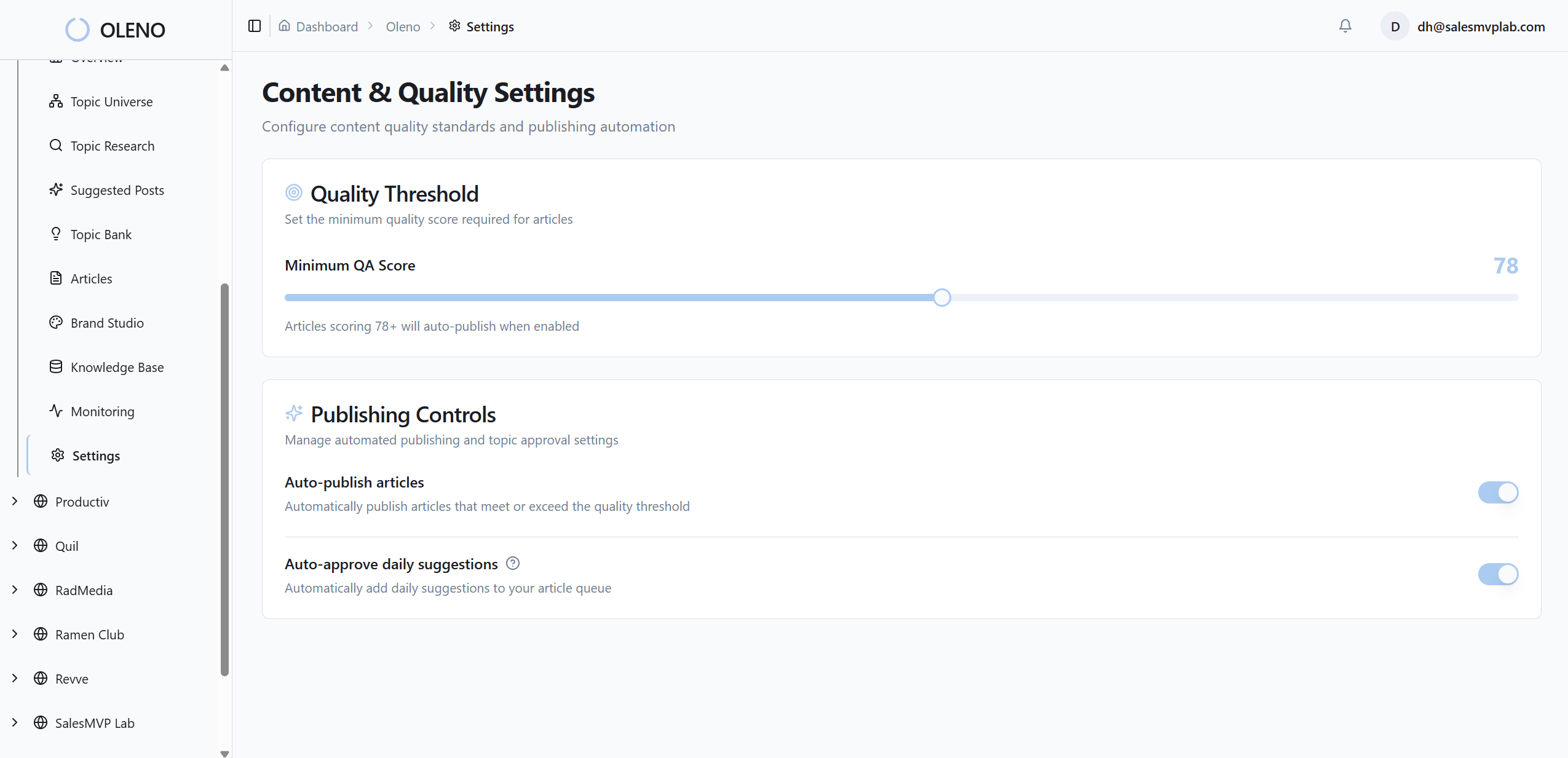
You can also define product truth and claim boundaries, including what use cases you support and what you explicitly avoid. This limits exposure and reduces back and forth. Narrative rules and positioning live here too, which is how Oleno keeps your point of view present without repeating the same sentence on every page.
Because governance is separate from execution, you can raise the bar over time. As pass rates improve, tighten thresholds for voice or structure and the system absorbs the change. Consistency without meetings, that’s the goal.
The execution engine blocks publishing until checks pass
Oleno runs drafts through deterministic pipelines, and nothing publishes until it meets the bar. The engine applies QA gates for voice alignment, narrative compliance, factual grounding, clarity, and SEO structure. If a check fails, Oleno auto-revises within your constraints, then re-tests. If it still fails, the draft is blocked and routed.
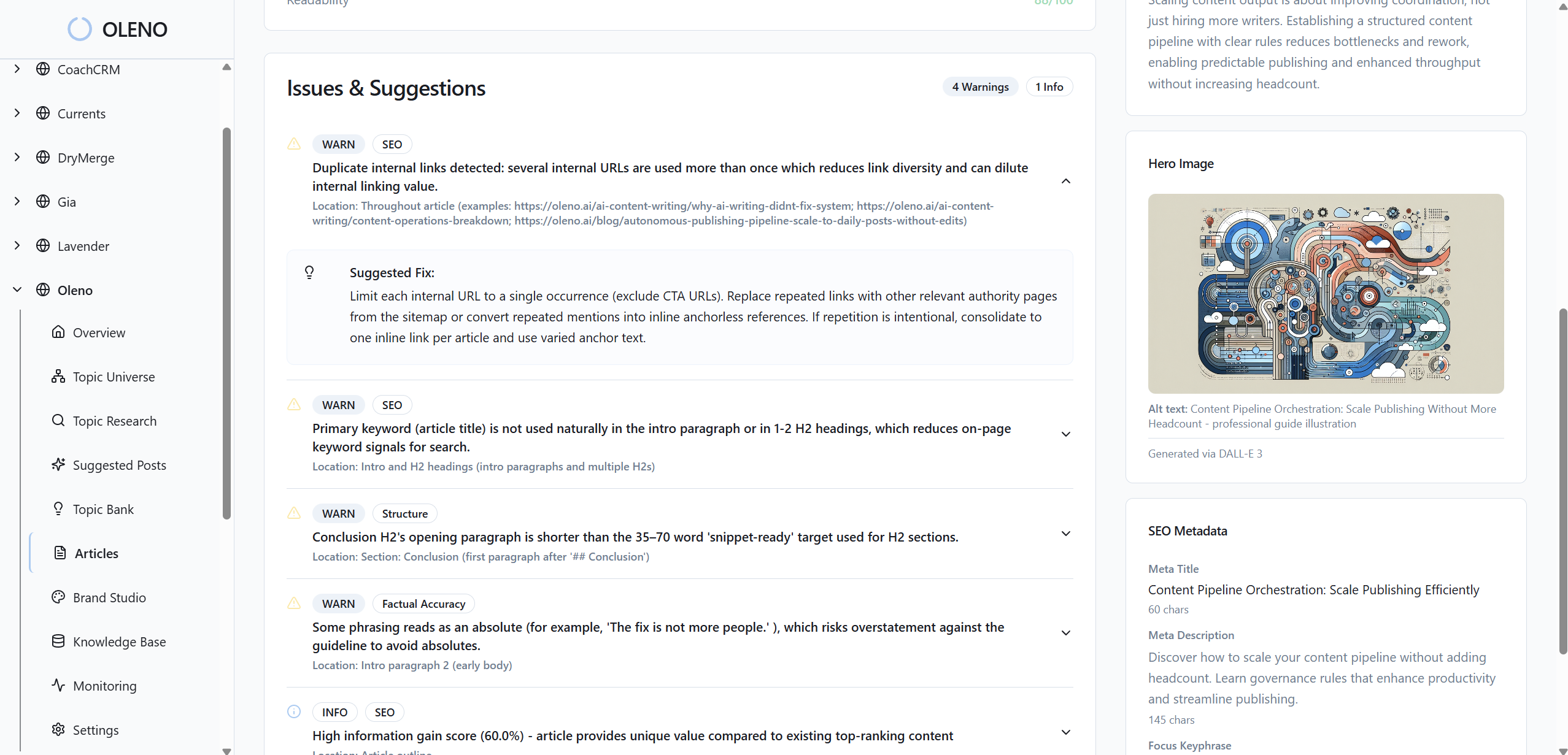
Editors and stakeholders don’t see 50 drafts that need hands-on editing. They see a small set of flagged exceptions, plus a steady flow of publish-ready content. That shifts your team’s energy from fixing basics to shaping the narrative and selecting higher leverage topics.
This approach also protects your cadence. Because Oleno runs daily and the pipeline is repeatable, you can publish continuously, not in bursts. The system, not individual heroics, carries the load.
Operational controls integrate with your CMS and cadence
Oleno publishes directly to WordPress, Webflow, HubSpot, and other CMS platforms as draft or live, and uses idempotency so duplicates do not appear. Optional distribution reuses approved content only, which prevents drift in channels. Operational views give you pass rates, common failure patterns, and quality trends over time.
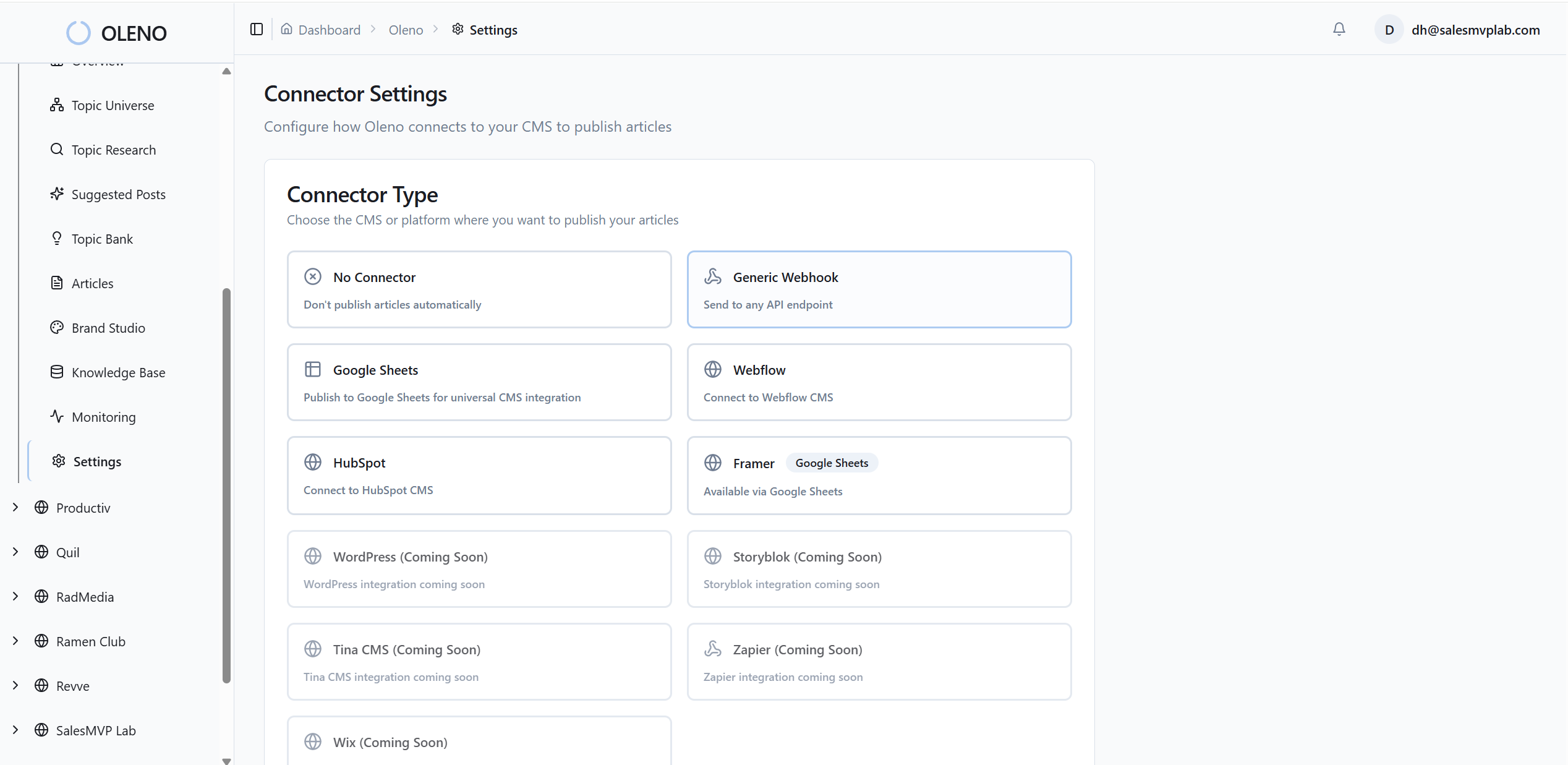
This visibility isn’t about traffic analytics, it’s about whether your engine is running well. If voice passes drop, you’ll see it. If structure fails spike, you’ll see it. Then you can adjust governance or thresholds and move on. No committee, no fire drill, just a system you can trust.
If you want to see how Oleno’s QA controls map to demand-gen jobs and pipeline stages, we can walk it live. Set your rules once, then see them enforced end to end. You can request a demo and we’ll use your real content to show the gates at work.
Conclusion
You don’t fix quality at the end. You fix it by making quality a property of the system. When you encode voice, facts, claims, structure, and uniqueness into a gate that actually holds, you protect speed and reduce rework. Sales trusts what ships. Legal breathes easier. Your narrative compounds.
I’ve done the hero editor thing. It doesn’t scale. The teams that grow without adding headcount do one thing differently. They move rules upstream, and let the system carry the routine. Then they use their time on the parts that truly require judgment. That’s how demand gen stops resetting every quarter and starts compounding over time.
About Daniel Hebert
I'm the founder of Oleno, SalesMVP Lab, and yourLumira. Been working in B2B SaaS in both sales and marketing leadership for 13+ years. I specialize in building revenue engines from the ground up. Over the years, I've codified writing frameworks, which are now powering Oleno.
Frequently Asked Questions