Reduce Micromanagement with the Executive Dashboard View

Micromanagement usually isn’t a personality flaw. It’s a visibility problem. If you don’t have a single place you trust, you end up living in Slack, chasing updates, doing status checks, and trying to piece together what’s shipping from a bunch of half-answers.
That’s why the executive dashboard matters. Not because dashboards are sexy. Because when you can see pipeline health, quality trends, and coverage gaps in one view, you stop babysitting tasks and you start managing outcomes. Oleno built the Executive Dashboard for exactly that moment.
If you’re a Head of Marketing at a growth-stage SaaS, you don’t need more status meetings. You need a system that tells you what’s on track, what’s blocked, and what’s drifting. Without you having to be the human router.
Key Takeaways:
- Most micromanagement is just leaders compensating for missing visibility, and that compensation can burn several hours a week in check-ins.
- Managing by exception means you only jump in when something misses a target date, fails a Quality Gate, or drifts off plan.
- An executive dashboard is only useful if it reflects a governed system (brand voice, product truth, audience targeting), not a pile of tasks.
- Oleno’s Executive Dashboard shows cadence, quality score trends, coverage gaps, and capacity signals (via Health Monitor) so you can steer the system instead of chasing people.
Why Status Pings Become A Full-Time Job
Status Checks Steal Hours That Should Go To Strategy
Status checks are expensive because they never come in one clean batch. It’s a drip feed. A DM here. A Slack thread there. A “quick update?” that turns into three follow-ups and a mini meeting.
Let’s pretend you’ve got a solo marketer or a tiny team. You do two 30-minute status meetings a week, plus one 45-minute weekly planning check-in. That’s 1 hour 45 minutes. Add the daily Slack pings, maybe 20 minutes a day, five days a week. You’re at almost 3.5 hours weekly.
And that’s the polite version. The real version is you’re context switching all day, which is where the time actually dies.
Inconsistent Execution Forces Managers To Monitor Every Task
When execution is inconsistent, you start hovering. Not because you love control. Because you’ve been burned.
A draft shows up off-brand. A launch blog ships with the wrong angle. A “competitive” page turns into a generic listicle. So you compensate. You insert yourself earlier. You add another review step. You add a doc. You ask for more frequent updates.
You can feel it happening in real time. Your calendar slowly fills up with “check-in” meetings that exist purely because you don’t trust the work will land.
This is the part most people miss: quality issues create management overhead. Not just rework.
Hidden Blockers Turn Small Delays Into Avoidable Fire Drills
The worst delays aren’t the big obvious ones. It’s the hidden blockers that nobody flags because they don’t want to be the person with the bad news.
So a thing sits. Then it sits longer. Then it gets escalated late, when you’ve got two days before a launch and now you’re in a fire drill, rewriting copy at night because it “has to ship.”
That fragmentation tax is real. Coordination cost starts exceeding creation cost, and you’re basically paying leadership time to glue a broken process together.
What A Real Executive Dashboard Needs To Do
Replace Ad-Hoc Oversight With System-Level Governance
The fix isn’t “get better at managing.” The fix is building a system where the work is governed before it’s executed.
If you want less micromanagement, you need a few things defined once, then applied everywhere:
- how the brand sounds (voice rules, terms you like, terms you hate)
- what you believe about the market (positioning, enemy framing, your point of view)
- what’s true about the product (approved descriptions, boundaries, supported use cases)
- who you’re talking to (audiences, personas, use cases)
When those inputs are missing, the only “governance layer” is you, in Slack, doing interpretive dance in a thread.
Manage By Exception, Not By Constant Check-Ins
Most leaders don’t want more data. They want fewer surprises.
Managing by exception is simple: you only get involved when something is off track. Missed cadence. Blocked stage. Quality Gate failure. Coverage drift that means you’re ignoring a segment for three weeks.
Everything else just runs.
I’ve watched teams try to solve this with a spreadsheet and a Monday board and a weekly meeting. It’s better than nothing. But it still puts the burden on humans to keep the system honest.
Make Cadence And Coverage Observable To Kill Status Meetings
When cadence and coverage are observable, status meetings become optional. Not because you banned them. Because they stop being useful.
You can look at the system and answer basic questions in under a minute:
- Are we shipping at the rate we said we would?
- Is quality holding steady or slipping?
- Are we over-indexed on top-of-funnel fluff again?
- Are we ignoring a core use case this month?
That’s the bar. Anything less and you’re back to pings.
If you want to see what this style of visibility looks like in practice, Request A Demo To Review Your Dashboard Setup.
How The Executive Dashboard View Works Inside Oleno
One Dashboard Shows Pipeline Health, Coverage, And Pace In Real Time
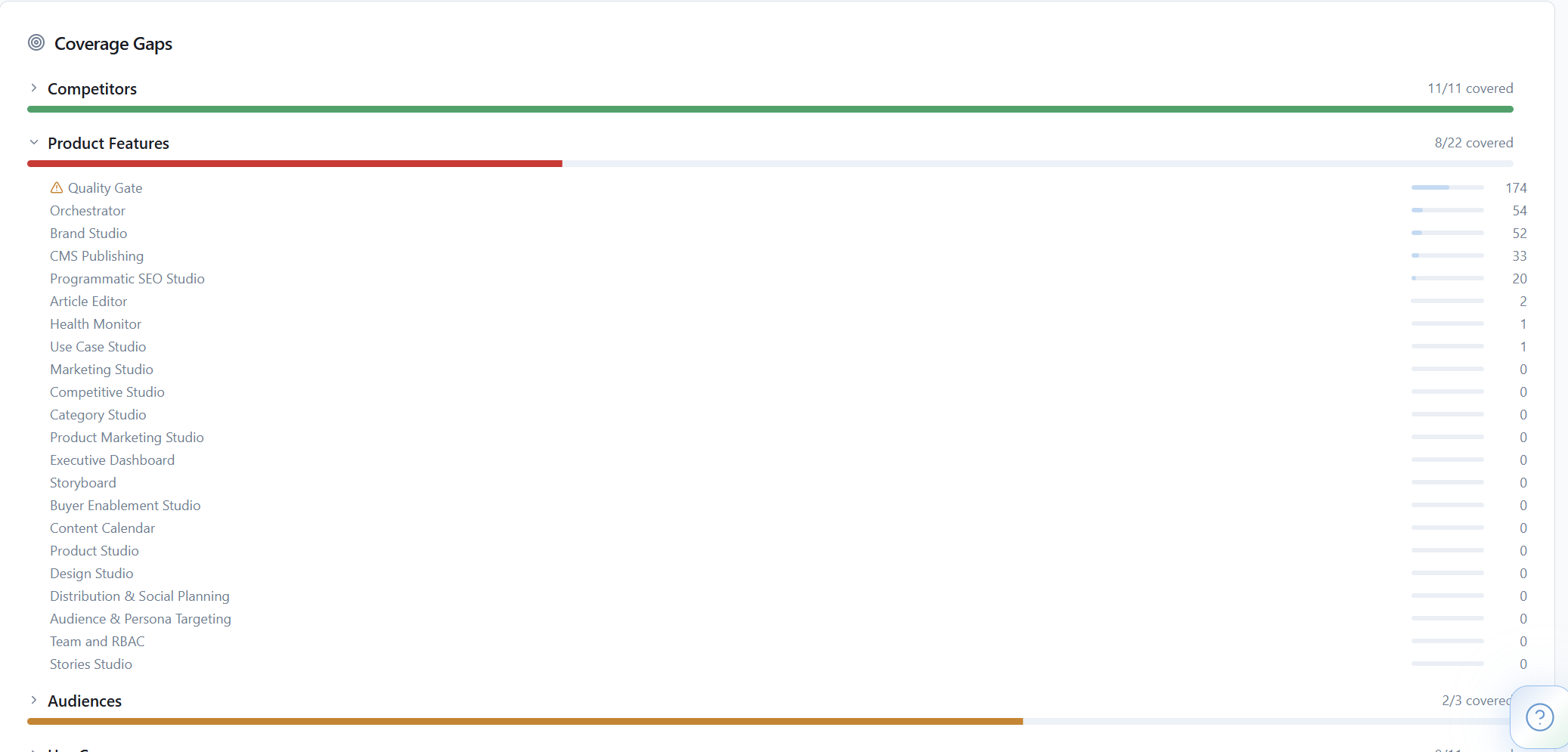
Get a single place to see content operations as work moves: output cadence, quality score trends, coverage gaps across dimensions, pipeline health, dimension balance, and capacity signals from Health Monitor.
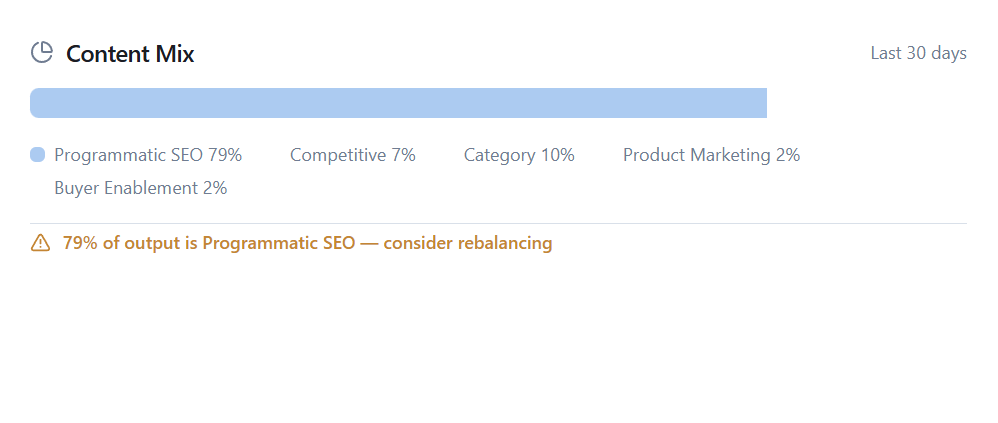
So instead of asking, “What’s going on with content?” you can answer:
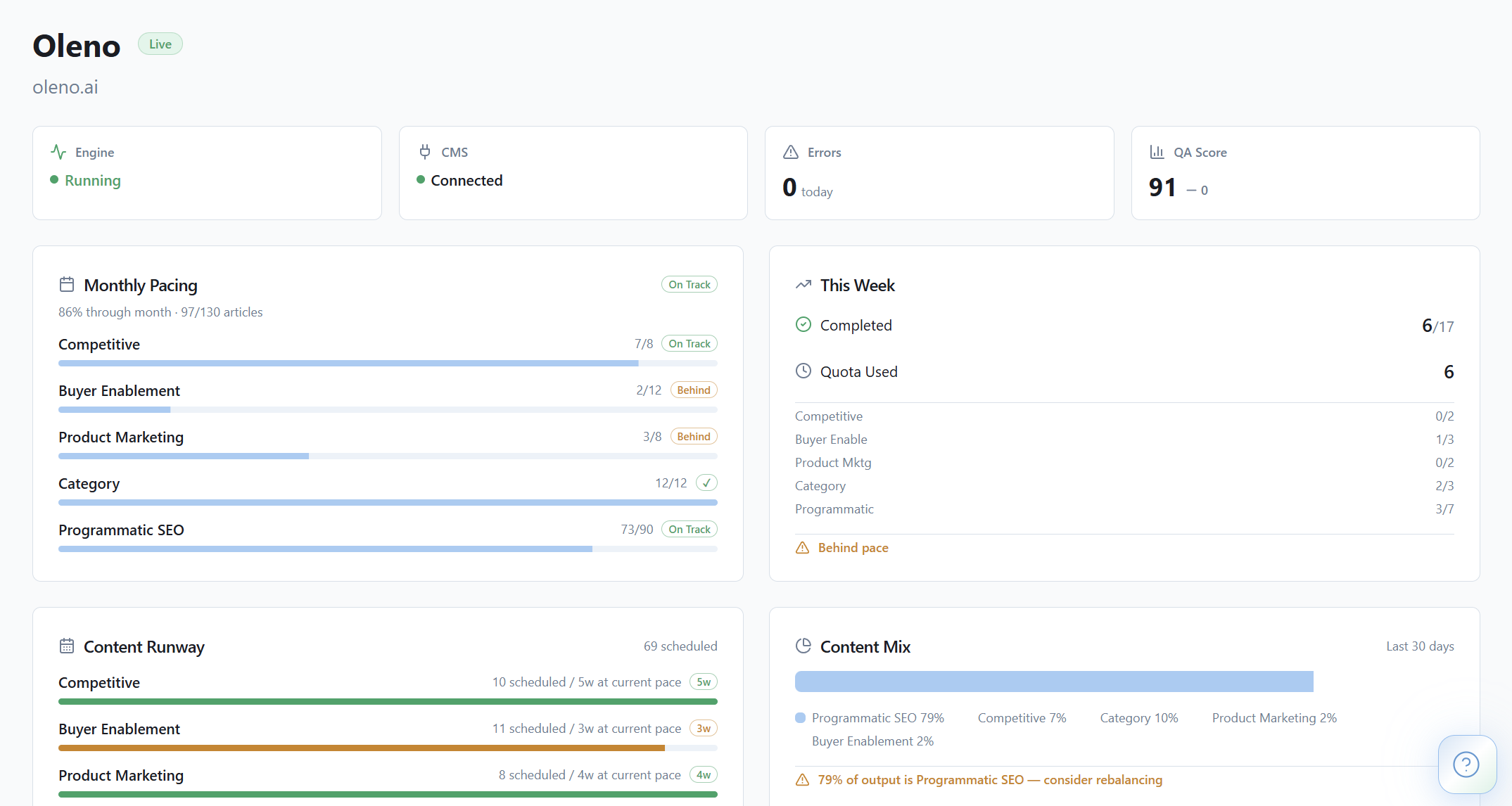
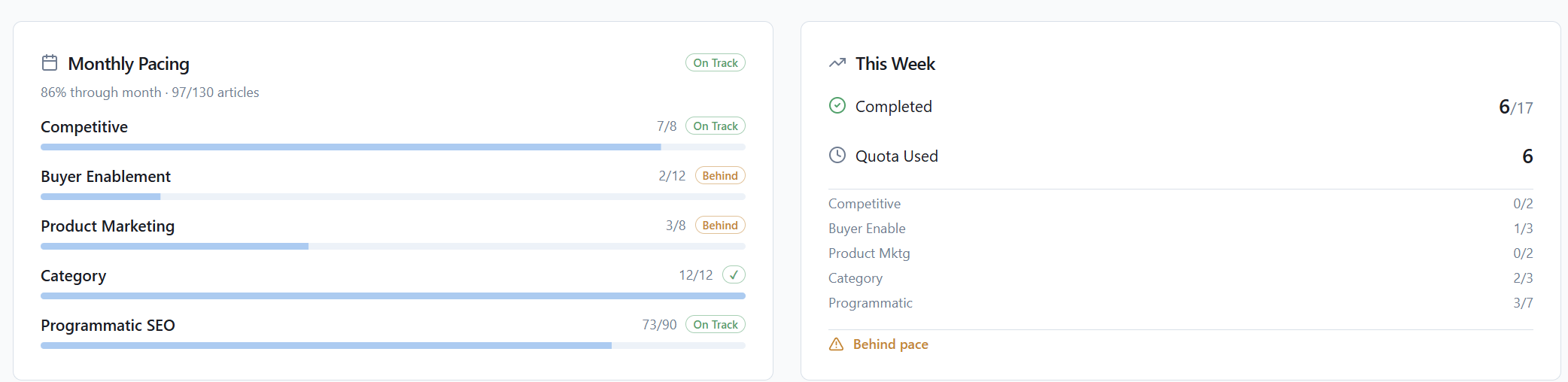
- what shipped this week vs what was scheduled
- where the queue is building up
- whether quality scores are trending up or down
- which audiences, products, and use cases are getting coverage, and which are being neglected
It’s tied into how Oleno runs work. The Orchestrator paces production to weekly and monthly targets, and the Executive Dashboard is where you see whether that pacing is holding.
Governance Statuses Reveal Exactly Where Work Is Blocked And Why
Micromanagement usually comes from ambiguity. “It’s blocked” is not helpful. Blocked where. Blocked why. Blocked by what kind of issue.
In Oleno, the pipeline runs through deterministic steps, and the Quality Gate blocks anything that fails objective standards. When something doesn’t clear, you’re not guessing. You’re looking at a real reason, like voice mismatch or factual accuracy issues that conflict with Product Studio truth.
This is where it starts to feel like a system instead of a content sweatshop. You don’t need to read every draft to find the one that’s going to embarrass you. The exceptions surface themselves.
Role-Based Filters Let Executives See What Matters In Seconds
Executives don’t want the whole mess. They want the executive dashboard view.
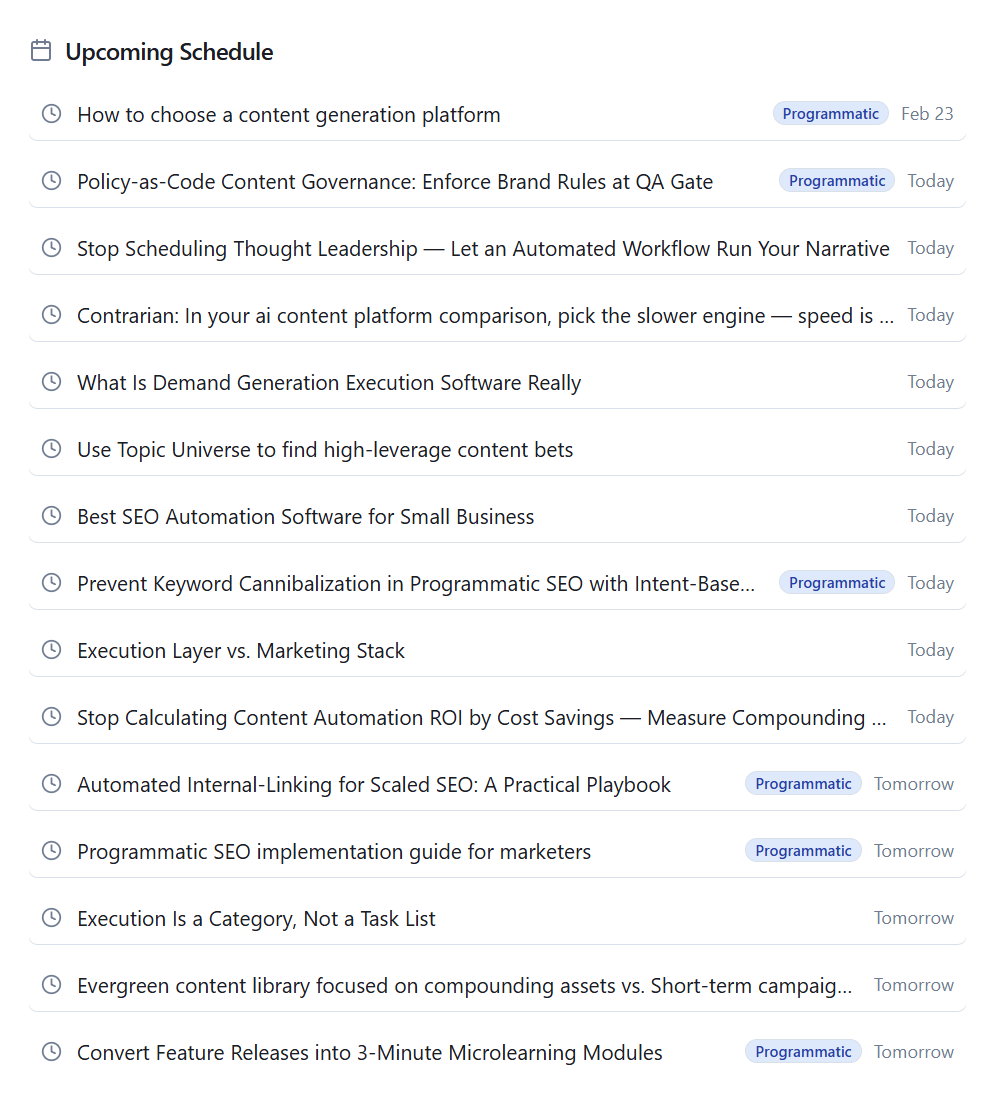
The dashboard is meant to give CMOs and VPs the “exec view” without them having to micromanage. Managers can live deeper in the weeds if they want, but leadership gets the signal:
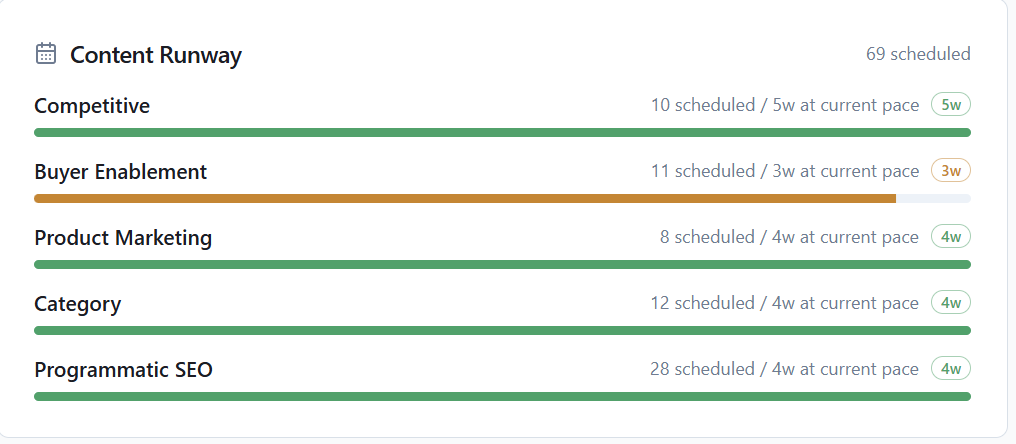
- pipeline health
- trend lines
- coverage balance
- capacity and load signals
- the short list of exceptions that need a decision
That’s a huge difference from being the person who has to DM three people to figure out why one article didn’t ship.
What This Looks Like For A Growth-Stage Team
A Solo Marketer Replaces Three Meetings With A 15-Minute Review
I’ve been the solo marketer. It’s brutal. You’re doing strategy, execution, and reporting, and the second you add even one contributor, you inherit coordination overhead.
At PostBeyond I could crank out 3 to 4 solid blog posts a week because I had the context, the framework, and full control. As soon as the team grew, output slowed down, quality got uneven, and I started spending time managing instead of writing. That’s the trade nobody warns you about.
Now imagine you take three recurring meetings (a weekly planning sync, a content status sync, and a cross-functional check-in) and you replace them with a 15-minute executive dashboard review. Not because meetings are evil, but because you can see what’s happening without the performance of “updating the group.”
That’s usually where the micromanagement starts to fade. You’re not blind anymore.
Managing By Exceptions Cuts Slack Pings To Near Zero
I won’t say your Slack pings go to literal zero. Real life doesn’t work like that. But it changes the shape of the conversation.
Instead of:
- “Any update?”
- “Where’s the draft?”
- “Did this get reviewed?”
- “Is this on track?”
You get:
- “Quality Gate flagged voice mismatch, can you approve the updated phrasing?”
- “This item missed the target date, do we drop it or re-prioritize?”
- “Coverage is drifting away from the quarterly theme, should we adjust weights?”
One is babysitting. The other is leadership.
If you want to test this without a massive commitment, do a tight pilot. Request A Demo To Set Up A Two-Week Pilot. Measure how many status touches you do in week one, then compare it to week two once you’re running on exceptions.
Coverage Views Align Weekly Work To Quarterly Themes
Growth-stage marketing resets quarterly. New priorities. New “big bet.” New scramble. So even if your team is shipping, you can still be drifting.
The coverage view is what keeps you honest.
If your Storyboard priorities say “this quarter we’re going heavy on category POV and buyer enablement,” the Executive Dashboard should make it obvious whether you’re actually doing that. Not in a retrospective. In the week-to-week reality.
That’s when you stop asking, “Are we doing the right work?” because you can literally see the answer.
Where The Executive Dashboard Doesn’t Help (And That’s Fine)
Dashboard Value Depends On Well-Defined Governance Inputs
If you don’t define brand voice, product truth, and your point of view, a dashboard can’t magically invent those standards for you. You’ll just be looking at output stats for content that still needs heavy human correction.
Oleno is built around governance studios for a reason: Brand Studio, Marketing Studio, and Product Studio give the system something real to enforce. Without those inputs, visibility is limited because the underlying work is still ad hoc.
It Shows System Health; It Doesn’t Create Strategy For You
This is important. The dashboard won’t replace positioning work. It won’t replace leadership judgment. It won’t replace knowing your customer and choosing a direction.
I’m a big believer in systems, obviously. But strategy is still human. You decide what you believe, what you’re willing to say, what you’re willing to ignore, and where you’re placing your bets.
The dashboard just makes sure execution doesn’t quietly wander off into the woods.
Visibility Is For Oleno-Run Work, Not External Tools
The Executive Dashboard reflects Oleno pipelines and signals. It’s showing you system health for work that’s being run through Oleno’s planning, governance, studios, and operations layers.
If half your work is happening in random docs, random agencies, or external task tools, the dashboard can’t see that. Not unless the work is routed through Oleno.
That limitation is also a forcing function. If you want fewer surprises, you need a single system of record for execution.
See The System, Not The Tasks
See The System, Not The Tasks
Micromanagement drops when leaders can see the executive dashboard view and trust what they’re seeing. Not “trust” like blind faith. Trust like, “this reflects reality, and I know what’s blocked and why.”
Oleno is built to run demand gen as a system: governance inputs set once (Brand Studio, Marketing Studio, Product Studio, Audience & Persona Targeting), job-based pipelines executed through the studios, paced by the Orchestrator, evaluated by the Quality Gate, made visible in the Executive Dashboard, and monitored by Health Monitor.
That’s the stack.
If you want a focused walkthrough, keep it simple. Bring one audience segment, one use case, and your current cadence goal. We’ll map what “on track” actually means, what exceptions should surface, and what you can ignore.
Book A Demo For An Executive Dashboard Walkthrough
Turn Status Time Into Strategy Time
If you’re serious about reducing status overhead, don’t debate it in theory. Measure it.
Track, for two weeks:
- How many hours you spend on status checks (meetings plus Slack pings).
- How many “surprises” show up late (blocked work, quality issues, coverage drift).
- How many exceptions actually require leadership judgment.
Then compare that baseline to what it looks like when you’re operating off dashboard visibility and exceptions.
That’s when you know if micromanagement was a personality issue. Or just a missing system.
About Daniel Hebert
I'm the founder of Oleno, SalesMVP Lab, and yourLumira. Been working in B2B SaaS in both sales and marketing leadership for 13+ years. I specialize in building revenue engines from the ground up. Over the years, I've codified writing frameworks, which are now powering Oleno.
Frequently Asked Questions