Run a 1‑Writer Content Engine: Scale 4x Quality Output

Most teams assume you need more writers to scale. You don’t. You need a system that turns one good writer into a consistent engine. Back when I ran Steamfeed, we published at volume because rules were clear, not because we hired a small army. Voice was consistent. Topics were mapped. Contributors weren’t guessing.
Later, at PostBeyond, I was the lone marketer for a while. I could ship 3–4 strong posts a week because I had a framework I trusted. When the team grew, quality dipped. Not because they weren’t talented—because context and judgment weren’t encoded. The meetings got longer. The edits got subjective. That’s the trap you’re trying to avoid.
Key Takeaways:
- Scale one writer by turning editorial decisions into rules the system enforces
- Organize work around demand-gen jobs, not formats, so output maps to pipeline
- Gate publishing on quality checks (voice, claims, grounding) to cut rework
- Automate the boring parts: formatting, CMS publishing, distribution, and rollback
- Design for interruption with reuse, refresh, and fixed review windows
- Track throughput, QA pass rate, and time-to-publish—then adjust rules, not people
Why One Writer Can Outperform Bigger Teams With The Right System
One writer outperforms larger teams when judgment is encoded and enforced by the process. The system protects voice, claims, and structure so the writer spends time on angles and clarity, not guardrails. It’s how a solo operator can ship four pieces a week while a five-person team stalls.

The Trap Of Hiring For Volume
More writers rarely fix consistency. They amplify variance. If voice, POV, and claims aren’t clear, every new person adds a new interpretation. You don’t get scale; you get drift. And drift is expensive. It shows up as review loops, edits that contradict each other, and content that doesn’t ladder back to demand.
When we crossed 500, 1,000, then 2,500 pages at Steamfeed, volume worked because rules were simple and visible. Contributors had a shared spine. The lesson wasn’t “publish more.” It was “decide once, then let many people execute without meetings.” With one writer, this matters even more. That person can move quickly because they’re never guessing.
The practical shift is upstream. Define voice, banned terms, claim boundaries, and canonical facts. Bake them into templates and briefs. Then enforce them automatically. The writer still exercises judgment—but within rails that protect narrative and reduce rework.
Why Creation Speed Is Not The Bottleneck
Drafting faster is nice. It’s not the choke point. Judgment is. If claims and narrative aren’t set, fast drafts just reach the review bottleneck sooner. You’ll trade typing time for editing debt. And you’ll feel busy without getting publish-ready work out the door.
There’s also a new reality: content competes in search and LLM-driven retrieval. Speed alone won’t help if your structure, grounding, and POV are loose. Modular, governed content tends to win in those ecosystems. The piece has to be findable, scannable, and credible. As Graphite’s analysis of AI content and retrieval points out, structure and intent alignment matter more than raw volume.
So the fix isn’t “more prompts.” It’s decisions. Turn preferences into rules. Turn rules into checks. Let the pipeline block the wrong output automatically. That’s how one writer’s speed translates into reliable throughput.
Want a quick look at a governed workflow, end to end? Try the free version and see if it fits your reality: Try Generating 3 Free Test Articles Now.
What Actually Breaks When You Scale Output?
When output scales without rules, variance explodes. Voice wobbles. Claims drift. Structure loosens. Review time stretches because every piece is a one-off debate. Cadence slips, which kills momentum. You start protecting brand risk with more meetings, and the machine slowly grinds to a halt.
Most teams over-index on headlines and ideas. The breakdown happens in the middle: structure, grounding, and claims. Those are system problems, not writing problems. Solve them once and reapply the solution every time. The writer focuses on angle and clarity. The pipeline polices everything else. That’s how scale becomes predictable instead of fragile.
The Real Bottleneck Is Fragmented Execution And Missing Governance
The bottleneck isn’t creativity. It’s fragmentation—strategy in slides, execution in people’s heads, and quality in scattered reviews. Governance centralizes judgment, then the system applies it everywhere. That’s how one writer produces like a team, without heroic effort.

Set Rules Once To Scale Judgment
Governance is a one-page standard your writer trusts. Voice rules. Banned phrases. Claim boundaries with examples. Canonical product truths and phrasing. CTA style. Link rules. It’s the difference between “sounds about right” and “this is how we say it here.” The document is short on purpose. It gets used.
Grounding matters. If you want safe claims and fewer rewrites, you need a reliable fact base and sourcing discipline. Use primary or high-quality secondary sources, and define what “credible” means. If your team needs a quick reference, academic gateways like Paperpile’s catalog of academic search engines help your SME reviewers point to better sources fast.
You’ll still debate edge cases. That’s healthy. The key is turning every recurring edit into a rule that the system enforces next time. Less opinion ping-pong. More clean drafts.
Jobs Over Formats, Always
Formats are outputs. Jobs are reasons. Organize around demand-gen jobs—Acquire, Educate, Convert, Reuse, Refresh—so every piece has a purpose. Each job gets inputs, a structure, and a definition of “good.” The writer then picks the format that best serves the job, not the other way around.
This shift cleans up your calendar. Instead of a random mix of blogs, guides, and social posts, you see a balanced system running across the funnel. You protect air cover and bottom-of-funnel support. You can also throttle jobs up or down as priorities change without rebuilding the world.
The writer loves this model because constraints create freedom. They know where the piece fits and what it needs to accomplish. They can focus on the angle that earns attention, not reinvent the structure every time.
Who Does What In A 1‑Writer Model?
Make roles explicit. The writer assembles and crafts. SMEs contribute facts and short reviews on claims—no rewrites. The system enforces voice and structure through checks. Operations handles publishing safety and reuse. With responsibility clarified, you eliminate draft ownership confusion and the “who’s on first?” review dance.
Your SMEs are busy. Respect that. Give them tight windows and a narrow job: confirm claims, add missing facts, flag risk. Thirty minutes, not three hours. The writer integrates changes once. Then the pipeline validates and publishes. Maturity here is less about tools and more about discipline. But the right checks make discipline easier to keep.
The Hidden Costs Of Manual Reviews And Ad Hoc Publishing
Manual reviews and ad hoc publishing don’t just slow you down; they create hidden taxes on time, morale, and opportunity. Quantifying them—even roughly—builds urgency to change. You don’t need perfect data. Directionally right is enough to act.
Time Leakage Across The Week
Let’s pretend a piece takes 12 hours to draft, 6 hours across review cycles, and 4 hours to format and publish. That’s 40% of time not spent on writing. If governance removes half the edits and publishing is automated, you reclaim a full day per piece. That’s your path to 3–4x output over a quarter.
Teams that adopt automation and templates often report meaningful time savings. The ranges vary, but the pattern’s consistent: less time in coordination, more in creation. Benchmarks compiled by industry trackers like AI Multiple’s content writing statistics point to efficiency gains when teams formalize process and guardrails. Not guaranteed, but directionally helpful.
Map your own week. Count the pings, edits, formatting, and CMS work. Then decide what to eliminate, not just accelerate.
The Rework Tax Without Claim Boundaries
Ambiguous claims are a rework magnet. Legal sees a risk. Product wants different phrasing. Sales asks for a qualifier. Suddenly, a clean piece is on draft three with a new headline and a weird tone. The window closes. Content slips.
Fix it at the source. Define approved claims with boundaries and examples of risky language. Add canonical phrasing that mirrors how your product team already speaks. Review shifts from rewriting to validating. Your writer ships faster because the lane is clear.
I’ve seen this flip a review loop from days to hours. Not always, but often. Especially when you pair claims with better source hygiene.
When Great Content Misses Demand
Strong writing can still miss if it doesn’t bridge to your solution. At Proposify, we ranked for topics that didn’t map back to proposals or e-signature. Great traffic. Weak pipeline. It wasn’t a writing problem. It was a job alignment problem.
Tie every asset to a job. Add a single POV line that connects problem to approach. Include a next action that matches where the reader is likely to be. You keep personality, but now you’ve got intent. That’s what turns readers into buyers over time.
Still burning hours in approvals and formatting? There’s a saner way to run this week to week: Try Using An Autonomous Content Engine For Always-On Publishing.
When The Engine Stalls, Everything Feels Harder
Missed cadence compounds. Reviews stack, SMEs get busy, and momentum evaporates. The fix isn’t hustle; it’s constraints that survive interruptions. Your process has to work on bad weeks, not just good ones.
The Three‑Day Slip That Becomes A Month
One draft misses Tuesday. SMEs push to Friday. Edits land Monday. Design’s in another sprint. By the time it’s ready, the brief is stale, and the next piece is already late. The schedule wasn’t flexible; it was fragile.
Constrain the system. Fixed SME windows. Prebuilt briefs that aren’t reimagined every week. A QA gate that greenlights or blocks automatically. Cadence survives because the machine moves even when people are pulled into other work. You’re optimizing for reliability, not heroics.
When Your Only Writer Is Pulled Into Sales
It happens. Launch week. Board deck. Fire drill. If throughput depends on a person, output goes to zero. If it depends on rules and an operational lane, you can pause creation while reuse and refresh keep the calendar moving. You protect momentum by designing for interruption.
This is where those job buckets help. Reuse and refresh are real jobs with scheduled outputs. They reduce risk when creation dips. It’s not perfect. It’s resilient.
How Do You Recover Trust After A Bad Publish?
You ship something off-brand or shaky on facts. Annoying. Also avoidable. Roll back fast. Run a root-cause check. Add a rule to prevent a repeat. Idempotent publishing, canary checks, and grounding tests reduce risk. You don’t promise “never again.” You promise reversibility and learning.
Then you communicate it. “We tightened the claim boundary here. We added a banned-term rule there.” Trust returns when people see the system evolve.
A Production‑Ready Playbook For A 1‑Writer Content Engine
You can run this with one writer if you design the system around decisions, not personalities. Start small, encode judgment, and make the work visible. The following playbook keeps quality stable as volume grows.
Codify Governance Into A One‑Page Brief That Actually Gets Used
Build a compact brief template your writer opens first, every time. It includes voice rules, banned terms, claim boundaries, canonical facts, and linking guidance. One page forces focus. Pair it with a living fact sheet and reusable H2/H3 structures per job. The writer starts from rules, not a blank page.
Make it iterative. Each time an edit repeats, add the rule upstream. The document is a living contract between strategy and execution. When you treat it that way, reviews get shorter and conversations get clearer.
Add a quick sourcing checklist that nudges toward first-party data and credible references. Define what “good enough” looks like so people don’t over-research the wrong things.
Define The Five Jobs And A Realistic Time Budget
Map the week across Acquire, Educate, Convert, Reuse, Refresh. Allocate hours with a ceiling. Example: 12 hours create, 6 hours convert assets, 4 hours reuse, 2 hours refresh. SMEs get 30-minute claim checks in fixed windows. Put it on a board. Defend it.
Collaboration with SMEs works best when expectations are narrow and timeboxed. Practical guidance like Enventys Partners’ SME collaboration patterns can help you script short, focused inputs. The writer turns facts into narrative. The system handles the rest.
Interjection. If budgets slip for two weeks straight, shrink scope before you change the plan.
Run A Weekly Batching Cadence With Modular Reuse
Three-day loop. Day 1 discover and brief. Day 2 draft with modular blocks. Day 3 QA and publish. Build a library: canonical intros, proof points, CTA blocks, and product snapshots. Lock structure so assembly is fast. Reuse rules produce segment variants and channel formats without rewriting.
You’ll feel the benefits in two places. First, less context switching. Second, cleaner distribution, because variants are planned, not improvised. The writer keeps momentum and the calendar stays honest.
Automations, Publishing Safety, And The Core Metrics To Track
Ship a few practical automations each month: grounding checks, voice linting, banned-term scans, schema injection, link validation, image alt checks, JSON-LD templates, canary publish, rollback, idempotent writes, and channel formatting. Nothing fancy. Just guardrails.
Track four numbers: throughput, QA pass rate, time-to-publish, and cost per article. When one dips, fix the rule, not the person. You’re improving the system, not grading the writer.
How Oleno Automates The 1‑Writer Engine End To End
Oleno turns your governance and jobs into a running system. You define voice, rules, and product truths once, then Oleno applies them to every brief and draft. It enforces structure and claims, publishes safely to your CMS, and reuses approved content across channels without inventing new positioning.
Governance Setup And Claim Control The Writer Can Trust
With Oleno, you encode brand voice, narrative rules, approved claims, and product truths. Those constraints flow into every piece automatically. Voice and banned-term linters catch issues early. Knowledge grounding checks reduce risky phrasing before reviews start. The outcome isn’t perfection; it’s fewer subjective edits and faster approvals.
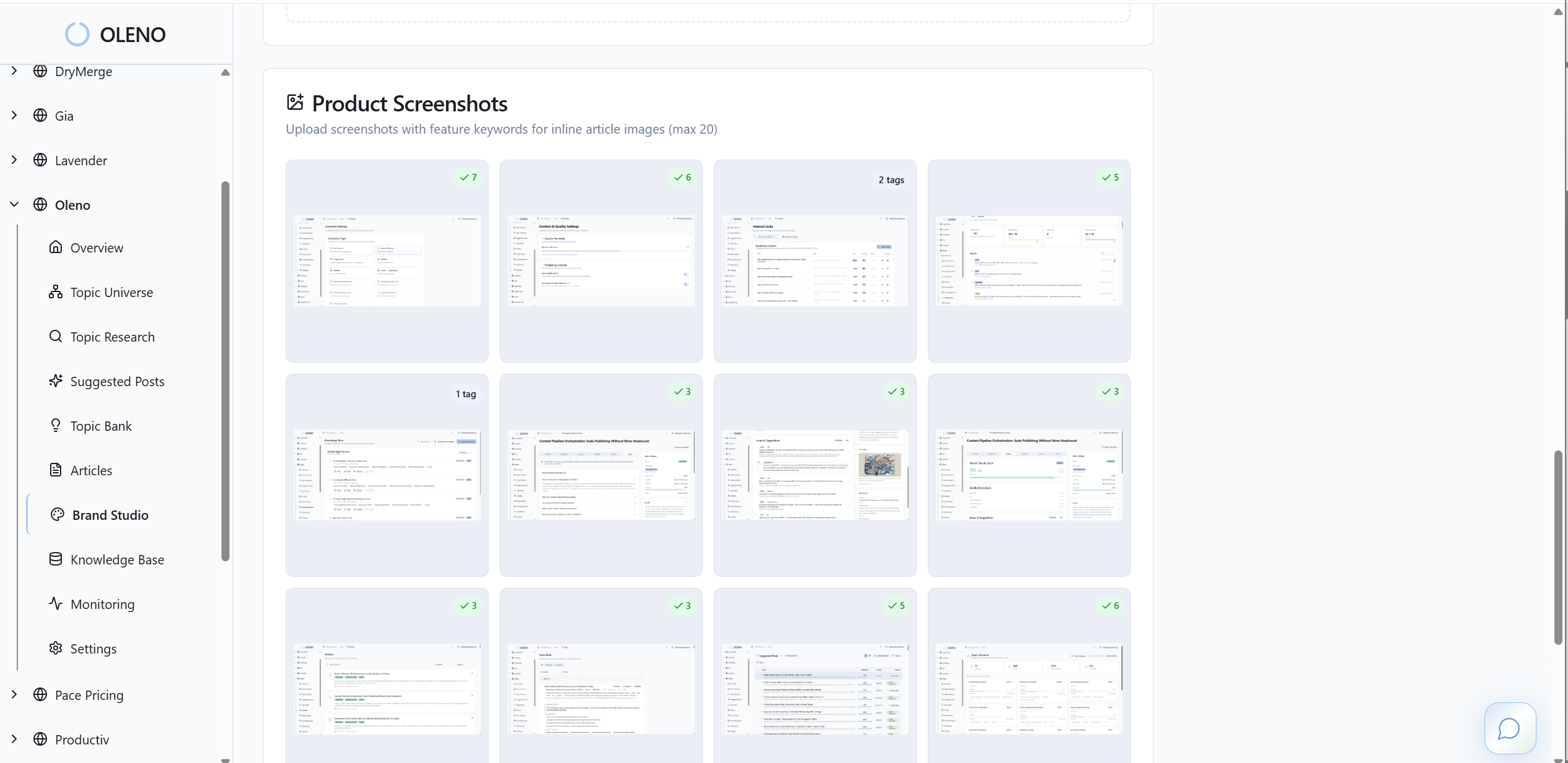
Because governance applies everywhere, your one writer isn’t carrying context alone. They can focus on angle and clarity. The system handles consistency.
Job‑Based Pipelines With A QA Gate That Blocks Bad Output
Each job runs through a deterministic flow—discover, angle, brief, draft, QA, enhance, publish. Oleno enforces structure and grounding, then blocks publishing until checks pass. That reduces rework, preserves cadence, and protects narrative coherence even when priorities shift.

If creation slows, the engine can keep running reuse and refresh jobs so you don’t lose the week. Small team, steady output.
Publishing Control, Reuse, And Safe Rollback
Oleno publishes directly to your CMS—WordPress, Webflow, Storyblok, HubSpot, Framer, and more—as draft or live. Idempotent writes prevent duplicates. Canary publishing lets you test in production-similar conditions, then roll back if needed. Reuse rules turn approved content into channel-ready variants without generating new claims.
That combination—control plus reversibility—lowers the risk of shipping. It’s practical safety for a one-writer team.
Measurement And Sampling That Protect Throughput
You see output volume, cadence, quality trends, and common failure patterns over time. Statistical sampling catches edge cases QA might miss. The point isn’t vanity analytics. It’s operational reliability: is the engine running well this week?
When signals degrade, you update rules at the source. Oleno then applies them everywhere. That’s how you turn a one-writer operation into durable infrastructure.
Want to run this without stitching tools together all week? Start here: Try Oleno For Free.
Conclusion
You don’t need headcount to scale quality. You need decisions encoded as rules, jobs that map to the funnel, and a system that enforces both every time. One writer can produce like a team when governance removes ambiguity, QA gates block risk, and publishing is safe and reversible. Do the hard thinking once. Let the system carry it forward. Then keep writing.
About Daniel Hebert
I'm the founder of Oleno, SalesMVP Lab, and yourLumira. Been working in B2B SaaS in both sales and marketing leadership for 13+ years. I specialize in building revenue engines from the ground up. Over the years, I've codified writing frameworks, which are now powering Oleno.
Frequently Asked Questions