Signature Story Frameworks: 3 Formats That Boost Retention 30%

Most teams treat storytelling like vibes. Great line here, clever turn there, ship it and move on. I’ve done that dance. At Steamfeed, the volume carried us. At Proposify, personality carried us. But when the question shifted to retention, not reach, everything changed. You can’t attribute lift to a one-off hit. You need formats that repeat and metrics that tie back to product reality.
Here’s the harder truth. The format is the system. If your stories don’t open the same way, don’t place visuals the same way, don’t pin the next action in the same spot, your audience never learns where to look for value. And your dashboard never shows a clear retention signal. Structure creates memory. Memory drives habit. Habit drives retention.
Key Takeaways:
- Signature story formats work when tied to lifecycle moments and measured as cohorts
- Snippet-ready openings and fixed visual rules make content scannable and memorable
- Don’t chase a “30 percent” promise blindly, instrument the window and trigger first
- Upstream gaps (briefs, visuals, links, QA) cause downstream rework and fuzzy attribution
- Use three formats: Origin to Outcome, Micro Case Study, Sequential Value Narrative
- Systemize execution with briefs, snippet-ready structure, deterministic links, and QA gates
Why Signature Story Frameworks Drive Retention When They Are Systemized
Signature story frameworks drive retention because they teach readers where to find value, every time. Fixed openings, proof elements, and visual rules reduce cognitive load and speed behavior change. Think of a standard opener that names the change, shows the outcome, and points to one action, same place, every post.

Why storytelling without templates fails measurement
When every story looks different, you get applause, not attribution. Your team ships clever one-offs, then spends the next month debating whether the spike came from the story, the timing, or luck. You can’t cohort posts if there’s no shared structure to cohort against. The pattern is the point; it’s how you isolate effect from noise.
What works instead is a small, stubborn library of formats. Each format gets a snippet-ready opener, must-have proof, and fixed visual placements. Readers learn the rhythm, so they scan faster and act sooner. Your analytics team learns the rhythm too. Now you can compare apples to apples and ask a clean question: did this format move retention for this stage, yes or no? For more on the memory effect of repeatable “signature stories,” see the research summarized in Creating Signature Stories.
What makes a story signature instead of just content
A signature story isn’t a topic; it’s a repeatable structure tied to a lifecycle moment and a single metric. It always opens with “what changed” and “what to do next,” includes one must-have proof (quote, chart, or screenshot), and uses consistent visual placement so readers build muscle memory. You don’t improvise the frame, you fill it.
About the “30 percent” lift. Treat it as a working target, not a guarantee. It’s realistic when formats map to product triggers with clear attribution windows. If you can’t instrument the trigger and timeline, you won’t see the lift, even if it’s there. That’s a measurement problem, not a story problem.
Ready to skip the theory and see repeatable structure in practice? Try Generating 3 Free Test Articles Now.
The Hidden Breakpoint In Retention Content Is Upstream Of Publishing
Retention content fails upstream when formats aren’t mapped to lifecycle stages and briefs lack instrumentation. Without trigger definitions, attribution windows, and visual rules, you ship content that looks good but doesn’t move behavior. Map formats to onboarding, activation, expansion, and churn, then enforce the rules in the brief.
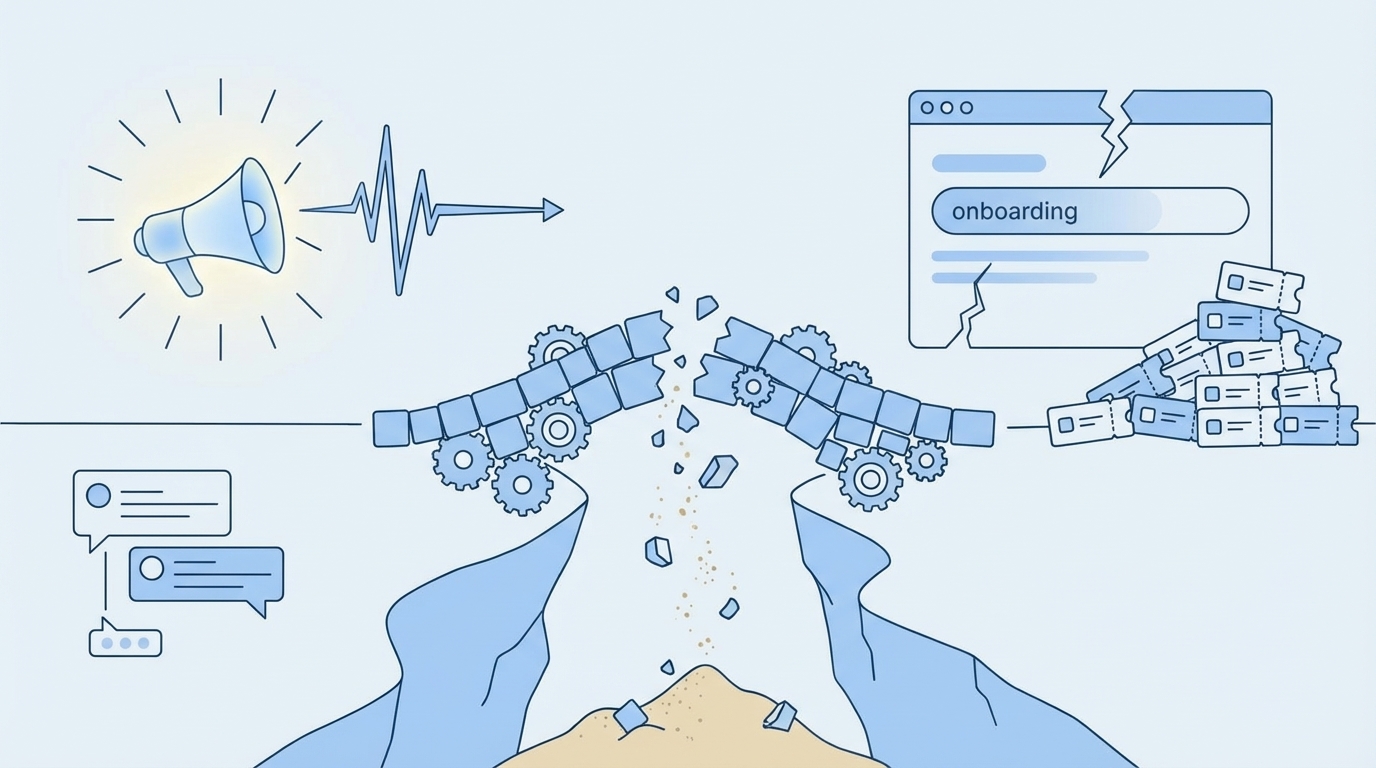
What traditional approaches miss across lifecycle stages
Most teams pitch “storytelling” as brand. Then they ship without lifecycle mapping. Onboarding needs context and one action. Activation needs proof near the metric. Expansion needs compact success stories that echo across channels. Churn needs a sequence that resolves objections in order, not a single Hail Mary post.
The fix is boring, which is why it works. Pick one format per high‑impact trigger, not ten. Tie each to a KPI and a 28–60 day window. Onboarding: Origin to Outcome that shows what changed and what to do now. Activation/expansion: Micro Case Study that names the metric in the opener. Churn: a Sequential Value Narrative that resolves one objection per episode. This mirrors how lifecycle-aligned messaging improves outcomes in controlled experiments; see the framing in CMR620’s lifecycle messaging overview.
How do we map stories to onboarding, activation, expansion, and churn?
Start with product events you already track. New account created, first key action, milestone hit, renewal date set. Assign a format to each and make the rules explicit in the brief: opener structure, proof type, one next action, visual positions, and the attribution window you’ll use to judge it. Simple beats clever here.
Then enforce it. For onboarding, Origin to Outcome explains the “why now” and shows one visible next click. For activation and expansion, Micro Case Studies put the metric in the first 40–60 words and place the chart or screenshot near that line. For churn, run a series where each episode tackles one objection with a linked action. The map is the system, the system creates the lift.
The Cost Of Unsystematic Stories Drains Ops And Blurs Results
Unsystematic stories fuel rework because no two pieces share the same rules. Editors adjust tone late, designers hunt for images, and PMMs debate where proof goes. Every late change compounds. Hours go up, confidence goes down, and you still can’t prove the impact. The cost is real, even if it’s buried.
Engineering and editorial hours lost to rework
I’ve lived the scramble. At LevelJump, we were three people wearing ten hats. Without fixed formats, we’d swap screenshots last minute, rewrite openers to fit the announcement, and chase internal links after publish. The edits weren’t bad; they were unplanned. Unplanned edits always cost more than planned constraints.
Let’s pretend your team edits eight hours per piece across six roles. Twelve posts later, that’s 96 hours, more than two full work weeks, in avoidable churn. Multiply that by a quarter and you’ve delayed the next three ideas you wanted to ship. QA gates and format libraries don’t eliminate edits; they move them to the brief where changes are cheaper.
What does rework look like in numbers
Picture three teams, each shipping weekly. Two iterations per post. 1.5 hours per iteration, per team. That’s 27 hours a week in churn, before you measure if the post did anything. And those hours have a morale tax. People start hedging. They hold back ideas because “we’ll rewrite it anyway.”
Tight formats, enforced by QA, reduce iteration loops and make outcomes more predictable. I like Jay Acunzo’s take on compact proof structures, “situation, intervention, outcome”, because it compresses cycles without dumbing down the story. Worth a skim: 3 Types Of Signature Stories.
Still wrestling with late edits and fuzzy attribution? Try Using An Autonomous Content Engine For Always-On Publishing.
When Stories Drift From Product Reality, Trust Erodes Fast
Trust drops when stories win attention but fail to guide the next product action. The social thread spikes, onboarding slips, and support tickets creep up. That gap isn’t about copy quality; it’s about format fidelity. Pin the next action in the opener and the first visual, or expect behavior to stall.
When a launch thread lands but onboarding still drops
We’ve all seen it. The launch thread sings. The demo clips are tight. Signups pop. Then onboarding dips because the first story users see doesn’t show “what to do next” in a consistent place. People bounce. Support gets noisy. Leadership wonders if the “quality” slipped. It didn’t. The format did.
Fix it with Origin to Outcome. Open with “what changed” and “what you should do right now.” Place a single hero diagram to anchor the mental model and a screenshot at the first action. Then repeat that pattern the next time. Readers will learn where to look for the next click, which often reduces time-to-first-value without touching the product.
The 3am scramble before a board update
I’ve been there. Numbers due at nine. Slack pings everywhere. And the question lands: “What did content do for retention?” If your formats don’t carry consistent metrics and attribution windows in the brief, you can’t defend them. You’ll wave at anecdotes. The board won’t love it.
Bake metrics into the brief fields, not the report. Define the window, the trigger, the KPI, and where the proof lives in the post. If sales needs expansion references, that lives in the Micro Case Study format. If success needs an objection-handling sequence, that’s the series format with enforced internal links. For deeper definitions of credibility in story structure, see the original work in What Are Your Signature Stories.
A Practical Library You Can Ship This Quarter
A practical signature library includes three formats mapped to lifecycle moments: Origin to Outcome for onboarding, Micro Case Study for activation and expansion, and a Sequential Value Narrative for churn. Each has a snippet-ready opener, proof placement rules, and brief fields that make measurement possible. Keep the rules tight and predictable.
Format 1: Origin To Outcome, for onboarding and early activation
Use Origin to Outcome when new users need context without fluff. The opener states what changed and the one action to take. The body shows the turning point and the visible outcome with one screenshot placed at the first action. Readers should leave knowing why it matters and exactly what to click next.
Keep the brief strict: user segment, event trigger, single outcome metric, and the 28–60 day window you’ll evaluate. QA checks opener size (40–60 words), action clarity, and screenshot placement. If you want to experiment, A/B the opener variant or screenshot position, not the structure. Structure is the constant that teaches recognition.
Format 2: Micro Case Study, for activation, expansion, social, and in‑product proof
Micro Case Studies run a compact three-block structure: situation, intervention, outcome, plus one line of credible voice (quote or user mention). The snippet opener should state the metric in plain terms. Place an annotated chart or screenshot near that line so eyes meet proof before they wander.
Brief fields include ICP tag, problem pattern, asset owner, and metric source. QA checks the presence of a real metric and credible quote. Your test plan can play with quote-first vs chart-first, but keep the rest fixed. This format translates well across social, email, and in-product notes because its proportions stay consistent.
Format 3: Sequential Value Narrative, for churn prevention and complex expansions
Use a series when one post can’t resolve layered objections. Each episode owns one objection and one action. The opener clarifies which step this is and what success looks like. Visual rules stay consistent: series banner, step icon, and a screenshot only when it serves the action.
Operationally, enforce internal links across episodes and a 21–30 day cooldown per topic. Brief fields include the objection list, step order, and per-episode KPI. QA checks link integrity and step completeness. That consistency helps readers progress and makes it easier for sales and success to guide customers to the right “episode.”
How Oleno Operationalizes Signature Story Formats End To End
Oleno operationalizes signature formats by turning them into governed briefs, snippet-ready sections, deterministic links, brand visuals, and QA gates, all before publishing. This isn’t another writing tool. It’s a system that takes your lifecycle map and ships format-true, production-ready articles, reliably.
Information Gain briefs with lifecycle metadata
With Oleno, every topic starts as a structured brief that already includes competitive research, information gain scoring, and external source candidates. You add lifecycle stage, event trigger, target KPI, and a simple test plan. Low-differentiation outlines get flagged early, which saves you from shipping repeats in a new coat of paint.
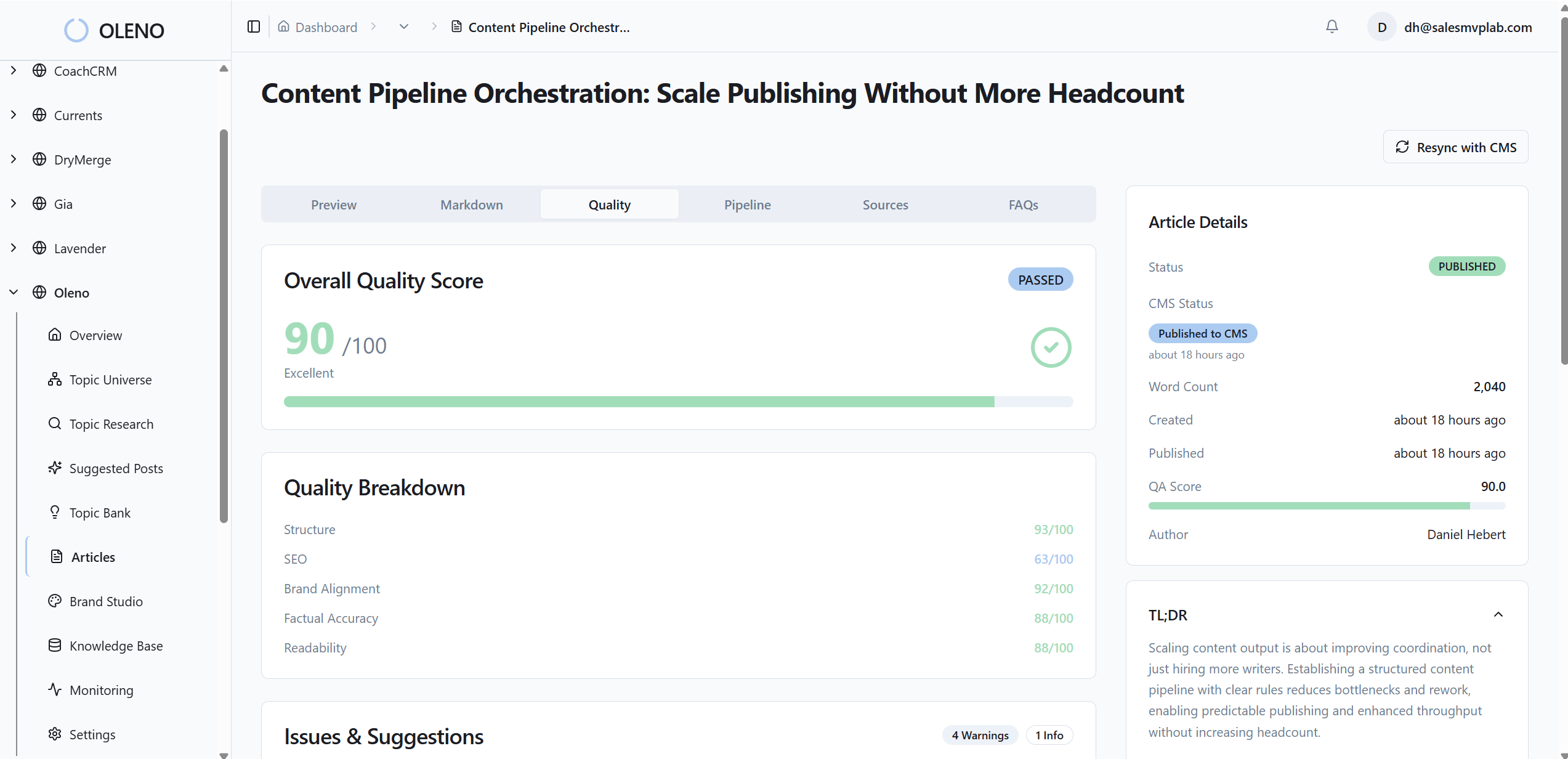
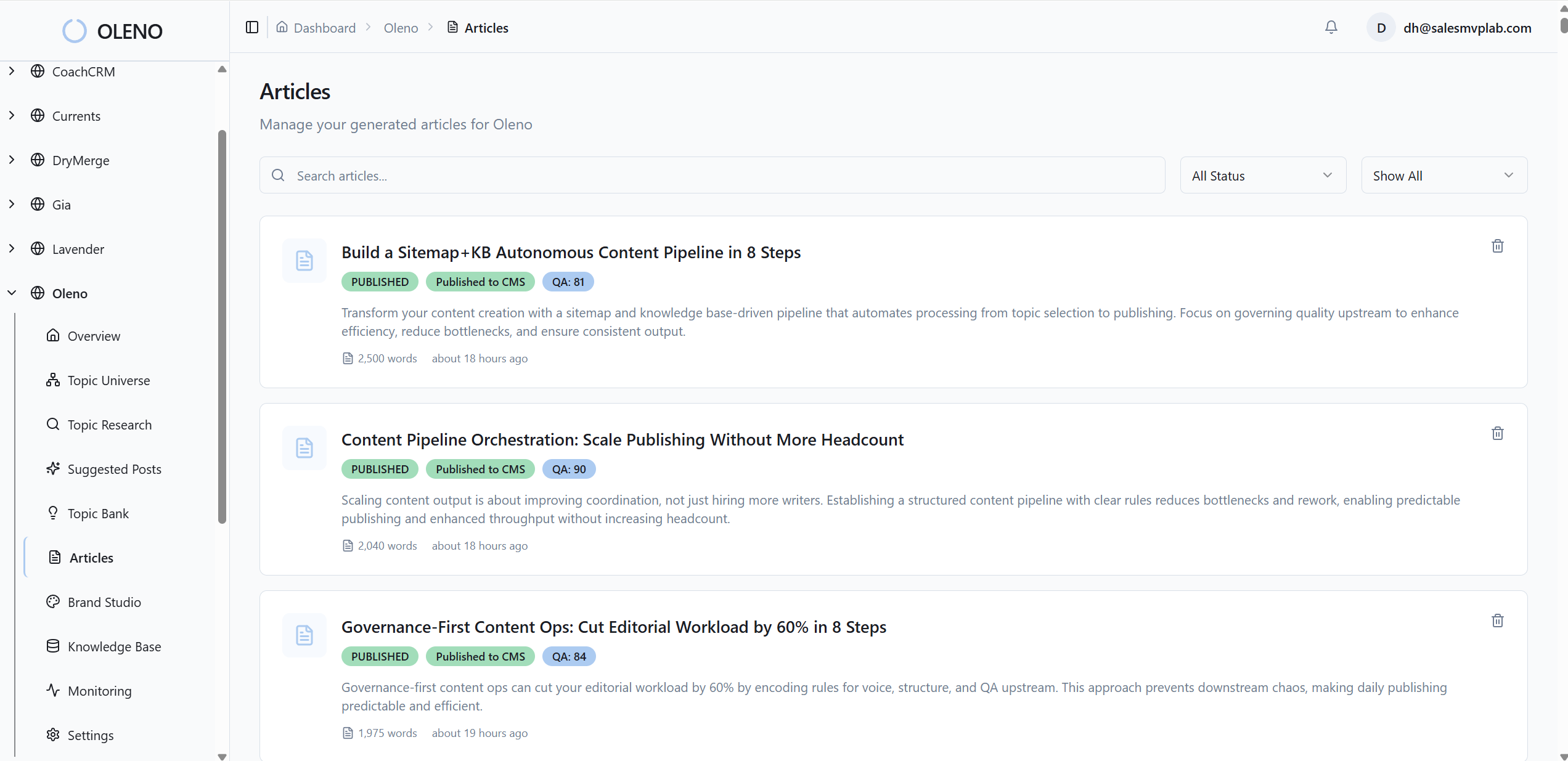
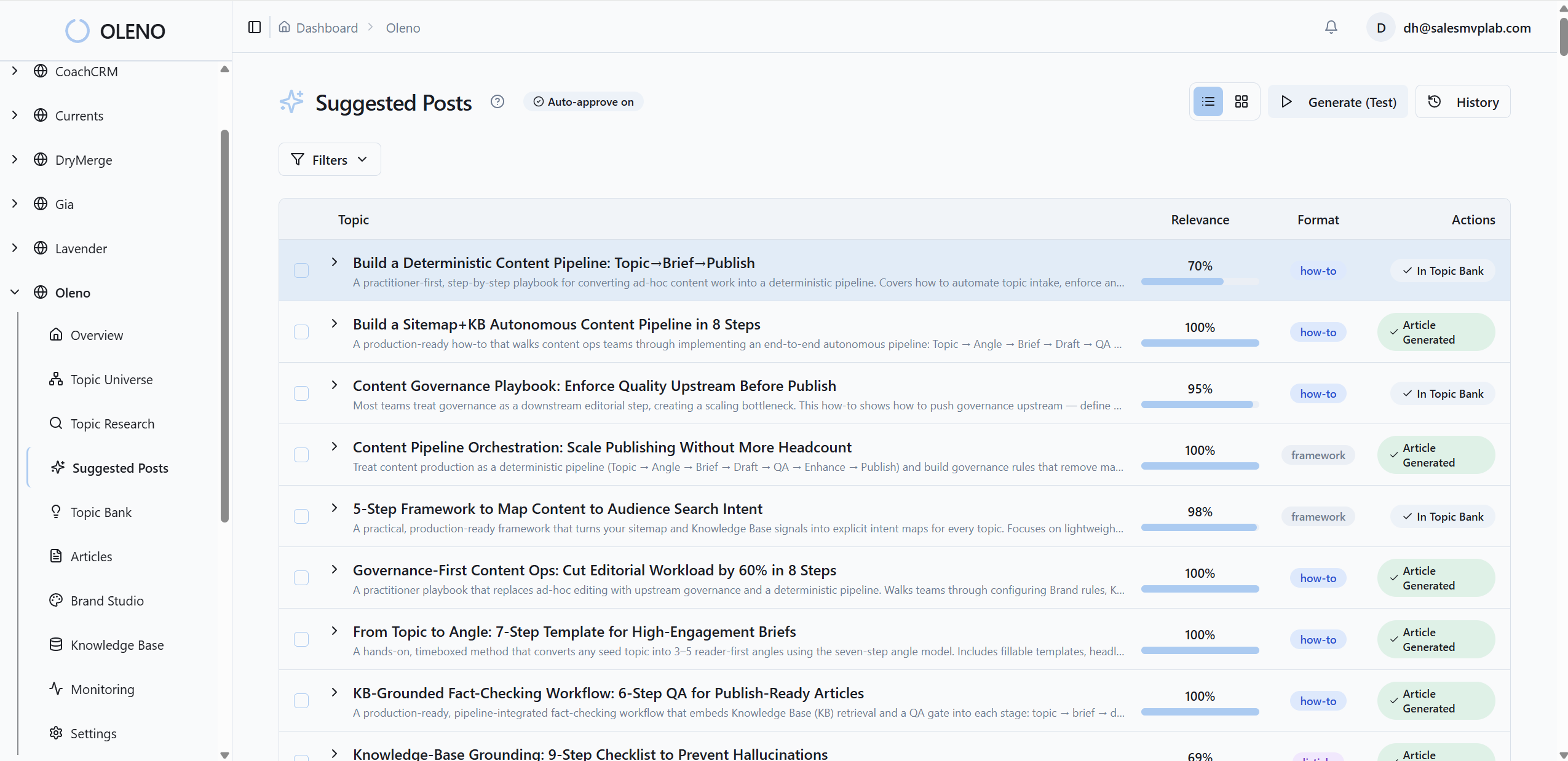
Oleno then enforces snippet-ready structure automatically. Every H2 opens with a 40–60 word, three-sentence paragraph that answers directly, adds context, and gives an example. Deterministic internal links are injected from your verified sitemap at natural sentence boundaries, no fabricated URLs, no orphan sections. Visual Studio generates hero and inline images using your brand assets and matches product screenshots to relevant sections, prioritizing solution areas. Finally, QA-Gate runs 80-plus checks across tone, structure, visuals, and schema, and enforces 90‑day cooldowns so your series formats don’t saturate the same topic.
Here’s how that changes your week. The rework hours you felt in Section 3 get pulled forward into briefs and automated checks. The fuzzy “did this format lift retention?” turns into a clean cohort question because every asset carries its window and metric in the brief. And yes, publishing is handled: Oleno maps fields and delivers to WordPress, Webflow, or HubSpot without duplicate posts.
If you want to see the end-to-end system run on your inputs, not a demo site, Try Oleno For Free. In 10 minutes you’ll have format-true drafts with snippet-ready openings, brand visuals placed correctly, and links you don’t have to babysit.
Conclusion
Retention stories work when they look the same where it matters and change only where it counts. Systemize the few formats that map to your lifecycle, pin the proof and next action in the same places, and carry the KPI in the brief. Do that, and you’ll trade late-night edits for repeatable lift, one clean, measurable format at a time.
About Daniel Hebert
I'm the founder of Oleno, SalesMVP Lab, and yourLumira. Been working in B2B SaaS in both sales and marketing leadership for 13+ years. I specialize in building revenue engines from the ground up. Over the years, I've codified writing frameworks, which are now powering Oleno.
Frequently Asked Questions