Snippet-Ready Article Structure: Capture Featured Snippets & AI Citations

Most teams think snippets are about luck or domain ratings. They’re not. Snippets are awarded at the section level. If your H2s don’t open with a clear, liftable answer, you lose the quote. And once you see it, you can’t unsee it. Structure isn’t cosmetic. It’s eligibility.
I learned this the annoying way. We’d ship strong pieces, smart POV, solid visuals, clean prose, and still watch someone else get the snippet. We tweaked intros. We added schema. We “optimized” headings. Nothing moved until we standardized one boring rule: every H2 opens with a 40-60 word, three-sentence block that can be copied verbatim. After that, wins started showing up.
Key Takeaways:
- Treat each H2 like its own mini answer block designed to be cited
- Open every section with a 40-60 word, three-sentence paragraph: answer, context, example
- Size paragraphs and lists to match common snippet display limits
- Make sections independent so search and AI can lift them cleanly
- Automate structural checks; keep nuance reviews human
- Don’t wait for luck, enforce snippet-readiness upstream in your process
Structure Is Not Cosmetic, It Decides Who Gets Cited
Snippet-ready structure means writing sections that can be quoted without editing. Search engines and assistants favor short, self-contained paragraphs positioned directly under headings. A crisp three-sentence opener, answer, context, example, makes selection trivial. Think: “What is X?” followed by “Here’s how it works” and “For example, Y at Z scale.”

What is snippet-ready structure and why does it matter?
A snippet-ready section opens with a direct answer, adds a single clarifying fact, then anchors with one simple example. That 40-60 word block is easy to lift intact by both search engines and assistants. If your opener isn’t quotable on its own, you’re asking machines to stitch context. They won’t.
Most teams try to solve this at the page level, tweaking title tags, meta descriptions, or the intro. That helps indexing, sure. It doesn’t decide who gets cited. Snippet-readiness lives at the section level. One rule, repeated 10 times, beats a perfect intro every single day.
Here’s the useful tension. Personality still matters. But structure sets the stage. When you consistently give machines a clean block to grab, your odds of being surfaced rise. Not guaranteed, but noticeably better.
Why section-level rules beat page-level tweaks
Page-level tweaks help you get crawled; section-level rules help you get selected. A uniform H2 opener pattern increases the number of extractable units per article. Ten liftable blocks beat one tidy intro. Volume of clean units equals more shots on goal.
Page polish also tends to drift over time. One editor nails it; the next one forgets a detail. Section rules are easier to enforce upstream. They’re binary. Does every H2 open with the three-sentence pattern at 40-60 words? Yes or no. That clarity prevents the frustrating rework we’ve all done.
There’s another upside. Section-level discipline makes content modular. Sales can quote it. PMM can reuse it. Docs can reference it. Reusability isn’t an accident; it’s a function of how tightly you write the first paragraph under every heading.
How do search engines and AI decide what to quote?
They prefer concise, well-placed answers with predictable formatting. Short, declarative text near headings outperforms buried explanations. Consistent sizing improves display integrity; lists with 4–8 items often surface cleanly, while long blocks get clipped. You win by making extraction low-risk and low-effort.
If you want the official flavor, Google describes how featured snippets pull concise answers near headings in their documentation. The throughline is consistent: clear, direct answers close to the question perform best. Read the guidance once, then bake it into your writing rules. Don’t rely on memory. See Google’s featured snippets documentation.
Ready to skip the theory and see it working end to end? Try Generating 3 Free Test Articles Now.
The Real Root Cause of Missed Snippets Is Inconsistent Sections
Missed snippets rarely come from bad ideas. They come from variable section patterns that confuse extractors. When every H2 opens differently, some with a story, others with fluff, machines hesitate. Standardize the opener (answer, context, example) and you create repeatable eligibility across the page.

What traditional advice misses
Traditional guidance over-optimizes keywords and under-optimizes extractability. You get crawlable pages that still fail snippet tests. The fix isn’t “write better intros”; it’s operational: one opener pattern, enforced every time. Answer first. Context second. Example third. Boring? A little. Effective? Consistently.
The other miss: treating structure as stylistic choice. It isn’t. It’s an interface contract with machines. When you honor that contract, your odds go up across dozens of surfaces, SERP snippets, AI answers, even social previews that auto-pull the first lines under headings. Small rule, big ripple.
And yes, creativity still fits. Write the opener like a tight executive brief. Then use the rest of the section to tell the story, show nuance, or add visuals. You don’t lose voice. You gain clarity where it matters most.
What is a snippet-ready H2 opener?
It’s a three-sentence, 40-60 word paragraph placed directly under the H2. Sentence one answers the implied question plainly. Sentence two narrows scope or adds a key fact. Sentence three anchors the idea with a named technique, metric, or example. No hedging. No warm-up lines.
When teams adopt this, they often discover two things. First, weaker sections become obvious because you can’t write a clean opener without clarity. Second, editors spend less time fixing structure and more time pushing the narrative. That’s the trade you want.
If you want a second lens on clarity, I like practical advice about concise writing from academic circles. It echoes the same rules in different words. Start with a direct claim. Then defend it. See Enago Academy’s guide to concise writing.
The Hidden Cost of Non-Snippet-Ready Structure
Non-snippet-ready structure burns hours in cleanup and dilutes extractability. The costs stack: manual resizing, inconsistent openings, and approvals that slow to a crawl. Over a quarter, those “just five minutes” edits add up to days. Standardize the pattern, and you reclaim time without sacrificing voice.
Time sinks from rework and guesswork
Let’s pretend your team spends 20 minutes per H2 fixing openings, resizing lists, and trimming fluff. Ten H2s per article means over three hours of cleanup. Publish eight posts a month and you’ve burned 24 hours on avoidable edits. That is one workday lost to formatting headaches.
The hidden tax isn’t just time. It’s decision fatigue. Writers start guessing what “good” looks like. Editors become layout referees. Reviews focus on structure, not substance. Morale dips because the work feels like rework. A simple, enforced opener rule eliminates these micro-decisions at the source.
And yes, you can make this nearly binary. Pass if the opener hits 40-60 words, contains answer/context/example, and list lengths sit inside display limits. Fail otherwise. Reserve human attention for the interesting part: is the idea actually worth saying?
The opportunity cost of lost AI citations
Snippets and assistants are quiet distribution. You won’t always see the lift in a dashboard, but the brand recall compounds. Miss one citation a day for 90 days and you’ve lost dozens of passive exposures. Not catastrophic, but meaningful.
The fix is structural, not promotional. Increase the number of extractable units per article, and you increase your surface area for mentions. Over a quarter, that adds up. If you like the craft angle, there’s a reason scientific writing emphasizes tight claims early in sections. It’s readable and quotable. See PLOS’s “Ten Simple Rules for Writing a Paper”.
Tired of losing hours to cleanup that never makes the page better? Try Using an Autonomous Content Engine for Always-On Publishing.
When Snippets Go To Someone Else, It Feels Like You Did All The Work
It stings because you did most of the work, research, angle, narrative, but the structure blocked you at the finish. Without uniform H2 openers, you invite uncertainty. Competitors with simpler, cleaner section rules slip past you. It’s not effort. It’s eligibility.
The 3am refresh spiral and stakeholder pressure
You ship a strong post. Competitor gets the snippet. You refresh the SERP six times and convince yourself it’ll flip overnight. Stakeholders want quick wins. You rewrite openings, reformat lists, and second-guess the angle. You’re not fixing quality; you’re fighting structure debt.
I’ve been there. I once spent a weekend “polishing” a piece that didn’t need polish, it needed a system. The moment we standardized openers across the page, we stopped “chasing the snippet” and started earning them. Not every time, but enough to notice.
Here’s the punchline. The right rule set feels restrictive on day one and liberating on day ten. It moves decisions upstream where they’re cheap and takes pressure off launch week.
A short story from the trenches
We had voice, visuals, even momentum. Traffic looked fine, but snippets kept going elsewhere. The fix wasn’t more personality; it was a repeatable process. H2 openers standardized. Paragraphs sized. Examples anchored. The first week felt rigid. Week three, we started getting pulled into answers.
And the team dynamic changed. Editors stopped being the “structure police.” Writers got faster because they knew exactly how to start each section. SEOs spent time on strategy instead of triage. That’s the kind of boring that compounds.
One more thing: we didn’t write less creatively. We wrote more intentionally. The opener carried the burden of clarity. The rest of the section carried the story.
A Repeatable Section-Level Playbook You Can Ship In One Cycle
A practical playbook has four parts: design the H2 opener, size paragraphs and lists for extractability, make each section independent, and automate the checks that don’t require taste. You can pilot this in one sprint, then scale it across your calendar.
Design the H2 opener: direct answer, context, example
Draft a 40-60 word block under every H2. Sentence one states the answer plainly. Sentence two narrows scope or sets expectations. Sentence three provides a concrete example, named technique, small metric, or specific case. Write this before anything else. It sets the spine for the section.
This is the editorial equivalent of a unit test. If you can’t write the opener cleanly, the idea isn’t tight enough yet. Push on the claim until it compresses. Then expand confidently with supporting paragraphs, visuals, and quotes. The opener earns your eligibility; the section earns your authority.
A useful guideline: the opener should still make sense when pasted into a doc with no other context. If it doesn’t, you’ve left the reader, and the machine, hanging.
Size paragraphs and lists for extractability
Keep paragraphs under 80 words, with the opener at 40-60. For list snippets, aim for 4–8 bullets, each under 20 words. If you include a table, keep it to 3–5 rows and 2–3 columns. These constraints roughly mirror common snippet display bounds, which reduces truncation risk.
Worried about being “too short”? You’re not reducing depth; you’re improving scannability and quoteability. Use the body to add nuance, examples, counterpoints, short pull-quotes. One interjection: don’t pad. Clean beats long.
When in doubt, draft the long version, then compress. Most teams find they lose nothing important and gain clarity.
Make sections independent with micro-outlines and examples
Before writing, create a three-line micro-outline per H2: claim, proof, example. The opener becomes the claim. Your first paragraph after the opener carries the proof. The next paragraph anchors with an example. Independence increases quoteability, and it also makes repurposing a breeze.
The example doesn’t have to be a case study. It can be a named method, a small number, or a “let’s pretend” scenario to illustrate scale. The goal is concreteness. Machines favor it. Humans remember it. If you want to go deeper on structured data support later, keep Google’s Article structured data handy for your devs.
How Oleno Embeds Snippet-Readiness In Your Workflow
Oleno bakes snippet-ready patterns into the pipeline, no prompting, no manual policing. Drafts open every H2 with the three-sentence paragraph by design. A QA gate validates structure and clarity, while schema and internal links are generated deterministically. Visuals are placed intentionally to reinforce examples.
How snippet-ready paragraphs get enforced by default
Oleno generates a 40-60 word, three-sentence opener under every H2: direct answer, supporting context, practical example. This isn’t a suggestion; it’s how the draft is written. Because the pattern is consistent, eligibility scales across entire pages, not just the intro.
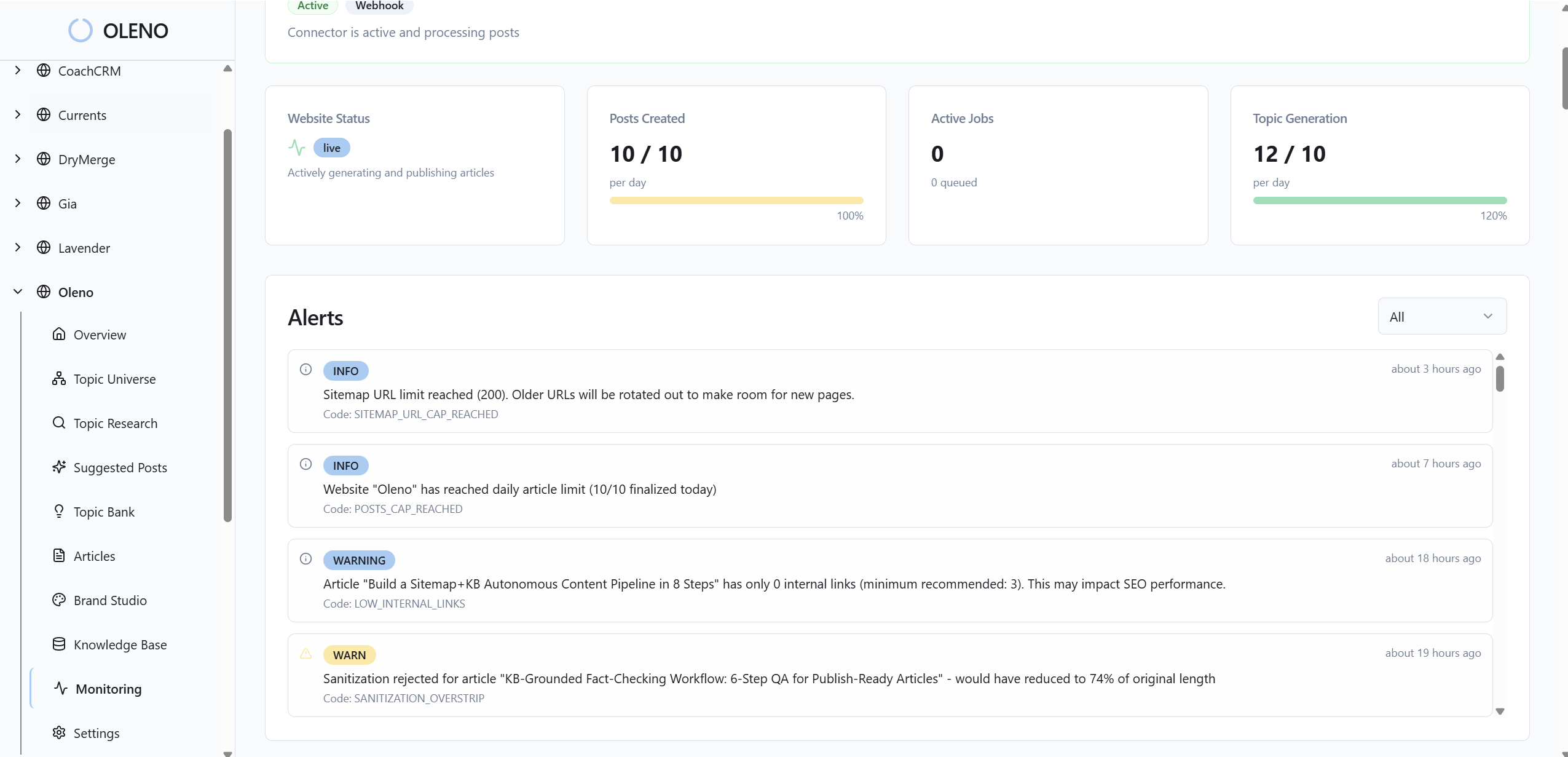
That consistency does two things. First, it creates more extractable units per article, which increases your chances of being cited. Second, it removes the need for editors to be the “format cops.” They can focus on narrative strength instead of fixing the same structural errors repeatedly.
We’ve seen this remove friction fast. Once the team trusts the opener pattern will be present and sized correctly, reviews speed up and conversations shift to substance.
How quality assurance validates structure before publish
Oleno runs an 80-plus check QA gate that evaluates structure, information gain, clarity, and snippet readiness. It flags missing openers, oversize paragraphs, weak examples, and other structural gaps, then refines drafts until standards are met. You don’t rely on memory. The system enforces the basics.
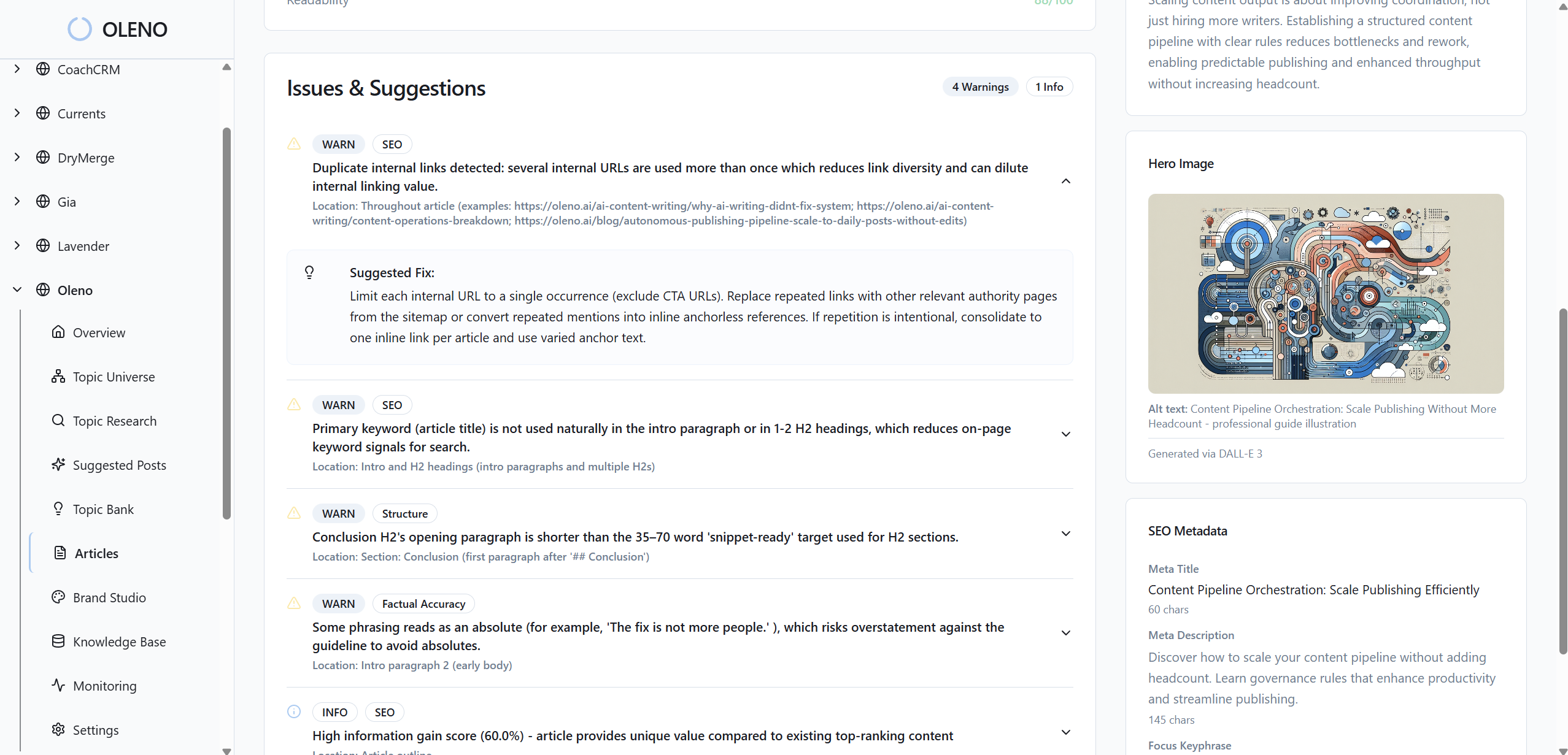
Quality isn’t just about passing checks; it’s about preventing rework. By resolving structural issues before content ever hits your CMS, you protect calendar integrity and keep launches on schedule. Editors review nuance and accuracy, the parts machines shouldn’t decide.
And when something fails, the pipeline retries with targeted adjustments. It’s deterministic where it matters, and flexible where taste is required.
How schema and internal links clarify meaning for machines
Oleno programmatically generates JSON-LD for Article, FAQ, and BreadcrumbList, then injects internal links from verified sitemaps with exact-match anchors. No fabricated URLs, no random linking, no manual cleanup. Machines get clear signals, and pages reinforce your topical authority safely.
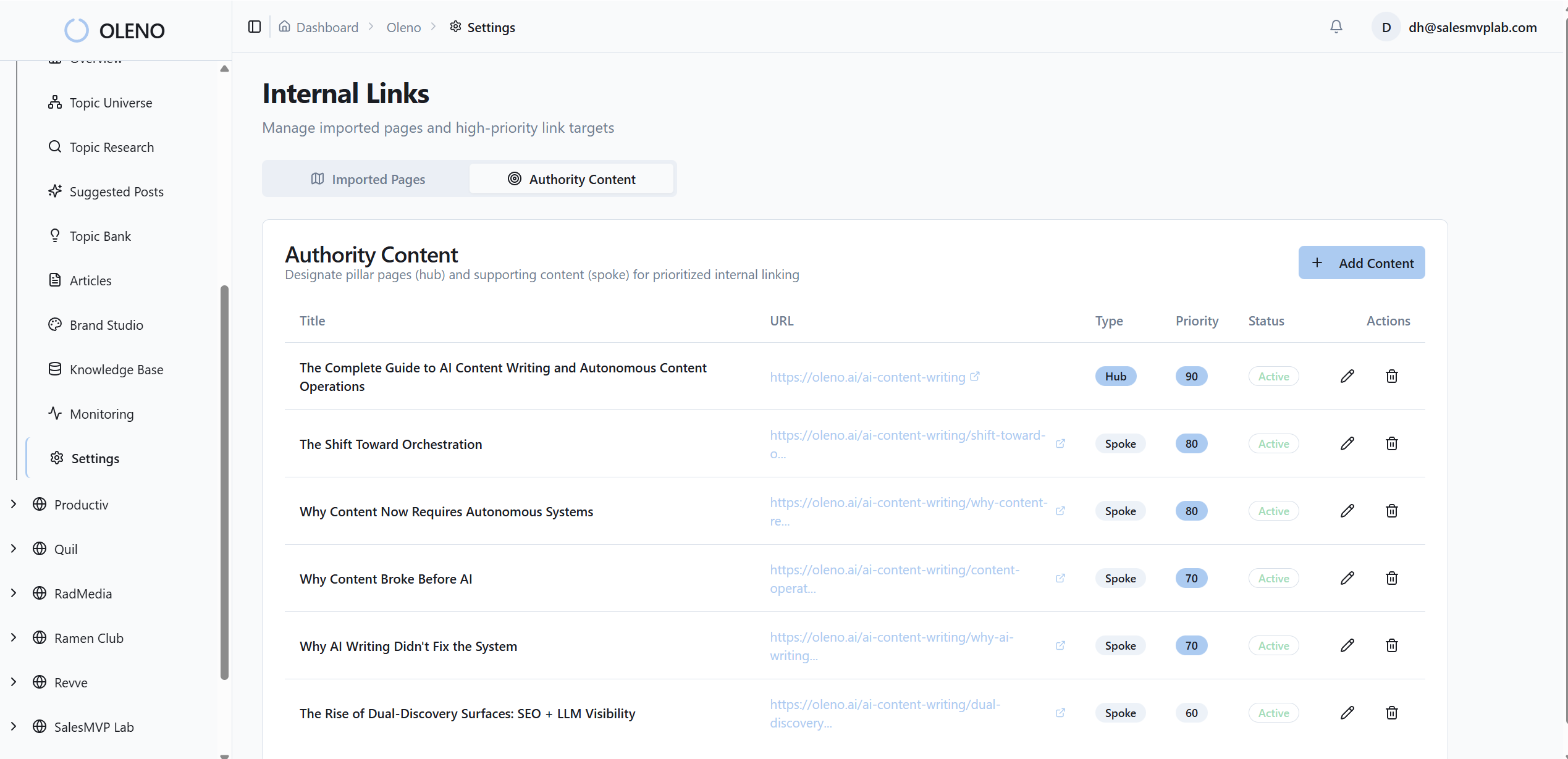
That determinism matters. Internal link placement follows rules, not vibes. Schema ships attached and valid, not forgotten until a post-launch checklist. The result is a page that reads well to humans and resolves cleanly for machines, exactly what snippet and AI surfaces prefer.
Visuals matter too. While we didn’t dedicate a separate subsection to it here, Oleno’s Visual Studio pairs relevant screenshots and brand-consistent images with the right sections and generates alt text automatically. It reinforces examples and makes sections feel complete.
If you’re ready to see the system do the boring parts for you, Try Oleno for Free.
Conclusion
You don’t earn citations by hoping your best paragraph gets noticed. You earn them by making every section quotable on purpose. Standardize the H2 opener. Size your units. Make sections independent. Then let a system enforce the rules so your team can argue about ideas, not commas. Do that for one quarter and notice how many times your words start showing up where decisions are made.
About Daniel Hebert
I'm the founder of Oleno, SalesMVP Lab, and yourLumira. Been working in B2B SaaS in both sales and marketing leadership for 13+ years. I specialize in building revenue engines from the ground up. Over the years, I've codified writing frameworks, which are now powering Oleno.
Frequently Asked Questions