Snippet-Ready Sections: 3-Step Template for AI & SEO Wins

Most teams write great long-form posts and still get ignored by AI assistants and featured snippets. It’s not the ideas. It’s the structure. Your answers are buried two paragraphs down, including ai readiness seo checklist, wrapped in hedging, and missing the tiny example machines need to lift you cleanly. So models cite someone else—the one who made it easier.
I’ve lived this. Shipped a 2,000-word guide, then had to rewrite every H2 opener at 3am because nothing was extractable. The content was good. The structure wasn’t. Here’s the fix: a simple three-sentence opener per section that raises your odds of being quoted by search engines and assistants. Every time.
Key Takeaways:
- Open every H2 with a 3-sentence, 40–60 word paragraph: answer, context, example
- Treat each section as standalone and citable—short, specific, named entities
- Use question-form H3s sparingly to map to interrogative queries
- Enforce snippet-readiness with QA, not heroics at the end
- Measure originality at the brief level, not after the draft is done
- Preserve structure with deterministic linking, schema, and clean publishing
Why Most Long-Form Posts Miss AI Citations and Snippets
Most long-form posts miss AI citations because they bury the answer and skip a micro example. Assistants and SERPs favor short, self-contained paragraphs that can be quoted without edits. A 3-sentence H2 opener—answer, context, example—gives machines a clean chunk to display with confidence.

The signals AI assistants and SERPs actually read
Extractors look for direct answers with clear boundaries. They prefer named entities over pronouns, simple sentence structures, and context that doesn’t meander. If the answer lives in sentence one and you follow with a line of context plus a tiny example, you make it easy to lift. That’s the point: reduce the model’s risk.
In practice, that means your H2 opener reads like it was built for a card view. Then the rest of the section can go deep. Most teams reverse the order—setup first, including the shift toward orchestration, answer later—which forces machines to guess. You don’t want extractors guessing. You want them copying.
If you need a deeper dive on formatting principles, this walkthrough of snippet mechanics pairs well with your editorial process: Mastering Featured Snippets Technical SEO Guide.
What is a snippet-ready section and why does it matter?
A snippet-ready section opens with the answer in one sentence, adds one or two lines of context, then shows a micro example. That opener should be 40–60 words. It stands alone, so search engines and assistants can cite it without trimming or rephrasing. Fewer edits. Fewer misquotes. More visible real estate.
The benefit compounds. When every section is extractable, you create more “surface area” for citations across a single article. Assistants can quote multiple parts of your piece, not just the intro. And when your vocabulary stays consistent—entities, product names, frameworks—you reduce ambiguity across the board.
Example: why one paragraph wins and another loses
Winning paragraphs hit three beats in three sentences. They name the thing cleanly, explain the why briefly, then show an example that fits on one line. Losing paragraphs hedge, bury the answer, and force readers (or machines) to hunt for the payoff.
If you can’t copy and paste your opener into a card and have it make sense, it’s not snippet-ready. I know that sounds strict. It’s also the difference between “ranked” and “quoted.”
Ready to validate the approach in your own stack without babysitting every draft? Spin up a test run and see where structure alone moves the needle: Try Generating 3 Free Test Articles Now.
The Real Bottleneck Is Section Microstructure, Not Word Count
The real blocker isn’t word count—it’s section microstructure. Machines lift chunks, including why ai writing didn't fix, not whole pages. If your H2 opener buries the answer or meanders, you’ll miss snippet windows even with perfect keywords. Build each section to be extractable: answer first, context second, micro example third.

Why conventional SEO advice misses section-level extraction
Traditional advice optimizes the page. Title tags, headers, internal links. All useful. But assistants don’t quote your title; they quote the paragraph that answered cleanly. If your sections read like meandering intros that finally land a point, you’re forcing a model to rewrite you. It won’t. It’ll cite someone else.
This is why teams with solid strategy still get out-cited by leaner competitors. The competitor wrote for extraction at the section level. Less polish, more precision. It’s a mindset shift: you’re not writing a chapter; you’re packaging a pull-quote with context and a proof line.
How machines choose quotable chunks
Assistants prefer short, semantically tight passages with explicit entities and minimal pronouns. They’re looking for boundaries. A 40–60 word opener creates a clear block. Keep clauses simple. Avoid nested conditionals that balloon the sentence. Then add a one-line example to demonstrate immediate usefulness.
There’s nuance here. You can still write with personality and depth. You just front-load clarity. For a technical framing of LLM-friendly structure, this primer is useful context: LLM SEO Optimization.
When should you use question headers?
Use question-form H3s when the search intent is clearly interrogative or when you need an explicit Q→A moment for voice search. Keep H2s as statements to maintain narrative flow. Then sprinkle two or three question-form H3s across the article to capture specific queries without fragmenting the story.
Don’t overdo it. Too many questions can make a piece feel like an FAQ instead of a guide. The balance to strike: narrative first, retrieval second.
The Hidden Costs That Pile Up When Sections Are Not Snippet-Ready
Non–snippet-ready sections create steady, invisible drag: extra editing hours, lost citation opportunities, and structural fixes at publishing. You might still rank, but you’ll lose the quote box. Over time, that’s fewer impressions, fewer assisted conversions, and more rework your team can’t afford.
Engineering and editorial hours lost to rework
Let’s pretend an 1,800-word post takes six hours to write and two hours to edit. If your sections aren’t extractable, add another hour for “make it snippet-friendly” rewrites. At four posts a week, that’s roughly 16 hours a month of frustrating rework. Over a quarter, you’ve burned a full work week—on preventable edits.
Here’s the part that stings: those hours don’t improve your ideas. Effective why content broke before ai strategies They clean up structure you could have handled upfront with a template. When bandwidth is tight—and it always is—this is where teams quietly fall behind.
The opportunity cost in SERPs and AI answers
When your opener hides the answer or runs long, you trade featured real estate for line breaks. You might hold a top-three spot, but assistants won’t quote you. That gap compounds. The brand that’s quoted earns attention and trust faster, even if you both rank on page one.
We saw this repeatedly while scaling content across small teams. The best piece didn’t win the quote. The best opener did. You don’t need to love that reality. You do need to design for it.
What happens when sections ramble past snippet length?
Long openers push the answer below the fold of the chunk. Machines trim aggressively and may drop your key claim. Keep the opener tight. Name entities. Add a micro example. You’re creating a self-contained unit that can be lifted without risk.
Want a sanity check against common pitfalls that break extractability? This quick list is a good bar to clear before you ship: AI Readiness SEO Checklist.
If you’re spending cycles fixing structure after the fact, there’s an easier way. Let a system enforce it for you so your team focuses on substance: Try Using an Autonomous Content Engine for Always-On Publishing.
The Moments That Make This Pain Obvious
You feel the problem at two moments: when you’re rewriting openers late at night and when a competitor gets the citation you deserved. Both are avoidable with a standard opener pattern and light QA. Once you see it, you can’t unsee it. And you won’t want to.
The 3am edit cycle you cannot repeat
I’ve done the 3am pass. Solid draft, wrong structure. None of the H2s started with answers; examples were buried; context ran long. We fixed it, but it wasn’t repeatable. That’s your trigger to standardize the template and make it non-negotiable. Not to work harder next time—just to change the rules of the game.
Our small teams at PostBeyond and LevelJump lived in this mode. Smart people, thin margins. The shift wasn’t more effort; it was a guardrail. Answer first. Context second. Example third. Then you can sleep.
When your best article gets cited without credit
You publish the definitive guide. Another brand gets quoted because they wrote a cleaner opener. It’s demoralizing. It’s also data. Assistants prefer low-risk copy-paste candidates. Become one. Front-load the claim and show a tiny example that proves it.
When optimizing why content now requires autonomous, the good news? This is fixable in today’s editorial cycle. You don’t need new headcount to win quotes. You need a repeatable microstructure.
Who benefits most from snippet-ready sections?
Teams shipping weekly or more. Product marketers who need to connect education to product without forcing a pitch. And lean teams who can’t afford endless editing. If you rely on organic to feed pipeline, this template reduces volatility. It protects quality as you scale across contributors.
It also makes coaching easier. You’re not arguing taste—you’re enforcing a three-sentence rule any writer can follow.
A 3-Step Template You Can Ship Today (3 steps)
A snippet-ready H2 opener uses three sentences: a direct answer, a short context line, and a micro example. Keep the total to 40–60 words. Use named entities and simple clauses. This creates a citable block assistants can lift without rewriting or trimming the point you care about.
Step 1: Write the direct answer in one line
Start with the answer in a single, declarative sentence. No hedging. Use the primary entity by name—don’t make machines resolve pronouns. Aim for under 20 words. Example: Snippet-ready sections open with a direct answer, then add short context and a micro example.
Why so strict? Because extractors reward clarity and boundaries. If the answer lives in sentence one, you’ve already done most of the work.
Step 2: Add one to two lines of context with entities
Follow with one or two lines that explain why the answer matters. Anchor with explicit entities, standards, or systems so models map the claim semantically. Keep the full opener under 60 words. Example: This pattern improves featured snippet eligibility and AI quote confidence because extractors prefer short, self-contained chunks.
If you’re teaching a framework, mention it by name here. That’s how you get cited with the right label, not “a blog said.”
Step 3: Show a practical example with micro-format
Close with a one-sentence illustration. Think “Example:” followed by a compact case or a two-item inline list. No indentation. No bullets needed. Example: Answer first, then context, then “Example: H2 opener uses answer, context, example.”
Interjection. If it feels too simple, it’s working. Complexity belongs in the body, not the opener.
For more structure tips that mirror this template, this reference is a handy complement: AIO Snippet Structure and Mastering Featured Snippets Technical SEO Guide.
How Oleno Enforces Snippet-Ready Sections at Scale
Oleno enforces snippet-ready sections by design. Every H2 opens with a three-sentence, including ai content writing, 40–60 word paragraph that passes QA checks for answer-first structure. Then visuals, schema, and publishing happen in a governed pipeline so structure survives the CMS. You get consistency without handholding.
Snippet-ready H2 openers, by default
Oleno writes H2 openers as answer, context, example—then validates length and clarity during automated QA. Writers don’t need coaching on every draft; the system enforces the rule. The result is fewer rewrites, cleaner extraction boundaries, and more sections eligible for citations across your site.
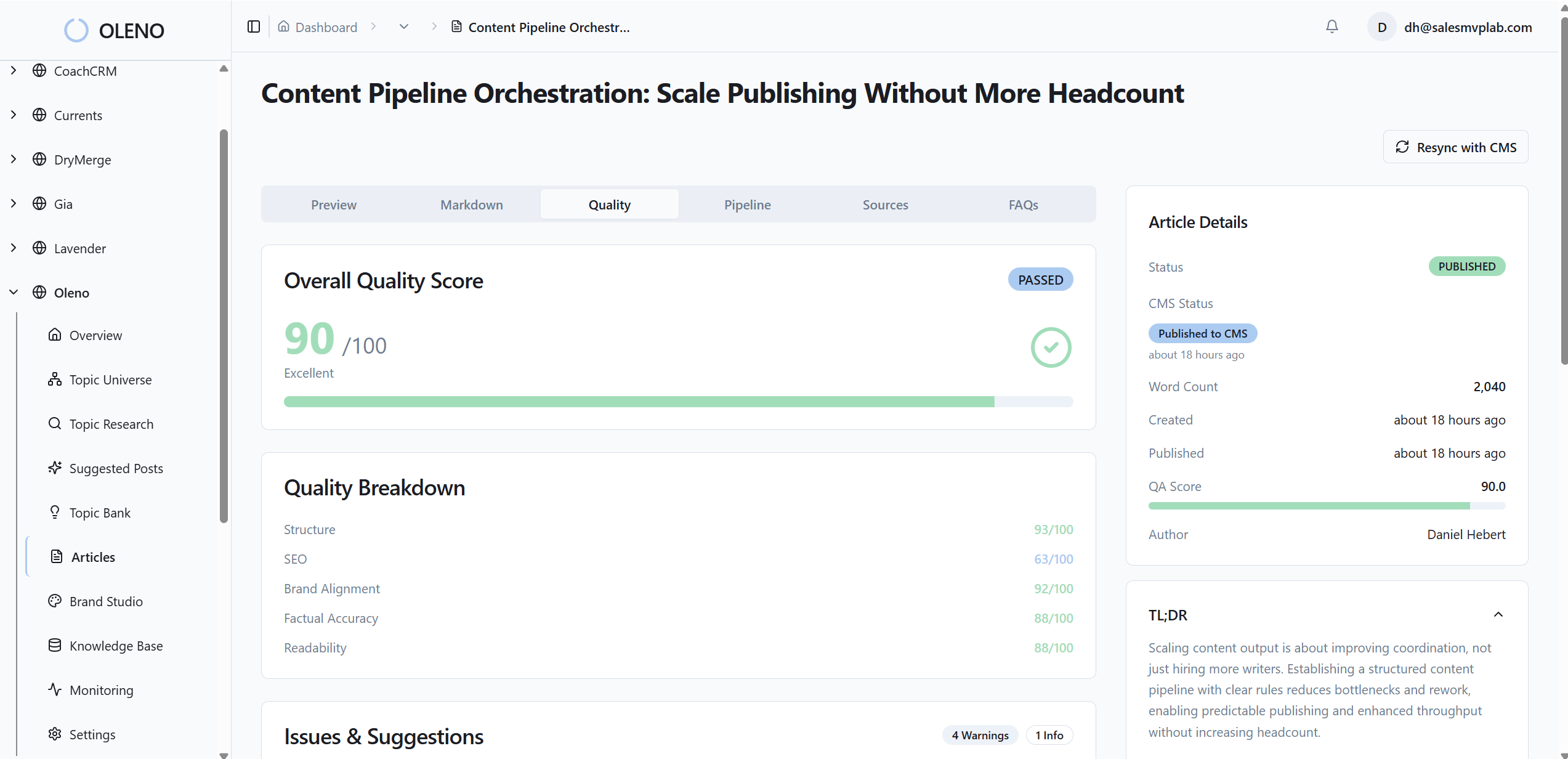
Because sections stand alone, assistants can quote multiple parts of a single article. That increases your “citation surface area” without changing your publishing cadence. Oleno keeps the sentences tight and the entities explicit.
Brief generation with information gain scoring
Before a word is written, Oleno builds a brief with competitive research and an Information Gain Score. Low-differentiation outlines get flagged early, which forces unique angles per H2 instead of copycat filler. You avoid writing sections that repeat what’s already out there and fail to win snippets on originality.
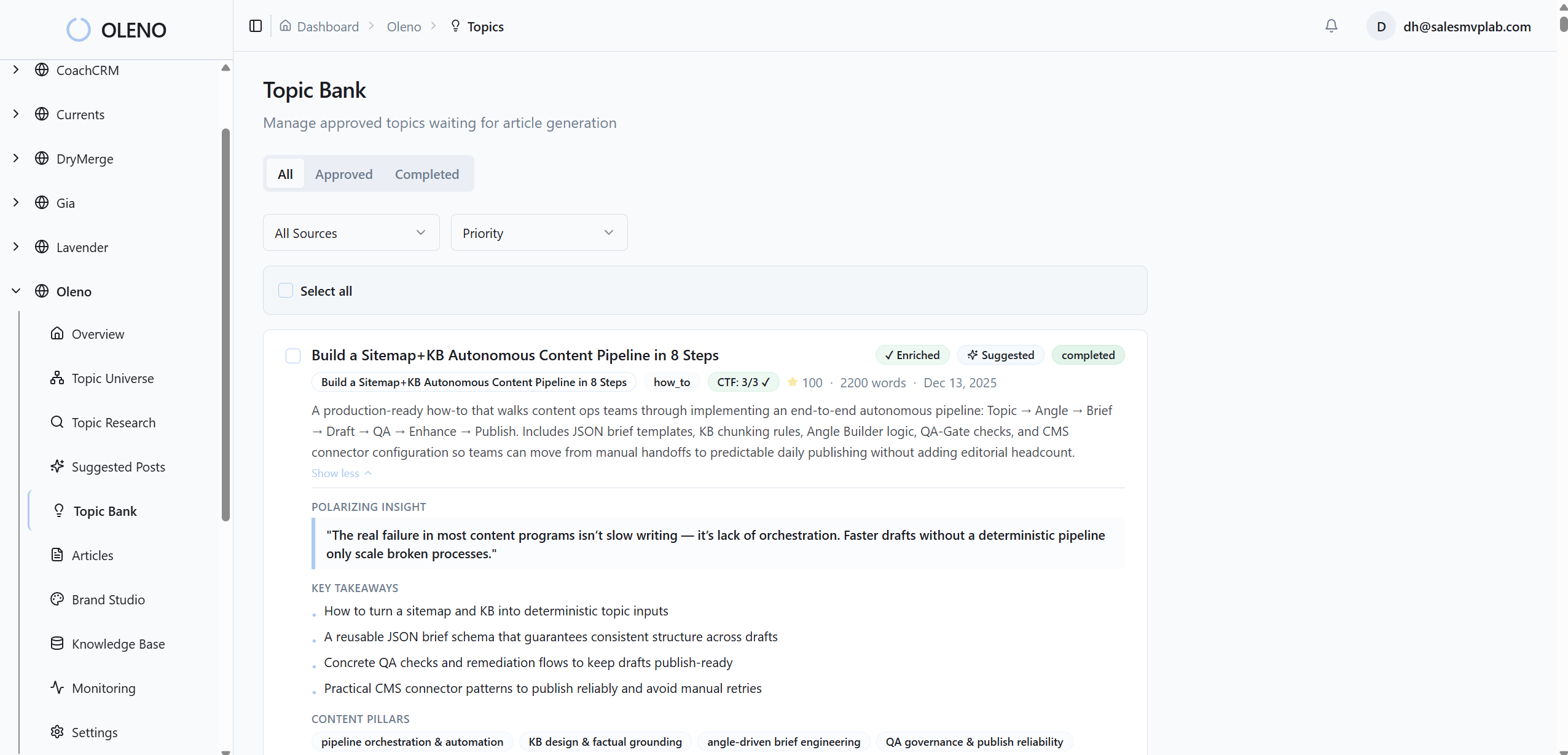
This upfront enforcement is the difference between “we hope this is new” and “we know this adds something.” Oleno bakes that into every brief so your team doesn’t.
QA, schema, and deterministic delivery that preserve structure
Oleno’s QA checks snippet readiness, tone alignment, and section structure. Then it generates JSON-LD for Article and FAQ where relevant, and injects internal links deterministically from verified URLs after drafting. Publishing connectors map fields reliably to WordPress, Webflow, or HubSpot without breaking headings or paragraphs.
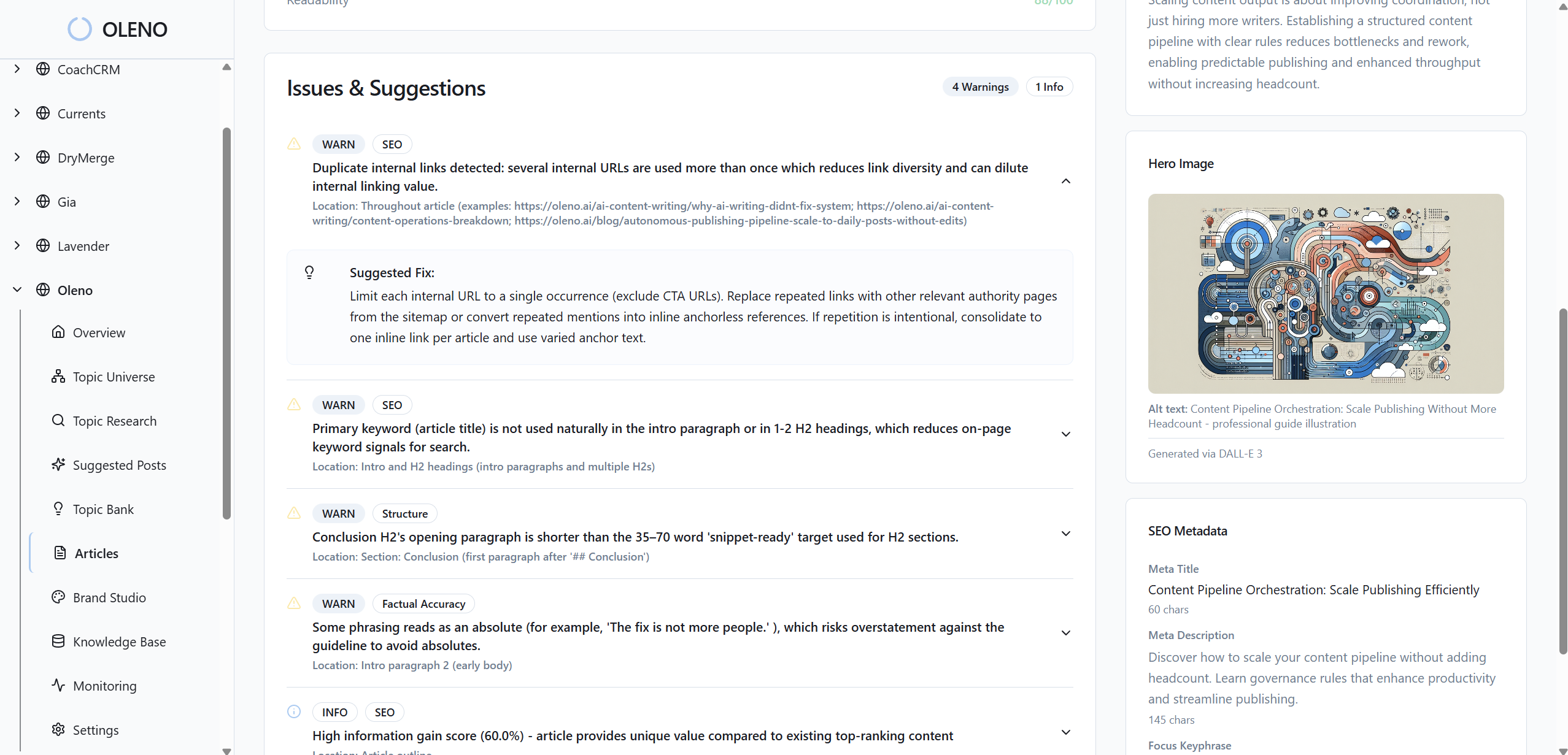
That end-to-end determinism matters. The paragraph you approved survives the pipeline intact, which preserves snippet-ready structure in production. For a broader checklist that mirrors this discipline, this overview captures the essentials: Beyond SEO: Your GEO Checklist.
Here’s how this ties back to the costs we covered: the late-stage edits go away, the quote box shows up more often, and your team spends time on narrative instead of structure. If you want the system to run without you hovering, Oleno’s built for that.
Curious how this looks with your topics and brand voice? Get a feel for the pipeline on your own content: Try Oleno For Free.
Conclusion
Here’s the simple truth. You don’t need more words—you need extractable sections. Answer first. Context second. Micro example third. When that’s enforced by a system, not willpower, you stop paying the editing tax and start earning citations you can actually see.
Do this once, you’ll feel the difference. Do it every time, you’ll compound it.
About Daniel Hebert
I'm the founder of Oleno, SalesMVP Lab, and yourLumira. Been working in B2B SaaS in both sales and marketing leadership for 13+ years. I specialize in building revenue engines from the ground up. Over the years, I've codified writing frameworks, which are now powering Oleno.
Frequently Asked Questions