Stop Scheduling Thought Leadership, Automate Your Narrative Workflow

Most exec thought leadership fails because the executive thought leadership workflow is built around calendar slots, not signal. You ship because “it’s Tuesday,” not because you actually have something to say that’s grounded in proof, timely, and aligned with what buyers are searching for.
And that calendar-first approach quietly creates a tax. Rushed drafts. Frustrating rework. The CEO bails last minute because it doesn’t feel true, or it feels risky, or it just feels like filler. Then the team loses confidence in the channel, and you end up with a content program that looks active but doesn’t compound.
A calendar is guesswork. Authority compounds when stories line up with topical opportunity and product truth. That’s the whole bet behind building Oleno: encode what’s true and what you believe once, then run an always-on system that publishes when the narrative and evidence actually align.
Key Takeaways:
- Calendar-first thought leadership wastes exec time because you’re filling dates instead of publishing when proof and market signal show up.
- A real executive thought leadership workflow starts with governance (Brand Studio and Product Studio) so voice and claims don’t drift when you scale volume.
- Real demand and relevance signals should be your publish trigger so you stop writing “interesting” posts that have no demand behind them.
- Turn founder POV and customer anecdotes into reusable assets with Stories Studio, so you aren’t reinventing “what should we say” every week.
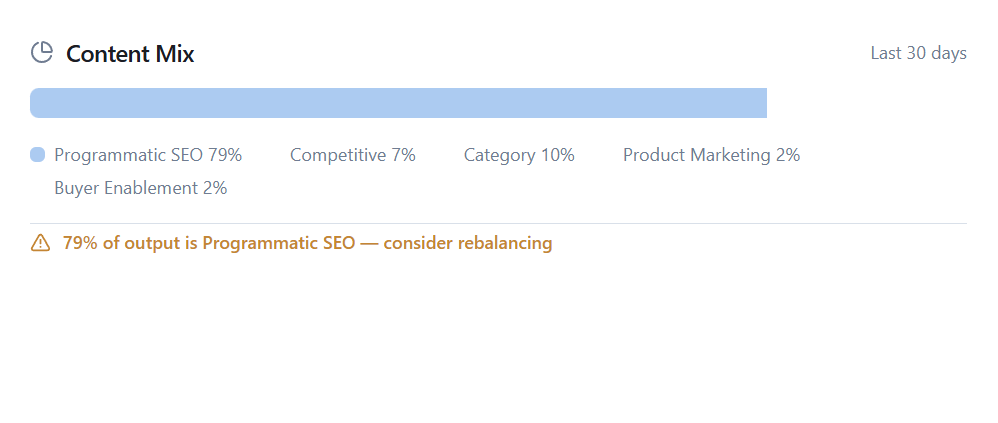
- Teams that systematize production often move from 4 to 8 pieces a month to 20 to 40 plus, and the same idea applies to executive content when you stop relying on heroic effort.
Why Calendar-Driven Thought Leadership Creates More Rework Than Results
Calendar slots force content that hasn’t earned publication. That’s the core problem. You’re committing to a date before you’ve earned the right to hit publish, which usually means you’re writing backward from a deadline instead of forward from proof.
If you’ve ever been in that Friday afternoon scramble, you know what it looks like. Someone asks the exec for “a quick take,” marketing tries to turn it into something coherent, legal gets nervous, and by Monday it’s either watered down or quietly dropped. Either way, you burned time and political capital.
Calendar Slots Force Content That Hasn’t Earned Publication
A scheduled post is a promise. But you’re often promising output without knowing if you’ll have the inputs. Inputs are the whole game: a real customer outcome, a product change you can stand behind, a sharp POV you can defend, or a market moment your buyers actually care about.
When those inputs aren’t there, you end up manufacturing importance. That’s where the “hot take” addiction comes from. It’s not strategy. It’s deadline pressure.
And it creates a weird dynamic with executives. They start to associate thought leadership with being asked for last-minute favors, reviewing drafts that don’t sound like them, and taking risk on claims they don’t fully trust. Not a fun loop.
Thought Leadership Works When Timing Follows Signal, Not Dates
The better pattern is boring, and that’s why it works. You run an always-on workflow that’s watching for signal, and when the signal and the proof line up, you publish.
Signal can be a few things:
- buyers searching for a topic you actually have credibility on
- a customer story that matches a real pain in your market
- a product milestone that changes how the buyer should think
- a consistent POV you’ve already earned the right to repeat
The repeat part matters. Most teams are scared of repeating themselves. But repetition is how positioning compounds. It’s also how exec content gets remembered.
In The GEO Era, Consistency Beats Sporadic Hot Takes
LLMs don’t reward random spikes of content. They reward consistency, clarity, and a POV that shows up across lots of pages, lots of answers, lots of angles. That’s a big part of what GEO is forcing: you can’t be vague, you can’t be inconsistent, and you can’t have your narrative drift every time a different person writes the post.
I saw a version of this years ago with SEO. At Steamfeed we hit 120k uniques a month, and most pages were under 100 views. That’s not a contradiction. It’s the point. Breadth plus depth plus consistency creates step-function growth at scale. We saw it at 500 pages, then 1,000, then 2,500, then 5,000, then 10,000.
Exec thought leadership can work the same way. But only if it’s a system. Not a calendar.
How To Build An Always-On Executive Thought Leadership Workflow
You build an executive thought leadership workflow by encoding your non-negotiables once, mapping topic coverage in Category Studio so you know what deserves an exec take, pulling real narrative assets from Stories Studio, then publishing only after a Quality Gate checks voice, evidence, and claims. After that, you spin variants for different personas and channels without touching the core story. The Orchestrator keeps the whole thing moving based on capacity, not dates.
This isn’t about posting more. It’s about posting when you’ve earned it, and doing it in a way that doesn’t create a weekly headache.
Encode Your Narrative Once So Execution Can’t Drift
Start with the stuff that shouldn’t change week to week. Voice. POV. product truth. audience context. The whole point is to stop having every exec post feel like a fresh debate about what you’re allowed to say and how you’re allowed to say it.
In Oleno, this lives in the governance layer:
- Brand Studio sets voice rules (tone, rhythm, preferred and prohibited terms, CTA construction, structure rules, exemplars).
- Marketing Studio captures what you want the market to believe (your category framing, your point of view, your narrative frameworks).
- Product Studio is the guardrail for accuracy (approved product descriptions, approved claims, boundaries, supported and unsupported use cases).
If you skip this, you’ll pay for it later. With rewrites. With exec trust. With legal stress.
The good news is once it’s set, it applies everywhere, automatically, because the system injects those constraints into each step of the pipeline and Quality Gate scores output against them.
Map Your Topic Coverage To Surface What Deserves An Executive Take
Exec posts shouldn’t start as “what should we post next Tuesday.” They should start as “what topics are showing real demand, and where do we have real proof.”
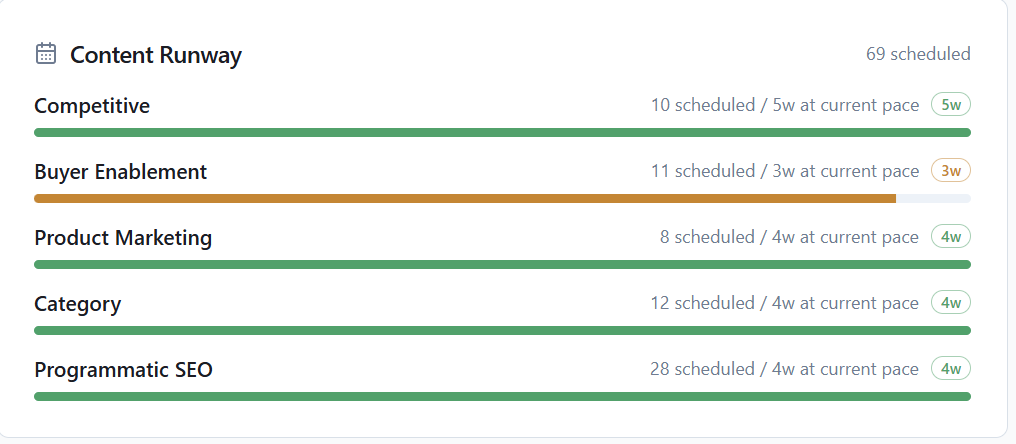
Category Studio is how you avoid the random idea treadmill. You organize what should exist, define coverage, and prioritize the areas where you have credibility. Then the Orchestrator can schedule work against your priorities, fit, and quotas, without someone babysitting a spreadsheet.
When you’re mapping topic coverage specifically for exec narratives, you’re looking for topics that meet three filters:
- there’s search or buyer interest (signal)
- you have a defensible point of view (narrative)
- you have something real to point to (proof)
And yes, sometimes you’ll find a topic that’s a great thought leadership angle but has no buyer intent. That’s still valid. Just don’t pretend it’s demand gen. That mistake is expensive, I’ve made it. At Proposify we ranked for a lot of stuff, but plenty of it was disconnected from the product narrative, so it didn’t compound into pipeline.
Materialize Stories Only When Signal And Evidence Align
This is where most programs break. They try to “get exec content” by asking executives to be writers. That’s backwards. Execs should be inputs and reviewers, not the production line.
Stories Studio is the move here. You capture founder stories, customer anecdotes, sales insights, and industry examples once, then you use those narrative assets to enrich drafts so they feel lived-in, not generic, especially when evaluating executive thought leadership workflow.
So instead of chasing the CEO for “a take,” you’re pulling from a library of already-approved stories:
- a moment where a customer struggled, and what changed
- a product decision and the tradeoff behind it
- a contrarian belief you’ve repeated internally for years
- a real example from the field that gives the post teeth
Then the workflow only spins up a draft when it can attach those story assets to a prioritized topic in Category Studio. No filler. No slot-filling.
If you’ve tried the other way, you know the pain. At LevelJump we recorded videos with the CEO and transcribed them. It was faster. But we didn’t have strong topic discovery or consistent SEO structure, so we were shipping founder insight into a void half the time.
Route Drafts Through Non-Negotiable Quality Gates Before Exec Review
Executives don’t want to review half-baked drafts. They want to review options. Tight ones.
That’s what the Quality Gate is for. It evaluates every article against brand standards, structural requirements, and quality thresholds before it reaches any review queue. If it fails, it gets enhanced and re-evaluated. Less manual triage.
This is also where Product Studio earns its keep. When your thought leadership touches product, it’s easy for a writer to accidentally overclaim. Or to frame a use case that sales would never stand behind. Product Studio is the single source of product truth, and the QA layer cross-checks outputs against it and flags violations.
You still keep human judgment. You’re just not wasting exec time on basic clean-up.
And if you’re thinking “won’t that slow us down,” I’d argue the opposite. Slow is when you ship drafts around Slack for three days and nobody knows what’s approved.
Spin Persona And Channel Variants Without Touching The Core
Once you have a solid core exec asset, you shouldn’t be rewriting it five times for five audiences. That’s where drift sneaks in. It’s also where marketing teams burn out.
This is where Audience & Persona Targeting plus Distribution & Social Planning come in.
You keep the core narrative stable, then generate variants that match:
- a CMO / VP Marketing lens (ROI, narrative consistency, executive visibility)
- a different industry context if you sell into multiple verticals
- channel constraints (LinkedIn post, newsletter blurb, blog version)
Distribution & Social Planning handles the social side: generating platform-specific posts from articles, creating schedules, and giving you a workbench for editing and approval. Use CMS Publishing to push long-form pieces live to your site, and hand off social variants to your existing social tools for posting.
Quick interruption: this is where most teams accidentally create a second calendar. Don’t.
The point isn’t to reintroduce schedule pressure. It’s to reuse what’s already proven.
Publish Directly And Pace Output With Capacity, Not Dates
Once you stop scheduling by date, you need a replacement for “how do we keep momentum.”
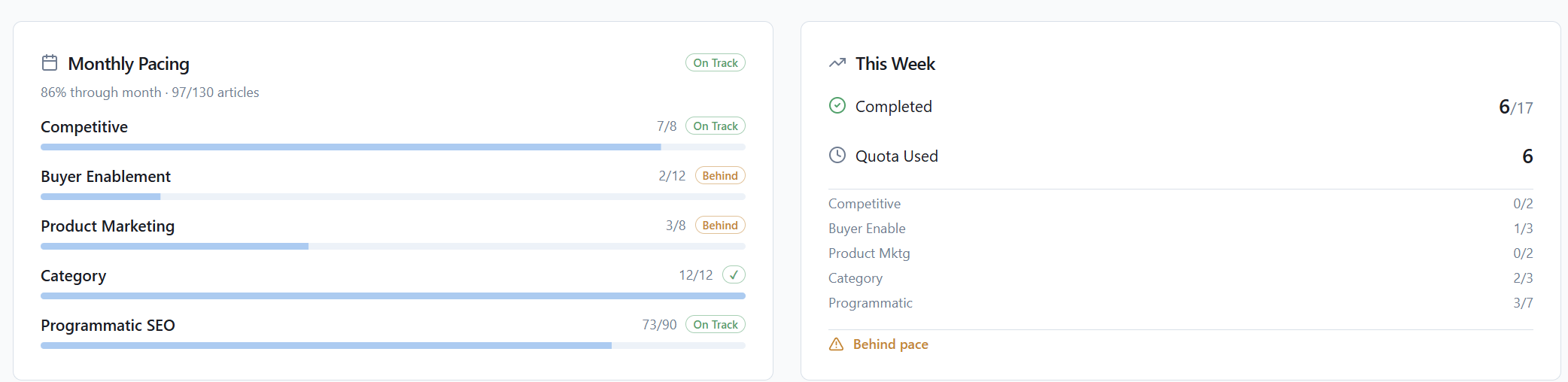
The replacement is capacity targets. Weekly and monthly targets. SLAs you can actually sustain.
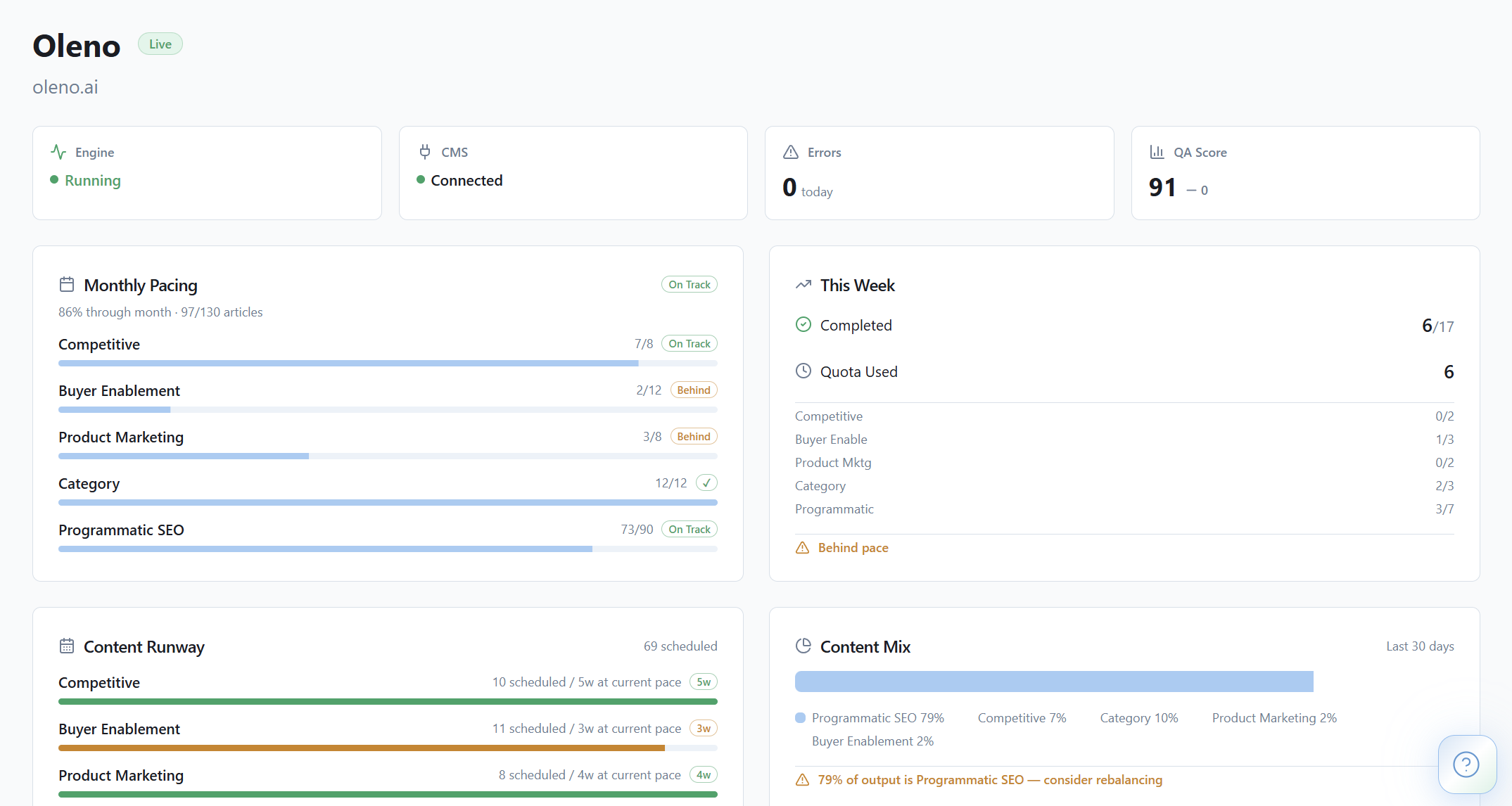
This is what the Orchestrator is built for. It runs the pipeline: scheduling work, enforcing quotas, and respecting cadence settings. Human review stays in the loop at the points you choose.
And this is where you can get really practical. Let’s pretend your exec can only approve 2 pieces a month without it becoming a headache. Fine. Set the system to produce 4 candidates a month, run them through Quality Gate, and only route the best 2 for exec approval.
That’s a real executive thought leadership workflow. Capacity-driven. Proof-driven. No date pressure.
If you want to see how this looks for your team, you can Request a Demo To Map Your Executive Workflow.
How To Keep The Workflow Reliable When Real Life Happens
A workflow is only useful if it survives chaos. And exec thought leadership has chaos baked in. Product launches shift. Market news hits. Legal gets involved. The CEO goes dark for two weeks.
So you want a few rules that keep the system honest, without turning it into a brittle process.
Tie Every Executive Post To A Live Proof Point
Don’t publish exec takes that can’t point to something current and defensible. Proof can be a customer anecdote you’ve captured, a benchmark, a product milestone, or even a repeated field insight from sales, especially when evaluating executive thought leadership workflow.
A simple filter I like is: if you can’t answer “what are we pointing to” in one sentence, it’s probably not ready.
This also reduces risk. Exec content gets dangerous when it floats above reality.
Protect Voice With Governance, Not More Reviewers
Most teams respond to inconsistency by adding reviewers. That usually makes the process slower and more political, not better.
Governance rules (voice attributes, prohibited terms, claims boundaries, audience context) are the scalable way to keep a consistent executive presence. Brand Studio encodes the voice. Marketing Studio encodes the POV. Product Studio encodes what’s true. Then Quality Gate checks if the draft stayed inside the lines.
Reviewers should be for judgment. Not basic compliance.
Replace Time-Boxed Calendars With Capacity Targets And SLAs
Your calendar shouldn’t be a content deadline. It should be a planning tool.
Capacity targets are cleaner:
- 2 exec approvals per month
- 80% first-pass acceptance rate
- 0 posts published without a named proof point
- a max review window (like 48 hours) so nothing drags on forever
You’ll still publish consistently. You just won’t publish nonsense.
Set Manual Overrides For Urgent Memos And Sensitive Topics
Not everything should be automated, and not everything should go through the same lane.
Oleno isn’t going to bypass legal or PR for sensitive topics. It also won’t invent net-new claims, since Product Studio and the QA layer exist to prevent that kind of risk. If you have an urgent memo, crisis comms, or something politically sensitive, you should use a manual override and a human approval lane. Team & RBAC helps here by defining who can draft, who can approve, and which path a piece must follow.
That’s not a weakness. That’s adult behavior.
Measure Narrative Consistency, Not Vanity Cadence
Posting twice a week means nothing if every post sounds like a different company.
What you actually want to watch is:
- are we repeating the same core beliefs in different ways
- do our differentiators show up consistently
- do we have coverage across the problems we want to own
- are we building a library that an LLM can confidently synthesize
Executives care about being understood. Not hitting a posting streak.
What Success Looks Like After Ninety Days for Executive thought leadership workflow
Success is when your executive thought leadership workflow stops feeling like a recurring fire drill and starts feeling like a system that compounds. You publish when you have something earned to say, you reuse stories without repeating yourself, and you don’t lose three days a month to rewrites and approval chaos.
You should see a few practical shifts:
- fewer dropped posts, because you’re not committing to dates before inputs exist
- higher first-pass acceptance, because Quality Gate and governance reduce “make it sound like me” rewrites
- more consistent monthly throughput, because output is paced by capacity targets, not optimism
And if you want a rough expectation anchor, the same kind of systematization is how teams go from 4 to 8 pieces a month to 20 to 40 plus in SEO content production. Exec content is a different beast, obviously, but the mechanism is similar: a repeatable pipeline beats heroic effort.
Replace Date-Driven Churn With Compounding, Coherent Signals
When the workflow is signal-triggered, you stop publishing one-off opinions that evaporate. You build a consistent POV that shows up across channels and topics, which is the whole point in a GEO world where synthesis and recall matter.
Increase Output Reliability Without Adding Headcount
The biggest hidden win isn’t volume. It’s reliability. You don’t need “more ideas.” You need fewer resets, fewer context gaps, and fewer rounds of subjective editing.
I’ve lived the alternative. At PostBeyond I could write 3 to 4 solid posts a week when I had the context and the time. When the team grew, output slowed because context didn’t transfer, and I had less time because I was managing people and stuck in meetings. That’s the trap. Headcount doesn’t automatically fix throughput if the system is missing.
Free Executives To Approve Finished Options, Not Babysit Drafts
Exec time is the expensive input. Use it for direction and final approval.
If your exec is editing intros, you’re wasting the channel. And you’re training them to hate the channel.
What To Do Next If You Want This Running
If you want to stop guessing and start running this like a system, start with a governance audit and a Category Studio mapping. That’s the foundation. Without it, you’re back to calendars and last-minute scrambles.
You can Request a 30-minute Governance Audit For Exec Content and we’ll walk through voice rules, product truth boundaries, approval lanes, and how you’d set capacity targets without turning this into another scheduling headache.
Then, when you’re ready to see the whole thing end-to-end, Book a Demo To Map Your Category Coverage. That session is where you’ll see which narratives are actually “exec-ready” because they have signal, proof, and a clean path to distribution.
About Daniel Hebert
I'm the founder of Oleno, SalesMVP Lab, and yourLumira. Been working in B2B SaaS in both sales and marketing leadership for 13+ years. I specialize in building revenue engines from the ground up. Over the years, I've codified writing frameworks, which are now powering Oleno.
Frequently Asked Questions