Why CMOs Should Sell Brand Studio as an Execution Engine

You probably felt this this week. Another draft came in, it was decent, maybe even pretty good, but it still needed PMM fixes, tone fixes, claim fixes, CTA fixes, and one more round because it just didn’t sound like your company. That stop selling creativity sell problem is really an execution problem wearing a creative costume.
For a scaling SaaS team, that's expensive. Not just in hours, but in drift. Once content, PMM, SEO, and demand gen all start touching the same asset without one operating system behind them, review debt piles up fast. And if you're trying to win in SEO and LLM visibility at the same time, inconsistency starts to cost more than a weak draft ever did.
Oleno is built around that reality. Brand Studio matters because it doesn't treat brand as a mood board or a writing tip sheet. It turns your voice, language rules, and structural preferences into something the system can actually apply every time content gets generated, checked, and published.
Key Takeaways:
- Creativity usually isn't the thing slowing mid-market SaaS marketing teams down. Rework, handoffs, and inconsistent review standards are.
- Once 4 or more contributors touch the same content stream, coordination cost often exceeds creation cost unless brand rules are encoded somewhere shared.
- Brand Studio defines tone, preferred terms, banned language, CTA style, structure rules, and voice exemplars so content can be verified against real standards.
- Oleno can support teams moving from 4 to 8 articles per month toward 20 to 40 plus, but only when strategy, product truth, and audience context are already defined.
- If you want to see what governed execution actually looks like in practice, you can request a demo.
Why Creativity Breaks Down As Teams Scale
Creativity Is Not The Bottleneck In Scaling SaaS Marketing
The bottleneck usually isn't ideas. It's getting strategy to survive contact with the workflow. A lot of SaaS teams already have smart people, solid messaging instincts, and a decent sense of what they want to say. Then the work moves through content, PMM, SEO, leadership, and demand gen, and the final piece somehow sounds like five people negotiating in a Google Doc.
That's the reframe. The pain is not creative scarcity. The pain is execution drift.
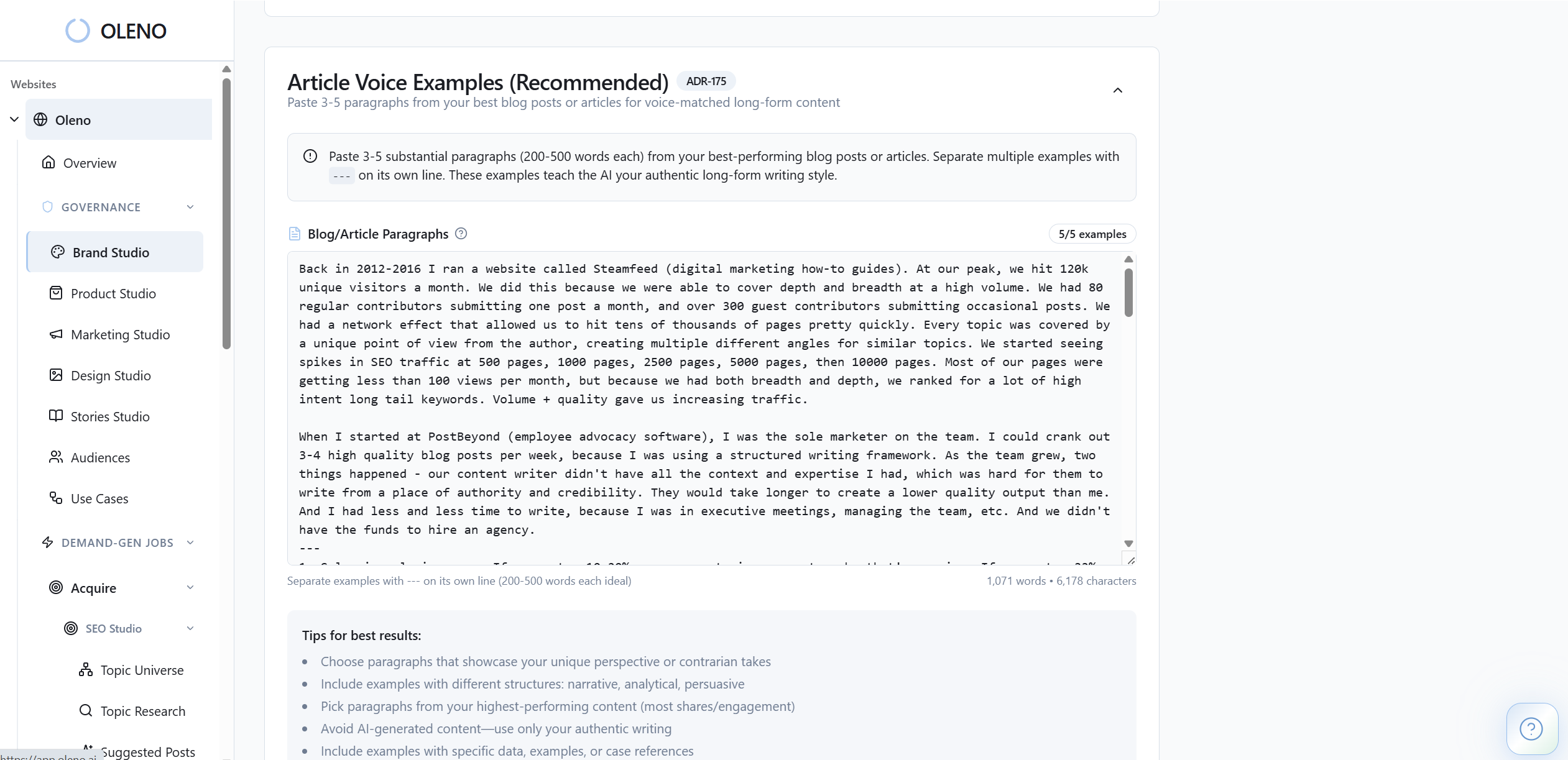
Back in 2012-2016 I ran a digital marketing site that hit 120k unique visitors a month. We had 80 regular contributors and 300 plus guest contributors. Volume worked because we had both breadth and strong points of view, but that setup only compounds when the system can hold quality together. Without that, more contributors just means more variation, more inconsistency, and more pages that technically exist but don't really strengthen your market position.
A CMO at a 200-person SaaS company sees this in a very specific way. Monday morning, the content lead is waiting on PMM comments, PMM is fixing product language, SEO is rewriting headers, and demand gen is asking for a stronger CTA because the piece doesn't connect to pipeline. By Wednesday the article is still not out. Everyone was productive. Nothing shipped. That's not a creativity issue. That's an operating issue.
More Contributors Usually Mean More Drift, Rework, And Review Debt
More people rarely fixes this by itself. In my experience, it often makes it worse first. When I started at PostBeyond, I could write 3 to 4 high quality blog posts a week because I had the context in my head and I was using a structured framework. As the team grew, the writer had less context than I did, I had less time than before, and quality went down while cycle time went up. Sound familiar?
There's a simple threshold I like here: once content regularly requires 3 or more stakeholder passes, you're not managing quality anymore, you're funding review debt. Let's pretend one article takes 45 minutes of combined rewrite time across content, PMM, and leadership. At 8 articles a month, that's 6 hours. At 24 articles, that's 18 hours. And that's just rewriting tone and messaging. It doesn't include delayed publishing or opportunity cost.
Fair point, some review is healthy. Of course it is. If you're making product claims or going after evaluators, you want rigor. But rigor is not the same thing as re-deciding your brand every single draft. If every asset triggers a fresh debate about wording, angle, or positioning, your standards aren't operational. They're tribal knowledge.
That is where most teams get stuck. They hire for output when what they really need is enforcement.
Why Governed Execution Wins In The GEO Era
Strategy Only Compounds When Execution Is Governed
Strategy only compounds when the rules behind it show up everywhere. A strong market point of view hidden in the CMO's head doesn't scale. Same with brand voice. Same with category framing. Same with product truth. If the team has to rediscover those things each time a draft appears, the work resets over and over.
That's why I disagree a bit with the usual "we just need better writers" diagnosis. Better writers help. Strong PMMs help. A sharp editor helps. But if the system they work inside keeps dropping context on the floor, you'll still get drift. The old model is human memory plus repeated correction. The better model is defined standards plus repeatable enforcement.
The GEO shift makes this more obvious. Search used to reward tactical execution a lot more. Now you're trying to be surfaced by humans, search engines, and LLMs at the same time. And LLMs tend to reward brands whose positioning, product definitions, audience language, and point of view keep showing up consistently across many assets. You don't need a few good pieces. You need a catalog that agrees with itself.
If you want to see that system-level difference in context, a useful next step is to request a demo.
The Teams That Win In GEO Make Consistency Visible At Scale
Consistency is not boring. It's actually how authority becomes visible.
A lot of AI writing and SEO tools are still anchored in channels and tactics. They can help draft, rewrite, or optimize a page. Fine. But they don't really solve for your market POV, your enemy framing, your product boundaries, your audience-specific language, or your CTA rules across the whole system. So humans still carry the burden. They write the prompts, catch the inaccuracies, fix the tone, and decide what should exist next. Speed goes up. Reliability doesn't.
I remember hearing April Dunford on a panel years ago after someone spent way too long rattling off tactic after tactic. Her point was blunt. Tactics without strategy are shit. She was right then, and it's even more true now. What most AI content tools have done is make tactical output easier while leaving the underlying marketing plan untouched.
There's a practical benchmark here. If your team can't explain the same product, same problem, and same point of view in roughly the same language across SEO articles, PMM pages, and demand gen assets, you're not really running a narrative system. You're producing isolated documents. And isolated documents don't compound.
So the real shift is this: stop selling creativity as the differentiator. Sell execution quality. Sell the fact that your team can encode how it writes and then verify that standard at scale.
How Brand Rules Become A Real Operating Layer
Brand Studio Turns Subjective Guidance Into Operational Rules
Brand Studio exists because "make it sound like us" is not a system. It's feedback.
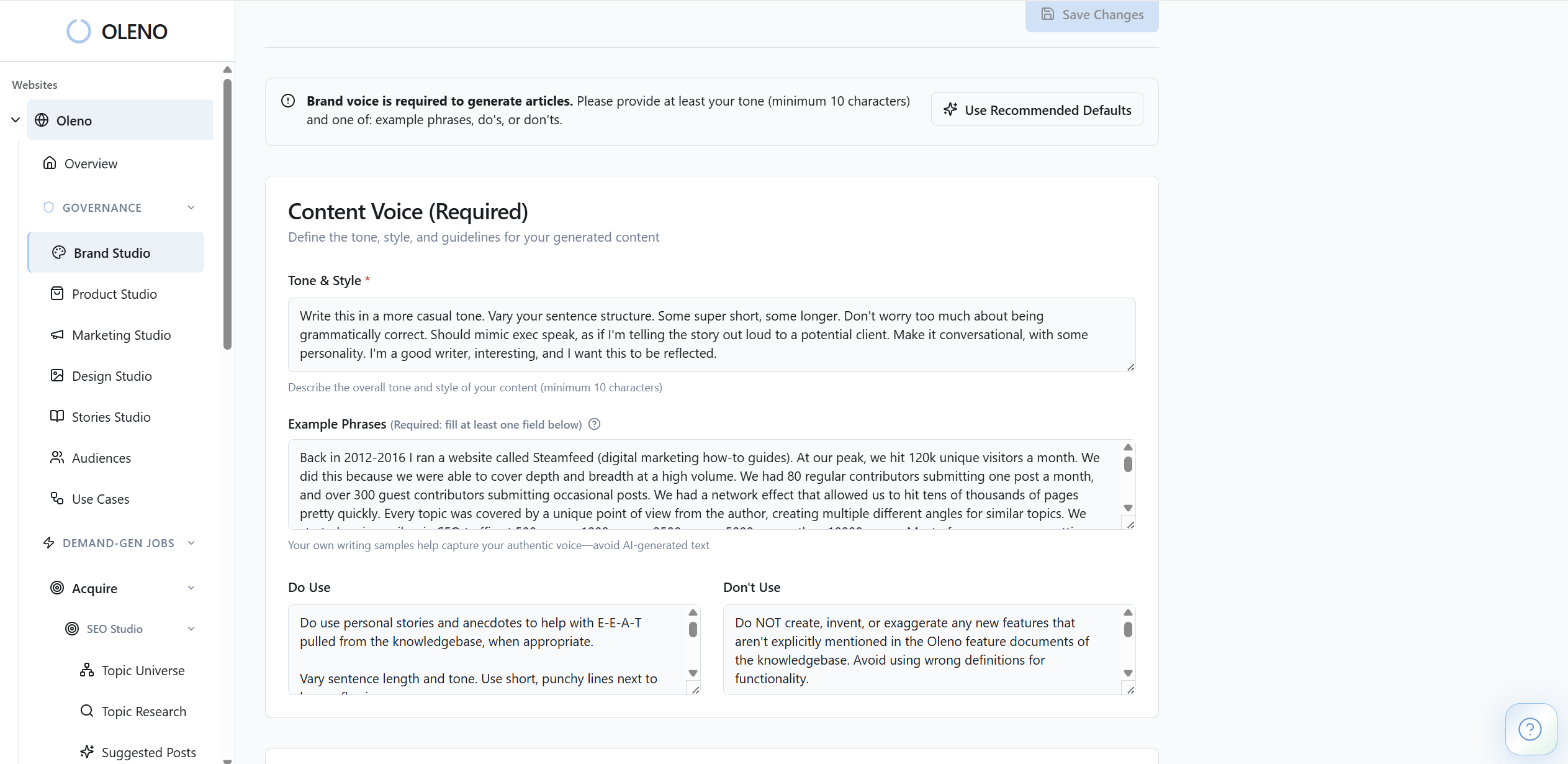
Inside Oleno, brand studio lets you define tone and style, preferred terms, words to avoid, CTA style, structure rules, and article voice exemplars. That's important because most brand guidance lives in messy places. Old docs. Slack threads. Comments from last quarter. Maybe one strong editor who catches everything. Maybe.
What changes here is the format. Subjective guidance becomes explicit rules. Not every part of voice can be reduced cleanly, and I'd be wary of claiming otherwise. But a surprising amount can. If your company always avoids certain phrases, prefers a tighter sentence rhythm, wants more direct CTAs, or needs specific structural patterns, those can be set once instead of re-explained 40 times.
I think of this as the 5-rule threshold. If your editor repeats the same 5 corrections on most drafts, those aren't editorial observations anymore. They're system requirements.
And that matters because it reduces subjective churn. Writers don't have to guess. Reviewers don't have to re-litigate. Leadership doesn't have to rewrite half the piece just to make it sound familiar.
Oleno Injects Brand Constraints Into Every Content Job Automatically
This only works because brand rules don't sit off to the side as a reference doc. Oleno applies them inside the broader content engine.
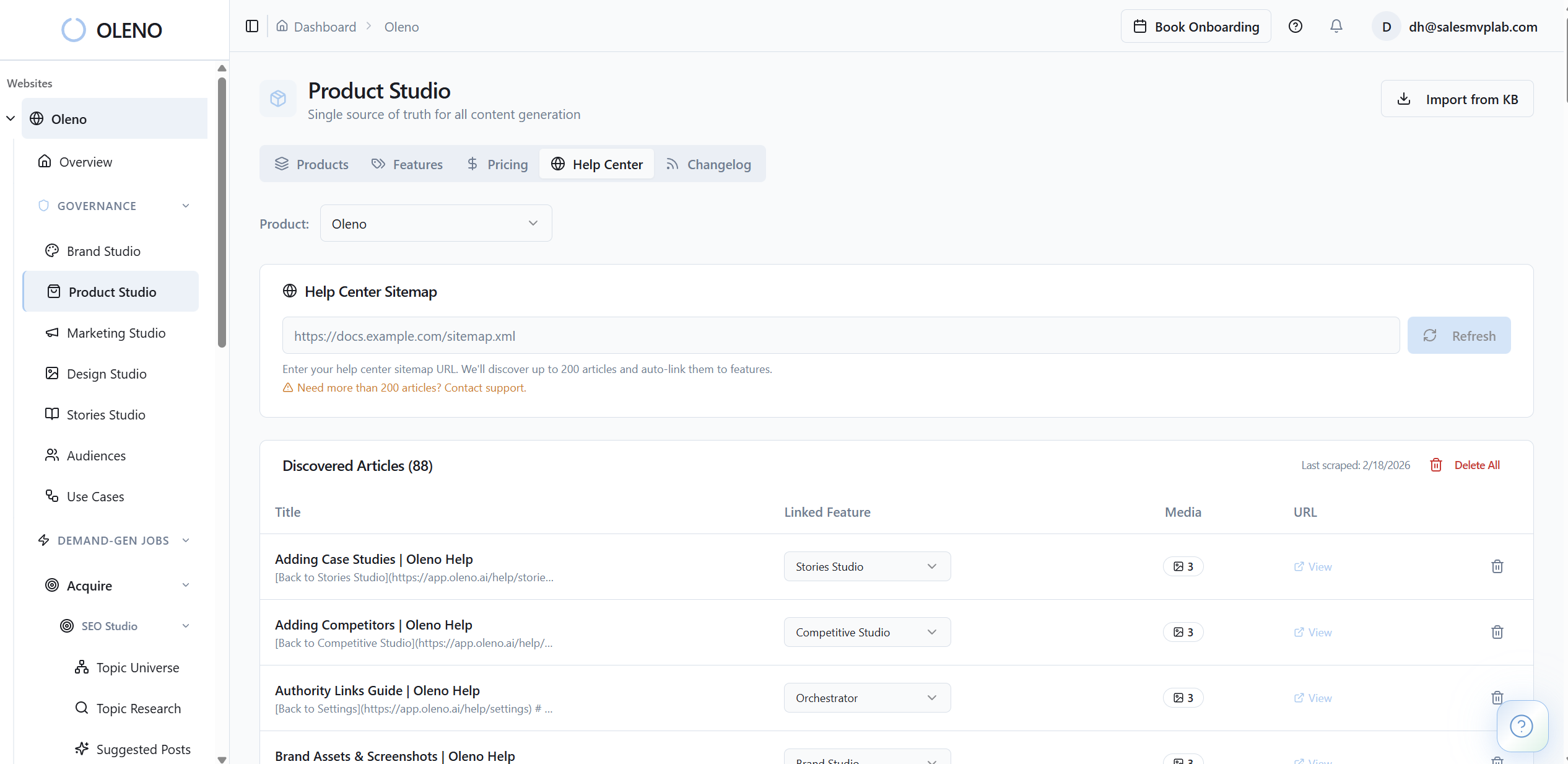
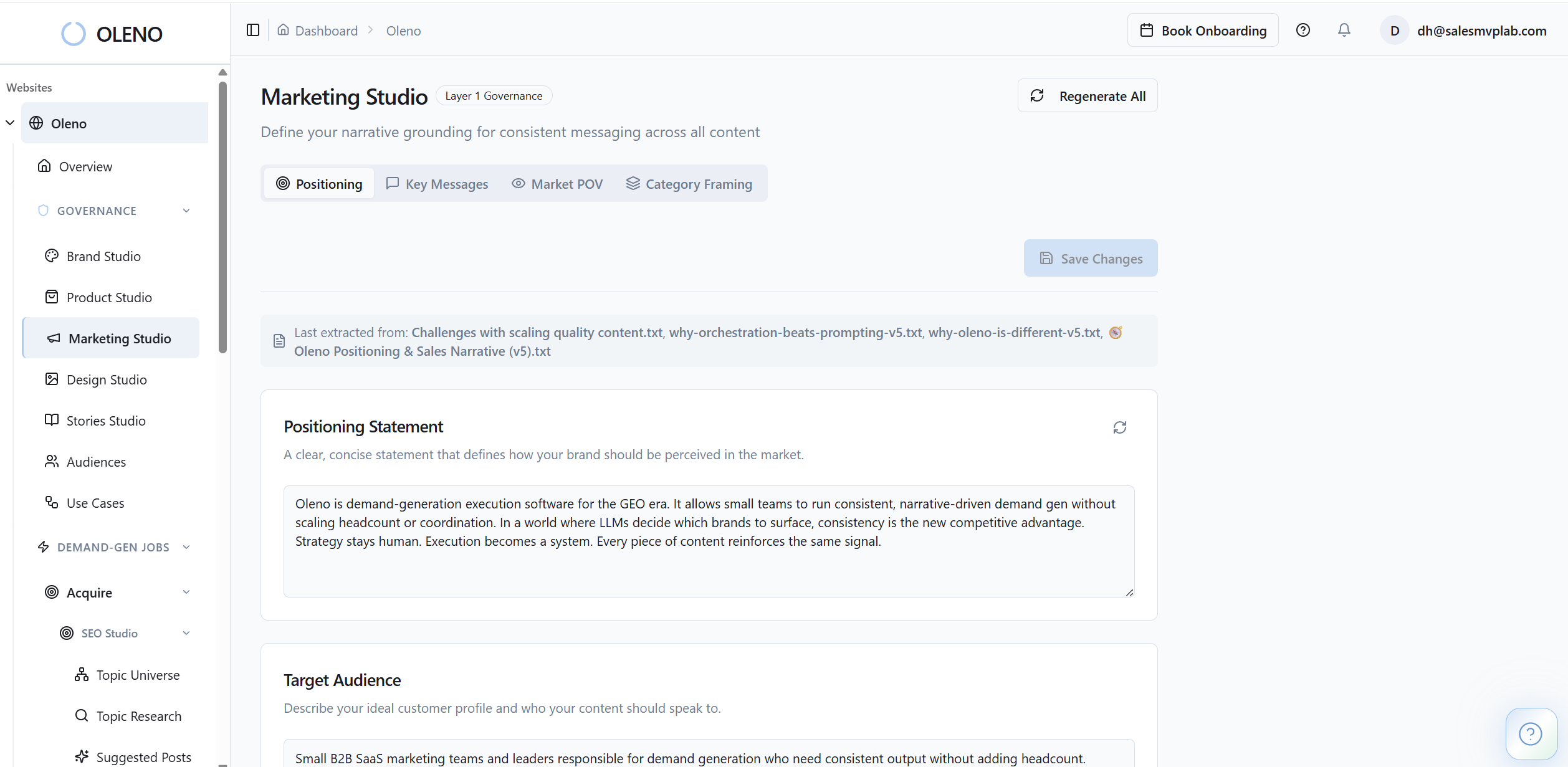
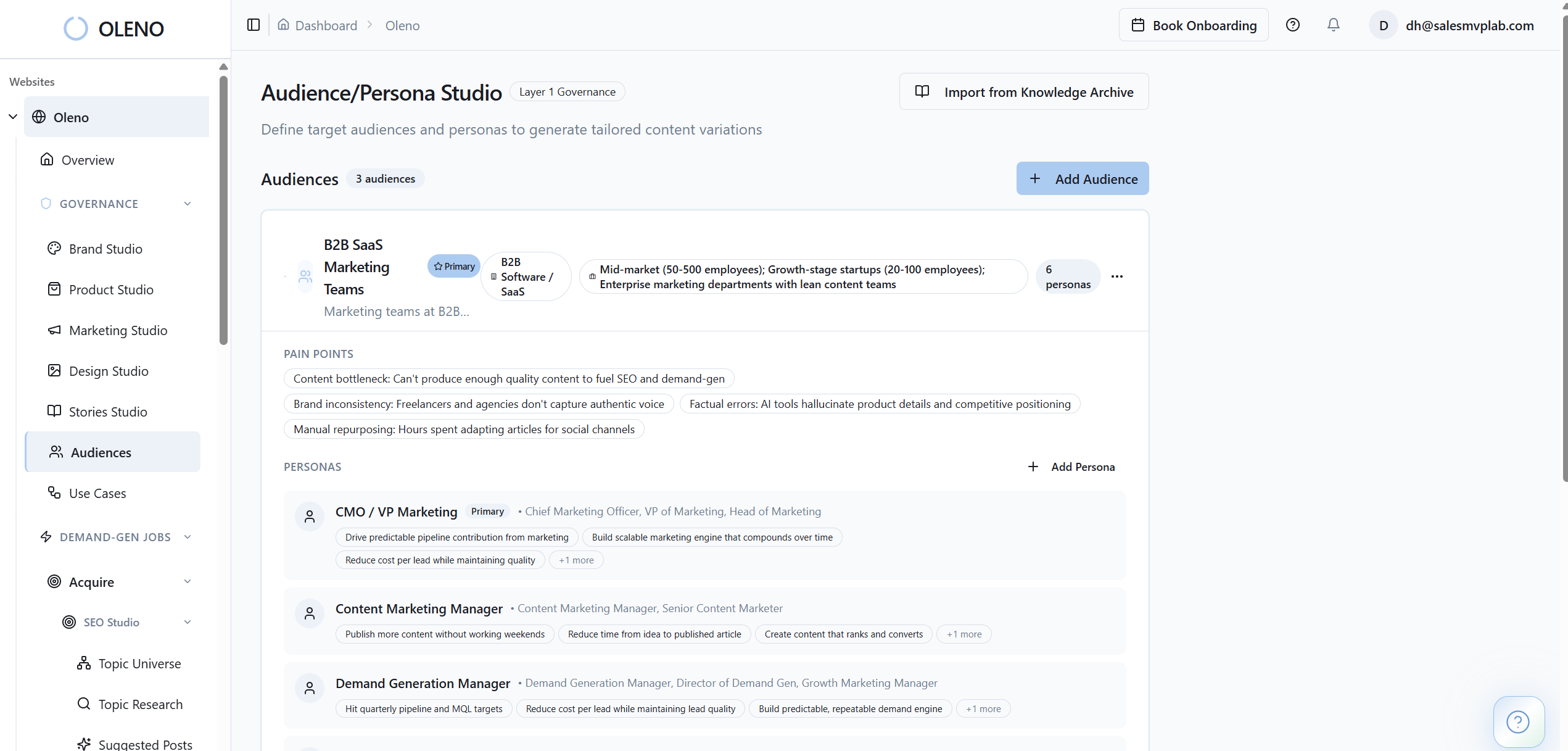
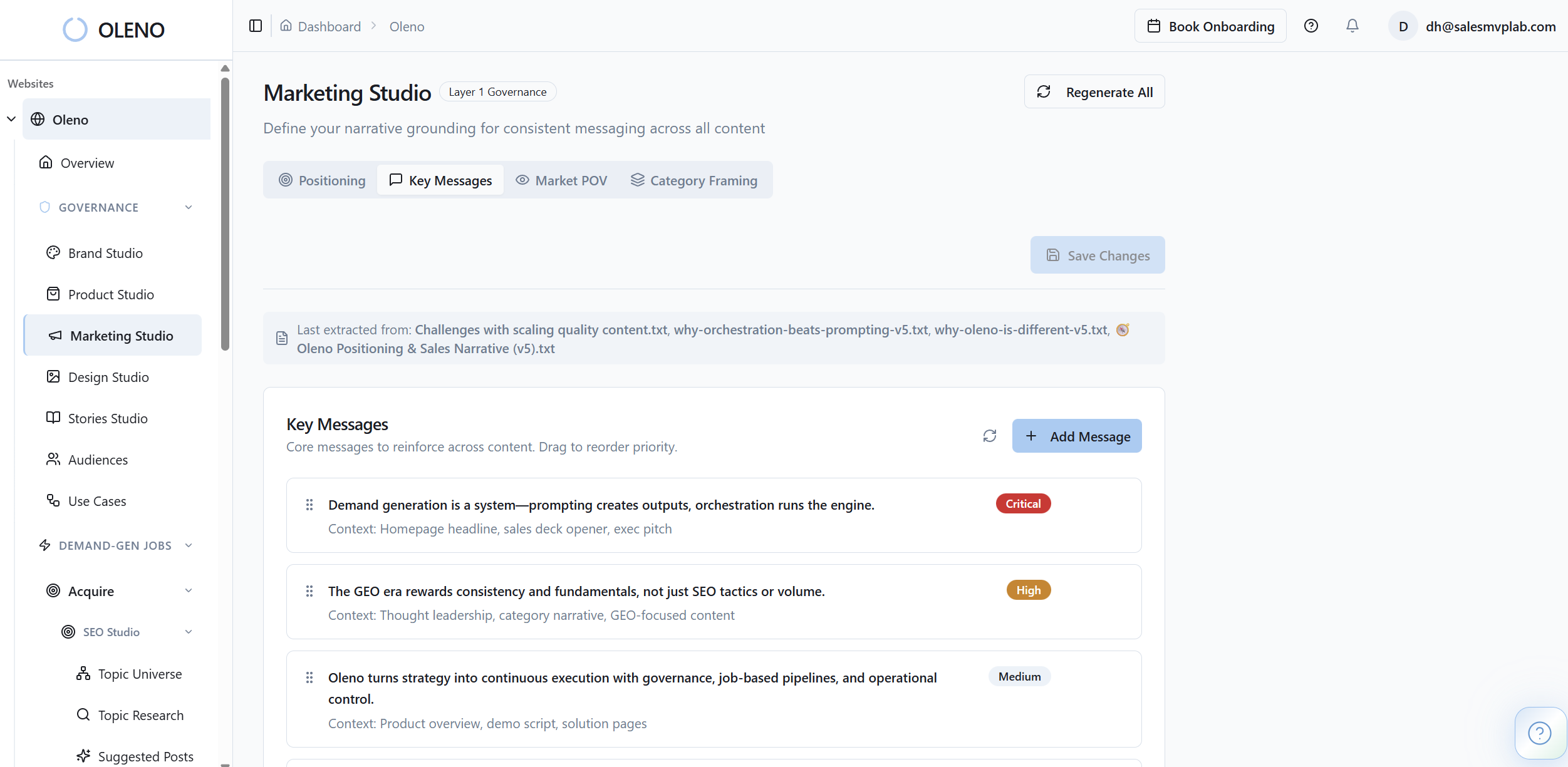
Brand studio is part of the governance layer. Marketing studio holds category framing, key messages, and narrative direction. Product studio holds approved product descriptions, claims, boundaries, and screenshots. Audience & persona targeting defines who you're speaking to and how that message should shift by segment. Then the system runs job-based content creation with those inputs applied throughout drafting, QA, and publishing.
That separation matters more than it sounds. Prompt libraries still leave the burden on humans to remember which prompt to use, what to paste into it, what changed last month, and whether the final output actually respects the rules. Oleno is built more like a production system. Governance gets defined once. Jobs execute within it. Quality gate checks whether the output stayed inside the lines before it moves on.
Back when I built my first autonomous content engine for a B2C app, the pain wasn't generating text. GPTs could already do that. The pain was all the repeated copy-paste work and the constant need to babysit output before it hit the CMS. I was spending 3 to 4 hours a day on that nonsense. That's when it became obvious to me: drafting isn't the core problem. Execution reliability is.
Governance Works Because Execution And Operations Stay Separate
A lot of teams blend everything together. Strategy, briefing, writing, review, QA, publishing. One blob. Then they wonder why every step feels fragile.
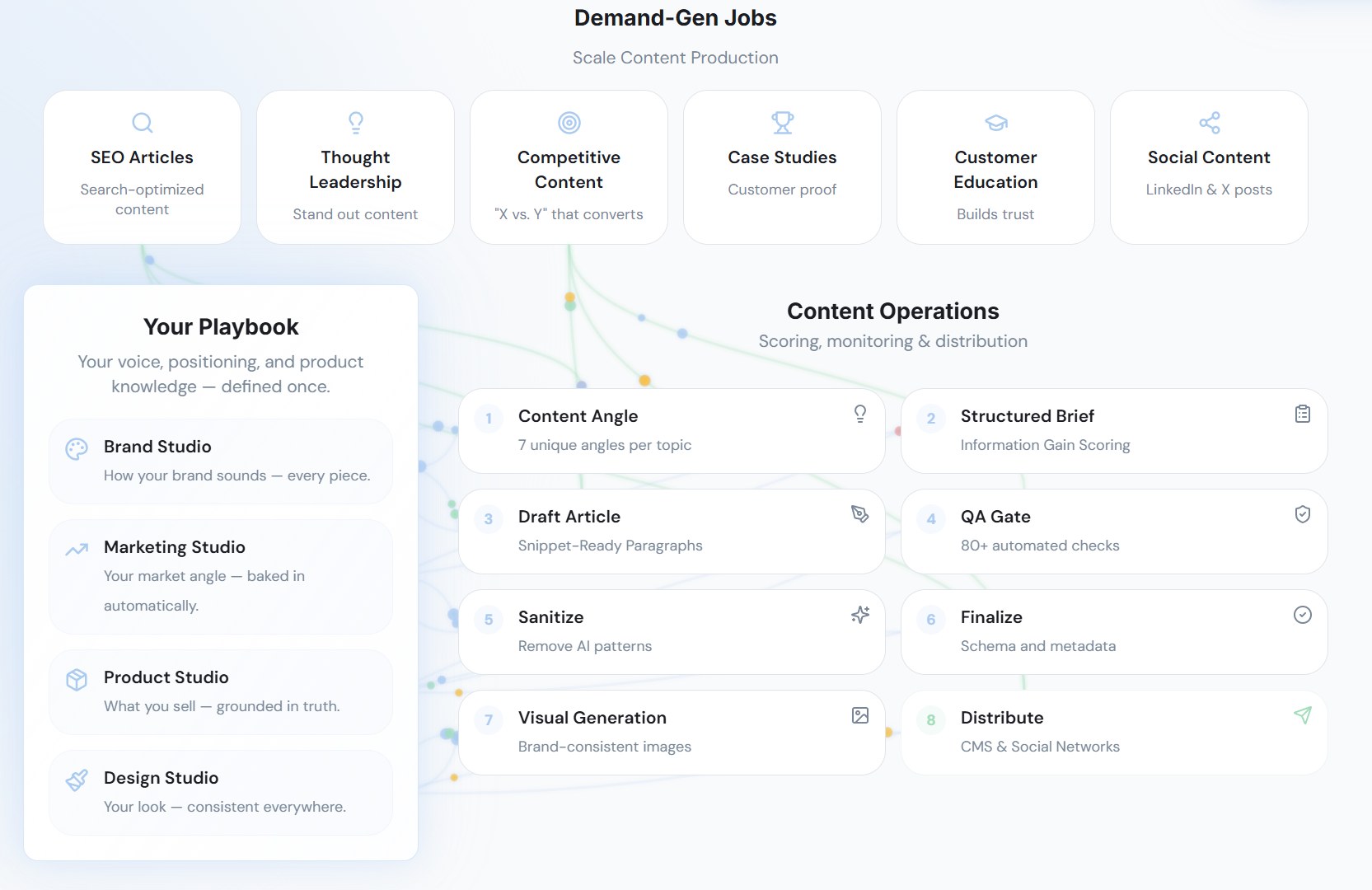
Oleno is useful here because it separates planning, governance, the actual job types, and operations. Brand studio doesn't have to also be your planning tool. Product studio doesn't have to act like an editor. The orchestrator handles scheduling and execution across the pipeline. Quality gate checks outputs before they reach the finish line. CMS publishing handles delivery after the content passes. That separation is what keeps one standards layer from getting diluted by day-to-day production noise.
There's an old warehouse analogy I like. If you throw inventory rules, pick lists, truck scheduling, and quality inspection into one station, the whole thing jams. Content works the same way. Strategy should set the spec. Execution should produce against the spec. Operations should move the work. If one person or one prompt is doing all three, breakdown is just a matter of volume.
This is also where the executive view starts to matter. CMOs don't need to micromanage sentences. They need to know whether the machine is producing on-brand, publish-ready output across teams and use cases. That's a different conversation entirely.
What A Governed Workflow Looks Like In Practice
One Approved Brand System Can Align Content, PMM, And Demand Gen
Picture a mid-market B2B SaaS team with a content lead, one PMM, an SEO manager, and a demand gen lead. That's a very normal setup. The team isn't weak. It's busy. And every function brings valid input. The issue is that input arrives late and inconsistently.
Before a governed setup, the workflow usually looks like this. Content gets a brief. PMM later says the narrative missed the category framing. SEO adjusts headings to match search intent. Demand gen asks for a stronger commercial tie-in. Leadership rewrites the intro because it doesn't sound like the company. None of those people are wrong. They're just correcting too late.
After brand studio is configured alongside marketing studio, product studio, and audience context, the draft starts from tighter constraints. The wording is closer to the company voice. The forbidden language is already filtered. The CTA style is aligned. The structural preferences are already known. Product truth is grounded. That doesn't mean no one reviews it. It means the review starts from a narrower error band.
That narrower band is the whole game. Fewer subjective edits. Fewer "this feels off" comments. Fewer late PMM fixes because the narrative was misframed from the start.
A Governed Workflow Can Move Output From 4 Articles To 20 Plus
The sharpest example in Oleno's use cases is SEO content scaling. The stated outcome is moving monthly output from 4 to 8 articles toward 20 to 40 plus without adding headcount. That kind of jump only works if the hidden review burden doesn't scale at the same rate.
Let's pretend your team publishes 6 pieces a month right now. Each one takes one writer, one SEO pass, one PMM pass, a leadership skim, and a manual publishing handoff. If every stage adds just 20 minutes of avoidable rework caused by brand inconsistency or missing context, that's 100 minutes per article. Across 24 articles, that's 40 hours in a month. Basically a full work week burned on fixing preventable drift.
I've seen versions of this movie before. At one company we had strong writers and good rankings, but the content sat too far away from the solution. It ranked, sure, but it didn't really support demand gen. That gap matters. Brand consistency is not just about sounding polished. It's also about keeping problem, positioning, and product relevance attached to the work so output compounds into pipeline, not just pageviews.
If your team wants to see how this governed model ties together across planning, standards, and execution, you can book a demo.
Where Brand Studio Stops And Leadership Still Has To Lead
Brand Studio Does Not Replace Positioning Work Your Team Has Not Done
This is probably the most important caveat in the whole piece. Brand studio cannot invent good positioning for you.
If your market point of view is fuzzy, if your product definitions are shaky, if your category framing changes every week, or if leadership still disagrees on what the company actually sounds like, no system is going to rescue that fully. It can only enforce what you've already decided. That's still valuable. But it's different.
I actually think this is a strength, not a weakness. Too many tools imply they'll somehow solve strategic confusion with better generation. They won't. If the inputs are weak, the outputs may still be polished but they won't be convincing. And polished confusion is still confusion.
So yes, your team still has to do the hard thinking. Define voice. Approve claims. Clarify the point of view. Decide what language belongs to the brand and what doesn't. Brand studio can operationalize those choices. It can't make them on your behalf.
Governance Improves Execution, But Leaders Still Own Strategy
Leaders still own the standards. They also own the exceptions.
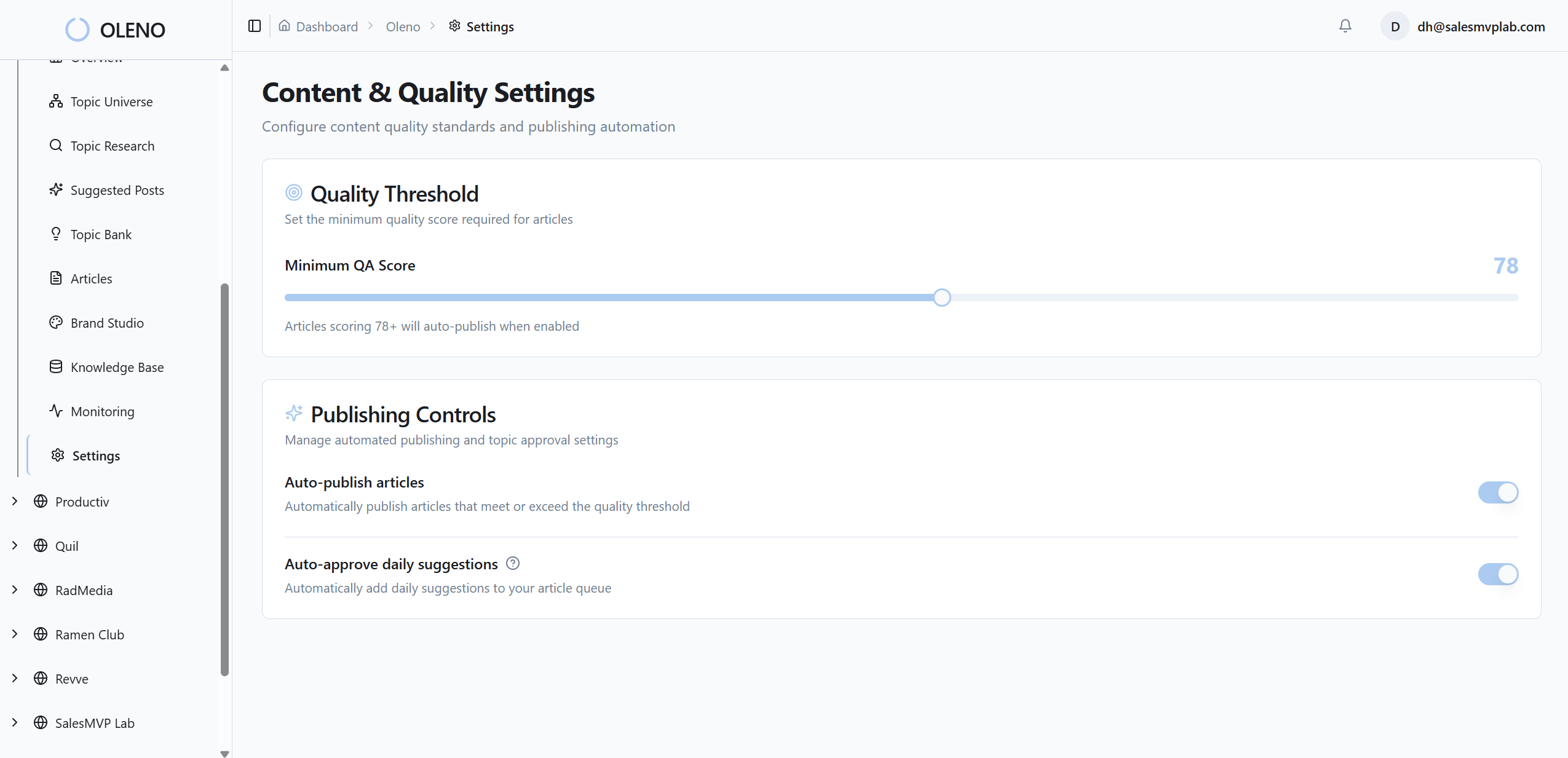
Some teams will hear "execution engine" and assume total autopilot. That's not the right mental model. The better rule is this: if the work requires strategic judgment, leadership stays involved. If the work requires repeated enforcement of already-approved standards, the system should carry that load.
That split is healthier anyway. You don't want your senior team spending Tuesday afternoon fixing sentence rhythm across 12 drafts. You do want them deciding how the company frames the category, what the product can honestly claim, and which audience matters most this quarter.
Brand studio governs expression and consistency. It doesn't replace executive judgment, product truth, or market conviction. That's why the teams that get the most from it are usually the ones who've already done enough strategy work to know what should be enforced.
Why Execution Engines Matter More Than Prompt Libraries
Teams That Operationalize Brand Execute Faster With Less Rework
The real pitch to a CMO is not "our system writes creatively." That's too vague, and frankly, it's the wrong hill to die on.
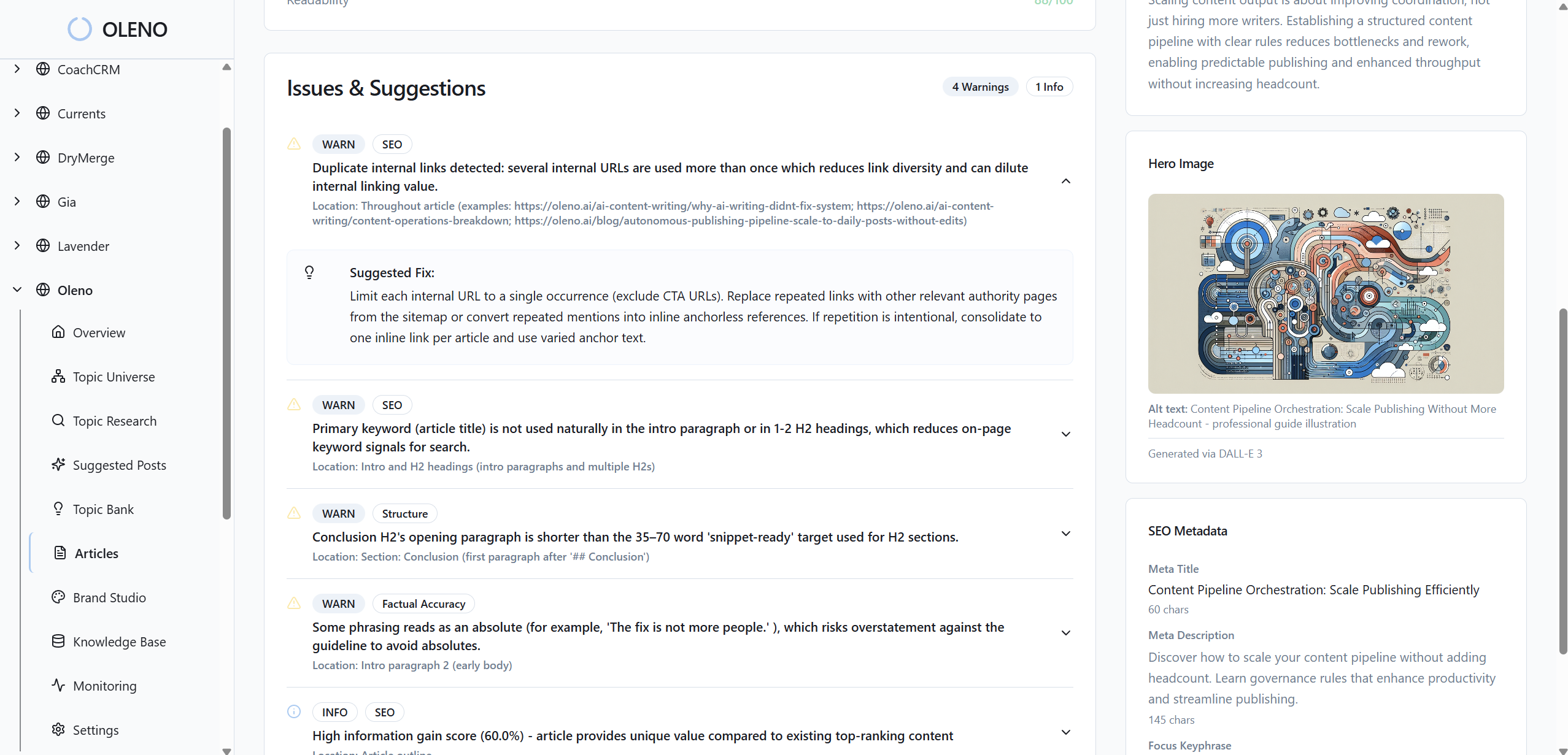
The better pitch is that your team can encode how it sounds, what it believes, what it can claim, and how assets should be structured, then run content production against those standards repeatedly. That reduces review debt. It lowers rewrite volume. It makes output more believable across SEO, PMM, and demand gen. And it gives leadership a better shot at proving content ROI because the system is aligned to the same story.
If you're still buying tools draft by draft, prompt by prompt, you're probably buying local speed while keeping system fragility. Plenty of teams do that for a while because it feels productive. Fair enough. It can be useful in pockets. But once volume matters, consistency becomes the moat.
The Next Step Is To Govern Your Demand Gen System, Not Another Prompt
If this problem sounds familiar, the next step isn't another prompt template. It's seeing whether your team has enough strategic clarity to encode the rules once and let the system carry them forward.
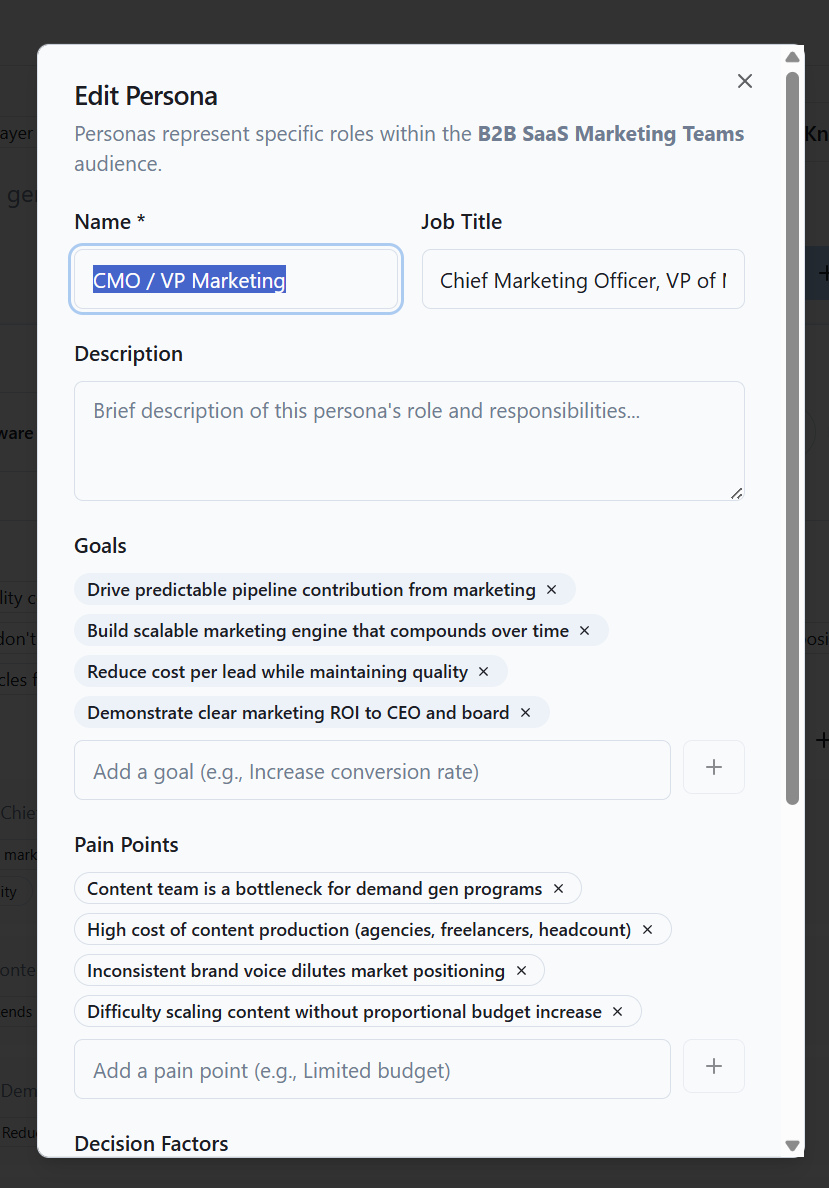
Oleno is built for that kind of work. Brand studio gives you the brand layer. Marketing studio gives you the narrative layer. Product studio keeps claims accurate. Audience & persona targeting keeps messaging relevant by segment. Then the wider system handles scheduling, job execution, QA, and publishing so content doesn't reset every week.
That shift is subtle at first. Then it changes everything. You stop debating the same wording every Tuesday. You stop treating every draft like a special event. You start building an execution system that can hold its shape as output grows.
If you want to see whether that model fits your team, book a demo.
About Daniel Hebert
I'm the founder of Oleno, SalesMVP Lab, and yourLumira. Been working in B2B SaaS in both sales and marketing leadership for 13+ years. I specialize in building revenue engines from the ground up. Over the years, I've codified writing frameworks, which are now powering Oleno.
Frequently Asked Questions